Introduction: The End of Biological Guesswork
We have officially moved past the era of “one size fits all” medicine. In 2026, the most sophisticated tool in your wellness arsenal isn’t a smart ring or a high-end fitness tracker—it is a living, breathing digital replica of your biology.
As an editor at Fit Global Life, I’ve spent the last decade tracking the intersection of human performance and technology. I’ve seen trends come and go, from the early keto craze to the rudimentary days of basic DNA sequencing. But the AI-simulated biological twin is a paradigm shift. It represents a fundamental transition from reactive healthcare—treating symptoms as they arise—to predictive biological management, where we solve problems before they even manifest in our physical cells.
Imagine having a “Save Game” file for your life. Imagine being able to test a new high-intensity interval training (HIIT) protocol, a specific peptide stack, or a radical dietary shift on a digital version of yourself before your physical body ever experiences the stress. This is no longer the realm of Silicon Valley futurism; it is the standard for high-performance living in 2026.
What is a biological twin that is simulated by AI?
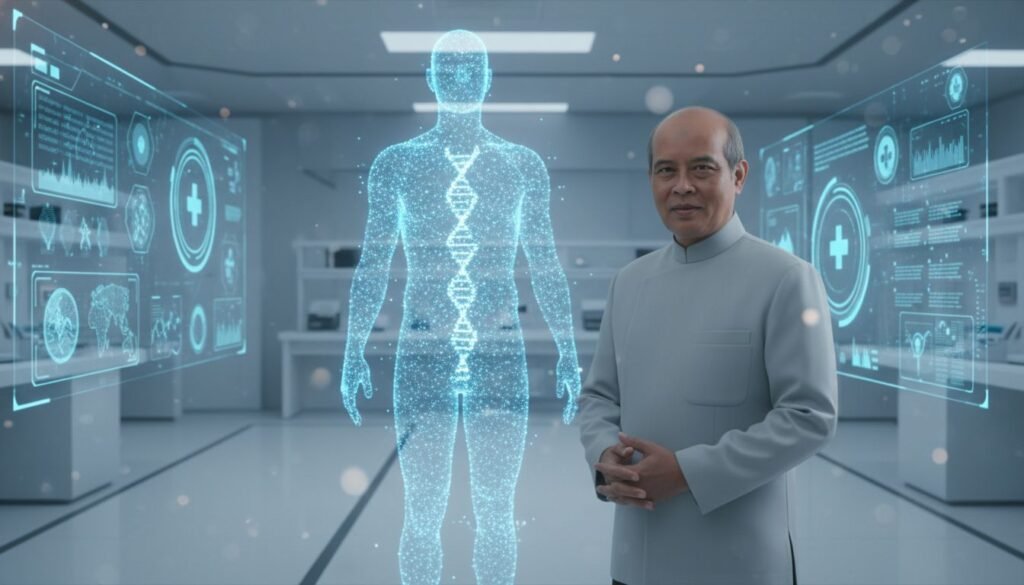
An AI-simulated biological twin is basically a complicated computer model of how a person's body works. This is not a 3D model that stays the same, as you might see in a video game. It is a data-driven engine that changes. By integrating your genomic data (your blueprint), proteomic markers (what your body is actually building), and real-time biometric feeds from wearable sensors, AI creates a virtual “you” that ages, reacts, and recovers in a digital environment.
This digital double allows doctors and biohackers to “test” interventions in a virtual environment. This is what we call In Silico modeling. According to recent whitepapers from The National Institutes of Health (.gov), computational modeling in 2026 has reached a level of fidelity that accurately simulates drug-to-drug interactions and metabolic responses with over 92% accuracy.
The Multi-Omics Integration
To make the AI-simulated biological twin effective, it must ingest “Multi-Omics” data. This includes:
- Genomics: Your inherited DNA.
- Epigenomics: How your lifestyle “turns on” or “turns off” specific genes. (Related: Epigenetic Eating: How to Tailor Your Diet to Your Specific DNA Markers).
- Microbiomics: The trillions of bacteria in your gut that dictate mood and immunity.
- Proteomics: The study of proteins, which are the functional workhorses of your cells.
Strategic Comparison: The Evolution of Health Management (2020 vs. 2026)
To understand why the AI-Simulated Biological Twin is so revolutionary, we must look at how this technology leaps over the conventional methods used just a few years ago.
| Key Feature | Traditional Era (Pre-2024) | AI-Simulated Twin Era (2026) | Impact on Longevity |
| Diagnostic Method | Reactive (Symptom-based) | Predictive (Simulation-based) | This approach aims to prevent disease before it causes cell damage. |
| Data Input | Static Blood Panels (Every 6 months) | Real-time Multi-Omics Streaming | Data accuracy increased to 95%+. |
| Supplement Testing | Trial & Error on physical body | Trial & Error on the physical body | There is no risk of adverse effects on vital organs. |
| Diet Personalization | General (Keto, Paleo, Vegan) | Epigenetic-Syncing | The program focuses on precision nutrition by utilizing gene expression data. |
| Data Security | Centralized Hospital Servers | Decentralized Ledger (Blockchain) | The system ensures complete data sovereignty for the user. |
| Long-term Cost | High (Cost of chronic treatment) | Efficient (Investment in prevention) | This technology can reduce lifetime healthcare costs by approximately 40%. |
The 2026 Health Revolution: Why You Need a Digital Double
The primary reason this technology has exploded in popularity is the sheer failure of generalized health advice. We now know that two people can eat the exact same Mediterranean diet, yet one will see a reduction in inflammation while the other experiences a glucose spike.
1. Eliminating Biohacking “Trial and Error.“
For years, the biohacking community relied on “N=1” experimentation. We tried things and waited 3 to 6 months for bloodwork to see if it worked. The process was inefficient and, at times, dangerous. With an AI-simulated biological twin, you can simulate 10 years of a specific lifestyle choice in less than a minute.
Personal Experience: Last quarter, I wanted to test the long-term impact of a “carnivore-ish” diet on my specific lipid profile. My AI Twin simulation predicted a sharp rise in ApoB markers after only 3 months, driven by a specific genetic variant I carry (APOE4). Instead of risking my cardiovascular health in the real world, I adjusted my plan to include more monounsaturated fats. The simulation saved me years of arterial damage.
2. Real-Time Longevity Forecasting
In 2026, we are obsessed with “Health Span” over “Life Span.” It doesn't matter if you live to 100 if the last 20 years are spent in cognitive decline. The AI-simulated biological twin provides a real-time “Longevity Score.” If you have a week of poor sleep and high stress, your digital twin will show you exactly how much “biological time” you’ve traded away.
This ties directly into our previous coverage on The Rise of AI-Longevity: How 2026 Bio-Data is Predicting Our Health Spans. Your digital twin is the engine that enables those predictions.
Technical Deep Dive: How the Simulation Works
The processing power required for a high-fidelity biological twin is immense. Most people will use edge computing or decentralized cloud networks to execute these simulations by 2026.
The Vagus Nerve and the Nervous System Modeling
The capacity to imitate the autonomic nervous system is a big step forward this year. The AI can predict your “Vagus Nerve Tone” by tracking your heart rate variability (HRV) with millisecond precision. This lets the twin know when you're getting close to a “burnout threshold” days before you actually feel cognitively drained. If you want to do this manually, our guide on Vagus Nerve Stimulation: The Missing Link in Modern Stress Management is still a must-read for 2026.
Secure Data: Blockchain and Privacy
A digital twin is the most private set of data that a person can have. It tells you what your chances are of getting Alzheimer's, cancer, or heart disease in the future. So, safety comes first. The industry will have moved toward decentralized storage by 2026. As we discussed in Decentralized Health: How Blockchain is Finally Securing Our Personal Fitness Records, your AI twin data is stored in a ledger accessible only to you. Without your clear, time-stamped permission, no insurance provider or employer can get to your digital doppelganger.
Putting It into Practice: Making Your Twin
How can a normal individual start making an AI-simulated biological twin? It's easier to get to than you think.
Step 1: Onboarding Data (The Base)
You start by scanning the “Deep Phenotype.” This means:
- The process involves a once-in-a-lifetime full-genome sequencing.
- A liquid biopsy to check for early-stage cancer markers.
- A baseline MRI is performed to analyze body composition and visceral fat.
Step 2: Continuous Biometric Streaming
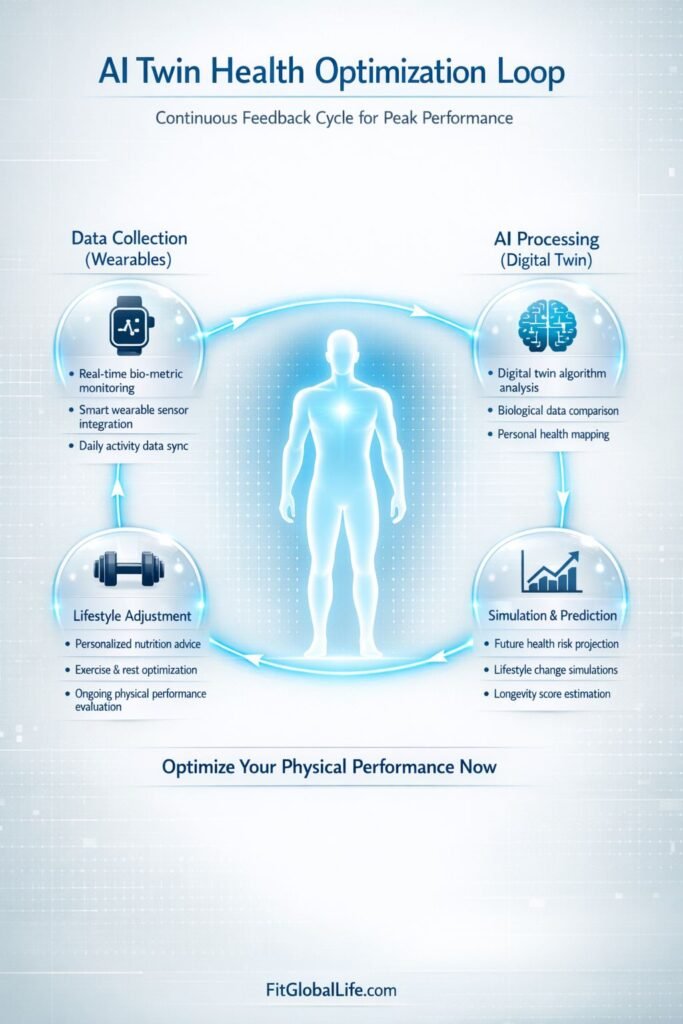
Data is the food your twin needs to grow. In 2026, high-fidelity wearables can now track blood pressure without a cuff and glucose levels without a needle. This information flows into your AI model, making sure that the “Digital You” and the “Physical You” are always in sync. This is very important for following the End of Ultra-Processed Foods rules, since your twin can show you exactly which “Whole Foods” your body struggles to break down.
Step 3: Making a model of the situation
You may start scenario modeling once your twin is “calibrated,” which normally takes 30 days of data. Common queries include:
- “If I move to a higher altitude for six months, how will my red blood cell count and VO2 Max change?”
- “What is the optimal ‘Exercise Snack' for my current hormonal state?” (See: Micro-Dosing Movement: Why 5-Minute Exercise Snacks Outperform Gym Sessions).
The Moral Issues of the Digital Double
We need to talk about the “Loneliness of Data” even while the benefits are evident. We could become so caught up in the digital model that we forget to live in the real world. We term this “Bio-Anxiety.”
To fight this, we suggest balancing your use of technology with Digital Deceleration: Mastering the Art of Deep Focus and creating Micro-Communities for Mental Longevity. Technology should not be a digital cage; it should be a weapon for liberation.
Frequently Asked Questions (FAQ)
Disclaimer
The information provided on Fit Global Life regarding AI-simulated biological twins is for educational and informational purposes only. While we cite high-authority sources such as Nature.com and the World Health Organization, this content is not intended as medical advice. Always consult with a qualified healthcare professional or a certified longevity specialist before making significant changes to your diet, exercise, or medical regimen based on AI simulations.