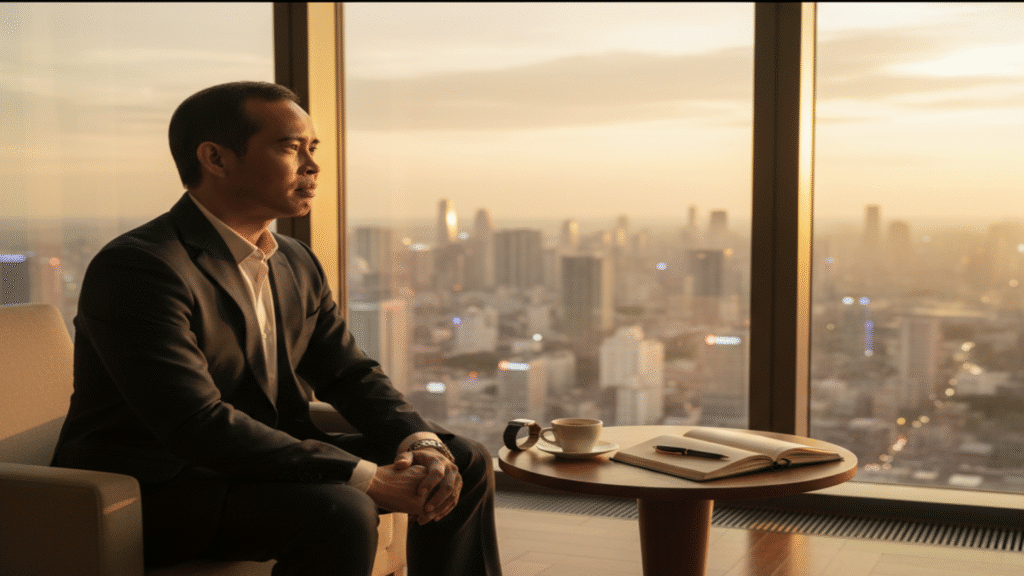

We often live life as if we have a limitless supply of tomorrows. In my years coaching individuals on holistic wellness and mindset—from high-flying executives to burnt-out creatives—I have noticed a recurring pattern. There is a specific set of realizations that usually hit people in their 50s or 60s. When they do, the reaction isn’t joy; it is often a heavy sigh followed by the words, “I wish I understood this sooner.”
This article isn't just another list of motivational fluff. These are powerful life insights distilled from psychology, behavioral science, and the raw, unfiltered experiences of those who learned the hard way.
If you are reading this now, consider it a shortcut. You don’t have to wait for a midlife crisis to wake up. Here are the seven truths that change everything.
1. The “Spotlight Effect” is a Narcissism Trap
Why We Care Too Much About What Others Think
One of the most debilitating behaviors I see is the paralysis caused by the fear of judgment. We don’t start that business, we don’t go to the gym, and we don’t speak up because we are terrified of the audience we imagine is watching us.
Psychologists call this the Spotlight Effect. It is the tendency to overestimate how much other people notice about us.
Here is the brutal, liberating truth: Nobody is watching you.
Everyone else is too busy worrying about their own “spotlight” to care about yours. A study published in the Journal of Gilovich, Medvec, & Savitsky found that people consistently overestimate how much others notice their actions and appearance.
The Fit Global Life Perspective: When I first started my journey, I was terrified of publishing “imperfect” content. I thought every typo would be a career-ending scandal. The reality? No one cared.
- The Insight: You are the main character in your movie, but you are just an extra in everyone else’s.
- Actionable Step: Do one thing this week that you’ve been avoiding out of embarrassment. Wear the loud shirt. Post the raw video. Realize the world keeps turning.
2. Busy is Not the Same as Productive (The Pareto Trap)
The Illusion of “The Hustle”
We live in a culture that fetishizes exhaustion. If you aren’t tired, you aren’t working hard enough, right? Wrong. This assumption is one of the most dangerous misconceptions of the modern era.
Many people confuse motion with progress. They spend 12 hours a day “grinding,” yet their bank accounts and happiness levels remain stagnant. This is a failure to apply the Pareto Principle (80/20 Rule) to our energy management.
Powerful insights on productivity suggest that 80% of your results come from 20% of your efforts. The rest is just noise.
The Data: Research from Stanford University indicates that hourly productivity declines sharply when the workweek exceeds 50 hours. After 55 hours, productivity drops significantly, making any additional hours essentially pointless.
How to Apply This:
- Evaluate the activities in your day: Determine the 20% of tasks that have a significant impact, such as sales calls, content creation, and strategic planning.
- Eliminate the rest: Ruthlessly cut or delegate the 80% (e.g., doom-scrolling, endless E-mail chains, perfectionism).
3. Health is a “Silent Debt” With High Interest
Your Body Keeps the Score
In your 20s and 30s, your body is forgiving. You can eat junk, skip sleep, and miss workouts, and still function. You think you’re getting away with it. You aren't. You are simply accumulating biological debt.
This is one of those powerful life insights that usually lands when the first scary diagnosis arrives.
According to the World Health Organization (WHO), noncommunicable diseases (heart disease, diabetes, etc.) kill 41 million people each year, equivalent to 71% of all deaths globally. Most of these are lifestyle-related.
My Personal View: I view health not as a vanity metric (six-pack abs), but as a vehicle for freedom. If your car breaks down, you cannot travel, no matter how much money you have for gas.
- Sleep is not a luxury: It is a neurobiological necessity.
- Movement is medicine: A sedentary lifestyle is the smoking of our generation.
Read more in our Nutrition category
4. Compound Interest Applies to Relationships, Not Just Money
The Myth of the “Self-Made” Man
We are obsessed with financial compound interest, but we ignore relational compound interest.
The longest study on happiness, the Harvard Study of Adult Development, ran for nearly 80 years. The conclusion? It wasn’t money, fame, or cholesterol levels that predicted who would grow old happily and healthily. It was the quality of their relationships.
Many people learn too late that career achievements are lonely without someone to share them with. They sacrifice marriages and friendships on the altar of success, only to realize the Altar is cold and empty.
The “Inner Circle” Strategy: You do not need 100 friends. You need 3 to 5 people who:
- Call you out on your nonsense.
- Celebrate your wins without jealousy.
- Are there when the chips are down?
Invest time in these people. Call them. Visit them. Forgive them. These powerful life insights regarding connection are the most potent antidepressants available.
5. Comfort is the Enemy of Growth (Antifragility)
Embracing the Suck
Human beings are wired to seek comfort and conserve energy. It is an evolutionary survival mechanism. However, in today’s world, this instinct undermines our potential.
If you are always comfortable, you are atrophying.
Nassim Nicholas Taleb introduced the concept of Antifragility—things that gain from disorder. Muscles grow only when torn (exercise). The immune system strengthens only when exposed to pathogens. Your character grows only through adversity.
The Insight: Most people spend their lives building walls to keep chaos out. The wise person tears down the walls and learns to dance in the rain.
- Do hard things intentionally: Take cold showers, have difficult conversations, and learn a language that frustrates you.
- The result: When life inevitably hits you with a tragedy (and it will), you won't break. You will be resilient because you have practiced suffering.
6. Money buys “Options,” Not “Happiness.”
The Financial Freedom Paradox
“Money can't buy happiness” is a half-truth told by poor people to feel better and by rich people to keep you from trying.
The more accurate, powerful life insights regarding finance are:
- Money alleviates misery: It solves problems such as hunger, lack of shelter, and lack of healthcare.
- Money buys autonomy: The ability to say “no” to a toxic boss or “yes” to a dream trip is invaluable.
However, once your basic needs and security are met (the saturation point), the correlation between money and happiness flattens. This is known as the Easterlin Paradox.
The Trap: I see people in high-paying jobs who are miserable because they fell into “Lifestyle Creep.” They make more, so they spend more on things they don’t need, to impress people they don’t like. They are rich, but they are not free.
The Goal: Aim for wealth (assets that buy back your time), not status (luxury goods that devour your income).
7. You Will Never “Find Yourself” because You are a Creator
The Static Personality Myth
“I'm just trying to discover myself.” I hear this phrase constantly. It implies that “Self” is a hidden treasure buried under a rock somewhere, and if you dig deep enough, you’ll discover a finished statue.
This is false. You are not a statue; you are clay.
Neuroplasticity proves that the brain continues to change throughout life. You are not “bad at math,” “introverted,” or “lazy” by genetic decree. These are current states, not permanent traits.
Why this is one of the most potent life insights: If you believe you need to find yourself, you will feel lost when you change. If you realize you must create yourself, you become the architect of your destiny.
- Stop searching: Start building.
- Experiment: Try hobbies, careers, and roles that feel “unlike you.” You might be surprised at who you can become.
Conclusion: The Cost of Inaction
Reading these seven powerful life insights is the easy part. The hard part is overcoming the inertia of your daily habits to apply them.
Regret is a terrifying thing. It is the ghost of the potential you never fulfilled. But here is the good news: It is not too late. Whether you are 25 or 65, the moment you accept these truths is the moment your second life begins.
Confucius once said, “We have two lives, and the second begins when we realize we only have one.”
Welcome to your second life.
What is your Next Step? Don't just close this tab. Choose one insight from the list above. Please write it down on a sticky note and place it on your bathroom mirror. Commit to focusing on that single truth for the next 7 days.
If you found value in these insights, share this article with someone who needs to hear it, or subscribe to our newsletter for more deep dives into human potential.
Frequently Asked Questions (FAQ)
Q: Can these powerful life insights really change my life? A: Knowledge is potential power. These insights only change your life if you move from knowing them to embodying them through daily action.
Q: Which insight is the most important? A: While all are crucial, the “Spotlight Effect” often prevents people from acting on the others. Once you stop fearing judgment, you are free to pursue health, wealth, and relationships authentically.
Q: How do I start applying these insights? A: Start small. Do not try to overhaul your life overnight. Pick one area (e.g., Health) and apply the insight (Bio-debt) by changing one habit this week.