Introduction: The Death of the Glorified Burnout
For decades, the standard response to “How are you?” was a badge of honor: “Busy.” In the early 21st century, hustle culture normalized burnout. You weren't “grinding” hard enough if you weren't so tired and wired that you were about to pass out.
But as we go into 2026, the flaws in that foundation have grown into a canyon. AI's quick automation of cognitive functions has separated “hours worked” from “value created.” There has been a huge change in this new world. A corner office or a full calendar used to be the ultimate luxury. Now, it's having control over your time and peace of mind. “Soft Living” is the best way to be flexible in the Post-Work Wellness Economy.
1. What “Soft Living” Means in 2026
“Soft Living” is often associated with laziness or a lack of goals. It is a complex way of living that prioritizes emotional and physical health over meaningless work.
The Philosophy of Intentionality
In 2026, Soft Living is defined by:
- The Rejection of Artificial Urgency: Refusing to treat every email as a crisis.
- Boundaries by Design: Using AI agents to control who can talk to whom, making sure that focus time is sacred.
- Sensory Curation: Means paying close attention to the quality of the things around you, like the lighting, air quality, and sound comfort.
As we said in our guide to Digital Deceleration, being able to tune out the digital noise is becoming a rare and costly skill.
2. The Economic Pivot: Health as the Main Industry
As AI takes over the “doing,” people are left with the “being.” This has led to the growth of a large economic sector focused on improving people's lives.
The Comfort of Taking Your Time
The Post-Work Wellness Economy is more than just a way of thinking; it's a trillion-dollar sector.
- Acoustic Tourism: Wealthy travelers are paying more for “Silent Cities” and peaceful parks because they want to escape the noise of a world that is always connected.
- Regenerative Real Estate: Homes are no longer built solely to look nice; they now feature integrated Circadian Lighting and Vagus Nerve Stimulation zones. (See our analysis on Circadian Lighting at Home).
The Shift in Consumer Spending
In 2026, status is displayed through:
- Biological Age vs. Chronological Age: Showing off your AI-Longevity Bio-Data report is the new way of showing you have “made it.”
- Unstructured Time: The ability to take a Tuesday afternoon for a “micro-community” gathering is more impressive than a luxury watch.
3. AI and the Liberation from the 9-to-5
AI is the main thing that started the Soft Living movement. AI has prompted people to rethink the workweek by automating the boring, repetitive, and logistical tasks.
From being productive to being present
The goal is no longer to be “productive”—AI is already infinitely more productive than any human. The goal is to be present.
- The 3-Day Focus Week: In 2026, many smart companies have switched to a shorter schedule where people handle the “strategy and soul” and AI handles the “output.”
- Algorithmic Gifting of Time: The Wellness Economy doesn't use AI to increase labor; instead, it uses AI to reclaim time for hobbies, family, and biological recuperation.
4. Soft Living Hacks: How to Plan Your Day
To live softly, you need to take charge of your biological and mental architecture.
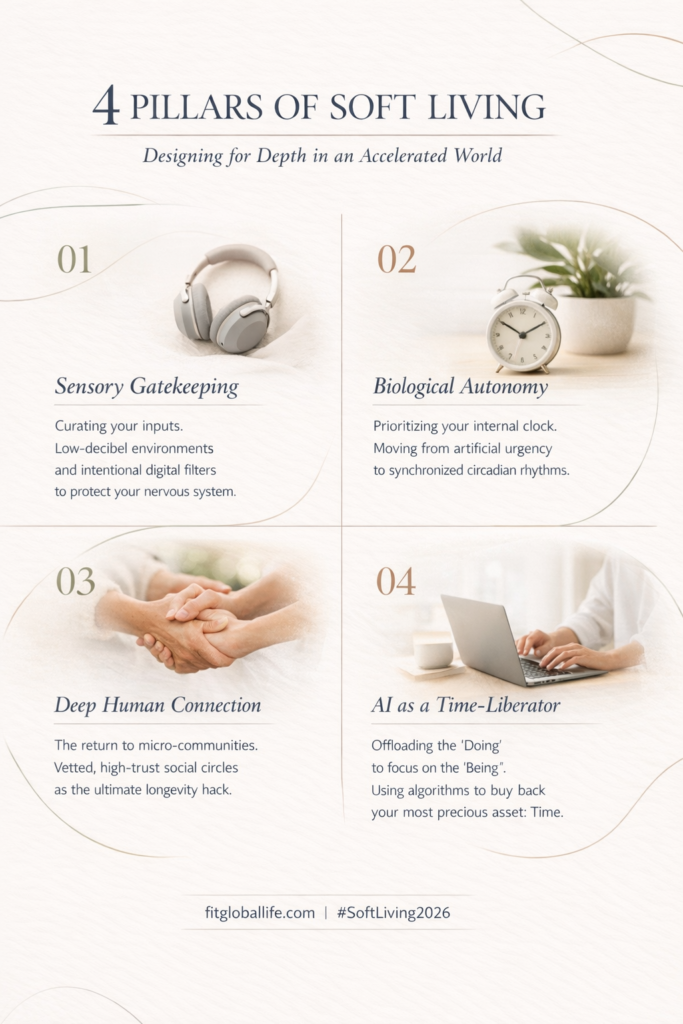
A. Sensory Gatekeeping
Your nervous system is constantly being bombarded. To live “softly,” you must curate your inputs.
- Acoustic Architecture: Keeping the noise level low by using noise-canceling technology or natural soundscapes.
- Digital Boundaries: Your devices are set to “Focus Mode” by default, which only allows notifications you have manually approved.
B. The “Exercise Snack” Method
We don't have to work out hard for an hour at the gym anymore. As explained in the Micro-Dosing Movement, Soft Living integrates movement naturally throughout the day, avoiding the stress spike that can follow a long day of focus.
C. Nervous System Maintenance
Soft Living is impossible with a frayed nervous system. Regular Vagus Nerve Stimulation (via tVNS or cold exposure) is essential for maintaining a “soft” state of mind.
5. The Social Part: Micro-Communities and How to Get Over Loneliness
In 2026, the most important thing to have is a sense of belonging. In a world run by AI, connecting with other people has become increasingly valuable.
Micro-Communities as Longevity Strategy
Loneliness is as lethal as smoking 15 cigarettes a day. Soft Living emphasizes the return to small, intentional social circles.
- Collaborative Wellness: Instead of solo gym sessions, 2026 sees the rise of “Wellness Circles”—groups that combine socializing with bio-hacking or mindful movement.
- The End of the Algorithm-Led Social Life: People are leaving big social networks and joining smaller, more trusted ones.
6. How to Be a Modern Leader with Strategy
Using a Soft Living strategy is a sensible way for leaders to lead in a way that lasts.
- Quality over quantity: Leaders may filter out the “noise” and focus on the two or three decisions that actually matter.
- The CEO is the “Chief Wellness Officer.”: By showing the whole firm how to live a soft life, turnover goes down, and the “Cognitive Health Span” of the whole team increases.
- External Resource: The Global Wellness Institute says that the wellness economy will rise by 10% every year, reaching new highs by 2026.
Conclusion: Choosing the Soft Path
The Post-Work Wellness Economy is not a way to escape reality; it is a way to alter it. We can get back in touch with our humanity when we let machine intelligence take care of the mechanical parts of our existence.
In 2026, it takes a lot of guts to choose Soft Living. You have to say “no” to the ghost of hustling culture and “yes” to a future where your health, peace, and time are the real signs of your prosperity.
FAQ: The Post-Work Wellness Economy
Disclaimer
The concepts of “Soft Living” and the “Post-Work Wellness Economy” discussed in this article are cultural and lifestyle observations for the year 2026. While many practices mentioned (such as nervous system regulation and movement) have health benefits, this content does not constitute professional career or medical advice. Implementation of lifestyle changes should be tailored to individual circumstances. Fit Global Life is not responsible for any personal or professional outcomes resulting from the adoption of these trends.