
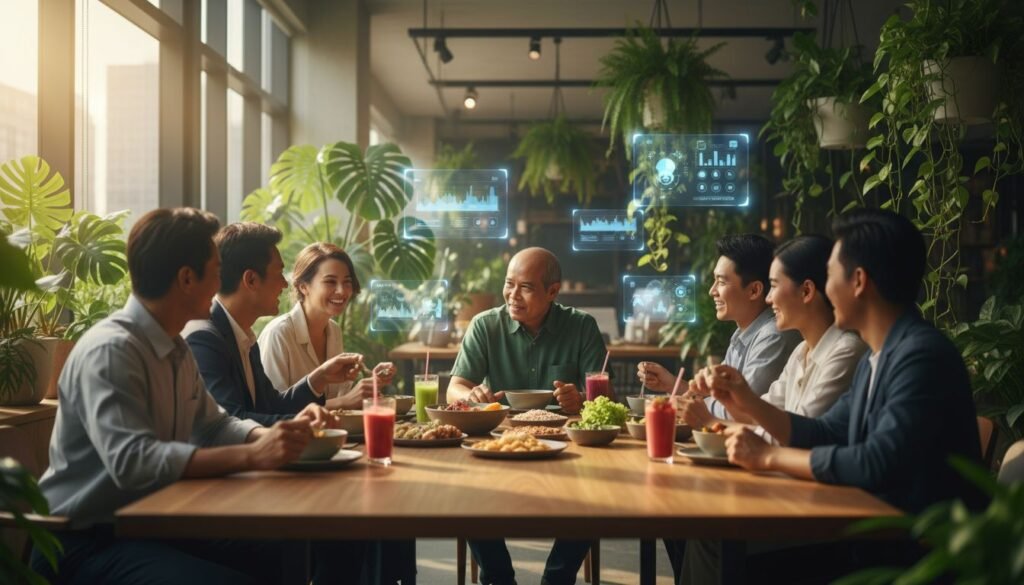
We have spent the last five years perfecting our “internal” environments. We have used subdermal sensors to improve our gut microbiomes, synchronize our circadian lights, and track our sleep cycles with military accuracy. But in 2026, the wellness business will have to deal with a harsh biological fact: You can’t bio-hack your way out of being alone.
As the Editor of Fit Global Life, I have observed a massive paradigm shift. The most sophisticated wearable tech is no longer just measuring heart rate; it’s measuring “Social Cohesion” markers alongside Heart Rate Variability (HRV). Why? The facts from 2026 are clear: being alone is a biological poison that is worse for your health than smoking 15 cigarettes a day.
In this in-depth look, we talk about how Social Wellness Micro-Communities have become the best way to “loneliness antidote” and how “Social Fitness” has become the most important measure of mental health in a society that is becoming more and more AI-driven.
1. The Biological Cost of the “Silent Pandemic” of Today
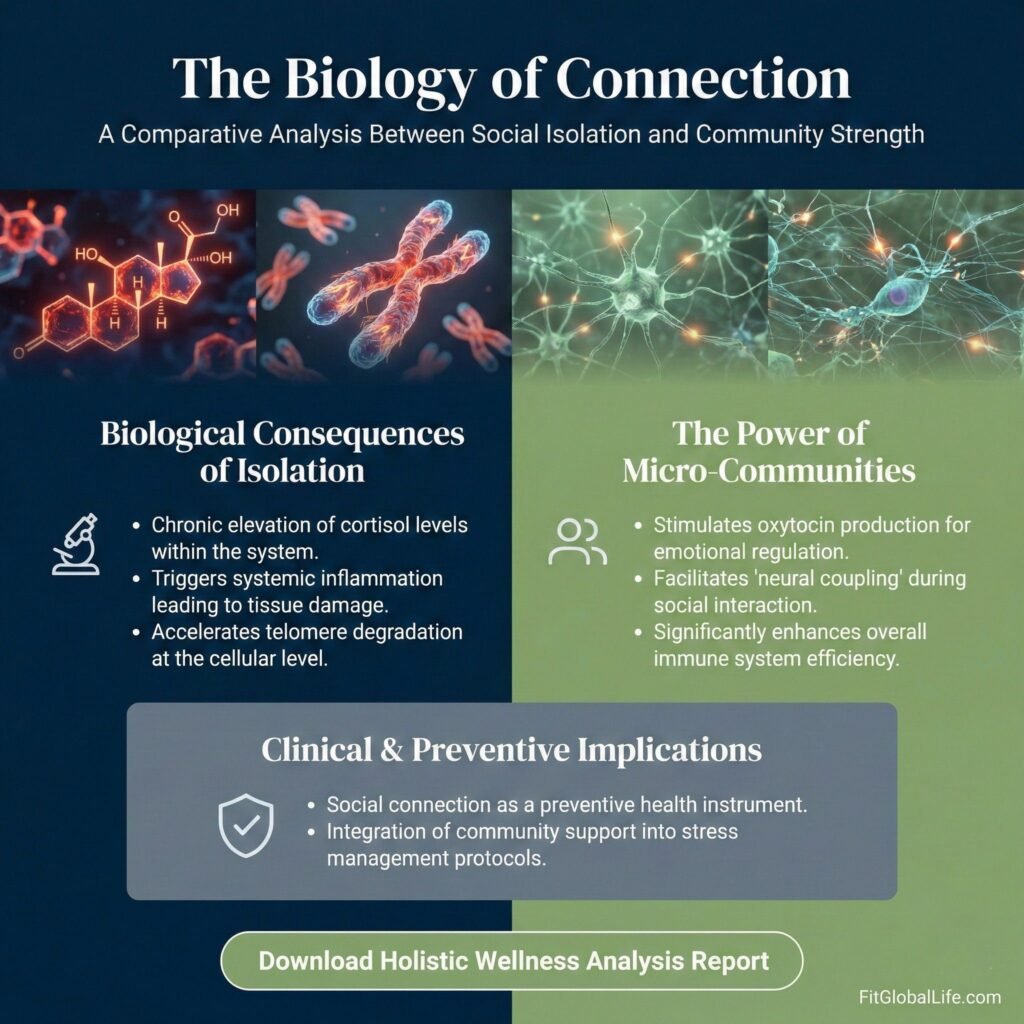
For years, we thought of loneliness as a “sad feeling” or a side effect of living in the contemporary world. In 2026, the global medical community officially treated it as a systemic inflammatory condition. Being alone for a long time makes the nervous system always “fight or flight,” which raises cortisol levels and speeds up the shortening of telomeres, the protective caps on our DNA.
The Structure of Isolation
The most recent information from the National Institutes of Health (NIH) says that being socially isolated raises the risk of dementia by 50% and the risk of coronary heart disease by 29%. But the 2026 view goes deeper. We now understand that without high-quality social interaction, the body produces fewer “Natural Killer” (NK) cells, making us more susceptible to emerging post-pandemic pathogens and internal cellular mutations.
Introducing the “Social Fitness” Score
We are moving beyond the BMI and body fat percentages. At Fit Global Life, we propose the Social Fitness Score. If your physical fitness is determined by your VO₂ Max, then your mental longevity is determined by the quality of your micro-communities. These are small, high-trust groups (typically 3-6 people) that provide the emotional safety and intellectual stimulation that no AI algorithm—no matter how empathetic—can replicate.
2. From “Soft Living” to “Collective Living”: The 2026 Shift
You may have read our previous piece on The Post-Work Wellness Economy, where we discussed “Soft Living”—a lifestyle prioritizing peace over productivity. Micro-communities are the logical evolution of that trend.
In an AI-driven world where nearly 40% of our daily interactions occur with synthetic agents or virtual assistants, the value of “High-Touch” human experiences has skyrocketed. We are seeing a move away from massive 500-person commercial gyms toward “Bio-Hacking Social Clubs”—spaces where you don’t just lift weights, but you solve problems, share organic meals, and engage in “Collective Flow States.”
Why “Micro” is the New “Macro”
The Dunbar Number suggests humans can maintain about 150 stable relationships. However, for Mental Longevity, the “Inner Circle” of 5 is what regulates our nervous system. Micro-communities in 2026 focus on:
- Shared Intentionality: Not just hanging out, but growing together with aligned goals (e.g., a meditation group or a regenerative food collective).
- Physical Proximity: Moving away from digital-only “communities” toward localized hubs. Physical presence triggers the release of pheromones and hormones that 8K video calls simply cannot simulate.
- Radical Vulnerability: The ability to be “off-screen” and authentic without the pressure of social media curation.
3. The Science of “Social Mirroring” and Neuro-Architecting
As a specialist in Neuro-Architecting Your Morning, I’ve found that the people occupying your physical space are as influential as the lighting or air quality in your home.
When we engage in deep, face-to-face conversation, our brain waves often begin to synchronize—a neurobiological phenomenon known as Neural Coupling. This synchronization releases massive amounts of oxytocin (the “bonding hormone”) and actively suppresses the amygdala’s fear response.
Expert Insight: “A micro-community acts as an external nervous system. When you are stressed, the collective calm of your ‘tribe’ physically recalibrates your own biology via the mirror neuron system. This is the ultimate longevity tool.” — Fit Global Life Editorial Team.
Data from the Harvard Study of Adult Development, the world’s longest study on happiness, confirms that strong relationships are the single best predictor of health in old age, surpassing genetics, IQ, or social class.
4. How to Build Your Loneliness Antidote: A 2026 Framework
Building a micro-community isn’t about being popular; it’s about being an architect of your social environment. Here is how to audit and build your social wellness micro-communities:
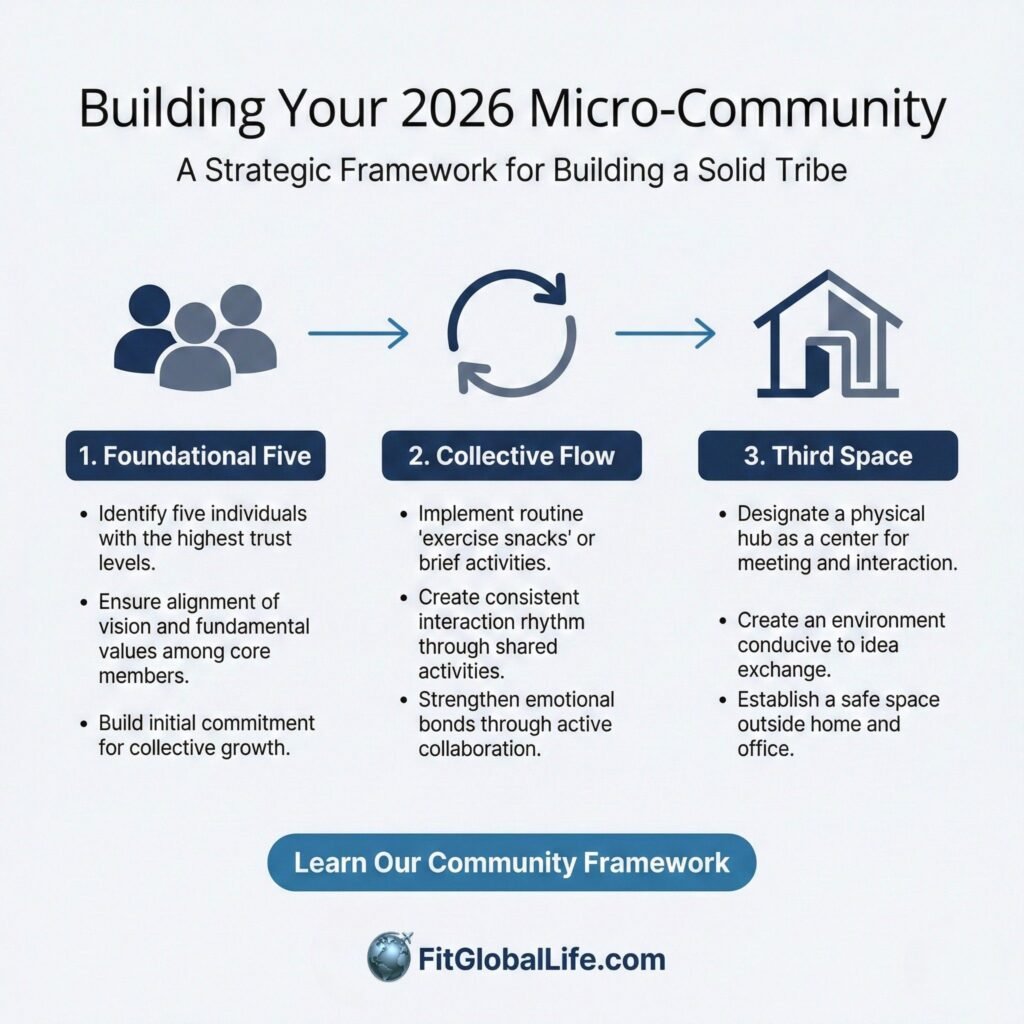
To help you get started, we’ve distilled the micro-community architecture into this simple blueprint:
A. The “Foundational Five” Audit
Identify five individuals who challenge you, support you, and—most importantly—show up physically. In 2026, a “text-only” friend is an acquaintance, not a community member. Ask yourself: Who would I call at 3 AM if my bio-tracking system flagged a serious health anomaly?
B. Implement “Exercise Snacks” Together
Instead of a solo 1-hour gym session, invite a neighbor for a 5-minute ‘Exercise Snack’. The combination of intense movement and social bonding creates a “Longevity Multiplier.” These short, high-quality interactions lower blood pressure more effectively than long, isolated workouts.
C. Create a “Third Space”
Your home is the First Space, your work (or remote setup) is the Second. Find a Third Space—a local park, a quiet “no-screen” cafe, or a dedicated wellness club—where your micro-community meets without the distraction of digital notifications. The architecture of this space should encourage eye contact and open body posture.
5. The Future: Decentralized Health and Social Records
We are also seeing the integration of Blockchain and Social Wellness. In our article on Decentralized Health, we touched on how data privacy is key.
Future platforms are emerging where your “Social Wellness Micro-Communities” can securely share health goals and bio-data (with full consent) to create collective accountability. Imagine a decentralized group where, if one member’s “Stress Marker” spikes for three consecutive days, the others are automatically notified to reach out. This is the future of Proactive Loneliness Prevention.
6. Global Perspectives: Blue Zones 2.0
We can learn much from the “Blue Zones”—regions where people live significantly longer. The secret wasn’t just the olive oil; it was the Moai. This Okinawan term refers to “social groups that meet for a common purpose” and support each other for life.
In 2026, we are reinventing the Moai for the digital age. Whether it’s a “Bio-Hacking Book Club” in London or a “Regenerative Farming Collective” in Bali, these social structures are the bedrock of human durability. For more on these destinations, check out our guide to Bio-Hacking Retreats.
FAQ: Social Wellness Micro-Communities
Conclusion: The Ultimate Bio-Hack is Belonging
As we navigate an increasingly automated world, the most radical thing you can do for your health is to be unabashedly human. Longevity is a team sport. By investing in social wellness micro-communities, you aren’t just adding years to your life; you are adding life to your years.
Stop tracking your heart rate for a moment and go talk to a neighbor. Your brain—and your telomeres—will thank you.
Disclaimer
The information presented in this article is for educational and informational purposes only and is not intended as professional medical advice, diagnosis, or treatment. Always seek the advice of your physician or other qualified health provider with any questions you may have regarding a medical condition. Never disregard professional medical advice or delay in seeking it because of something you have read on this website.