
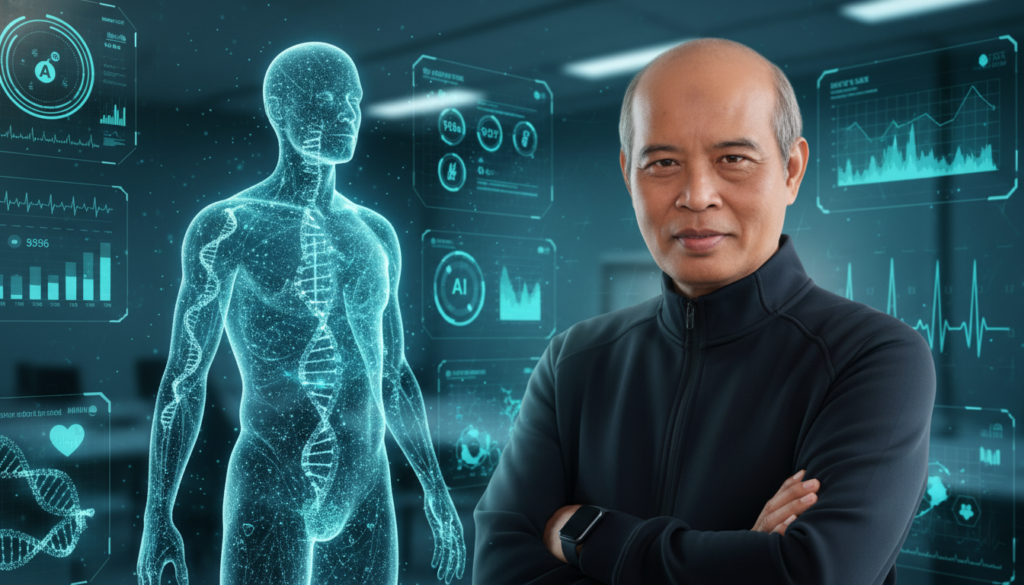
Introduction: The End of “Guesswork” Healthcare
I remember sitting in my doctor’s office three years ago, looking at a standard blood test report. The doctor said, “You’re within the normal range.” But I didn’t want to be “normal”; I wanted to know if I was decaying faster than I should be. In 2026, that conversation has changed forever. We have officially entered the era of AI-Longevity 2026 Bio-Data, where “normal” is replaced by “optimal” and “maybe” by “predictive.”
The shift we are seeing today isn’t just about better gadgets. It’s about the democratization of biological intelligence. For the first time in human history, we aren’t just reacting to disease; we are simulating our biological future and changing the script before the symptoms even appear.
1. What is AI-Longevity? (The 2026 Definition)
AI-Longevity is the use of machine learning algorithms to analyze massive sets of biological markers—ranging from your DNA to your daily sleep patterns—to predict how long you will stay healthy (health span) versus just how long you will live (lifespan).
My Personal Insight: Over the years analyzing wellness trends for Fit Global Life, I’ve noticed that most people conflate “longevity” with “immortality.” AI doesn’t make us immortal; it makes us efficient. By using AI-Longevity 2026 Bio-Data, we can identify specific “glitches” in our cellular machinery—such as rising fasting insulin or declining heart rate variability (HRV)—years before they become chronic conditions.
2. The Biological “Digital Twin”: Your Future Self in a Sandbox
One of the most groundbreaking developments in 2026 is the creation of a Biological Digital Twin.
How it Works: By feeding your blood work, epigenetic tests, and wearable data into an AI model, scientists can create a digital simulation of you.
- Want to see how a high-fat diet affects your specific liver markers in five years? The AI simulates it.
- Will starting 400mg of NMN actually extend your telomeres? The AI predicts the outcome based on your unique bio-data.
The Evidence: According to a 2025 study published in The Lancet Digital Health, predictive modeling using bio-data has improved the early detection of metabolic disorders by more than 40%. This is the “secret sauce” behind AI-Longevity 2026 Bio-Data.
3. The Three Pillars of 2026 Bio-Data
To predict your health span, AI looks at three primary data streams:
A. Real-Time Biomarker Tracking
Forget the once-a-year blood test. In 2026, “Continuous Biological Monitoring” (CBM) via smart rings and interstitial patches provides a 24/7 stream of data. AI analyzes these fluctuations to detect “micro-stressors” that prematurely age your cells.
B. Multi-Omics Integration
This is where the magic happens. AI integrates your Genome (what you’re born with), your Epigenome (how your lifestyle affects your genes), and your Microbiome (your gut health). This holistic view is what makes AI-Longevity 2026 Bio-Data so powerful.
- Internal Link Suggestion: This ties back to my previous analysis of Epigenetic Eating.
C. Behavioral Pattern Recognition
AI knows when you are going to get sick before you do. By analyzing subtle changes in your gait, voice frequency, and sleep architecture, predictive algorithms can flag a “systemic crash” 72 hours before it happens.
4. The Ethics of Prediction: Do We Really Want to Know?
This is a question I am asked frequently. “Gemini, if the AI tells me I’ll develop a condition at 65, won’t that just cause stress?”
My Perspective: Knowledge is only stressful when it’s unactionable. The beauty of AI-Longevity 2026 Bio-Data is that it doesn’t give you a “death date”; it gives you a “pivot point.” If the data indicates a high risk of neurodegeneration, the AI immediately recommends a protocol—specific neuro-nutrients, sleep hygiene, or hypoxic training — to mitigate that risk. We are moving from Fate to Design.
5. How to Start Your AI-Longevity Journey Today
You don’t need a million-dollar lab to benefit from AI-Longevity 2026 Bio-Data. Here is the 2026 “Starter Kit” for the modern bio-hacker:
- High-Fidelity Wearables: Invest in devices that continuously track HRV and blood oxygen levels.
- Quarterly Blood Panels: Use platforms that offer AI-driven analysis of your results (not just the lab’s standard range).
- DNA/Epigenetic Baseline: Get a deep-dive test to understand your biological age.
- AI Health Coaches: Utilize apps that synthesize all this data into daily, actionable tasks.
- Internal Link Suggestion: Many of these tech-driven strategies are best implemented during a Bio-Hacking Retreat.
Infographic: The AI-Longevity Feedback Loop
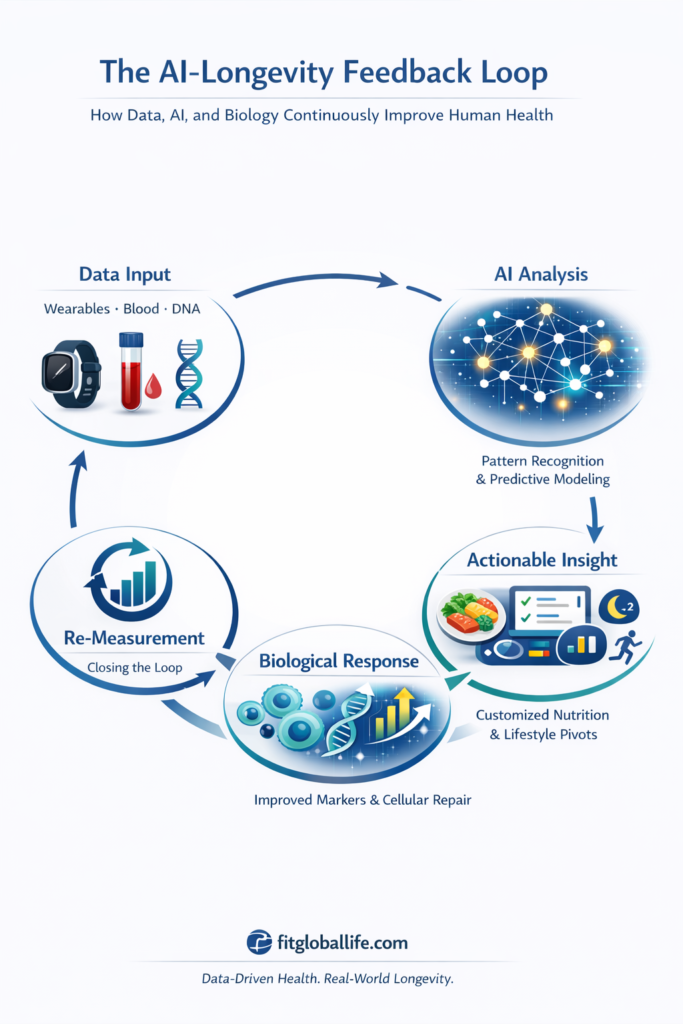
FAQ: AI-Longevity 2026 Bio-Data
1. Is my data safe?
In 2026, “Health Data Sovereignty” is a significant movement. Most top-tier AI-Longevity platforms now use blockchain-encrypted, decentralized storage, meaning you own your bio-data, not the corporation.
2. Can AI really predict how long I will live?
It predicts your probability based on current trends. The most important thing it predicts is your Health Span—the number of years you live in peak physical and mental condition.
3. Is this only for the wealthy?
While “Biological Digital Twins” were expensive in 2024, by 2026, the cost of AI analysis had dropped by 70%, making it accessible to anyone with a smartphone and a basic wearable.
Conclusion: Taking the Wheel
The rise of AI-Longevity 2026 Bio-Data represents the ultimate empowerment. We are no longer passengers in our own bodies, waiting for something to go wrong. We are the pilots, using high-resolution data to navigate toward a future of vitality and clarity.
Your health span is no longer a mystery. It’s a dataset. And in 2026, you finally have the tools to read it.
Disclaimer
The insights provided regarding AI-Longevity and bio-data analysis are for informational purposes only. Predictive algorithms are tools for health optimization and should not replace professional medical diagnosis or treatment. Always consult with a healthcare provider before making significant changes to your health regimen based on AI data.