
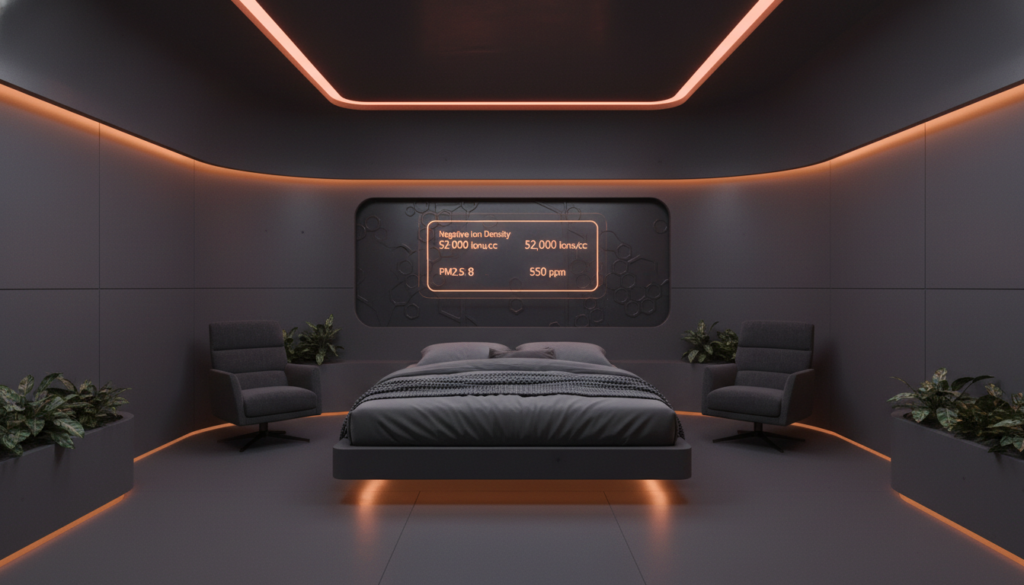
We spend a third of our lives in unconsciousness, yet most biohackers allocate 90% of their budget to supplements and only 10% to the space where their brain actually repairs itself. By 2026, we've moved beyond simple “sleep hygiene” like cool rooms and dark curtains. We're now entering the advanced era of The Architecture of Sleep.
If you’ve been following our journey through Mitochondrial Recovery, you know that cellular energy is the foundation of life. However, your mitochondria cannot recover if your brain remains in a “high-alert” state caused by poor environmental design. Your bedroom is not just a place to sleep; it is a specialized space created for neural restoration and cognitive longevity.
Beyond the Mattress: How Your Environment Acts as a Cognitive Filter
The old idea of sleep focused on comfort—like choosing the right mattress and pillow. By 2026, the elite view has shifted toward Environmental Signaling. Your brain constantly monitors its surroundings, even during deep sleep. If your room feels “closed,” “imbalanced,” or cluttered, your amygdala stays partly active, cutting short your REM (Rapid Eye Movement) cycles.
The Architecture of Sleep suggests that the physical layout of your room acts as a cognitive filter. A cluttered or poorly designed space creates “cognitive noise” that hinders the glymphatic system—the brain's waste removal process—from functioning optimally. This gap explains why mastering Internal Waste Management is essential. When the brain detects environmental stress, it shifts focus to vigilance rather than deep cleaning.
The Geometry of Rest: How Room Shape Influences Neural Scaling
Why do we feel more relaxed in some spaces than others? It all relates to Neuro-Architecture. Research into sleep environment design suggests that bedrooms with specific geometric ratios, like the Golden Ratio, help lower resting heart rates before sleep begins.
Angular Tension and Sleep Latency
Sharp angles, exposed overhead beams, and “sharp” furniture edges can trigger a psychological effect called “cutting tension.” In 2026, we use the science of Neuro-Aesthetics to lessen visual complexity. By incorporating curved edges and “hidden” storage, we reduce the brain's processing demand.
When your eyes (even behind closed lids) don't detect jagged “threats” in the room's geometry, your nervous system can switch from sympathetic (fight or flight) to parasympathetic (rest and digest) much faster. This lowers sleep latency—the time it takes to fall asleep—and extends the duration of your first deep sleep cycle.
Air Ionization and Respiratory Efficiency: The Hidden Sleep Boost
Perhaps the most overlooked element in The Architecture of Sleep is the air itself — not just the temperature, but also the electrical charge and purity.
In nature, especially near waterfalls, mountains, or following a thunderstorm, the air is rich in Negative Ions. These ions make you feel better and help your lungs work better. On the other hand, metropolitan apartments are full with positive ions from electronics and HVAC systems, which can make people irritable and cause oxidative stress.
Active Ionization: The 2026 Standard
Active Air Ionization is becoming a part of modern sleep sanctuaries. Unlike standard purifiers that just trap dust, ionizers “scrub” the air by attaching to micro-particulates (PM2.5), causing them to fall out of your breathing zone. This technology mimics the atmospheric conditions of a high-altitude forest, directly improving blood oxygen saturation. For a brain undergoing intense Mitochondrial Recovery, this oxygen-rich, ionically balanced environment is non-negotiable.
4 Steps to Create Your 2026 Sleep Sanctuary
The Architecture of Sleep: Advanced 2026 Protocol
To apply the principles of The Architecture of Sleep to your life, you need to go beyond aesthetic interior design and adopt “Environmental Engineering.” Use this particular set of steps to turn your bedroom into a place where your brain can heal.
1. Golden Ratio Alignment and Furniture Arrangement
The shape of a room directly affects the autonomic nervous system.
- The Command Position: Arrange your bed so you have a clear view of the door from a distance, but you’re not directly in line with it. This evolutionary hack signals the amygdala (the brain's fear center) that you are safe from “intruders,” lowering subconscious vigilance.
- For symmetry and neural stability: put the same nightstands and lamps on both sides of the bed. In The Architecture of Sleep, symmetry means order and mental stability, which helps the brain get ready for sleep by reducing the amount of visual information it has to process.
- Ceiling Height and Anxiety: If you can, stay away from low ceilings that are directly above your head or beams that are open. These can cause a “spatial compression” impact on the mind, which can lead to small concerns that make it hard to fall into deep sleep.

2. Active Air Ionization and Particulate Filtration
Air quality in 2026 isn't just about freshness; it’s about molecular charge and purity.
- Ion Density Optimization: Ensure the negative ion density is at least 50,000 ions per cubic centimeter. Negative ions act as natural “scrubbers” that make it easier for the brain to take in oxygen during the REM phase. This is incredibly important for people who are focusing on Mitochondrial Recovery.
- Precise Humidity Control: Keep the humidity levels between 40 and 60% for precise control. Too dry air raises the number of static positive ions, and too humid air fosters mold growth. Both of these things are bad for the respiratory system.

3. Circadian-Integrated Lighting Systems
Your bedroom lighting should align with the biological circadian rhythm to prevent “Biological Friction.”
- Sunset Phase Integration: Two hours before sleep, all lighting should automatically transition to the amber-red spectrum (below 2000K). This mimics the traditional campfire, which naturally stimulates melatonin production.
- The Zero-Blue Zone Policy: Get rid of all blue light “leaks,” including LED lights on chargers or streetlights. Even minimal blue light exposure can suppress melatonin for hours, harming the quality of your sleep and recovery.
4. Electromagnetic Shielding (The Faraday Bedroom)
We need to protect our biology from invisible frequency pollution as we enter the Sovereign Health Era.
- Faraday Paint Implementation: Use conductive shielding paint on the walls of your bedroom to block outside RF (Radio Frequency) transmissions like 6G and satellite Wi-Fi. This makes a “silent electrical space” where cell phone calls can happen without interference from other electromagnetic waves.
- Circulatory Kill-Switch: Install a “demand switch” that cuts power to the bedroom circuits at night. This removes “dirty electricity” from wires near your head, creating a pristine environment for Biological Twin simulations to manifest in real-world cellular repair.
The Glymphatic System: How Environment Cleans the Brain
The most important function of sleep in 2026 is the Glymphatic Flush. This occurs when the spaces between brain cells expand, allowing cerebrospinal fluid to carry away metabolic waste, such as amyloid-beta, which builds up during a day of intense cognitive work.
However, this drainage system is very sensitive to environmental stress. If The Architecture of Sleep is ignored—such as when the room is too bright, noisy, or chaotic—the glymphatic system works at only 30–40% capacity. By improving your environment, you can ensure a full “flush” every night, which is the best way to prevent neurodegenerative decline and support Neuro-Plasticity Over 40.
Measuring Success: Data-Driven Sleep Settings
In the age of Quantum Wellness, we no longer guess. We use subatomic environmental sensors to monitor:
- VOC (Volatile Organic Compounds): Making sure your “eco-friendly” mattress isn't releasing chemicals that gradually harm the nervous system.
- Particulate Matter (PM2.5): Maintain levels below 10 μg/m³ to reduce pulmonary inflammation.
- Carbon Dioxide (CO2) Monitoring: High CO2 levels in a closed bedroom cause morning “brain fog” and impaired executive function.
Conclusion: Designing for the Subconscious
The Architecture of Sleep is the ultimate biohack because it works while you do nothing. You don't need to remember to take a pill or log an app. Once your environment is optimized, it becomes a “silent coach” working constantly for your biology.
By aligning bedroom layout, air quality, and electrical surroundings with biological needs, you are not just “sleeping better”—you are creating a sanctuary that actively enhances your cognitive lifespan. The future of performance depends not only on what you do while awake but also on how you design for when you are not.
FAQ
Medical Disclaimer:
The information provided by Fit Global Life about The Architecture of Sleep, air ionization, and environmental biohacking is for educational purposes only. It does not replace professional medical advice, diagnosis, or treatment. Always consult a qualified health provider before making major changes to your living environment, especially if you have chronic respiratory, cardiovascular, or neurological conditions.