
In the frantic landscape of 2026, the term “Digital Nomad” has undergone a radical transformation. There was a time when you could tell how successful you were by how many Starbucks you could work from in a month. Today, a new elite group of remote workers is forming. These are the people who value Biological Wealth more than just being able to work from wherever.
Welcome to the era of Blue-Zone Nomadism.
As the lead editor at Fit Global Life, I’ve spent years analyzing how our modern office environments—even the “flexible” ones—are essentially biological traps. High cortisol, sedentary loops, and processed “convenience” foods are the taxes we pay for our hyper-connectivity. But what if your “office” was strategically located in a geographic “Longevity Pocket”? What if the very air you breathed and the hills you walked to lunch were hacking your DNA for a longer life?
This is not a vacation. It is a calculated, career-sustaining relocation strategy.
The Biological Foundation: Why Environment Trumps Willpower
Environmental Epigenetics: Hacking Your DNA Without Supplements
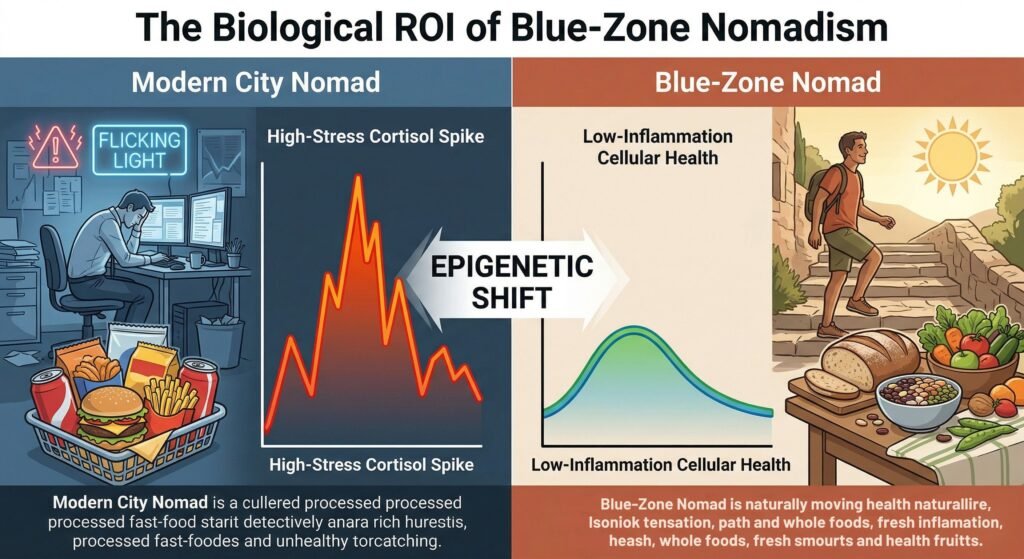
The core philosophy of Blue-Zone Nomadism rests on the science of Environmental Epigenetics. We often hear that “genetics loads the gun, but lifestyle pulls the trigger.” However, in the Blue Zones—Sardinia (Italy), Okinawa (Japan), Nicoya (Costa Rica), Icaria (Greece), and Loma Linda (California)—the environment actually prevents the trigger from being pulled.
Research from the National Institutes of Health (NIH.gov) demonstrates that chronic low-grade inflammation, or “inflammaging,” is the primary driver of age-related decline. For the remote worker, this inflammation is triggered by blue light, sedentary behavior, and social isolation. When you practice Blue-Zone Nomadism, you are outsourcing your discipline to your surroundings.
The Cost of “Inflammaging” in the Remote Work Era
In 2026, we see a rise in “Tech-Neck” and “Zoom-Fatigue” not just as minor annoyances, but as systemic inflammatory triggers. When you work in a high-stress urban environment, your sympathetic nervous system is constantly “on.” By relocating to a Blue Zone, the ambient noise, natural scents (phytoncides), and slower pace of life act as a continuous vagus nerve stimulation, lowering systemic inflammation without you having to “try.”
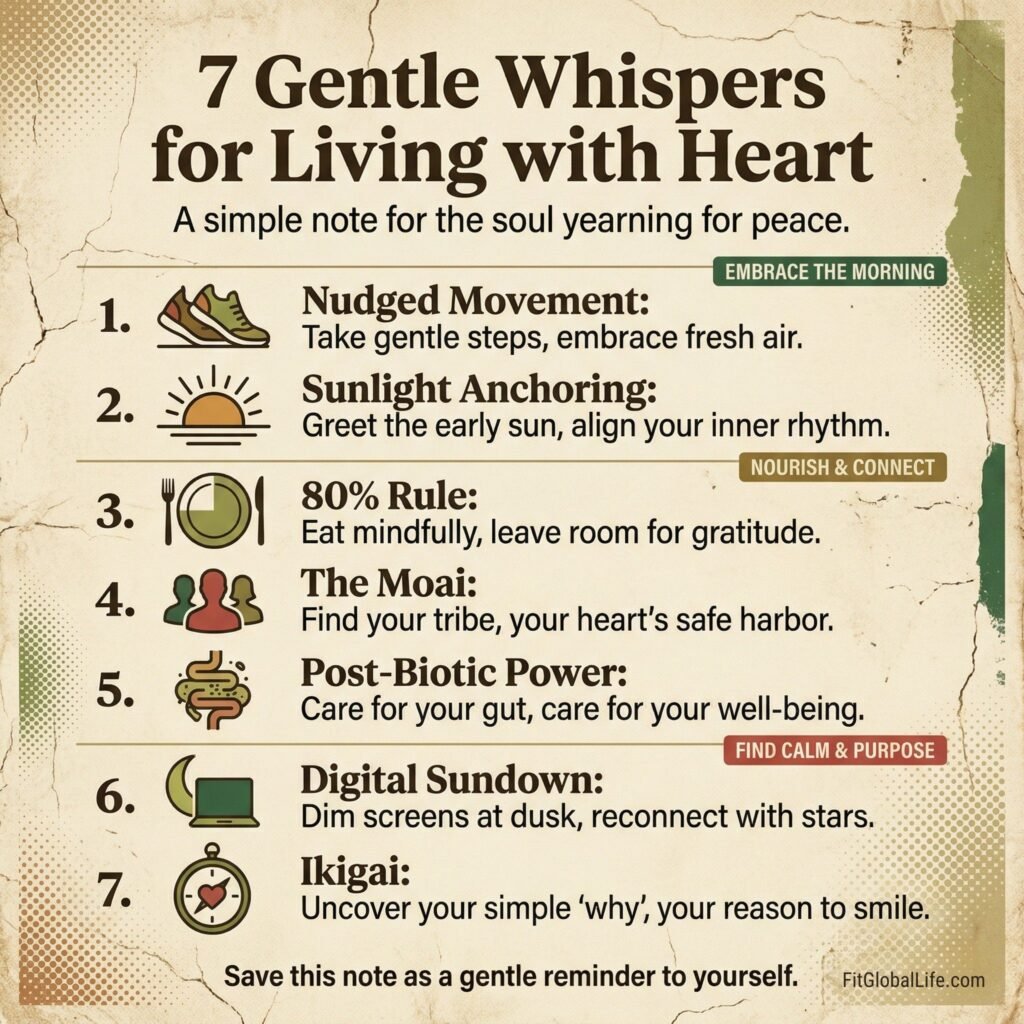
1. The “Nudged” Movement Strategy (Functional Fitness)
Ditching the Gym for Natural Inclines
The first secret habit of Blue-Zone Nomadism is abandoning the concept of “The Gym” as a destination. In longevity hotspots, exercise is “baked in” to daily life. For the remote worker, this means choosing a home base that requires Natural Movement.
In my travels through the Ogliastra region of Sardinia, I noticed that the centenarians didn't lift weights; they walked steep, cobblestone paths to visit neighbors. If you are staying in a high-rise in Dubai, you are fighting your environment. If you are staying in a hillside villa in Icaria, your environment is working for you.
Zone 2 Cardio: The Sweet Spot for Mitochondrial Health
According to Harvard Health, consistent “Zone 2” movement—the kind of low-intensity activity that keeps you slightly breathless but able to speak—is the gold standard for mitochondrial health.
Fit Global Life Insight: Instead of a 1-hour intense CrossFit session that spikes your cortisol before a big meeting, the Blue-Zone Nomad opts for “movement snacks.” A 15-minute walk on uneven terrain every 2 hours keeps the lymphatic system flowing and prevents the “brain fog” associated with stagnant sitting.
2. Pre-Work Sunlight Anchoring & Circadian Alignment
The 480nm Wavelength: Why Morning Light is Your Best Nootropic
Your internal clock is your most valuable productivity tool. Blue-Zone Nomadism practitioners use “Sunlight Anchoring.” By exposing your retinas to the specific blue-light frequencies (around 480nm) of the early morning sun, you suppress melatonin and trigger a healthy cortisol spike.
This isn't just about feeling “awake.” It’s about Mitochondrial Recovery. If you've read our previous deep dive on Mitochondrial Recovery: Why Cellular Energy is the Only Metric That Matters in 2026, you know that light is a nutrient.
Managing “Social Jetlag” Across Global Time Zones
Working for a NY firm while living in Greece? That's a recipe for social jetlag. The Blue-Zone Nomad manages this by using “Light Priming.” If you must work late, use red-shifted lighting to protect your melatonin, but never skip the morning sun anchored to your local geography. This creates a biological “anchor” that prevents the DNA damage associated with shift work.
3. The 80% Rule (Hara Hachi Bu) for Cognitive Load
Neuro-Inflammation and the Dangers of “Working to Empty”
The Okinawans have a 2,500-year-old Confucian mantra: Hara Hachi Bu—eat until you are 80% full. In Blue-Zone Nomadism, we apply this to Cognitive Load. In the West, we work until we are “empty.” This leads to neuro-inflammation, where the brain's immune cells (microglia) become hyper-active, causing long-term cognitive decline.
The “Reserve” Strategy: Ending Deep Work with Energy to Spare
The Blue-Zone Nomad works until they are 80% exhausted. By stopping while you still have a “reserve” of mental energy, you ensure that you have the capacity to engage with the local community in the evening. This prevents the “zombie mode” that many remote workers fall into after an 8-hour screen session.
4. Radical Social Integration: The “Moai” Effect
Oxytocin vs. Cortisol: The Science of Belonging
In Okinawa, a Moai is a social support group for life. Loneliness is statistically as lethal as smoking 15 cigarettes a day. Blue-Zone Nomadism solves this by forcing radical integration. When you are in a small village in Nicoya, you cannot remain anonymous.
Micro-Socializing: Why the Local Baker is Better for You than Slack
Every time you have a genuine, face-to-face interaction with a local, your brain releases oxytocin. This hormone directly counteracts the corrosive effects of cortisol. Forget “Networking” on LinkedIn; real longevity comes from knowing the name of the person who grows your vegetables.
5. Post-Biotic Power: Functional Nutrition for the Nomad
Beyond Probiotics: How Local Fermentation Heals the Gut
In our article on Post-Biotic Power: Why Probiotics are Obsolete, we discuss how the metabolites produced by your gut bacteria (post-biotics) are what actually heal your body. Blue-Zone Nomadism puts you in the heart of this.
Whether it’s the sourdough of Sardinia (with specific local lactobacilli) or the purple sweet potatoes of Okinawa, the food is “Alive.” These foods provide the short-chain fatty acids (SCFAs) that maintain the integrity of your blood-brain barrier.
The “Longevity Bean” Rule: Cheap Nutrition for High-Performance
The cornerstone of every Blue Zone diet is legumes. For the remote worker on the go, this is the ultimate hack. Beans are shelf-stable, high in fiber, and provide a slow-release glucose curve that prevents the “afternoon slump” common with high-carb office lunches.
6. Digital Sundowning & The “Dark” Period
Melatonin as a Brain “Janitor”: The Importance of Total Darkness
In Blue Zones, once the sun goes down, the pace of life slows. Blue-Zone Nomadism requires a “Digital Sundown.” Melatonin is not just for sleep; it is a powerful antioxidant that “cleans” your brain of metabolic waste (amyloid-beta) during the night. If you are checking Slack at 11 PM, you are effectively turning off the “janitorial service” in your brain.
Designing a Low-EMF Sleep Sanctuary While Traveling
When traveling as a nomad, your environment is often unpredictable. The Blue-Zone Nomad puts sleep first by using Faraday pouches for phones and making sure that no “standby” lights are on. This makes the surroundings low in electromagnetic fields, like in traditional longevity villages.
7. Finding Your “Ikigai”: Purpose-Driven Productivity
Plan de Vida: Moving Beyond KPIs to True Fulfillment
In Nicoya, they call it Plan de Vida. Most remote workers are driven by “KPIs.” The Blue-Zone Nomadism habit involves realigning your work with a higher purpose. When your work has meaning beyond the paycheck, your body produces fewer stress hormones.
Aligning Remote Projects with Human Connection
Does your code help people? Does your writing inspire health? When you make your digital work more in line with human-centered ideals, it lowers the “moral injury” that many people in corporate jobs feel. This is a hidden but major source of chronic stress.
Aligning your digital output with human-centric values reduces the “moral injury” often felt in corporate roles, which is a hidden but significant source of chronic stress.
The Real World and Economic Aspects of Long-Term Travel
Health ROI: Comparing the Cost of Healthcare to the Cost of Living
People who don't like Blue-Zone Nomadism see it as a luxury. However, the economic burden of chronic disease is skyrocketing. By investing in a lifestyle that reduces your biological age (measured by DNA methylation tests), you are lowering future healthcare costs.
According to The World Health Organization (WHO.int), lifestyle-related diseases are the leading cause of death globally. Staying in a Blue Zone isn't an expense; it's an insurance policy.
Frequently Asked Questions (FAQ)
Disclaimer
The information provided in this article by Fit Global Life is for educational purposes only and is not intended as medical advice. Always consult with a qualified healthcare professional before making significant changes to your diet or lifestyle. This content is written by human experts with AI assistance for data synthesis.