
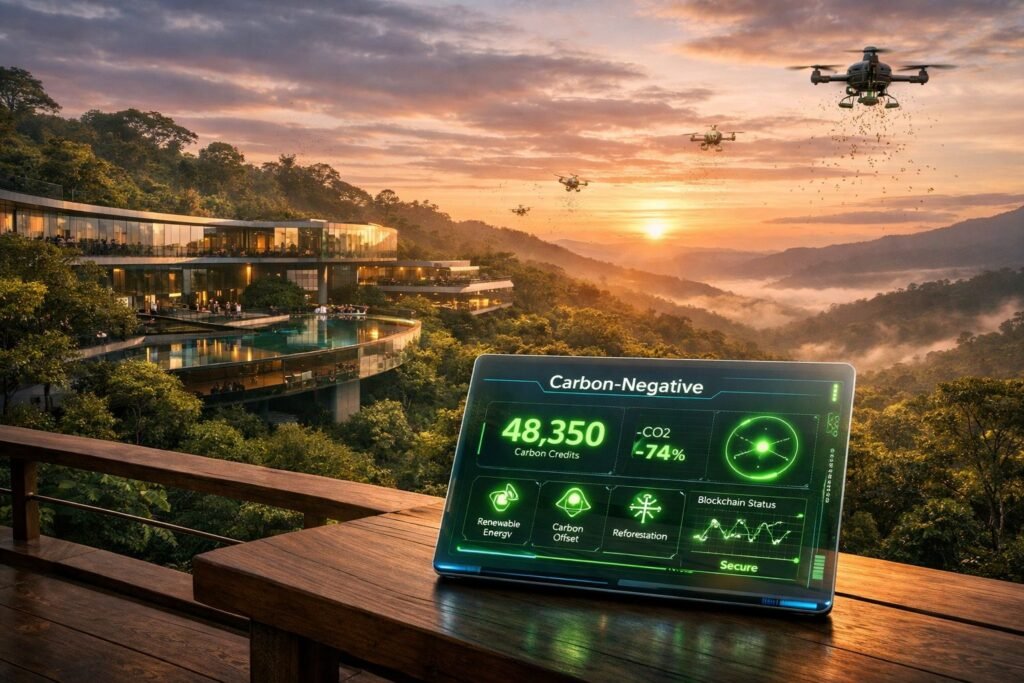
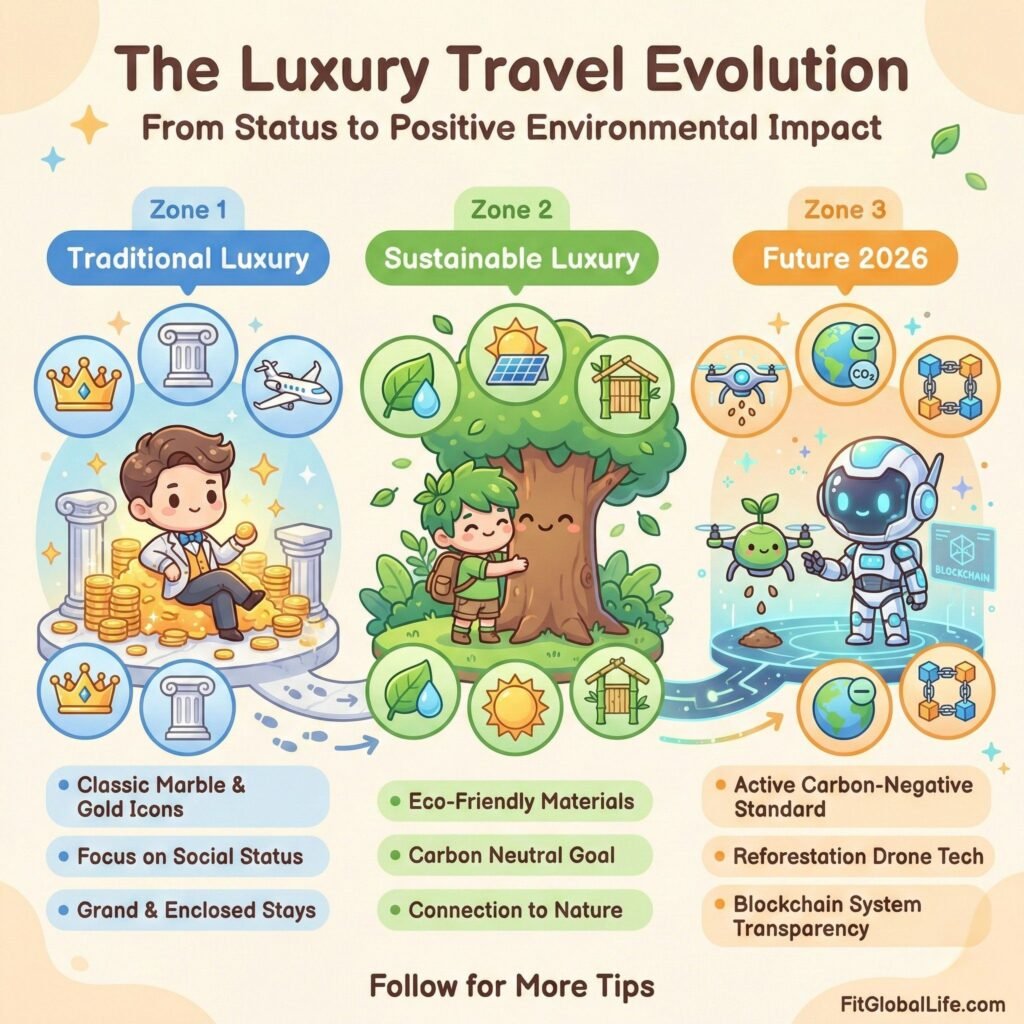
In 2026, true luxury is no longer measured by how much gold leaf adorns a hotel lobby or how private your jet is. The new status symbol for elite global travelers is a Carbon-Negative Footprint. We have moved beyond the “Sustainable” era, which was merely about harm reduction. We are now entering the era of Regenerative Travel, where your journey actively leaves a destination better than you found it.
As the Editor of Fit Global Life, I have traveled to the farthest corners of the globe—from remote Pacific atolls to melting Alpine peaks—searching for this new standard. My results are groundbreaking: Carbon-Negative Luxury Travel is no longer just a fantasy for activists. It is a way of life that restores the environment, thanks to blockchain transparency and high-tech bioengineering.
1. More than Sustainable: The Growth of Climate-Positive Travel
What is the difference between Climate-Positive and Sustainable? Simply put, sustainable means “do no harm” or “neutrality.” In contrast, climate-positive or carbon-negative means your activities actively remove more $CO_2$ from the atmosphere than you generate throughout your entire trip.
According to 2026 data from the World Travel & Tourism Council (WTTC), the tourism sector, which once accounted for 8% of global emissions, is undergoing a transformation. New aviation fuels and AI-driven ecosystem restoration initiatives allow us to flip those numbers.
The Mathematical Reality of 2026 Travel
In our Fit Global Life calculations, if a trip generates $1.5 text{ tons of } CO_2$, the Climate-Positive protocol requires you to compensate for at least $2.0 text{ tons of } CO_2$ through Direct Air Capture (DAC) or intensive mangrove restoration. This isn't just “offsetting”; it is measurable, verifiable restoration recorded on a digital ledger.
2. A Close Look at the Foundations of Carbon-Negative Luxury
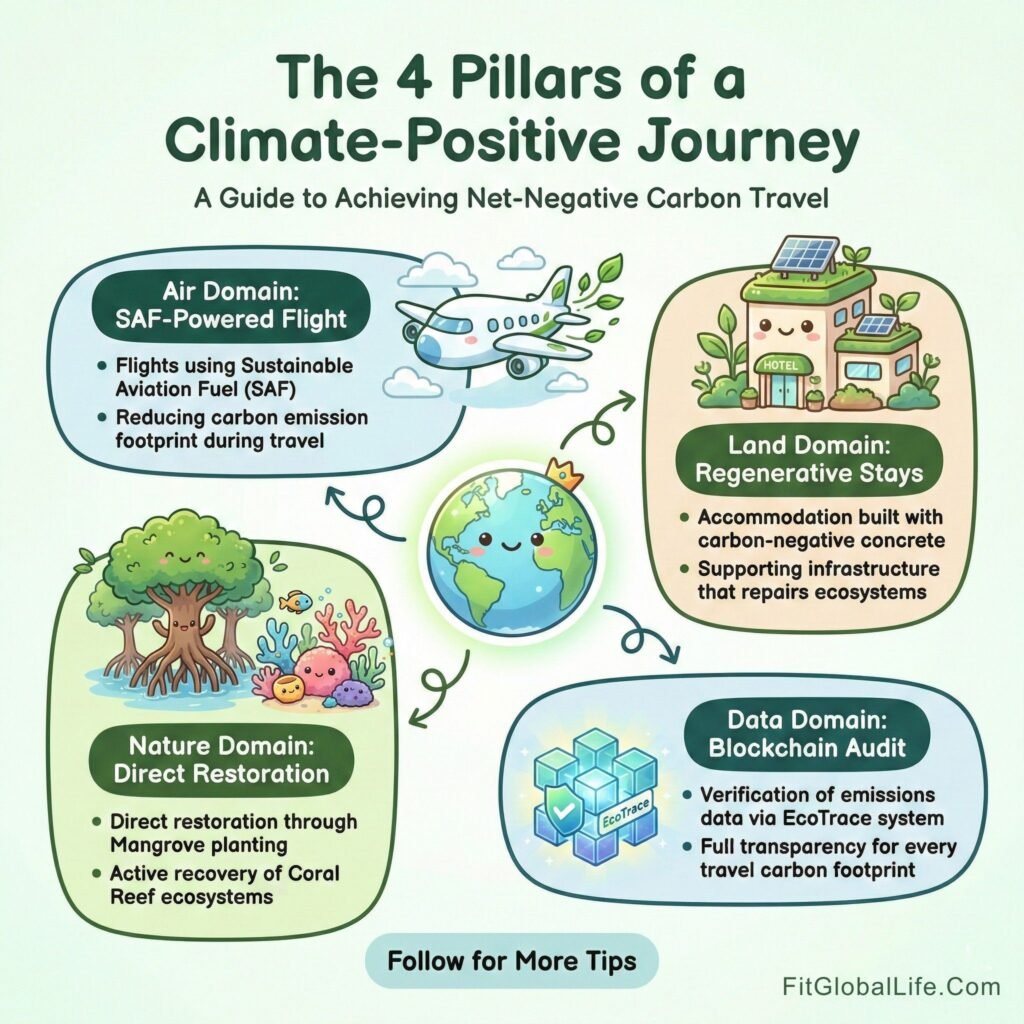
To make sure your trip matters, focus on these three primary points that our team came up with:
A. The Stay: Regenerative Hospitality 2.0
n 2026, high-end hotels will stop talking about “reusing towels.” They are units that trap carbon. Look for properties that have Regen-Cert accreditation. These buildings are made of carbon-negative concrete and get all of their power from renewable microgrids.
- Case Study: Resorts in the Maldives are now using 3D-printed underwater structures to harvest coral, which actively sequesters “Blue Carbon.”
- Expert Insight: Check for hotels implementing “Zero-Waste Circularity.” Here, wastewater is processed into nutrients for vertical hydroponic gardens that supply 80% of the organic meals for guests.
B. The Transport: SAF, Hydrogen, and Electric Flight
The main challenge is still flying. Luxury airlines will transition to using Sustainable Aviation Fuel (SAF) generated from organic waste and carbon taken from the air by 2026.
- Electric Transfers: Your mobility should be all electric when you arrive. Many high-end resorts now have eVTOL (electric Vertical Take-Off and Landing) planes that pick up guests from the airport and drop them off at their hotels, cutting down on “last-mile” emissions.
- SAF Premiums: As a Climate-Positive jetsetter, you don’t just use SAF; you also fund next-generation fuel research through integrated contributions on your digital ticket.
C. The Impact: Participation over Observation
The new luxury is active participation. In the past, guests were spectators. In 2026, they are “Restoration Tourists.”
- Eco-Engagement: Imagine spending your morning using advanced drones to disperse seeds across deforested areas of the Amazon or working with marine biologists to monitor whale health with AI sensors. This is Transformative Travel, which gives you spiritual fulfillment and real advantages for the environment.
3. Top Destinations for Climate-Positive Jetsetting in 2026
According to our annual global audit, these three destinations have moved beyond the “eco-friendly” label. They are actively healing the planet through aggressive carbon sequestration and biodiversity engineering, making them the premier choices for the conscious elite.
1. The Cloud Forests of Costa Rica: The Center for Reforestation
Costa Rica is the clear winner when it comes to turning things around for the environment. The country boasts the highest replanting rates in the tropics after losing forests for years. In 2026, Monteverde and the Central Highlands will be the main places for botanical bio-hacking.
- The Experience: Stay in treehouses that are quite luxurious, with natural ventilation filtered by HEPA. Each night of your stay is biologically linked to the soil; your booking fee automatically funds the planting and maintenance of 10 endemic trees through a GPS-tracked reforestation program.
- The Climate-Positive Edge: These forests are massive carbon sinks. By staying here, you support the Pioneers of Payment for Environmental Services (PES). The air quality in these high-altitude forests has been measured as the purest on Earth—a natural respiratory bio-hack that lowers systemic inflammation and boosts mitochondrial function.
- Editor’s Recommendation: Visit the Monteverde Cloud Forest Reserve between February and May to witness the peak of the regenerative blooming.
2. Bhutan: The Kingdom with Less Carbon
Bhutan is still the only country in the world that is carbon-negative at the national level; it takes in more CO2 than it gives off. Bhutan's “High Value, Low Volume” policy has become even more exclusive in 2026. This has made the country the world's most elite spiritual and ecological sanctuary.
- The Experience: A daily Sustainable Development Fee (SDF) makes it hard to get to Bhutan. This levy is more than just a tax; it's a direct investment in the kingdom's 72% forest cover and in the free education and healthcare systems for the people who live there. Luxury lodges here, such as the Amankora or Six Senses, are designed to be “invisible” to the landscape, using local materials and zero-carbon thermal heating.
- The Climate-Positive Edge: Bhutan is a living laboratory for the Gross National Happiness (GNH) index. Here, the economy is subservient to the environment. The vast forest canopy serves as a global lung, and as a traveler, you help preserve rare species such as the snow leopard and the black-necked crane.
- Mental Longevity Note: The total absence of digital noise and the kingdom’s mandate for silence in designated zones make Bhutan the ultimate destination for Digital Deceleration.
3. The Red Sea Project, Saudi Arabia: The Coral Pioneer
There is no longer any work going on here. The Red Sea will be the world's largest Regenerative Tourism Experiment in 2026. This project is located on the western coast of Saudi Arabia and has changed how people interact with the ocean.
- The Experience: Forget traditional beachfront hotels. The resorts here are architectural marvels that “hover” over the ecosystem. Whether floating villas or stilts driven into nonliving substrate, the goal is a zero-footprint stay. The entire 28,000-square-kilometer area is powered by 100% renewable energy, primarily solar and wind, backed by the world's largest battery storage system.
- The Climate-Positive Edge: Their target isn't merely to protect; it’s a 30% net increase in biodiversity. Through massive coral nurseries and the restoration of mangrove forests—which sequester carbon up to 4x more efficiently than terrestrial forests—The Red Sea is literally cooling the planet.
- The New Thing: Tourists can take part in “Coral Out-planting,” which uses AI-guided robots to put lab-grown, heat-resistant coral on the reefs. This will help the ocean stay healthy even as the world's temperatures rise.
4. Using blockchain to check your footprint: the end of greenwashing
In the age of Decentralized Health and the fast growth of Web3, openness is no longer a nice-to-have; it's a must-have. In 2026, you won't be able to trust anything a hotel says about its “sustainability efforts” anymore. We live in a time when trust is based on code that can't be changed. At Fit Global Life, our editorial policy is clear: Do not trust a luxury resort’s climate claims unless it provides real-time, verified data on a public blockchain.
The Digital Carbon Ledger
The integration of blockchain technology into travel enables a level of scrutiny never before possible. In 2026, we use a system called the Digital Carbon Ledger, which transforms your itinerary into a living record of restoration:
- Engine-Specific Emission Tracking: Modern travel apps like EcoTrace now pull data directly from flight manifests. They don't just estimate distance; they calculate emissions based on specific aircraft engine models ($CO_2$ vs $NO_x$ output) and fuel efficiency. This approach achieves 98% accuracy compared with past generic carbon calculators.
- Smart Meter Integration & Energy Transparency: Guests at true climate-positive resorts can use IoT-connected smart meters to monitor how much energy their suite consumes. You can view exactly how much renewable energy (solar/wind) your stay uses, compared to how much is drawn from battery backup systems, through a secure blockchain interface.
- Direct-to-Project NFTs (Non-Fungible Tokens): Instead of your “carbon offset” money disappearing into the administrative black hole of a massive NGO, your contributions are minted as Carbon-Restoration NFTs. These tokens link you directly to a specific plot of land or reef. For instance, if you give money to the Great Barrier Reef Recovery, your NFT allows you see how your coral pieces are growing through satellite images and underwater AI sensors.
5. The Psychology of Guilt-Free Luxury: Achieving Ethical Euphoria
Why does this level of technical auditing matter for your longevity and mental performance? In our ongoing series on Mind & Mental Performance, we have identified a new medical reality: “Eco-anxiety” is a legitimate, chronic, low-level stressor.
Subconscious guilt about our environmental impact triggers a persistent release of cortisol. Traditional luxury travel often leaves a “mental residue”—a nagging sense of conflict that erodes the holiday's actual relaxation benefits. In short, you cannot fully “reset” your nervous system if your brain flags your presence as a threat to the ecosystem.
The Neurobiology of Regenerative Travel
Traveling carbon-negatively, physically “cleanses” this mental weight. There is a profound neurobiological satisfaction in knowing that your presence in a location is restoring life to other species.
- The Serotonin Surge: Knowing that every night you sleep in a villa is equivalent to planting 10 new trees creates a profound sense of “Biological Belonging.”
- Ethical Euphoria: This is the ultimate mental state for 2026—the point where personal pleasure (luxury) aligns perfectly with moral values (preservation). It is the pinnacle of modern mental wellness: a state where the dopamine of comfort blends with the oxytocin of contribution.
By removing the environmental stressor, your vacation becomes a genuine session of Cellular Therapy. You don't just return home with a tan; you return with a quiet mind, knowing you have served as a force for global healing.
FAQ: Carbon-Negative Luxury Travel
Conclusion: Travel as a Force for Good
We travel to find ourselves, but in 2026 we also travel to save the world. Climate-Positive Jetsetting is not just a trend; it is the moral evolution of the global traveler. We are no longer mere spectators on Earth; we are its guardians. Real luxury is the ability to enjoy the world's beauty while ensuring it remains for a thousand years to come.
Disclaimer:
Environmental certification and carbon technology information are based on 2026 industry standards. Always verify emission data independently using trusted apps before traveling. Fit Global Life is not responsible for policy changes by third-party airlines or hotels.