
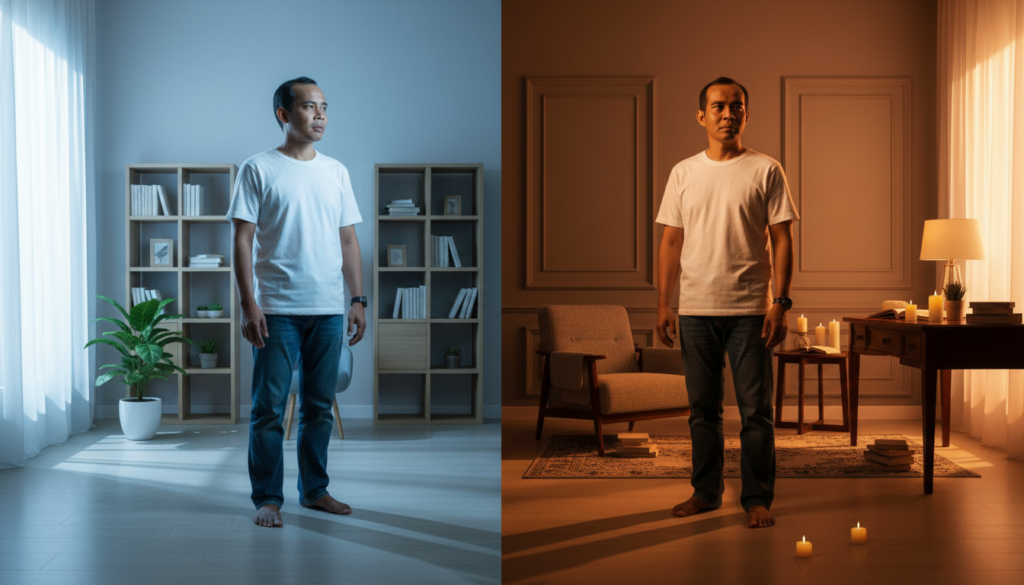
For years, I struggled with “social jetlag”—waking up groggy, losing focus by midday, and battling restless sleep. My deep dive into functional health revealed the real culprit wasn’t diet or stress, but my light environment.
We spend 90% of our lives indoors, under static, flickering LED or fluorescent bulbs that signal “NOON!” to our brains even at night. This is a silent disruptor. In this guide, I’ll share my expertise and personal experiments for implementing circadian lighting at home to synchronize your internal clock with the natural world.
The Invisible Crisis: Why Your “Master Clock” is Broken
Every cell in your body has a clock system that keeps it on a 24-hour schedule. These are called peripheral clocks. They are all coordinated by a main timekeeper in your brain, the Suprachiasmatic Nucleus (SCN). The SCN, found in the hypothalamus (a region deep in your brain), is sensitive to light. It relies almost entirely on signals from your eyes, particularly from specialized cells called intrinsically photosensitive Retinal Ganglion Cells (ipRGCs). These cells detect changes in light and tell the SCN when to help your body produce cortisol—the hormone that wakes you up and keeps you alert—and melatonin—the hormone that helps you sleep and recover.
Modern living exposes us to “light pollution” at home. Using bulbs high in blue light in the evening is like shouting to your SCN that the sun is at its peak, which causes circadian misalignment.
The Statistical Weight of Light
- The Melatonin Suppression Factor: Research published in the National Institutes of Health (NIH) confirms that exposure to room light before bedtime suppresses melatonin levels by over 50% in almost all individuals.
- Sleep Quality Gains: A landmark study in Nature found that synchronizing indoor lighting with the natural solar cycle improved sleep efficiency by 40% and reduced the time to fall asleep by an average of 22 minutes.
- The Economic Shift: According to Harvard Business Review, “Human-Centric Lighting” is no longer a luxury but a productivity necessity, with corporations investing billions to fix the biological clocks of their workforces.
The Deep Dive: How Blue Light Hijacks Your Brain
To master circadian lighting at home, we must first understand the enemy: the blue light peak. Blue light is naturally present in sunlight and vital for daytime alertness, but its presence after sunset is a biological anomaly.
In the natural world, as the sun sets, the “Color Temperature” (measured in Kelvin) drops. The sky shifts from a bright 6500K (cool blue) to a warm 2000K (candlelight amber). Our ancestors spent evenings around fires that emitted almost no blue light. Today, screens and overhead LEDs emit a massive spike in the 450-480 nanometer range, the exact frequency that tells the brain to “Stay Awake.”
When you disrupt this cycle, you don’t just feel tired. You disrupt your autonomic nervous system. High evening light keeps you in sympathetic (“fight or flight”) dominance, preventing the parasympathetic (“rest and digest”) system from taking over. This is why you might feel “wired but tired” at 11:00 PM.
Step-by-Step: Implementing Circadian Lighting at Home
Fixing your biological clock doesn’t require living in darkness. It requires what I call Strategic Spectrum Management—choosing and timing the color and intensity of your lights to fit your body's natural rhythm. Here is my plan for creating a lighting schedule that matches a 24-hour day.
1. The Morning Surge: 6:00 AM – 10:00 AM
In the morning, your goal is to “anchor” your circadian rhythm. A strong blast of light early in the day makes you more resilient to light at night.
- The Strategy: Use bulbs with a color temperature of 5000K to 6500K. These are often labeled as “Daylight” or “Cool White.”
- Personal Insight: I replaced the bulbs in my bathroom vanity with high-CRI (Color Rendering Index) LEDs. The Color Rendering Index (CRI) measures how accurately a light source displays colors compared to sunlight. Brushing my teeth under a 5000K light acts like a “biological reset button” for my body. It quickly stops any leftover melatonin from making me sleepy, so that morning fog disappears without an extra shot of espresso.
2. The Midday Maintenance: 10:00 AM – 4:00 PM
During the day, you need high-intensity light to maintain serotonin levels and cognitive function.
- The Strategy: If you work from home, position your desk within 2 meters of a window. Natural daylight is the ultimate source of circadian lighting at home.
- The Biohack: If you live in a place with dark winters (like London or Scandinavia), use a 10,000 Lux Light Box for 30 minutes at your desk. ‘Lux' is a unit measuring light intensity as it appears to the human eye. This device mimics sunlight's brightness and can help prevent Seasonal Affective Disorder (SAD), a type of depression linked to a lack of sunlight.
3. The Golden Hour Transition: 4:00 PM – 8:00 PM
As the work day ends, your lighting should begin its descent.
- The Strategy: Switch to neutral tones (3000K to 3500K). This tells your brain that the day is winding down.
- Natural & Insightful: This transition is the perfect time for what I call Digital Deceleration. Dimming the lights naturally signals your brain to stop the high-intensity processing of work tasks.
4. The Sunset Protocol: 8:00 PM – Bedtime
This is the most critical phase. Your home should become an amber zone for optimal evening lighting.
- The Strategy: Use bulbs rated at 2000K to 2700K. Even better, use specialized “Sleep Bulbs” engineered to have zero blue light.
- The Angle Secret: In nature, light from above (the sun) means daytime. Light from a low angle (a campfire) means nighttime. To optimize circadian lighting at home, turn off all overhead lights after 8:00 PM and use only floor or table lamps. This stimulates the lower part of the retina, which is less sensitive to circadian disruption.
Tools of the Trade: From Low-Tech to High-Tech
Level 1: The Manual Switch (Budget-Friendly)
You don’t need a smart home to fix your clock.
- Buy Two Sets of Bulbs: Put “Cool” bulbs in your kitchen and bathroom, and “Warm” bulbs in your living room and bedroom.
- Use Dimmers: Physical dimmer switches are underrated health tools.
Level 2: The Ecosystem That Runs Itself
- Philips Hue / LIFX: These systems can be programmed to follow a Circadian Rhythm scene. They automatically transition from 6500K at noon to 2000K at sunset without you lifting a finger.
- Caséta by Lutron: Smart dimmers that adjust your existing “dumb” bulbs based on the time of day.
Level 3: The Professional Biohacker
- Red Light Therapy (PBM): In the evening, I use a red light panel to help reset my body. PBM stands for photobiomodulation, a process in which specific wavelengths of red light (typically 660nm-850nm) are used to support cellular healing without inhibiting melatonin.
- Blue Blockers: If you have to watch TV or use a laptop at night, you have to wear orange-tinted glasses.
Beyond Sleep: The Surprising Benefits of Circadian Alignment
People generally associate circadian lighting at home with sleep, but its benefits extend to all areas of health.
1. Health of The Metabolism and Weight Control
Did you know that the way you digest glucose changes when you are exposed to light? Research has shown that exposure to intense blue light at night can make you more insulin-resistant. By fixing your lighting, you support your metabolism. As mentioned in my piece on Epigenetic Eating, your environment talks to your genes. Light is a primary signal for metabolic gene expression.
2. Mental Health and Emotional Resilience
Circadian disruption is a hallmark of depression and anxiety. A stable light-dark cycle stabilizes your mood by ensuring your neurotransmitters (serotonin and dopamine) are produced and recycled correctly.
3. Aesthetic and Functional Longevity
True beauty and longevity come from cellular repair. Deep sleep, supported by proper lighting, allows your brain’s glymphatic system to flush metabolic waste (beta-amyloid plaques).
Comparison Table: Common Bulbs vs. Circadian Bulbs
| Blue Light Peak | Very High (Disruptive) | Low to High (Adjustable) | Low |
| Color Temp | Fixed (usually 5000K) | Variable (2000K – 6500K) | Fixed (Warm 2700K) |
| Best Use | Garage, Workshop | Entire Home / Living Areas | Bedroom (Evening only) |
| Biological Impact | High Melatonin Suppression | Mimics Natural Sun Cycle | Minimal Suppression |
FAQ: Frequently Asked Questions about Circadian Lighting
Personal Closing Thoughts: The “Dark” Truth
Of all my experiments, mastering circadian lighting made the most profound difference to my daily energy.
We evolved under sunlight and darkness. For most of history, our nights were dark and days bright. Modern lighting has created a perpetual twilight, leaving us exhausted. Reclaiming your light environment helps restore natural rest.
Start tonight. Turn off that overhead kitchen light. Light a candle or turn on a low-intensity floor lamp. Listen to your body as it finally realizes that it’s time to rest.
Disclaimer
The information in this article, including tips on using circadian lighting at home, is for educational and informational purposes only. It is not meant to be medical advice. There is solid evidence that light treatment and circadian alignment work, although not everyone will have the same outcomes. Before making big changes to your environment, always talk to a doctor or an ophthalmologist first. This is especially important if you already have eye problems, are sensitive to light, or have trouble sleeping. Fit Global Life is not responsible for any negative effects that happen as a result of using the goods or programs indicated here.