

Decentralized Health: A recent data breach at a fitness app I trusted exposed crucial health data, making me realize how little control I had over my information. We keep track of our steps and calories, but we don’t often think about who owns the data we generate.
This sobering experience points to a larger issue for everyone using health and fitness apps. Today, big tech companies hold our biological information, profit from it, and often fail to protect it. Decentralized health, powered by blockchain, is emerging as a practical response for those serious about privacy and longevity.
The Problem: Your Body is a Data Goldmine (That You Don't Own)
Most of us wear wearables like Oura rings, Apple Watches, or Whoop straps. These devices generate thousands of data points daily. In the centralized model, you are the product. Your data is stored in walled gardens. You have limited access to the raw files and no control over how third parties use that information to profile your health risks.
According to a report by IBM Security, the average cost of a healthcare data breach has reached an all-time high of $10.93 million. But the cost to us as individuals is immeasurable. A number cannot define the loss of biological privacy.
Now that the risks are clear, what is the alternative?
At its core, decentralized health (DeHealth) uses blockchain technology, a distributed and permanent digital ledger, to store and manage health records. Instead of a single company holding your data, blockchain keeps it encrypted and distributed across a network. Only you have the private keys, secure codes that allow access to your data.
To help you visualize this shift, here is a breakdown of how decentralized health transforms your data from a corporate asset into your personal property:
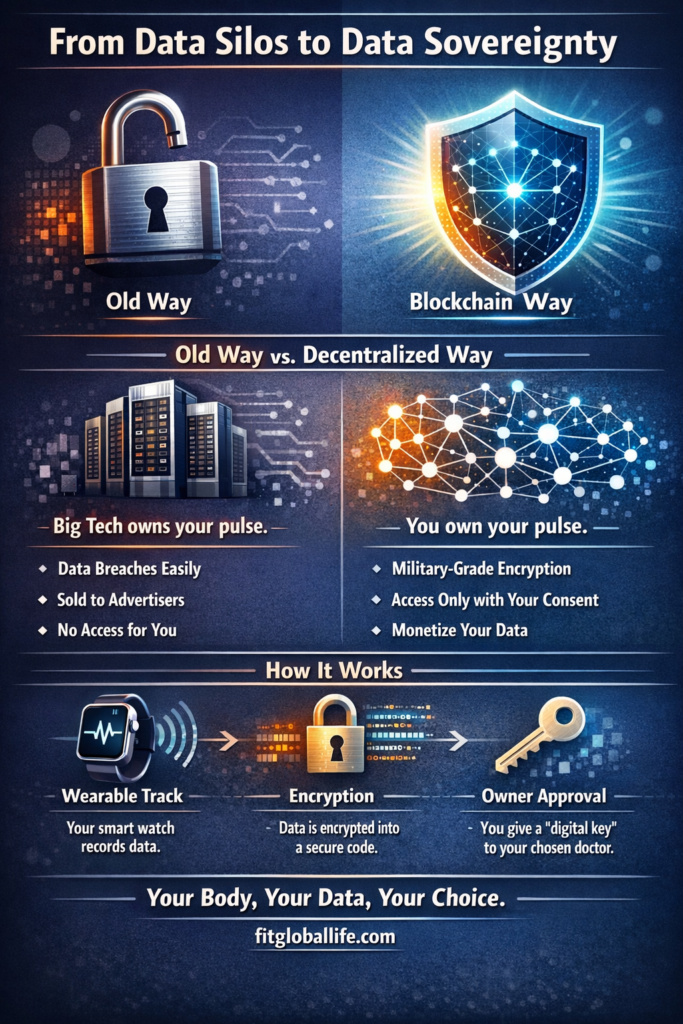
Why Blockchain Changes Everything for Fitness
- Immutability: Once your workout or bloodwork result is recorded, it cannot be altered by anyone. This creates a “Single Source of Truth.”
- Self-Sovereign Identity (SSI): You decide exactly which doctor, trainer, or insurance company gets to see specific parts of your data, and for how long.
- Imagine your gym data, Epigenetic Eating DNA results, and hospital records all communicating securely without an intermediary.
The 3 Pillars of Blockchain-Secured Fitness Records
1. Data Ownership and Monetization (Move-to-Earn)
With decentralized health, you can earn tokens for fitness achievements and choose to sell anonymized data directly to researchers. Unlike traditional apps, this model puts ownership and control in users’ hands.
I’ve experimented with several Web3 fitness platforms. The psychological shift of owning my data and being able to fund my supplement stack with it changes my motivation. It moves from extrinsic pressure to intrinsic empowerment.
2. Radical Security Through Cryptography
Centralized databases create a single point of failure. If a hacker gains access, everyone’s data is compromised. Blockchain uses a cryptographic method called Zero-Knowledge Proofs (ZKPs). With ZKPs, you can prove specific facts, such as being healthy enough for a lower insurance premium, without disclosing your entire medical history to the insurance company.
3. Verification of “Longevity” Claims
The industry is moving toward functional health, as discussed in our look at Wellness in 2026. Blockchain allows influencers, trainers, and supplement brands to prove results with verified, on-chain biological markers. No more fake before-and-after photos. The data won't lie.
Even with these advantages, questions remain: why hasn’t everyone adopted decentralized health yet?
Despite its potential, decentralized health faces hurdles. Managing private keys can be daunting for the average person. The World Health Organization has raised concerns about the energy use of some blockchain networks. However, modern proof-of-stake systems have mitigated mainly this.
| Data Ownership | Owned by the App Provider | Owned by the User |
| Security | Vulnerable Central Servers | Encrypted Distributed Ledger |
| Privacy | Data often sold to advertisers | Data shared only with permission |
| Access | Walled Gardens (Hard to export) | Interoperable (Universal access) |
Practical Steps to “Decentralize” Your Health Today
You don't have to be a coder to start securing your fitness records. Here is how I’ve started my transition to decentralized health:
- Audit your permissions. Review your current fitness apps to see what data they share. You’ll be surprised by how much background data they collect.
- Explore Web3 wellness apps. Look for platforms that use self-sovereign identity. These apps let you log in with a crypto wallet like MetaMask instead of an email and password. This keeps your identity separate from your biometrics.
- Use hardware wallets for health data. Just as you store Bitcoin on a Ledger or Trezor, new hardware wallets are emerging. These let you store your genomic and fitness data offline.
This tech-heavy approach often requires a mental reset. If you feel overwhelmed by constant health tracking, take a break with our guide on digital deceleration.
FAQ: Decentralized Health and Blockchain
Custom “Data Sovereignty” Schedule
| The Audit | Review app privacy policies and data exports. | Every 6 months |
| The Backup | Export raw CSV data from wearables to your own drive. | Monthly |
| The Encryption | Move sensitive records (DNA, Bloodwork) to a secure, decentralized vault. | Yearly |
Final Thoughts from an Expert
We are entering the Internet of Bodies, where biological data is our most valuable asset. Decentralized health is more than a technical upgrade; it is about reclaiming freedom and privacy as we pursue longevity and performance.
If you are ready to stop being a “data point” and start being a “data owner,” the time to explore blockchain health is now.
Disclaimer
The information in this article about decentralized health and blockchain is for educational and informational purposes only. It does not constitute financial, legal, or medical advice. Blockchain technology is rapidly evolving and involves inherent risks, including technical vulnerabilities and regulatory changes. Always do your due diligence before using new software or sharing sensitive health information. Fit Global Life is not responsible for any data loss or security breaches occurring on third-party platforms.