

Introduction: The Crisis of the “Always-On” Generation
I recently found myself in a state of “digital paralysis.” It was 10:00 AM, and I had 14 tabs open, 3 AI agents running tasks, and a smartwatch that vibrated every 90 seconds. Despite having the most advanced productivity tools in history, I hadn’t actually produced anything of value for hours. Does this sound familiar?
As we navigate 2026, we are realizing that more speed doesn’t always mean more progress. In fact, our brains are reaching a breaking point. This is where Digital Deceleration comes in. It’s not about quitting technology; it’s about intentionally slowing down your digital consumption to accelerate your cognitive output.
Just as we’ve learned to optimize our bodies through Micro-Dosing Movement and align our nutrition with Epigenetic Eating, we must now learn to “neuro-architect” our focus.
What is Digital Deceleration?
Digital Deceleration is the intentional slowing of digital interactions to allow the brain to enter “Deep Work” states. In 2026, when AI can generate content in seconds, the human ability to think deeply, synthesize complex ideas, and maintain focus is the rarest and most valuable skill in the economy.
The Dopamine Trap of 2026
Our brains were not evolved for the infinite scroll or the constant ping of AI notifications. We are living with biological hardware that is millions of years old, trying to process data streams that move at the speed of light. Research from Stanford University suggests that the constant “micro-hits” of dopamine from digital interactions are thinning our prefrontal cortex. This is the area responsible for long-term planning and impulse control. When this area thins, we lose our “CEO brain” and operate purely on reactive impulses.
The Science of the “Scattered Brain”
Why is it so hard to focus? The science identifies two primary culprits that our current tech-heavy environment exacerbates.
Cognitive Switching Penalty
Every time you glance at a notification while working, you pay a “switching penalty.” Most people believe they can “quickly check” an email and go back to work. However, data shows it takes the brain an average of 23 minutes to return to full focus after a single interruption. Checking your phone 10 times an hour prevents you from truly focusing. Digital Deceleration aims to eliminate this penalty entirely by creating impenetrable blocks of time.
Neuroplasticity and Instant Gratification
Our brains are plastic; they reshape themselves based on how we use them. By constantly consuming short-form, high-speed content, we are “rewiring” ourselves to have shorter attention spans. We are essentially training ourselves to be distracted. Digital Deceleration acts as a form of “Corrective Neuroplasticity,” training the brain to find pleasure in slow, deep, and difficult tasks once again.
Why AI Makes Focus More Valuable Than Ever
In the current landscape, AI can handle the “busy work.” It can draft emails, organize schedules, and even help you Master ChatGPT for better productivity. However, there is a limit: AI cannot provide original intent or creative intuition.
If you are constantly in a state of digital overwhelm, you become a mere “operator” of AI rather than a “visionary.” Deep focus allows you to leverage tools like the 5000+ Prompts Startup Toolkit with a clear mind. This ensures your output is unique, strategic, and not just a generic AI hallucination.
The Digital Deceleration Framework: 5 Pillars of Deep Focus
To implement Digital Deceleration, you need a system, not just willpower. Here is the framework for biological and digital synergy:
1. Environmental Architecture
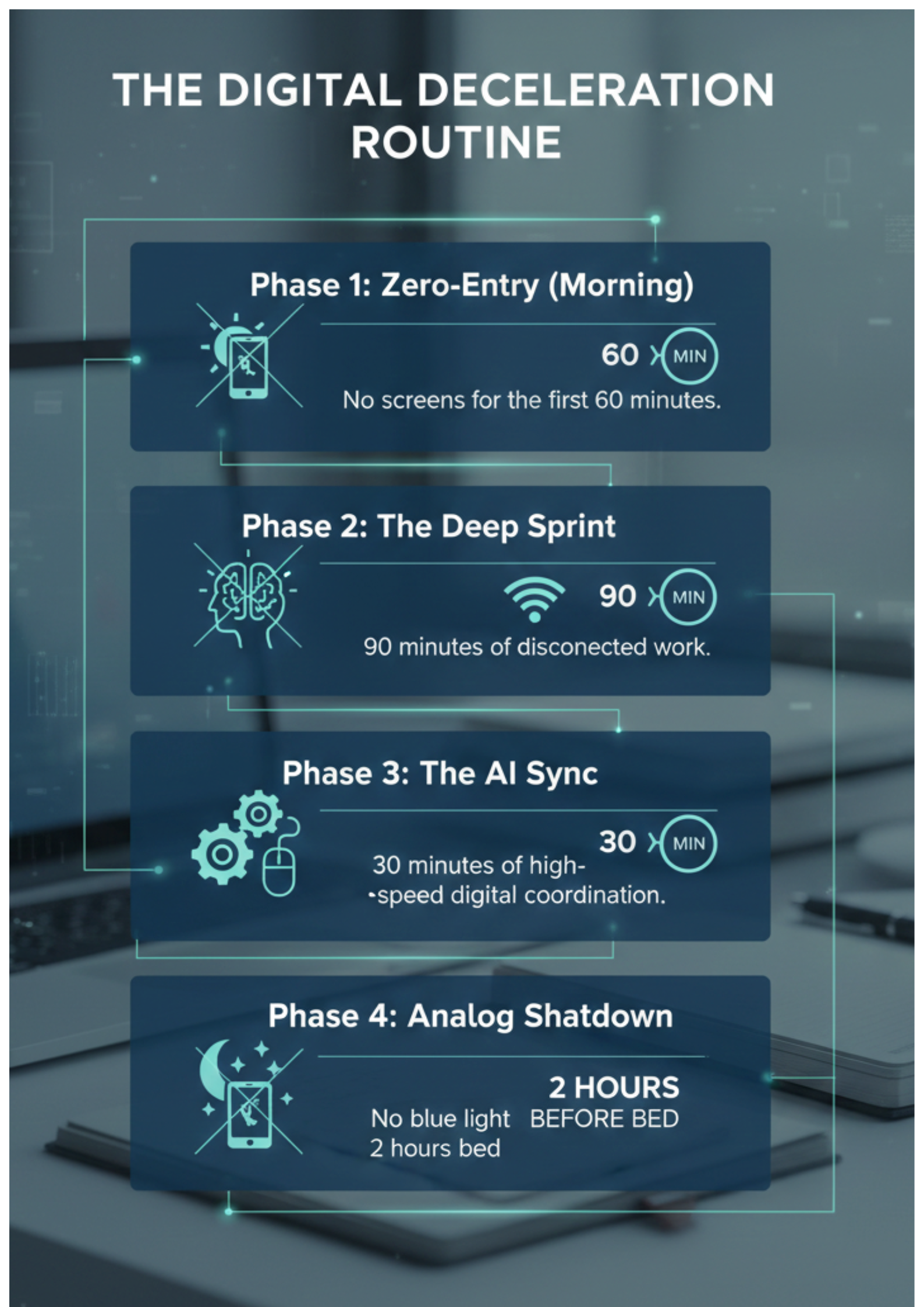
Your physical space dictates your mental state. If your phone is on your desk, even face down, your brain is subconsciously using energy to resist the urge to check it. In 2026, “Neuro-architecting” involves creating “Tech-Free Zones”. These are spaces where only analog tools (paper, pens, physical books) are allowed, forcing the brain to slow down its processing speed.
2. Chrono-Tasking
Stop fighting your biology. Use your peak circadian windows for your hardest tasks. This is where Digital Deceleration meets biological optimization. For most, this means working in 90-minute “Deep Sprints” followed by a 5-minute Micro-Dosing Movement break to flush cortisol and refresh the brain.
3. Monotasking Mastery
The myth of multitasking is dead. True excellence requires focusing on one window, one task, and one goal at a time. You should use “Focus Modes” on all devices to white-list only the essential AI agents needed for that specific task, silencing everything else.
How Digital Deceleration Complements Your Physical Health
Mental stress from digital overwhelm is not just “in your head”; it manifests as physical inflammation. When you practice Digital Deceleration, you lower your baseline cortisol levels. This has a ripple effect on your entire health ecosystem:
- Improve Digestion: Lower stress shifts you from “fight or flight” to “ rest and digest.”
- Effective Nutrition: It makes your Epigenetic Eating plan more effective because your body isn’t constantly diverted by stress signals.
- Biological Synergy: A calm mind is a prerequisite for a healthy body. You cannot biohack a stressed system effectively.
FAQ: Navigating the Slow-Tech Movement
Professional Disclaimer
Note: Digital Deceleration is a behavioral strategy for performance and mental clarity. It is not a clinical treatment for ADHD, clinical depression, or severe anxiety disorders. If you are experiencing mental health crises, please consult with a licensed psychologist or psychiatrist.