
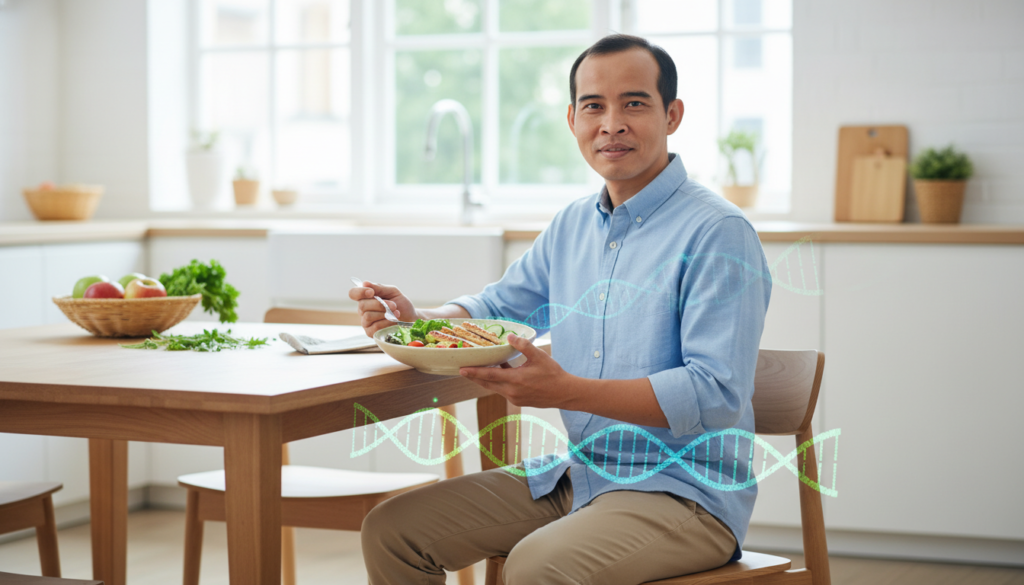
Introduction: The Day Your Plate Met Your Genome
I remember standing in my kitchen three years ago, staring at a plate of “healthy” kale and salmon, feeling completely exhausted. According to every wellness blog and fitness influencer, I should have been at my peak performance. But I wasn't. My joints ached, my brain was foggy, and my sleep was nonexistent.
It wasn't until I received my first epigenetic report that the truth came out: my body had a specific genetic variant in the CYP1A2 gene that made it difficult to metabolize caffeine, and a VDR mutation that meant my vitamin D absorption was nearly zero regardless of sun exposure. My DNA was literally screaming for a different approach.
Welcome to the era of Epigenetic Eating.
In 2026, we are finally moving past the era of “one-size-fits-all” nutrition. We no longer have to guess if Keto, Vegan, or Paleo is right for us. By understanding our DNA markers, we can communicate with our genes through the food we eat. This isn't science fiction; it’s the future of how we nourish our bodies to achieve the kind of peak efficiency we often seek in our careers, such as when using Mastering ChatGPT to optimize digital workflows or managing ventures with a 5000+ Prompts Startup Toolkit.
What is Epigenetic Eating? Decoding the Science of Nutrigenomics
To understand epigenetic eating, we must first dispel the myth that DNA is our destiny. Your DNA sequence (the genome) is like the hardbound book of your life. However, epigenetics is the study of the “highlighters” and “erasers” that decide which sentences in that book are actually read and acted upon by your body.
The Biological “Software” Analogy
Think of your DNA as the hardware of a computer and the epigenome as the operating system. You cannot change the hardware (your basic genetic code), but you can absolutely update the software to run more efficiently. Food is the most potent “code” we can input. Every time you eat, you are sending a biochemical signal to your cells that says either “Repair and Renew” or “Inflame and Decay.”
The Science of Methylation
According to research from the National Institutes of Health (NIH), one of the primary mechanisms of epigenetic eating is DNA methylation. This is a process where a small chemical group (a methyl group) is added to DNA, acting as a “silencer” for specific genes. By eating foods rich in methyl donors—like beets, spinach, and eggs—you can effectively “silence” genes associated with systemic inflammation.
Key DNA Markers You Must Know in 2026
If you want to master epigenetic eating, you cannot ignore these specific markers. These are the gatekeepers of your biological performance.
1. The MTHFR Gene (The Methylation Master)
This gene encodes an enzyme called methylenetetrahydrofolate reductase. It is critical for amino acid and B vitamin processing. If you have a variant here, your body struggles to detoxify.
- The Strategy: Avoid synthetic folic acid (found in processed flour) and prioritize natural folates from dark leafy greens. This level of precision is exactly what we advocate discussing when we discuss high-level productivity in our guide to Mastering ChatGPT.
2. The FTO Gene (The Fat Mass and Obesity Marker)
The FTO gene is arguably the most famous marker in nutrigenomics. It determines your satiety levels (how full you feel) and how your body stores saturated fats.
- The Strategy: If you carry the “A” allele (risk variant), a high-fat Keto diet might actually lead to weight gain and inflammation, whereas a high-protein, moderate-carb diet would keep you lean. Understanding this blueprint is as crucial for your body as having a 5000+ Prompts Startup Toolkit is for a new entrepreneur—it prevents you from wasting energy on strategies that don't fit your foundation.
3. The APOE Gene (Cholesterol and Alzheimer’s Risk)
The APOE4 variant is a heavy-hitter in Epigenetic Eating. It dictates how you process cholesterol and your risk for cognitive decline.
- The Strategy: Those with this marker should significantly limit saturated fats and focus on Omega-3 fatty acids to protect brain health.
How to Tailor Your Diet: A 2026 Personal Framework
Transitioning to a DNA-based diet is a four-stage process. I call this the “Bio-Alignment Protocol.”
Stage 1: The Bio-Data Audit
In 2026, we have moved beyond simple blood tests. You need a comprehensive Nutrigenomic panel. This looks at your SNPs (Single Nucleotide Polymorphisms). Without this data, you are essentially driving a car blindfolded.
Stage 2: Nutrient-Gene Mapping
Once you have your results, you map nutrients to your markers.
- Oxidative Stress (SOD2 marker): Increase intake of cruciferous vegetables.
- Inflammation (TNF-alpha marker): Increase curcumin and long-chain omega-3s.
Stage 3: Meal Architecture
This is where the rubber meets the road. You don't just eat “healthy foods”; you eat “your foods.” If your AMY1 gene indicates low starch tolerance, your meal architecture will prioritize fibrous vegetables over grains, even “healthy” ones like quinoa.
Stage 4: AI-Driven Iteration
The most exciting part of Epigenetic Eating in 2026 is the use of AI. Just as you might use Mastering ChatGPT to summarize a book, you can now use AI to analyze your weekly biomarkers (from a wearable device) and adjust your DNA-tailored grocery list in real time.
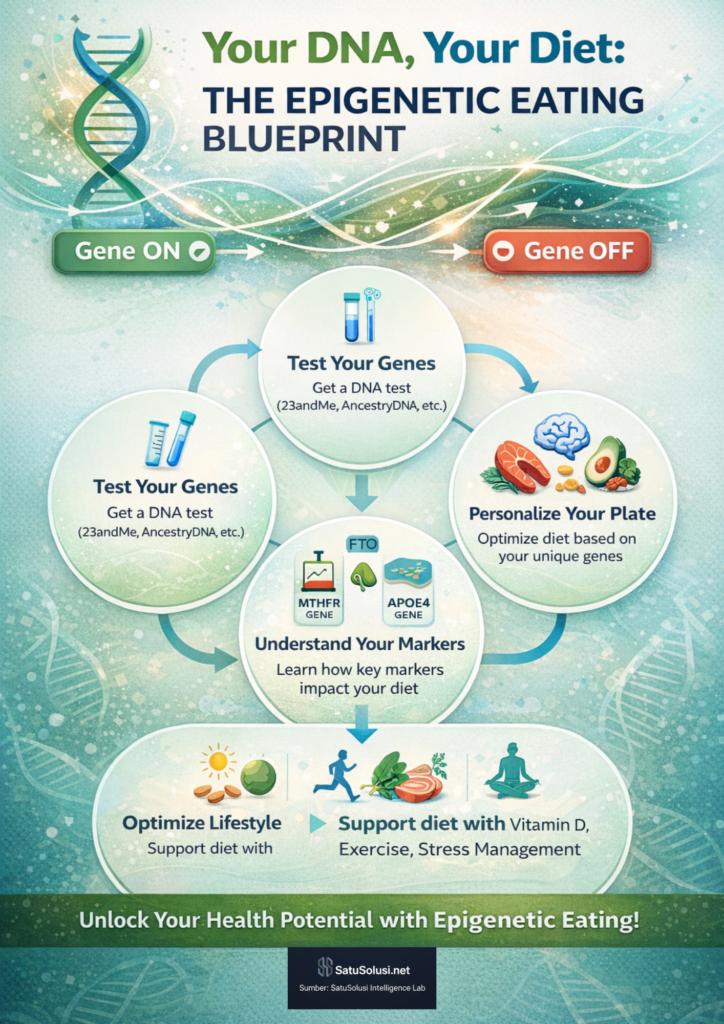
Your Epigenetic Eating Blueprint
The 4 Pillars of Precision Nutrition:
- Analyze: Clinical DNA test for Nutrigenomic markers.
- Identify: Pinpoint your specific SNP variants (MTHFR, FTO, APOE).
- Optimize: Select “Switch” foods (Sulforaphane, Methyl donors, and Polyphenols).
- Refine: Use AI and wearables to track real-time gene expression.
The Bio-Hacker’s Kitchen: Essential “Switch” Foods
In the world of Epigenetic Eating, certain foods are more than just calories; they are information. Here are the top three “Gene-Switching” foods you should incorporate:
- Broccoli Sprouts (Sulforaphane): This is the ultimate activator of the NRF2 pathway, which turns on over 200 antioxidant and detoxification genes. It is perhaps the most powerful epigenetic food in existence.
- Turmeric (Curcumin): Acts on the NF-kB pathway to silence pro-inflammatory genes.
- Blueberries (Anthocyanins): Research shows they can protect telomeres (the caps on your DNA) from shortening, helping slow the biological aging process.
The Synergy of AI and Epigenetics
As we move deeper into 2026, the intersection of health and technology is undeniable. We are seeing a massive shift in how people manage their wellness. People are no longer satisfied with generic advice. They want the same level of customization in their diet that they get in their digital tools.
If you are already using ours, you understand the value of having the correct input to produce the right output. Your body is the ultimate “startup.” If you feed it the wrong data (food that conflicts with your DNA), the system crashes. If you feed it the correct data, you scale your health beyond what you thought possible.
Statistics that Matter in 2026
- Lifestyle and diet, not just our inherited genes, determine 85% of our health span [Source: Harvard School of Public Health].
- The personalized nutrition industry is now a $21 billion powerhouse, growing at 15% annually.
- DNA-based dieting has been shown to improve weight-loss maintenance by 2.5x compared with standard caloric restriction.
FAQ: Frequently Asked Questions about Epigenetic Eating
Medical Disclaimer
Important Notice: The information provided in this article regarding epigenetic eating and DNA markers is for educational and informational purposes only. It is not intended as medical advice. Genetic data is complex and should be interpreted by a qualified healthcare professional or a certified genetic counselor. Always consult your doctor before starting a new diet or supplement protocol, especially if you have pre-existing conditions or are taking medication.
Conclusion: Rewriting Your Genetic Future
The most empowering realization of the 21st century is that you are seated at the table of your own evolution. You are not a passive observer of your health; you are the lead programmer. Through epigenetic eating, you can leverage the data written in your cells to live a life of vibrancy, longevity, and purpose. Start by looking at your DNA markers. Stop guessing. Start optimizing. Your future self will thank you for the “code” you choose to input today.