
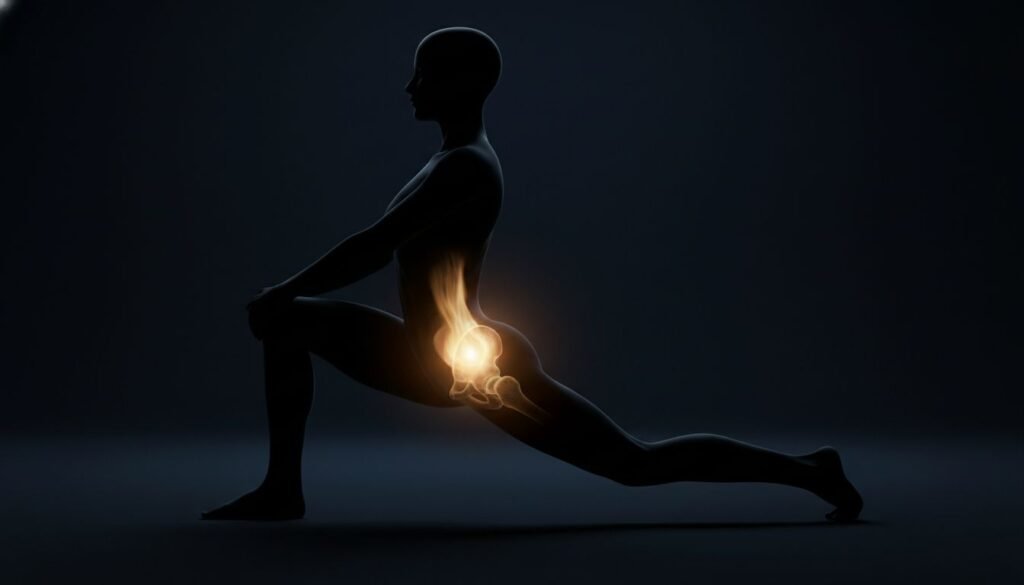
In the hyper-digital landscape of 2026, we are witnessing a strange paradox: as our virtual worlds expand, our physical bodies are shrinking into a state of permanent contraction. We spend our days hunched over “Biological Twins” and digital interfaces, unaware that our fascia is recording every micro-stressor.
As the lead editor at Fit Global Life, I’ve observed that the most persistent “burnout” isn’t mental—it’s muscular. Specifically, it’s stored in the pelvic bowl and the iliopsoas complex. This is where Somatic Release becomes the ultimate tool for reclaiming your biological sovereignty.
The Body Keeps the Score: Understanding Somatic Memory
Fascia: The Biological Hard Drive of Your Emotions
For decades, traditional medicine viewed fascia as mere “wrapping paper” for muscles. Today, we understand it as a sophisticated, liquid-crystalline matrix that functions as a secondary nervous system. According to research published in the Journal of Bodywork and Movement Therapies (.edu), fascia is highly enriched with sensory nerve endings.
When you experience trauma—whether it’s a sudden shock or the “slow-drip” stress of a corporate career—your fascia physically thickens to protect you. If this energy isn’t discharged, the fascia becomes “glued,” trapping the emotional charge. This is why you can’t just “think” your way out of anxiety; you have to physically dissolve the “hard drive” of the tissue.
Why the Psoas is Called the “Muscle of the Soul”
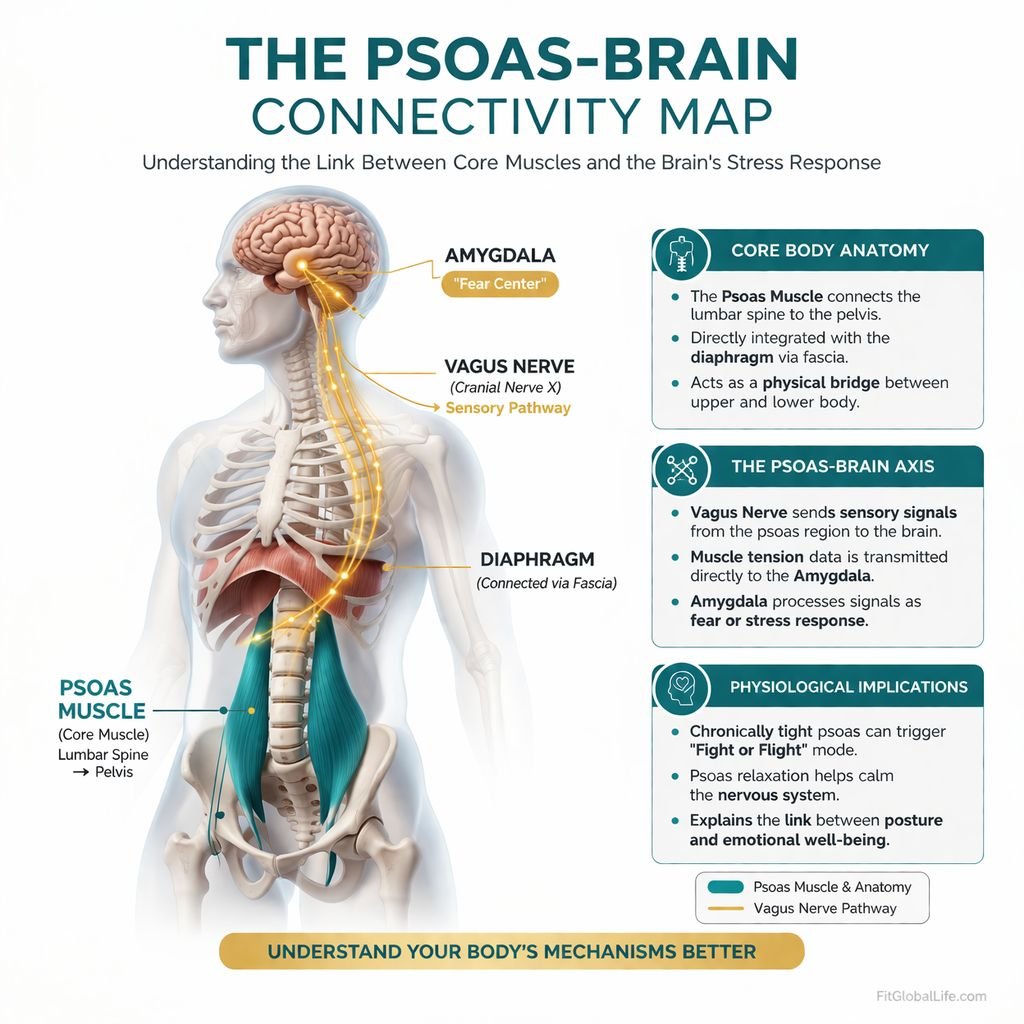
The Psoas Major is the only muscle connecting the mid-section to the legs. It is our primary “fight-or-flight” initiator. In the era of The Biological Twin, where we simulate health via AI, the psoas remains our most primal, unhackable link to our evolutionary past.
A chronically tight psoas sends a constant “danger” signal to the brain’s amygdala. It doesn’t matter if your AI-twin says your vitals are perfect; if your psoas is tight, your brain believes a predator is chasing you.
The Science of the “Fight-or-Flight” Hip Flexor
Chronic Stress and the Permanent Contraction Loop
When you sit for 8 hours a day, your psoas is in a shortened state. Over time, the brain forgets how to relax this muscle—a phenomenon known as Sensory-Motor Amnesia. This creates a “Contraction Loop” where physical tightness creates mental anxiety, which in turn creates more physical tightness.
By practicing Somatic Release, you are effectively “re-booting” your nervous system. This is a form of Sovereign Health, where you take control of your internal state rather than relying on external sensors.
How Hip Tightness Shuts Down Your Vagus Nerve
The Vagus Nerve, the commander of your “Rest and Digest” system, passes through the diaphragm, which is physically tethered to the psoas. A tight hip complex pulls on the diaphragm, restricting the Vagus Nerve’s ability to signal safety. This is why hip mobility is the secret “backdoor” to mental health.
5 Somatic Release Techniques to Clear Emotional Blockages
To achieve true Somatic Release, we must move beyond traditional “gym stretches” and enter the realm of neuro-muscular repatterning.
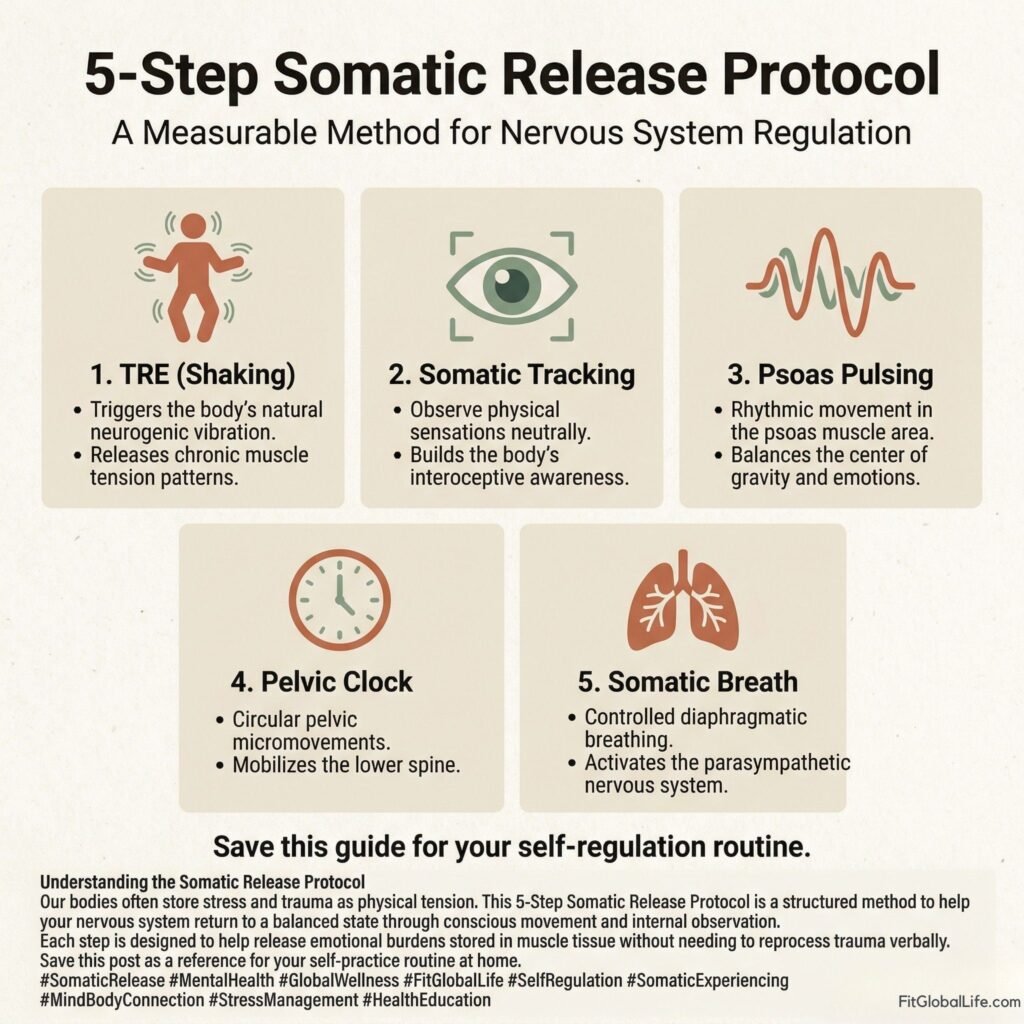
1. Therapeutic Tremoring (TRE): The Biological “Reset” Button
Therapeutic Tremoring is the most direct way to bypass the conscious mind and access the autonomic nervous system.
- The Deep Science: When mammals experience high stress, they shake. This “shaking” is the body’s way of completing the stress cycle. Modern humans have suppressed this reflex, leading to “trapped” energy.
- The Technique: You must fatigue the adductors and psoas through a series of “stressor” positions (like a wall-sit) and then lie in a supine butterfly position.
- The Experience: As the legs begin to shake involuntarily, you are witnessing a “discharge” of the sympathetic nervous system. It is not uncommon for practitioners to experience sudden emotional insights or a profound sense of “lightness” as years of stored cortisol finally leave the tissue.
2. Somatic Tracking: Healing Through Interoceptive Awareness
This technique utilizes the power of the prefrontal cortex to “witness” the hip’s tension without trying to fix it.
- The Process: You don’t listen to music or watch TV when you are in a deep, low-lunge position. You focus on yourself.
- The Habit: Scan the tension in your hip. Is it a “sharp” red or a “heavy” grey? By observing these sensations with curiosity rather than fear, you utilize the principles of Mitochondrial Recovery—reducing the oxidative stress that comes from “fighting” your own pain. This signals safety to the brain, allowing the fascia to “melt” naturally.
3. Psoas Pulsing: Breaking the Stretch Reflex
Traditional static stretching often fails because it triggers the “stretch reflex”—the muscle’s emergency brake that causes it to tighten when pulled too hard.
- The Innovation: Psoas Pulsing uses micro-movements (1-2 cm) at the end of your range of motion.
- Why it Works: These pulses hydrate the fascia. According to the Fascia Research Society (.org), rhythmic, gentle movement encourages the production of hyaluronic acid, which acts as a lubricant for “stuck” emotional tissues. It teaches the nervous system that the end-range of motion is a safe place to play, not a place to panic.
4. Pelvic Clocking for Sacral Release
The sacrum and pelvis are the “basement” of the body, where we store our most suppressed emotions, including shame and fear.
- The Technique: Lying on your back with knees bent, imagine your pelvis is a clock face. Gently tilt your tailbone toward 6 o’clock (arching the back), then toward 12 o’clock (flattening the back). Move slowly to 3 and 9 o’clock.
- The Benefit: This unlocks the deep rotators and the pelvic floor. As these muscles release, many people find that their “gut feeling” or intuition becomes clearer. You are literally clearing the “static” from your body’s internal communication lines.
5. Diaphragmatic “Somatic” Breathing
The diaphragm and psoas are anatomically fused at the crura. You cannot release one without the other.
- The Technique: Place one hand on your chest and one on your lower belly. As you inhale, feel your belly expand into your hips. On the exhale, make a low “Haaa” sound.
- The Science: The “Haaa” sound vibrates the Vagus Nerve. By consciously expanding the belly into the hip space, you are manually “massaging” the psoas from the inside out. This is the foundation of nervous system regulation that we emphasize at Fit Global Life.
The ROI of Somatic Healing: More Than Just Flexibility
Reclaiming Creative Flow
When the hips are locked, the energy of the body is diverted to “defense.” In a state of defense, creativity is impossible. By practicing Somatic Release, you unlock the “Sacral” energy that drives innovation. High-performers often find that their “Aha!” moments occur right after a deep somatic hip session.
Longevity and Structural Integrity
A tight psoas pulls the spine into a permanent arch (lordosis), leading to disc degeneration and chronic pain. By maintaining “Elastic Hips,” you are ensuring that your structural frame remains resilient well into your 80s and 90s. This is the physical equivalent of Blue-Zone Nomadism—moving your body with ease through the world.
Frequently Asked Questions (FAQ)
Q: Why do I feel like crying after a hip stretch? This is a “Somatic Release.” The psoas is intimately connected to the brain’s emotional centers. When the muscle lets go, the “trapped” emotional energy is finally processed by the brain. It is a sign of deep healing.
Q: How often should I perform these techniques? For chronic tension, 15 minutes of Somatic Tracking or Tremoring 3 times a week is more effective than a single 2-hour session once a month. Consistency signals “safety” to the nervous system.
Q: Is this the same as Yoga? While some positions look like Yoga, the intent is different. Yoga often focuses on “form” and “strength.” Somatic Release focuses entirely on “feeling” and “releasing” through the nervous system.
Conclusion: The Ultimate Biohack is Within
We have all the technology we need to keep track of our health in 2026, but we’ve lost the ability to feel our health. Somatic Release reminds us that our bodies are not only machines to be fixed; they are also places to explore.
When you liberate your hips, you not only become more flexible, but you also free yourself from the ghosts of your past. Your hips have been holding the weight of your world—it’s time to let them breathe.
Disclaimer
The information provided by Fit Global Life is for educational and informational purposes only. Somatic Release can trigger significant physical and emotional responses. This content is not a substitute for professional medical advice, diagnosis, or treatment. If you’ve been through a lot of trauma or physical harm in the past, you should talk to a doctor or a qualified Somatic Experiencing practitioner before you start these practices.