

Even with all of our smart wearables and Sovereign Health surveillance, parenting in 2026 is more stressful than ever. Many of us feel more reactive and disconnected from our children. Traditional advice often centers on timeouts, rewards, and punishments, but this approach doesn’t work with how our biology actually functions.
As the lead editor at Fit Global Life, I have spent years studying how people perform under stress. The most important factor for resilience is not intelligence or determination, but having a regulated nervous system.
Welcome to Polyvagal Parenting. This is more than just another parenting method; it is a science-based way to build real connections. Polyvagal Theory shows that a parent’s main role is not to control behavior, but to help children feel safe by providing co-regulation, acting as a steady source of comfort and security.
The Polyvagal Hierarchy: Learning about the Three States of Safety for People
We need to know how the nervous system works before we can conduct Polyvagal Parenting. Dr. Stephen Porges’ Polyvagal Theory delineates three distinct physiological states that govern our responses to the environment.
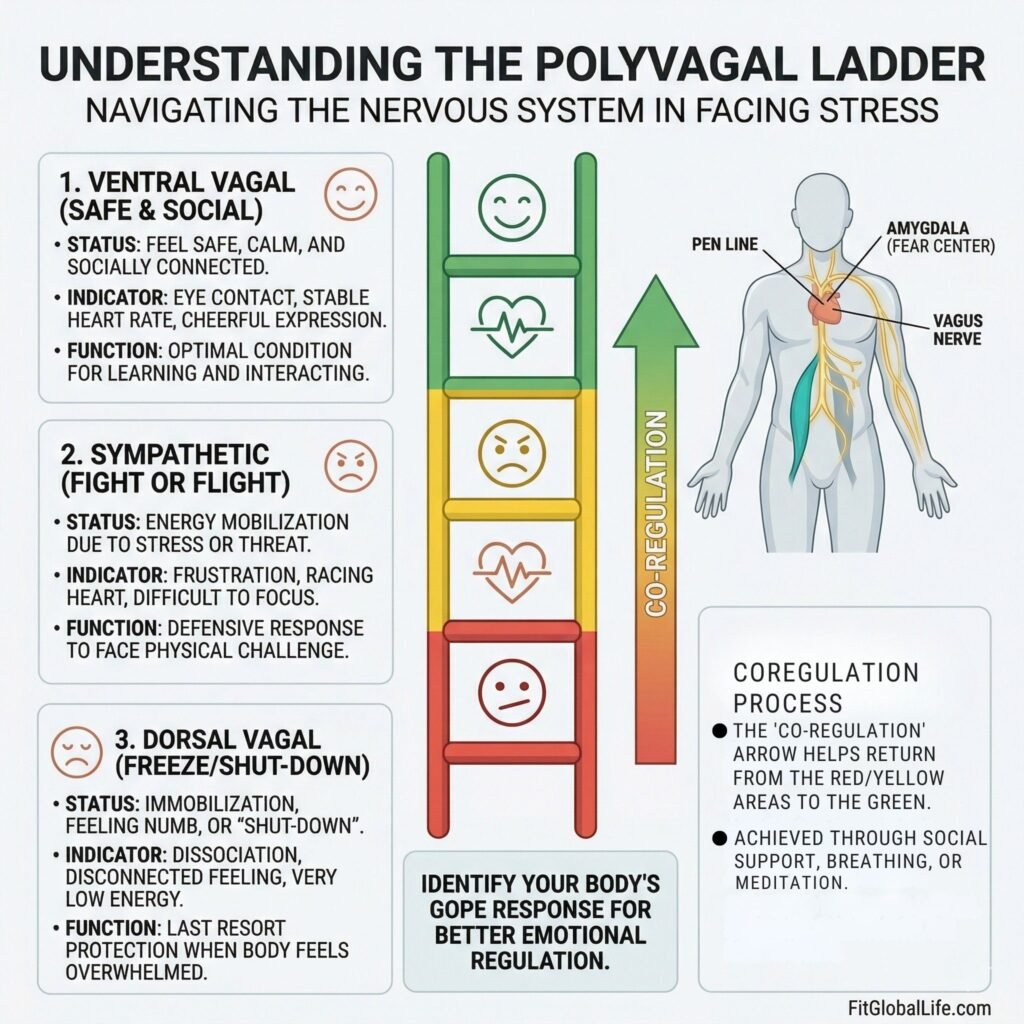
1. The Ventral Vagal State (Safe and Social)
This is the “optimal” state for connection, learning, and love. When a parent or child is in their Ventral Vagal State, their heart rate is steady, their facial muscles are expressive, and they feel a sense of safety. They are open to connection. They want to connect. In Polyvagal Parenting, our goal is to make our family’s “Window of Tolerance” bigger in this state.
2. The Sympathetic State (Mobilization: Fight or Flight)
When the nervous system detects danger, it triggers the Sympathetic State. This is mobilization—racing heart, rapid breathing, and a feeling of impending doom. In parenting, this manifests as tantrums, defiance, or screaming (from both the child and, if we are dysregulated, the parent).
3. The Dorsal Vagal State (Immobilization: Freeze)
When danger is overwhelming and escape is impossible, the body enters its ultimate defense mechanism: the “Freeze” response. This is marked by numbness, disassociation, and shut-down. If your child seems “checked out” or non-responsive after a period of intense distress, they may be in a Dorsal Vagal State.
The Core Practice: Co-Regulation Over Self-Regulation
The Self-Regulation Myth: A Biological Trap
In many parenting circles, we are told that the goal is to teach children to “self-regulate.” But neurobiology tells us that children cannot self-regulate effectively until their prefrontal cortex is fully developed, around age 25. Self-regulation is the fruit; Co-Regulation is the root.
Polyvagal Parenting teaches that a child’s nervous system is incomplete. According to a study published by the National Institutes of Health (NIH.gov), a parent’s warm, consistent presence is a primary regulator of a child’s biological stress response. When you scream “Calm down!” at a dysregulated child, you are a “Threat” trying to teach “Safety.” It is biologically impossible.
The Mirror Neuron System: You Are a Walking Bio-Feedback Machine
Your child’s brain is constantly scanning your face, your voice, and your body language (Prosody) via their mirror neuron system. In Blue-Zone Nomadism, we discussed the concept of “Moai” as a form of lifelong social support. Co-regulation is the first Moai a child experiences.
If your internal state is a chaotic sympathetic mess, that is the “blueprint” for safety you are giving your child. Polyvagal Parenting prioritizes the parent’s internal state as the most important parenting tool.
The “Put Your Own Oxygen Mask On First” Rule of Parenting
To co-regulate, you must be regulated. This is where most parents fail. We are so busy managing our families’ external behaviors that we neglect our own internal state. Fit Global Life advocates for “Internal Sovereignty”—taking ownership of your biological state.
Techniques for Parent Regulation Before Interaction
1. Vagus Nerve Toning: Before addressing a child’s meltdown, practice 2 minutes of a “Somatic Vagus Nerve stimulation.” This could be humming (creating a vibration in the throat where the Vagus Nerve passes), doing a Somatic Release hip-opening pulse, or dynamic psoas breathing to shift your own physiology out of “Fight” mode.
2. The 5-Second Pause: When your child triggers a sympathetic response in you, pause for 5 seconds. This is not just “counting to ten”; it is a physiological reset. Take one long, slow, 5-second exhale to trigger the parasympathetic nervous system and activate your Ventral Vagal state.
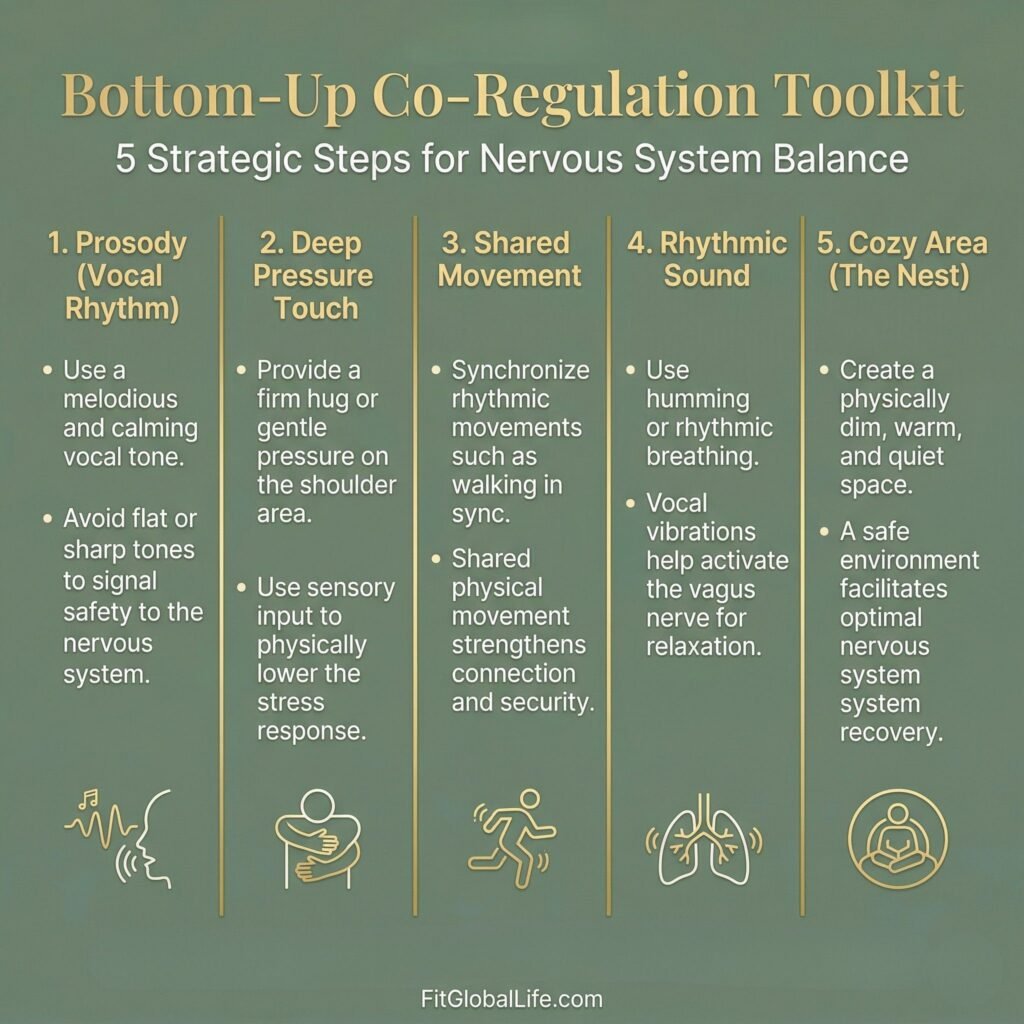
5 Practical Polyvagal Parenting Techniques for Dysregulated Moments
When a child is in a Sympathetic (Fight or Flight) or Dorsal (Freeze) state, they cannot hear your logic. You must use “Bottom-Up” techniques—addressing the body first, then the mind.
1. Prosody: The Melodic Voice of Safety
The muscles in the middle ear are tuned to the specific frequency of a human voice in the Ventral Vagal state. This is called Prosody—the melodic rhythm of your speech.
- The Technique: Instead of a sharp, loud command (“Stop that now!”), lower your voice to a melodic, slightly higher-pitched tone (“I see you are having a really hard time right now.”). Pair this with a soft, expressive face, making eye contact when possible without being predatory. This signals “safety” directly to the child’s brainstem.
2. Deep Pressure Touch: Grounding Through Proprioception
For many children, particularly those prone to Sympathetic meltdowns, proprioceptive input (pressure on the joints and muscles) is highly grounding.
- The Technique: Ask for permission first (“Can I offer you a squeeze?”). If yes, provide a firm, full-body hug, pressing their chest to yours. Hold the hug for at least 20 seconds. This releases oxytocin, which buffers against cortisol. It’s like a biological “anchor” that pulls them out of the “Fight” mode.
3. Co-Movement: Discharging Sympathetic Energy Together
A tantrum is essentially stored “Fight-or-Flight” energy with nowhere to go. Trying to make a child sit still is the worst thing you can do.
- The Technique: Join their mobilization. Invite them to a safe activity to discharge the energy. Say, “Wow, that feels so big! Let’s shake it off!” Then have a 30-second jumping-jack contest or a “run in place” sprint together. The core requirement is that you join them, providing the regulation during the mobilization.
4. Rhythmic Co-Regulation: Using Sound to Anchor the Vagus Nerve
Rhythm is primal. It is linked to the heartbeat the child heard in the womb, the ultimate safe space.
- The Technique: Use rhythmic chanting or singing during transitions or tense moments. It could be as simple as a low, shared “Haaaa” sound on the exhale. The low frequency activates the Vagus Nerve, encouraging the central nervous system to return to a balanced state. This is a form of Mitochondrial Recovery, that reduces the systemic inflammation resulting from prolonged “cellular fight” mode.
5. The Safety Nest: Gentle Recovery for the Freeze Response
If your child shuts down (Dorsal Vagal State), they are disassociated. They need gentle “coming back to life” signals, not demands.
- The Technique: Create a “Safety Nest”—a quiet space with blankets and low lighting. Don’t force them to talk. Sit near them, perhaps with a gentle hand on their back if allowed, and simply breathe in a regulated rhythm. Your proximity and calm heartbeat are a beacon of safety, gently pulling them out of the deep “freeze” response without overwhelming their fragile nervous system.
Long-Term Polyvagal Practices: Building a Resilient Family Culture
Designing an Environment of Safety in a High-Tech World
A truly resilient family culture is built when the home’s default setting is “Ventral Vagal Safety.” This means designing your physical and relational environment with nervous system health in mind. According to resources from Harvard University’s Center on the Developing Child (.edu), creating a stable, predictable, and responsive environment is fundamental for a child’s stress-management capabilities.
- Lighting and Sound: Use warm, low lighting in the evenings and minimize abrasive digital noise.
- The Social Moai: Structure family time around co-regulated activities rather than just passive screen time. Shared meals with eye contact and melodic conversation are essential for biological nutrition.
Frequently Asked Questions (FAQ)
Q: Doesn’t this approach just spoil children and ignore bad behavior? No. Polyvagal Parenting distinguishes between Dysregulation (a biological state) and Disobedience (a choice). Traditional discipline is for disobedience. For dysregulation, discipline won’t work. The goal of Polyvagal Parenting is to get the child back to a Ventral Vagal State where they can learn and accept logic. Disciplinary moments can only happen after the child is regulated.
Q: Is Polyvagal Parenting expensive? Not at all. The tools are intrinsic and biological—your voice, your gaze, your presence. While some high-tech wearables in 2026 can track Vagal Tone, they are not necessary to practice these foundational habits.
Q: Can Polyvagal Parenting work for neurodivergent children? Absolutely. In fact, many neurodivergent children have highly sensitive nervous systems that are prone to quicker dysregulation. Understanding their physiology from a Polyvagal lens is often the missing key to building connection and safety in neurodiverse families.
Conclusion: Taking back your family’s biological sovereignty
In a world that is focused on changing behavior, polyvagal parenting is a silent revolution. It reminds us that our main job as parents is to be a biological anchor of safety in a world that is often out of control.
In 2026, the best tool for parents isn’t an app, an AI version of your “perfect twin,” or a new way to give your child a time-out. It is your own regulated heartbeat, your soft gaze, and your willingness to say to your dysregulated child: “Your storm is big, but I am here, and I am safe.”
Reclaim your biological sovereignty, Bos. Your family’s resilience depends on it.
Disclaimer
The information provided by Fit Global Life is for educational and informational purposes only. Polyvagal Parenting is a framework for connection and nervous system health and is not a substitute for professional mental health therapy or medical intervention. If your child exhibits severe behavioral issues, self-harm, or persistent disassociation, please consult with a qualified pediatric psychologist or somatic-experiencing professional.