

Awe psychology begins with a strange truth: the mind does not only need calm, productivity, sleep, nutrition, or discipline. It also needs moments that make the self feel appropriately small. Not worthless. Not powerless. Small in the clean, clarifying way a person feels when standing under a wide night sky, hearing a choir lift a room into silence, watching an athlete perform at the edge of human possibility, or seeing a landscape so vast that the brain briefly runs out of categories. In those moments, something biological happens. The nervous system pauses its usual argument with the world. The attention field widens. The ego loosens its grip. The body receives a signal that life is larger than the problem currently occupying the screen.
That is why awe is not simply a beautiful feeling. In the science of emotion, awe is increasingly understood as a mind-body state with practical implications for stress, social connection, meaning, and health behavior. Classic work by Dacher Keltner and Jonathan Haidt defines awe around two core appraisals: perceived vastness and a need for mental accommodation, meaning the experience is too large, complex, or extraordinary to fit neatly into existing mental models. Their foundational paper on awe helped move awe from poetry into psychology, and newer reviews now describe it as a pathway through which nature, music, spirituality, collective movement, and other powerful experiences may support mental and physical health.
This article examines why witnessing greatness is not a luxury add-on for those with extra time. It is a biological necessity for a culture that is drowning in small screens, small arguments, small dopamine spikes, and very small attention spans. The goal is not to chase dramatic mountain-top experiences every weekend. The goal is to understand how awe works, why the body may respond to it, and how to build a realistic awe practice without turning wellness into another exhausting to-do list.
For FitGlobalLife readers, this topic sits naturally beside practices like staying present during busy workdays, reclaiming focus through digital detox habits, and using breathwork to reset the nervous system. Awe belongs in the same conversation because it does something those practices cannot fully do on their own: it shifts the self’s reference point. It does not just help you manage your mind. It reminds you that you are part of something bigger.
Key takeaways
- Awe is commonly triggered by vastness, beauty, moral courage, exceptional skill, music, nature, collective rituals, birth, death, and major intellectual insight.
- Research links awe with the “small self,” reduced self-focus, increased prosocial behavior, greater meaning, and several body-level pathways, including lower sympathetic arousal and possible inflammation-related effects.
- Awe is not the same as happiness. It can be joyful, humbling, quiet, eerie, tearful, or even mixed with fear. That complexity is part of its power.
- Modern life can create an “awe deficit” by trapping attention in predictable, monetized, algorithmic loops.
- A realistic awe practice can be built through nature walks, music, art, night-sky exposure, collective movement, moral beauty, and deliberate attention.
What Awe Psychology Actually Means
Awe is often described with big language because it feels big: wonder, reverence, astonishment, transcendence, sacredness, beauty, goosebumps. But scientifically, the most useful definition is more precise. Awe arises when a person encounters something vast enough to challenge their current mental frame. Vastness can be physical, like the ocean, mountains, galaxies, architecture, thunder, or a whale surfacing near a boat. It can be social, like witnessing self-sacrifice, moral courage, or collective solidarity. It can be cognitive, like finally understanding deep time, quantum weirdness, the immune system, or how a single seed becomes a forest. It can be aesthetic, like music, dance, painting, ritual, or film that makes the body go quiet.
The second ingredient is accommodation. The mind cannot simply file the experience under an existing label. It has to stretch. That stretching is important. Awe is not just “I like this.” It is “I need a bigger map.” That is why awe can feel disorienting and healing at the same time. The self is forced to update its scale.
Most wellness advice focuses on control: control your schedule, control your food, control your workouts, control your thoughts. Control matters, obviously. But awe introduces a different medicine: surrender to scale. It says, for a moment, stop trying to be the center of the entire dashboard. Notice the system you belong to. This is why awe pairs well with practices that train inner awareness, such as interoception for stress control, but it does not reduce to them. Interoception listens inward. Awe widens outward. A resilient mind needs both.
Awe also differs from gratitude. Gratitude often points to a benefit received: someone helped me, life gave me something, I have enough. Awe points to magnitude: this is larger than me, richer than I expected, more complex than my default story allowed. Gratitude warms the self. Awe rearranges it. Both can coexist, but they are not identical tools.
Why the Brain Needs Awe, Not Just Happiness
Happiness is not a bad target, but it is a narrow one. A life built only around feeling good can become fragile because the moment discomfort appears, the system assumes something is wrong. Awe is different. Awe can hold pleasure and discomfort together. You can feel awe at a storm, a funeral ritual, a newborn, a glacier, a cathedral, a war memorial, a rescue worker, or a scientific discovery. The emotion does not promise comfort. It offers context.
Context is biologically valuable. Stress becomes more damaging when the brain interprets a problem as total, permanent, and self-defining. Awe interrupts that compression. It reintroduces scale. Your inbox is real, but it is not the cosmos. Your disappointment is valid, but it is not the whole story. Your identity matters, but it is not the only thing in the room. In a culture where attention is repeatedly narrowed by alerts, metrics, deadlines, and comparison, awe may function like a psychological wide-angle lens.
That wide-angle effect is not merely poetic. A major review in Perspectives on Psychological Science proposes that awe may support well-being through five processes: shifts in neurophysiology, reduced self-focus, increased prosocial relationality, stronger social integration, and greater meaning. The review describes awe as a possible pathway to mental and physical health, especially when it emerges from nature, spirituality, music, collective movement, and other experiences that connect people to something larger.
This matters because many people are not only tired; they are trapped in tiny mental loops. They are managing attention debt, doomscrolling, fragmented work, and status anxiety while trying to “optimize” their way back to calm. FitGlobalLife has already explored this problem through the idea of attention debt and focus repair and the art of deep focus in an AI-driven world. Awe adds another layer: sometimes the brain does not need another productivity system. Sometimes it needs a bigger sky.
Awe Psychology Evidence Map
The evidence base is still developing, and responsible writing should avoid pretending that awe is a cure-all. Still, the pattern is interesting enough to take seriously. The table below summarizes key research directions and how they translate into everyday life.
| Research direction | What studies suggest | Practical meaning | Responsible caution |
| Definition of awe | Awe involves perceived vastness and the need to accommodate new mental frames. | Awe is not only “beauty”; it is a scale shift. | Not every intense feeling is awe. |
| Small self | Awe can reduce self-focus and increase a sense of connection to larger systems. | Useful for rumination, ego pressure, and perspective. | Small self should not mean shame or self-erasure. |
| Inflammation markers | Positive affect, especially awe in one study, was associated with lower IL-6. | Awe may be linked to body-level pathways. | Association does not prove awe directly lowers inflammation. |
| Awe walks | Older adults practicing weekly awe walks reported more positive emotions and less distress over time. | Brief, accessible practices can matter. | Exercise, social context, and expectation may also contribute. |
| Clinical intervention | A 2025 RCT in long COVID patients found reduced stress/depression and higher well-being after an awe intervention. | Awe may become a useful supportive tool in chronic stress contexts. | Small sample; replication needed. |
| Moral concern | Awe may expand moral concern through small-self and connectedness pathways. | Awe can make care feel larger than the ego. | Threat-based awe can work differently. |
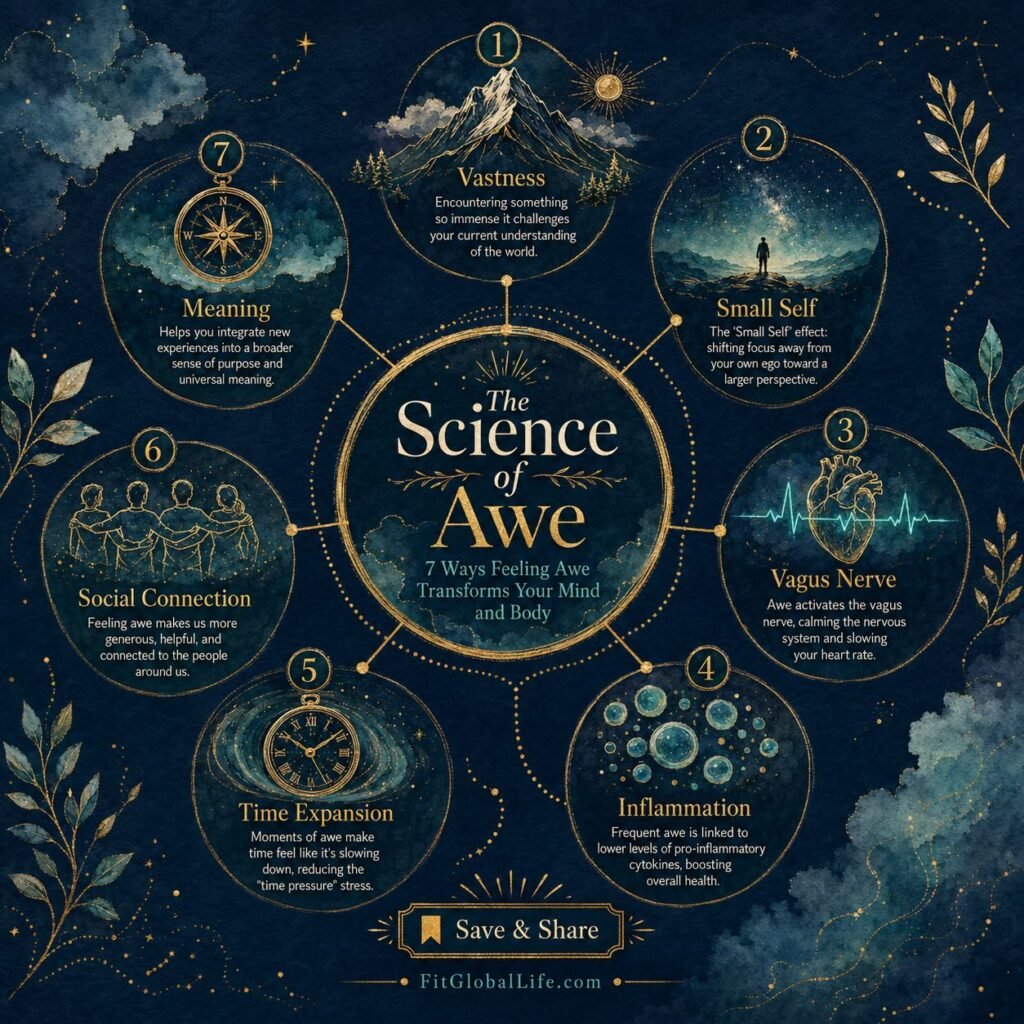
7 Powerful Biological Reasons Awe Matters
1. Awe Interrupts the Stress Loop
Stress narrows the field. When the brain detects threat or overload, attention contracts around what seems urgent. This is adaptive when the threat is immediate. It is less adaptive when the threat is a calendar notification, an argument replayed 37 times, a comparison spiral, or the dull panic of having too many tabs open in the mind. Awe interrupts this loop by pulling attention outward. It breaks the illusion that the current stressor is the whole universe.
In physiological terms, researchers have proposed that awe may shift the body away from sympathetic dominance and toward calmer regulation. The evidence is not final, but it is consistent with the lived experience of awe: the breath changes, the shoulders drop, time slows, and the body often becomes still. The 2023 review on awe and health notes physiological pathways such as reduced sympathetic activation and elevated vagal tone as part of the emerging profile of awe. This is why awe belongs beside understanding vagus nerve stimulation and stress management, and practical tools like stress recovery practices that use breathwork.
For practical purposes, this means an awe practice can act as a pattern interrupt. Instead of arguing with stress using more thoughts, you change the input. Look at the moon. Walk under tall trees. Listen to a live orchestra recording with full attention. Watch a thunderstorm safely from a window. Stand near the ocean and let the body receive scale. The point is not escapism. The point is nervous-system reorientation.
This is also why awe should not be confused with passive entertainment. Scrolling beautiful landscapes for three seconds each may create novelty, but it rarely creates accommodation. The nervous system needs enough time to register vastness. Awe is slow media for the body. The algorithm says: next, next, next. Awe says: stay, stay, stay.
2. Awe Shrinks the Ego Without Destroying Confidence
One of the most repeated findings in awe research is the “small self.” At first, that phrase can sound negative, especially in a culture that tells everyone to build personal brands, speak louder, optimize identity, and never lose confidence. But the small self is not self-hatred. It is proportionality. It is the relief of no longer needing to be the entire weather system.
Awe reduces the inflated urgency of the ego. That matters because many mental-health struggles are intensified by self-enclosure: What does this mean about me? Why am I behind? How do I look? Am I impressive enough? Why did they not reply? The self becomes a room with no windows. Awe opens a window. Suddenly, the mind can remember trees, ancestors, stars, music, history, oceans, mathematics, children laughing, strangers helping strangers, and the fact that life is more than performance.
This ego-softening can make confidence healthier. Instead of confidence built on domination or constant proof, awe supports confidence built on belonging. You are not the whole universe, but you are also not separate from it. That is a very different nervous-system message. It can reduce the pressure to win every conversation and turn life into a never-ending audition.
The FitGlobalLife article on emotional strength argues that resilience is not about pretending nothing hurts. Awe adds another dimension: resilience is also the ability to locate pain inside a larger frame. The mountain does not erase grief, but it changes the room grief is standing in. Sometimes that is enough for the next breath.
3. Awe May Support Healthier Inflammation Patterns
This is the part where we need to be both excited and careful. A widely cited study published in Emotion examined positive affect and inflammatory cytokines, especially interleukin-6, or IL-6. The researchers found that greater positive affect was associated with lower IL-6 across two studies, and awe was the strongest predictor among several positive emotions. the relationship between awe and IL-6 in PubMed.
That does not mean a sunset is a prescription, or that awe directly cures inflammation. The study is associative, and inflammation is complex. Sleep, diet, infection, stress, exercise, chronic disease, medications, and many other variables matter. But the finding is still fascinating because it suggests that the body may respond differently to distinct positive emotions. Awe may not simply be “nice.” It may be part of a broader biological ecology involving stress, social connection, and inflammatory signaling.
Why would awe relate to inflammation at all? One plausible explanation is behavioral and social. Chronic stress and isolation can shape inflammatory patterns over time. Awe may reduce self-focus, increase social connectedness, and encourage restorative behaviors such as walking in nature, attending music, joining ritual, or spending time in meaningful community. In other words, awe may not act like a pill. It may act like a gateway into healthier states and behaviors.
This is where wellness content has to avoid hype. The honest takeaway is not “awe lowers inflammation.” The honest takeaway is: early evidence links awe with body-level markers and deserves attention as part of a broader mind-body health strategy. That strategy still includes sleep, movement, food quality, social support, and medical care when needed. The body is not a vending machine where you insert wonder and receive perfect biomarkers. Biology is messier. Annoying, but true. It should sit beside fundamentals such as the science of rest and recovery and Zone 2 movement as a longevity habit.
4. Awe Expands Time Perception and Reduces Urgency
Many people today are not short on hours; they are short on felt time. A full day can feel like a disappearing file when it is sliced into notifications, micro-decisions, fast content, and unfinished tasks. Awe changes the subjective texture of time. When something feels vast, the mind often slows down. The next action becomes less frantic. The body receives the sense that there is more room to be alive.
This is one reason awe may be so helpful for overthinking. Overthinking is not always a thinking problem. Sometimes it is a scale problem. The mind keeps zooming in until one issue occupies the entire screen. Awe zooms out. It does not solve the issue for you, but it reduces the false sense that the issue is all there is. For readers who deal with this pattern often, see reducing cognitive load instead of feeding overthinking.
Consider the difference between scrolling a productivity thread and watching the sky change color for ten minutes. The thread may give useful tactics, but it often activates comparison: I should be doing more, I am behind, everyone else is optimized. The sky does not need you to become a seven-figure morning routine machine by Tuesday. The sky simply invites perception. That invitation is underrated.
Awe also teaches patience because many awe-inducing experiences cannot be forced. You cannot command fog to lift from a valley at exactly 7:12 a.m. You cannot rush a symphony into its climax. You cannot make the Milky Way appear in a city full of light pollution. Awe trains a slower relationship with reality, which is directly relevant to mental recovery in an urgency-addicted culture. You can also make mornings more awe-friendly by designing mornings that support mental clarity.
5. Awe Strengthens Social Bonding and Moral Concern
Awe tends to make people feel connected to something larger than the individual self. That “beyond” can be nature, humanity, God, ancestors, science, art, family, community, or life itself. This is not just a sentimental side effect. Research on awe and prosociality suggests that the small-self experience may increase generosity and collective concern. For example, a 2023 Frontiers study found that awe promoted moral expansiveness through small-self and connectedness pathways, extending concern beyond narrow in-groups. evidence on awe and moral expansiveness.
This matters because loneliness is not only an emotional issue; it is a public-health issue. The National Institute on Aging notes that loneliness and social isolation are associated with higher risks for health problems including heart disease, depression, and cognitive decline. Awe is not a substitute for friendship, therapy, or community care, but it can make the self more porous to connection. It reminds people that they are participants, not isolated planets. NIA guidance on loneliness and health.
Collective awe may be especially powerful. Think of singing in a crowd, watching a total eclipse, attending a ceremony, moving together in dance, hearing a stadium fall silent, or witnessing a community respond with courage after disaster. These experiences can dissolve the lonely illusion that each person is fighting existence alone. For a few minutes, the body knows togetherness before the mind can over-explain it.
This is why the topic connects naturally with FitGlobalLife’s discussion of micro-communities. If awe opens the self, community gives that opening somewhere to land. The future of mental longevity may not be more isolated self-optimization. It may be small groups, shared rituals, nature exposure, and meaningful collective experiences. Very retro. Very advanced. FitGlobalLife’s guide to micro-communities as an antidote to loneliness is a useful companion here.
6. Awe Helps the Mind Accommodate Complexity
Awe is triggered when reality exceeds the current mental frame. That means awe is, by nature, anti-simplistic. It teaches the brain that the world is bigger than its shortcuts. This is extremely relevant in an era of hot takes, tribal certainty, algorithmic outrage, and content designed to make everything instantly legible. Awe says: not so fast. Some things are too layered to flatten.
The need for accommodation is basically the mind admitting, “My current model is not enough.” That admission can be uncomfortable, but it is also the beginning of learning. Intellectual awe appears when a person encounters a scientific idea, historical pattern, philosophical insight, or technological possibility that rearranges their understanding. It is the feeling of seeing a hidden architecture behind reality.
This has practical implications for creativity. Many creative blocks come from trying to force new output from old categories. Awe expands the category set. A designer who studies coral reefs, a writer who studies astronomy, a founder who listens to Bach, or a wellness creator who watches how fungi networks operate may discover analogies that pure productivity cannot produce. Greatness becomes raw material for insight.
FitGlobalLife’s article on shadow work and creative genius looks inward at the hidden layers of the self. Awe looks outward at the hidden layers of the world. Together, they form a useful creative loop: descend into the self, then expand beyond the self. That is where fresh ideas tend to hide. Not in the 98th recycled carousel saying “drink water and believe in yourself.” Explore the internal layer through the shadow work blueprint for creative depth.
7. Awe Turns Ordinary Environments Into Nervous-System Cues
The most useful awe practice is not dependent on luxury travel. Yes, dark-sky reserves, mountains, ancient forests, great museums, and sacred architecture can be powerful. But awe can also be trained in ordinary environments if attention is deep enough. A tree root breaking through pavement is a lesson in persistence. A child learning to walk is biomechanics, courage, and comedy in one tiny human package. A cup of coffee is agriculture, sunlight, soil, trade routes, labor, chemistry, and ritual. Reality is flexing constantly; we are usually just too distracted to notice.
This is why awe can become a design principle. Your home, workspace, route, media diet, and weekend rituals can either shrink perception or expand it. A window facing sky, a plant you actually observe, a wall print of deep space, a playlist that demands attention, a weekly museum hour, a sunrise walk, or a no-phone meal under real conversation can all become cues for scale.
Environmental design matters because the nervous system learns from repetition. If every room tells the brain to rush, compare, consume, and respond, the mind becomes narrow by default. If some environments invite slowness, beauty, silence, and scale, the mind has a place to recover. This idea connects with FitGlobalLife’s interest in how physical space shapes performance and well-being, from circadian lighting to bedroom architecture. See also how bedroom layout can influence sleep and recovery and acoustic tourism and the power of silent environments.
The point is not to aestheticize your life into a Pinterest shrine. The point is to make awe more available than outrage. Because right now, outrage has distribution. Awe needs deliberate placement. Put greatness where your nervous system can find it. A strong example is dark sky reserves as an escape from light pollution.
The Awe Deficit: Why Modern Life Feels So Mentally Small
Modern life does not lack stimulation. It lacks scale. That difference matters. Stimulation can be tiny, fast, repetitive, and addictive. Awe is expansive, slow, and reorganizing. A person can spend six hours online and feel mentally starved, not because nothing happened, but because most of what happened was calibrated to capture attention rather than enlarge it.
The awe deficit is the condition of living inside predictable loops: same feeds, same rooms, same arguments, same metrics, same comparison triggers, same notifications, same bite-sized outrage. The mind becomes efficient but cramped. It learns to scan rather than behold. It learns to react rather than wonder. Eventually, even beautiful things become content units. Sunset? Post it. Concert? Record it. Meal? Photograph it. The self remains in the center, managing the evidence of experience instead of entering the experience itself.
This is not a moral failure. It is a design problem. Digital systems are built to keep attention moving. Awe often requires attention to stop. That is why a serious awe practice must include some form of digital boundary. Not because phones are evil. Phones are brilliant. But brilliance can still fry your nervous system like cheap street food at 2 a.m. if you consume it without limits.
The solution is not to reject modern life. It is to protect contact with the non-optimized world. A walk without headphones. A night sky without immediate posting. A museum visit without turning every painting into a selfie backdrop. A conversation with someone wise where you actually listen. A documentary that makes you feel responsible to the planet. A book that makes your problems feel historically tiny and ethically important at the same time.
Awe also needs contrast. If every surface is loud, nothing feels majestic. If every moment is captured, nothing feels sacred. If every experience is rated, ranked, and reviewed, fewer experiences are allowed to transform us. The awe deficit is not merely the absence of wonder. It is the over-presence of interruption.
This is where a broader digital wellness strategy helps. FitGlobalLife’s approach to digital deceleration and deep focus can make space for awe by reducing the noise that blocks perception. The brain cannot easily experience vastness while it is being poked by a notification every 90 seconds. Revolutionary insight, I know.
The Awe Practice: How to Build a Weekly Wonder Protocol
Awe should not become another wellness performance. The moment you turn it into a competitive checklist, you have basically taken a cathedral and installed a sales funnel in the altar. Keep it simple. The goal is not to manufacture transcendence on command. The goal is to increase the probability that your mind encounters vastness often enough to stay psychologically flexible.
A helpful starting point is the weekly wonder protocol: one planned awe exposure, three micro-awe moments, and one reflection. That is enough to begin. It is also realistic for people with jobs, families, traffic, laundry, and all the tiny chaos that makes adult life feel like a group project nobody agreed to join.
| Practice | Time | How to do it | Best for |
| Awe walk | 15-30 minutes | Walk slowly and look for vastness, detail, beauty, age, pattern, or life force. No productivity podcast. | Stress reset, rumination, screen fatigue |
| Night-sky pause | 5-15 minutes | Look at the moon, stars, clouds, or city sky. Let the scale register before taking any photo. | Perspective, humility, sleep transition |
| Moral beauty journal | 5 minutes | Write down one example of courage, kindness, mastery, or sacrifice you witnessed or learned about. | Cynicism, loneliness, meaning |
| Music immersion | 10-20 minutes | Choose one powerful piece and listen without multitasking. Track body sensations. | Emotional release, nervous-system downshift |
| Museum or architecture hour | 30-60 minutes | Stand with one work, building, or design longer than feels normal. Let details appear. | Creativity, patience, aesthetic sensitivity |
| Nature documentary with reflection | 20-45 minutes | Watch with full attention, then note one fact that changes your sense of scale. | Learning, ecological concern, family ritual |
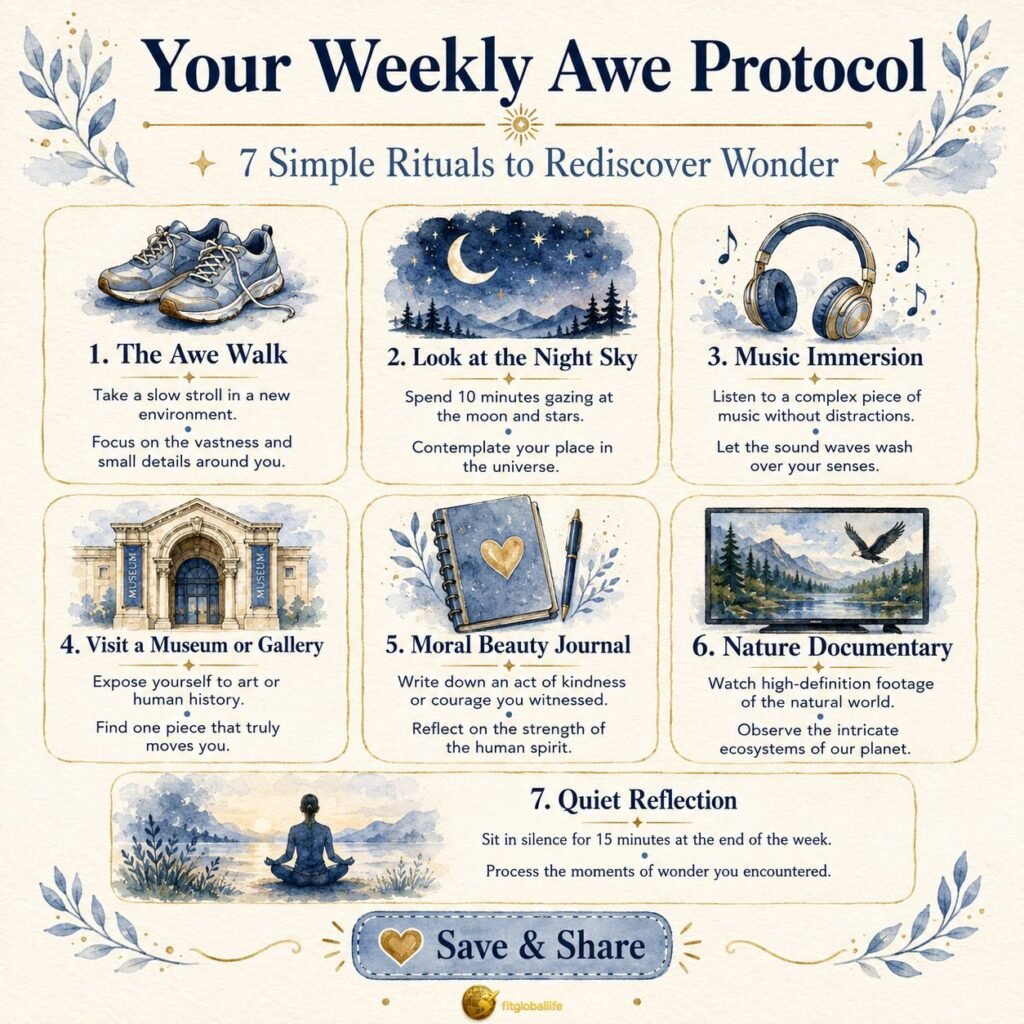
The awe walk has the strongest public-facing intervention story because it is simple. In a study of older adults, participants who took weekly 15-minute awe walks for eight weeks reported greater increases in daily prosocial positive emotions and greater decreases in distress over time. The awe walk study is available through PubMed Central. The intervention was not expensive, complicated, or dependent on exotic scenery. Participants were encouraged to shift attention outward and notice wonder in their surroundings.
That is the beauty of awe training: it begins with attention. You do not always need a plane ticket. You need a perceptual instruction. Look for vastness. Look for age. Look for pattern. Look for skill. Look for courage. Look for something that makes your current mental model feel too small. Then stay with it long enough for the body to believe you.
For people dealing with brain fog or mental fatigue, awe can be paired with nature exposure. FitGlobalLife’s 7-day nature reset for cognitive edge offers a more structured way to use natural environments for mental clarity. Awe is not the only mechanism there, but it is one of the most interesting: nature restores attention partly because it fascinates without demanding constant control.
For people whose stress is stored in the body, combine awe with somatic awareness. After an awe exposure, ask: what happened in my chest, throat, stomach, jaw, hands, breath, and posture? This links outward vastness with inward regulation. The article on somatic release and emotional tension can support that body-based angle.
What Awe Is Not: Avoiding Toxic Positivity and Spiritual Bypass
Awe is powerful, but it is not magic glitter sprinkled over suffering. It should not be used to silence pain, avoid responsibility, or tell people with serious mental-health challenges to “just look at the stars.” That is not wellness. That is emotional gaslighting with better lighting.
Awe is not a replacement for therapy, medication, trauma-informed care, social support, medical diagnosis, or structural change. It is a supportive psychological nutrient. Nutrients matter, but they do not replace surgery when surgery is needed. Likewise, a sunset may help the nervous system soften, but it should not be framed as a cure for depression, PTSD, chronic illness, or loneliness.
Awe is also not always positive. Threat-based awe exists. Earthquakes, violent storms, war footage, overwhelming crowds, or intimidating authority can produce vastness mixed with fear. For some people, especially those with trauma histories, certain forms of awe may feel destabilizing rather than healing. A responsible awe practice should be titrated: safe, voluntary, grounded, and adjustable.
This is why beauty-based, nature-based, art-based, music-based, and moral-beauty-based awe are often better starting points than threat-based awe. The goal is expansion with safety. The nervous system learns best when it is challenged without being flooded. Too little intensity becomes boring. Too much becomes dysregulating. The sweet spot is wonder with enough safety to stay present.
Finally, awe should not become an aesthetic identity. You do not need to become the person who posts sunrise quotes every morning and says “the universe” in every sentence. Please, the internet has suffered enough. Awe can be private, quiet, practical, and unsentimental. Sometimes the most honest awe is simply standing still for ten seconds and whispering, “Wow.”
A 2024 systematic review within a cognitive-behavioral framework notes that awe can involve both positive and threat-related appraisals, and that threat-based awe may evoke fear or anxiety in uncertain environments. That nuance matters for safe practice.
A Fresh Framework: The Three Types of Awe Modern Minds Need
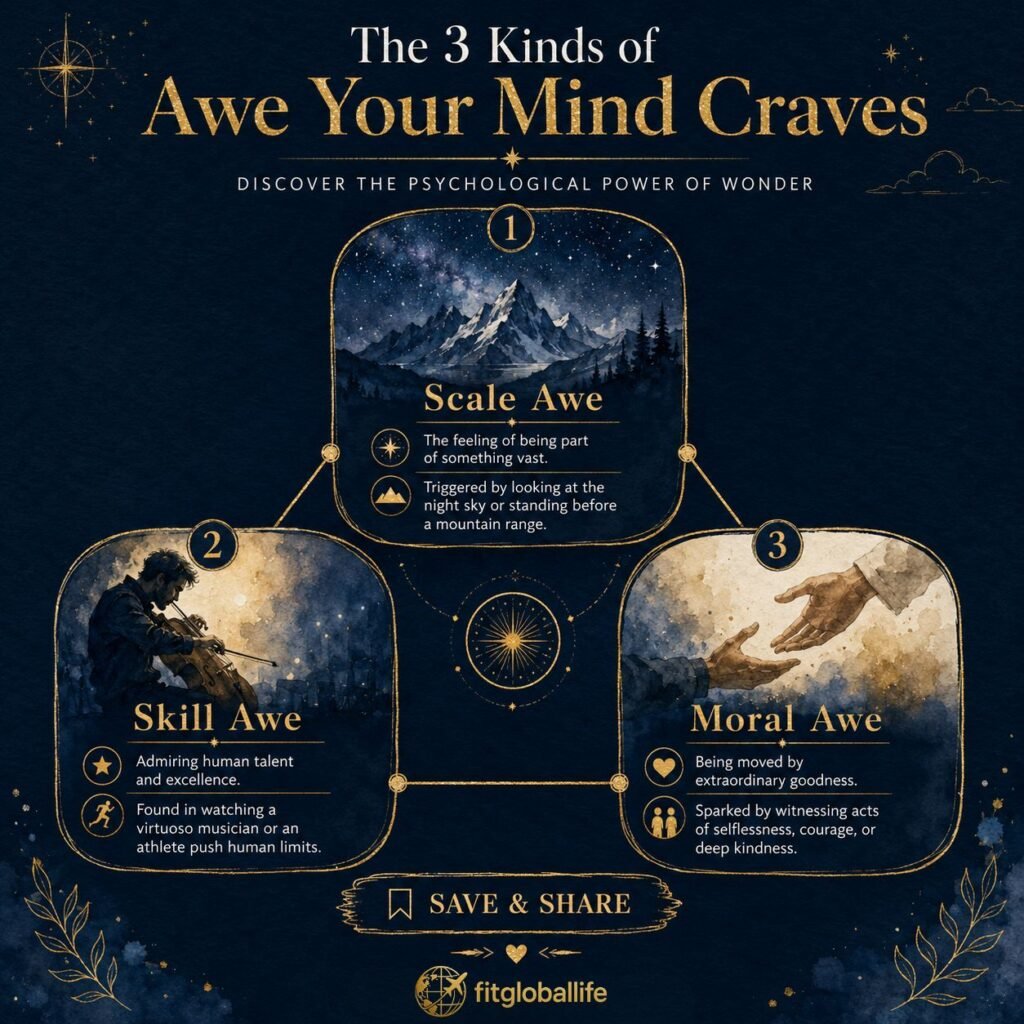
To make awe practical, it helps to divide it into three types: scale awe, skill awe, and moral awe. Most articles focus heavily on nature, which is valid, but incomplete. Modern minds need all three.
Scale awe comes from vastness: mountains, oceans, stars, old forests, ruins, deep time, large architecture, weather, and cosmic imagery. It reduces the tyranny of the immediate. Skill awe comes from witnessing mastery: a pianist, surgeon, dancer, craftsperson, athlete, scientist, writer, chef, or teacher operating at a level that makes effort look like grace. It expands the sense of human possibility. Moral awe comes from goodness under pressure: forgiveness, sacrifice, courage, rescue, solidarity, and principled action. It repairs cynicism.
Each type works differently. Scale awe says, “Your life is part of a larger world.” Skill awe says, “Human capacity is larger than your current habits.” Moral awe says, “Goodness is still real, even when the news feed acts like a dumpster with Wi-Fi.” A complete awe diet includes all three.
Conclusion: Greatness Is Not Luxury; It Is Mental Nutrition
The psychology of awe reveals something deeply human: we are not built to live only inside personal concerns. The mind needs contact with greatness, not because greatness makes us feel inferior, but because it restores proportion. Awe tells the ego to take a seat without telling the self to disappear. It widens attention, softens urgency, expands meaning, and may influence body-level pathways connected with stress and health.
Witnessing greatness is biologically necessary because the nervous system is shaped by what it repeatedly encounters. If it encounters only alerts, metrics, arguments, and comparison, it becomes narrow. If it encounters nature, music, moral courage, deep knowledge, beauty, and collective wonder, it remembers scale. That memory is not decorative. It is regulatory.
The practical invitation is simple: make awe easier to find than outrage. Put wonder into the weekly rhythm. Walk somewhere slowly. Look up. Listen deeply. Visit beauty. Study mastery. Notice courage. Let something larger than you interrupt the monologue of the self. Your brain does not need to win every moment. Sometimes it needs to be astonished back into balance.
FAQ
Awe psychology is the study of how people respond to experiences that feel vast, extraordinary, or beyond their current understanding. It explores the effects of awe on attention, self-concept, emotion, social behavior, meaning, and body-level stress pathways.
New research shows that awe can support well-being by reducing self-focus, enhancing meaning, improving social connection, and quieting aspects of stress physiology. But awe is a supportive practice, not a substitute for professional mental-health support.
Yes. Awe can come from everyday nature, music, art, moral courage, science, architecture, spiritual practice, deep conversation, or simply paying sustained attention to ordinary life. Travel can help, but it is not required.
A reasonable goal is one meaningful awe experience a week, and some brief micro-awe experiences scattered throughout the day-to-day. Consistency is more important than intensity.
Yes. Awe can be mixed with fear, uncertainty or vulnerability, especially awe that is caused by threat, danger, or overwhelming environments. Choose safe, grounding types of awe if you are stress-sensitive or trauma-sensitive.
Disclaimer
This article is for educational and informational purposes only. This information is not medical, psychological, psychiatric or therapeutic advice and does not diagnose, treat, cure or prevent any health condition or mental health issue. If you are suffering from chronic stress, anxiety, depression, trauma symptoms, chronic illness and emotional distress, please seek the help of a qualified healthcare or mental-health professional. Awe practices can be beneficial for well-being but are not a substitute for professional care, medication, therapy or emergency support when you need it.