

For the past decade, the global wellness community has operated under a comforting yet increasingly dangerous illusion: the belief that “Organic” is synonymous with “Nutritionally Complete.” As an investigative editor and content strategist at Fit Global Life, I have spent years tracking the evolution of human optimization. We have been conditioned to believe that by paying the “wellness premium”—avoiding synthetic pesticides, shunning GMOs, and choosing heirloom varieties from local farmers' markets—we are giving our bodies the pinnacle of human nutrition. We fill our expensive baskets with vibrant leafy greens and earthy roots, confidently checking the box on our daily vitality.
But as we go through the high-stakes, data-driven health landscape of 2026, a scary truth has come to light at the crossroads of agricultural science and clinical bio-hacking. Mineral deficiency in organic food has quietly become the silent pandemic of our decade, a metabolic ghost haunting even the most disciplined and affluent plates. It is a “Hidden Hunger” crisis, when the stomach is full but the cells are famished.
This isn't just about missing a few obscure vitamins to make your hair shine; it is a fundamental breakdown of the soil-to-human electrical circuit. In my extensive reviews of executive health profiles and sovereign health protocols, I have seen thousands of “optimal” eaters—individuals who track every macronutrient and source every leaf—present with the same systemic failures. They suffer from chronic cellular fatigue, disrupted sleep architecture, unexplained joint pain, and a complete collapse of resilience to stress.
They are not lacking calories. They are not lacking “clean” food. They are lacking the elemental building blocks of biological life—the trace minerals that have been systematically stripped from our earth over more than a century of extractive, yield-obsessed industrial logic. The “Organic” label proudly tells you what isn't in your food (toxins), but in 2026, the only metric that truly determines your health span is what is there.
The Great Depletion: The Myth of Modern Soil
To understand why mineral deficiency in organic food is a mathematical certainty today, we must look beneath our feet. Modern consumers often treat soil as a passive medium, a sterile sponge of “dirt” that simply holds plants upright while water and sun do the work. In reality, healthy soil is a complex, living “biocapacitor” teeming with fungal mycelia, nematodes, and bacteria. These microscopic organisms are the planet's biological miners; they actively break down solid rock and complex organic matter, converting elemental minerals into a bioavailable form that plant roots can absorb.
The harsh truth is that even organic soil is largely exhausted. A century of intensive farming—even well-meaning organic farming that avoids synthetic chemicals—has disrupted the natural return of minerals to the earth. When we harvest a crop, we physically remove minerals from that location. If we do not replace them with broad-spectrum remineralization (rather than just basic nitrogen-heavy compost), the soil goes bankrupt.
The Dilution Effect: Comparing 1950 to 2026
If you ate a standard organic apple in 1950, you received a specific, predictable “dose” of magnesium, iron, and copper. To get that same dose today, clinical research suggests you might need to eat five to eight of the same fruit. Historical agricultural data, including comprehensive reports from the National Institutes of Health (NIH), confirm that the mineral density in our food supply has plummeted by up to 40% across the board.
This phenomenon is known as the “Dilution Effect.” Modern crops have been selectively bred for rapid growth, pest resistance, and high carbohydrate yields, rather than for deep root systems that extract trace minerals. The plant grows big and looks beautiful on a grocery store shelf, but its internal mineral density is severely diluted. This is exactly why achieving mitochondrial recovery has become the primary obsession among longevity experts. You can eat perfectly clean, but if your cells lack the spark plugs to process that fuel, your energy engine stalls.
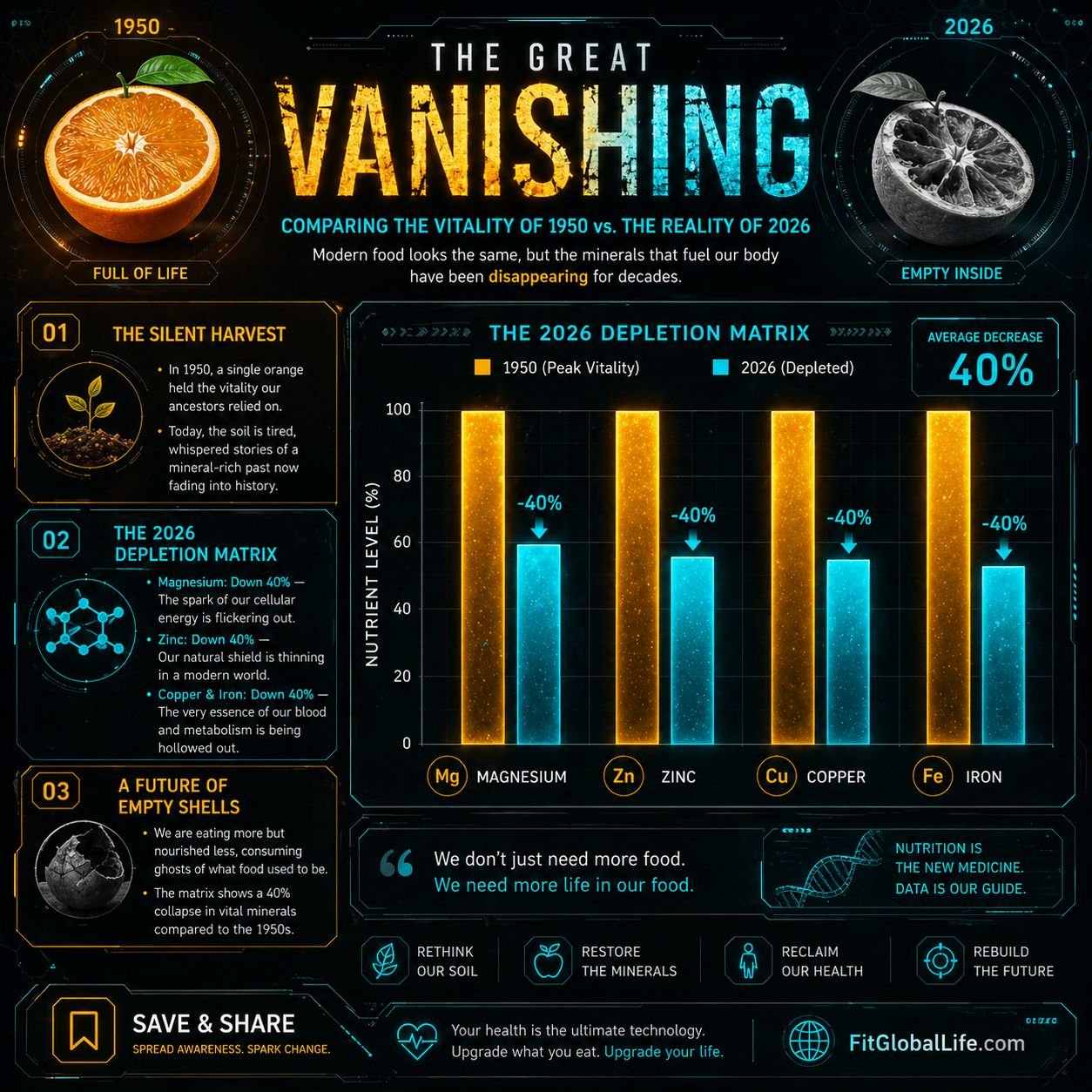 A century of intensive farming has created a massive gap in elemental nutrition.
The 12 Essential Nutrients Vanishing From Your Plate
When we investigate the specific biological mechanisms disrupted by mineral deficiency in organic food, the severity of the crisis becomes clear. Without these 12 nutrients, your body shifts from thriving regeneration to a constant state of biological triage.
1. Magnesium: The Master Spark Plug
Magnesium catalyzes more than 300 enzymatic reactions in the human body. Crucially, it binds to ATP (the energy currency of the cell), making it biologically active. Without magnesium, your body cannot produce or use energy. Even the darkest organic spinach today struggles to extract sufficient magnesium from depleted topsoil, leading to widespread anxiety, muscle cramps, and cardiovascular stress.
2. Selenium: The Genetic Defender
Selenium is essential for thyroid hormone conversion (T4 to T3) and forms the backbone of glutathione, your body's master antioxidant. Soils in many parts of the world, particularly in Europe and parts of North America, are notoriously selenium-poor. A deficiency here leaves your DNA vulnerable to rapid oxidative aging and slows your metabolic rate to a crawl.
3. Zinc: The Emotional Gatekeeper
Often praised for its role in immunity, zinc is equally vital for neurotransmitter synthesis. It regulates communication between neurons. A lack of zinc, exacerbated by mineral deficiency in organic food, is a fast track to emotional fragility, brain fog, and an inability to maintain cognitive sovereignty in high-stress environments.
4. Copper: The Iron Architect
Iron gets all the mainstream attention, but without bioavailable copper, iron cannot be properly loaded into red blood cells or utilized by your mitochondria. Copper deficiency, driven by soil depletion and excess zinc supplementation, leads to systemic fatigue and premature greying of the hair due to reduced melanin production.
5. Iodine: The Coastal Ghost
Most inland agricultural soils are deficient in iodine. Although standard table salt is fortified, health-conscious individuals who eat sea salt and organic, unfortified foods often inadvertently develop subclinical iodine deficiency. This can lead to stubborn weight gain, sluggish thyroid function, and cystic breast tissue.
6. Boron: The Hormonal Harmonizer
Boron is the “forgotten” trace mineral. It is essential for extending the half-lives of Vitamin D and testosterone in the bloodstream and for preventing calcium from leaching out of the bones. Modern organic farming rarely tests for or replenishes boron, contributing to the early onset of osteoporosis and hormonal decline in otherwise healthy adults.
7. Manganese: The Antioxidant Anchor
Manganese is a crucial cofactor for SOD (Superoxide Dismutase), the enzyme that protects your mitochondria from their own exhaust fumes. When you have a mineral deficiency, even in organic food, your mitochondria literally burn themselves out, leading to accelerated cellular aging and chronic inflammation.
8. Chromium: The Blood Sugar Stabilizer
Chromium helps insulin bind to cell receptors. A lack of chromium means that even a healthy, organic sweet potato can cause a massive blood sugar spike, undermining your attempts at an effective metabolic flexibility meal plan. It is heavily stripped during the processing of even “natural” foods.
9. Molybdenum: The Toxin Scrubber
Molybdenum is a trace element required by the liver to break down sulfites (naturally found in wines and certain foods) and cellular waste. Without it, individuals experience severe chemical sensitivities, brain fog, and localized pain after eating clean, organic meals.
10. Potassium: The Cellular Battery
Potassium maintains the electrical gradient of every cell in your body. While bananas are touted as the ultimate source, the actual bioavailable potassium in mass-market organic fruit has dropped significantly. This lack of electrical charge leads to sluggish nerve signaling and chronic water retention.
11. Vanadium: The Insulin Mimic
Emerging longevity research strongly points to vanadium for its ability to mimic insulin and drive glucose directly into muscle tissue rather than into fat cells. However, this trace mineral is almost nonexistent in heavily farmed organic soils that haven't seen glacial rock dust or volcanic ash in millennia.
12. Silica: The Structural Matrix
Silica is the true secret to structural integrity. It cross-links collagen fibers, giving your skin elasticity, your arteries strength, and your joints resilience. The decline in silica in modern produce is a primary reason so many turn to expensive collagen supplements to address a fundamental mineral deficiency in organic food.
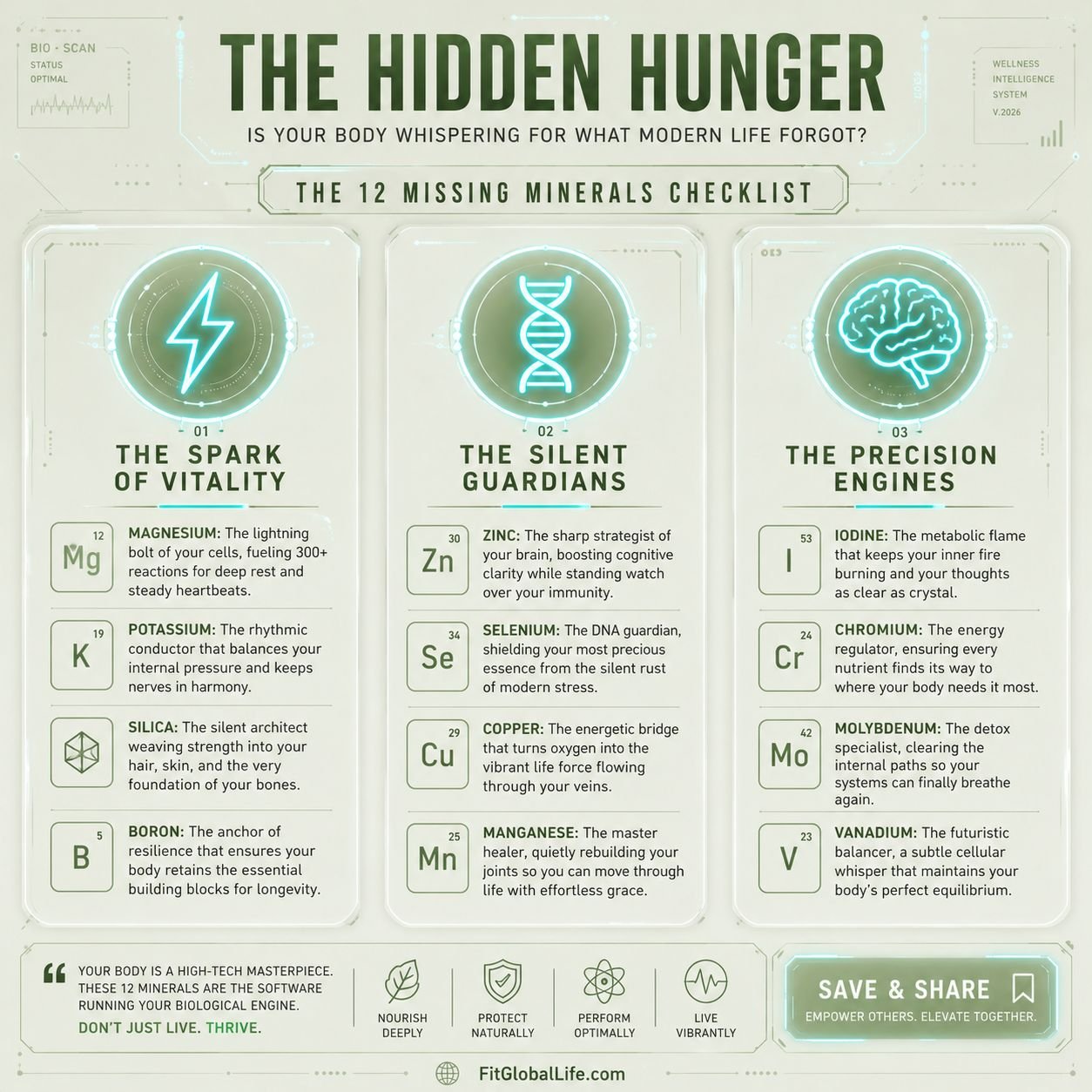 The essential building blocks for cellular energy and sovereign health.
The Biological “Missing Link”: Bio-Electrical Signaling
To fully grasp the magnitude of this issue, we must view the body not as a combustion engine but as a bioelectrical grid. Minerals are, at their core, electrolytes. They carry the electrical charges that enable your nervous system to communicate at lightning speed.
When we discuss cutting-edge therapies like vagus nerve stimulation, we are essentially manipulating electrical conductivity. If your “organic” diet has left you mineral-deficient, your internal wiring is frayed. You can invest thousands in devices and practice endless mindfulness, but without the mineral cofactors (such as magnesium and potassium) to conduct the electrical signal, your nervous system remains trapped in a hyper-vigilant, sympathetic state.
This electrical failure makes it very hard to master interoception, the ability to feel what's going on inside your body when it's low on energy. You cannot feel the subtle signals of your biology if the electrical wires are cut.
The Silent Thief: Glyphosate, Chelation, and Water
The problem extends beyond mere absence; it includes active interference. Even if you eat strictly organic, you still share an ecosystem with conventional agriculture. Glyphosate, the world's most ubiquitous herbicide, was originally patented not as a weed killer but as an industrial pipe cleaner and a powerful mineral chelator.
Chelation means to grab and bind. When glyphosate drifts into organic soil or water supplies, it aggressively binds to positively charged trace minerals such as manganese, zinc, and cobalt. It locks them in an insoluble cage, making them biologically unavailable to the plant, the microbiome, and ultimately to you. You might be eating organic food grown in soil that technically contains zinc, but residual agricultural chemicals have rendered it entirely useless to your biology.
Furthermore, our modern obsession with hyper-purified, reverse-osmosis drinking water compounds the mineral deficiency in organic food. While filtering out microplastics and heavy metals is vital, these systems strip away the naturally occurring dissolved minerals that humans have historically relied on for daily hydration and electrical balance.
Beyond the Grocery Store: Strategies for 2026 Nutrient Optimization
The realization that your pristine diet is incomplete can be unsettling, but at Fit Global Life, we focus on actionable sovereignty. To address mineral deficiencies in organic food, we need to shift our thinking from passive consumerism to proactive biological management.
1. Demand Regenerative, Not Just Organic
Organic is the baseline; Regenerative is the target. The Environmental Protection Agency (EPA) and global agricultural bodies increasingly recognize that regenerative farming—which focuses on zero-tillage, cover cropping, and rotational grazing of livestock—rebuilds topsoil and the microbiome. Regenerative farms naturally remineralize their soil, resulting in food that is vastly more nutrient-dense.
2. The Rise of “Post-Biotic” Power
For years, the wellness industry sold us probiotics to fix our guts. In 2026, we realize this is an incomplete equation. Post-biotic power is what the new frontier needs. When bacteria break down fiber, they make these metabolic byproducts. These post-biotics (such as short-chain fatty acids) alter gut pH and enable the intestinal wall to actively absorb trace minerals. If you want to fix a mineral deficiency in organic food, you must feed the microbes that do the extracting.
3. Epigenetic Eating and Bio-Personalization
We no longer have to guess what our bodies need. Through the science of epigenetic eating, we can examine our unique genetic code to determine our specific mineral burn rates. Some individuals genetically excrete magnesium at twice the normal rate under stress; others have genetic mutations that require massive amounts of dietary zinc to maintain immune function.
4. Strategic Supplementation: Fulvic and Humic Acids
To bridge the gap left by modern agriculture, bio-hackers are turning to ancient soil deposits. Fulvic and humic acids are naturally occurring organic compounds extracted from deep, prehistoric soils. They act as master “mineral transporters.” Because of their low molecular weight, they can carry up to 60 times their weight in trace minerals directly across the cellular membrane, bypassing compromised digestive systems entirely.
5. Multi-Source Hydration
Stop drinking dead water. If you use a reverse osmosis filter, you must immediately remineralize your water with trace mineral drops or unrefined Celtic sea salt. Hydration is not about water volume; it is about cellular absorption of H2O, which is physically impossible without a proper sodium-potassium-magnesium ratio.
Conclusion: The Sovereign Step Forward
The inconvenient truth of 2026 is that eating a flawless organic diet no longer guarantees health; it is merely the starting line. The systemic mineral deficiency in organic food is a complex web of soil depletion, chemical chelation, and biological disconnect.
To thrive in this environment, you must become the CEO of your biology. Look beyond the green labels. Demand regenerative sourcing, use targeted, earth-based supplements, and measure your cellular energy directly. True vitality is not skin-deep, and it certainly isn't found in a diluted, hollow apple. It is built, atom by atom, by reclaiming the elemental minerals that enable human optimization.