

If you find yourself opening a new browser tab only to forget why instantly, or if you feel a phantom vibration in your pocket when your phone isn't even in the room, you are not simply “distracted.” You are operating in a state of profound cognitive bankruptcy. In the modern, hyper-connected era, we have spent decades “borrowing” from our future cognitive reserves to pay for immediate, cheap hits of digital dopamine. This invisible yet highly destructive biological overdraft is known as Attention Debt.
Attention Debt, like financial debt, builds up interest over time. The more you go without focusing deeply and for a long time, the more your brain grows used to being disturbed all the time. This neuroplastic change causes brain fog that lasts for a long time, higher baseline anxiety, and a much lower ability to think deeply and analytically. The good news is that the brain is naturally flexible, so we can fix this damage to the nervous system. But paying back this debt takes a lot more than simply a short break from your phone on the weekends. It involves a complete and radical change in your biological inputs and digital environs.
The Evolutionary Mismatch: Why Your Brain Wasn't Made for the Infinite Scroll
To figure out why we go into Attention Debt so readily, we need to look at how humans have changed over time. The human brain has been evolving for hundreds of thousands of years to keep an eye on the surroundings for rapid changes. For example, a rustling shrub could signal a predator, and a burst of color could mean ripe fruit. Our brains developed an incredibly strong “orienting response,” which rewards us with a microdose of dopamine every time we process a novel piece of information.
Today, tech algorithms have weaponized this exact evolutionary survival mechanism. Social media feeds, breaking news alerts, and endless emails provide a supernormal stimulus that hijacks the brain's novelty-seeking pathways. We are using a Pleistocene-era brain to navigate a 21st-century digital landscape. Your brain literally cannot distinguish between the urgent survival signal of a physical threat and the artificial urgency of an unread Slack message. As a result, you are always hyper-aroused, which drains your brain's battery without ever plugging it back in.
What is Attention Debt, the Hidden Epidemic?
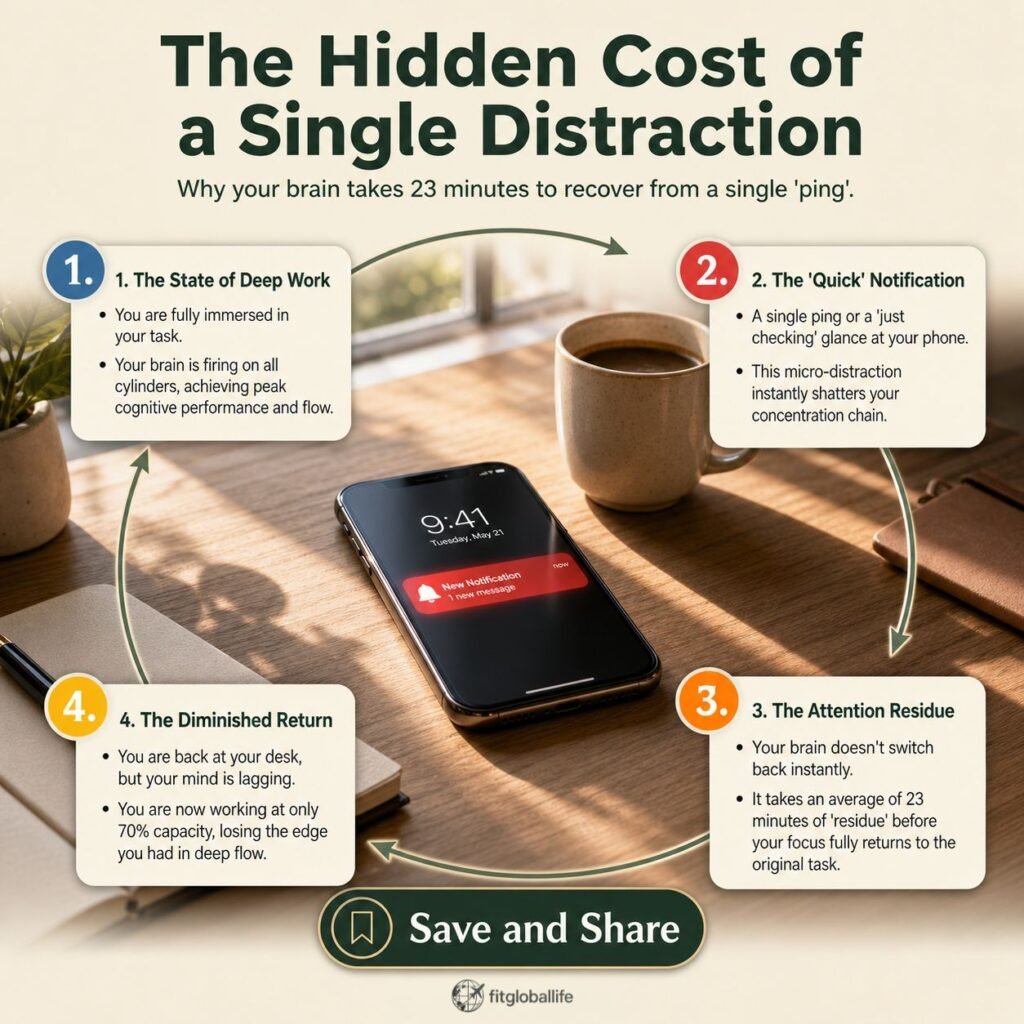
Attention Debt is the total neurological and physiological cost of always being just partially focused. Every time you make your brain switch contexts, it causes friction in your neural network. When you switch tasks, like when you glance at a text message while trying to write a hard report or read through a social feed while listening to a podcast, your brain doesn't transfer gears right away. Instead, it leaves a piece of its processing power behind.
The Neurobiology Behind Your “Distraction Hangover”
This leftover cognitive load is what cognitive neuroscientists call attention residue. According to landmark peer-reviewed research from the University of California, Irvine (Gloria Mark's studies on workplace interruptions), it takes an average of 23 minutes and 15 seconds to return to a state of profound focus after a single interruption.
Consider the math: if you check your device or switch tabs every 10 to 15 minutes, you never actually reach a state of deep focus. You are effectively living in a permanent “distraction hangover.” The prefrontal cortex—the CEO of your brain, responsible for executive function, logic, and long-term planning—is continuously starved of the metabolic energy it needs to operate efficiently because that energy is being burned during transitions between tasks.
Attention Debt vs. Clinical ADHD: Understanding the Difference
It is crucial to differentiate Attention Debt from clinical Attention Deficit Hyperactivity Disorder (ADHD). ADHD is a neurodevelopmental disorder characterized by structural differences in brain dopamine pathways from birth. Attention Debt, on the other hand, is environmentally acquired. It is a modern, lifestyle-induced condition where a previously healthy, functional attention span has been eroded by environmental friction. The symptoms—impulsivity, inability to focus, and working memory deficits—mimic ADHD, which is why so many adults falsely believe they are suddenly developing the disorder in their 30s or 40s. In reality, they are simply defaulting on their cognitive loans.
Why 2026 is the Era of Cognitive Sovereignty
As we integrate further into an AI-driven society engineered by hyper-personalized, predictive algorithms, the ability to command your own mind is no longer just a neat productivity hack; it is a fundamental survival skill. We are entering an era where the concept of “Cognitive Sovereignty” Is The Biggest Trend Of 2026 Because It Helps You Take Back Control Of Your Brain. The global elite are no longer those who hoard the most financial capital or data, but rather those who maintain impenetrable boundaries around their attention, protecting their minds from algorithmic harvesting.
The mind's tremendous neurological and financial cost
Today's “Attention Economy” is designed to keep you in mental debt. Tech platforms take advantage of our biases, but the cost to the consumer is huge. At the macro level, fragmented attention undermines productivity. But on a micro, biological level, the damage is much more insidious.
Cortisol, Gray Matter, and the Shrinking Prefrontal Cortex
Chronic task-switching forces the brain to rely on the amygdala (the brain's fear and emotional center) rather than the prefrontal cortex. According to studies published in the Proceedings of the National Academy of Sciences (PNAS), chronic media multitaskers exhibit a measurable decrease in gray matter density within the anterior cingulate cortex—the precise brain region responsible for emotional regulation, empathy, and impulse control.
Furthermore, high Attention Debt correlates directly with elevated baseline cortisol levels. Every time an unexpected notification chimes, your body releases a microdose of stress hormones. Over months and years, this allostatic load leads to systemic inflammation, adrenal fatigue, and a physically weakened “focus muscle.” We literally lose the brain’s architectural mass that regulates our own consciousness. For anyone looking to understand how to arrest this mental decline, checking out the STOP Overthinking: The Shocking Cognitive Load Reduction Blueprint is a critical first step.
7 Powerful Protocols to Repay Your Attention Debt
Moving from cognitive bankruptcy back to ultimate mental wealth requires a highly strategic, science-backed repayment plan. You cannot fix a broken brain with the same frantic, low-attention habits that broke it in the first place. Relying on sheer willpower will fail. Instead, you must alter your environment and biology. Here are seven deep-health protocols to effectively “repay” your concentration.
1. Radical Digital Deceleration and Dopamine Downregulation
Repaying Attention Debt starts with aggressively breaking the algorithmic loop. This isn't about throwing away your smartphone or moving to the woods; it’s about moving at a human, biological pace. When you constantly consume hyper-stimulating content, your brain downregulates its dopamine receptors to protect itself from the flood of dopamine. This makes normal, slow tasks (like reading a book or doing complex work) feel agonizingly boring.
To upregulate your dopamine receptors and regain sensitivity, you must engage in Digital Deceleration: Mastering the Art of “Deep Focus” in an AI-Driven World. Implement a weekly 24-hour “Acoustic Day” during which no digital notifications, screens, or artificial dopamine triggers are permitted. If you're feeling severe cognitive burnout, doing a highly structured 7-Day Digital Detox: A Simple Reset for Ultimate Body & Mind Health is biologically necessary to flush the extra dopamine from your neural pathways and let your receptors reset to a healthy baseline.
2. Learning how to control cognitive impulsivity by mastering interoception
Interoception is the ability of the central nervous system to feel and understand how the body is feeling on the inside. When you feel the compulsive, almost painful “itch” to pick up your phone or check your email, it is a somatic (bodily) signal that precedes action.
By deeply understanding and practicing Interoception: The “Sixth Sense” You Need to Master for Total Stress Control, you can learn to sit with that physical discomfort and intercept the impulse before it translates into a distraction. Research published by the National Institutes of Health (NIH) indicates that mindfulness and interoceptive training physically thicken the neural pathways connecting the insula (body awareness) and the prefrontal cortex (executive control), essentially giving you the neurological brakes to stop yourself from task-switching.
3. The Architecture of Your Focus Environment (Sensory Gating)
Your physical environment is a silent but immensely demanding partner in your cognitive load. If your office is messy, poorly light, or noisy, your brain has to constantly use “background energy” (sensory gating) to block out things that aren't important. This uses up your concentrate batteries before you even start working.
Using the ideas from Neuro-Architecting Your Morning: How Your Physical Space Can Help You Do More, you can create a custom “Deep Work Sanctuary.” This means using biophilic design (bringing in natural elements) to lower your heart rate and using natural light to wake you up during the day. A clean, deliberately engineered room tells the brain, “It is safe to stop scanning for threats and dive deep.”
4. Metabolic Flexibility: ATP and Brain Fuel
Your brain, despite accounting for only 2% of your total body weight, furiously consumes roughly 20% of your total daily energy in the form of glucose and oxygen. If you are riding a daily blood sugar rollercoaster—spiking from ultra-processed carbohydrates and crashing hours later—your focus will inevitably crash alongside it. You cannot sustain attention without a stable supply of cellular energy (ATP).
You need to control your body's energy sources to pay off Attention Debt. “The Glucose Synergy: Why Food Pairing is More Powerful Than Calorie Counting” and other strategies like this help keep insulin levels from increasing too quickly, which is what makes you feel foggy in the afternoon. When you eat carbs with fats and fibers, you make sure that the prefrontal cortex gets a consistent, slow stream of energy. This lets you think for a long time instead of just having short bursts of frenzied energy.

5. Leveraging Nootropic Nutrition for Synaptic Repair
We have entered an era where we no longer eat to avoid disease; we eat to engineer specific neurobiological outcomes. Chronic multitasking causes oxidative stress and synaptic fraying. To physically repair the synaptic damage caused by your digital habits, functional, targeted nutrition is mandatory.
Integrating Nootropic Nutrition 2026: How to Plan Your Diet for Maximum Mental Clarity teaches you how to employ powerful natural ingredients to fix your brain. Clinical studies have shown that adaptogens like Lion's Mane mushroom can increase Nerve Growth Factor (NGF), which helps repair the myelin sheaths that protect neurons. People have done a lot of research on Bacopa Monnieri, an ancient Ayurvedic herb, to see how it can help with memory recall, speed up the processing of visual information, and make neuroplasticity easier.
6. Somatic Release: Detaching the Nervous System from Chronic Stress
We frequently forget that the brain and body are not separate entities. We hold chronic, low-grade stress in our fascial tissue, which acts as a biological anchor, tethering our attention to an anxiety-driven, hyper-vigilant state. Tension held in the jaw, shoulders, or deep in the psoas muscles sends a continuous, subconscious afferent signal via the vagus nerve to the brain, telling it that we are in a sympathetic “fight or flight” survival state. In survival mode, deep, singular focus is biologically impossible because the brain wants to scan the horizon for danger.
Utilizing Somatic Release: Why Your Hip Mobility is the Hidden Key to Unlocking Emotional Trauma helps discharge this trapped kinetic energy. By engaging in somatic shaking, deep stretching, and breathwork, you signal to the autonomic nervous system that the environment is safe. When the body finally feels safe, the mind can finally anchor onto a single task without the distraction of background anxiety.
7. Circadian Alignment and Glymphatic Washing for Prefrontal Recovery
Perhaps the most critical, non-negotiable step in repaying Attention Debt happens when you are completely unconscious. Your prefrontal cortex—the very part of the brain responsible for maintaining focus and resisting the urge to check TikTok—can only clear out toxic metabolic waste products (like amyloid-beta plaques) during deep, slow-wave sleep. The brain's glymphatic system manages this cleaning process.
Your biological clock is off if you stay up late gazing at blue light, doomscrolling, or sleeping at various times. This is like trying to drive a complicated machine that hasn't had its oil changed. Circadian Lighting at Home: The Essential Approach to Fixing Your Biological Clock makes sure that your glymphatic system operates right by following a strict, non-negotiable plan. Changing the light in your room can help your brain manufacture more melatonin. This can help you achieve the deep sleep your brain needs to “wash” overnight so you can wake up with a fully energized attention span.
What Will Deep Work Look Like in an AI-Driven Economy
The value of human work is shifting a lot as AI takes over more and more normal, computational, and administrative activities. The only human skill that will command a premium in the coming decade is the ability to apply intense, unbroken, creative focus to complex, ambiguous, and deeply human problems.
In the rapidly emerging Post-Work Wellness Economy: Why “Soft Living” is the New Status Symbol, your personal “Focus Quotient” will vastly outweigh your traditional IQ. The people who win in the future economy will not be those who can multitask the fastest; they will be the people who can sit still, think deeply, and produce profound insights. By actively and aggressively repaying your Attention Debt today, you are not merely alleviating daily stress—you are future-proofing your economic, creative, and intellectual value against the rise of the machines.
Conclusion: Investing in Your Ultimate Mental Wealth
Attention Debt is not a permanent life sentence, but make no mistake: it is a progressive neurodegenerative condition if left unchecked. The longer you wait to initiate your biological repayment plan, the steeper the cognitive interest becomes, and the harder it will be to reclaim your mind.
Start today by choosing just one protocol from the list above. Perhaps begin by establishing firm digital boundaries, such as using Beyond 10,000 Steps: The Science of ‘Zone 2’ Cardio for Maximum Longevity (to build brain matter) or simply turning off all non-human notifications on your devices. Observe how quickly, even within just a few days, your mental clarity begins to return. Your attention is your scarcest, most precious, and most valuable asset. It is the lens through which you experience your entire life. Stop spending it carelessly on algorithms that do not care about your ultimate growth. It is time to clear your debts and invest in your mental wealth.
Frequently Asked Questions (FAQ) About Attention Debt
The most common early symptom is “cognitive fragmentation.” This is the persistent, uncomfortable feeling that your mind is racing in five different directions at once, accompanied by a low-grade anxiety, even when you are trying to relax on the couch or do a single, simple task like reading a physical book.
No. While nootropics, adaptogens, and stimulants (like caffeine) are incredibly powerful tools for temporary neuro-enhancement, they cannot out-supplement a fundamentally broken lifestyle. Taking stimulants without changing your sleep and digital habits is like using a credit card with a high interest rate to pay off your mortgage. To properly pay off your cognitive debt, you need to make substantial changes in your life, like altering your sleep routine to match your body's natural rhythms and limiting how much time you spend online.
While many people report a significant, noticeable boost in mental clarity and lower anxiety after just 72 hours of a strict digital detox, complete neural pathway recovery takes longer. It usually takes between 21 to 60 days of constant, conscious effort to downregulate hyper-stimulated dopamine receptors and physically strengthen the prefrontal brain.
Yes. Decades of neuroscience research show that human neurology is entirely incapable of true parallel processing in high-level cognitive tasks. We do not multitask; we engage in rapid “task-switching.” Every time you switch your attention from one thing to another, your brain burns glucose and incurs a cognitive penalty (attention residue), which actively worsens your Attention Debt and exhausts your brain.
Of course. Doing some types of physical activity for a long time makes the brain make a lot more of a protein called Brain-Derived Neurotrophic Factor (BDNF). BDNF is like a biological “Miracle-Gro” for your brain. It helps new neurons grow and makes new, strong neural pathways that directly improve your ability to stay focused for a long time.
Disclaimer
The information provided in this article is for educational, informational, and self-empowerment purposes only and is not intended to substitute for professional medical advice, psychiatric diagnosis, or treatment. Always consult with a qualified healthcare provider or neurologist before starting new supplement protocols, making radical changes to your diet, or if you are experiencing severe, debilitating cognitive distress or suspect you have a clinical neurological condition such as ADHD.