

A brain fog reset is not about escaping life, deleting every app, or pretending a forest walk can magically fix a chaotic lifestyle. It is about giving your overloaded brain the one environment it rarely receives anymore: low-threat, low-noise, high-sensory, biologically familiar space.
Most people do not wake up one morning and suddenly lose their mental sharpness. Brain fog usually arrives quietly. First, you reread the same paragraph three times. Then you forget why you opened a tab. Then simple decisions start feeling strangely heavy. Eventually, your calendar looks normal on the outside, but inside your head, it feels like 47 browser tabs are open, and one of them is playing music. Classic modern brain chaos. Very premium, very annoying.
This article is a 7-day nature-based reset designed for people who feel mentally dull, overstimulated, digitally fried, or creatively blocked. It is not medical treatment. It is not a miracle detox. It is a structured lifestyle reset built around attention restoration, circadian rhythm support, gentle movement, silence, natural light, and sensory decompression.
The core idea is simple: your brain is not broken; it may be under-recovered. In a culture that treats every dip in clarity as a productivity problem, the more useful question may be: what has your brain been exposed to all week, and what has it been denied?
For readers who have already explored FitGlobalLife’s guide on Digital-Free Destinations: The Ultimate Guide to True Unplugging Wellness Retreats, this article goes one step deeper. Instead of only removing screens, we rebuild the conditions your brain needs to feel clear again: morning light, slow walking, low-friction meals, silence, grounding routines, and exposure to nature that does not turn into another productivity challenge.
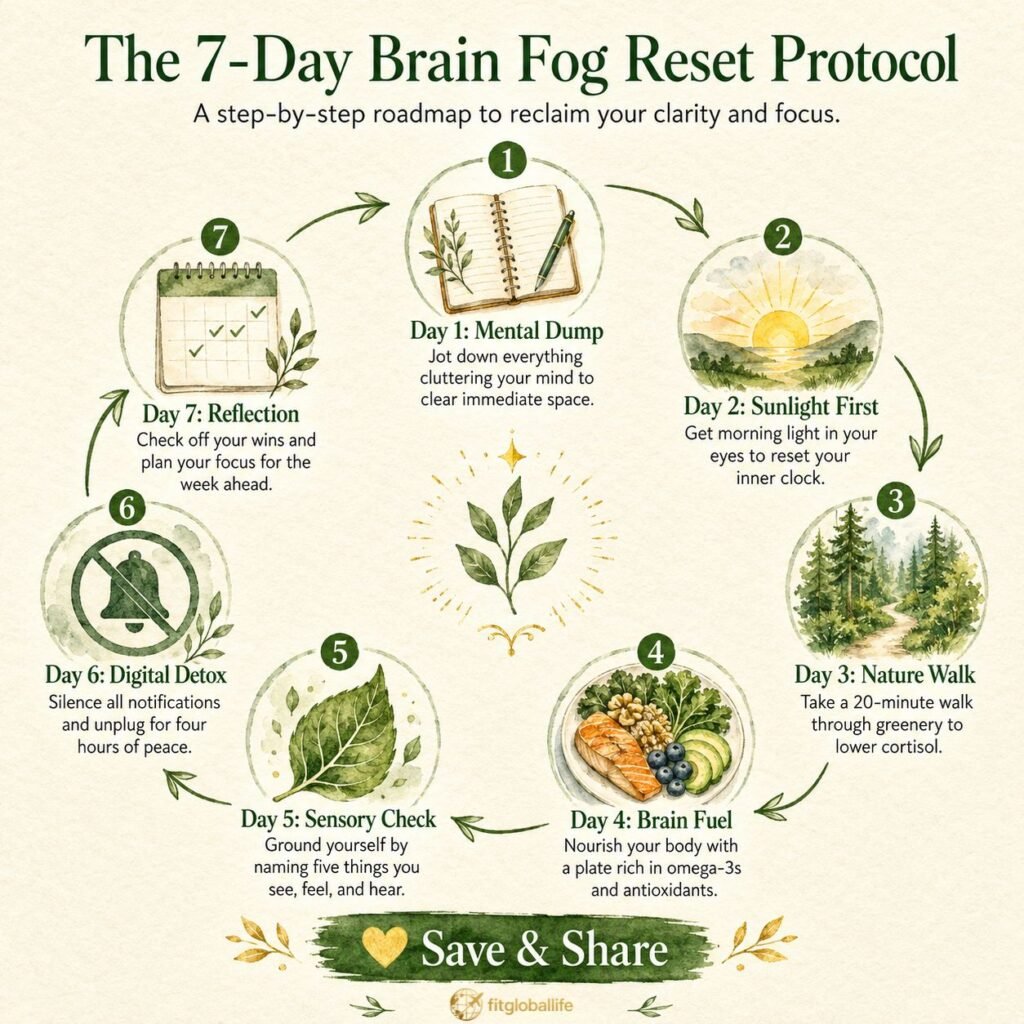
Brain Fog Reset: Why Nature Works Better Than Another Productivity Hack
A brain fog reset should not begin with another app, dashboard, or wearable metric. That is the trap. Many people try to solve mental fatigue with more cognitive input: more supplements, more tabs, more podcasts, more optimization systems, more “morning routines” that look impressive on Instagram but feel like unpaid labor.
Nature works differently because it reduces demand rather than adding complexity. It is less about becoming superhuman and more about becoming less aggressively overclocked. The modern brain is not only tired from working; it is tired from constantly switching contexts, filtering alerts, monitoring social signals, and living in spaces that rarely invite true downshifting.
The U.S. Environmental Protection Agency notes that Americans spend roughly 90% of their time indoors, where indoor pollutant concentrations can sometimes exceed outdoor levels. That matters because modern cognitive life is not only digital; it is indoor, seated, screen-lit, air-conditioned, and acoustically crowded.
A 7-day nature reset is not a vacation from responsibility. It is a nervous-system intervention disguised as a simple week outdoors. You are not trying to “hack” the brain. You are trying to stop harassing it. This is why a reset pairs naturally with FitGlobalLife’s perspective on Weekend Reset Retreats Near Jakarta, especially for busy professionals who need to recover without disappearing from their lives for a month.
Research on nature exposure suggests that natural environments can support attention recovery, stress reduction, mood regulation, and well-being. A widely cited Scientific Reports study found that spending at least 120 minutes per week in nature was associated with better self-reported health and well-being among nearly 20,000 participants in England.
That does not mean 120 minutes is a magic number for everyone. It means that exposure to nature appears to have a dose-response relationship, and many modern people are underdosed. The unique angle of this protocol is what I call cognitive rewilding: rebuilding the brain’s tolerance for quiet, spacious attention before forcing it back into high-output work.
This also explains why the reset connects with the logic behind Regenerative Travel: 5 Ethical Destinations Where Your Trip Truly Gives Back. The healthiest journeys are not only about what a place gives you; they are also about whether your presence, pace, and choices respect the environment that is helping you recover.
What Brain Fog Really Feels Like in Modern Life
Brain fog is not a formal diagnosis. It is a lived experience. People usually describe it as mental cloudiness, poor concentration, low motivation, word-finding problems, forgetfulness, sluggish thinking, or the sense that their brain is online but buffering.
It can come from many causes: poor sleep, chronic stress, dehydration, nutritional gaps, anxiety, depression, medication effects, hormonal changes, long illness, excessive screen exposure, burnout, or underlying medical conditions. That is why persistent or severe brain fog should be discussed with a qualified healthcare professional.
But lifestyle-related brain fog often follows a recognizable pattern. You wake up tired, check your phone before your feet touch the floor, absorb work messages before sunlight hits your eyes, drink caffeine before hydration, sit indoors for hours, jump between tasks, eat irregularly, answer notifications during meals, and then wonder why your brain refuses to perform like a clean machine.
Your brain is not lazy. It is defending itself from overload. Brain fog often becomes the visible symptom of invisible accumulation: too many open loops, too many unresolved decisions, too many synthetic stimuli, too little sunlight, too little embodied movement, and too little silence.
This is where FitGlobalLife’s broader content cluster on focus and digital well-being becomes useful. Readers can continue from this article to Digital-Free Destinations for the retreat angle, then move on to AI in Wellness for a more balanced view of how technology can support health without becoming another source of noise.
The Science Behind Nature, Attention, and Mental Recovery
Attention Restoration: Your Brain Needs “Soft Fascination”
Attention Restoration Theory suggests that natural settings help restore directed attention by gently engaging the mind without requiring constant vigilance. A natural scene can hold awareness through soft fascination: moving leaves, flowing water, birdsong, clouds, shadows, light, and texture.
Unlike a busy street or notification-heavy screen, nature does not demand constant decision-making. It gives the brain something to notice without requiring it to respond. That difference is huge. A forest path may be visually rich, but it is not shouting for conversion rates, urgent replies, or algorithmic proof of relevance.
A classic University of Michigan study reported that participants improved performance on memory and attention tasks after walking in nature; the university’s summary described about a 20% improvement in memory and attention after a nature walk. The related paper indexed in PubMed concluded that interactions with nature can improve directed attention abilities.
This is why the protocol below prioritizes input-free walking. Not power walking. Not podcast walking. Not “record content while walking” walking. Just walking. Radical, apparently.
For a soundscape-oriented companion piece, connect this point to The Silent Revolution: Why Acoustic Tourism is the Ultimate Longevity Hack for 2026, because mental clarity is shaped not only by what we see, but also by what we stop hearing.
Stress Physiology: Nature Helps Downshift the Nervous System
Brain fog is not only a focus problem. It is often a stress-state problem. When the body stays in a high-alert state for too long, the brain becomes less efficient at deep thinking, working memory, emotional regulation, and creative synthesis.
Forest bathing, gentle walking and calm outdoor sitting are nature-based routines that may enable the body to transition towards parasympathetic healing. A 2024 study published in Frontiers in Psychology focused on forest bathing among stressed people. It found that forest bathing improved physiological stress management and sympathovagal balance. However, it also pointed out the necessity for longer-term controlled investigations.
That nuance matters. Nature is powerful, but we should not oversell it like a wellness guru selling moon water. The evidence is promising, not magical. This is a reset, not a replacement for medical care, therapy, adequate sleep, or serious life changes when those are needed.
For a body-based recovery bridge, link readers to The Body-Mind Connection: 5 Somatic Practices to Instantly Reduce Stress and Anxiety and The Power of Breathwork: 3 Simple Techniques to Reset Your Nervous System in 5 Minutes. Both strengthen the point that mental clarity is not only a cognitive skill but also a regulated state of the body.
Light, Sleep, and Circadian Repair
Many brain fog resets fail because they ignore light. Morning outdoor light helps anchor circadian timing, while excessive evening light can delay sleep signals. Your brain uses light as a biological timestamp, and modern indoor life often gives it a confusing timestamp: dim mornings, bright nights, and blue-lit scrolling at exactly the wrong moment.
A 2019 open-access review on light, circadian rhythms, sleep, and mood concluded that daylight, especially at high intensity, is generally beneficial for sleep, while artificial light exposure from screens and indoor lighting can influence circadian timing.
This is why the protocol begins each day outside, ideally within the first hour after waking. The sleep-focused reader should also move from this article into The Architecture of Sleep: How Bedroom Layout and Air Ionization Influence REM Cycles because environmental design can either support or sabotage recovery long after the nature walk ends.
Movement Without Performance Pressure
Exercise is useful, but a brain fog reset does not need to become a fitness challenge. Gentle movement in nature gives the brain circulation, sensory variation, and mood support without adding performance pressure. If the reader wants a long-term health bridge after this reset, link naturally to The Longevity Investment: 5 Science-Backed Health Habits for a 100-Year Life.
The goal is not to hit a personal record. The goal is to become human again after spending too long as a chair-based notification processor. This is why the reset uses walking, stretching, easy hiking, swimming, gardening, and mobility instead of intense workouts.
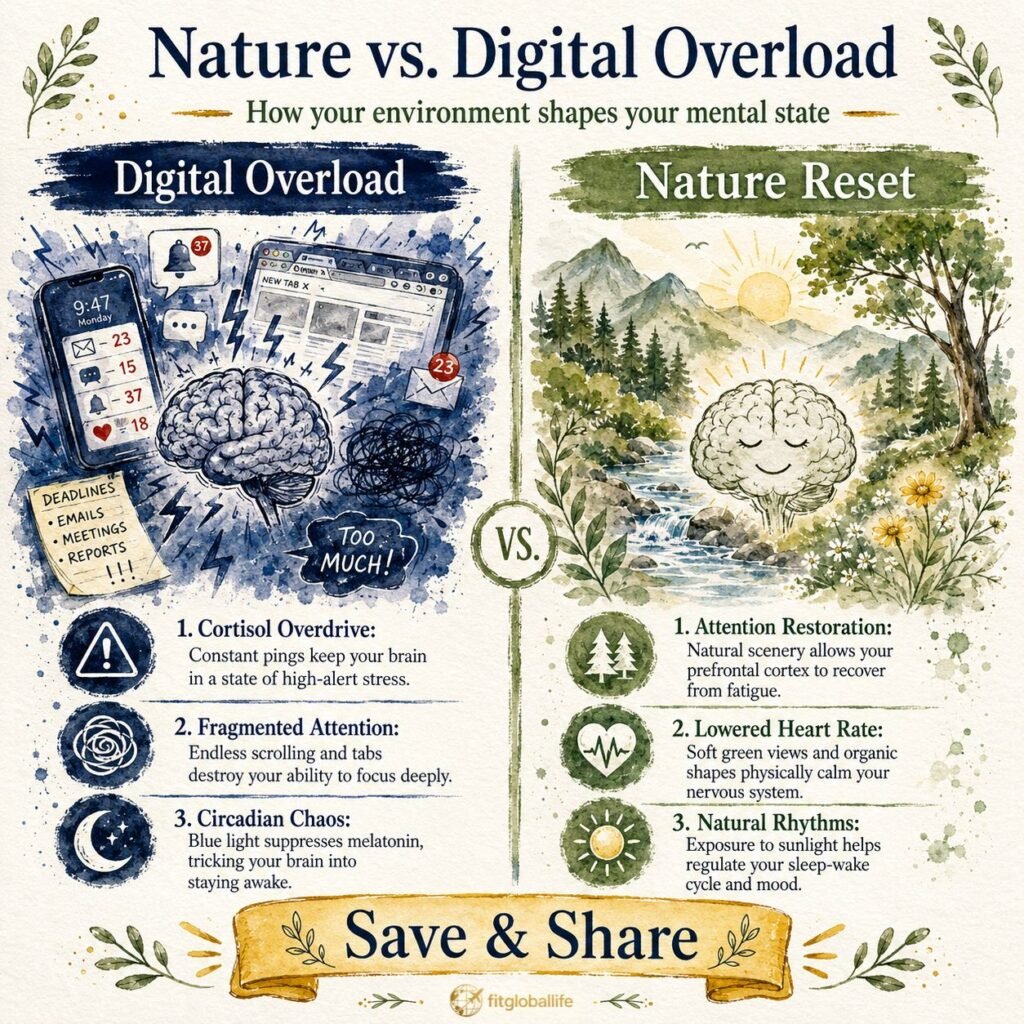
The 7-Day Brain Fog Reset Protocol
This protocol works best in a nature-rich location: a forest cabin, mountain village, coastal town, quiet retreat, lakeside stay, national park area, or even a city with accessible parks and botanical gardens. You do not need luxury. You need fewer inputs, more daylight, and enough safety to relax.
If travel is not possible, use an urban nature reset: morning walks in a park, lunch outdoors, evening screen boundaries, plants near the workspace, and weekend time in larger green spaces. FitGlobalLife’s Hidden Urban Retreats 2025: Wellness Cities You Must Explore can support that angle nicely.
Day 1: Audit the Fog
Day 1 is not about fixing anything. It is about observing the pattern. Begin with a 20-minute outdoor walk without headphones. Notice your baseline: energy, mood, focus, headache, tension, sleepiness, cravings, irritability, and how often your hand reaches for your phone without permission. That tiny automatic reach? That is the plot twist.
| Checkpoint | Question |
| Sleep | How many hours did I sleep last night? |
| Energy | When does my energy crash most often? |
| Focus | What task feels hardest right now? |
| Screens | How soon after waking do I check my phone? |
| Body | Where do I feel tension? |
| Food | Do I feel mentally worse after certain meals? |
| Environment | Where do I feel clearer: indoors, outdoors, near water, under trees? |
The point is to stop treating brain fog as one vague enemy. You are mapping its triggers. For lunch, eat a steady meal: protein, fiber-rich plants, healthy fats, and slow carbohydrates—no extreme fasting on Day 1. A foggy brain does not always need discipline; sometimes it needs breakfast like an adult.
Cognitive clarity is best maintained by stable everyday inputs, not sporadic supplement panic. For nutritional consistency, point readers to Nootropic Nutrition 2026: How to Plan Your Diet for Maximum Mental Clarity.
Day 2: Rebuild Morning Light
On Day 2, step outside within 30 to 60 minutes of waking. Stay outdoors for 10 to 30 minutes, depending on weather, safety, skin sensitivity, and local UV conditions. You do not need to stare at the sun. Please do not do that. Just be outside in natural light.
Pair the light with slow movement: walking, gentle stretching, watering plants, or sitting near an open natural view. Your goal is to teach your body that the morning has started. In the evening, reduce exposure to bright screens and overhead lighting for 60 to 90 minutes before sleep. If you must use devices, dim the screen and avoid emotionally activating content. Nothing ruins sleep prep like “one quick scroll” that turns into geopolitical doom, celebrity drama, and someone arguing about protein powder.
Day 2 supports the sleep-focus loop. Better morning light can support better sleep timing, and better sleep is one of the most underrated interventions for brain fog.
Day 3: Walk Without Input
Day 3 is the first real cognitive reset day. Take a 45- to 60-minute walk in the most natural environment available. Forest, beach, rice fields, botanical garden, lakeside path, quiet park, riverside trail—anything with fewer cars and more living texture.
| Allowed | Not Allowed |
| Natural sounds | Podcasts |
| Wandering thoughts | Work calls |
| Looking around | Scrolling |
| Gentle pace | Step-count obsession |
| Breathing slowly | Recording content every 3 minutes |
This is where attention restoration begins to feel real. At first, the mind may rebel. It may generate random thoughts, old worries, imaginary conversations, or sudden urges to be productive. Let it. The mind often gets louder before it gets clearer.
After walking, write three lines: What did I notice outside? What thought kept repeating? What feels slightly lighter now? This is not journaling for aesthetics. It is cognitive defragmentation.
Day 4: Eat for Steady Mental Energy
Day 4 focuses on metabolic calm. Brain fog often worsens when meals create energy spikes and crashes. A nature reset should not become a restrictive diet. Instead, build meals that keep blood sugar and energy steadier.
| Plate Zone | Examples |
| Protein | Eggs, fish, tofu, tempeh, yogurt, lentils, chicken, beans |
| Fiber | Leafy greens, vegetables, berries, oats, legumes |
| Slow carbs | Sweet potato, brown rice, quinoa, whole grains |
| Healthy fats | Avocado, olive oil, nuts, seeds |
| Hydration | Water, herbal tea, mineral-rich fluids |
Avoid building the day around caffeine, pastries, and “I’ll eat properly later.” Later is where good intentions go to ghost you. Day 4 also includes one outdoor meal. Eat slowly. No phone. No laptop. No “productive lunch.” Your digestive system deserves better than being used as a keyboard accessory.
Day 5: Practice Sensory Recovery
By Day 5, many people notice something subtle: colors feel sharper, sleep feels deeper, or thoughts feel less crowded. Not always dramatic. Sometimes clarity returns like a shy cat: slowly, suspiciously, then suddenly sitting on your lap.
Today’s practice is sensory recovery. Spend 30 minutes outdoors, focusing on one sense at a time.
| Minute | Practice |
| 0-5 | Notice light and shadow |
| 5-10 | Listen for layered sounds |
| 10-15 | Feel air, temperature, and texture |
| 15-20 | Notice natural smells |
| 20-25 | Observe small movement: leaves, insects, water |
| 25-30 | Sit without trying to improve anything |
This helps pull the brain out of abstract rumination and back into embodied awareness. Brain fog often disconnects people from bodily cues; sensory recovery rebuilds that bridge.
Day 6: Choose Silence Before Stimulation
Day 6 introduces a half-day low-stimulation window. For four to six hours, reduce speech, messaging, scrolling, news, music, entertainment, and multitasking. You can walk, stretch, nap, read lightly, journal, cook, sit outside, or do simple chores.
The goal is not punishment. It is signal reduction. If a full silent retreat interests your audience, link internally to “Finding Your Focus: Top 7 Silent Meditation Retreats for Profound Inner Growth.” That article supports the deeper version of this reset.
At night, write: What did silence make louder? What did silence make easier? What did I reach for when I felt bored? Boredom is not the enemy. Boredom is often the doorway back to creative thought.
Day 7: Build Your Return Plan
Day 7 is where most resets fail. People feel clearer, then return to the same lifestyle that created the fog. So the final day is not about celebration. It is about integration.
| Habit | Minimum Version |
| Morning light | 10 minutes outside after waking |
| Input-free walk | 20 minutes, 3x per week |
| Screen sunset | No high-stimulation screen use 45 minutes before bed |
| Nature block | 120 minutes total outdoors per week |
| Weekly silence | 2 hours low-stimulation time |
| Stable breakfast | Protein + fiber before caffeine overload |
Do not choose all six unless you enjoy failing with ambition. Pick three. Make them easy enough to survive a messy week. The point is to leave the reset with a smaller, stronger operating system.
The 7-Day Nature Reset Schedule
| Day | Main Goal | Nature Practice | Digital Boundary | Reflection Prompt |
| Day 1 | Awareness | 20-minute walk | No phone during walk | What does my fog feel like? |
| Day 2 | Circadian repair | Morning light | Dim screens before bed | How does light affect my energy? |
| Day 3 | Attention restoration | 45-60 minute input-free walk | No headphones | What became clearer after walking? |
| Day 4 | Energy stability | Outdoor meal | No screen while eating | Which foods make me sharper? |
| Day 5 | Sensory recovery | 30-minute sensory scan | No multitasking outdoors | What sense woke up today? |
| Day 6 | Silence | 4-6 hour low-stimulation block | Minimal messaging | What did silence reveal? |
| Day 7 | Integration | Choose 3 repeat habits | Design screen rules | What will I protect next week? |
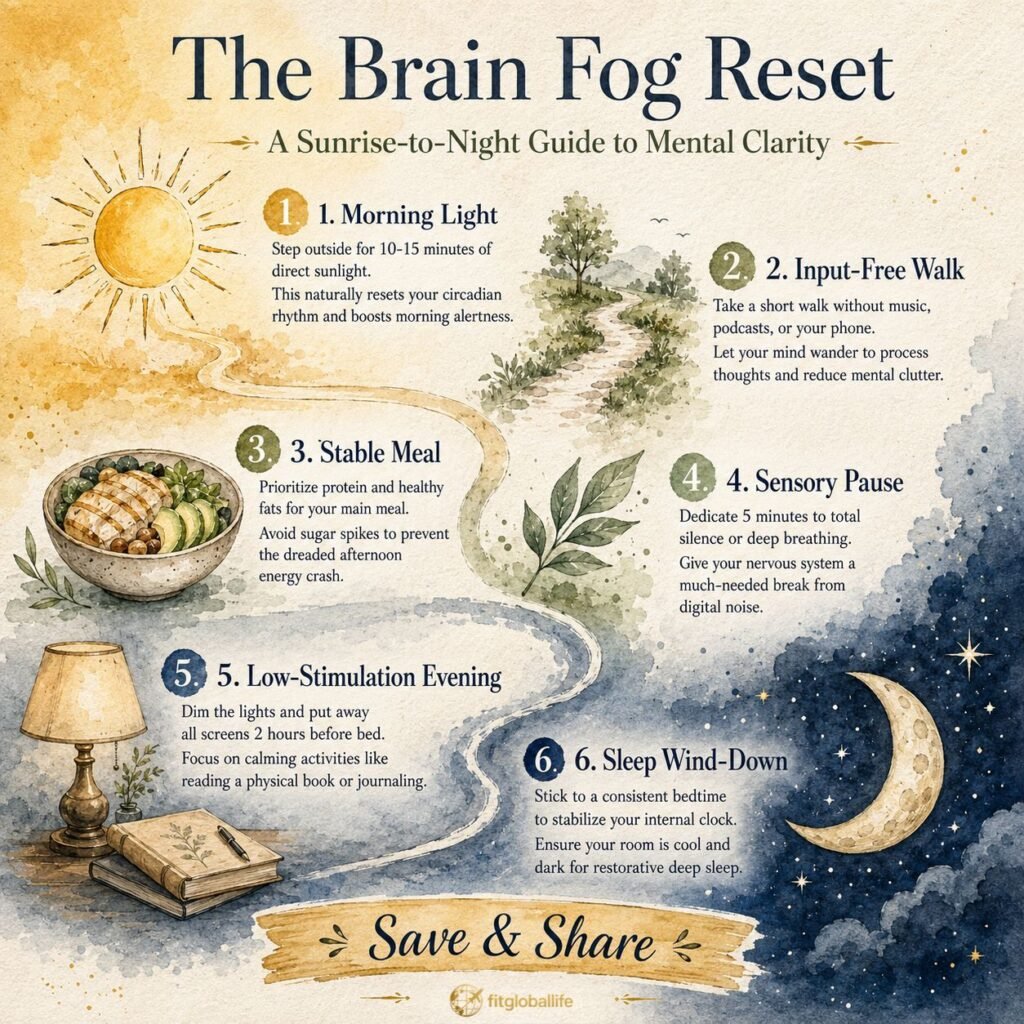
What to Avoid During a Brain Fog Reset
A reset works because it reduces the load. So avoid turning it into another achievement project. Do not overplan every hour. Do not track 20 metrics. Do not replace work stress with wellness stress. Do not attempt intense fasting, extreme workouts, or supplement experimentation without professional guidance.
Do not spend your nature reset filming every leaf for content. Yes, I know. Content creator pain. But the forest does not need a production schedule today. Let one part of your life exist without becoming an asset pipeline.
And don’t think of nature as a cure-all. The World Health Organization report on urban green spaces and health highlights health pathways such psychological relaxation, stress reduction, physical exercise, and lower exposure to environmental stressors, although the data differs by context and population.
That nuance protects trust. E-E-A-T is not about sounding confident all the time. It is about knowing where confidence ends.
Who Should Be Careful With This Protocol
This 7-day brain fog reset is gentle for many people, but it is not automatically suitable for everyone. Speak with a healthcare professional first if your brain fog is sudden, severe, worsening, or accompanied by symptoms such as chest pain, fainting, confusion, neurological changes, severe depression, panic attacks, fever, unexplained weight loss, or major sleep disruption.
Also, be careful if you have a history of trauma, severe anxiety, or mood instability. Silence and reduced stimulation can sometimes bring difficult emotions to the surface. In that case, a guided retreat, therapist-supported plan, or shorter nature windows may be safer than an intense solo reset.
The Deeper Shift: From Productivity to Cognitive Stewardship
The real purpose of a brain fog reset is not to make you more productive so you can return to abusing your attention more efficiently. That would be tragic—very corporate villain arc.
The deeper purpose is cognitive stewardship. Your attention is not an infinite resource. Your sleep is not optional. Your nervous system is not a machine that performs better just because you yell “discipline” at it. Mental clarity comes from rhythm: light and dark, effort and recovery, stimulation and silence, social connection and solitude, work and wandering.
This is where FitGlobalLife’s broader philosophy fits naturally. Articles such as Digital-Free Destinations, Weekend Reset Retreats Near Jakarta, and Regenerative Travel all point toward the same idea: a better life is not always built by adding more. Sometimes it begins by removing the noise that made you forget what clear felt like.
Key Takeaways
A brain fog reset works best when it combines exposure to nature, morning light, input-free walking, stable meals, silence, better sleep cues, and realistic reintegration.
The evidence for nature and cognition is promising: nature walks have been linked to improved attentional performance, regular nature contact has been associated with better health and well-being, and forest bathing research suggests potential stress-regulation benefits. But the most practical truth is this: your brain may not need another optimization system. It may need a week where it is finally allowed to stop bracing.
Start with seven days. Keep three habits. Protect your clarity as it matters—because it does.
FAQ
A brain fog reset is a short, structured period designed to reduce mental overload and rebuild clarity through sleep support, exposure to nature, movement, hydration, nutrition, silence, and reduced digital stimulation. It is not a medical treatment, but it can help people identify lifestyle patterns that may be contributing to mental fatigue.
Seven days will not eliminate all the reasons for brain fog, but it can make enough environmental change to increase alertness, sleep cycle, stress levels, and attention patterns. Research has found that exposure to nature can restore attention and increase well-being, but findings vary depending on the individual and the situation.
No. Travel can help by removing you from familiar triggers, but an urban version can still work. Use parks, botanical gardens, riverside walks, balcony sunlight, outdoor meals, and screen boundaries. The key is consistent contact with nature and reduced input.
Durable energy focus: protein, fiber, slow carbs, healthy fats & hydration. Don’t make the week about caffeine, sugar spikes, booze or erratic meals. People with health issues or special dietary demands should visit a trained health provider.
Seek medical care if brain fog is abrupt, severe, chronic, worsening, or associated with neurological symptoms, fainting, chest discomfort, severe mood changes, fever, significant sleep disturbance, or unexplained physical problems. Lifestyle resets are supportive not a substitute for diagnosis or therapy.
Disclaimer
This text is for educational and informational purposes only and is not a substitute for medical advice, diagnosis or treatment. Sleep difficulties, stress, dietary deficits, infections, pharmaceutical effects, hormonal shifts, neurological issues, mental health diseases, and chronic illness can all contribute to brain fog. If symptoms persist, are severe, abrupt or disturbing always seek the advice of a skilled healthcare expert. Weather, terrain, allergens, sun, bugs and safety are also dangers associated with outdoor sports. Always tailor any advice to your health, location and professional advice.