

Thought patterns that quiet confidence breaks are not random little flaws in personality. They are repeated mental shortcuts that quietly tell you to shrink, delay, apologize, over-explain, compare, or wait until you feel perfectly ready before you take one honest step. Quiet confidence does not fight those patterns with loud slogans. It breaks them by creating a different relationship with your own mind: less performance, more evidence; less self-attack, more self-trust; less panic rehearsal, more clear action.
The reason this topic matters is simple: many people lack ability. They are carrying mental habits that make ability feel unsafe to use. Someone can be skilled, kind, experienced, and prepared, yet still walk into a meeting, relationship conversation, new workout, creative project, or career pivot with the same old script: “What if I mess this up? What if they judge me? What if everyone else already knows what I am doing?” That inner voice can sound responsible, but it often behaves like a nervous security guard who keeps blocking the door to your own life.
Quiet confidence is not arrogance. It is also not the trendy version of confidence where someone looks calm on camera while secretly outsourcing their worth to likes, applause, or the next win. A more useful definition is grounded self-trust. The American Psychological Association describes self-efficacy as a belief in your capacity to perform in a specific situation. That idea gives quiet confidence a practical backbone: it is confidence built from lived evidence, not from pretending fear disappeared.
This article examines five thought patterns that quiet confidence disrupts. Some are classic forms of distorted thinking. Some come from stress, perfectionism, comparison culture, old criticism, or years of measuring yourself through other people's reactions. They do not make you broken. They make you human with a brain trying to avoid pain. The goal is not to become a person who never doubts. The goal is to become a person who can notice doubt without handing it the steering wheel.
What Quiet Confidence Actually Means
Quiet confidence is the ability to stay connected with yourself when the room, the task, or the conversation becomes uncomfortable. It is not the absence of nerves. It is the presence of self-trust under nerves. Loud confidence often tries to prove. Quiet confidence tries to stay honest. Loud confidence says, “Watch me.” Quiet confidence says, “I can handle the next step, even if I am not fully sure yet.”
That difference matters because many confidence tips accidentally train performance. They tell people to fix posture, speak louder, dress sharper, visualize success, or repeat affirmations. Those tools can help in the right context, but they can also become costumes if the underlying thought pattern remains untouched. You can stand tall while still believing one mistake makes you unworthy. You can speak clearly while still believing everyone is secretly disappointed in you. You can post motivational captions while your nervous system is still whispering, “Do not let them see the real version.”
Quiet confidence goes deeper. It asks, “What thought keeps making you smaller?” What assumption keeps stealing your timing? What fear makes you abandon your own standards? In that sense, quiet confidence overlaps with cognitive reframing, emotional regulation, and behavior change. The American Psychological Association explains cognitive behavioral therapy as an evidence-based approach that helps people change unhelpful patterns in thought and behavior, and the same broad idea is useful here: when a thought pattern keeps producing avoidance, shame, or over-control, it deserves to be examined instead of obeyed.
This does not mean every difficult thought is false. Sometimes anxiety points to a real problem. Sometimes discomfort signals a boundary. Sometimes hesitation is wisdom. Quiet confidence is not toxic positivity with better lighting. It is the capacity to separate signal from noise. Signal says, “Prepare more for this presentation.” Noise says, “You are embarrassing and should cancel.” Signal says, “This relationship needs a clearer conversation.” Noise says, “If you ask for what you need, you will be abandoned.” Quiet confidence learns the difference.
Why Thought Patterns Shape Confidence More Than Personality Does
People often talk about confidence as if it were a personality trait, like being extroverted or charismatic. In real life, confidence is much more situational. A person can feel steady in parenting but insecure at work. Another can speak easily in a small group but freeze online. Another can handle crisis well but crumble after mild criticism. The pattern is not random. Confidence rises or falls depending on what the mind predicts will happen if the person acts.
A thought pattern is a repeated prediction. “If I try, I will fail.” “If I speak, they will judge.” “If I rest, I will fall behind.” “If I set a boundary, I will lose love.” Repeat a prediction long enough, and it begins to feel like truth. Then the body joins in: tight chest, shallow breathing, racing thoughts, fatigue, irritability, shutdown. This is why confidence work often needs both cognitive and nervous-system tools. You are not only changing sentences in your head; you are changing the body's expectation of threat.
The global context makes this even more relevant. The World Health Organization reports that anxiety disorders affect hundreds of millions of people, which means many readers are not dealing with simple self-doubt in isolation. They are living in a culture of pressure, uncertainty, comparison, and information overload. The APA's Stress in America reporting also highlights how social uncertainty, misinformation, and disconnection can become major stressors in daily life.
That is why quiet confidence cannot be reduced to “just believe in yourself.” That phrase is cute on a mug, but life is not a mug. Quiet confidence is a practiced response to inner pressure. It is built by noticing the pattern, testing it against reality, taking a small value-aligned action, and storing the evidence. Over time, the brain learns: “I can be uncomfortable and still participate. I can be imperfect and still be respected. I can disappoint someone and remain safe. I can start small and still be serious.”
If your confidence often collapses under mental overload, start by exploring your attention debt. Divided attention makes simple things seem bigger than they are. If your mind is constantly switching between messages, worries, tabs, feeds, and unfinished decisions, your brain may interpret that clutter as incapacity. You are not incapable; you are overloaded. Quiet confidence often begins by reducing noise before demanding courage.
The 5 Thought Patterns Quiet Confidence Breaks
| Thought pattern | What it sounds like | What it protects you from | Quiet-confidence replacement |
| Readiness debt | “I need to feel ready first.” | Discomfort, exposure, early awkwardness | “I can begin before certainty arrives.” |
| Identity labeling | “I failed, so I am a failure.” | Repeated disappointment, shame | “This is data, not a verdict. |
| Pressure to read minds | “They are judging me.” | Rejection, Social Embarrassment | ” I don't have to deal with imagined opinions. |
| Safety perfection | “If it’s not safe, it’s not good.” | Criticism, loss of control | “Good enough can be honest and useful.” |
| Approval dependence | “If I say no, I will lose them.” | Conflict, abandonment, guilt | “A clear boundary is not cruelty.” |
These five patterns are not separate boxes in real life. They often travel together like a chaotic group chat. Readiness debt delays action. Identity labeling makes one mistake into a character flaw. Mind reading creates imaginary critics. Perfect safety makes the bar so high you feel like you can’t do anything. Approval dependence makes your choices dependent on whether everyone else stays comfortable. Quiet confidence breaks the cycle by interrupting one link at a time.
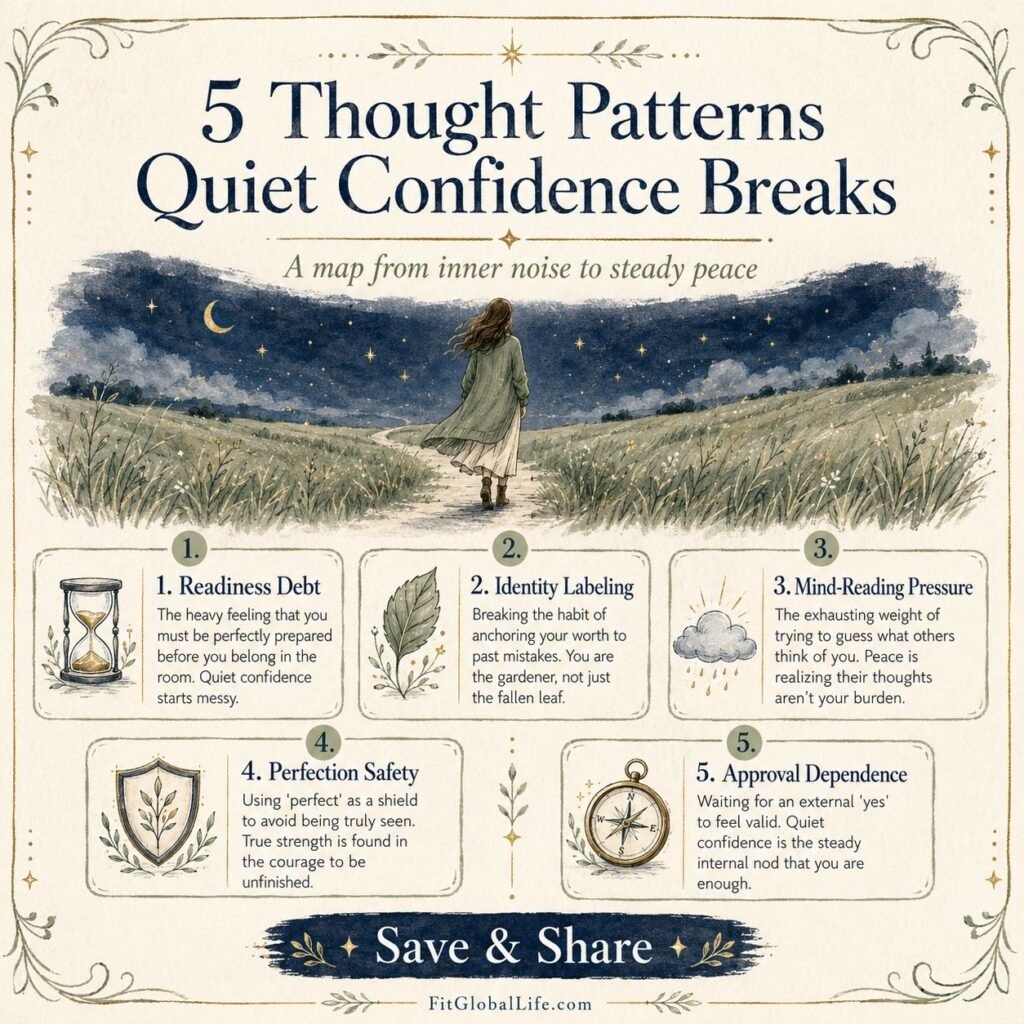
Pattern 1: “I have to feel ready before I act”
The first pattern is confidence debt, the belief that confidence must come before action. It sounds mature because preparation is valuable. But hidden inside it is a trap. You keep taking more notes, watching more videos, rewriting more plans, buying more tools, and waiting for a clean emotional signal that never comes. You do not start because you are not ready. Then you stay unready because you never start. Very efficient. Also rude.
Quiet confidence breaks this by changing the order: action creates confidence. Not reckless action. Not blind action. Small, clean, honest action. If you want to speak more clearly in meetings, confidence does not magically appear after 300 private rehearsals. It appears after you contribute one useful sentence and survive the mild inner earthquake. If you want to publish, confidence grows when you post one thoughtful piece, receive imperfect feedback, and realize you are still alive. If you want to improve health, confidence grows when you complete the boring repeatable habit, not when you finally feel like the ideal version of yourself.
This is where self-efficacy becomes practical. You do not need a global belief that you are amazing. You need task-specific evidence. “I can send the email.” “I can ask one question.” “I can walk for ten minutes.” “I can tell the truth without giving a TED Talk.” Each completed action becomes a receipt. Quiet confidence loves receipts. It is not impressed by vague self-hype; it wants proof that you keep showing up.
A useful question is: What is the smallest action that would make readiness slightly less important? Not the biggest action. Not the most impressive action. The smallest meaningful action. If your brain says, “I need to be ready to record videos,” the smallest action might be recording a 30-second private clip. If it says, “I need to be ready to set boundaries,” the smallest action might be writing the sentence before saying it. If it says, “I need to be ready to change careers,” the smallest action might be one informational conversation.
This pattern also breaks when you stop confusing anxiety with instruction. Anxiety often says, “Wait.” Sometimes that is useful. Often it is simply the body's old alarm system reacting to novelty. The CDC includes breathing, journaling, time outdoors, breaks from upsetting media, and daily gratitude among healthy stress-coping strategies, and these tools can help the body become calm enough for action without requiring total certainty. For a body-based companion to this work, you can pair the cognitive step with a breathwork reset or gentle somatic practices.
Quiet confidence replacement: “I can begin before certainty arrives.” Say it plainly, then prove it small. Your goal is not to become fearless. Your goal is to stop treating fear as the final decision-maker.
A practical reset for readiness debt
- Name the delayed action in one sentence.
- Write the reason you say you are not ready.
- Separate real preparation from emotional permission.
- Choose a 10-minute version of the action.
- Complete it before you revise the plan again.
The last step is the spicy one. Many people revise plans to avoid the emotional risk of acting. Quiet confidence does not ban planning; it puts a timer on it. Plan, then move.
Pattern 2: “One Mistake Means I Am Not Built for This”
The second pattern is identity labeling. It turns events into identities. You make a mistake, and the mind says, “I am careless.” A pitch gets ignored, and it says, “I am not persuasive.” You skip a workout, and it says, “I have no discipline.” Someone responds coldly, and it says, “I am too much.” One event becomes a biography. That is not insight. That is a courtroom with terrible evidence standards.
Quiet confidence breaks identity labeling by refusing to turn data into a verdict. A mistake may show that a system needs improvement. It may show that you were tired, rushed, unsupported, undertrained, distracted, or trying something genuinely difficult. It does not automatically reveal your worth. This distinction is crucial because shame rarely produces clean learning. Shame makes people hide, deny, quit, or overcompensate. Quiet confidence asks better questions: What happened? What part was mine? What part was context? What can be adjusted next time?
Research and clinical practice around cognitive restructuring are relevant here because the goal is not to replace every negative thought with a fake positive one. It is to examine whether the thought is accurate, useful, and complete. Research on cognitive restructuring shows how therapy often works with beliefs and meaning, not just surface-level optimism. A thought like “I failed” may be accurate in a narrow sense. A thought like “I am a failure” is a meaning the mind added. Quiet confidence challenges the meaning.
This pattern is especially common in high achievers because their identity is often tied to competence. If competence has been your safest currency, mistakes can feel existential. A messy first draft feels like being exposed. A misunderstood comment feels like a loss of status. A low-energy day feels like moral failure. The higher the internal standard, the more ordinary imperfection starts to look like danger.
The healthier move is to build a recovery identity. Instead of “I never mess up,” which is fragile and, frankly, suspicious, the identity becomes “I recover honestly.” That identity can survive real life. It allows you to apologize without collapsing, revise without self-hatred, and learn without turning every error into an identity crisis. This is where emotional strength mind shifts are useful because resilience is not the refusal to feel pain; it is the ability to metabolize pain without becoming permanently smaller.
A simple sentence can help: “This is data, not a verdict.” Use it after a mistake, a rejection, a bad day, or a moment when your inner critic starts writing a dramatic Netflix trailer about your future. Then get specific. What data did the moment provide? Maybe you need more sleep. Maybe the timeline was unrealistic. Maybe you need feedback. Maybe you need to practice the skill in a lower-stakes setting. Maybe you need to stop expecting expert output from beginner reps.
Quiet confidence is not soft on responsibility. It is actually more responsible because it keeps you close enough to the truth to change. Harsh self-labeling feels serious, but it often becomes avoidance wearing a judge’s robe. If you are “just bad at this,” you do not have to improve the system. If you are “a failure,” you do not have to identify the next experiment. Quiet confidence says, “Nope. We are not escaping into shame today. We are learning. Annoying, but effective.”
A practical reset for identity labeling
When a mistake happens, write three columns: event, story, adjustment. The event is what a camera could record. The story is what your mind says it means. The adjustment is the next practical change. For example: Event: I stumbled during a presentation. Story: I am not a good speaker. Adjustment: rehearse transitions and slow down the opening. This one exercise can turn a shame spiral into a training loop.
Pattern 3: “Everyone Is Judging Me”
The third pattern is mind-reading pressure. It assumes other people are watching, evaluating, comparing, and quietly lowering your score. This thought pattern can make ordinary life feel like a performance review. You walk into a room and scan for signs. You post something and monitor reactions. You send a message and analyze punctuation as if you were decoding ancient prophecy. One dry “ok” and suddenly your nervous system is in a board meeting.
Quiet confidence breaks mind-reading by returning you to what you actually know. The mind may say, “They think I am awkward.” What do you know? Maybe they looked away. Maybe they were tired. Maybe they were thinking about lunch. Maybe they were awkward too. The problem is not that people never judge. People do judge sometimes. The problem is that mind-reading treats possibility as proof. Then you start managing imaginary opinions instead of living your actual values.
A calmer alternative is: “I do not need to manage imaginary opinions.” This does not mean you ignore feedback. It means you stop inventing feedback when none has been given. Quiet confidence can receive real feedback because it is not wasting all its energy fighting fictional feedback. This is a major upgrade, emotionally and logistically. Fewer ghost critics. More bandwidth.
The NHS guidance on reframing unhelpful thoughts recommends learning to recognize common unhelpful thinking styles, catching them in the moment, checking them, and changing them. That sequence works well for mind-reading. First, catch the thought: “They are judging me.” Then check it: “What evidence do I have? What else could be true?” Then change the response: “I can stay present without solving their private thoughts.”
Mind-reading pressure often becomes stronger in digital spaces. Online life gives us numbers, silence, seen receipts, delayed replies, reactions, unfollows, and algorithmic weirdness. The mind turns it all into a mirror. If this is part of your pattern, revisit your digital detox protocol and your cognitive sovereignty. Quiet confidence requires some control over what gets permission to shape your self-image. If every notification becomes a referendum on your worth, your confidence will always live in rented space.
A useful practice is the “three explanations rule.” When you feel judged, list three possible explanations for the other person's behavior. They might be judging you. They might be distracted. They might be insecure. They might be dealing with something private. They might have a face that looks unimpressed at rest. The goal is not to prove the positive explanation. The goal is to loosen the false certainty of the negative one.
Another practice is value anchoring. Before you enter a room, post a piece of content, speak up, or have a hard conversation, write one value you want to embody. Maybe clarity. Maybe kindness. Maybe courage. Maybe curiosity. Then measure the moment by that value, not by guessed approval. Did you speak honestly? Did you stay respectful? Did you ask the question? Did you share the work? Quiet confidence grows when your scorecard comes from your values rather than imagined applause.
This is also where the body matters. If the body is activated, the mind becomes more likely to detect threat. For some readers, mind-reading is not just a thought; it is a social nervous-system response. Practices like interoception skills can help you notice what is happening internally before you assign it to someone else's opinion. A tight throat does not always mean rejection. It might mean activation. Warm face does not always mean humiliation. It might mean your body is mobilizing.
A practical reset for mind-reading pressure
Use this sentence: “I am having the thought that they are judging me.” That small phrase creates distance. You are not declaring the thought true; you are noticing it as a mental event. Then ask, “What would I do next if I did not have to manage their imagined opinion?” The answer is usually simple: finish the sentence, send the message, ask the question, continue the work, or leave with dignity.
Pattern 4: “If It Is Not Excellent, It Is Unsafe”
The fourth pattern is perfection safety. It does not say, “I enjoy excellence.” That would be fine. It says, “If this is not excellent, I am unsafe.” The difference is huge. Excellence can be inspiring. Perfection safety is exhausting. It turns every output into a threat assessment. A simple email becomes a legal document. A first draft becomes a moral test. A workout becomes worthless unless it is optimized. A social post becomes unacceptable unless it is brilliant. Suddenly you are not improving; you are negotiating with a tiny perfectionist lawyer in your head.
Quiet confidence breaks the perfection-safety trap by separating quality from self-protection. You can care about quality without using perfection as emotional armor. You can revise the article, practice the speech, improve the design, or prepare the proposal without believing imperfection will destroy your belonging. This is not lowering standards. It is removing panic from the standard.
Perfection safety often hides inside noble language: “I just have high standards.” Maybe. But high standards produce better work. Perfection safety often produces late work, hidden work, overworked work, or no work. If your standards make you more honest, skilled, and consistent, they are probably healthy. If they make you avoid, freeze, resent, or endlessly polish things no one has asked you to polish, they may be fear in a tailored suit.
The quiet-confidence replacement is: “Good enough can still be honest and useful.” This sentence is not an excuse for laziness. It is an antidote to paralysis. Many meaningful things start as good enough: the first walk after burnout, the first therapy appointment, the first budget, the first awkward boundary, the first draft, the first meal prep, the first quiet morning routine. A life changes through repeated usefulness more often than through a single perfect performance.
If perfection safety is connected to mental fog or too many inputs, strengthen the basics first. The site already has guides on health habits that age well and on the science of self-care, because confidence is not separate from sleep, energy, attention, food, movement, and recovery. A depleted brain becomes dramatic. A rested brain is still annoying sometimes, but at least it has better battery life.
Self-compassion is also important here. Harvard Health describes self-compassion as showing care toward yourself when you suffer, fail, or feel inadequate, and notes that it is a learnable skill. A meta-analysis of self-compassion interventions also found effects on reducing depressive symptoms, anxiety, and stress, which makes self-compassion more than a soft slogan. For perfection, safety, and self-compassion, it's not about letting yourself off the hook. It is about staying regulated enough to stay on the hook without tearing yourself apart.
Try this distinction: high standards ask, “What would make this better?” Perfection safety asks, “What will keep me from being criticized?” High standards are connected to craft. Perfection safety is connected to threat. High standards can stop when the work is useful. Perfection safety keeps moving the finish line because the real goal is not excellence; it is immunity from discomfort. Spoiler: immunity from discomfort is not available. We checked—terrible subscription model.
A practical reset for perfection safety
Choose a definition of done before you start. For example: “This draft is done when it has a clear intro, five useful sections, credible sources, and one final edit.” Or: “This workout is done when I move for twenty minutes.” Or: “This conversation is done when I state the need and listen to the response.” A definition of done protects you from emotional over-editing. Quiet confidence does better with clear finish lines.
Pattern 5: “If I Say No, I Will Lose Approval”
The fifth pattern is approval dependence. It makes your nervous system treat other people's comfort as your assignment. You say yes when you mean no. You over-explain simple boundaries. You apologize for needs that are not wrong. You become available at the cost of resentment. Then, because resentment feels ugly, you call it kindness and keep going. Been there, bought the emotionally exhausted T-shirt.
Quiet confidence breaks approval dependence by making room for respectful disappointment. This is a big one. Many people do not fear boundaries because they lack communication skills. They fear boundaries because they believe another person's disappointment means danger. The thought sounds like, “If they are upset, I did something wrong.” But disappointment is not always evidence of wrongdoing. Sometimes it is evidence that two people have different needs.
The quiet-confidence replacement is: “A clear boundary is not cruelty.” It may be inconvenient. It may require adjustment. It may disappoint someone who preferred the old pattern. But clarity is not harm. In fact, unclear resentment often damages relationships more than direct honesty does. When you say yes while silently building a case against someone, the relationship does not become safer; it becomes foggier.
Approval dependence often grows from adaptive roots. Maybe being agreeable kept peace in your family. Maybe you learned that praise came when you were useful. Maybe conflict felt unsafe. Maybe your work culture rewards constant availability. Quiet confidence does not mock those origins. It respects that the pattern once helped, then asks whether it is still allowed to run the whole system.
One way to practice is the short boundary. Many people make boundaries too long because they are trying to control the listener's reaction. A quiet boundary can be simple: “I cannot take that on this week.” “I need more notice next time.” “I am not available after 7 p.m.” “I am going to rest today.” “That does not work for me.” You can be kind without building a 14-slide presentation defending your humanity.
This connects closely with social health. If someone only values the version of you with no limits, the relationship may need to be reviewed. A supportive connection should make boundaries possible, not automatically punish them. Readers working on relational confidence may benefit from exploring micro-communities for mental longevity, as confidence is easier to build around people who respect reality rather than just performance.
Approval dependence also has a body signature. You may feel guilt in your stomach, pressure in your chest, heat in your face, or a sudden urge to soften the boundary before the other person even responds. This is a perfect place to use nervous system habits and mind-body recovery. Regulation does not make boundaries effortless, but it gives your body a chance to learn that honesty can be survivable.
A practical reset for approval dependence
Write the boundary in three versions: too harsh, too soft, and clear. Too harsh might attack. Too soft might apologize for existing. Clear states the limit and, when appropriate, the next option. Example: Too strong: “Stop this.” Too soft: “Sorry. I can try maybe. I feel bad.” Clear: “I cannot take this on today. I can look at it Friday.” Quiet confidence lives in the clear version.
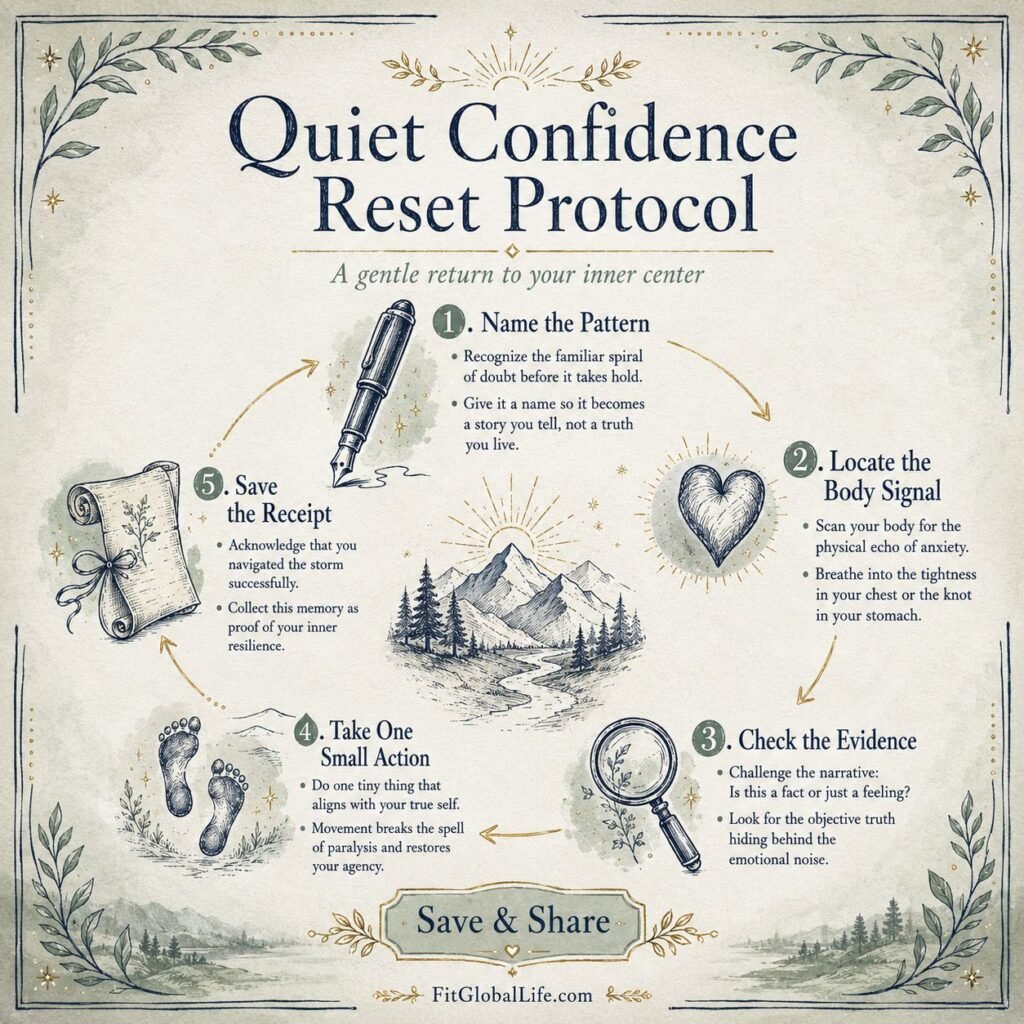
How Quiet Confidence Breaks a Pattern in Real Time
The five patterns are easier to understand on paper than in a real Tuesday afternoon when someone sends a vague message, your deadline moves, your body is tired, and your inner critic suddenly gets a microphone. So here is a simple real-time protocol.
First, pause long enough to identify the pattern. You can say, “This is readiness debt,” or “This is mind-reading,” or “This is perfection safety.” Naming is powerful because it turns the thought from reality into an object you can work with. You are no longer inside the thought; you are observing the thought.
Second, locate the body response. Is the thought living in your chest, jaw, stomach, throat, shoulders, or breathing? This matters because an activated body can keep feeding the thought even after the rational mind has argued with it. If the body is loud, do not debate the thought for twenty minutes. Regulate first. Step outside, breathe slowly, stretch, drink water, or reduce stimulus. The daily health article on climate anxiety explains how stress at the macro level can show up in the micro of the body when it is tied to greater social or environmental unpredictability.
Third, ask for evidence and alternatives. Not forced positivity. Evidence. What do you know? What are you assuming? What else could explain this? What has happened before? What would you tell a friend? This is where cognitive reframing becomes practical. The goal is not to win a debate with your mind. The goal is to loosen the thought enough to choose a wiser action.
Fourth, take one value-aligned action. Quiet confidence is built by action after reframing. If you only think about thinking, you can become very insightful and still stuck. The action might be sending the message, taking the walk, asking for clarification, closing the laptop, publishing the draft, setting the boundary, or sleeping instead of doom-scrolling. Make the action small enough to do and meaningful enough to count.
Fifth, store the evidence. This is the part people skip. After the action, write down what happened. “I asked the question and the meeting continued.” “I posted, and one person found it useful.” “I said no and the world did not explode.” “I made a mistake and repaired it.” Evidence needs a place to land. Over time, these notes become the quiet-confidence archive your future self can borrow from.
If you want a broader weekly structure, pair this protocol with micro-retreats for mental clarity or redesign the first hour of the day with neuro-architect your morning. Confidence is easier when your environment stops ambushing your attention every five minutes.
A 7-Day Quiet Confidence Practice Plan
| Day | Pattern to notice | Small practice | Evidence to record |
| Day 1 | Readiness debt | Do a 10-minute version of one delayed task. | What action became possible before you felt ready? |
| Day 2 | Identity labeling | Turn one self-label into event, story, adjustment. | What did the mistake actually teach? |
| Day 3 | Mind-reading pressure | List three explanations for someone's behavior. | Which assumption softened? |
| Day 4 | Perfection safety | Define “done” before starting a task. | Did the clear finish line reduce over-editing? |
| Day 5 | Approval dependence | Say one clear, respectful no or not-now. | What happened after the boundary? |
| Day 6 | Body awareness | Track where self-doubt shows up physically. | What signal did your body give before the thought intensified? |
| Day 7 | Evidence archive | Review the week's receipts. | What proof of self-trust can you carry forward? |
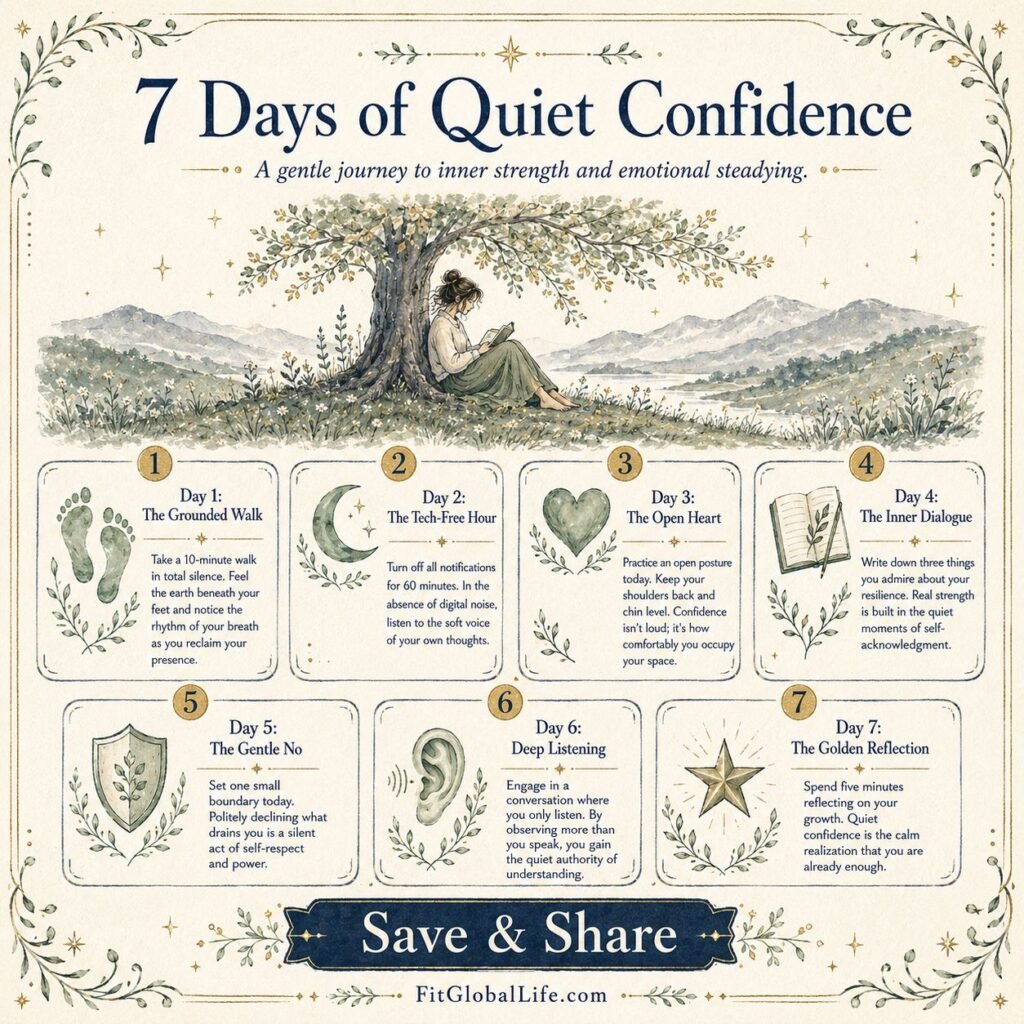
This plan is intentionally small. Quiet confidence does not need a dramatic personality rebrand. It needs repeated moments where you stop abandoning yourself. Seven days will not erase every old pattern, but it can prove something important: you are not required to obey the first thought your mind serves you. Sometimes the first thought is just the opening bid.
Common Signs Quiet Confidence Is Growing
Quiet confidence often grows quietly. Shocking, I know. You may not suddenly become the loudest person in the room. You may stop shrinking so fast. You may notice a critical thought and recover within 10 minutes, rather than 3 days. You may ask for clarification instead of spiraling. You may publish the useful thing before it becomes perfect. You may let someone be mildly disappointed without immediately betraying your boundary.
Another sign is cleaner energy. When you stop performing with certainty, you save energy. When you stop managing imaginary opinions, you save energy. When you stop turning every mistake into a personality trial, you save energy. This energy can return to craft, relationships, movement, rest, and creativity. That is one reason quiet confidence is not just a mindset topic; it is a wellness topic.
You may also become less attracted to fake confidence. Loud certainty can start to feel less impressive when you have tasted groundedness. You begin to notice the difference between someone who dominates a room and someone who can stay honest in one. You stop confusing noise with authority. You stop assuming that the most visible person is the most secure. This is a major upgrade in perception.
Finally, quiet confidence changes how you handle fear. Fear becomes information, not identity. It can still be uncomfortable. It can still slow you down. But it no longer automatically means stop, hide, please, perfect, or apologize. It becomes one voice in the meeting, not the CEO.
Conclusion: Quiet Confidence Is Built in the Moment You Do Not Abandon Yourself
The five thought patterns that quiet confidence breaks are common because they are protective. Readiness debt protects you from exposure. Identity labeling protects you from repeated disappointment by making quitting feel logical. Mind-reading protects you from rejection by trying to predict it early. Perfect safety protects you from criticism. Approval dependence protects you from conflict. The problem is that these protections often become cages.
Quiet confidence opens the cage without pretending the world is harmless. It says prepare, but do not wait forever. Learn from mistakes, but do not become them. Notice other people, but do not live inside their imagined opinions. Care about quality, but do not use perfection as armor. Love people, but do not trade your limits for temporary approval.
The next time one of these thought patterns appears, do not panic. Recognize it. Name it. Check it. Regulate the body. Take one small action that proves you can stay with yourself. That is the real flex. Not loud. Not flashy. Extremely powerful.
FAQ
Quiet confidence is grounded in self-trust. It means you can act, speak, choose, repair, and learn without needing constant external validation or perfect certainty. It is not arrogance or emotional numbness. It is the ability to stay steady enough to do the next honest thing.
Yes, especially if the overthinking is driven by fear of making mistakes, judgment, rejection or uncertainty. Quiet confidence helps here by transforming vague mental loops into specific questions and small actions. More support can be found in the site’s guide on cognitive load reduction blueprints and mental fitness drills.
Not really. Self-esteem is often used to mean how good you generally feel about yourself. Quiet confidence is more practical and situational. It’s closer to self-trust and self-efficacy: the belief that you can manage a specific moment, bounce back from mistakes, and keep acting in alignment with your values.
Then, be kind to yourself and consider professional support. Thought-pattern work can be useful, but it’s not a substitute for therapy, trauma-informed care, or medical support when symptoms are strong, persistent, or interfering with daily life. Confidence should not become another reason to be hard on yourself.
It depends on the pattern, the context, and your support system. Some people feel a shift after a few small actions. Deeper patterns can take months of repeated practice. The goal is not instant transformation. The goal is to build evidence that you can trust yourself in more situations than before.
Disclaimer
This article is for educational and informational purposes only. It is not medical advice, a mental health diagnosis, psychotherapy, or a substitute for professional care. If you are experiencing persistent, severe self-doubt, anxiety, depression, trauma responses, panic or intrusive thoughts that are interfering with your daily life, please seek help from a licensed mental health professional or qualified healthcare provider. If you are in danger or are thinking about hurting yourself, please call your local emergency services or a crisis hotline in your country immediately.