Nature retreats are often sold as escape: cabins, waterfalls, linen robes, dramatic before-and-after promises, and a price tag that quietly asks your credit card to breathe through it. But the better question is not, “Where can I disappear?” It is, “What kind of environment helps my nervous system remember safety?” That distinction matters. A gentle nervous reset is not a personality makeover. It is a shift from chronic bracing into steadier breathing, clearer attention, warmer social connection, and more flexible energy.
This guide is for the person who does not need another overpacked vacation pretending to be wellness. You may be tired, overstimulated, emotionally flat, screen-soaked, or simply carrying too many tabs in your head. The goal here is not to chase extreme biohacking, punish yourself with silence, or collect another “healing journey” badge for Instagram. The goal is to match the right natural setting to the specific kind of stress your body is holding.
The science is promising but also more nuanced than the wellness industry sometimes admits. A large Scientific Reports study of 19,806 adults found that spending at least 120 minutes per week in nature was associated with better self-reported health and well-being, but this does not mean two hours magically cures burnout. It means nature contact can become a practical baseline, especially when it is repeated and low-friction. Read the original findings on weekly nature exposure and wellbeing.
A broader review on nature exposure and health links natural environments with lower stress, improved mood, reduced rumination, and healthier patterns of physical activity. The CDC also notes that parks and green spaces can support physical activity, reduce stress, improve mental health, and strengthen community connection when they are safe and accessible; see its public-health guidance on parks, recreation, and green spaces. Translation: nature helps most when it is not treated as a luxury object. Your nervous system does not care whether the trees are boutique. It cares whether the environment lowers threat, restores rhythm, and lets your senses come back online.
Below are seven nature retreats for a gentle nervous reset, each matched to a different nervous-system need. You will find not only destination ideas, but also the physiological logic, who it is best for, what to avoid, and how to integrate the benefits after you return to real life—because the inbox will still be there, rude but loyal.
Why Nature Retreats Work Differently Than Another Vacation
A normal vacation can be wonderful and still fail to restore you. The flight is early, the itinerary is ambitious, the food is irregular, the sleep is strange, and the camera roll becomes a productivity dashboard. Nature retreats work differently when they reduce cognitive load instead of adding novelty for novelty’s sake. The nervous system is constantly reading cues: sound, light, temperature, facial expressions, physical distance, movement, and predictability. When those cues feel less threatening, the body can shift toward recovery.
Think of your nervous system as less of a switch and more of a weather system. You do not “turn off stress” because someone handed you herbal tea. You influence conditions. Forest shade changes temperature and glare. Ocean rhythm slows breathing. Soft trails create movement without performance pressure. Birdsong and wind provide texture without the sharpness of alerts, traffic, or open-plan office noise. That is why a well-designed retreat should feel less like a schedule and more like a nervous-system climate.
The National Park Service summarizes several nature benefits, including attention restoration, mood support, physical activity, and cognitive performance, especially when people walk or exercise in green settings. For readers who want a practical bridge between research and public education, its overview on how nature supports attention and productivity is useful. This does not make nature a replacement for medical or psychological care. It makes nature a highly underrated setting for recovery behaviors that humans already need: movement, daylight, quiet, social connection, sleep, play, and sensory variety.
The word “gentle” is doing real work here. Some retreats are intense on purpose: fasting, cold exposure, strict silence, plant-medicine ceremonies, long hikes, sleep restriction, or emotionally heavy group processing. Those may be appropriate for some people under the right guidance, but they are not automatically better. If your system is already overloaded, more intensity can become another stressor wearing a spiritual hat. For a calmer starting point, pair this article with FitGlobalLife’s guide to wellness retreat planning questions before booking anything expensive or remote.
A gentle reset is usually built from four elements: sensory downshifting, predictable rhythm, safe movement, and integration. Sensory downshifting lowers the amount of sharp input. Predictable rhythm stabilizes meals, sleep, light exposure, and rest. Safe movement releases stress chemistry without turning the trip into an athletic performance. Integration means you return home with one or two behaviors you can actually keep, not a suitcase full of promises and one morally superior journal.
The Gentle Nervous Reset Framework: 7 Nature Retreats and Their Best Use Cases
| Retreat Type | Best For | Primary Reset Mechanism | Avoid |
| Forest bathing retreat | Overthinking, body tension, shallow breathing | Slow walking, tree canopy, scent, sound | Overscheduling “healing activities” |
| Blue-space coastal retreat | Emotional heaviness, grief, irritability | Wave rhythm, horizon gaze, salt air, swimming or shore walking | Turning it into a party beach vacation |
| Mountain silence retreat | Attention fatigue, notification addiction, mental clutter | Quiet altitude, wide views, low social demand | Choosing silence when you need support |
| Farm-and-soil retreat | Disembodiment, burnout from screen work | Hands-on tasks, meal rhythm, soil contact, local food | Romanticizing labor or ignoring allergies/safety |
| Dark-sky wilderness retreat | Circadian drift, existential flatness, awe deprivation | Darkness, stars, earlier nights, low artificial light | Staying up too late for the perfect photo |
| Walkable green-city retreat | Need recovery but cannot take long leave | Urban parks, botanical gardens, low-friction walking | Packing the weekend like a conquest |
| Guided somatic nature retreat | Stress stored as body vigilance or freeze | Trauma-informed facilitation, breath, interoception, choice | Unqualified facilitators promising instant breakthroughs |
Use this framework like a menu, not a personality quiz. A coastal retreat can help attention. A forest retreat can soften grief. A farm stay can improve sleep. But the categories give you a practical starting point, especially if you are choosing between many beautiful options that all claim to be “transformational.” In wellness travel, vague promises are everywhere. Specific recovery needs are your filter.
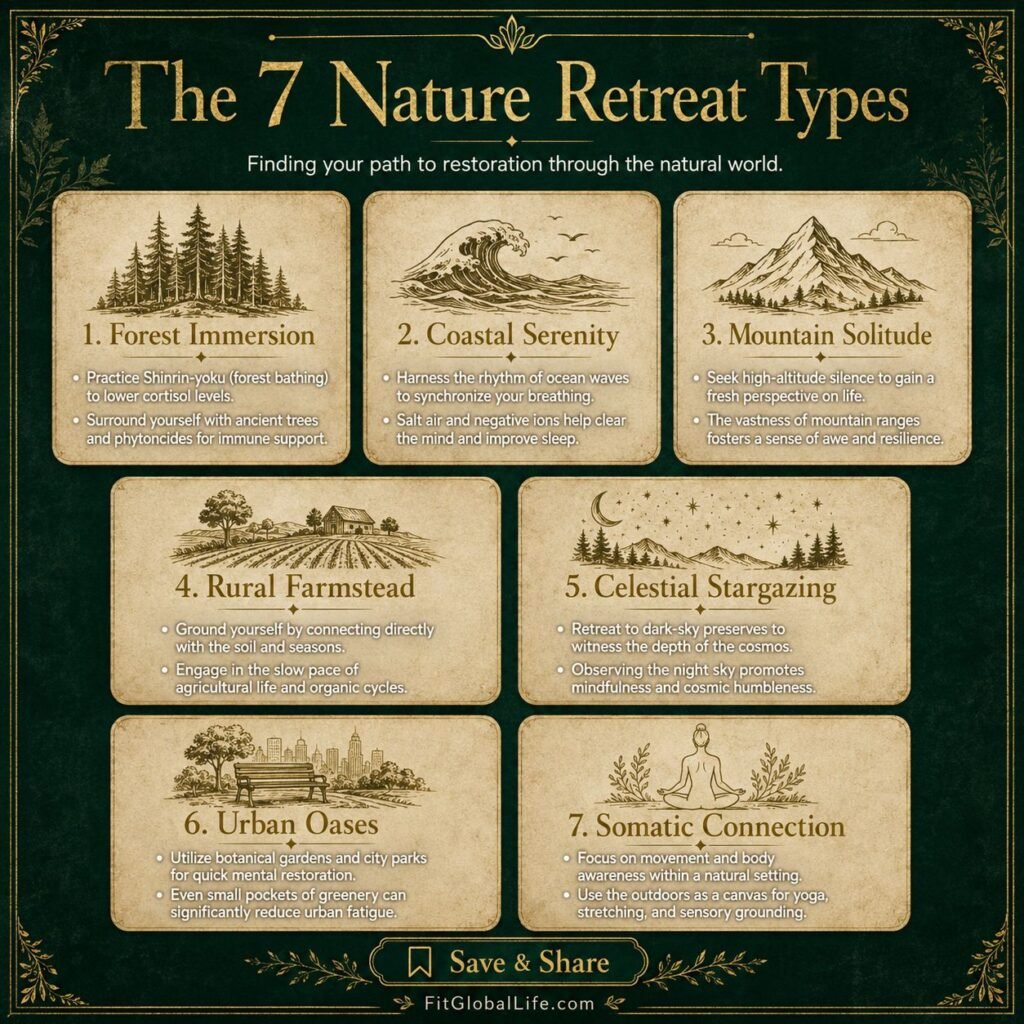
1. Forest Bathing Retreats: For a Body That Forgot How to Exhale
Forest bathing, or shinrin-yoku, is not hiking with better branding. The practice is closer to slow sensory immersion: walking without rushing, noticing texture, breathing under canopy, hearing layered sound, and letting the body move at a pace below achievement mode. A review of forest bathing research describes possible psychological and physiological benefits, including anxiety reduction and parasympathetic activation; see the review on forest bathing and parasympathetic responses. A PubMed-indexed meta-analysis also reported that forest bathing may reduce short-term cortisol levels, though the authors called for more research and noted placebo effects may play a role; read the paper on forest bathing and cortisol.
This is the retreat type for people whose stress shows up as muscular armor: tight jaw, shallow breath, high shoulders, digestive tension, and constant mental rehearsal. The forest does not demand eye contact. It does not ask you to explain yourself. It simply offers repetitive, nonthreatening stimuli: bark, moss, shadow, breeze, roots, birds, rain. The nervous system often responds well to that kind of sensory reliability. It is nature’s version of “no meeting today.” Already iconic.
A good forest retreat should be structured around slowness. Look for guided forest therapy walks, optional journaling, simple meals, quiet evenings, and access to easy trails rather than summit-driven hiking. The goal is not elevation gain. The goal is permission to stop scanning. If the retreat itinerary includes back-to-back workshops, sunrise intensity, and a “transform your life by lunch” energy, run gently in the opposite direction.
Best practices are simple. Arrive with your phone already on low-power mode. Spend the first hour walking slower than feels normal. Use a five-sense check-in: three things you see, two things you hear, one thing you feel through the soles of your feet. Eat enough. Hydrate. Nap if the body asks. If your mind gets louder at first, that is not failure. It may simply be the sound of your system downshifting after weeks or years of noise.
A forest retreat pairs well with simple somatic practices and breathwork before arrival. It becomes more effective when you know what to do with your body besides “relax,” which is possibly the least relaxing command ever invented.
Who should be cautious? Anyone with severe depression, active trauma symptoms, high anxiety around isolation, mobility limitations, or medical conditions affected by terrain and climate should choose guided, accessible options and consult a qualified professional when needed. Forest silence can be soothing, but it can also reveal emotions that have been hidden under busyness. Gentle does not mean unstructured neglect. It means supported simplicity.
2. Blue-Space Coastal Retreats: For Emotional Softening and Breath Rhythm
Blue-space retreats center water: coastlines, lakes, rivers, wetlands, hot springs, and quiet islands. Water has a different nervous-system signature from forests. Forests wrap you. Water opens you. The horizon widens visual attention. Waves create rhythm. The air changes. The body often begins to breathe with the environment before the mind has finished negotiating. A systematic review on blue-space mechanisms and health summarizes evidence that blue spaces may support restoration, physical activity, social connection, and psychological well-being.
A coastal retreat is especially helpful when stress has become emotional rigidity: irritability, grief, numbness, resentment, or the sense that you are always “holding it together.” Watching water gives the mind something gentle to follow. Not too boring, not too demanding. Environmental psychologists sometimes describe this as soft fascination: attention is held without being hijacked. That is the opposite of social feeds, where attention is not held but kidnapped and sold back to you with ads.
The best blue-space retreat does not need to be luxurious. A clean guesthouse near a quiet beach can do more than a resort where every hour becomes content production. Look for tide walks, simple swimming, kayak options, coastal trails, water-view meditation, and early nights. Avoid party coasts, cruise-like itineraries, and resorts where the natural environment is decorative rather than accessible. The point is not to look relaxed in linen. The point is to let the body match rhythm with something older than your calendar.
Try a 20-minute horizon practice: sit or stand where you can see water movement, soften your jaw, and let your eyes rest beyond the near field. Do not force deep breathing. Let the exhale lengthen naturally. If tears come, let them. If boredom comes, let that too. Many overstimulated people mistake boredom for danger because the brain has been trained to expect constant input. Water helps retrain that expectation.
For readers planning travel with recovery in mind, FitGlobalLife’s guide to walkable cities for a travel reset can help you build lower-stress movement into a coastal itinerary. If your emotional load is tied to screen overload, add a light version of a seven-day digital detox structure rather than trying to quit your entire digital life in one dramatic weekend. Dramatic detoxes look good in captions and fall apart by Tuesday.
Safety matters. Swim only where conditions are safe. Respect tides. Find a safe place, solo traveler. If you are in deep grief or processing, go to a retreat with a good facilitator or at least close access to support, not alone. Water can soften the emotional body, but you still deserve practical containment.
3. Mountain Silence Retreats: For Attention Fatigue and Overstimulation
Mountain silence retreats are for the mind that has been sandblasted by notifications, obligations, and decision fatigue. The appeal is not just scenery; it is reduced signal density. Fewer signs, fewer voices, fewer commercial cues, fewer choices. Mountains create scale. They remind the mind that not every thought deserves a press conference.
This retreat type supports people dealing with attention debt: the cumulative fatigue that comes from fragmented focus. FitGlobalLife has a deeper guide on attention debt recovery, and nature-based silence is one way to stop borrowing from tomorrow’s attention. In a mountain setting, attention is invited outward without being grabbed. The eye follows ridgelines. The ear catches wind. The body feels slope and temperature. These are rich inputs, but they are not frantic.
A silence retreat does not have to mean complete monastic silence. For nervous-system recovery, “low verbal demand” may be enough: meals without small talk, solo walking periods, no group sharing unless optional, quiet mornings, and digital boundaries. Some people need silence; others need warm guidance with fewer words. Know which one you are. If silence feels punishing or unsafe, choose a guided contemplative retreat rather than a remote cabin where your thoughts can start a group chat without permission.
FitGlobalLife’s article on silent retreat readiness is worth reading before choosing this path. Silence can restore attention, but it can also amplify unresolved anxiety. The key is dosage. A two-hour silent hike may be perfect. Seven days alone may be too much. The nervous system loves challenge only when it also senses choice, exit, and support.
Design your mountain reset around simple anchors: daylight walk after breakfast, warm lunch, rest, short contemplative practice, early dinner, offline evening, consistent bedtime. Avoid heroic hikes unless your body is trained. Exhaustion is not regulation. Pain is not proof. You are not there to win the mountain. The mountain has been there longer and has better posture.
One unique benefit of mountain settings is awe. A growing body of research suggests awe can shift attention away from self-preoccupation and toward connection, meaning, and humility. Seen through the lens of awe as biological repair, mountain views can create a healthy psychological re-scaling: your problems may remain real, but they stop filling the whole screen.
4. Farm-and-Soil Retreats: For Grounding, Rhythm, and Sensory Repair
Farm-and-soil retreats are underrated because they do not always look glamorous. There may be mud. There may be chores. There may be vegetables that had the audacity to exist before branding. But for people burned out by abstraction—spreadsheets, strategy decks, metrics, endless content loops—working near soil can bring the body back into sequence: wake, move, harvest, cook, eat, rest.
This retreat is ideal for disembodiment. You know the feeling: your head is online, your body is a chair accessory, and meals are interruptions rather than nourishment. Farm settings restore contact with materials: soil, water, leaves, wood, fruit, grain, animals, weather. The feedback is immediate. If you water plants, the soil changes. If you knead dough, texture responds. If you pick herbs, scent arrives before thought. The nervous system often calms when action and consequence become visible again.
There is also a nutrition bridge. Retreat meals built around seasonal whole foods can support stable energy, especially when they reduce ultra-processed snacks and irregular eating. This article should internally connect to FitGlobalLife’s piece on regenerative soil and food vitality because the farm retreat is not only about scenery; it is about the ecosystem behind the meal.
The right farm retreat should not romanticize labor. Look for clear expectations, humane schedules, safety guidance, and optional participation. A few hours of low-intensity gardening can be grounding. Eight hours of unprepared field work is not a retreat; it is a plot twist. People with allergies, asthma, back pain, heat sensitivity, or immune concerns should check conditions before booking. Also, if animals are involved, ethical treatment should be non-negotiable.
A simple farm reset practice: spend one meal per day eating without a phone, naming the origin of each item as best you can. Tomato from garden. Rice from region. Eggs from farm. Herbs from path. This practice is not about purity. It is about reconnection. Stress narrows the world to threats and tasks; food origin widens it back into relationship.
For post-retreat integration, borrow from health habits that age well: lower the friction of the next healthy choice. The real win is not becoming a different person for three days. The win is returning home with a rhythm you can actually repeat: morning daylight, regular meals, a weekly market walk, a small herb pot, or one screen-free dinner. Tiny habits beat dramatic reinventions because tiny habits actually survive contact with Monday.
5. Dark-Sky Wilderness Retreats: For Circadian Recovery and Awe
Dark-sky retreats are not just for astronomy lovers. They are for people whose internal clock has been bullied by artificial light, late-night scrolling, irregular sleep, and the strange modern habit of treating midnight like a second afternoon. A dark-sky retreat uses low artificial light, earlier evenings, natural darkness, and star exposure to rebuild respect for the body’s timing systems.
This retreat type works best for people with sleep drift, existential flatness, and awe deprivation. Darkness changes behavior. You slow down because there is less to do. You speak softer. You notice temperature. You look up. If the sky is clear, stars create scale in a way no motivational quote can. For readers who want to plan the night-sky version carefully, explore dark-sky travel for overstimulated minds before booking a remote stay.
The science of sleep is more complex than “darkness fixes everything,” but light exposure timing matters. A retreat that reduces evening light while increasing morning daylight can support circadian consistency. The same lesson can come home through sleep-friendly room design: dimmer evenings, cooler rooms, less screen glare, and a bedroom that does not behave like a mini command center.
A dark-sky reset itinerary should begin before sunset. Eat early. Walk at dusk. Put phones away before the sky becomes the main event. Use red-light settings only when needed. Do not turn stargazing into content labor. The nervous system does not reset while you are performing wonder for strangers. Let awe be private sometimes. Revolutionary, honestly.
Pair this retreat with low-stimulation days. Avoid caffeine late in the day. Keep alcohol minimal or absent, because it can fragment sleep even when it makes you sleepy at first. Bring layers. Choose safe, guided locations if wildlife, terrain, or navigation are concerns. Dark is healing only when it feels safe enough. If remote wilderness creates fear, choose a certified dark-sky lodge or observatory-adjacent retreat instead of camping alone.
The psychological gift of a dark-sky retreat is perspective. Under a full star field, the mind often stops pretending it controls everything. That can be humbling in the best way. Your deadlines are real. Your worries are real. But they are not the entire cosmos. Sometimes the reset is not relaxation; it is proportion.
6. Walkable Green-City Retreats: For People Who Cannot Disappear for a Week
Not everyone can fly to a forest lodge or coastal sanctuary. Time, money, caregiving, mobility, work, visas, and health constraints are real. A walkable green-city retreat is the practical answer: a low-cost, low-friction reset built around urban parks, botanical gardens, riverside paths, quiet cafés, libraries, local markets, and phone-light boundaries. It is less cinematic than a mountain cabin, but it may be more repeatable. Repeatable is sexy in a long-term-health kind of way.
Public-health organizations increasingly recognize that access matters. The WHO report on urban green spaces and health describes green spaces as important urban resources for mental and physical health. The CDC similarly emphasizes safe, equitable, and inclusive access to parks and trails. These sources are important because nature retreat culture can accidentally become elitist. A nervous reset should not require a passport and a trust fund.
The green-city retreat is best for people who need recovery but cannot tolerate travel logistics. Choose a neighborhood with tree-lined walks, a quiet hotel or guesthouse, healthy simple food nearby, and at least two nature anchors: a park, river, garden, cemetery path, waterfront, or urban forest. Your itinerary should look almost suspiciously simple: wake, walk, breakfast, rest, museum or garden, lunch, nap, sunset walk, early dinner, offline evening.
This is where micro-retreats that still matter and a nearby weekend reset become practical, not lesser, options. Micro-recovery is not second-class recovery. Sometimes the best reset is the one close enough to repeat monthly.
To make it work, remove the two things that usually destroy urban rest: shopping-as-distraction and itinerary inflation. You do not need six neighborhoods, four restaurants, three galleries, and a heroic step count. You need nervous-system contrast: fewer alerts, more trees, slower meals, softer sound, and enough walking to metabolize stress without chasing exhaustion.
A green-city retreat can also support social regulation. Meet one calm friend for tea. Join a slow walking tour. Sit in a public garden where you feel safely anonymous. Human nervous systems regulate partly through other nervous systems, but not all social contact is regulating. Choose people and places that do not make your body brace.
7. Guided Somatic Nature Retreats: For Safety, Regulation, and Integration
Guided somatic nature retreats combine natural settings with body-based practices: breath awareness, gentle mobility, grounding, interoception, mindful walking, trauma-informed choice, and sometimes group reflection. This is the most appropriate option for people who know they need support, not just scenery. It is especially useful when stress shows up as vigilance, freeze, dissociation, shutdown, or difficulty sensing what the body needs.
Somatic work can be powerful because the nervous system is not only cognitive. You cannot think your way out of every stress response. Sometimes the body needs orientation, movement, warmth, pressure, sound, breath, and relational safety. FitGlobalLife has several internal supports for this section, including vagus nerve regulation basics, interoception as a stress compass, and hip mobility and emotional release.
The non-negotiable factor is facilitator quality. Look for credentials, clear scope of practice, trauma-informed language, consent-based exercises, transparent pricing, realistic claims, and referral pathways for mental-health support. Avoid anyone promising instant nervous-system “rewiring,” guaranteed trauma release, or one-week enlightenment. Your body is not a software update. It deserves respect, pacing, and choice.
A guided retreat should include integration time. This means not only what happens during the retreat, but what happens after: a home practice, a check-in, a list of signs that you are overactivated, and simple ways to return to regulation. That is where everyday mind-body recovery matters, because the real test is not how calm you feel on a beautiful deck. The test is whether you can access even 10 percent of that calm during a normal Tuesday.
For parents or caregivers, the lessons can extend to family life. A person who learns to notice their own activation may respond differently to a child, partner, or aging parent. This is why family nervous-system regulation is a useful follow-up for readers who are not just healing for themselves, but trying to create calmer relational spaces.
This retreat is also the one where “gentle” matters most. Some people need slow exposure to body sensation because the body has not always felt safe. The best facilitators understand that regulation is built through titration: a little sensation, then orientation; a little emotion, then grounding; a little story, then present-time safety. Nature helps because it offers external anchors: trees, stones, wind, horizon, ground. The body learns: I am here, now, and there is more than the stress.
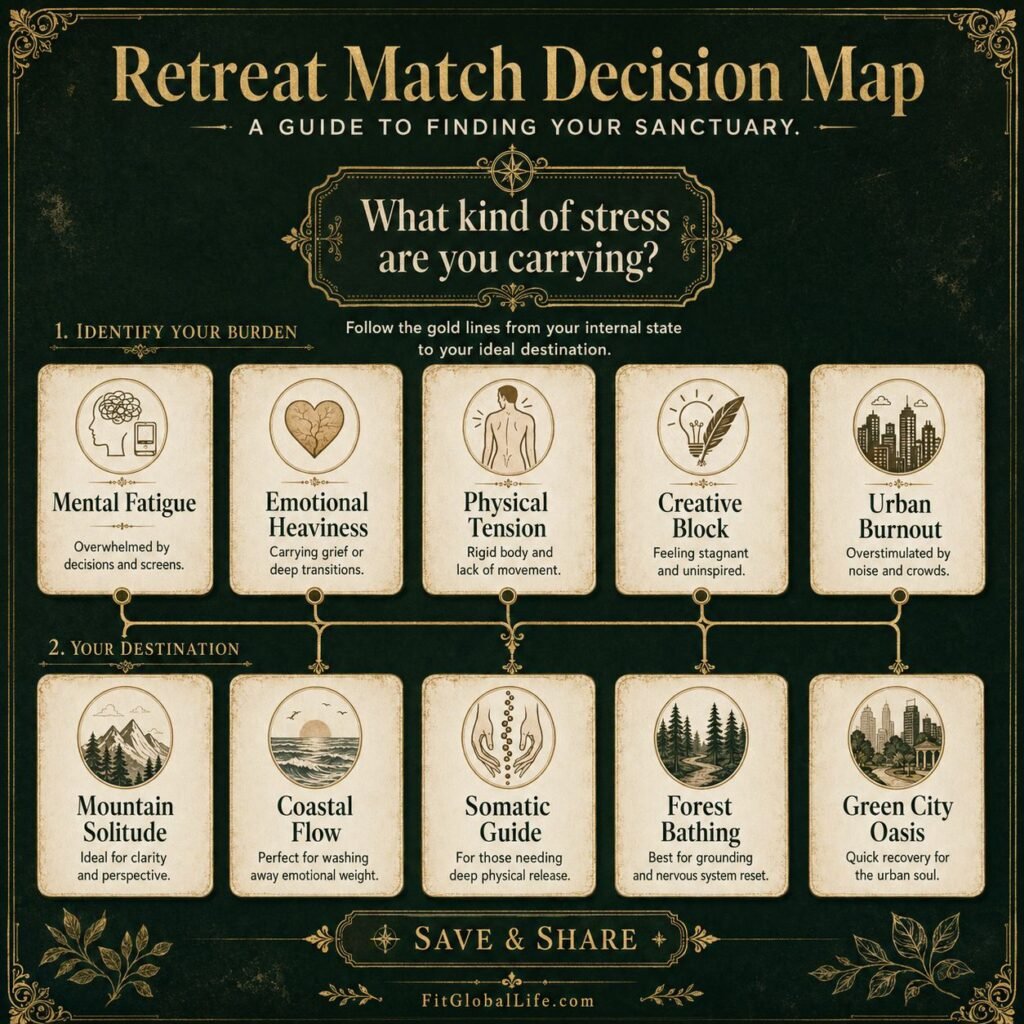
How to Choose the Right Nature Retreat Without Overloading Yourself
Choosing a retreat can become its own stress spiral. The wellness market is crowded, and every retreat page seems to promise clarity, renewal, and a version of you who wakes up at 5 a.m. glowing suspiciously. Use a nervous-system filter instead of a fantasy filter. Ask: What is my main stress pattern? What environment feels safe? How much structure do I need? How much solitude is supportive rather than destabilizing? What can I afford without creating financial stress?
| Stress Pattern | Retreat Match | Rationale |
| Jaw tension, racing mind, shallow breathing | Forest bathing retreat | Layered sensory calm and slow walking invite parasympathetic shift. |
| Grief, irritability, emotional hardness | Blue-space coastal retreat | Water rhythm and horizon gaze support soft fascination and emotional release. |
| Fragmented attention, notification fatigue | Mountain silence retreat | Low signal density reduces cognitive load. |
| Screen burnout, disembodiment | Farm-and-soil retreat | Hands-on rhythm reconnects action, body, and nourishment. |
| Sleep drift, late-night scrolling | Dark-sky retreat | Low evening light and awe rebuild respect for circadian rhythm. |
| Limited time or budget | Walkable green-city retreat | Repeatable access beats rare perfection. |
| Freeze, vigilance, body-based stress | Guided somatic nature retreat | Skilled facilitation supports safety and integration. |
Next, screen the logistics. Travel time should not exceed your recovery capacity. If getting there requires three flights, a boat, and a mountain goat with Wi-Fi, the trip may be impressive but not regulating. Choose fewer transitions. Choose clear food options. Choose a room where you can sleep. Choose hosts who respond clearly to questions. Your nervous system starts reading safety cues before you arrive.
Budget is also part of regulation. A retreat that creates debt may offer temporary calm and long-term stress. Consider a tiered approach: monthly micro-retreat, quarterly weekend reset, annual deeper retreat. This creates rhythm instead of scarcity. You are not failing if your reset happens in a local park. You are building a sustainable relationship with recovery.
Finally, match retreat intensity to life season. If you are grieving, caregiving, recovering from illness, or navigating major transition, choose support over rugged independence. If you are stable but overstimulated, a quiet nature retreat may be enough. If you are deeply burned out, one retreat will not repair a lifestyle that keeps injuring you. It can, however, give you enough nervous-system space to make the next honest change.
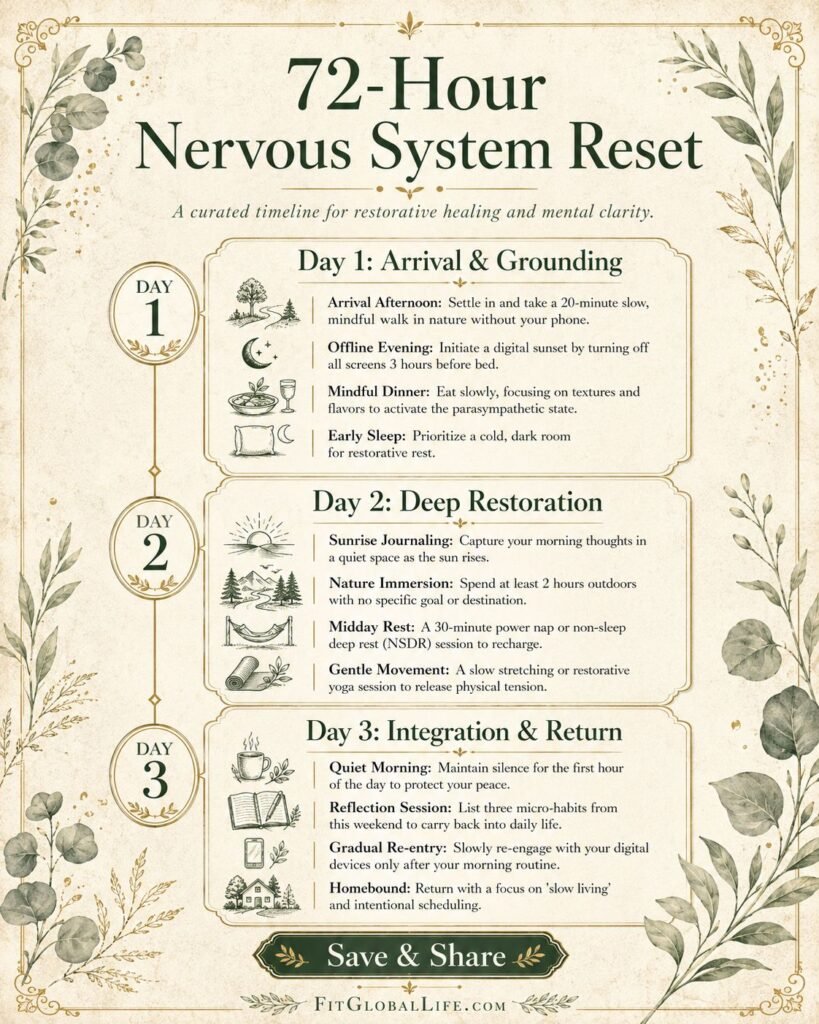
A 72-Hour Gentle Nervous Reset Itinerary
You do not need a full week to begin. A 72-hour retreat can be enough to interrupt stress momentum, especially if you keep the plan simple. The structure below works for forest, coast, mountain, farm, dark-sky, green-city, or guided somatic settings. Adjust based on safety, weather, mobility, and personal needs.
| Time | Practice | Nervous-System Aim |
| Before departure | Set an out-of-office message, download maps, decide phone rules, pack simple layers. | Reduce anticipatory stress and decision load. |
| Arrival afternoon | Unpack slowly, take a 20-minute orientation walk, eat a simple meal. | Teach the body where it is and what is available. |
| First evening | No major processing. Dim lights, warm shower, early bed. | Let the system land before asking it to transform. |
| Day 2 morning | Daylight walk, gentle breath practice, protein-rich breakfast. | Support Circadian Rhythm and Stable Energy. |
| Day 2 midday | Main nature immersion: forest walk, sit on the shore, farm chore, guided somatic session. | Create sustained sensory downshift. |
| Day 2 afternoon | Nap, journal, or read. No productivity catch-up. | Prevent retreat from becoming disguised work. |
| Day 2 evening | Sunset walk, early dinner, offline night. | Reinforce rhythm and recovery. |
| Day 3 morning | One final nature contact, then write a two-sentence integration plan. | Convert calm into repeatable behavior. |
| Return day | Avoid stacking meetings immediately after arrival. | Protect the reset from re-entry shock. |
The integration plan should be almost laughably small. “I will walk outside for 15 minutes after lunch on Tuesday and Thursday.” “I will keep my phone out of the bedroom three nights this week.” “I will sit under a tree every Sunday morning.” Tiny is not weak. Tiny is how the nervous system learns trust.
If you want a more structured digital boundary, use FitGlobalLife’s guide to a true digital-free destination and the site’s practical digital detox protocol. The goal is not to become anti-technology. The goal is to stop letting technology choose your nervous-system weather every hour.
Common Mistakes That Turn a Retreat Into Another Stress Project
The first mistake is overplanning. You cannot spreadsheet your way into surrender. A good retreat has enough structure to feel safe and enough space to let the body speak. If every hour is optimized, the nervous system receives the same message it gets at work: perform, track, improve. That is not a reset. That is productivity wearing sandals.
The second mistake is choosing aesthetics over fit. A retreat can look beautiful and still be wrong for your system. A silent cabin may be heaven for one person and panic fuel for another. A group retreat may regulate someone who needs warmth and overwhelm someone who needs solitude. Choose based on your stress pattern, not the brochure’s emotional lighting.
The third mistake is confusing discomfort with depth. Some discomfort is normal when you slow down. But intensity is not automatically healing. If a retreat ignores consent, pushes emotional disclosure, minimizes medical needs, or shames people for needing rest, leave. Gentle recovery is not a lack of courage. It is intelligent pacing.
The fourth mistake is returning directly into chaos. The day after a retreat should not begin with six meetings and a heroic inbox battle. Build a landing zone: groceries, laundry buffer, simple dinner, and one early night. Your nervous system needs re-entry, not a surprise boss fight.
The fifth mistake is expecting nature to fix a life structure that keeps producing stress. A retreat can reveal what helps. It cannot compensate forever for chronic sleep debt, toxic work, loneliness, constant digital overload, or poor boundaries. Use the retreat as data. What changed your breathing? What softened your mood? What made you feel safe? Then bring one piece home.
Final Thoughts: Let Nature Lower the Volume Before You Try to Fix Your Life
The best nature retreats do not force a new identity. They lower the volume enough for your actual needs to become audible. Maybe your body needs sleep more than strategy. Maybe your mind needs silence more than motivation. Maybe your heart needs water, not another self-improvement plan. Maybe your attention needs trees, not another app designed to rescue you from the apps that broke your focus in the first place.
A gentle nervous reset is a return to rhythm. Light in the morning. Darkness at night. Walking without hurry. Meals that do not feel like interruptions. Conversations that do not require performance. Sounds that do not attack you. Views that widen the mind. Breath that gradually stops asking permission.
Start where you are. If you can book a forest retreat, beautiful. If you can sit beside a city pond for 30 minutes, also beautiful. If you can take one phone-free walk under ordinary trees, that counts too. Your nervous system is not impressed by luxury. It is impressed by safety, repetition, and honest attention. Nature retreats are not an escape from life at their best. They are practice for returning to life with less bracing and more breath.
FAQ
Nature retreats are not a guaranteed medical treatment, but research links nature exposure with lower stress, better mood, improved attention, and better self-reported well-being. The evidence is strongest when nature contact is repeated, accessible, and paired with supportive behaviors like walking, sleep, social connection, and reduced digital overload.
A full week can be helpful, but it is not required. A 72-hour reset can interrupt stress momentum, and a weekly two-hour nature habit may be more sustainable for many people. The best duration is the one you can recover from financially, physically, and logistically.
Many anxious people benefit from forest bathing, gentle coastal retreats, or guided somatic nature retreats. The key is to avoid settings that feel unsafe, too remote, too socially demanding, or too intense. If anxiety is severe or disabling, choose qualified support and consult a healthcare professional.
You may not get the full immersion of a destination retreat, but local parks can still offer stress reduction, movement, daylight exposure, and attention restoration. For many people, repeatable local nature contact is more valuable than one expensive retreat that never becomes a habit.
Yes, but keep it realistic. Decide your phone rules before arrival: airplane mode during walks, no phone in bed, check messages once daily, or use a basic emergency-only setup. Too-strict detoxes can backfire into anxiety; pick boundaries that support safety and presence.
Disclaimer
This article is for educational and informational purposes only and does not constitute medical, psychological or therapeutic advice. Nature retreats, forest bathing, breathwork, somatic practices, digital detoxes and wellness travel may be beneficial for some individuals but are not substitutes for diagnosis, treatment, crisis care, medication, therapy or professional medical guidance. If you have severe anxiety, depression, trauma symptoms, sleep disorders, cardiovascular conditions, mobility limitations, concerns about pregnancy, allergies or any medical condition affected by travel, climate, fasting, altitude, swimming, hiking or isolation, check with a qualified healthcare professional before booking a retreat. If you are in crisis or feel unsafe, contact local emergency services or a trusted crisis-support resource immediately.