
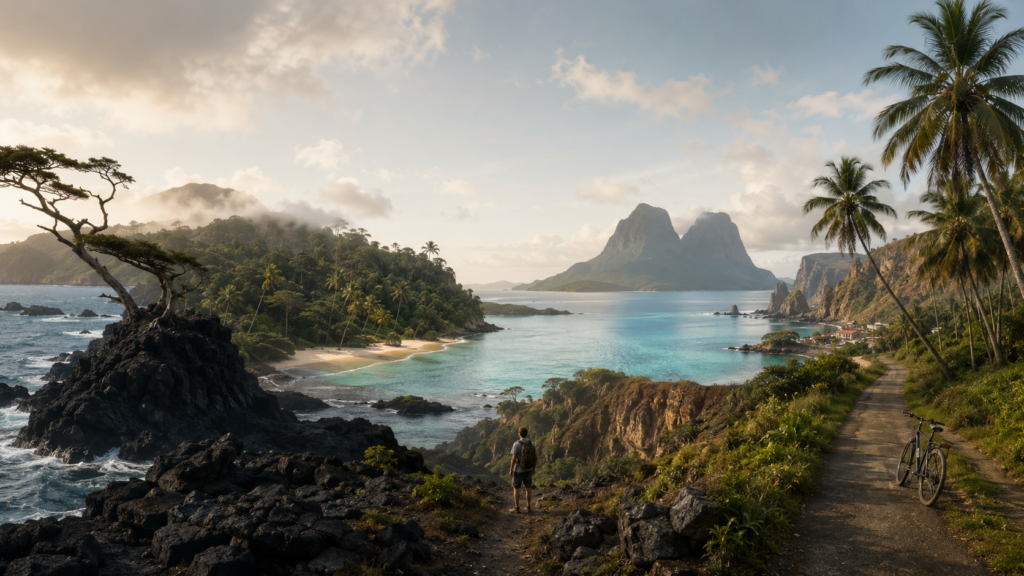
The best low-crowd islands for slow travel in 2026 are not necessarily the most remote dots on the map. They are places where a longer stay still fits the scale of local life, where the number of beds or the difficulty of access slows visitor turnover, and where travelers can do less without feeling that the trip has failed. That distinction matters. A quiet island is not an empty product waiting to be consumed; it is a living community with limited water, waste systems, roads, medical services and ecological tolerance.
Travel demand is hardly disappearing. UN Tourism reported an estimated 1.52 billion international arrivals in 2025, followed by a further 2% rise in the first quarter of 2026. At the same time, the OECD’s 2026 tourism policy review urges destinations to shift from volume-based growth toward value, resilience and active management of visitor flows. In plain English: the future of better travel is not just more places. It is better timing, longer stays and less pressure per experience.
That is why this guide builds on the philosophy of staying longer and moving less without recycling a generic list of hidden gems. Each island below was selected for a different form of quiet: a visitor cap, a small tourism base, conservation-led identity, lower-carbon mobility or access friction that naturally discourages rushed itineraries. None is crowd-proof. Public holidays, school breaks, festivals, perfect-weather weekends and one badly timed cruise call can change the atmosphere fast. The aim is not to promise solitude. It is to improve the odds of traveling at a pace the island can absorb.
Why Low-Crowd Islands Matter More in 2026
For years, travel marketing treated low crowds as a luxury benefit: fewer people in your photos, shorter restaurant waits, quieter beaches. That view is too narrow for 2026. On small islands, crowd pressure can affect freshwater use, waste collection, housing prices, ferry capacity, trail erosion and the everyday privacy of residents. The OECD notes that visitor flows can increase pressure on land and water while adding waste, pollution and soil damage. Islands feel those limits earlier because their infrastructure has nowhere else to expand.
There is also a traveler-side reason to care. Fast island hopping creates a strange kind of exhaustion: airport, transfer, ferry, check-in, one sunset, one rushed boat tour, repeat. The itinerary looks rich on paper and feels thin in memory. A slower island stay gives your attention time to become local. You learn when the bakery sells out, which bay is calm in the morning, how the wind changes the ferry conversation, and why the same beach feels different on the fourth visit.
This is the practical difference between a destination that is merely lesser-known and one that genuinely supports a slower rhythm. A trendy ‘hidden’ beach can become crowded in a season. A well-managed island, by contrast, has structural reasons to remain small-scale. That is also why this list does not use social-media invisibility as proof. The better question is whether tourism remains compatible with local systems—an idea explored more broadly in FitGlobalLife’s guide to travel that supports rather than extracts.
How We Chose These Low-Crowd Islands for Slow Travel
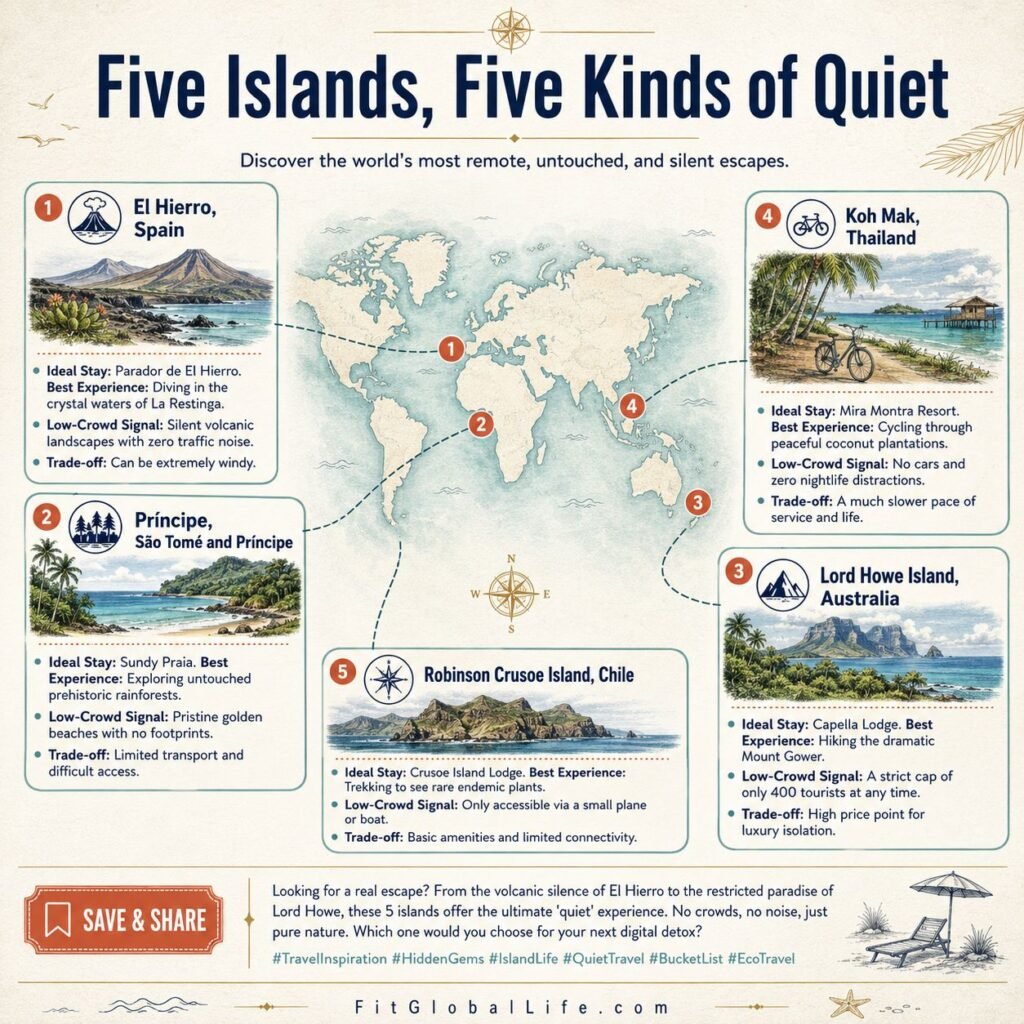
The selection uses what I call the Low-Crowd Integrity Test. It is not a scientific ranking, and it does not pretend that five destinations can be compared with perfect data. Tourism statistics are uneven, especially on remote islands. Instead, the test uses five signals that are visible enough to guide a real booking decision.
The Low-Crowd Integrity Test
- Pressure ceiling. Is there a formal visitor limit, a small bed base, limited transport capacity or another structural brake on high-volume tourism?
- Access friction. Does reaching the island require a ferry connection, small-plane transfer, weather buffer or advance planning that discourages two-night checklist travel?
- Local-life visibility. Can visitors still encounter ordinary island routines—markets, fishing, farming, schools, community events—rather than a landscape dominated by tourism businesses?
- Ecological governance. Is there a biosphere reserve, national park, low-carbon program, biosecurity regime or visitor-management plan with more substance than a green leaf on a hotel brochure?
- Stay-depth potential. Can a traveler spend at least five to seven nights without manufacturing a frantic schedule? Good slow travel needs repeatable days, not endless attractions.
This approach borrows from the concept of tourism carrying capacity. UNESCO’s visitor-management guidance distinguishes physical, ecological and social limits—the number of beds or cars a place can hold, the level of impact an ecosystem can tolerate, and the point at which crowding degrades resident or visitor experience. The carrying-capacity framework for heritage sites is older than Instagram tourism, but its logic has aged exceptionally well.
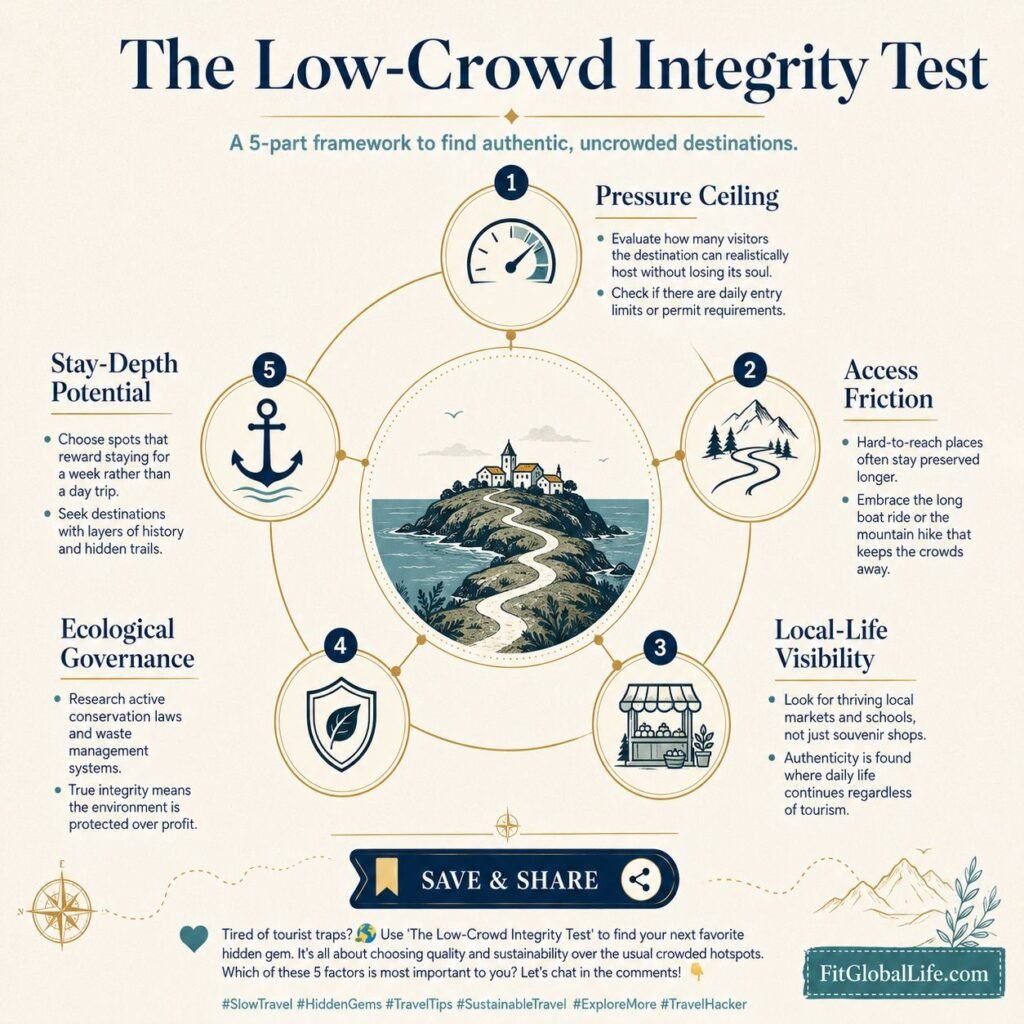
Quick Comparison: Five Islands, Five Different Kinds of Quiet
| Island | Best for | Ideal stay | Why crowds stay lower | Main trade-off |
| El Hierro, Spain | Hiking, diving, volcanic landscapes | 6–9 nights | Smallest Canary Island; biosphere reserve; indirect access | A rental car is often useful; microclimates change plans |
| Príncipe, São Tomé and Príncipe | Rainforest, beaches, birdlife, deep rest | 7–10 nights | Whole-island biosphere reserve; small resident population | Limited services and costly connections |
| Lord Howe Island, Australia | Reef, hiking, birding, polished nature stay | 5–8 nights | Formal cap of 400 visitors at one time | High prices and limited beds require early booking |
| Koh Mak, Thailand | Cycling, beach time, easy tropical reset | 5–7 nights | Low-carbon tourism identity; low-rise, small-scale feel | Weather and boat schedules shape the trip |
| Robinson Crusoe Island, Chile | Endemic nature, diving, hiking, maritime culture | 7–10 nights | Remote air/boat access; biosphere reserve; one settlement | Connections can be disrupted; services are genuinely limited |
The stay lengths above are recommendations, not rules. They include enough time for one weather-disrupted day and at least one deliberately blank day. On remote islands, a blank day is not wasted. It is often the day the place stops feeling like a project.
1. El Hierro, Spain: Volcanic Quiet Without Leaving Europe
El Hierro sits at the western edge of the Canary Islands and offers a useful lesson: low-crowd travel does not always require a heroic expedition. It requires choosing the island that most package itineraries skip. UNESCO describes El Hierro as the westernmost and smallest Canary Island, with a biosphere reserve spanning roughly 269 square kilometers. The official tourism site shows that access generally involves a short domestic flight or a ferry from Tenerife; the ferry connection to La Estaca takes about two hours and twenty minutes.
The island is not secret. Divers know La Restinga, hikers know the laurel forests, and Canarian travelers know the natural pools. Yet El Hierro still lacks the high-volume resort texture associated with Tenerife or Gran Canaria. Its quiet comes from scale, topography and indirect access. Roads curl through steep terrain, weather changes across short distances, and the most satisfying days often combine only two things: a walk and a long lunch.
El Hierro also has a credible sustainability story, though travelers should resist turning it into a marketing halo. The official island guide reports that its wind-and-pumped-hydro system once supplied the island with renewable electricity for 24 consecutive days in 2019. The point is not that every visitor arrives carbon-free—most do not—but that local infrastructure and identity have been shaped by a serious conversation about energy autonomy. That makes El Hierro a stronger fit for readers already thinking about lower-impact travel without performative perfection.
What a Slow Week on El Hierro Can Look Like
Base yourself in one area for at least four nights before considering a second base. Valverde or the northeast works well for arrival logistics; Frontera offers access to the Golfo valley; La Restinga suits divers and travelers who want the south to set the rhythm. Spend one day on a marked trail through forest and volcanic terrain, one day around natural pools, one day with a local food or wine focus, and one day doing almost nothing beyond a village walk and sunset.
The island rewards repetition. Return to the same bakery. Swim in the same protected pool under different wind conditions. Revisit a viewpoint after clouds move. If night skies matter to you, leave one evening flexible rather than booking every dinner; El Hierro pairs naturally with the slower attention described in FitGlobalLife’s guide to escaping artificial light for a clearer night sky.
The Honest Trade-Off
El Hierro is compact on a map but not always quick in practice. Public transport exists, yet a car gives more freedom for dispersed trailheads and weather pivots. Roads can be steep and winding. Natural swimming areas are not automatically safe in rough seas, and the island’s microclimates can cancel the beach day you imagined. That variability is the point. Choose El Hierro when you are willing to let weather edit the schedule.
2. Príncipe, São Tomé and Príncipe: Rainforest Time
Príncipe is the island on this list that most clearly asks travelers to surrender metropolitan expectations. UNESCO’s biosphere profile covers the entire island and surrounding islets and lists a population of 8,778. Ancient rainforest, volcanic formations, fishing communities and small beaches exist in close proximity, but the visitor experience is not built around constant choice. There are fewer places to stay, fewer transfers and fewer backup plans. For slow travelers, that can be a gift. For control enthusiasts, it can feel like an intervention.
The island’s low-crowd character is partly ecological and partly logistical. Príncipe is not a convenient weekend add-on. Most international visitors route through São Tomé, then continue by domestic connection. Schedules, luggage limits and weather can change, so current arrangements should be verified directly before booking. The official regional tourism overview emphasizes the UNESCO biosphere status, waterfalls, beaches and protected landscapes, but the more important slow-travel feature is the human scale between them.
Príncipe works best when the trip is not treated as a beach inventory. A day can be built around a guided forest walk, a community visit, cacao history, birding or a boat outing. Another day may involve only reading, swimming and watching rain move across the canopy. The island’s humidity, sudden showers and slower service are not flaws to be optimized away. They are reminders that tropical ecosystems run on conditions, not calendar alerts.
What a Slow Week on Príncipe Can Look Like
Plan a minimum of seven nights on the island itself if the budget allows, with extra connection time in São Tomé. Use one locally guided nature day early in the stay; it gives context to everything that follows. Reserve one boat day but do not stack water activities back-to-back. Spend one morning in or around Santo António, one day learning about food or cacao, and at least two unstructured days near your accommodation.
This is a strong destination for a true screen reset, but do not confuse weak connectivity with automatic mindfulness. Download essential documents, maps and contact details before arrival, then deliberately narrow your online habits. FitGlobalLife’s guide to destinations designed for genuine unplugging offers a useful preparation mindset: remove digital dependency without removing practical safety.
The Honest Trade-Off
Príncipe can be expensive relative to the number of conventional attractions, especially once regional flights and higher-end eco-lodges are included. Medical care, retail options and transport alternatives are limited. Rain can reshape the day. Travelers who need nightlife, dense restaurant choice or frictionless mobility should choose somewhere else. Príncipe is compelling because life is not arranged around visitor convenience—and that requires respect rather than complaint.
3. Lord Howe Island, Australia: Quiet by Design
Lord Howe Island offers the clearest structural crowd-control signal in this guide. Its official tourism association states that the UNESCO World Heritage destination welcomes only 400 visitors at any one time. That ceiling does not guarantee an empty trail or private beach, but it protects the island from the volume spiral common in famous nature destinations. Limited beds also force a useful planning discipline: book flights and accommodation together, then stay long enough to justify the effort.
The island lies roughly 700 kilometers northeast of Sydney, with current flights taking under two hours. Once there, the geography is compact enough for cycling and walking, while the experience stretches from lagoon snorkeling to birdwatching and guided mountain hikes. The official Lord Howe travel guide also notes that the surrounding marine environment includes the world’s southernmost coral reef and more than 500 fish species.
Lord Howe’s quiet feels curated rather than rough. Services are limited but generally polished. Trails are marked, accommodation is regulated by scarcity, and the island’s biosecurity culture is visible. This is a good choice for travelers who want nature without improvising every basic need. It is also a reminder that low crowd levels can come with a premium price. Scarcity protects experience, but it does not make it affordable.
What a Slow Week on Lord Howe Can Look Like
Give the island five to eight nights. Begin with a gentle lagoon day rather than an ambitious summit. Alternate high-effort and low-effort days: snorkeling, then a bicycle loop; a guided hike, then a beach picnic; birding, then a completely unscheduled morning. If Mount Gower is a priority, book the required guided walk with a weather buffer and avoid placing it on the final full day.
The strongest slow-travel habit here is to repeat short routes. Cycle the same road at different hours. Return to Ned’s Beach when conditions change. Watch seabirds rather than collecting a checklist. The result resembles the nervous-system benefit discussed in FitGlobalLife’s guide to gentle nature-based recovery: consistency, sensory detail and enough time for the body to stop bracing for the next transfer.
The Honest Trade-Off
Availability is the first barrier. The 400-person cap means beds can sell out well in advance, and prices reflect limited supply. Weather can affect flights, ocean activities and mountain access. Biosecurity rules matter; clean footwear and gear before arrival, follow hygiene stations and never treat endemic wildlife as content props. Lord Howe is not the place for a spontaneous bargain escape. It is a place to plan carefully and then move slowly.
4. Koh Mak, Thailand: A Low-Carbon Alternative in the Gulf
Koh Mak is the easiest tropical island in this guide to misunderstand. It is accessible enough to attract visitors, and it sits near better-known Koh Chang and Koh Kood, so ‘low-crowd’ should be read as relative and seasonal. The reason it belongs here is not invisibility. It is a locally promoted effort to stay small-scale. The Tourism Authority of Thailand describes Koh Mak as the country’s first low-carbon destination and a place preserved from mass tourism, with tranquility and local culture central to the experience.
The island’s flatter terrain supports cycling, low-rise accommodation and a less motorized rhythm than many Thai beach destinations. There are beaches, rubber and coconut landscapes, small restaurants and boat connections to neighboring islands, but the best itinerary avoids turning Koh Mak into a transfer hub. Stay put. Let one beach become familiar. Learn which roads are comfortable in the heat. Notice the difference between a locally run meal and a resort-only bubble.
Koh Mak is also a useful test of honest sustainability. A low-carbon label does not erase the emissions of long-haul flights, speedboats, air conditioning or imported goods. It does, however, create a reason to make choices that fit the island’s direction: cycle when practical, refill water, avoid unnecessary boat mileage, choose reef-conscious operators and stay longer. Those decisions align with FitGlobalLife’s broader framework for traveling with a purpose beyond consumption.
What a Slow Week on Koh Mak Can Look Like
Five to seven nights is enough to shift from holiday mode into island rhythm. Spend the first day near your accommodation. Rent a bicycle only after checking heat, road condition and your own comfort. Use one day for kayaking or a responsibly operated marine excursion, one for a local food loop, one for a neighboring-island trip if conditions are good, and keep at least two half-days empty.
The quietest experience often comes in shoulder periods, but monsoon weather and reduced boat schedules can make ‘off-season’ a logistical gamble rather than a bargain. Verify current routes and do not book tight same-day international connections after a boat transfer. A calm itinerary is partly a scheduling skill; FitGlobalLife’s guide to reducing avoidable travel stress is especially relevant here.
The Honest Trade-Off
Koh Mak is not isolated from tourism growth. Popular weekends and peak-season periods can feel busy, and nearby island-hopping circuits create short-stay traffic. Tropical heat may limit cycling, mosquitoes are part of the environment, and marine conditions can change. Choose Koh Mak because you are willing to enjoy a smaller radius, not because you expect a private Thailand fantasy at budget-resort prices.
5. Robinson Crusoe Island, Chile: Access Friction as a Feature
Robinson Crusoe Island is the most logistically demanding destination in this guide, and that difficulty is one reason its pace remains distinct. The island is part of Chile’s Juan Fernández Archipelago, a UNESCO biosphere reserve with a listed population of 926 across the reserve. The only inhabited settlement on Robinson Crusoe is San Juan Bautista, where most visitor services are concentrated.
Chile’s official tourism site, updated in June 2026, explains that commercial flights take roughly 2.5 hours from Santiago to the island airfield. Arrival is followed by about an hour by boat to Cumberland Bay. Cargo-ship travel from the mainland can take two to three days and runs infrequently. The official Robinson Crusoe planning page recommends the warmer, drier period from November to March and tells travelers to confirm lodging and tickets well in advance.
That sequence—small plane, exposed airstrip, boat transfer, one settlement—changes traveler behavior before the trip begins. A two-night stay makes little sense. Weather buffers become normal. Luggage discipline matters. The island’s endemic species, national-park trails, diving and lobster culture cannot be separated from remoteness. This is not a polished ‘desert island’ performance. It is a community whose transport, food supply and daily logistics are shaped by the Pacific.
What a Slow Week on Robinson Crusoe Can Look Like
Plan seven to ten nights plus mainland buffers. Use the first full day to orient in San Juan Bautista, confirm guides and learn how sea conditions affect access. Reserve separate days for hiking and diving rather than stacking them. Add a day looking at community, local history, food and maritime life. Keep two flexible days for weather, rest or repeating a shorter walk.
The island is ideal for travelers who can replace certainty with preparation. Carry offline documents, a modest medical kit and enough essential medication for delays. Do not hike remote terrain casually, and use local guides where required or strongly recommended. The mindset overlaps with FitGlobalLife’s guide to places where technology cannot replace local knowledge, but Robinson Crusoe turns that philosophy into logistics rather than poetry.
The Honest Trade-Off
Flights and boats can be disrupted. Costs are high relative to service choice. Internet and medical capacity are limited. Hiking can be steep, diving requires appropriate skill and operators, and the island is not a casual add-on to a packed Chile itinerary. Choose it when you can tolerate uncertainty and when the journey itself is part of the stay—not an obstacle between you and the content.
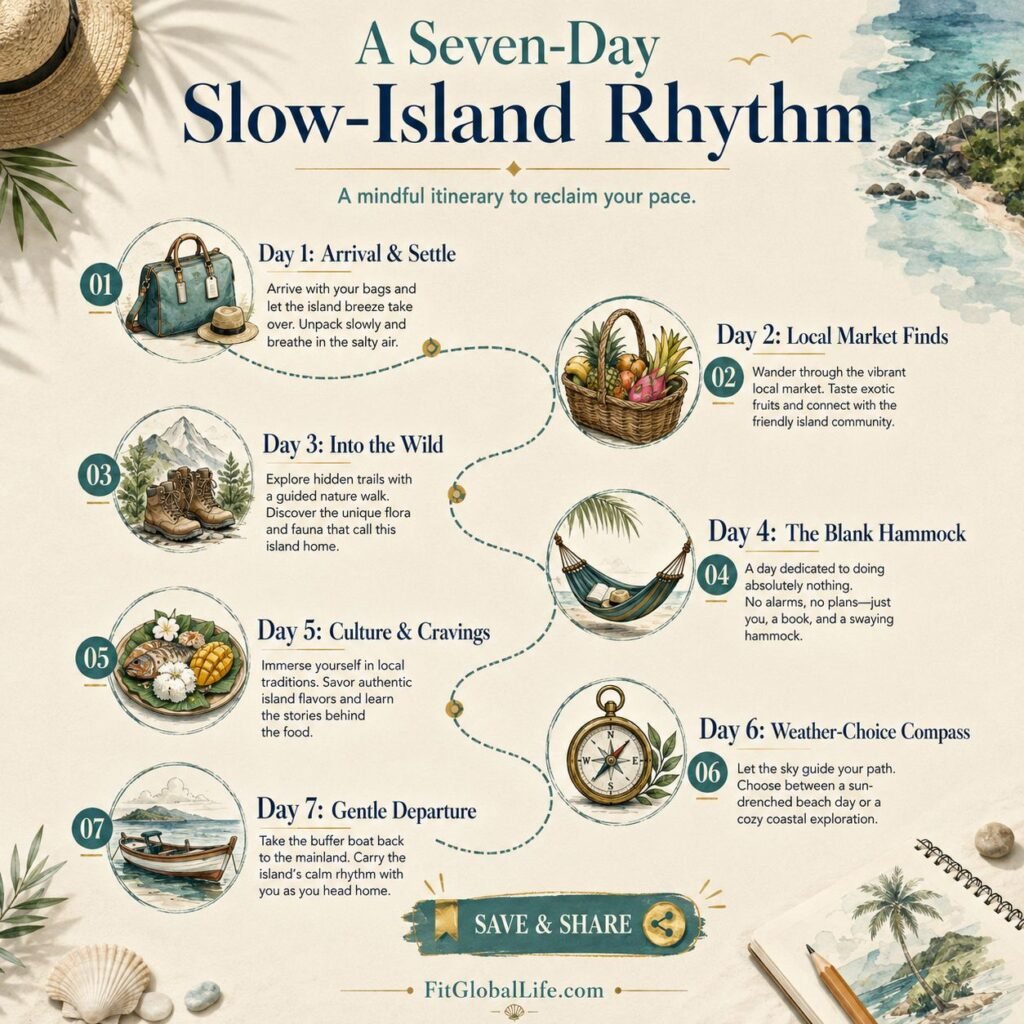
A Seven-Day Slow-Island Rhythm That Actually Works
Many travelers agree with slow travel in theory and then build a fast itinerary on a smaller map. The solution is not to remove planning. It is to plan the rhythm rather than maximize the inventory. This seven-day structure works on all five islands with local adjustments.
- Day 1 — Arrive and shrink the radius. Check in, buy basic supplies, walk nearby and stop. Do not book a major tour after a remote connection.
- Day 2 — Learn the local operating system. Visit the main settlement, market, visitor center or guide. Ask about weather, closures, water use, transport and community rules.
- Day 3 — One signature nature experience. Choose a guided hike, reef outing, forest walk or dive. One anchor experience is enough.
- Day 4 — Leave it blank. Repeat a beach, read, journal, nap, do laundry or follow a local recommendation. This is the day most itineraries wrongly delete.
- Day 5 — Culture and food. Prioritize a community-run experience, producer, craft, farm, cacao visit, fishing tradition or historical walk.
- Day 6 — Weather-choice day. Use the best conditions for the activity you postponed. If everything already worked, take a second slow nature day.
- Day 7 — Departure buffer. Avoid a tight chain of boat, small plane and long-haul flight. Remote beauty comes with remote transport math.
This schedule also reduces the temptation to chase noise. If silence itself is part of the goal, use FitGlobalLife’s article on acoustic tourism and recovery from constant sound as a pre-trip prompt: identify which noises you are leaving, which sounds you want to notice, and whether you can resist filling every quiet gap with a podcast.
How to Keep a Quiet Island Quiet
Low-crowd destinations are vulnerable to the exact attention that makes them desirable. Publishing a guide is therefore not neutral. Travelers need a code of conduct stronger than ‘leave no trace,’ especially where tourism affects housing, water and the dignity of everyday community living.
- Stay longer, cut the transfers. A seven-night stay usually distributes spending better than three two-night island stops while lowering repeated transport demand.
- Book locally where practical. Favor locally owned accommodations, guides, food businesses and transport providers. Ask respectful questions rather than assuming every ‘eco’ claim is verified.
- Respect water scarcity. Short showers, fewer linen changes and conscious laundry matter more on small islands than luxury-hotel habits suggest.
- Do not geotag fragile micro-locations. Share the island or general area when appropriate, not a nesting site, unmarked trail or tiny cove that cannot absorb sudden attention.
- Use guides for more than navigation. Local guides add ecological and cultural context, spread benefit and reduce accidental rule-breaking.
- Travel outside pressure peaks, not outside safety. Shoulder season can help, but monsoons, cyclone windows, wildfire risk or rough seas are not clever crowd-avoidance hacks.
- Accept closed access. A trail, reef or beach closure is management doing its job, not a personal attack on your itinerary.
Better island travel also means examining the carbon cost of access. One longer, well-planned trip may be more defensible than several short flights, although there is no perfect formula. FitGlobalLife’s discussion of climate-positive travel and its limits can help readers separate meaningful reduction from attractive green language.
Budget, Packing and Insurance for Remote Island Travel
Slow travel can reduce daily spending because there are fewer transfers and fewer paid attractions. It does not automatically make remote islands cheap. Flights on small aircraft, limited accommodation, boat charters, imported food and guide requirements can increase the base cost. A realistic budget should include four buffers: one extra night near the gateway, flexible ticket conditions, a weather-disruption reserve and enough cash or payment alternatives for places with unreliable terminals.
Pack for repetition, not variety. A compact wardrobe, quick-dry layer, reusable bottle, sun protection, reef-conscious toiletries, dry bag and basic first-aid supplies cover most needs. For day walks and boat transfers, a lightweight packable daypack is more useful than a bulky carry-on that tries to win an argument with a small aircraft’s luggage limit. Choose a product that fits your actual load, weather and activity level; the link is an affiliate redirect.
Health planning matters more when the nearest advanced care requires an evacuation or return to the main island. Bring sufficient prescription medication, copies of prescriptions, emergency contacts and a clear understanding of your coverage. Travelers comparing flexible international options can review a practical travel medical protection plan before departure. This is an affiliate link to SafetyWing; coverage, exclusions, age limits, adventure-sport add-ons and destination rules vary, so read the current policy wording rather than relying on a summary.
Also prepare your body for the route. Long transfers, heat, sea motion, unfamiliar food and disrupted sleep can turn a quiet trip into a recovery project. FitGlobalLife’s guide to staying well while traveling across different environments is a useful pre-departure checklist, especially for hydration, movement, food safety and sleep.
Affiliate disclosure: This article contains affiliate links. If you purchase through them, FitGlobalLife may earn a commission at no additional cost to you. Recommendations should be evaluated against your own itinerary, health needs and budget.
Who Should Not Choose a Low-Crowd Island
A remote or low-volume island is not automatically the best vacation. Choosing the wrong style of quiet can create resentment toward a place that never promised to entertain you. Consider a more connected destination when any of the following is true:
- You need advanced or frequent medical care and cannot safely manage limited local services.
- You have only two or three nights and must connect through weather-sensitive transport.
- Your ideal day requires dense restaurant choice, nightlife, shopping and spontaneous tour availability.
- You dislike repeating routes, adapting to closures or leaving half a day unplanned.
- Your budget has no room for delays, rebooking, extra gateway nights or higher island prices.
- You are traveling primarily to capture ‘empty’ scenery and may treat residents or wildlife as part of the set.
There is no shame in choosing a walkable, better-served city or mainland base instead. In fact, FitGlobalLife’s guide to healthier trips built around walkability may produce a calmer experience with less logistical risk. Slow travel is a method, not an island aesthetic.
Final Thoughts: Choose Depth, Not Emptiness
The most useful lesson from these five islands is not that remote places are morally superior. It is that good travel becomes more attentive when movement has limits. El Hierro uses volcanic geography and indirect access to slow the day. Príncipe asks you to accept rainforest time. Lord Howe protects scale with a formal visitor cap. Koh Mak shows how a reachable island can still choose a lower-carbon identity. Robinson Crusoe turns logistical friction into a reason to stay.
In 2026, the smartest low-crowd trip is not the one with the least people in the photograph. It is the one where your stay does not require the island to behave like a city, where your spending reaches local hands, where nature rules can disappoint you without becoming negotiable, and where you remain long enough to notice more than the highlights.
Choose one island. Add one buffer day. Remove two activities. Return to one place twice. That is not missing out. That is finally arriving.
Frequently Asked Questions
It means an island where visitor volume is relatively limited by policy, bed capacity, access, seasonality or local tourism scale. It does not mean guaranteed solitude. Crowd levels can change by month, weekend, event and weather window.
Koh Mak or El Hierro will usually feel more approachable because they have established tourism services and practical gateway connections. Lord Howe is highly organized but expensive and capacity-limited. Príncipe and Robinson Crusoe require more tolerance for logistical uncertainty.
Five nights is a useful minimum for easier islands; seven to ten nights is better for destinations involving small planes, ferries or weather-sensitive transfers. Add a gateway night when a missed connection would threaten an international flight.
No. Off-season may bring monsoons, rough seas, reduced transport, closed businesses or dangerous conditions. Shoulder season is often the better compromise, but current local weather patterns and official guidance should decide the timing—not a generic crowd calendar.
Often not. Limited flights, small accommodation inventories, imported supplies and guide requirements can increase costs. Slow travel may lower daily activity and transfer spending, but the access cost can remain high. Budget for delays and flexibility.
Disclaimer
This article is for general travel planning and educational purposes. Transport schedules, entry rules, weather patterns, park access, accommodation availability, safety conditions and insurance terms are subject to change without notice. Please check details with official tourism authorities, transport operators, local guides, government travel advisories and policy documents before booking. Outdoor, marine and remote-island activities carry risks and may require qualified guides, permits, appropriate fitness or specialist insurance. The publisher does not guarantee crowd levels, weather, access, prices or individual outcomes. Affiliate links may generate a commission at no additional cost to the reader.