There are places where the blue dot becomes less of a guide and more of a joke with a charging cable. This unmapped guide is not about proving that technology is useless. GPS has saved travelers from wrong turns, bad roads, dangerous weather windows, and the kind of overconfidence that makes a person say, “I think the trail is just over there,” right before the trail files a missing-person report. But the deeper problem of modern travel is not that we cannot find places. It is that we often arrive without being available to them.
We move through the world with maps, reviews, screenshots, booking confirmations, translation apps, satellite layers, pinned cafes, and ten saved reels titled “hidden gem” that all lead to the same queue. The itinerary becomes a performance. The destination becomes a backdrop. The soul, meanwhile, is stuck in airplane mode. That is why slow travel is not laziness; it is attention management; it gives perception enough time to catch up with movement.
This article explores five regions where navigation still has limits and where the traveler must use older instruments: humility, listening, local knowledge, weather sense, bodily awareness, and respect. Some of these places are physically remote. Some are culturally dense. Some are not appropriate for casual travel without serious preparation. The point is not to romanticize difficulty. The point is to ask a better question: what kind of place can return us to ourselves without turning itself into a product?
Why the Unmapped Guide Matters in the Age of Perfect Navigation
We live in a strange era: the world is more mapped than ever, yet people feel more lost than ever. A phone can tell you the nearest restaurant, the route elevation, the border of a national park, the estimated wait time, and whether someone on the internet thinks the coffee is “mid.” But it cannot tell you whether you are rushing because you are excited or because silence makes you uncomfortable. It cannot tell you whether a place is asking you to slow down. It cannot tell you whether a community is welcoming visitors or tolerating extraction in prettier shoes.
That tension matters because global travel has rebounded hard. UN Tourism reports that 1.52 billion international tourists were recorded in 2025, surpassing the pre-pandemic era and reminding us that travel is no longer a niche privilege of wandering romantics with linen shirts and suspiciously flexible jobs. Travel is a mass behavior. Mass behavior needs ethics, not just inspiration.
At the same time, digital connectivity is uneven. The International Telecommunication Union estimates that roughly 2.2 billion people still remain offline. That does not simply mean some travelers cannot livestream a sunrise. It means map data, road reports, business listings, emergency information, and local digital representation are distributed unequally. A place can be culturally sophisticated and digitally underrepresented at the same time. Confusing “not online” with “not important” is one of the most boring mistakes a modern traveler can make. Please do not be that person. The internet already has enough main characters.
GPS itself is extraordinary, but it is not magic. The U.S. government’s GPS information center explains that GPS can be free, open, and dependable, yet still limited by signal conditions, device quality, terrain, and human interpretation. In mountainous regions, canyons, dense forests, high latitudes, extreme weather, or areas with poor local map data, the blue dot may be approximate. More importantly, GPS can locate your body while your attention is still outsourced. That is the heart of this unmapped guide: the real destination is not obscurity. It is present.
The Soul Gap: When Travel Becomes Too Mapped
The soul gap is the distance between arriving at a place and actually meeting it. You know the feeling. You get to the viewpoint, take the photo, post the story, check the next pin, and leave before your nervous system has registered the scale of the sky. The body traveled. The mind remained in content-production mode. Brutal, but fair.
This is why the new luxury is not necessarily a five-star room. The new luxury is unfragmented attention. It is a morning without a notification reflex. It is a guide who knows when to speak and when the landscape should speak first. It is a meal whose value is not its plating but the story of who grew, caught, carried, smoked, fermented, or blessed it. It is known that true digital-free destinations are not anti-technology; they are pro-recovery.
Research on nature and health does not reduce the wilderness to a supplement, but it does support what many travelers intuitively know: contact with natural environments can restore mental energy, reduce stress pathways, and support health across psychological and physiological dimensions. A large review in *International Journal of Environmental Research and Public Health* notes that nature exposure is associated with benefits across mental and physical health pathways. The experience is not only aesthetic. It is biological, social, and cognitive.
Movement matters too. The World Health Organization recommends that adults should aim for at least 150 to 300 minutes of moderate-intensity aerobic activity each week, and remote travel often adds gentle but sustained movement: walking ridgelines, carrying packs, stepping over stones, breathing thinner air, or simply using the body in ways office life quietly edits out. But the best trips do not treat the body as a machine to be optimized. They treat it as a listening device.
How to Read This Unmapped Guide Without Romanticizing Risk
Remote does not automatically mean better. Difficult does not automatically mean deep. Expensive does not automatically mean ethical. And “untouched” is often a lazy word that erases the communities who have lived with, named, sung, hunted, protected, prayed, mapped, farmed, and navigated a landscape for centuries. If a place feels empty to you, that may say more about your knowledge than about the place.
Use this unmapped guide as an invitation to think differently, not as a checklist to conquer. Some regions listed here require permits, local operators, seasonal planning, cultural sensitivity, insurance, medical readiness, and the humility to cancel when conditions are wrong. The article is written for wellness-minded travelers, creators, remote professionals, and curious readers who want travel to become less extractive and more reciprocal. That aligns with traveling with purpose instead of collecting destinations.
The five regions were chosen using four filters. First, each has a strong sense of place that cannot be reduced to coordinates. Second, each reveals a limitation of digital travel culture. Third, each offers a different form of wellness: awe, silence, cultural memory, embodied movement, ecological humility, or digital deceleration. Fourth, each demands respect for local authority rather than traveler ego.
Quick Comparison Table: 5 Regions Where GPS Still Can’t Find Your Soul
| Region | What makes it unmapped in the deeper sense | Soul lesson | Best-fit traveler | Main caution |
| Upper Svaneti, Georgia | Medieval tower villages, high Caucasus valleys, long-isolated cultural landscapes | Time is not only horizontal; it is ancestral | Slow hikers, culture lovers, mountain village travelers | Weather, roads, cultural respect, seasonal access |
| Torngat Mountains, Labrador | Inuit homeland, fjords, polar bear country, remote base-camp model | Local knowledge is survival, not decoration | Advanced nature travelers, Arctic learners, conservation-minded visitors | Polar bears, remoteness, cost, guided logistics |
| Lorentz National Park, Indonesian Papua | Snowcap-to-tropical marine transect, biodiversity, Indigenous lands, limited access | A place can exceed the categories in your head | Researchers, serious eco-travelers, conservation readers | Access restrictions, permits, ecological sensitivity |
| Mongolia’s sacred mountain landscapes | Sacred mountains, nomadic traditions, steppe-scale distance, spiritual geography | Direction can be devotional, not only functional | Long-distance overland travelers, culture-first trekkers | Harsh weather, guide dependence, sacred-site etiquette |
| Ennedi Massif, Chad | Sahara rock art, sandstone labyrinths, deep desert memory | The past is not behind us; it is under our feet | Expedition travelers, archaeology-minded readers | Security advisories, extreme logistics, do-not-improvise zone |
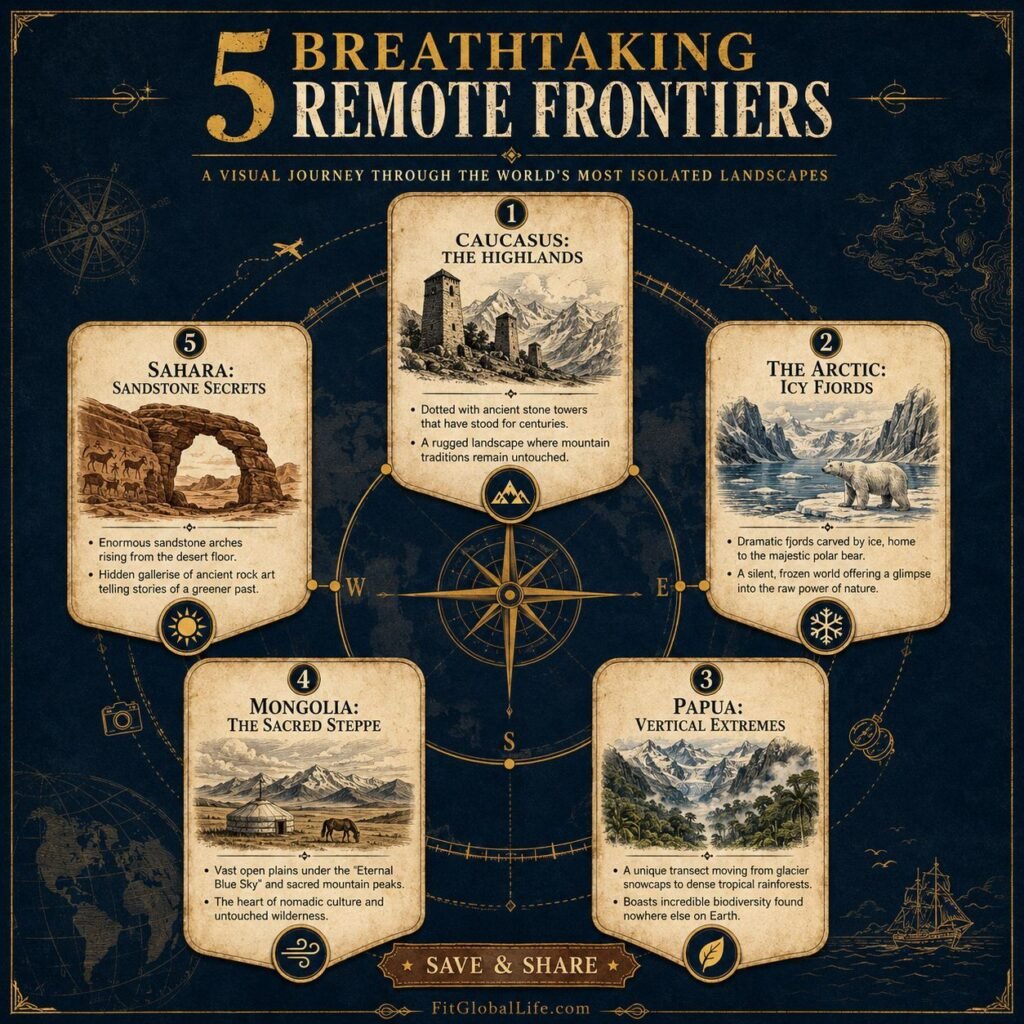
Region 1 – Upper Svaneti, Georgia: Where Towers Teach Vertical Time
Upper Svaneti sits in the Caucasus like a memory with stone shoulders. The region is known for high mountain scenery, medieval villages, and defensive tower houses that rise from the landscape with a kind of quiet stubbornness. UNESCO notes that Upper Svaneti is recognized for mountain scenery, medieval villages, and tower houses preserved by long isolation. That phrase, “long isolation,” matters. It does not mean the region lacked history. It means history had to pass through snow, rock, kinship, architecture, and oral memory before it became legible to outsiders.
Why GPS Feels Too Small Here
GPS can guide you toward Mestia, Ushguli, and the trails between villages, but it cannot explain why a tower changes the emotional geometry of a valley. A blue dot moves left or right. A tower moves your gaze upward. It asks you to think in centuries. It reminds you that people once built not for content, not for resale value, not for “mountain aesthetic,” but for weather, defense, clan life, and continuity.
That is why Upper Svaneti belongs in an unmapped guide. The most important orientation here is not simply spatial. It is temporal. Many modern travelers experience time as a queue of next steps: next bus, next trail, next photo, next hotel, next cappuccino. Svaneti interrupts that. It says: ” You are not the only timeline in the room. Mountains have one timeline. Families have another. Villages have another. Your 48-hour itinerary is cute, but let us not get carried away.
The wellness value is subtle. It is not spa wellness. It is anti-friction wellness. The terrain makes you earn your attention. Walks between villages can involve weather shifts, uneven surfaces, steep climbs, and long visual distances. You are forced into body awareness. The mind cannot doom-scroll and descend a rocky trail with grace at the same time. This is where reclaim focus from screen anxiety becomes more than a productivity hack; it becomes practical mountain intelligence.
What the Region Can Teach the Traveler
Upper Svaneti teaches vertical time. In cities, progress often feels like speed. In Svaneti, progress may mean maintenance: repairing a roof, preserving a tower, passing down a song, feeding guests, keeping a road usable, and returning after winter. That kind of continuity is easy to underestimate if your life is built around updates.
It also teaches the difference between seeing culture and being accountable to it. A tower is not a prop. A village is not a theme park. The traveler should ask, “Am I spending locally?” Am I respecting private spaces? Am I learning basic etiquette? Am I treating people as people, not background texture for my “authentic travel” era? The bar is not that high, bos, but somehow the internet keeps tripping over it.
How to Visit With Respect
Plan for shoulder-season weather, route flexibility, and local guesthouses. Avoid turning drone footage into a nuisance. Hire local guides for longer routes or unclear conditions. Read before you go, not only after you arrive. Pack patience. Spend more time in fewer places. That last point is underrated: fewer locations often create deeper memory. If you are designing a recovery-focused trip, combine village walking, unhurried meals, and a daily offline window. The goal is not to disappear from the world. It is to return with a less performative nervous system.
Region 2 – Torngat Mountains, Labrador: Where Inuit Knowledge Outranks the Blue Dot
The Torngat Mountains in northern Labrador are not a wilderness fantasy. They are in the Inuit homeland. Parks Canada describes how the Torngat Mountains are an Inuit homeland of powerful stories, spirits, traditions, fjords, caribou, bears, and ancient rocks. That framing should change how a traveler thinks before booking the first flight. You are not entering an empty edge of the map. You are entering a living cultural landscape where knowledge has consequences.
Why GPS Feels Too Small Here
In the Torngats, the blue dot may tell you where you are, but it cannot tell you what the wind is about to do in a fjord, where bears may move, how ice changes access, what a place name carries, or when it is wiser to wait. The region exposes the limits of individualistic travel. Many modern travelers are trained to believe independence is the highest form of competence. The Torngats suggest something more mature: dependence on the right knowledge is not weakness. It is wisdom.
The Torngat Mountains Base Camp model reinforces this. Nunatsiavut describes how Torngat Mountains Base Camp brings together Inuit elders, interpreters, youth, bear guards, and researchers. That is not just accommodation. It is an ethical infrastructure. It places interpretation, safety, cultural continuity, and research in the same orbit. Travelers who are serious about wellness should pay attention. Wellness is not only what happens inside your body. It is also the quality of the relationship between your body, a place, and the people who hold responsibility there.
What the Region Can Teach the Traveler
The Torngats teach relational navigation. You navigate through people, protocols, stories, caution, and permission. This is where the word “guide” regains its full dignity. A guide is not merely someone who prevents you from getting lost. A guide helps you understand what getting lost would even mean in that landscape.
The wellness lesson is awe with boundaries. Arctic and subarctic environments can produce a powerful shift in self-perception: the self becomes smaller, but not worthless. That is the sweet spot of awe. It reduces the exhausting demand to be the center of everything. It gives the ego a chair and politely tells it to sit down. For readers interested in the science and psychology of this state, awe is biologically useful, not just poetic.
How to Visit With Respect
Do not improvise this trip. Use official park information, registered operators, and local expertise. Parks Canada’s activity guidance emphasizes remote planning; in places like this, Parks Canada recommends careful planning for remote park travel. Budget realistically. Respect bear-safety rules. Ask what cultural interpretation is appropriate to photograph or share. Do not treat the place as a trophy for your feed. A good Torngats trip should make you more careful, not more smug.
Region 3 – Lorentz National Park, Indonesian Papua: Where the Map Changes Biomes Before Your Mind Can Keep Up
Lorentz National Park is one of those places that makes ordinary travel categories look underqualified. UNESCO states that Lorentz National Park covers 2.35 million hectares and protects a rare intact transect from snowcap to tropical marine environment. Read that again slowly: snowcap to tropical marine environment. In one protected landscape, the imagination must travel from glaciers and high mountains through wetlands and lowlands toward coastal systems. That is not a destination. That is a vertical planet.
Why GPS Feels Too Small Here
GPS can display a boundary, but it cannot convey ecological continuity. A satellite map may show green, white, brown, and blue, but it cannot convey how radically the living world changes across altitude, rainfall, geology, and human presence. Lorentz challenges the traveler’s habit of reducing places to a single visual identity. It is not “jungle.” It is not “mountain.” It is not a “Papua adventure.” It is a complex protected area shaped by tectonics, glaciation, biodiversity, and Indigenous relationships to land.
This is also where ethical restraint matters. Not every extraordinary place needs to become a mass-travel product. Some destinations should remain difficult to access because difficulty protects them from casual consumption. That sounds harsh until you remember what happens when fragile places become algorithmic trends. The location tag becomes a leak. The trail becomes a queue. The local community becomes customer service. The ecosystem becomes a backdrop with trash management issues. We can do better.
What the Region Can Teach the Traveler
Lorentz teaches category humility. Modern knowledge often sorts the world into folders: forest, coast, mountain, culture, wildlife, wellness, adventure. Lorentz says: ” Yes. All of that. At once. Now behave accordingly.
For wellness readers, the lesson is not necessarily “go there next month.” The lesson may be to understand that the Earth is more layered than our lifestyle language. A place like Lorentz can recalibrate imagination even from afar. It can make everyday choices feel connected to larger systems: carbon, biodiversity, Indigenous land rights, consumption, mobility, food, and energy. This is where regenerative travel gives something back and becomes more than a brand-friendly phrase. It becomes a standard.
How to Visit With Respect
If travel is possible and appropriate, treat it as a serious expedition that requires permits, local coordination, conservation awareness, and up-to-date safety information. Many readers may be better served by learning about the region, supporting credible conservation work, and choosing accessible alternatives that distribute tourism benefits without stressing protected ecosystems. If you do go, do not go to “discover.” People already know where they live. Go to learn, contribute carefully, and leave less of a trace than your ego wants.
Region 4 – Mongolia’s Sacred Mountain Landscapes: Where Direction Is Also Devotion
Mongolia’s vastness is often described with clichés: endless steppe, big sky, horses, yurts, and freedom. Some of that is visually true, but the deeper truth is more interesting. In the sacred mountain landscapes associated with Great Burkhan Khaldun, UNESCO notes that Great Burkhan Khaldun is tied to long-standing mountain worship traditions and Mongolia’s sacred landscape heritage. Here, direction is not just orientation. It can be devotion, memory, cosmology, and restraint.
Why GPS Feels Too Small Here
A GPS route can cross the steppe, but it cannot tell you how to behave near an ovoo, how to understand sacred geography, or how nomadic pastoral life reads land through water, grazing, wind, animal movement, and ancestral practice. Digital maps flatten spiritual topography into coordinates. They are good at a distance. They are not good at reverence.
The unmapped quality of Mongolia is not that no one knows the place. It is that knowledge is carried differently. It may be seasonal, embodied, relational, and oral. A herder’s sense of direction may include weather memory, animal behavior, and inherited routes. A traveler’s downloaded map is useful, but it is not equivalent. That distinction matters. Confusing data with wisdom is basically the flagship bug of the 2020s.
What the Region Can Teach the Traveler
Mongolia’s sacred landscapes teach spaciousness without emptiness. Many travelers from crowded cities interpret low-density landscapes as blank. But the steppe is not blank. It is full of relationships: between herders and animals, families and seasonal movement, mountains and ritual, weather and survival, hospitality and boundaries.
The wellness lesson here is nervous-system expansion. When the horizon opens, the mind often tries to fill it with plans. Stay longer. Let the first discomfort pass. Let boredom become perception. That is the moment when a practical 7-day digital detox stops being a challenge and starts becoming a doorway. In wide landscapes, the phone often feels embarrassingly small. Good. Let it.
How to Visit With Respect
Travel with reputable local operators and interpreters, especially when visiting sacred sites or remote pastoral regions. Ask before photographing people, homes, animals, rituals, or religious markers. Master basic hospitality etiquette. Don’t treat nomadic life as a costume. Don’t pay lip service to local families and guides. Pay them fairly. If you camp, manage waste with discipline. The steppe may look infinite, but impact is never imaginary.
Region 5 – Ennedi Massif, Chad: Where Stone Remembers a Greener Sahara
The Ennedi Massif is not simply desert scenery. It is a sandstone archive. UNESCO describes the Ennedi Massif as containing one of the largest ensembles of rock art in the Sahara. That sentence should humble any traveler who thinks remoteness means absence. The rocks hold evidence of human imagination, animals, climate memory, and ancient movement across a Sahara that was not always as we imagine it now.
Why GPS Feels Too Small Here
GPS can mark a canyon, an arch, or a camp, but it cannot interpret a painted animal on stone. It cannot tell you what it meant to make art in a landscape whose climate has transformed across millennia. It cannot translate the feeling of standing before an image made by someone whose world is gone and yet somehow still present. The map says: here. The rock says: Remember.
Ennedi is also a serious logistics and security environment. This is not a casual “book now, figure it out later” destination. Travel conditions in parts of Chad can be complex, and responsible planning requires up-to-date government advisories, expert operators, permits, and a clear risk assessment. In other words, do not let poetic language turn off your adult brain. Beautiful places can still be dangerous. Both things can be true.
What the Region Can Teach the Traveler
Ennedi teaches deep time. It breaks the illusion that the present is the main event. Rock art makes the traveler feel both intimate and tiny: someone placed a mark on stone thousands of years before your camera roll existed, and that mark still interrupts the present. That is not content. That is contact.
The wellness lesson is an existential perspective. Many people travel to escape stress, but some landscapes do something even more powerful: they rearrange the scale of stress. Your inbox does not vanish, unfortunately. Bills remain undefeated villains. But after standing before ancient art in a desert canyon, the nervous system may remember that not every urgent thing is important. That insight can become part of the quiet economy mindset: slower, deeper, less reactive, more durable.
How to Visit With Respect
Only consider travel with specialized, reputable operators and current safety information. Respect rock art as heritage, not decoration. Do not touch, wet, trace, lean on, or stage props near archaeological surfaces. Do not geotag sensitive sites if local experts advise against it. Pay attention to local guides when they restrict access. The most meaningful travelers are not the ones who “find” everything. They are the ones who know when not to expose something.
The Unmapped Wellness Method: How Remote Places Recalibrate the Nervous System
The phrase “where GPS still can’t find your soul” is poetic, but the method behind it is practical. The unmapped wellness method is a way to design travel around attention recovery rather than content capture. It has five steps: reduce digital dependence, increase embodied movement, learn from local knowledge, practice relational ethics, and integrate the return.
First, reduce digital dependence before the trip, not only during it. Download essential maps, emergency contacts, translation tools, and medical information. Then create intentional offline windows. This is not about proving you are superior to your phone. Nobody is impressed. Your phone contains banking, tickets, maps, memories, and 400 photos of food you were absolutely going to organize someday. The point is to use technology as a tool, not as a nervous-system leash.
Second, increase embodied movement. Remote travel often asks you to walk, climb, carry, balance, breathe, and notice. These are not side effects. They are part of the medicine. Movement makes memory stick. A place reached only by car and consumed in ten minutes often becomes blurry. A place reached by effort enters the body. That is why seven days in nature can reset brain fog more convincingly than another tab labeled “productivity tips.”
Third, learn from local knowledge. This is the difference between consuming scenery and entering a relationship. Local guides are not accessories. They are interpreters of risk, culture, weather, history, and meaning. Paying them fairly is not an optional decoration. It is the basic cost of ethical access. In many unmapped places, the safest route is not the one your app recommends; it is the one your guide says is still passable after rain.
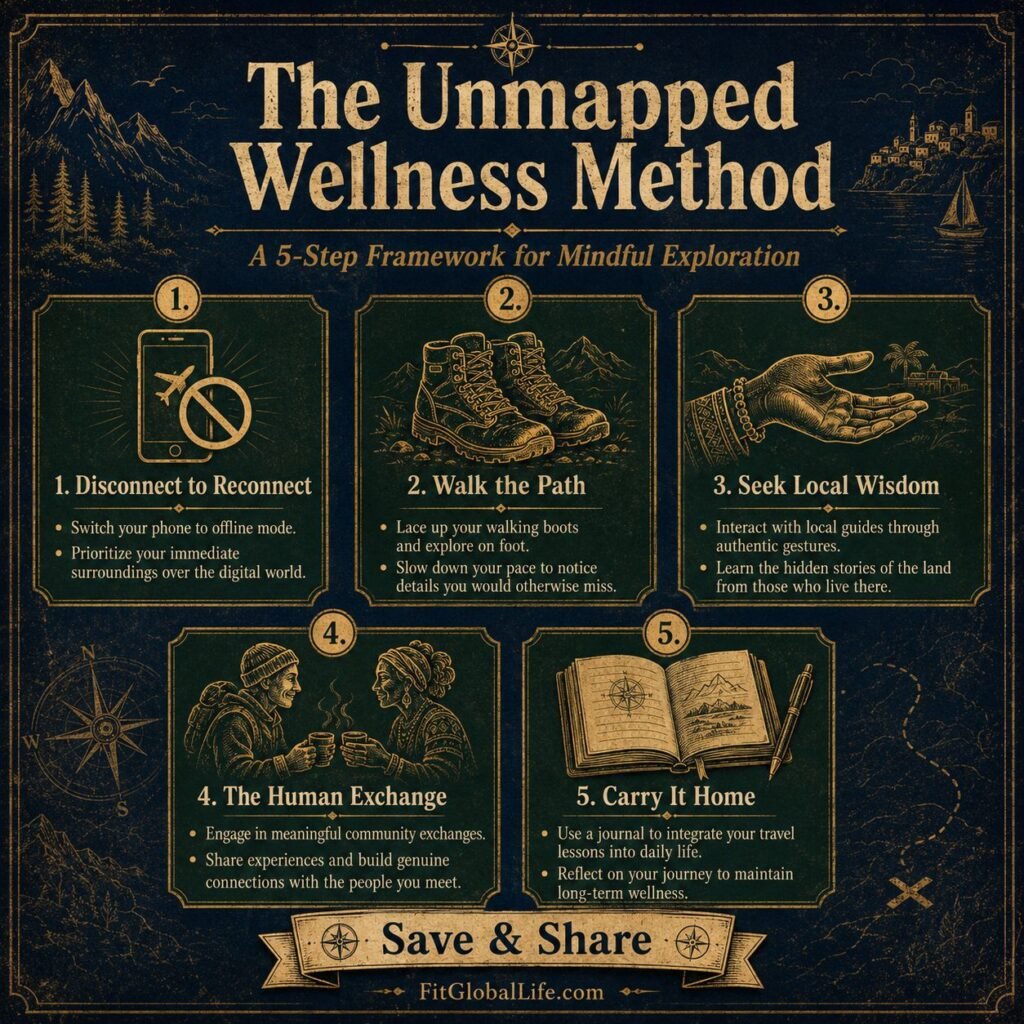
Fourth, practice relational ethics. Ask who benefits from your presence. Ask who pays the cost of your waste, noise, road use, cultural misunderstanding, or viral post. Ask whether the community wants more visitors, different visitors, fewer visitors, or better-managed visitors. These questions may feel less glamorous than a drone shot, but they are the backbone of sustainable travel without sacrificing style.
Fifth, integrate the return. The trip is not complete when you land at home. It is complete when something about your daily life changes. Maybe you keep one offline morning per week. Maybe you replace one rushed vacation with one longer, slower journey. Maybe you invest in body-mind recovery techniques instead of booking another escape every time your schedule catches fire. Maybe you become less available to urgency and more available to meaning.
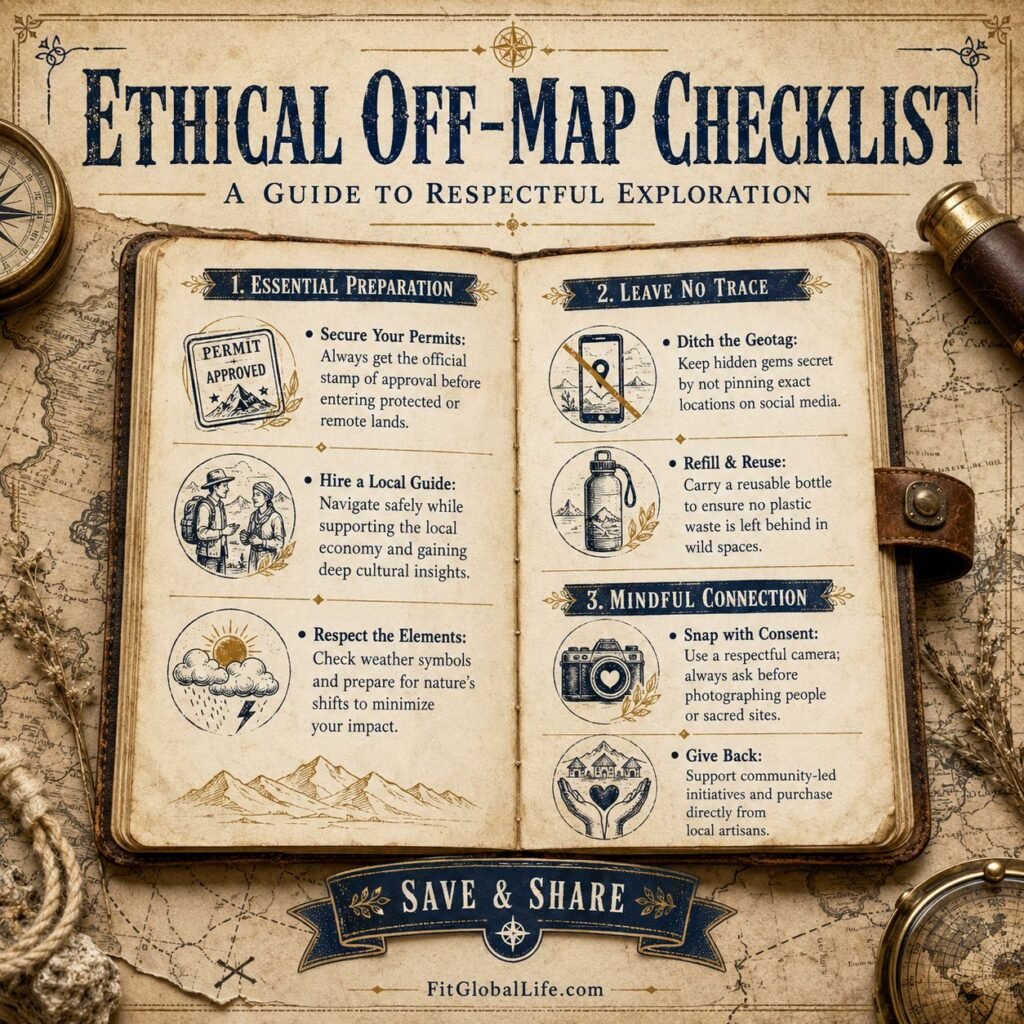
Ethical Travel Checklist Before You Go Off the Map
| Question | Why it matters | Better traveler action |
| Is this place safe to visit right now? | Conditions change faster than evergreen articles | Check current government advisories, local operators, weather, and access rules |
| Do local communities benefit from my trip? | Remote tourism can drain cash & attention without creating local value | Book local guides, local stays, community experiences, fair services |
| Am I ready without burdening others? | Poor preparation passes the risk on to guides, rescuers, communities and ecosystems | Bring the right equipment, insurance, medications and realistic fitness expectations |
| Will geo-tagging put this place at risk? | Fragile sites can be damaged by sudden exposure | Delay posts, avoid precise tags, follow local advice on sensitive areas |
| Am I confusing difficulty with transformation? | Hard trips can inflate ego instead of deepening awareness | Choose the trip that fits your capacity, not your fantasy identity |
| Do I know what not to photograph? | Some people, rituals, homes, graves, and sacred spaces require consent or privacy | Ask first, accept no, and do not turn refusal into drama |
| What will I change after returning? | Travel without integration becomes consumption | Keep one practice: slower mornings, offline windows, walking, local buying, or deeper rest |
This checklist may look less sexy than “top hidden places to visit before everyone else,” but it is more useful. The internet has turned the word hidden into a marketing coupon. Truly respectful travel is not about arriving at a place before it gets “ruined.” It is about refusing to be part of the mechanism that ruins it.
Closing: Let the Map Help You Arrive, Then Put It Down
The best map is not the one you worship. It is the one that helps you arrive safely and then knows when to become quiet. Use GPS. Use offline maps. Use satellite messengers where appropriate. Use weather forecasts, permits, operators, and official guidance. This article is not a manifesto for reckless wandering. It is a reminder that navigation is bigger than coordinates.
The unmapped guide is ultimately a guide to humility. Upper Svaneti teaches vertical time. The Torngats teach relational knowledge. Lorentz teaches ecological complexity. Mongolia’s sacred landscapes teach reverence. Ennedi teaches deep memory. None of these places exists to fix your burnout on demand. They are not therapy products with better views. They are living, layered, difficult, beautiful regions that may help you remember what your phone cannot: you are a body, a guest, a witness, and a participant in a world that is older and stranger than your itinerary.
So yes, bring the map. But do not let the map be the whole relationship. Let the road interrupt you. Let the guide correct you. Let the weather humble you. Let silence feel awkward before it feels medicinal. Let a mountain make your ambition smaller and your attention wider. That is where GPS still cannot find your soul. And honestly, thank goodness. Some things should not be optimized.
FAQ
In this article, the unmapped guide is travel that is more than digital mapping. It does not mean the places are literally unknown or undocumented. It means their deepest value cannot be mapped through GPS, reviews, pins, or itineraries. You need local knowledge, cultural humility, sensory awareness, and time.
Not all of these are open to the average traveler at all times. Upper Svaneti might be open to prepared mountain travelers at the right season, but places like the Torngat Mountains, Lorentz National Park and Ennedi need more specialized planning, permits, expert guidance and up-to-date safety checking. Always check official travel advisories and local conditions before you go.
GPS is extremely useful but accuracy and usability can be affected by terrain, quality of device, satellite geometry, local map data, weather, battery life and user interpretation. In remote areas the bigger problem is usually not the satellite signal itself but the lack of reliable roads, updated trail data, connectivity, rescue access or local context.
Remote travel can support wellness when it includes slower pacing, exposure to nature, sustained movement, digital boundaries, meaningful social contact, and integration upon returning home. It can also create stress if poorly planned. The goal is not to suffer for growth. The goal is to create conditions where attention, body awareness, awe, and humility can return.
Before you ask yourself if you can travel, ask yourself if you should. Use local guides, pay a fair price, respect permits, don’t geotag sensitive locations, ask for permission before taking photos, follow waste disposal rules, and learn some basic cultural etiquette. Travel less, stay longer. Ethical travel is less about looking woke and more about doing less harm and more good for your destination.
Disclaimer
This article is for educational and editorial purposes only. It is not a safety manual, an expedition plan, a medical recommendation, a legal advisory, or a substitute for professional travel guidance. Risks can be involved including weather, wildlife, altitude, political instability, limited medical access, poor communications and changing requirements for entry in remote regions. Before you plan any trip, check official travel advisories, park authorities, local operators, licensed guides, healthcare professionals when relevant, and current weather and access information. Do not use this article as your sole source for making travel decisions.