

Recovery rituals work better than motivation because they do not ask your tired brain to negotiate with itself. Motivation is useful when it shows up, but it is a terrible boss. It changes with sleep, stress, hormones, workload, weather, unread messages, family pressure, and the tiny emotional injury of opening your inbox before breakfast. A recovery ritual is different. It is a pre-decided sequence that tells the body, “We are safe enough to restore now,” even when the mind is still trying to earn permission to rest.
That distinction matters because many people are not failing from laziness. They are failing from depletion. They are trying to run a high-demand life on low-grade recovery, then blaming themselves for not feeling inspired. The usual advice says, “Find your why,” “push harder,” or “be more disciplined.” Sometimes that helps. Often it just adds shame to an already overloaded nervous system. A better question is: what would you do every day if you stopped waiting to feel ready?
This guide is built for professionals, caregivers, creators, travelers, students, and quietly exhausted high performers who do not need another motivational quote in beige typography. They need reliable recovery rituals that lower friction, restore energy, and keep life from becoming a permanent emergency. Think less “beast mode,” more “human maintenance.” The nervous system is not a smartphone; sadly, you cannot just yell at it until it reaches 100 percent. Rude, but true.
Editorial affiliate disclosure: This article may contain affiliate links. If you choose to buy through a link, FitGlobalLife may earn a commission at no extra cost to you. Recommendations are included only when they support the recovery ritual being discussed; they are not presented as medical treatment, diagnosis, or a guaranteed result.
Why Recovery Rituals Work Better Than Motivation
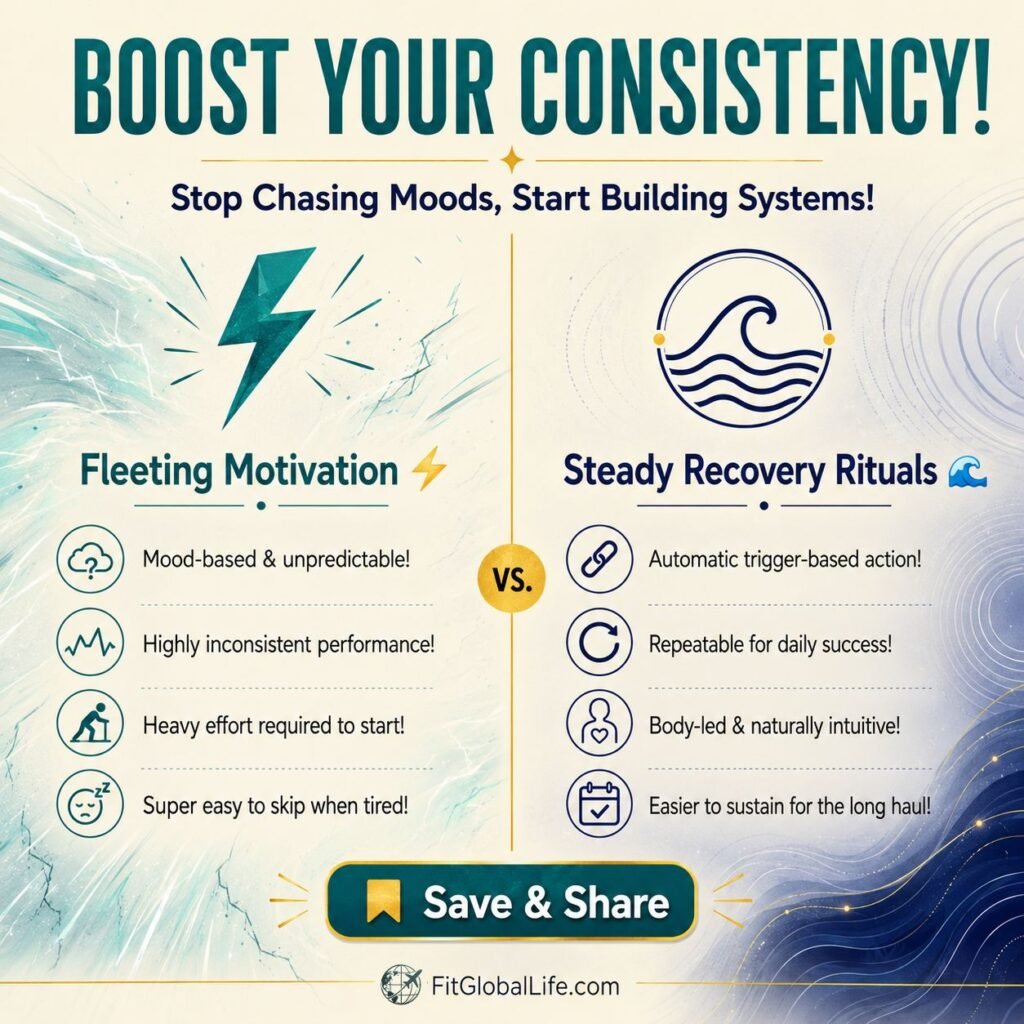
Motivation is a weather pattern; ritual is architecture
Motivation rises when conditions are favorable. Good sleep, positive feedback, supportive people, clear goals, and a manageable schedule can make action feel almost effortless. But the same person may feel completely different after a poor night, a difficult conversation, or a week of constant alerts. That is why motivation-only routines collapse under real life. They depend on emotional weather. Rituals create architecture: a doorway, a sequence, and an ending point that remains available even when the weather gets chaotic.
Behavior science gives this idea a practical backbone. Research on implementation intentions shows that “if-then” planning can help translate goals into action by pre-deciding when, where, and how a behavior will happen. A meta-analysis of mental contrasting with implementation intentions found positive effects on goal attainment, which supports a simple editorial takeaway: people often do better when the next step is already designed before motivation is tested. See the implementation intentions meta-analysis for the research background.
A recovery ritual is an if-then plan for your energy. If the laptop closes, then the shutdown ritual starts. If the nervous system feels charged, then the downshift begins. If focus becomes foggy, then a micro-retreat replaces another caffeine scroll. This is why the topic pairs naturally with FitGlobalLife’s guide to mental fitness drills for stronger focus, but it should not repeat that focus article. The deeper promise here is not sharper concentration first. The promise is recovery first, then clearer concentration as a side effect.
Recovery is not laziness; it is performance maintenance
The culture of constant output has trained many people to treat recovery as a reward for finishing everything. The problem is obvious: everything is never finished. Work messages continue, the body keeps aging, responsibilities regenerate like browser tabs, and the algorithm always has one more thing to show you. If recovery only happens after life becomes quiet, recovery will almost never happen.
This is not just a lifestyle complaint. The World Health Organization and International Labour Organization estimated that long working hours led to 745,000 deaths from stroke and ischemic heart disease in 2016. That does not mean every busy week is a medical emergency, but it does challenge the fantasy that more hours are always neutral. A life without recovery has a cost. See the WHO and ILO long working hours estimate for the underlying public health context.
Sleep is another signal. CDC data reported that 35 percent of U.S. adults had insufficient sleep duration in 2020, and insufficient sleep is associated with several chronic health risks. Again, the point is not to scare readers into perfection. The point is to stop treating recovery as optional decoration. The body tracks debt. It may tolerate a withdrawal for a while, but it eventually asks for payment, plus interest, and the interest rate is straight-up disrespectful. For background, see the CDC insufficient sleep data.
FitGlobalLife has already explored the science of rest and everyday mind-body recovery. This article builds on those foundations by asking a sharper question: which recovery rituals are so simple and repeatable that they still work on days when motivation has left the group chat?
The Recovery Rituals Framework: Stop Waiting to Feel Ready
A useful recovery ritual has three parts: a trigger, a body-based action, and a closure cue. The trigger tells you when the ritual starts. The body-based action shifts physiology rather than only chasing a better thought. The closure cue tells the brain that the ritual is complete, so it does not become another vague self-improvement project.
This matters because tired people do not need complicated routines. They need short, repeatable scripts. A ritual should be small enough to perform before you believe in it. That is the gold standard. If you can only do it when your mood is already good, it is not a recovery ritual; it is a luxury accessory.
| Ritual | Best trigger | Core action | Recovery signal |
| 10-Minute Shutdown | Workday ends or one project ends | Close loops, write tomorrow’s first task, physically leave the workstation | Mental detachment and lower evening rumination |
| Nervous-System Downshift | Body feels wired, rushed, or reactive | Long exhale breathing, orienting, unclenching, slow movement | Reduced urgency and more choice before reacting |
| Energy Ledger | Midday slump or weekly review | Name energy drains, deposits, and one tradeoff | Less self-blame and more realistic planning |
| Micro-Retreat | Attention gets noisy or emotionally flat | 10-30 minutes away from input, preferably outside or sensory-light | Restored vigor, perspective, and body awareness |
| Sleep-First Promise | Evening decision point | Protect bedtime cues before productivity overflow | Better next-day baseline energy |
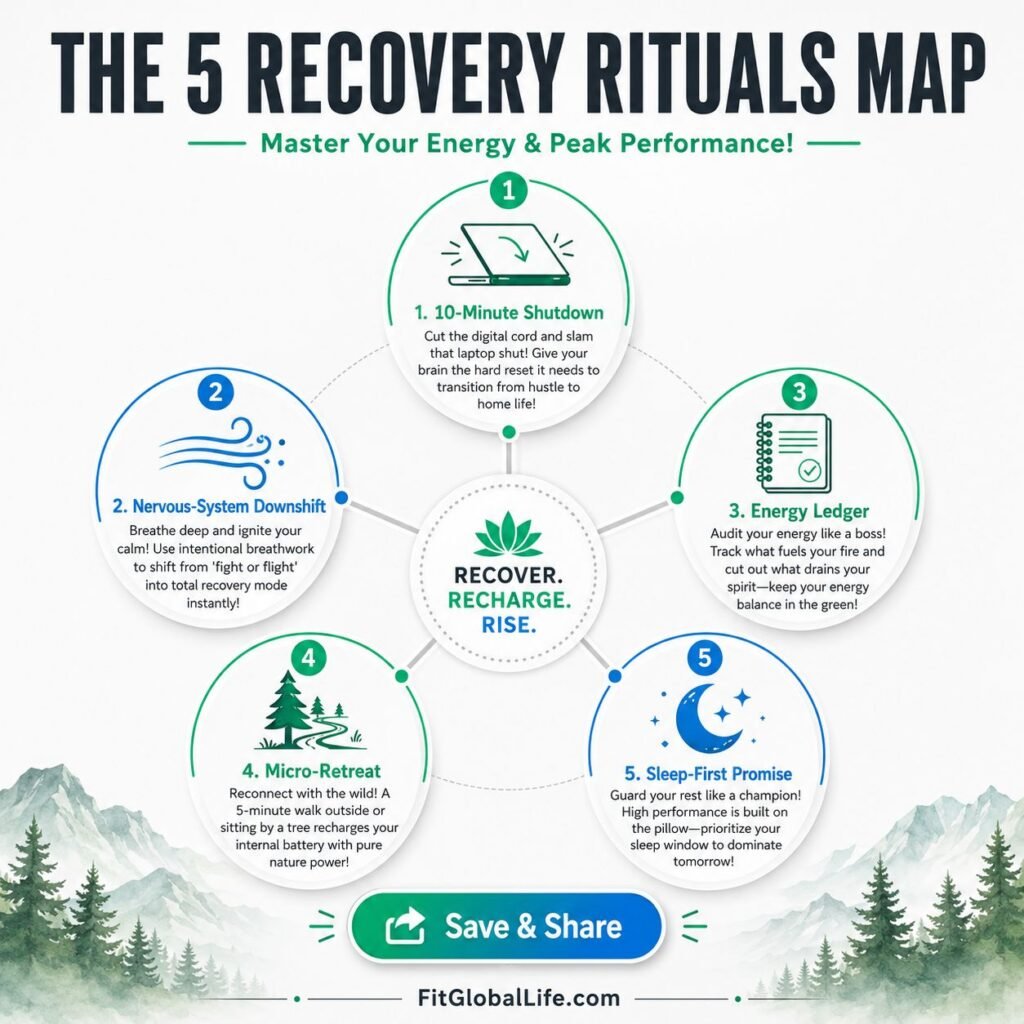
Notice what is missing from this table: a demand to feel inspired. The ritual begins from a situation, not from a mood. That one design choice changes everything. It turns recovery into a default instead of a debate.
Recovery Ritual 1: The 10-Minute Shutdown Ritual
The first recovery ritual is a clean shutdown. Not a dramatic life reset. Not a three-hour evening routine with a Himalayan lamp, oat milk, and a journal that costs more than dinner. Just ten minutes to close the loop between effort and recovery. This ritual is especially important for remote workers, creators, founders, parents, and anyone whose work follows them through a pocket-sized rectangle.
The shutdown ritual starts with one sentence: “Today is closed.” It sounds too simple, which is exactly why it works. The brain hates unfinished loops. If you end the day by simply collapsing into entertainment, your body may be on the sofa while your mind is still answering imaginary emails. Shutdown gives the nervous system a boundary it can feel.
How to practice the shutdown ritual
- Write a three-line closure note: what was completed, what is still open, and what comes first tomorrow.
- Move unfinished tasks out of your head and into one trusted place, such as a simple evening journal. Do not spread them across five apps like digital confetti.
- Close work tabs, silence non-urgent alerts, and physically leave the work surface for at least two minutes.
- Use one sensory cue: wash your hands, change lighting, step outside, play one calm song, or make tea.
- Say a short closing line: “Enough for today.” Corny? Maybe. Effective? Also maybe. Let the body vote.
Why this ritual beats motivation
Motivation tells you to push until you feel satisfied. The shutdown ritual tells you to stop when the loop is closed enough. That is a different skill. It protects recovery from perfectionism. It also supports psychological detachment from work, which is a key recovery experience studied in occupational health research. NIOSH guidance for demanding schedules also emphasizes planning rest days after consecutive shifts, reinforcing the idea that recovery needs to be scheduled rather than improvised. See the NIOSH rest-day planning guidance for a practical occupational-safety perspective.
This ritual also connects with FitGlobalLife’s digital detox protocol because digital boundaries are often the first place recovery leaks. The shutdown ritual does not require disappearing from the internet. It simply creates a friction line between useful connection and compulsive availability. For readers who struggle with scattered attention, the internal guide on attention debt and focus recovery can become the next step after this article.
Try this for seven evenings. Do not measure whether you feel instantly transformed. Measure whether your mind returns to work less often after the day ends. A recovery ritual is successful when it reduces unnecessary re-entry.
Recovery Ritual 2: The Nervous-System Downshift
The second ritual is for the moment when your body is technically safe but does not believe it yet. You know the feeling: shoulders high, breath shallow, jaw tight, thoughts moving like a group chat with no admin. In that state, motivation advice often backfires. “Just be positive” is not very useful when your body is preparing for a threat that is mostly made of calendar invites.
A nervous-system downshift is a short ritual that uses the body to send a different message. It does not deny stress. It gives the body evidence of safety through breath, orientation, touch, and movement. This is why it sits close to FitGlobalLife’s articles on nervous system habits for a calmer week and somatic practices for stress relief, but the goal here is narrower: creating one repeatable reset before you react, continue, or decide.
How to practice the downshift
- Pause and place both feet on the floor. Let the chair or ground carry more of your weight.
- Look around slowly and name five neutral objects. This tells the brain you are in the present, not inside the imagined emergency.
- Take six slow breaths with a longer exhale than inhale. For example: inhale for four counts, exhale for six.
- Unclench one area: jaw, hands, belly, shoulders, or forehead. Choose one. Do not turn relaxation into a full-body performance review.
- Ask: “What is the next kind action?” Not the perfect action. The kind one.
Optional setup note: if your body resists slowing down after a long day, practicing on a soft meditation cushion can make the ritual feel more supported without turning it into a complicated wellness project.
Why this ritual beats motivation
Motivation tries to change the story in your head. A downshift changes the state that is shaping the story. That difference matters. When the body is activated, the mind often interprets everything through threat, urgency, or shame. A calmer state does not magically solve the problem, but it widens the space between stimulus and response. That tiny space is where better decisions live.
Mindfulness and meditation practices have been studied for stress, anxiety, sleep, and quality-of-life outcomes. The evidence is not a magic wand, and responsible health writing should not pretend that one breathing exercise cures chronic distress. Still, organizations such as NCCIH summarize research suggesting mindfulness may help people manage stress-related symptoms and improve aspects of well-being. See the NCCIH meditation and mindfulness evidence for a balanced overview.
If readers want a deeper practice after this article, link them toward FitGlobalLife’s short breathwork reset and the practical guide to mindfulness at work. In this article, keep the ritual simple: notice activation, breathe longer out than in, orient to the room, unclench, choose the next kind action.
Recovery Ritual 3: The Energy Ledger Ritual
The third ritual is the most underrated because it sounds almost too practical. An energy ledger is a weekly check-in that tracks what drains you, what restores you, and what tradeoff you will make next. It replaces vague self-blame with observable patterns. Many people say, “I need more motivation,” when the truth is closer to: “I spent my best energy on the wrong things and left my actual life with leftovers.” Ouch, but useful.
An energy ledger is not a mood diary. It is not a gratitude journal. It is a small decision tool. The aim is to see where energy is leaking before the body has to scream. It works especially well for people who are responsible, ambitious, and terrible at noticing when they are tired until they become weirdly angry at a spoon in the sink. No judgment. The spoon knows what it did.
How to practice the energy ledger
- Once a week, draw three columns: drains, deposits, and tradeoffs.
- Under drains, list the situations that consumed more energy than expected: meetings, late screens, conflict, decision overload, travel, social pressure, heavy meals, poor sleep, or emotional labor.
- Under deposits, list what reliably restored you: walking, sleep, cooking, silence, a supportive conversation, sunlight, light strength training, prayer, stretching, music, or unstructured time.
- Under tradeoffs, choose one specific swap for next week: fewer late meetings, one batch-cooked meal, a shorter workout, earlier device cutoff, or a protected Sunday morning.
- End with one sentence: “Next week, I will protect energy by ______.”
If you prefer structure, a weekly wellness planner can keep the energy ledger visible, especially when busy weeks make patterns easy to miss.
Why this ritual beats motivation
Motivation asks whether you feel excited. The energy ledger asks whether the plan matches your actual capacity. That is a more adult question. It also prevents a common trap in wellness content: giving the same routine to everyone. A 26-year-old freelancer, a 42-year-old parent, a 58-year-old manager, and a remote worker crossing time zones may all need recovery, but the energy math will look different.
This section can internally support FitGlobalLife’s article on wellness habits that improve daily energy because the energy ledger helps readers choose which habit actually deserves attention. It can also link to health habits that age well for readers who want a longer view across decades. The fresh angle here is that recovery is not only what you do after depletion; it is how you design a week that creates less unnecessary depletion in the first place.
For a data-aware audience, the ledger also introduces a healthier way to use wearables. Instead of obsessing over a single score, readers can compare subjective energy with sleep, movement, workload, and mood. The body is not a dashboard, but patterns can still teach. The goal is not to micromanage biology. The goal is to stop pretending every week has the same budget.
Recovery Ritual 4: The Micro-Retreat Ritual
The fourth ritual is a micro-retreat: a short, deliberate withdrawal from input so the brain and body can metabolize life. This does not require booking a cabin, quitting your job, or announcing a spiritual rebrand on Instagram. A micro-retreat can be 10 minutes on a balcony, 20 minutes walking without a podcast, 30 minutes in a park, or one lunch eaten without scrolling through other people’s emergencies.
The point is not escapism. The point is sensory reduction. Many people are not only tired from work; they are tired from constant input. Notifications, headlines, group chats, bright rooms, traffic, reels, comparison, and the emotional whiplash of modern feeds all ask the nervous system to process more than it was designed to process at once. A micro-retreat gives the system fewer signals to manage.
How to practice a micro-retreat without disappearing from life
- Choose a duration: 10, 20, or 30 minutes. Keep it realistic. A 10-minute ritual done often beats a perfect retreat done never.
- Remove one category of input: no phone, no podcast, no email, no news, or no conversation.
- Choose one environment: outside, near a window, in a quiet room, at a slow cafe table, or during a gentle walk.
- Let the body lead. Notice temperature, sound, light, breathing, and muscle tension.
- Return with one small next step. Do not overthink the lesson. The ritual is recovery, not a TED Talk audition.
Why this ritual beats motivation
Motivation often tries to add stimulation: a new playlist, a new challenge, a new quote, a new app. Micro-retreats subtract stimulation. That subtraction can be the medicine. A systematic review and meta-analysis on micro-breaks found evidence that micro-breaks can improve well-being indicators such as vigor and fatigue, while performance effects may depend on task type and break design. See the micro-breaks systematic review and meta-analysis for the research base.
Nature exposure is especially useful for this ritual. A broad review in the International Journal of Environmental Research and Public Health summarizes evidence linking nature exposure with several health outcomes, including stress-related markers such as cortisol. For deeper context, see the nature exposure and health review. This is also where FitGlobalLife can link readers to nature retreats for a gentle nervous reset if they want a longer-form travel or retreat angle.
For readers who cannot easily access nature, the principle still works: reduce input, slow the body, widen attention, and let the mind stop chewing the same problem. A quiet hallway, a stairwell stretch, a parked car, or a phone-free lunch can be humble but powerful. Recovery does not always look aesthetic. Sometimes it looks like staring at a wall for six minutes and becoming less feral. We take the win.
For noisy homes, open offices, or travel days, noise-reducing earbuds can help create a small pocket of quiet. The goal is not to escape life forever; it is to give the nervous system a cleaner signal for a few minutes.
Recovery Ritual 5: The Sleep-First Promise
The fifth ritual is the hardest because it challenges the modern addiction to squeezing one more thing from the evening. A sleep-first promise is a pre-decided boundary that protects tomorrow’s baseline energy. It says: “I do not borrow from tomorrow unless it is truly worth the interest.” This is not about moralizing bedtime. Adults have jobs, children, elders, deadlines, travel, hormones, anxiety, grief, and seasons where sleep is genuinely difficult. The ritual is not perfection. It is protection.
Most motivation advice treats the morning as the beginning of discipline. Recovery thinking treats the night before as the beginning of tomorrow’s capacity. A poor evening can make the next morning feel like pushing a shopping cart with one cursed wheel. You can still move, but everything takes more effort.
How to practice the sleep-first promise
- Choose a non-negotiable “lights-down runway” of 20 to 45 minutes. This is not necessarily sleep time; it is the transition toward sleep.
- Create one environmental cue: dim lights, lower room temperature if possible, switch to warm light, reduce noise, or move the phone away from the bed.
- Create one mental cue: write tomorrow’s first task, capture worries, or use a short prayer, meditation, or gratitude line.
- Create one physical cue: slow stretching, a warm shower, relaxed breathing, or reading something that does not emotionally attack you.
A small sleep cue can also help. A comfortable sleep mask or warm bedside lighting may support the lights-down runway without making bedtime feel like another performance task.
- Use a decision phrase: “This can wait unless it protects health, safety, or deep responsibility.”
Why this ritual beats motivation
Motivation wants tomorrow to rescue today’s choices. The sleep-first promise is more honest. It understands that tomorrow’s self is not a mythical productivity angel with unlimited patience. Tomorrow’s self is you, but slightly more vulnerable to whatever you did tonight.
CDC sleep data and cardiovascular-health organizations continue to emphasize sleep as a foundation of health, not a soft bonus. FitGlobalLife can internally connect this section to circadian lighting at home for readers who want to improve environmental sleep cues. It can also support the wider conversation around vagus nerve stimulation and stress management because evening downshifts often depend on helping the body exit high-alert mode.
The sleep-first promise does not mean every night becomes perfect. It means you stop treating your body like an employee who should be grateful for four hours of maintenance and unlimited unpaid overtime. That may not sound glamorous, but it is one of the most radical recovery rituals available.
How to Build a Recovery Ritual Stack in 7 Days
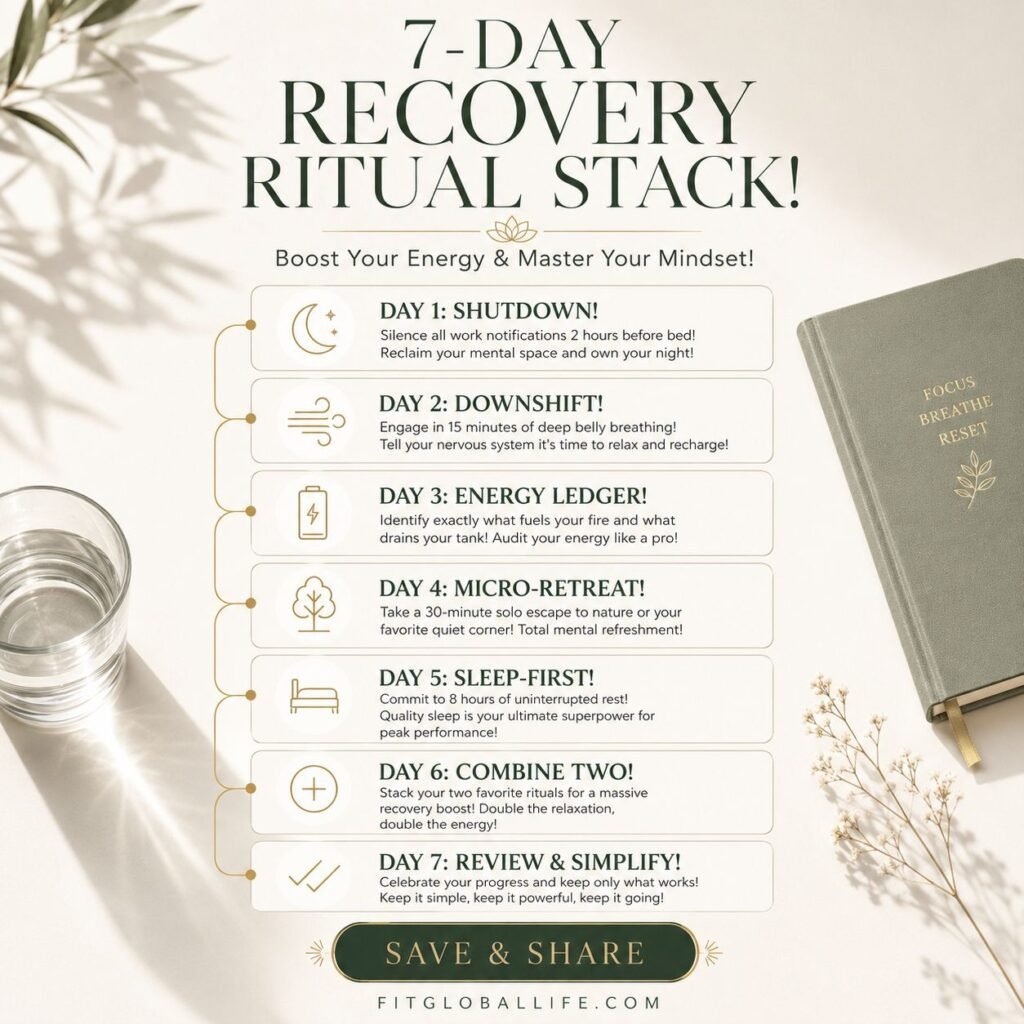
A recovery ritual stack is a small set of rituals placed at predictable points in the week. The goal is not to do all five perfectly. The goal is to make recovery visible, repeatable, and tied to real-life triggers. Start smaller than your ego wants. Your future self will thank you, probably without sending a formal email.
| Day | Practice | Minimum version | Success marker |
| Day 1 | Shutdown ritual after work | Write tomorrow’s first task and close tabs | You know where tomorrow begins |
| Day 2 | Nervous-system downshift | Six long-exhale breaths and five neutral objects | You react 10 percent less automatically |
| Day 3 | Energy ledger mini-check | List one drain and one deposit | You identify a real energy leak |
| Day 4 | Micro-retreat | 10 minutes without input | Your body feels less crowded |
| Day 5 | Sleep-first promise | 20-minute lights-down runway | Bedtime has a beginning, not a crash landing |
| Day 6 | Combine two rituals | Shutdown plus sleep-first promise | Evening feels less mentally open-ended |
| Day 7 | Review and simplify | Keep only the ritual that helped most | Recovery becomes easier, not more complicated |
Readers who want more structure can move next into FitGlobalLife’s seven-day digital reset or use exercise snacks for busy days as a movement-based recovery layer. The key is sequencing. Do not install ten new habits at once and then wonder why your nervous system has filed a complaint.
Physical activity deserves a balanced mention here. The CDC recommends that adults get at least 150 minutes of moderate-intensity physical activity each week plus two days of muscle-strengthening activity. That recommendation is not the same as saying every recovery day requires an intense workout. In fact, a smart recovery stack includes gentle movement, strength, walking, mobility, and true rest across the week. See the CDC adult activity guideline for the baseline public-health recommendation.
Common Mistakes That Make Recovery Rituals Fail
Mistake 1: Making the ritual too aesthetic
If your recovery ritual requires perfect candles, perfect silence, perfect clothes, perfect supplements, and a perfect room, it will not survive a normal Tuesday. Keep the ritual portable. The best recovery practices can travel through imperfect days.
Mistake 2: Confusing numbing with recovery
Numbing reduces feeling temporarily. Recovery restores capacity. Scrolling, overeating, alcohol, revenge bedtime procrastination, and endless streaming may provide relief, but they can also leave the body less restored. No shame spiral needed. Just ask: “Do I feel more available to life after this, or only less aware of life while doing it?”
Mistake 3: Waiting until burnout to begin
A ritual built during burnout has to work against a larger deficit. Start when you are only mildly tired. Recovery rituals are easier to install before the nervous system is fully cooked. Preventive recovery is less dramatic, but it is much cheaper.
Mistake 4: Treating recovery as individual failure
Some recovery problems are not solved by better breathing. They are caused by unrealistic workloads, unsafe environments, caregiving overload, financial pressure, health conditions, or social isolation. In those cases, the kindest ritual may be asking for support, changing a condition, speaking with a professional, or reviewing a practical protection plan that can reduce avoidable worry around health, travel, income, or caregiving responsibilities.
Mistake 5: Measuring only productivity
Recovery is not valuable only when it makes you produce more. Yes, better recovery can improve focus and performance. But people also deserve recovery because they are alive, not because they are monetizable. That sentence might ruin a hustle-bro webinar, but it belongs in a human wellness article.
Conclusion: Build the System Before You Need It
Motivation is not the enemy. It is a welcome visitor. The mistake is building your life as if that visitor pays rent. Recovery rituals are more dependable because they do not require you to feel inspired, clear, calm, or confident before you begin. They give you a trigger, a body-based action, and a closure cue. They reduce negotiation. They protect energy. They make recovery a normal part of living instead of a rescue mission after collapse.
Start with one ritual this week. Not five. One. Choose the shutdown ritual if your mind keeps working after work. Choose the nervous-system downshift if stress hijacks your reactions. Choose the energy ledger if your week keeps draining you in predictable ways. Choose the micro-retreat if your attention feels crowded. Choose the sleep-first promise if tomorrow keeps paying for tonight.
The deeper lesson is simple: you do not need to become a more motivated person to live better. You need a kinder operating system. Recovery rituals are that system. They work quietly, repeatedly, and without applause. And honestly, that is the point. The body does not need a standing ovation. It needs a rhythm it can trust.
Frequently Asked Questions
Recovery rituals are repeatable routines that help the body and mind move from demand into restoration. They tend to be associated with triggers like completing work, feeling stressed, losing focus or getting ready for sleep. They are not dependent on mood unlike motivation.
Motivation changes with energy, sleep, stress, and emotion. Recovery rituals work better because they are pre-decided. They reduce the need to negotiate with yourself when you are already tired.
A useful recovery ritual can take as little as 2 to 10 minutes. Longer rituals can help, but consistency matters more than duration. A short daily ritual usually beats a perfect ritual that rarely happens.
They can help with burnout prevention and recovery, but burnout can be a workplace culture, caregiving, financial pressure or medical issue. Recovery rituals are helpful tools, not substitutes for professional care or structural change.
Start with the ritual that fits your biggest energy leak. If evenings feel mentally unfinished, try the shutdown ritual. If stress feels physical, try the nervous-system downshift. If your week keeps draining you, start with the energy ledger.
Disclaimer
This article is for educational and lifestyle information only. It is not medical advice, diagnosis, or treatment. Readers with chronic fatigue, insomnia, anxiety, depression, burnout symptoms, cardiovascular concerns, or any persistent health issue should consult a qualified health professional. Recovery rituals can help with well-being, but they are not a replacement for proper medical care, therapy, workplace support or emergency help when needed.
Affiliate and insurance note: The product and protection links in this article may be affiliate links. They are included for convenience and editorial relevance, not as personal financial, insurance, legal, or medical advice. Always compare terms, exclusions, coverage limits, local regulations, and your own needs before purchasing insurance or any wellness-related product.