

Most people do not need another dramatic reset. They need nervous system habits that make an ordinary week feel less like a string of emergencies. The nervous system is not a mood board. It is the body’s living communication network, constantly reading energy, safety, demand, sleep, food, relationships, deadlines, and the tiny cues we barely notice. When those cues keep saying “hurry,” “perform,” “check,” or “prepare for impact,” the body responds even when the calendar looks normal.
That is why a calmer week is rarely built by one perfect meditation session on Sunday night. It is built through small signals repeated often enough that the body starts to trust them. A soft morning start. A breath that downshifts the pace before a meeting. A meal that prevents the 3 p.m. crash. A walk that helps your muscles discharge tension instead of turning it into jaw clenching. A boundary with your phone that gives your brain a chance to stop scanning. These are not “extra” wellness tasks. They are environmental cues that teach the body how to move between effort and recovery.
This article is not a substitute for therapy, diagnosis, or medical care. It is a practical guide for readers who feel functional but wired, productive but irritated, tired but unable to settle. If that sounds familiar, this is your low-drama starting point. No cold plunge required. Your nervous system already has enough plot twists.
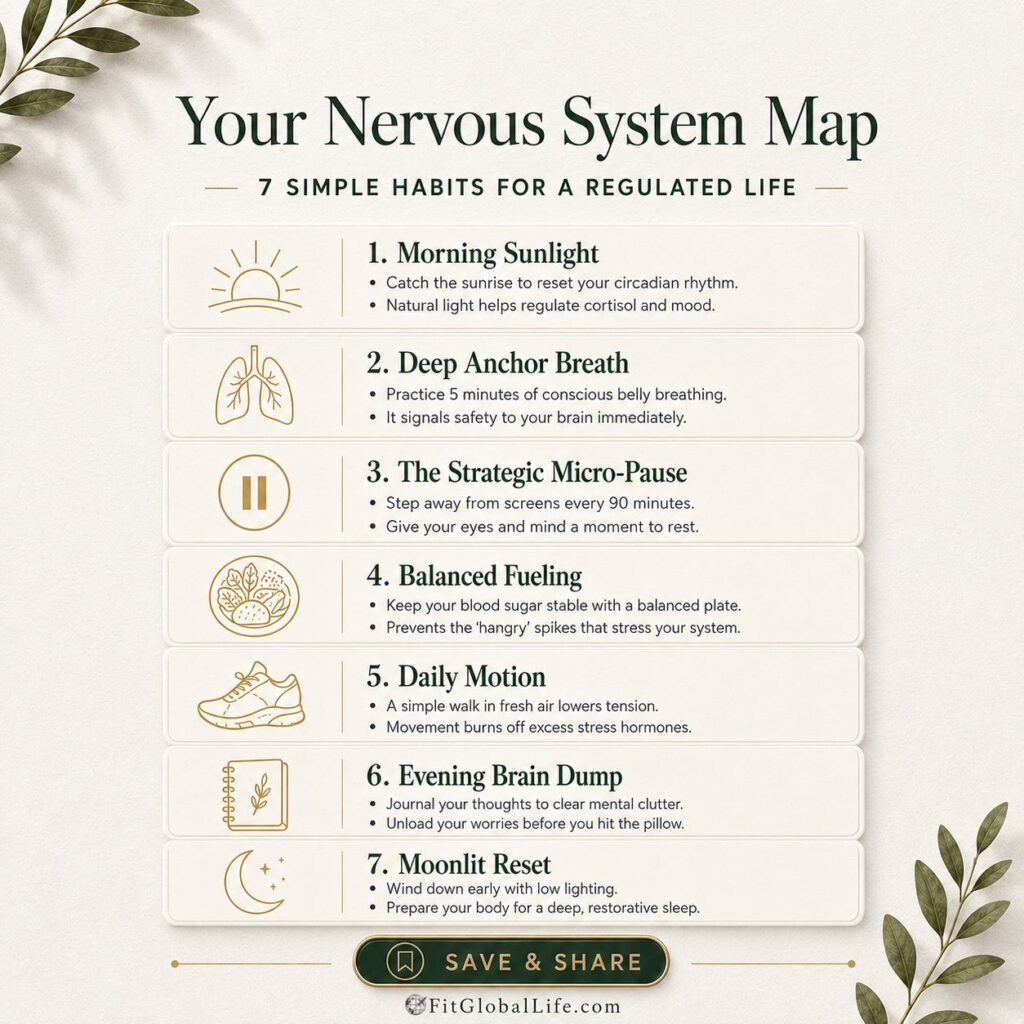
Why Nervous System Habits Matter More Than Another Reset
The modern wellness market loves the word reset. Reset your body. Reset your metabolism. Reset your mind. Reset your life before breakfast. Cute slogan, but the body is not a laptop. You cannot force-quit years of stress with one weekend routine and expect the system to reboot perfectly on Monday.
A more useful frame is rhythm. The nervous system has to rise and fall all day. It should mobilize when you need to think, move, speak, protect, decide, or create. Then it should soften when the demand has passed. Trouble starts when the “on” state becomes sticky. The email is over, but the chest remains tight. The conversation ended, but the body keeps rehearsing it. The workday is finished, but the mind is still hunting for unfinished loops.
The NCCIH explanation of stress describes stress as a physical and emotional reaction to life’s challenges, with fight-or-flight changes such as faster breathing, higher heart rate, muscle tension, and increased blood pressure. That response is useful in short bursts. It is less useful when the body receives the same alarm tone from screens, calendars, noise, poor sleep, under-eating, over-caffeinating, and social pressure every single day.
This is where nervous system habits become powerful. They do not promise a permanently calm personality. They teach transitions. A good habit helps the body notice when demand is over, when safety is present, and when recovery is allowed. That is also why this article pairs naturally with FitGlobalLife’s pieces on everyday mind-body recovery, soft living, and health habits that age well. The big idea is simple: calm is not a vibe you chase. It is a capacity you train in ordinary moments.
One more thing: a calmer week does not mean a slow, sleepy, unambitious week. A regulated person can still work hard, care deeply, train intensely, and handle pressure. The difference is recovery. Without recovery, high performance becomes a stress subscription with hidden fees. With recovery, effort becomes sustainable. Big difference, bos-level upgrade.
A Simple Nervous System Map: Stress, Recovery, and Daily Cues
Before the seven habits, it helps to understand the map without drowning in jargon. Your autonomic nervous system helps regulate functions you do not consciously manage moment by moment, including heart rate, digestion, sweating, breathing patterns, and blood pressure. The sympathetic branch generally supports mobilization: energy, alertness, action. The parasympathetic branch supports restoration: digestion, settling, social connection, repair. Real life is not a neat switch between the two. It is more like a mixer board. Several channels can be active at once.
A stressful week is not only about major events. It is also about cue stacking. Bright light late at night, skipped meals, rushed mornings, shallow breathing, constant notifications, unresolved conflict, indoor days, and no pause between tasks can all tell the body that demand is continuous. None of these cues has to look dramatic. Together, they create the background hum many people call anxiety, restlessness, fatigue, brain fog, or being “not myself lately.”
Autonomic balance vs. chasing calm
Autonomic balance does not mean being relaxed all the time. It means having range. You can activate when needed and come back down when it is safe. The term “heart rate variability,” or HRV, often comes up in this context because it’s about variation between heartbeats and can give clues about recovery, fitness and stress resilience. A Harvard Health overview of HRV notes that higher HRV may be related to cardiovascular fitness and resilience to stress, but also points out that context is important. In plain English: HRV can be interesting feedback, but your body is not a spreadsheet and one number should not boss your mood around.
This matters because some readers turn nervous system regulation into another performance goal. They track every signal, worry when their wearable says recovery is low, and then become stressed about their stress data. The better approach is gentler: use data if it helps, but prioritize repeatable cues you can feel. Can you breathe more slowly after the practice? Can you enter a meeting with less jaw tension? Can you stop doom-scrolling ten minutes earlier? Can you eat before the crash? Tiny yeses count.
Calmer weeks are built in repetitions, not emergencies
The body learns from repetition. A five-minute practice done four times a week often beats a perfect one-hour routine that happens once and then disappears. This is why FitGlobalLife’s guide to interoception skills is relevant here: if you can sense early signals from the body, you can respond before stress becomes a full-body takeover. Regulation becomes less about emergency repair and more about weekly design.
Think of the seven habits below as a menu, not a moral test. You do not need to do all of them perfectly. Start with two. Add one more when the first two feel natural. The goal is not to become the calmest person in the room. The goal is to stop making your body work overtime for problems that can be solved with better cues.
The table below gives you the quick map before the deeper guide.
| Habit | Nervous system target | Simple weekly practice | Watch-out |
| Morning safety cue | Reduce immediate threat scanning | Two minutes of light, water, and slow orientation before phone checking | Do not turn it into a 14-step routine |
| Breath gear shift | Support parasympathetic settling | Three to five slow exhale-focused breaths before task transitions | Avoid breath-holding or forced deep breathing |
| State breaks | Interrupt stress accumulation | One 60- to 90-second pause between focused tasks | Do not use the pause to check another screen |
| Stable meals | Reduce energy-driven anxiety | Protein, fiber, hydration, and regular meal timing | Do not confuse under-fueling with discipline |
| Circadian anchors | Support sleep-wake rhythm | Morning light, dimmer evenings, consistent wind-down | Do not chase perfect sleep; protect cues |
| Gentle movement | Discharge tension through the body | Walk, mobility, stretching, or easy Zone 2 movement | Do not punish stress with extreme exercise |
| Recovery review | Create emotional closure | End the week with wins, triggers, and one adjustment | Do not turn reflection into self-criticism |
7 Nervous System Habits for a Calmer Week
1. Start the Day With a Low-Friction Safety Cue
Your first waking minutes are not neutral. They set a tone. Many people open their eyes and immediately hand the steering wheel to a phone: alerts, news, messages, work reminders, social comparison, and tiny emergencies dressed as notifications. The body receives one message before breakfast: scan harder.
A low-friction safety cue is a small action that tells the body, “We are here, we are not late for a tiger, and we can enter the day one step at a time.” It can be ridiculously simple: sit up, place both feet on the floor, notice three things in the room, drink water, step near a window, or take ten slow breaths before touching the phone. The point is not spiritual perfection. The point is sequencing. Let the body arrive before the world rushes in.
Try this: before opening any app, look around the room and name five ordinary details. “White wall. Brown table. Morning light. Pillow. Door.” This practice is not magic. It is orientation. Orientation helps shift attention away from imagined threat and toward present reality. It pairs well with FitGlobalLife’s guide on interoception skills because both practices train the ability to notice body signals earlier and more kindly.
The weekly version is even easier. Choose three mornings this week when you delay phone checking by five minutes. Not thirty. Five. If you can do more, beautiful. If not, five minutes still tells the nervous system that the day does not have to begin with a digital fire alarm.
2. Use Breath as a Gear Shift, Not a Performance Ritual
Breath is one of the few body functions that is both automatic and influenceable. That makes it a practical bridge between the body and the mind. When stress rises, breathing often becomes shallow, fast, or held. When breathing slows down, especially with a longer exhale, the body may receive a cue that demand is easing.
A review on diaphragmatic breathing found evidence that this kind of breathing may reduce stress through both physiological markers and self-report measures. Another review found that relaxation strategies such as progressive muscle relaxation, deep breathing, and guided imagery can increase relaxation compared with control conditions. For a wider practice menu, FitGlobalLife’s article on a breathwork reset is a natural next read.
The mistake is turning breath into a performance. You do not need to inhale like a monk in a documentary. If deep breathing makes you dizzy, tense, or panicky, stop forcing depth. Try softness instead. Breathe in normally through the nose if comfortable. Exhale slowly like you are fogging a mirror with your mouth closed or gently sighing through the nose. Repeat three to five times. That is enough to interrupt momentum.
Best use cases: before opening email, after a difficult conversation, before eating, while waiting for a meeting to start, or when you notice your shoulders creeping up like they have a mortgage. Breath works best as a gear shift, not as a once-a-day ceremony.
3. Add State Breaks Between Tasks
Many people do not have one stressful task. They have ten tasks stacked so tightly that the body never receives a signal that one demand has ended. You finish a report and instantly open messages. You leave a call and immediately check analytics. You answer a personal text while walking into another work task. The body experiences this as continuous activation.
A state break is a short pause that separates one nervous system state from the next. It can be sixty seconds. Stand up. Shake out your hands. Look at something far away. Walk to the kitchen. Roll your shoulders. Place one hand on your chest and one on your belly. The point is to create punctuation. No punctuation, no paragraph. No state break, no transition. The week becomes one giant run-on sentence.
For people who work at desks, this connects directly to mindfulness at work. A mindful workday is not about floating above deadlines. It is about noticing the body before stress leaks into every tab, every reply, and every decision. The 2024 Nature Human Behaviour study on brief mindfulness exercises found that self-administered mindfulness exercises were more effective than an active control for reducing short-term self-reported stress among English speakers from higher-income countries. That does not mean mindfulness fixes everything. It means brief practices can matter when they are realistically used.
A practical state break formula: close the old task, breathe once, move the body for thirty seconds, name the next task out loud, then start. It sounds almost too basic. That is the charm. Regulation should be usable on a Tuesday, not only at a retreat with flute music and suspiciously expensive tea.
4. Let Food Stabilize Energy Before Anxiety Fills the Gap
Not every anxious feeling begins as a thought. Sometimes the body is under-fueled, dehydrated, over-caffeinated, or riding a blood sugar roller coaster. When energy drops, the brain often starts explaining the feeling with available worries. Suddenly the inbox feels dangerous, a small comment feels personal, and the future looks like a spreadsheet made of doom.
A nervous-system-friendly week does not require a perfect diet. It requires fewer energy cliffs. Aim for meals that combine protein, fiber-rich carbohydrates, healthy fats, and hydration. For many readers, breakfast or the first substantial meal is the biggest lever. A coffee-only morning can feel efficient until the body sends an invoice around noon.
This is where FitGlobalLife’s pieces on daily energy habits and anti-inflammatory meal planning can support the bigger picture. Food is not a personality test. It is information. A stable meal tells the body that resources are available. A chaotic pattern of skipping, snacking, and catching up at night can tell the body to stay alert.
Try the “calm plate” approach three times this week: one protein source, one fiber-rich plant, one slow carbohydrate or additional vegetable, one fat source, and water. The goal is not aesthetic eating. It is fewer internal alarms. If food choices are affected by medical conditions, disordered eating history, pregnancy, medication, or blood sugar concerns, consult a qualified professional. Wellness advice should help your body, not bully it.
5. Protect Circadian Anchors: Light, Sleep, and Wind-Down
Sleep is where the nervous system does a lot of boring, glorious maintenance. Mood regulation, immune function, memory, appetite signals, and stress recovery all lean on sleep. Yet many people treat sleep like leftover time after work, scrolling, chores, and “one more episode.” Then they wonder why their body feels like a phone stuck at 12 percent battery with location services on.
The CDC sleep indicator reports that 35 percent of U.S. adults reported insufficient sleep duration, defined as fewer than seven hours on average in a 24-hour period. This does not mean every reader needs the exact same schedule. It means sleep is not a soft topic. It is infrastructure.
Circadian anchors are daily cues that help the body understand time. Morning light tells the system the day has started. Dimmer evenings tell it the night is coming. Regular meals, movement, and wind-down routines also contribute. FitGlobalLife’s article on circadian lighting at home can deepen this section for readers who want practical room-level changes.
Start with the two-anchor rule. Anchor one: get bright outdoor light, or at least window light, early in the day. Anchor two: reduce bright screens and intense work in the final thirty minutes before bed. If that is not realistic every night, choose four nights. Nervous system habits work through direction, not perfection. Your body is smart, but it is not petty. It responds to repeated cues.
6. Move Stress Through the Body Gently
Stress is physical. It lives in breathing, muscles, digestion, posture, skin, and energy. That is why thinking your way out of every stress response can feel like arguing with a smoke alarm while toast is still burning. Sometimes the body needs movement before the mind can update.
The WHO physical activity fact sheet states that regular physical activity provides significant physical and mental health benefits and can reduce symptoms of depression and anxiety. This does not mean every stressful day needs a punishing workout. In fact, when the body is already overloaded, extreme intensity can sometimes feel like more demand. Gentle movement often works better: walking, mobility, slow cycling, stretching, yoga, easy swimming, or a relaxed hike.
FitGlobalLife’s guide to simple somatic practices is useful here because somatic work reminds readers that the body is not just a vehicle carrying the brain around. It is part of the conversation. The same applies to Somatic Release and a gentle nervous reset in nature, especially for readers who calm down more easily outdoors than in a chair.
Try this weekly target: three movement sessions that are easy enough to finish feeling clearer, not crushed. Ten minutes counts. A walk after lunch counts. Stretching while the kettle boils counts. If movement becomes another scoreboard, the nervous system may hear “more pressure.” If movement becomes a friendly discharge route, the body often hears “we can complete the stress cycle.”
7. End the Week With a Recovery Review, Not Self-Judgment
A calmer week needs feedback. Not harsh review. Not a courtroom scene where you prosecute yourself for every missed habit. Feedback. The nervous system learns when you notice what helped, what overloaded you, and what needs adjustment.
On Friday evening, Saturday morning, or Sunday afternoon, ask three questions. What gave me energy this week? What drained me faster than expected? What one cue would make next week kinder? Keep the answers short. You are not writing a thesis. You are gathering useful signals.
This habit connects with FitGlobalLife’s pieces on emotional strength and how to stay calm when money stress spikes. Reflection becomes powerful when it turns emotional noise into pattern recognition. Maybe you notice that late meetings always disrupt dinner. Maybe group chats drain you more than work itself. Maybe Sunday planning helps, but Sunday overplanning makes you tense. Good. Now the week has data you can actually use.
The review should end with one small design change. Not “be less stressed.” That is not a plan. Try “walk before opening my laptop on Wednesday,” “prep one protein option,” “turn off work alerts after 7 p.m.,” or “schedule one real break after the hardest meeting.” Tiny design changes beat giant self-improvement speeches. Every time.
The 7-Day Calmer Week Plan
Here is a practical way to use the habits without turning your life into a wellness spreadsheet. Pick one main cue per day. Repeat the basics when they help. The aim is to lower friction and create a body-level rhythm of effort and recovery.
| Day | Primary cue | Practice | Why it helps |
| Monday | Morning safety cue | Five phone-free minutes after waking; water, window light, three room details | Prevents the week from starting in threat scanning |
| Tuesday | Breath gear shift | Three longer exhales before each meeting or focused task | Creates transitions instead of stress stacking |
| Wednesday | State breaks | One 90-second screen-free pause after every major task block | Gives the body punctuation |
| Thursday | Stable energy | Build one calm plate meal and hydrate before caffeine refill | Reduces energy crashes that mimic anxiety |
| Friday | Gentle movement | Ten to twenty minutes of walking or mobility after work | Discharges tension before the weekend |
| Saturday | Micro-recovery | Create a small offline window, nature walk, or home reset | Turns recovery into a real weekly event |
| Sunday | Recovery review | Write three lines: helped, drained, adjust | Converts stress into useful information |
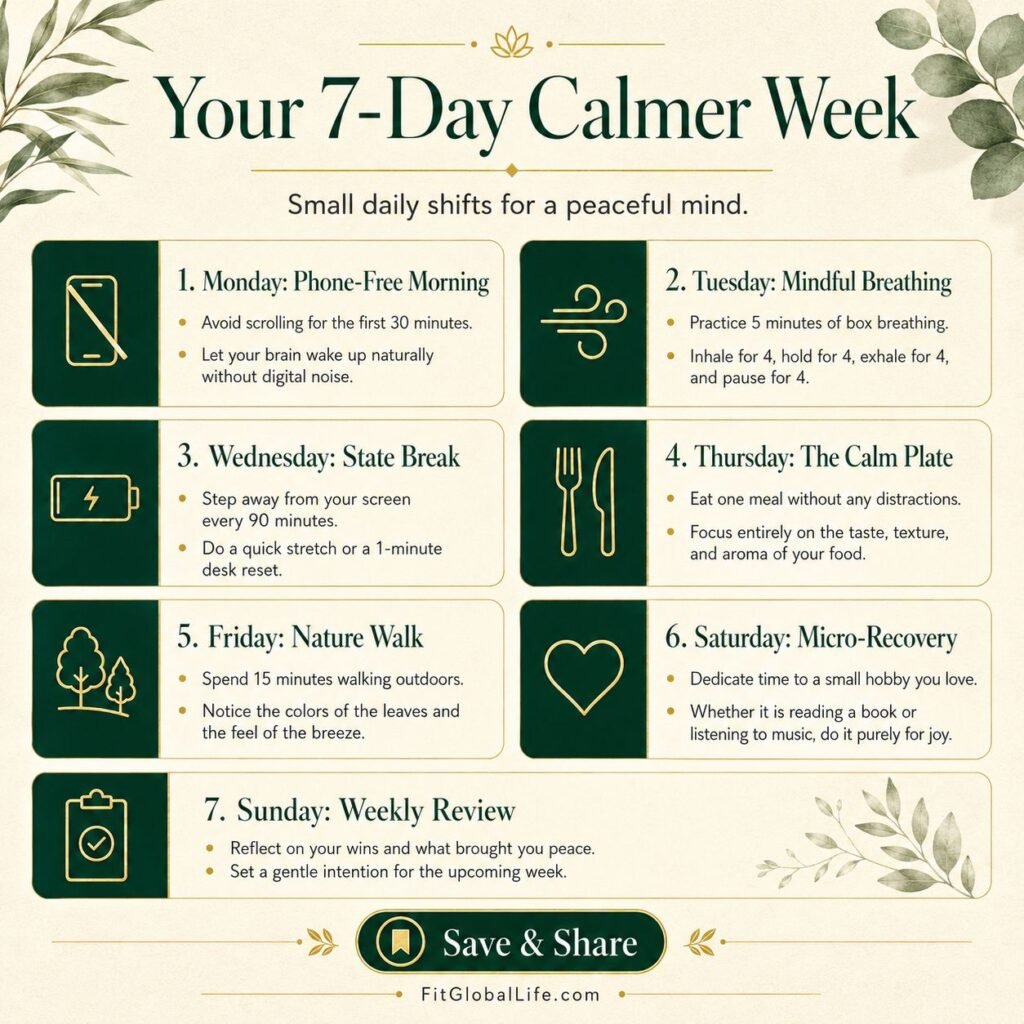
If you have more time, layer in a micro-retreat rhythm once or twice a month. A micro-retreat can be as simple as a half-day without errands, a quiet park morning, a slow meal, or a digital-free block at home. The point is not luxury. The point is recovery with a boundary around it.
For readers who feel mentally scattered, FitGlobalLife’s article on attention debt can help explain why constant switching makes the brain feel expensive to operate. Nervous system habits and focus habits are close relatives. When attention is constantly pulled, the body often stays on alert. When attention has a place to land, the body gets fewer false alarms.
How to Personalize These Habits Without Overthinking Them
The best nervous system habits are specific enough to repeat and flexible enough to survive a real week. Personalization matters because the same practice can feel calming for one person and irritating for another. One reader may settle quickly with quiet breathwork. Another may feel calmer after walking, humming, or cleaning the kitchen for five minutes. A third person may need food before any reflective practice works at all. The body has preferences. Listening to them is not being dramatic; it is being accurate.
Use the “signal, not style” test. Do not ask whether a habit looks like wellness. Ask what signal it sends to your body. Does it say safety, nourishment, transition, connection, completion, or rest? Or does it secretly say pressure, comparison, control, and one more thing to fail at? A beautiful routine that makes you tense is not regulation. A boring routine that helps you soften is gold.
For busy professionals, the most useful habit is often the transition cue. Put one small pause between roles: worker to parent, creator to partner, caregiver to self, commuter to human being who is allowed to breathe. This is especially helpful if your life asks you to switch emotional gears quickly. Without transition cues, the body carries the previous role into the next room. That is how a work email becomes a sharp tone at dinner, or a stressful commute becomes a restless evening.
For people who feel numb or disconnected, begin with gentle body awareness rather than intense emotional digging. Notice temperature, contact points, hunger, thirst, breath, and muscle tension. You are teaching the brain that body signals can be noticed without panic. This is where the phrase “listen to your body” becomes practical rather than vague. Listening starts with neutral data, not dramatic interpretation.
For high achievers, the challenge is often permission. You may understand the science and still feel guilty about stopping. In that case, frame recovery as capacity management. Rest is not the opposite of discipline. It is how discipline remains available next week. If you are building a career, family, creative project, or health change, your nervous system is not a side character. It is the infrastructure. Ignore it long enough and the whole production gets laggy. Very cinematic, but not ideal.
For readers who live with chronic stressors, personalization also means honesty. A five-minute breathing practice can help you meet the day, but it should not be used to normalize harmful conditions. If a workplace, relationship, financial situation, or environment keeps pushing your body into survival mode, nervous system habits may support you while you seek bigger changes. Calm practices should increase agency, not teach you to tolerate everything.
A simple way to personalize the week is to choose one cue from each category: one body cue, one environment cue, and one relationship cue. A body cue might be breathing, walking, stretching, eating earlier, or drinking water. An environment cue might be morning light, fewer notifications, dimmer evenings, or a cleaner desk. A relationship cue might be asking for clarity, delaying a reactive reply, setting a kind boundary, or repairing after a tense moment. Three cues are enough. You are building a calmer ecosystem, not auditioning for the Wellness Olympics.
After seven days, keep what helped and drop what felt performative. This is not quitting. This is intelligent editing. The nervous system responds best to cues that are believable, repeatable, and close to your real life. Calm does not need to be fancy. It needs to be practiced where you actually live.
Common Mistakes That Keep the Body on Alert
The first mistake is using calm practices only when everything is already on fire. That is like watering a plant only when it has filed a formal complaint. A nervous system habit works best when it is practiced during mild stress, normal transitions, and ordinary days. Then it is available during harder moments.
The second mistake is stacking too many wellness goals at once. Breathwork, journaling, supplements, sauna, cold exposure, perfect sleep, perfect meals, perfect screen boundaries, perfect steps, perfect morning sunlight. Suddenly the “calm routine” has the emotional tone of a tax audit. Choose fewer practices. Repeat them. Let them become familiar.
The third mistake is confusing numbness with regulation. Being regulated does not mean you feel nothing. It means you can feel something without being hijacked by it. A calm week still has frustration, grief, excitement, boredom, urgency, and conflict. The difference is that emotions can move through you instead of becoming your whole weather system.
The fourth mistake is ignoring digital inputs. If you practice breathing for five minutes and then spend two hours absorbing outrage, comparison, and fragmented attention, your body may stay activated. FitGlobalLife’s a digital detox protocol gives readers a practical next step for building cleaner digital boundaries without disappearing from modern life.
The fifth mistake is treating the vagus nerve like a magic button. The vagus nerve is important, and FitGlobalLife’s vagus nerve explainer can help readers explore the topic. But wellness content sometimes turns physiology into fantasy. Humming, breathing, social connection, safe movement, and rest may support parasympathetic activity, but no single hack can replace sleep, nutrition, relationships, medical care, or a safer life structure. Keep the science humble. The body appreciates humility.
A 2025 APA Stress in America report described societal division as a significant stress source for many adults. The lesson for daily health is not that every person must personally solve global tension before lunch. The lesson is that modern stress is layered. Your calming habits need to meet real life, not a fantasy life where the news is peaceful, the inbox is empty, and everyone uses their turn signal.
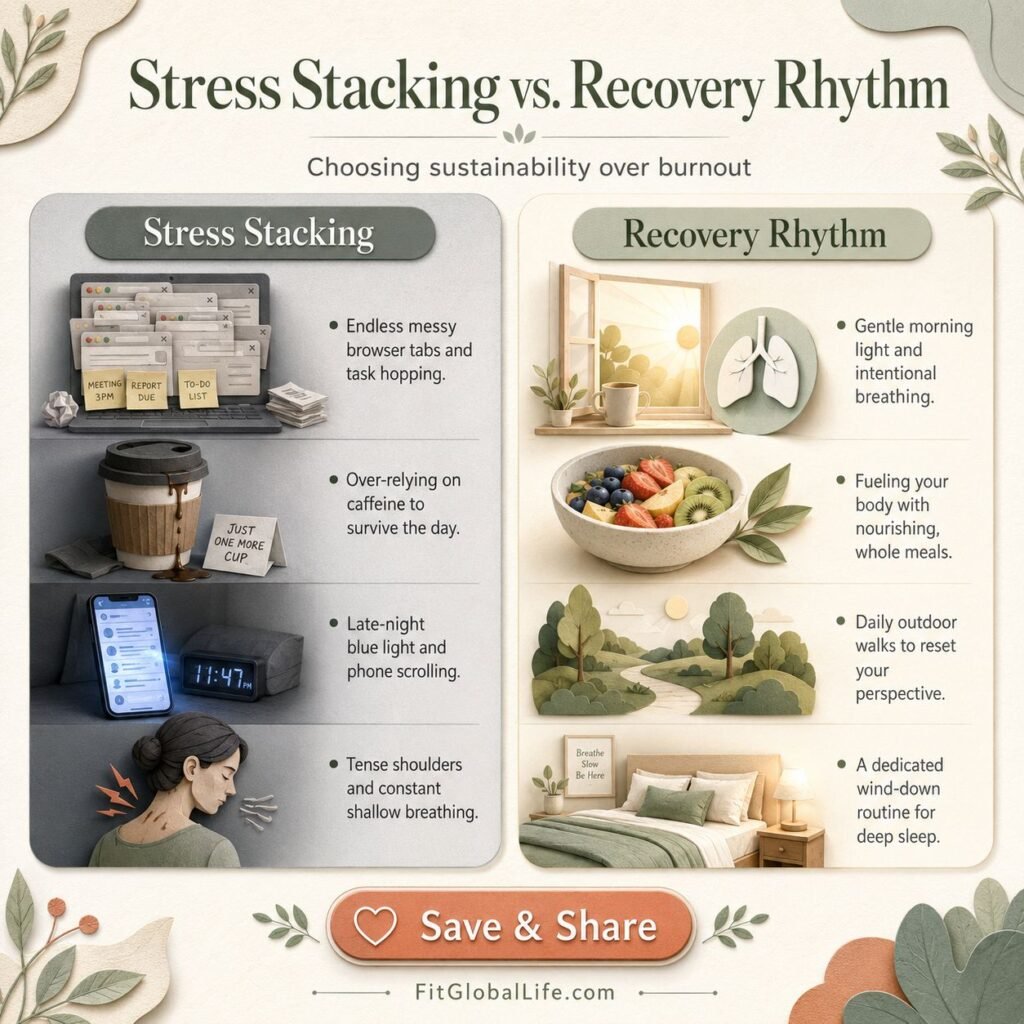
When Calm Habits Are Not Enough
Some stress responses need more support than lifestyle habits can offer. Anxiety, panic, depression, trauma symptoms, insomnia, intrusive thoughts, compulsive behaviors, substance use, eating concerns, or relationship danger can interfere with daily functioning. Getting professional help is important. Soothing habits can be helpful to support care, but they shouldn’t take the place of care.
Healthy actions like taking care of your body and mind, connecting with others, and getting help when needed are part of the CDC stress coping guidelines. The NIMH stress fact sheet also encourages people to understand the difference between everyday stress and anxiety that persists or interferes with life. This distinction matters. A breathing practice can help before a meeting. It cannot fix an unsafe workplace, untreated trauma, severe sleep deprivation, or a medical issue.
Also, some nervous system symptoms overlap with physical health conditions. Palpitations, dizziness, chest pain, fainting, unexplained shortness of breath, severe fatigue, or sudden changes in mood should be discussed with a qualified healthcare provider. The internet is useful. Your body still deserves a real human clinician when symptoms are serious.
For families, nervous system habits are not only personal. They are relational. If one adult learns to pause, soften their voice, notice hunger, or repair after conflict, the household often feels different. FitGlobalLife’s piece on family nervous system regulation can be a helpful follow-up for readers who want these habits to support family life, not just individual calm.
Final Thoughts: Your Nervous System Needs a Weekly Environment
The most useful nervous system habits are not glamorous. They are repeatable. They fit between real responsibilities. They respect biology. They do not shame you for being human. A calmer week begins when you stop asking your body to perform calm while living inside constant cues of urgency.
Start with two habits: one morning cue and one transition cue. Then protect one sleep anchor. Then add one movement practice. Then review the week. Slowly, the body learns that stress can rise and fall. Work can begin and end. Feelings can be felt without becoming emergencies. Recovery can be scheduled before collapse.
This is the quiet power of weekly design. You do not need to become a different person. You need a different set of signals. The nervous system is listening anyway. You might as well give it something kinder to hear.
FAQ
Nervous system habits are small repeated practices that help the body move between alertness and recovery. For example, breathing more slowly, sleep cues, movement, meals, digital boundaries, and quick breaks between tasks. These aren’t treatments, but they can support managing everyday stress.
Some practices, like a longer exhale or a short walk, may feel helpful in minutes. Deeper change usually comes from repetition over days and weeks. The goal is not instant peace. The goal is to make recovery easier for the body to access.
No. Meditation can be one nervous system habit, but it’s not the only one. How regulated or overloaded you feel is a function of movement, light exposure, mealtiming, sleep routines, body awareness, social connection, and digital boundaries.
Some people find them helpful to cope with daily stress and low-level anxiety (especially if used regularly). But if your anxiety is chronic, or severe, or is interfering in a significant way with your life, you should talk to a licensed mental health professional or your health care provider.
Start with a five-minute phone-free morning and three slow exhales before task transitions. These two habits are simple, free, and easy to repeat. They create a calmer beginning and more punctuation throughout the day.
Disclaimer
This article is for educational and informational purposes only. It is not medical advice, mental health treatment, diagnosis, or a substitute for care from a qualified professional. If you are suffering from chronic anxiety, panic attacks, trauma symptoms, depression, insomnia, chest pain, fainting, extreme fatigue, or any other concerning symptoms, please contact a licensed healthcare professional for advice. If you think you may harm yourself or other people, immediately call your local emergency number.