

| Affiliate disclosure: This article may contain affiliate links. If you choose to buy through these links, FitGlobalLife may earn a commission at no extra cost to you. We only mention resources that fit the article’s topic and encourage readers to review all product details directly with the provider. |
Journaling prompts for self-trust are often presented as a shortcut to certainty: write the right question, uncover your “true answer,” and never doubt yourself again. Real self-trust is less cinematic and far more useful. It is the ability to hear your own signals, check them against reality, make a workable decision, and remain on your own side if the outcome is imperfect.
That last part matters. Many people do not lose self-trust because they never know what to do. They lose it because every mistake becomes evidence against their character. A delayed project becomes “I am unreliable.” One awkward boundary becomes “I am selfish.” A choice that did not work becomes “I cannot trust myself.” The mind takes one event, writes a lifetime review, and gives it one star.
This guide takes a different approach. The goal is not to make you louder, more certain, or allergic to advice. The goal is to help you become better calibrated. You will use nine prompts to collect evidence, distinguish fear from fact, notice borrowed voices, interpret body signals with humility, run small decision experiments, repair past choices, design boundaries, and keep one realistic promise for seven days.
That approach complements Fit Global Life’s guide to quiet confidence and the thought patterns it breaks, but it does not repeat the same framework. Quiet confidence asks how you stop obeying distorted thoughts. Self-trust asks what you do next: how you choose, test, learn, and return to yourself without turning reflection into self-punishment.
Key Takeaways
- Self-trust is not permanent certainty. It is a reliable process for noticing, deciding, learning, and repairing.
- Useful journaling produces evidence or action. It does not merely produce prettier versions of the same worry.
- A body signal is data, not a verdict. Tightness may mean danger, fatigue, conflict, excitement, hunger, memory, or several things at once.
- Small reversible decisions often build more trust than months of abstract overthinking.
- The strongest self-trust practice is keeping a promise small enough to survive a real week.
What Self-Trust Actually Means
Self-trust is the confidence that you can participate honestly in your own life. It includes confidence in your perception, but it also includes confidence in your ability to update that perception. It includes trusting a preference, and trusting yourself enough to change your mind when new evidence arrives. It includes making a decision, and knowing that a disappointing result will lead to a debrief rather than an identity attack.
This is why self-trust is different from self-certainty. Certainty says, “I must know.” Self-trust says, “I can respond.” Certainty tries to eliminate risk before movement. Self-trust accepts that many adult decisions arrive without complete information: career changes, relationships, creative work, health routines, travel, boundaries, and the eternal question of whether replying “sounds good” somehow sounded angry.
It is also different from confidence as performance. You can speak firmly and still abandon your own needs. You can look calm and still outsource every decision. You can be highly competent at work and distrust yourself in relationships. Self-trust is quieter. It appears in the moment you notice discomfort before resentment, ask one more question before agreeing, submit the useful draft instead of hiding the perfect one, or admit that an old plan no longer fits.
If second-guessing has become your default operating system, start with a practical blueprint for reducing cognitive load. Overthinking is not always a lack of intelligence. It is often intelligence trapped in an endless risk meeting with no chairperson and no closing time.
Healthy self-trust also leaves room for emotional skill. The aim is not to suppress fear, anger, grief, or uncertainty. It is to stop letting the first emotion make every decision alone. Fit Global Life’s guide to building emotional strength through realistic mind shifts is useful here because emotional resilience is not the absence of emotion; it is the ability to stay in relationship with yourself while emotion moves.
What the Research Says About Journaling
Journaling is accessible, private, inexpensive, and adaptable, which makes it attractive as a self-reflection practice. The evidence is promising, but it deserves accurate language. A 2022 systematic review and meta-analysis of journaling interventions screened 3,797 records and included 20 randomized controlled trials covering 31 outcomes. The authors reported a small-to-moderate overall benefit and a greater reduction in patient health scores in journaling groups, while also emphasizing high heterogeneity and methodological limitations.
In other words: writing can help, but “journaling works” is too broad a claim. The prompt, population, duration, support, outcome, and writing style all matter. Expressive writing about distress is not identical to gratitude journaling. A ten-minute decision debrief is not identical to writing about trauma for twenty minutes. A journal can support therapy, but it is not automatically therapy because it has nice paper and a ribbon bookmark.
A 2025 systematic review of 51 studies of positive expressive writing found the most consistent benefits to be in well-being and positive affect, such as optimism and happiness. Effects were less consistent for negative affect, stress, anxiety, broader psychological health, and physical health, and the included studies were rated poor or fair in quality. That nuance is helpful: positive writing may support well-being, but it should not be sold as a universal mental-health cure.
There is also a useful connection between self-trust and agency. APA’s overview of self-efficacy and human agency explains why belief in one’s ability to act influences effort, persistence, and resilience. Self-trust is not identical to self-efficacy, but they overlap in a practical way: every kept promise, completed experiment, and repaired decision gives the brain evidence that you can influence what happens next.
Research summarized by the American Psychological Association on self-affirmation also suggests that reflecting on core values and strengths can support aspects of well-being and self-related outcomes. The important word is reflecting. Empty praise may feel thin when your nervous system has receipts to the contrary. Values-based writing works better when it connects identity to behavior: “I value honesty, so I will ask the uncomfortable question,” not merely “I am unstoppable,” typed while hiding from the email.
The safest conclusion is simple: journaling is a tool. It becomes more useful when the question is specific, the writing is honest, and the final line leads to a realistic action or a more accurate interpretation. Pair it with mental fitness drills that strengthen focus when attention is scattered, or with recovery rituals that reduce decision friction when exhaustion is making every question feel philosophical.
How Journaling Prompts for Self-Trust Actually Work
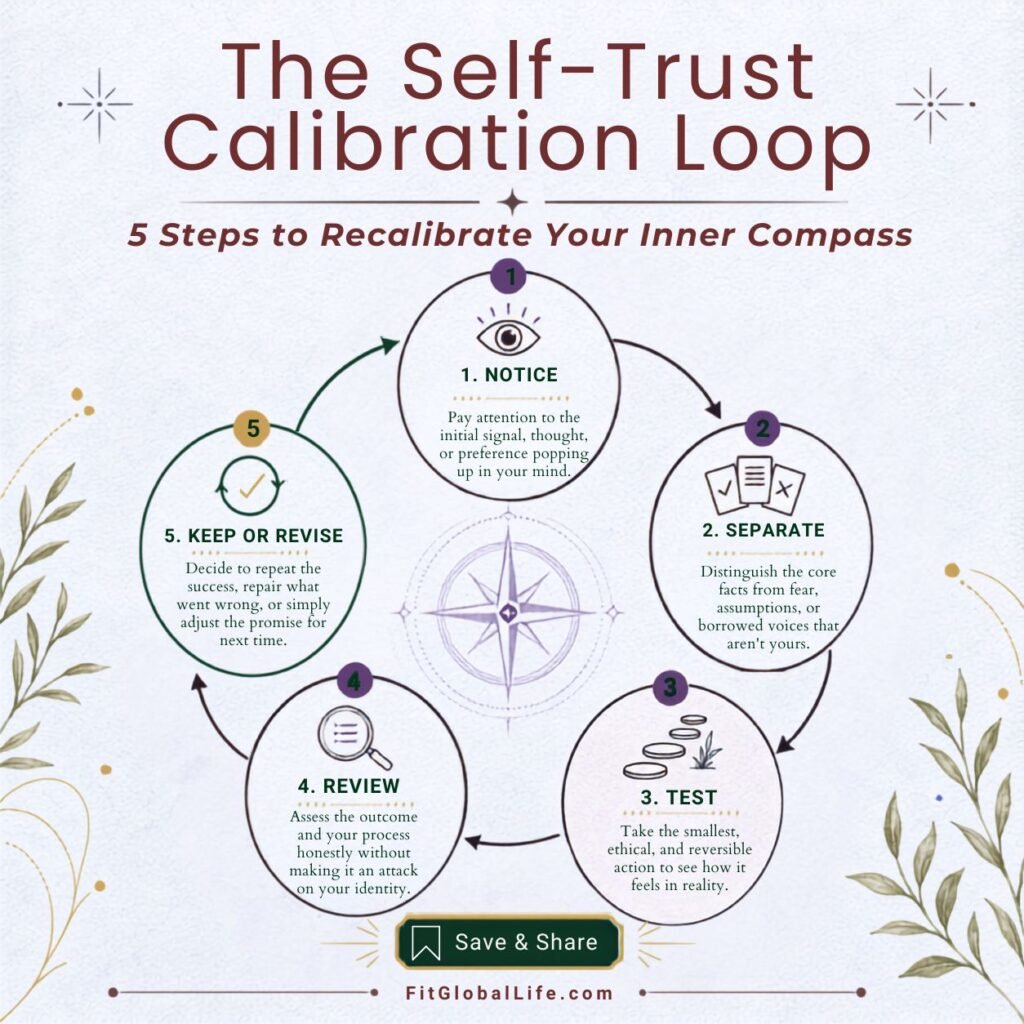
The nine prompts in this guide follow a five-step model called the Self-Trust Calibration Loop. A calibration loop does not ask you to believe every thought. It helps you improve the relationship between signal, interpretation, action, and feedback.
| Step | Purpose | Example |
| 1. Notice | Name the thought, body cue, preference, fear, or conflict without immediately explaining it. | “My chest tightened when I agreed.” |
| 2. Separate | Sort what is fact, fear, assumption, memory, or a borrowed voice. | “The deadline is fact. ‘They will hate me’ is a prediction.” |
| 3. Test | Choose the smallest ethical, reversible action that can produce new information. | Ask for clarification before accepting the assignment. |
| 4. Review | Do not judge process or outcome into a statement about your value. | The request was refused, but the line was drawn clearly and politely. |
| 5. Keep or tweak | Repeat what worked, fix what did not and make the next promise smaller or clearer | Next time I’ll ask for scope before I say yes. |
The loop matters because trust in yourself is based on feedback not fantasy. If all you notice are feelings, you might mistake intensity for accuracy. If all you analyze are facts, you might erase meaningful preferences. If you act without review, you will repeat patterns without learning. If you review without compassion, you create a journal that feels like surveillance.
A calibrated journal holds two truths at once: your internal experience deserves attention, and your first interpretation may still need testing. That balance is especially important when reading body signals. Fit Global Life’s guide to interoception and stress control can deepen your ability to notice sensations, while the calibration loop helps you avoid making every sensation the final answer.
Before You Begin: Five Rules for Useful Journaling
1. Use a container, not an endless session
Set a timer for 10 to 15 minutes. A time boundary reduces the chance that reflection turns into rumination. You can continue if the writing feels constructive, but you do not need to excavate your entire personality before breakfast. The point is to create a usable snapshot, not a 14-volume autobiography of Tuesday.
2. Write for accuracy, not aesthetics
Your journal does not need perfect handwriting, poetic language, matching pens, or a sunrise beverage placed at a suspiciously precise angle. Use paper, a notes app, or a simple guided journal you will actually open. The best format is the one with the least friction and enough privacy for honesty.
3. Separate facts, interpretations, and borrowed voices
When a sentence contains “always,” “never,” “everyone,” or “they probably think,” pause. Draw three columns: What happened, What I am predicting, and Whose rule this resembles. This prevents inherited expectations from disguising themselves as intuition. For deeper work on inherited or hidden material, see the shadow work blueprint for examining the parts we edit out.
4. Treat body signals as information, not instructions
Notice the body before explaining it. Tight jaw. Warm face. Heavy chest. Restless legs. Flat energy. Then list at least three possible meanings. A racing heart can signal fear, excitement, caffeine, lack of sleep, conflict, or a health issue. The body-mind connection and simple somatic practices can help you build a more precise vocabulary, and simple breathwork techniques may help you settle before interpreting.
5. End with one sentence you can use
Every entry should finish with one of four endings: I know, I need to ask, I will test, or I will pause. This turns journaling from emotional storage into agency. Sometimes the honest ending is “I do not have enough information yet.” That is not failure. It is cleaner than manufacturing certainty because the notebook is getting impatient.
9 Journaling Prompts for Better Self-Trust
You can use the prompts in order as a nine-day sequence, choose the one that matches your current situation, or repeat one prompt for a week. Do not chase the most profound answer. Look for the most accurate answer that gives you a next step.
1. What Evidence Shows That I Can Handle What Happens Next?
What evidence shows that I can handle what happens next – even if I cannot control the outcome?
Self-doubt often asks the wrong question: “Can I guarantee this will work?” Very few meaningful choices come with that guarantee. A better question is whether you have evidence that you can respond to what follows. Evidence may include previous problems solved, skills learned, people you can contact, money saved, boundaries available, or the simple fact that you have survived uncertainty before.
Divide the page into three parts: proof from the past, resources in the present, and support I can request. Keep the evidence behavioral. “I am strong” is an affirmation. “I asked for help during the last transition and built a workable plan” is evidence. Your brain trusts receipts more than slogans.
This prompt is especially useful before a decision, difficult conversation, publication, trip, application, or health appointment. It shifts attention from predicting a perfect outcome to recognizing response capacity. If your attention keeps jumping to worst-case scenarios, the article on repaying attention debt and restoring concentration can help you create enough cognitive space to think clearly.
Finish with: “Even if this is uncomfortable, I can respond by…”
2. Which Promise to Myself Did I Keep Recently, and What Made It Possible?
Which promise to myself did I keep recently, and what conditions helped me keep it?
People with low self-trust often remember every broken promise and ignore the ones they kept. They remember the abandoned workout plan but not the appointment they attended, the message they sent, the walk they took, the meal they prepared, the budget they opened, or the night they stopped scrolling ten minutes earlier. The evidence archive becomes biased toward prosecution.
Choose one promise from the past two weeks. It can be tiny. Describe the cue, time, environment, emotional state, and level of difficulty. Then ask what reduced friction. Maybe the task was visible. Maybe someone expected you. Maybe you made it smaller. Maybe you did it before decision fatigue arrived. Self-trust grows faster when you understand the conditions that support reliability.
This prompt turns trust from a personality trait into a design question. The lesson is not “try harder.” It may be “prepare earlier,” “remove one step,” “protect sleep,” “ask for accountability,” or “stop making promises during motivational weather.” Fit Global Life’s nervous system habits for a calmer week are relevant because a regulated week makes promises easier to keep than a week built from alarms, skipped meals, and heroic intentions.
Finish with: “I am more reliable when…”
3. Whose Voice Am I Hearing When I Second-Guess Myself?
Whose voice, rule, or expectation am I repeating when I second-guess myself?
Not every thought in your head originated there. Some arrived through family expectations, school, work culture, religion, social class, gender roles, online advice, previous relationships, or a manager who treated urgency as a personality. Borrowed voices are not automatically wrong, but they should not be allowed to wear your name tag without review.
Write the sentence exactly as it appears: “Responsible people never change plans.” “Good partners do not need space.” “Creative work is only valuable when it performs.” “Rest must be earned.” Then ask: who benefited when I believed this? When has the rule protected me? When has it made me smaller? What would a more adult, contextual version sound like?
A mature rewrite preserves any wisdom without preserving the cage. “Responsible people never change plans” might become “Responsible people communicate when reality changes.” “Rest must be earned” might become “Rest protects my ability to contribute.” This is not rebellion for content. It is authorship.
Finish with: “The rule I choose now is…”
4. What Did I Know Before I Started Explaining It Away?
What did I notice before I began minimizing, rationalizing, or explaining it away?
Sometimes you notice a mismatch quickly: a request feels unclear, an opportunity feels inflated, a conversation leaves you drained, a schedule looks impossible, or a “yes” arrives before consent has caught up. Then explanation begins. You tell yourself not to be difficult. You compare your reaction with someone else’s. You produce a beautiful legal defense for ignoring your own data.
This prompt does not assume the first signal is always correct. It asks you to preserve the signal before analysis edits it. Write the first observation in neutral language. “They changed the terms twice.” “I felt relief when the meeting was canceled.” “The role sounds impressive, but the daily tasks do not interest me.” “I keep delaying the same call.” Neutral observations are easier to test than dramatic conclusions.
Next, write what you said to override the observation. Then ask what additional information would confirm or challenge it. This keeps intuition connected to evidence. It also protects you from the opposite mistake: treating discomfort as proof that something is wrong when it may simply be new.
For situations where constant input makes your own signal hard to hear, digital deceleration and deep-focus practices can help reduce the volume before you interpret the message.
Finish with: “Before deciding, I need to verify…”
5. What Is My Body Signaling, and What Else Could That Signal Mean?
What is my body signaling right now, and what are three plausible explanations?
“Trust your body” is useful advice until it becomes an invitation to interpret every sensation as prophecy. The body is intelligent, but its signals are influenced by sleep, hunger, hormones, medication, caffeine, pain, memory, stress, excitement, illness, environment, and relationship context. A signal deserves attention; it does not deserve monopoly power.
Create two columns. In the first, record sensation without story: pressure behind the eyes, shallow breath, buzzing hands, heavy shoulders, warm face, open chest, grounded feet. In the second, list possible meanings. Include at least one physical explanation, one emotional explanation, and one contextual explanation. Then ask what response would be supportive across several possibilities.
For example, if you feel shaky before a presentation, a universally useful response may be food, water, slower breathing, and a clearer opening line. You do not need to determine whether the shakiness is 43 percent fear and 57 percent caffeine. You need to respond intelligently.
A short nature break can also widen your attention when internal signals feel too loud. Fit Global Life’s guide to nature retreats for a gentle nervous reset explains why environment can support recovery without pretending that scenery replaces care.
Finish with: “The kindest accurate response to this signal is…”
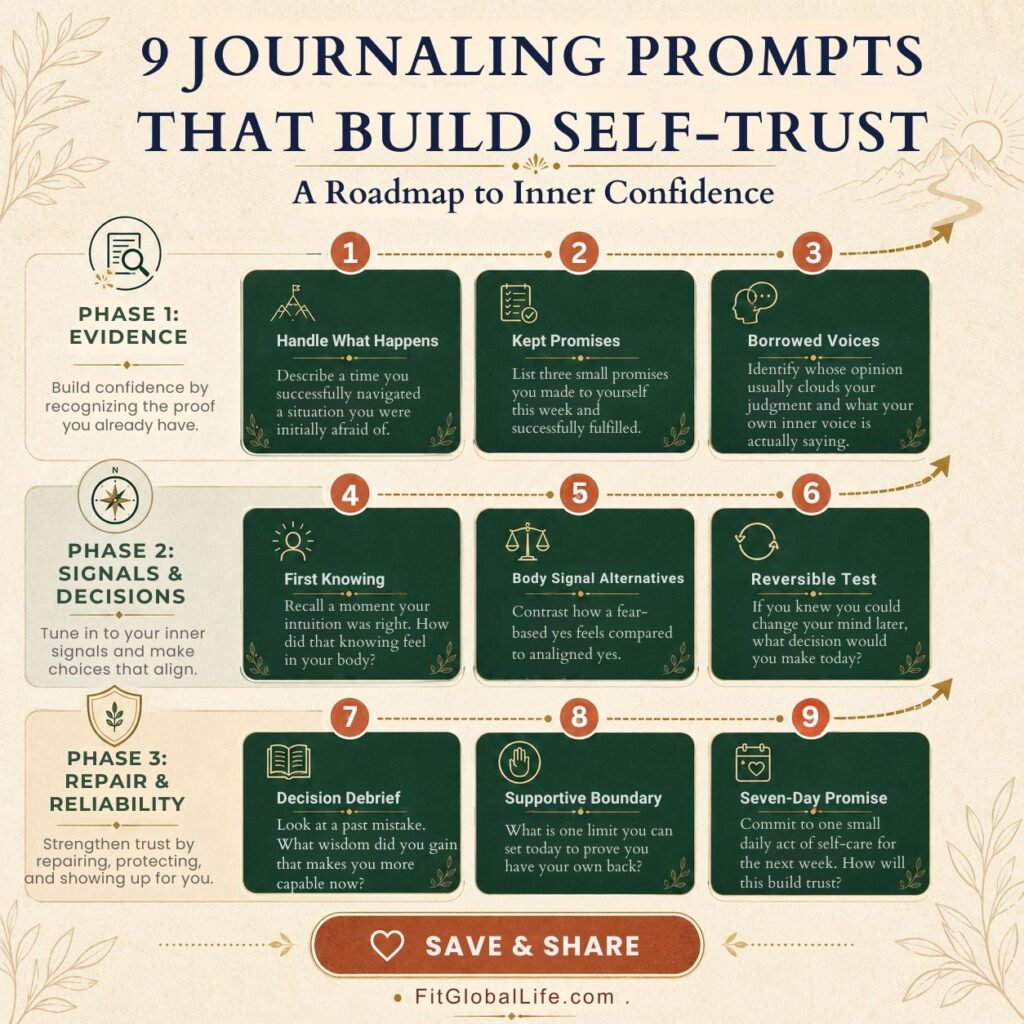
6. Which Choice Is Reversible Enough to Test Instead of Debate?
Which part of this decision is reversible enough to test for seven days?
Overthinking treats every choice like a permanent tattoo on the forehead of destiny. Many choices are not permanent. They are experiments: a new morning routine, a different meeting format, one week without notifications, a draft offer, a trial class, a boundary on one channel, a weekend itinerary, a conversation before a commitment.
Write the decision you are debating. Mark each part as reversible, partly reversible, or hard to reverse. Then identify the smallest reversible component that can generate information. A career change may be hard to reverse immediately, but an informational interview, course, freelance project, or shadow day is a test. Ending a relationship is significant, but asking one direct question and observing the response is information.
Define the test, duration, success signal, stop condition, and review date. This prevents the experiment from becoming a vague lifestyle era. “Try focused mornings for seven days, with messages off until 10 a.m.; success means completing one priority block on four days; stop if urgent responsibilities are missed.” Now the decision has edges.
Finish with: “The smallest honest test is…”
7. What Did My Last Disappointing Decision Teach Me About My Process, Not My Worth?
What did my last disappointing decision teach me about my process – not my worth?
Self-trust is not built by pretending every choice was correct. It is built by proving that mistakes produce learning instead of exile. Choose one decision that still makes you wince. Write what you knew at the time, what you did not know, what pressure was present, what need you were trying to meet, and what signal you ignored or overvalued.
Then separate outcome quality from decision quality. A thoughtful decision can produce a bad outcome because uncertainty is real. A careless decision can produce a good outcome because luck also has a résumé. Judge the process: Did you gather enough information? Did you ask the right people? Were you exhausted? Did fear rush the timeline? Did approval replace preference?
Write one repair, one lesson, and one future safeguard. A repair may be an apology, a corrected plan, money set aside, a follow-up appointment, or a boundary. A lesson names the pattern. A safeguard changes the system. “I will not accept major work while on the call; I will review scope and reply the next morning.” That is self-trust becoming infrastructure.
Awe can also help loosen the identity grip of one disappointing choice. The guide to awe psychology and psychological perspective explores how a wider frame can reduce excessive self-focus without erasing responsibility.
Finish with: “The next decision will be better because…”
8. What Boundary Would Make Self-Trust Easier Here?
What boundary would reduce the need to betray myself in this situation?
Sometimes self-trust does not fail inside the person. It fails inside a system that rewards immediate access, unclear expectations, emotional labor, or constant availability. You may trust your judgment perfectly well and still struggle to act on it because the environment punishes pauses.
Name the moment you usually abandon yourself: agreeing before checking capacity, answering while activated, accepting vague work, lending money without terms, reading comments before recovery, taking calls during family time, or sharing personal information before trust exists. Then design a boundary that protects the decision point.
A useful boundary has four parts: the trigger, the limit, the communication, and the consequence. “When a new request changes scope, I will pause delivery, confirm the revised deadline in writing, and resume after agreement.” “When a conversation becomes insulting, I will end the call and revisit it only when respectful communication is possible.”
Boundaries are not proof that you distrust others. They are structures that make honest participation possible. They also reduce resentment, which is often the bill that arrives after repeated self-abandonment.
Finish with: “To remain honest with myself, I will…”
9. What One Seven-Day Promise Will I Keep?
What one promise is small enough to keep for seven days and meaningful enough to matter?
The final prompt converts insight into evidence. Choose one action that can be completed in under fifteen minutes or attached to an existing routine. It should be specific, visible, and under your control. “Write for five minutes after coffee.” “Pause before agreeing.” “Walk after lunch.” “Place the phone outside the bedroom.” “Record one honest preference each day.”
Make the promise smaller than your ego prefers. Grand promises are emotionally exciting and statistically excellent at disappearing by Thursday. The goal is not to impress your future self. The goal is to become believable to your future self.
Write the cue, minimum version, backup plan, and tracking method. Cue: after dinner. Minimum: three sentences. Backup: one sentence in a notes app. Tracking: seven boxes. If you miss a day, do not restart the identity drama. Record what interfered, adjust the design, and continue. Repair is part of trust.
At the end of seven days, answer three questions: What became easier? What resistance repeated? What promise is now realistic for the next week? The win is not merely seven check marks. The win is better knowledge of how you support your own reliability.
Finish with: “For the next seven days, I promise to…”
A Seven-Day Self-Trust Practice Plan
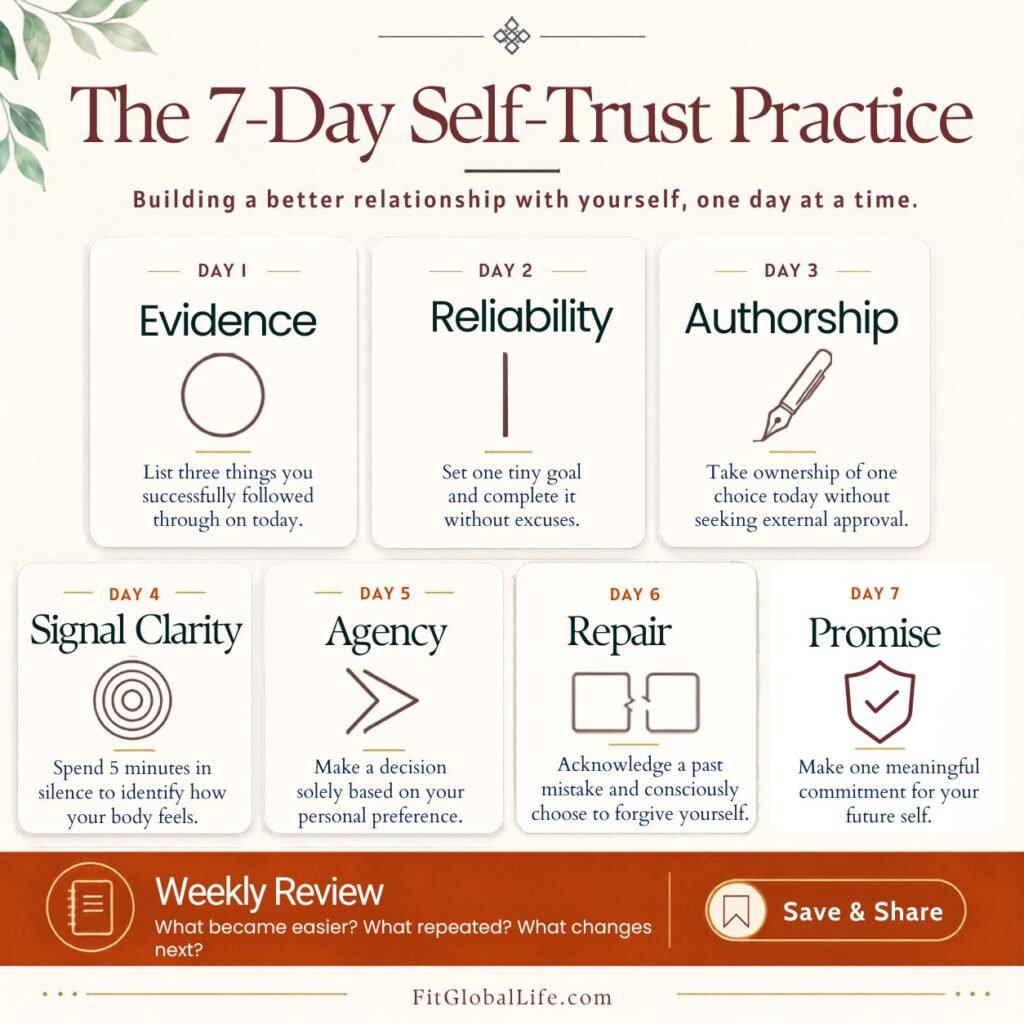
Use this plan when you want structure without turning journaling into another full-time job. Each day requires about 10 to 15 minutes. On Day 7, review rather than starting a new excavation project.
| Day | Theme | Prompt focus | Concrete output |
| Day 1 | Evidence | Prompt 1: response capacity | List three past receipts and one support resource. |
| Day 2 | Reliability | Prompt 2: kept promise | Identify the condition that made follow-through easier. |
| Day 3 | Authorship | Prompt 3: borrowed voice | Rewrite one inherited rule in adult, contextual language. |
| Day 4 | Signal clarity | Prompts 4 and 5 | Record first observation, body cue, and three possible meanings. |
| Day 5 | Agency | Prompt 6: reversible test | Design one seven-day experiment with a stop condition. |
| Day 6 | Repair | Prompts 7 and 8 | Name one process lesson and one protective boundary. |
| Day 7 | Evidence building | Prompt 9: kept promise | Choose one small promise and create seven visible check boxes. |
Keep the plan gentle enough to coexist with work, family, health, and ordinary chaos. If your mind feels foggy rather than reflective, start with basic recovery. A structured seven-day nature reset for brain fog may be more useful than demanding deeper insight from a depleted brain. Sometimes clarity needs sleep, food, movement, and fewer tabs before it needs another question.
How to Review Your Journal Without Turning It Into a Courtroom
A journal can become a place of freedom, or it can become a private performance review conducted by the least rested version of you. Use the R.E.A.D. review once a week to keep reflection constructive:
- R – Review evidence. Highlight facts, completed actions, direct quotes, repeated body cues, and outcomes. Do not highlight insults you wrote about yourself.
- E – Extract one pattern. Choose one repeated sequence, such as “unclear request -> instant yes -> resentment.” Avoid diagnosing your entire personality.
- A – Adjust one condition. Change timing, environment, boundary, cue, task size, or support. Insight without design is just premium rumination.
- D – Decide the next test. Choose one action and a review date. The journal should send you back into life, not replace it.
Also notice language that sounds final: “This proves I am…,” “I will never…,” “Everyone knows…,” or “I always ruin…” Replace verdicts with observations. “I delayed two difficult messages this week” is actionable. “I am a coward” is dramatic, inaccurate, and weirdly lazy because it explains everything while improving nothing.
When an entry contains genuine progress, let it count. Many people are excellent at analyzing pain and strangely allergic to documenting competence. Keep a small evidence page at the back of the journal: boundaries communicated, promises kept, repairs made, questions asked, decisions tested, help requested, and moments you changed your mind for a good reason. Self-trust needs a balanced dataset.
When Journaling Is Not Enough
Journaling is not the right tool for every moment. Stop or reduce the practice if writing repeatedly intensifies panic, dissociation, intrusive memories, compulsive checking, self-harm urges, or severe distress. Highly activating material may need a safer setting and professional support rather than solo excavation.
Seek qualified mental-health or medical care when symptoms persist, interfere with daily functioning, or involve trauma, depression, severe anxiety, panic, sleep disruption, eating concerns, substance use, abuse, or danger. A journal can help you prepare for an appointment by recording patterns and questions. It should not be used to delay care or to convince yourself that enough insight will make an unsafe situation safe.
The same principle applies to body signals. Chest pain, fainting, sudden shortness of breath, severe fatigue, palpitations, or significant changes in mood or functioning deserve professional evaluation. “Listen to your body” sometimes means close the notebook and call a clinician.
Self-trust includes knowing when another person’s expertise is useful. Asking for help is not outsourcing your agency. It is using your agency to widen the support around a problem.
Conclusion: Trust Yourself Enough to Stay Teachable
Better self-trust does not make you certain about every choice. It makes you less likely to disappear from your own decision-making process. You notice the first signal without worshipping it. You separate fact from fear and inherited rules. You test what can be tested. You review outcomes without attacking your identity. You repair. You revise. You keep one promise small enough to become evidence.
That is the deeper value of these journaling prompts for self-trust. They do not ask you to become a person who never hesitates. They help you become a person who can hesitate without abandoning yourself. The page becomes a place where uncertainty is organized, not denied; where emotion is heard, not promoted to chief executive; and where mistakes become tuition rather than a permanent sentence.
Start with the prompt that makes you slightly uncomfortable but still feels safe. Write for ten minutes. End with one usable sentence. Then do the small thing you wrote down. Self-trust is built there – not in the perfect answer, but in the moment your words and actions begin recognizing each other.
Frequently Asked Questions
Most people will notice patterns with three to five short sessions a week, and it doesn’t make reflection feel compulsory. You can also use one prompt before a decision, and one weekly review after. Consistency is more important than volume.
Choose the form that supports privacy, honesty, and repetition Handwriting can be slower, more embodied; type can be easier for access, speed, search, or travel. Research includes both handwritten and typed methods, so there is no universal moral victory for buying a fountain pen.
Write what makes the question difficult. “I do not know because…” is a valid opening. You can also list facts, sensations, and missing information instead of forcing an insight. Sometimes the most trustworthy answer is that you are not ready or do not yet have enough data.
Journaling helps you validate intuition more easily because you become more aware of repeated signals, preferences, triggers and results. It does not make intuition infallible. Use body signals and first impressions as data then check context, evidence and risk.
No, these prompts are self-reflection educational tools. They may be used in conjunction with therapy, or help you formulate questions for a professional, but they are not diagnostic or therapeutic for mental-health issues. If distress is persistent, severe, unsafe, or disruptive, seek qualified support.
Disclaimer
This article is for educational and informational purposes only. It is not medical advice, mental-health treatment, diagnosis, or a substitute for care from a licensed professional. Journaling can bring up difficult emotions. Stop the exercise and seek appropriate support if writing causes significant distress or worsens symptoms. Please call your local crisis or emergency services immediately if you think you may hurt yourself or someone else.