

Human skills for wellness are becoming more valuable precisely because wellness technology is becoming more capable, more persuasive, and more difficult to ignore. A ring can estimate sleep stages. A watch can count movement, display heart-rate trends, and congratulate you for standing up. An app can guide breathing, generate meal ideas, or turn a quiet morning into twelve dashboards before coffee. Some of that is genuinely useful. The problem begins when measurement is mistaken for wisdom, a notification is mistaken for care, or a score becomes more believable than the person wearing the sensor.
The wellness market is now enormous. The Global Wellness Institute’s latest monitor estimates that the global wellness economy reached $6.8 trillion in 2024. A market that large will produce excellent tools, mediocre tools, clever marketing, and a heroic amount of beige packaging. It will also reward products that make ordinary human uncertainty feel like a problem only a subscription can solve.
This guide is not anti-technology. It is anti-outsourcing. Technology is strongest when it helps a person notice a pattern, remember a plan, communicate clearly, or access qualified support. It is weakest when it quietly replaces body awareness, judgment, relationships, or the ability to act without permission from a dashboard.
That distinction gives this article a different job from FitGlobalLife’s guide to the major wellness economy shifts shaping 2026 or its practical framework for health habits that stay useful across decades. Those pieces examine market direction and durable behaviors. Here, the focus is the human operating system underneath every routine: the trainable capacities that help you use technology without becoming used by it.
Affiliate Disclosure: This article contains affiliate links. If you purchase through these links, FitGlobalLife may earn a commission at no additional cost to you. This does not influence our editorial standards or recommendations. As an Amazon Associate, I earn from qualifying purchases.
Why Human Skills for Wellness Matter More in a High-Tech Era
The wellness-tech promise is seductive because it offers clarity. Sleep becomes a score. Stress becomes a color. Recovery becomes a number. Movement becomes a ring that closes. For a busy person, that can feel merciful. Instead of interpreting a messy body and an even messier life, you receive a clean answer before breakfast.
But clean answers can hide dirty assumptions. Consumer devices estimate many things indirectly. In a well-known validation study of seven wrist-worn devices, heart-rate measurements were generally more accurate than estimates of energy expenditure; none of the devices measured energy expenditure accurately enough across all tested activities. The practical lesson from the wearable accuracy research is not that wearables are useless. It is that every metric has a measurement method, an error range, and a context.
Regulators make a similar distinction. The FDA’s updated general wellness guidance for low-risk products clarifies the category of products intended to support a healthy lifestyle. That category is not automatically the same as a device cleared to diagnose or treat a disease. Meanwhile, the Federal Trade Commission says that health-related product claims should be truthful, non-misleading, and supported by appropriate science; its health products compliance guidance is a useful reality check whenever marketing language begins wearing a lab coat.
There is also a wider public-health mismatch. More technology does not automatically produce more healthy behavior. Despite years of step counters, exercise platforms and activity reminders, 31 percent of adults worldwide didn’t get enough activity in 2022, according to the World Health Organization. And in the United States, a report from the National Center for Health Statistics in 2026 showed that 30.5 percent of adults didn’t get at least seven hours of sleep in 2024. We do not have a data shortage. We have a translation problem: how to turn information into decisions that fit a real body, a real schedule, and a real social environment.
That translation depends on human skills.
| Key idea A wellness tool should increase your capacity to notice, choose, act, connect, or seek appropriate help. If it mainly increases checking, fear, spending, or dependence, the tool may be technically impressive and behaviorally expensive. |
The Human Operating System: Nine Skills, Not Nine Gadgets
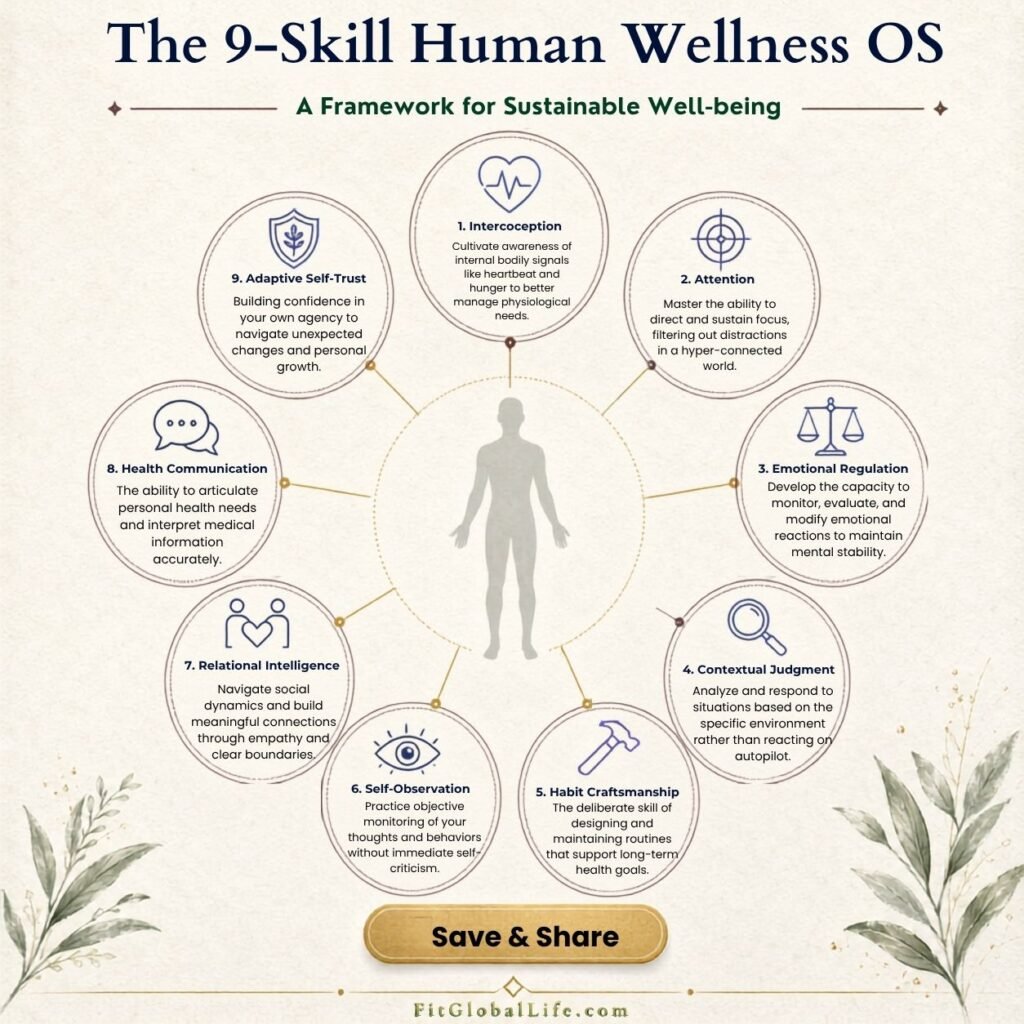
The nine skills below work as a system. Interoception tells you what may be happening inside. Attention helps you stay with the signal long enough to understand it. Emotional regulation keeps discomfort from hijacking the response. Judgment gives context. Habit Craftsmanship offers insight into actions. Honest Observation is feedback without shame. Relational Intelligence is co-regulation and support. Communication helps you ask better questions. Adaptive self-trust lets you update the plan without surrendering agency.
Technology can assist at every stage, but it should not own the stage.
| Human skill | What it protects | Legitimate tech role | Hype warning |
| 1. Interoceptive literacy | Body-signal awareness | Capture a trend or prompt reflection | A score overrides pain, fatigue, hunger, or symptoms |
| 2. Attention ownership | Focus and mental boundaries | Block distractions or schedule focus | More alerts are marketed as more control |
| 3. Emotional regulation | Response flexibility under stress | Guide practice or provide biofeedback | Normal discomfort is framed as dysfunction |
| 4. Contextual judgment | Accurate interpretation | Organize data for review | One reading is treated as a verdict |
| 5. Habit craftsmanship | Repeatable healthy behavior | Reduce friction and cue action | Streaks replace real-world function |
| 6. Honest self-observation | Learning without self-punishment | Store notes or simple trends | Tracking becomes surveillance |
| 7. Relational intelligence | Connection and co-regulation | Help coordinate contact | A chatbot is sold as a full substitute for people |
| 8. Health communication | Safer decisions and timely help | Prepare questions and records | An app implies diagnosis or individualized treatment |
| 9. Adaptive self-trust | Agency and course correction | Offer another input | The device becomes the final authority |
1. Interoceptive Literacy: Read the Body Before the Dashboard
Interoception is the ability to sense and interpret internal signals such as heartbeat, breathing, temperature, fullness, tension, nausea, fatigue, and the bodily texture of emotion. It is not mystical intuition, and it is not automatically accurate. It is a skill of noticing, checking, and learning what different signals mean in context.
A systematic review reported meaningful associations between interoception, vagal tone and emotional regulation but also highlighted the heterogeneity and the nascent state of the evidence base. That nuance matters. The interoception review supports the importance of body awareness without turning every stomach flutter into a prophecy.
Wellness technology can add an external data stream, but it cannot tell you the complete meaning of a sensation. A higher resting heart rate might reflect illness, heat, dehydration, alcohol, poor sleep, anxiety, a hard training block, medication, or ordinary variation. A wearable may flag the change. Human skill asks what changed around it.
FitGlobalLife’s deeper guide to interoception as an internal sense explores the topic in detail, while its article on simple somatic practices for the body-mind connection offers a gentler practice route. In this framework, the key is not to become hypervigilant. It is to become literate.
Practice: The 60-Second Three-Layer Check
Pause before opening a wellness app and ask three questions:
1. Sensation: What do I physically notice without interpreting it? For example: tight jaw, warm face, heavy eyelids, shallow breath.
2. Emotion: What emotion may be involved? Choose a specific word rather than “bad”: disappointed, overstimulated, lonely, apprehensive, frustrated.
3. Need or next check: Do I need water, food, movement, rest, connection, a boundary, medication as prescribed, or professional assessment?
Then look at the device if the information could change a sensible decision. This order matters. It keeps the body from becoming a secondary source in its own story.
Watch for: compulsive pulse checking, panic after normal variation, or ignoring significant symptoms because a device says everything is fine. If you have new, worsening or persistent symptoms, you need qualified medical attention, not a stronger Bluetooth connection.
2. Attention Ownership: Decide What Gets Access to Your Mind
Attention is a health resource because it determines what you notice, rehearse, learn, and repeatedly act on. A device that interrupts you thirty times a day can claim to support wellness while quietly consuming the very cognitive capacity needed to cook, walk, rest, talk, or think.
FitGlobalLife describes this accumulation as attention debt: the unfinished cognitive residue left by repeated switching, alerts, and open loops. Its digital detox protocol built around sustainable habits is useful when the solution needs to be more practical than “throw your phone into the sea.” Please do not throw your phone into the sea. The fish have enough problems.
Wellness apps are not exempt from attention economics. A meditation platform can send marketing notifications. A sleep app can make bedtime feel like an exam. A food tracker can turn lunch into data entry. A recovery dashboard can become the first emotional event of the morning. The content may be health-oriented; the interaction pattern can still be extractive.
Practice: The Two-Window Attention Audit
For seven days, create two short windows for wellness data: one after your morning routine and one near the end of the day. Outside those windows, disable nonessential wellness notifications. Keep urgent medical alerts only when they are clinically appropriate and set up with professional guidance.
During each window, ask:
- Did this information change a decision?
- Did it improve a behavior?
- Did it reduce uncertainty, or merely create another thing to monitor?
- Could a lower-tech cue do the same job?
For example, a simple analog alarm clock can remove the phone from the bedside without requiring a new digital ecosystem. It is not glamorous. That is part of its charm. A tool that does one job cannot upsell you while you are half asleep.
If your attention already feels crowded, FitGlobalLife’s cognitive load reduction blueprint can help simplify the wider environment. Attention ownership is not the ability to concentrate perfectly. It is the ability to choose what deserves repeated access.
3. Emotional Regulation: Separate Discomfort, Danger, and Data
Wellness technology often translates emotion into physiological proxies: heart rate, heart-rate variability, skin temperature, breathing rate, sleep disruption, or self-reported mood. These signals can be informative. They are not the emotion itself, and they do not automatically explain its cause.
Emotional regulation is the ability to notice an emotional state, make room for it, understand enough of its function, and choose a response that fits the situation. It is not suppression. It is not permanent calm. It is not smiling while your nervous system files a formal complaint.
One useful micro-skill is affect labeling: putting feelings into words. Research on affect labeling and emotional processing suggests that naming emotion can operate as a form of regulation, although no single technique works identically for everyone or every situation. Specificity helps because “I am overwhelmed” gives the brain more usable information than “my recovery score is terrible, therefore the day is ruined.”
Practice: Name, Normalize, Next Move
Use a three-part response:
- Name: “I feel apprehensive and physically activated.”
- Normalize: “This reaction makes sense before a difficult conversation; it does not prove I am unsafe.”
- Next move: “I will slow my exhale, review my first sentence, and enter the meeting.”
This is where a breathing timer or biofeedback tool may help, provided it supports a skill rather than promising to repair the nervous system in sixty seconds. FitGlobalLife’s guide to three simple breathwork techniques offers low-friction options, and its article on nervous system habits for a calmer week shows why repeated cues matter more than dramatic resets.
Emotional regulation also protects against the shame loop created by tracking. A missed target is information. It is not a character diagnosis. The thought patterns discussed in quiet confidence and self-trust are especially relevant when a number begins to sound like a moral judgment.
4. Contextual Judgment: Interpret Numbers Without Worshipping Them
Data becomes useful only after interpretation. Contextual judgment is the ability to ask what a number measures, how it was measured, what else could explain it, whether the pattern is stable, and what action would be proportionate.
This skill is boring in the best possible way. It protects you from treating one poor night as a health crisis, one glucose response as a forbidden-food verdict, one high-stress alert as a diagnosis, or one excellent score as permission to ignore pain.
A practical interpretation sequence is Data + Context + Trend + Consequence:
- Data: What exactly does the device claim to measure or estimate?
- Context: What happened around the reading: travel, alcohol, illness, medication, menstrual cycle, heat, workload, training, conflict, late meals, or disrupted sleep?
- Trend: Is this one point, a repeated pattern, or a long-term change?
- Consequence: What is the smallest sensible action, and what would justify professional review?
This is also an E-E-A-T skill for readers. A trustworthy wellness claim should make its evidence, scope, and limitations visible. The FTC’s guidance is blunt for a reason: scientific-looking language does not substitute for scientific support. A product can use graphs, white coats, and the word “clinically” while still offering fog with excellent typography.
FitGlobalLife’s mental fitness drills for stronger focus can strengthen the pause between signal and conclusion. That pause is where judgment lives.
Practice: Use a Four-Question Evidence Card
Before buying or acting on a wellness product, write four answers:
1. What exact problem am I trying to solve?
2. What outcome would matter in daily life, not just on a dashboard?
3. What evidence is there for this particular product and this particular claim?
4. What are the costs: money, time, attention, anxiety, data sharing, and opportunity cost?
A product does not need to be perfect to be useful. It does need a job description.
5. Habit Craftsmanship: Build Behavior That Survives Bad Days
Most wellness outcomes are not produced by information alone. They are produced by repeated behavior under changing conditions. Habit craftsmanship is the ability to design cues, reduce friction, scale the action, recover after interruption, and keep the behavior attached to a meaningful identity rather than a fragile streak.
A 2024 systematic review of habit-formation studies found wide variation in the time required for behaviors to become automatic; reported medians were roughly 59 to 66 days, while means in some studies were longer. The habit formation review is a useful antidote to the viral claim that every habit becomes automatic in 21 days. Some habits settle quickly. Others take months. Missing one day is not a system failure.
Technology helps when it reduces friction: a calendar reminder for medication, a saved walking route, a grocery list, a timer, or a prewritten shutdown checklist. It fails when the streak becomes the goal. A person can maintain a perfect app streak while the practice itself becomes mechanical, resentful, or disconnected from real function.
Practice: Design the Minimum Viable Habit
Choose a behavior with three levels:
- Full version: a 30-minute walk.
- Reduced version: a 10-minute walk.
- Minimum version: put on shoes and walk for two minutes.
The minimum version is not a trick to make you do more. It protects continuity on hard days. It teaches that identity can survive reduced capacity.
Use an implementation cue: “After lunch, I walk.” Then design the environment: shoes visible, route decided, phone on do-not-disturb, weather alternative ready. FitGlobalLife’s guide to recovery rituals that work better than motivation explains why pre-decided sequences outperform repeated negotiation when energy is low.
The same logic applies to sleep, meals, mobility, meditation, and connection. A good habit system has an easy restart. It expects travel, deadlines, caregiving, illness, grief, celebration, and random Tuesdays with aggressive plot development.
6. Honest Self-Observation: Learn Without Turning Life Into Surveillance
Self-observation is different from self-surveillance. Observation asks, “What pattern can I learn from?” Surveillance asks, “How can I catch myself failing?” The first expands choice. The second often narrows life around compliance.
A dashboard records what its sensors and inputs can capture. It does not automatically record why you skipped a workout to care for a parent, why a late conversation was more valuable than an early bedtime, or why resting was the healthiest decision available. Without narrative context, metrics can erase meaning.
Honest self-observation includes numbers when useful, but it also includes function and lived experience:
- Can I concentrate on meaningful work?
- Do I recover after effort?
- Am I more irritable, withdrawn, or impulsive?
- Is movement becoming easier?
- Do I wake with enough energy to participate in my life?
- Are my routines supporting relationships or competing with them?
Practice: The Weekly Four-Line Review
Once a week, use a simple paper reflection journal and complete four lines:
1. What gave me energy?
2. What repeatedly drained me?
3. What did my body or behavior try to tell me?
4. What is one adjustment for next week?
Keep the review brief. The goal is a learning loop, not a memoir produced under fluorescent lighting.
FitGlobalLife’s article on the science of intentional rest is a useful companion because many people misread fatigue as a motivation problem. Its guide to mindfulness at work also supports observation in environments where attention and stress are constantly being negotiated.
Self-observation becomes unhealthy when it increases fear, restriction, compulsive checking, body dissatisfaction, or avoidance of needed care. In those cases, simplify the tracking and seek appropriate professional support.
7. Relational Intelligence: Use Connection as Part of the Health System
Wellness culture often frames health as a solo optimization project: your sleep, your macros, your routine, your discipline, your data. Human biology is less individualistic. Relationships influence stress, behavior, meaning, safety, and whether people seek help early or hide until a problem becomes harder.
The U.S. Surgeon General’s advisory on social connection and health summarizes evidence linking stronger social connection with better health outcomes. In the underlying advisory, a synthesis of 148 studies found that social connection was associated with a 50 percent increase in the odds of survival. That does not mean every social interaction is medicinal or that loneliness can be solved by scheduling brunch. It means connection deserves a place beside movement, sleep, and nutrition in any serious wellness model.
Relational intelligence includes asking for support, offering support without taking over, repairing misunderstandings, choosing trustworthy people, setting boundaries, and recognizing when a digital interaction is not meeting a relational need.
Technology can help coordinate connection. It can schedule a call, maintain contact across distance, connect a person with a support group, or make therapy more accessible. It cannot guarantee attunement. A chatbot can provide language and structure; it does not share responsibility, history, touch, community, or the ethical obligations of a qualified professional.
Practice: The Five-Minute Contact Rule
When you notice the urge to numb, overtrack, or doom-scroll, send one low-pressure message to a safe person: “No need to fix anything. I have had a heavy day and wanted a little human contact. How are you?”
The message is small enough to use before isolation hardens into a private universe. For another route into connection, FitGlobalLife’s exploration of awe as a biological and psychological need shows how experiences larger than the self can soften rumination and restore perspective.
8. Health Communication and Help-Seeking: Know What to Ask and When to Escalate
A device may collect data, but safer care still depends on communication. Health communication is the ability to describe symptoms, timeline, severity, triggers, medications, relevant history, and the effect on daily function. Help-seeking is the ability to recognize when self-care has reached its limit.
This is one of the most underrated human skills for wellness because marketing often encourages a false binary: either ignore the body or become your own laboratory. There is a third option—pay attention, document clearly, and involve qualified care when appropriate.
Practice: Use the CLEAR Question Template
Before a medical or mental-health appointment, prepare five points:
- C – Change: What changed from your baseline?
- L – Length: When did it start, and is it constant or intermittent?
- E – Effect: How does it affect sleep, movement, work, eating, mood, or daily function?
- A – Actions: What have you already tried, including medications or supplements?
- R – Red flags and requests: What worries you, and what decision do you need help making?
Bring device data only if it supports the timeline or the clinician has asked for it. A month of trends may be useful. Forty screenshots without context may become digital confetti.
Seek urgent local care for emergency symptoms. Seek routine professional review for persistent or worsening symptoms, major changes from baseline, side effects, disordered eating or exercise patterns, severe sleep disruption, or emotional distress that is interfering with life. Technology should lower the friction of care, not become a waiting room you never leave.
For readers balancing wellness with travel or unfamiliar environments, FitGlobalLife’s broader approach to the great simplification of elite wellness is relevant: fewer, clearer systems are often safer than carrying a portable laboratory into every trip.
9. Adaptive Self-Trust: Use Data, Then Keep Your Agency
Self-trust is not stubborn certainty. It is the ability to make a reasonable decision, observe the result, accept new evidence, and revise without collapsing into shame or outsourcing every choice.
This is closely related to psychological flexibility—the capacity to stay in contact with the present situation and adjust behavior in service of values. A foundational review describes psychological flexibility as an important component of health and well-being, while also emphasizing that flexibility is not a magical trait. It is a set of processes that can be practiced.
Adaptive self-trust sounds like this:
- “The score is lower, but I feel functional and the context explains it. I will monitor the trend.”
- “I feel unwell even though the device looks normal. I will not ignore the symptom.”
- “This tool helped for three months, but now it creates anxiety. I can stop.”
- “My plan worked in one season and no longer fits. Updating it is competence, not failure.”
Practice: Set Exit Criteria Before You Start
Before adding a wellness tool, write:
- the exact problem it will address;
- the behavior or decision it should improve;
- the trial period;
- the cost ceiling;
- the sign that it is creating harm or noise;
- the point at which a professional takes over.
This prevents sunk-cost thinking and endless subscriptions. It also aligns with FitGlobalLife’s framework for protecting cognitive sovereignty in a persuasive digital world. Agency is not refusing all influence. It is choosing which influence earns authority.
How to Use Wellness Technology Without Losing Human Agency
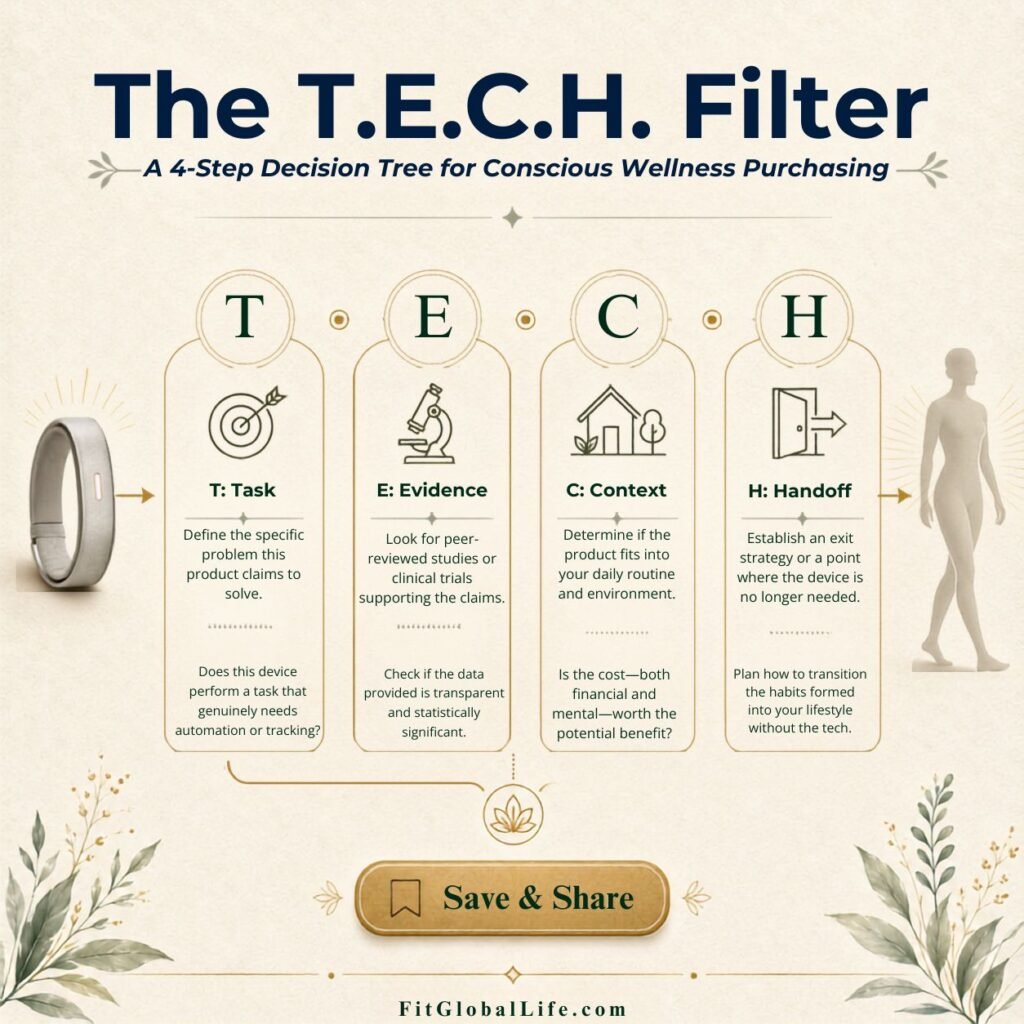
Use the T.E.C.H. filter before buying, downloading, or renewing a wellness tool.
T – Task
Name the exact job. “Improve my health” is too vague. “Remind me to take a prescribed medication at 8 p.m.” is clear. “Show whether my average bedtime is drifting later over four weeks” is clear. A tool without a defined task will invent jobs to justify its presence.
E – Evidence
Check whether evidence supports the claimed outcome, not merely the underlying sensor. A device may accurately measure heart rate while making a much weaker claim about readiness, stress, calorie burn, or future disease. Look for validation studies, appropriate comparison methods, diversity of samples, limitations, and whether the findings are relevant to your use case.
C – Context
Ask whether the tool fits your health status, culture, budget, disability, work, privacy needs, access to care, and emotional relationship with tracking. A technically good product can be a poor personal fit.
H – Handoff
Decide when human judgment or professional care takes over. The handoff may be to your own felt experience, a trusted person, a coach working within scope, a registered dietitian, a therapist, a pharmacist, or a physician. Good tools make handoffs clearer. Hype tries to keep every problem inside the product ecosystem.
| Situation | Tech can help when… | Pause or escalate when… |
| Sleep | It shows a multi-week pattern and supports a consistent schedule. | A poor score can make you anxious, even if you are rested, or if the symptoms persist. |
| Movement | It nudges walking or records broad activity trends. | Calorie estimates drive compensation, guilt, or unsafe training. |
| Stress | A breathing timer or HR trend supports a practice you already understand. | The app labels ordinary emotion as pathology or promises treatment. |
| Nutrition or glucose | A clinician has recommended monitoring for a defined purpose. | Single-food experiments become fear, restriction, or self-diagnosis. |
| Meditation | Audio guidance helps you begin and then becomes optional. | Missing a streak feels like failure or the platform keeps adding stimulation. |
| Travel wellness | It stores documents, medication reminders, or emergency contacts. | It creates false certainty about medical access, safety, or personal risk. |
A 30-Day Human-First Wellness Tech Reset
This is not a total digital detox. It is a controlled experiment designed to reveal whether a tool strengthens or weakens capability.
| Week | Human-first task | Technology rule | Evidence to collect |
| 1 – Observe | Notice energy, tension, sleepiness, appetite, attention, and connection. | Buy nothing new; disable nonessential wellness alerts. | Three short notes per day. |
| 2 – Train | Choose one of the nine skills and practice it for five minutes daily. | Use no device unless it directly supports that practice. | Can you notice or act sooner? |
| 3 – Test | Add one tool for one clearly defined job. | Set a start date, stop date, and success criterion. | Behavior change, function, and emotional cost. |
| 4 – Decide | Keep, simplify, or remove the tool. | Export useful data; delete noise-producing features. | Did agency, health behavior, or communication improve? |
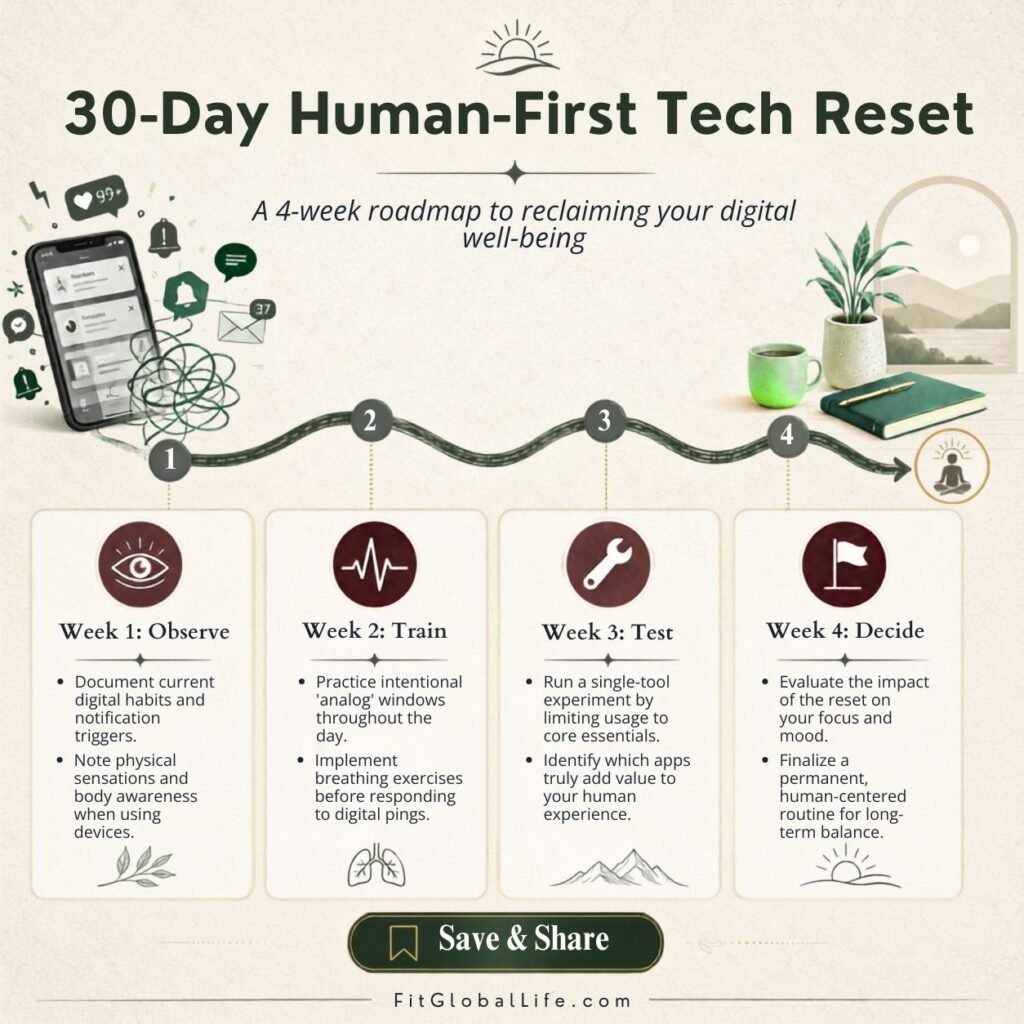
At the end of 30 days, rate the tool across four dimensions: function, behavior, emotion, and agency. Did it help you function better? Did a useful behavior become easier? Did it reduce or increase anxiety? Can you make decisions without checking it? Keep the tool only if the overall answer is positive.
What Wellness Tech Is Genuinely Good At
The critique of hype should not become a new form of hype. Human beings are not automatically wise, accurate, consistent, or unbiased. We forget medication. We misremember sleep. We normalize symptoms. We overestimate activity. We avoid appointments. Good systems are good to us.
- Technology is especially useful for:
- Memory and compliance: reminders for prescribed medication, hydration in some medical conditions, appointments and rehabilitation exercises.
- Longitudinal patterns: big trends not easy to see from one day to the next.
- Accessibility: remote care, captions, visual or haptic cues, adaptive interfaces and distance connection.
- Communication: Organized data and symptom histories requested by a clinician.
- Environmental design: reducing friction through timers, blocked notifications, prepared routines, and navigation.
- Safety functions: validated emergency detection or medical-device features used within their intended scope.
The standard is not “human good, technology bad.” The standard is fit for purpose, evidence, proportionality, and preserved agency.
The Real Competitive Advantage Is Human Capacity
The next wave of wellness technology will probably be more personalized, predictive, conversational, and invisible. Sensors will move deeper into clothing, homes, travel, insurance, workplaces, and clinical pathways. Artificial intelligence will become better at summarizing patterns and generating recommendations. The interface may feel increasingly human.
That makes actual human skill more important, not less.
A person who can notice internal signals without panic, protect attention, name emotion, evaluate claims, build flexible habits, observe without shame, maintain relationships, communicate clearly, and revise decisions has a durable advantage. They can use sophisticated tools without confusing sophistication with truth.
The best wellness technology should eventually make itself less central. It helps you learn the pattern, build the behavior, communicate the issue, or reach the right support. Then it steps back. A tool that must remain psychologically indispensable to prove its value may be solving the wrong problem.
Conclusion: Build the Person Who Can Use the Tool
Wellness technology can expand awareness, access, and consistency. It can also magnify anxiety, distraction, consumer pressure, and false certainty. The difference is rarely the device alone. It is the relationship between the device, the claim, the context, and the person using it.
Start with one human skill for wellness. Practice it before adding another metric. Use technology for a defined task. Review whether it improved function, behavior, connection, or care. Remove what creates more monitoring than meaning.
The goal is not to become impossible to influence. The goal is to become harder to manipulate and easier to help.
Frequently Asked Questions
Some wearable measurements are more reliable than others, and accuracy varies by device, activity, skin contact, population, algorithm, and metric. Heart-rate estimates may be reasonably useful in many conditions, while calorie expenditure and derived readiness or stress scores can carry greater uncertainty. Use trends as one input, read validation evidence for the exact feature, and do not use consumer data to rule out concerning symptoms.
Yes, especially when it reduces friction, reminds you at the right moment, tracks a meaningful trend, or supports a clear plan. It’s not as useful when the goal is to get people to engage with your app. Don’t measure success by streaks, badges or time in platform, measure by real world behavior and function.
There is no universal winner, but contextual judgment may be the coordinating skill because it determines how body signals, emotions, advice, and device data are interpreted. Interoception and attention provide the inputs; judgment helps decide what they mean and what action is proportionate.
You might want to stop or simplify tracking if it makes you anxious about bedtime, makes you doubt how you are feeling, or leads you to compulsively check. Start with sleep opportunity, light exposure, movement, caffeine timing, and a calmer wind-down. Severe insomnia, significant impairment during the day, and other symptoms may merit a professional evaluation.
Watch out for products that promise a lot or sound medical without proof, hide limitations, rely mostly on testimonials, treat normal variations as defects, or require endless engagement to feel safe. Define the task, examine evidence for the exact claim, calculate the full cost, and set a handoff point for qualified care.
Medical and Editorial Disclaimer
This article is for general educational and informational purposes only. It does not provide medical diagnosis, treatment, psychotherapy, nutritional therapy, or individualized health advice. Consumer wellness devices and apps vary in accuracy, regulatory status, intended use, and evidence quality. Do not delay or replace professional care because of information in this article or a reading from a consumer device. Seek appropriate local medical or mental-health support for new, severe, persistent, worsening, or emergency symptoms. Product availability, features, prices, affiliate terms, and regulatory guidance may change. Always review current official information and the instructions for the specific product you use.