
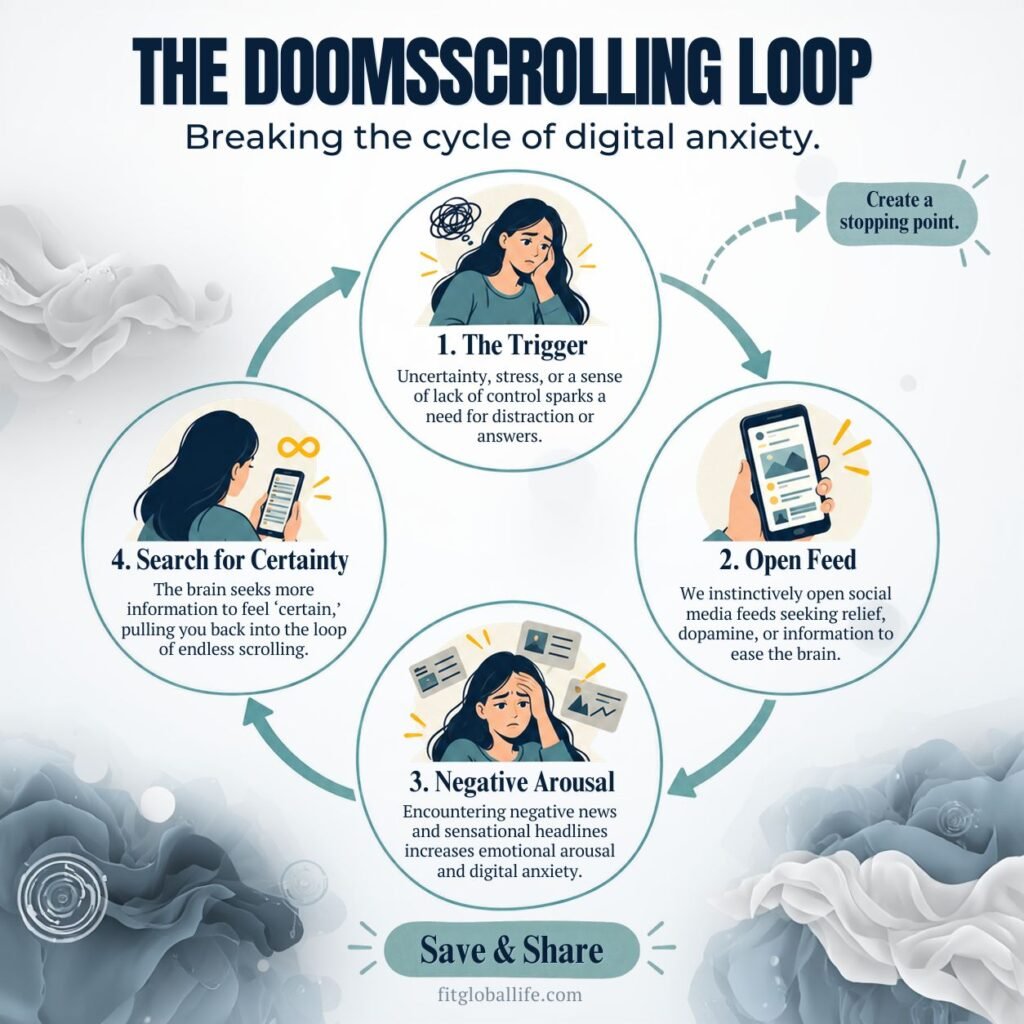
If you want to stop doomscrolling, the hardest moment is rarely the dramatic one. It is usually the tiny one: you unlock your phone to check a message, notice one alarming headline, tap it, swipe once, and somehow the feed becomes your evening. You are not necessarily learning more. You are monitoring. The information keeps changing, there is no natural finish line, and the next update always feels as if it might finally make the situation feel settled.
That distinction is important. Doomscrolling is more than just “using a phone too much.” It is frequent exposure to primarily unpleasant, frightening, or upsetting internet content, frequently with difficulties disengaging. A 2026 systematic review and meta-analysis of doomscrolling research, the most recent large synthesis I could find, consistently identified links to worse outcomes for mental health and wellbeing. Additionally, it cautions that cross-sectional research continue to dominate the evidence, making it impossible to establish that doomscrolling itself is the cause of those results.
Because of this, the purpose of this advice is not to scare you into following yet another all-or-nothing digital detox. Its purpose is to assist you in incorporating halting places into a system that seldom offers them. FitGlobalLife already provides a distinct approach on repaying attention debt and another set of useful focus practices for scattered days if fragmented concentration is your larger issue. The objective is more specific in this case: the negative-news loop.
Affiliate disclosure: This article may contain an affiliate link. If you buy through a marked link, FitGlobalLife may earn a commission at no additional cost to you. Product mentions are included only when they fit the practical advice.
Why It's So Difficult to Quit Doomscrolling in 2026
Threat-monitoring can be triggered by a variety of content seen in today's news environment, including war, harsh weather, political conflict, economic pressure, public health scares, layoffs, frauds, and AI-driven misinformation, all of which vie for attention on a single pocket-sized gadget. Simultaneously, social media and video platforms have emerged as primary news sources. According to the Reuters Institute Digital News Report 2026, 42% of respondents in all of its markets reported avoiding the news occasionally or frequently, up from 29% when the survey first started in 2017. Although that figure does not prove doomscrolling, it is a helpful indicator of how common news overload and exhaustion have grown.
It goes beyond “too much screen time” to include doomscrolling.
You can avoid doomscrolling by using a map when traveling, reading a lengthy article, or spending an hour on a video conversation with a friend. The loop—negative information, frequent checking, difficulty quitting, and a belief that the next piece of information is significant enough to continue—is what makes it unique. The association between doomscrolling and worse mental health was shown to be statistically explained by lesser mindfulness and higher levels of secondary traumatic stress in a sample of 400 persons. Although the 2024 study on doomscrolling, mindfulness, and subsequent traumatic stress is helpful since it suggests causes, it does not support the diagnosis of common readers based solely on a behavior.
Additionally, the term “dopamine addiction” is too offensive for a serious wellness topic. Digital behavior can be influenced by reward learning, novelty, habit signals, social reinforcement, emotional salience, and uncertainty. It sounds good to reduce the entire system to a single neurotransmitter, but actual behavior is more complicated. FitGlobalLife's more general contention that human abilities ought to direct wellness technology is particularly pertinent in this context: the objective is not to overcome technology in a moral conflict. It is to create an environment that gives your intentions a good opportunity.
Why ambiguity keeps the cycle open
Breaking news creates a specific trap: your brain keeps asking for closure from a stream that isn't yet able to provide it because the problem is still unsolved. Through psychological resilience and intolerance of uncertainty, a 2025 study of 443 participants found a link between trait anxiety and doomscrolling. Consider the study on anxiety, uncertainty, resilience, and doomscrolling as a suggestion rather than a conclusion: when ambiguity is hard to deal with, taking another look can feel like action even if it doesn't lead to a useful decision.
When it comes to upsetting public problems, the distinction is especially crucial. The answer is not to become apathetic if the trigger is conflict, catastrophe news, or stories about climate change. The same general point is made in FitGlobalLife's discussion of how climate anxiety might affect day-to-day health: being knowledgeable is not the same as being physiologically active all day.
A Quick Doomscrolling Self-Check
Doomscrolling becomes more likely when several of these are true at once:
- You open a news or social app without knowing what you came to find.
- You keep refreshing the same story even when there is no meaningful new information.
- You feel more tense, helpless, angry, or numb as you continue – yet you continue anyway.
- You lose track of time, especially late at night or during work transitions.
- You tell yourself you need to stay informed, but most of what you consume does not change a decision you can make.
- You finish scrolling without being able to summarize what you learned.
None of these automatically means you have a disorder. They are simply useful signals that the feed is running more of the session than you are. If your main issue is awareness during a busy day, the practices in mindfulness for hectic work hours can help you notice the transition earlier.
| What you notice | What may be keeping the loop open | Best first intervention | What “enough” looks like |
| You open feeds automatically | Habit cue / low-friction access | Add a pause before the app opens | You choose whether to enter |
| You refresh breaking news repeatedly | Uncertainty / monitoring | Use a two-source ceiling | You know the verified facts available now |
| You scroll in bed | Fatigue + no stopping cue | Create a phone parking time | The phone is physically out of reach |
| Distressing stories leave you wired | Physiological arousal | Move, breathe, change environment | Your body is calmer before more input |
| You fear missing an important update | FOMO / vigilance | Schedule finite check windows | You know when the next check will happen |
Seven Strategies to Quit Doomscrolling Without Disconnecting
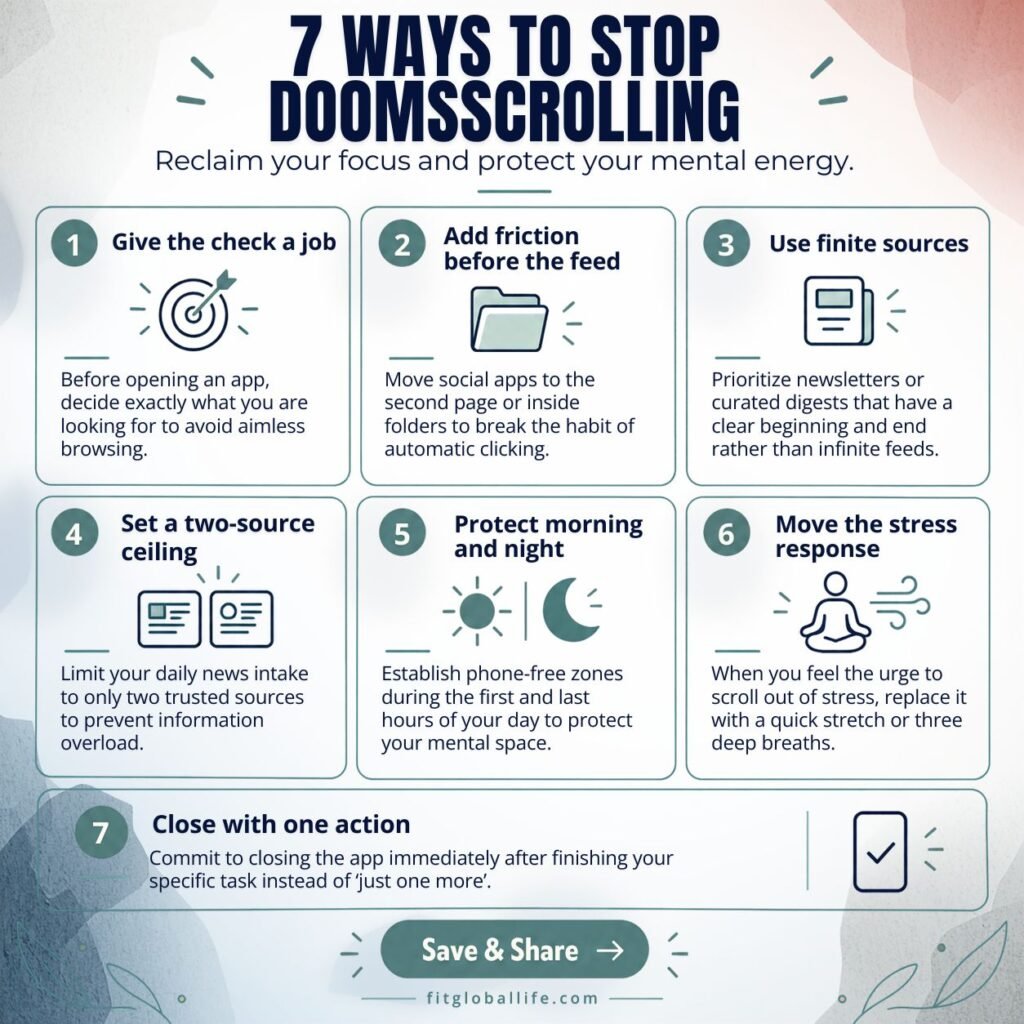
1. Assign a Task to Each News Check
The blank should be specific, such as whether the train is running, whether an official warning has changed, what the election authority stated, whether a storm route moved, or what happened in a story you are actively following, before you open a feed: “I am checking to find out ______.” “See what's going on” is not a job. It's an invitation to eternity.
Passive monitoring becomes a bounded information problem at this tiny step. The session ends when the question is addressed. Instead than hanging over the feed, plan the next check if there hasn't been a response yet. This is similar to the behavioral reasoning behind delaying digital input to safeguard deeper focus: specify the purpose of the technology before it begins to dictate what you focus on.
Try a ten-second rule: either enter the question into a note or say it aloud before tapping the app. It could seem almost absurdly tiny. The point is that. Instead of waiting until it has transformed into a subterranean staircase, you are attempting to catch the loop while it is still a doorway.
2. Prioritize Friction over the Feed
The cost of willpower increases after the feed is in motion. Make the choice a step ahead of time. Take social media and news apps off of your home screen. Close the most obsessive account. Use an app limit that necessitates an additional option. During a concentrated block, keep the phone in a bag. Keep those channels open and only gate the stream that consistently takes over if you still require messages from family or coworkers.
One of the more well-supported useful concepts in the literature on digital habits is this one. A brief intervention before to opening specific applications caused users to reject 36% of opening attempts in a six-week field experiment involving 280 participants; attempts to access the target apps decreased 37% between the first and sixth weeks, while actual openings were 57% lower after six weeks. The PNAS study on self-nudging and app-opening friction shows something helpful: a few seconds of friction can alter behavior at the precise moment a habit begins. However, it does not prove that the same tool will halt doomscrolling for everyone.
The environmental exercises in FitGlobalLife's mental fitness guide are a better companion piece than adding six more blockers if you find yourself losing focus throughout the day, not just around news.
3. Replace Infinite Feeds with Finite Information
A newspaper ends. A 20-minute broadcast ends. A newsletter ends. An algorithmic feed does not. That difference is behavioral, not nostalgic. When the medium has no natural stopping cue, you need to supply one.
Choose two or three trusted sources and access them directly rather than entering through a social feed. Prefer a daily briefing, a homepage, an email digest, a saved article list, or an RSS reader that can be cleared. For high-stakes topics, prioritize primary sources and established reporting over commentary clips. The goal is not less truth; it is less repetition.
A useful rule is “one pass, then out.” Read the update once, capture what matters, and leave. If you want a calming ritual after the news, use something genuinely finite – tea, a shower, a chapter of a book, music, or one of these simple self-care rituals you can do at home. The replacement should have an ending too. Swapping doomscrolling for infinite short-form comedy is a change of costume, not a change of architecture.
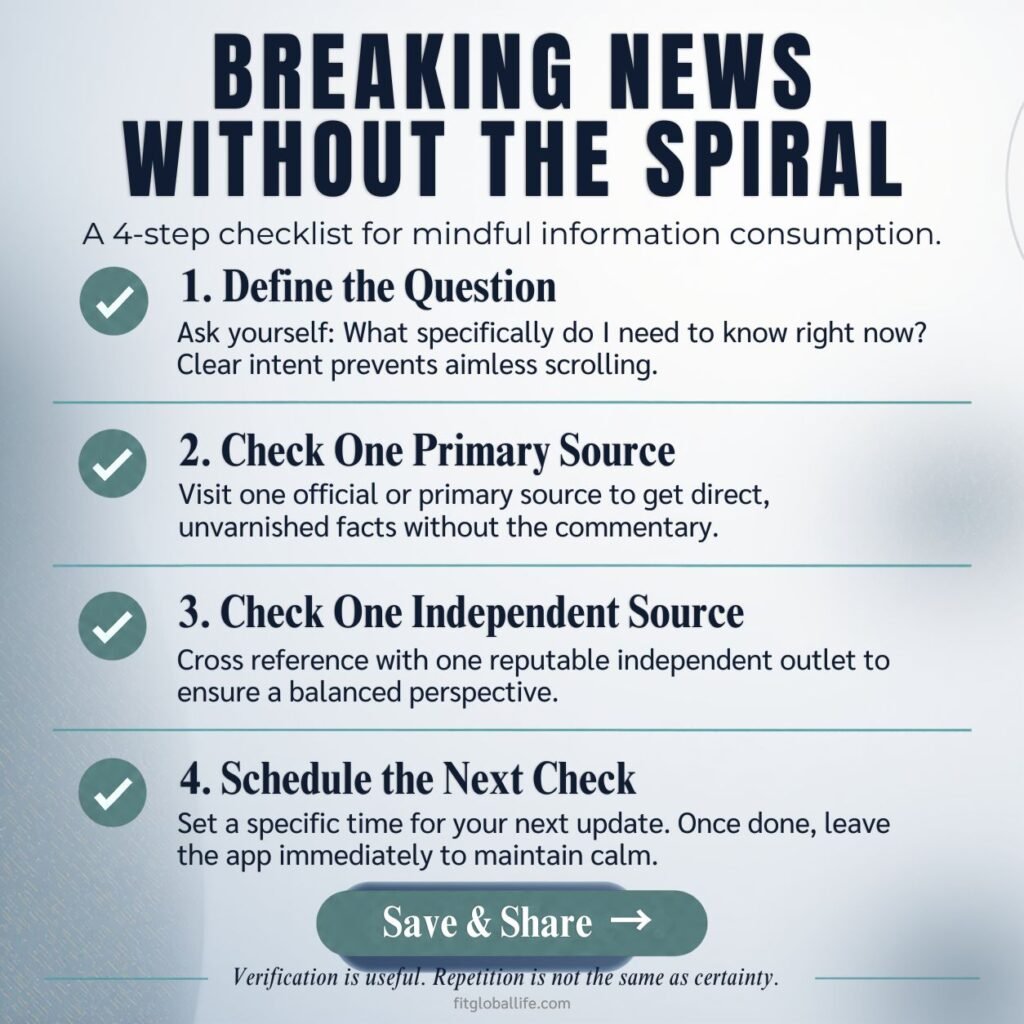
4. Use a Two-Source Ceiling During Breaking News
Breaking news is where good intentions get eaten alive because the facts are incomplete and the emotional stakes are high. Instead of chasing ten versions of the same update, pick a ceiling: one strong primary or official source when available, plus one reputable independent news organization. Check both. Then stop until a predetermined time or until a genuinely new event occurs.
Why two? Not because two is magically correct, but because it separates verification from accumulation. One source can be wrong; a second can help confirm or complicate the picture. Source number seventeen rarely multiplies certainty by seventeen. It often multiplies commentary, repetition, and emotional exposure.
If you are reading about a crisis that directly affects you, the ceiling can be adapted: keep alerts from the official service you truly need, while muting the river of reaction around it. This is a practical extension of the body-mind principle in FitGlobalLife's somatic stress guide: reduce unnecessary input while preserving information that supports safety and action.
5. Protect the First and Last 30 Minutes of Your Day
The first scroll of the morning is powerful because it lets the outside world choose your first emotional problem. The last scroll of the night is expensive because there is little left in the day to absorb or act on what you see. Start with a modest boundary: no algorithmic news or social feeds for the first 30 minutes after waking and the last 30 minutes before sleep.
You do not need to turn the bedroom into a tech monastery. Put the charger far enough away that checking requires standing up. Keep emergency contacts available if necessary. Use a regular alarm clock if your phone is the reason you bring the feed to bed. Research on social media and sleep is not perfectly uniform, but a 2024 systematic review with meta-analyses found that problematic social media use was associated with depression, anxiety, and sleep problems, while overall social-media measures also showed small associations with mental-health outcomes.
If sleep timing and environment are already messy, work on the larger system too; the article on building a more sleep-supportive bedroom environment can help you think beyond the phone itself.
6. Move the Stress Response Out of Your Body
Doomscrolling is often treated as if it were purely a thinking problem. But distressing information can show up physically: shallow breathing, jaw tension, a clenched stomach, restless legs, a racing pulse, or the wired-tired feeling of being exhausted and unable to stop checking.
When you notice that shift, do not immediately search for one more explanation. Stand up. Walk for five minutes. Look at a distant object instead of another screen. Take a slower exhale. Wash your face. Stretch. Step outside. The intervention is deliberately ordinary because the goal is not to perform wellness; it is to change state.
If you prefer a structured menu, use one of the nervous-system habits for a calmer week or a short recovery ritual that does not depend on motivation. Then decide whether another information check is actually necessary. Do not make breathwork or movement a permission slip to resume the same loop indefinitely.
7. Close the Loop with One Action or a News Receipt
The most distinctive antidote to doomscrolling is closure. After a news check, write three lines: “What I know. What I do not know. What I will do next.” Your next action may be practical – change a route, call someone, donate, vote, prepare supplies, send an email, verify a claim, or set a reminder. It may also be “nothing is required from me today.” That is still a decision.
If you prefer paper, a simple pocket notebook can make the ritual more concrete, but a scrap of paper or notes app works just as well. The tool is not the intervention; the ending is.
For emotionally complicated stories, the longer reflection prompts in FitGlobalLife's guide to journaling for self-trust can help separate your values from the algorithm's urgency. The news receipt is shorter. It should take one minute, not become a new research project.
This is where “staying informed” becomes something more adult than “staying exposed.” Information has done its job when it improves understanding or changes a useful decision. Beyond that point, repetition can feel responsible while quietly becoming a form of avoidance.
A 7-Day Exit-the-Feed Experiment
Do not install all seven strategies tonight. That is how an anti-overwhelm article becomes homework with branding. Treat the next week as an experiment in placement, not a referendum on your self-control. This is similar to the low-pressure approach behind tiny wellness wins you can repeat: make one change small enough to observe honestly.
| Day | Experiment | Minimum success condition |
| 1 | Name your two main doomscrolling entry points | Write down the two apps/sites and the time of day they usually catch you. |
| 2 | Give every news check a job | Use the sentence “I am checking to find out…” at least three times. |
| 3 | Add one layer of friction | Move, log out of, limit, or gate one high-risk feed. |
| 4 | Use finite information | Replace one feed session with a direct source or digest that ends. |
| 5 | Protect one edge of the day | Keep either the first or last 30 minutes feed-free. |
| 6 | Use the two-source ceiling | Apply it once to a developing story and schedule the next check. |
| 7 | Write a news receipt | Record: what I know, what I do not know, what I do next. Keep the two strategies that helped most. |
A short break from social media can help some people. In a randomized trial of 154 adults, a one-week social media break improved well-being and reduced depression and anxiety scores relative to usual use. But the broader evidence is mixed: a 2025 systematic review and meta-analysis of social-media abstinence found no significant overall effects on positive affect, negative affect, or life satisfaction across the included studies. That is another reason this article emphasizes redesigning use rather than pretending everybody needs the same detox.
If the experiment shows that distance from screens genuinely restores you, extend it in a way that fits your life. Some people benefit from a quiet weekend, a walk, or even travel designed around less digital stimulation. FitGlobalLife's nature-first ideas for screen-tired travelers are useful when the goal is recovery rather than digital punishment.
When Doomscrolling Is More Than a Habit Problem
A behavior strategy cannot solve every reason someone feels compelled to monitor bad news. Sometimes the feed is attached to a real threat, trauma history, caregiving responsibility, financial instability, political danger, or work that requires constant updates. Sometimes repeated scrolling is a coping behavior sitting on top of anxiety, depression, insomnia, or another mental-health concern.
Seek professional support if the pattern is persistent and significantly disrupts sleep, work, relationships, eating, mood, or your ability to function; if you feel unable to disengage despite repeated attempts; or if distressing content is triggering panic, intrusive memories, hopelessness, or other symptoms that feel bigger than a habit problem. A wellness article can offer environmental tools. It cannot diagnose the reason your nervous system is on watch.
Conclusion: Stop Doomscrolling by Building Endings
The most useful way to stop doomscrolling is not to become a person who never cares about bad news. It is to become a person who can tell when information has stopped being useful.
Give the check a job. Put friction before the feed. Choose sources that end. Set a ceiling when facts are still developing. Protect the edges of your day. Let your body come down from the alert. Then close the loop with one decision, one action, or one written receipt.
Your phone does not need to become the enemy. It just should not get to decide when the story is over.
FAQ
Doomscrolling is repeated or persistent engagement with predominantly negative, threatening, or distressing online information, often through social or news feeds, with difficulty disengaging even when the experience feels unpleasant. It is more specific than simply spending a long time on a phone.
Uncertainty, novelty, threat-monitoring, habit cues, fear of missing a crucial update, and feeds that exclude natural stopping points can all promote the practice. Finding the time and need that typically precede the scroll is a helpful first step because the precise mix varies depending on the individual and circumstance.
Not by default. Doomscrolling should not be casually classified as an addiction based on a single behavior, despite the fact that researchers have created doomscrolling scales and some studies look at obsessive or addiction-like characteristics. A trained clinician can assist in evaluating the larger picture if usage feels out of control or significantly impairs functioning.
Not always. While more comprehensive evaluations reveal conflicting findings, some experiments suggest benefits from brief breaks. Redesigning how and when you use social media may be more sustainable than completely removing it if it fosters community, relationships, or employment. Even so, taking a little, deliberate break can be a beneficial experiment.
A trustworthy global chronology does not exist. Strength of habit, platform design, stress level, sleep patterns, demands at work, and the motivation for news monitoring are all important factors. Instead of using a set number of days to assess progress, use observable behaviors like fewer automatic openings, shorter sessions, improved sleep boundaries, and the ability to stop when your information objective is reached.
Disclaimer
This article is for general educational and lifestyle information only. It is not medical advice, mental-health diagnosis, psychotherapy, or treatment. Associations described in doomscrolling and social-media research do not establish what is causing symptoms for an individual reader. If anxiety, low mood, sleep problems, trauma symptoms, or compulsive digital behavior are persistent, worsening, or interfering with daily life, consult a qualified health or mental-health professional.
Affiliate disclosure: FitGlobalLife may earn a commission from qualifying purchases made through marked affiliate links, at no additional cost to the reader. Recommendations are included for practical relevance and do not guarantee health, sleep, or productivity outcomes. As an Amazon Associate, FitGlobalLife may earn from qualifying purchases.