

The inbox has a talent for making an ordinary Tuesday feel like a national emergency. You can answer messages all morning, attend four meetings, move twelve tasks across a board, and still wonder what actually changed. That frustration helps explain the appeal of slow productivity: a deliberate way to create meaningful work without treating constant activity as proof of worth.
The movement is gaining attention as professionals question the costs of hustle culture, but it would be inaccurate to say it has already replaced fast-paced work everywhere. Some jobs remain rigid, under-resourced, or genuinely urgent. A better question is why more people are looking for a calmer, more measurable alternative—and how they can adopt one without abandoning ambition.
This guide looks beyond slogans. It explores seven reasons the shift makes sense, the evidence behind it, and a practical two-week experiment for people with deadlines, clients, caregiving, or creative work.
What Is Slow Productivity—and What Is It Not?
In his introduction to the slow productivity framework, author Cal Newport outlines a philosophy of doing less, working at a natural pace, and obsessing over quality. They also challenge the idea that visible busyness equals valuable output.
Slow productivity does not mean missing deadlines, refusing collaboration, or stretching simple tasks into all-day rituals. It means deciding what deserves effort, protecting enough attention to do it well, and making a sustainable pace part of the operating plan rather than a reward for finishing everything.
This is also narrower than the lifestyle or economic arguments in our discussion of building value without chasing fast growth. Here, the unit of analysis is the working week: its commitments, interruptions, deliverables, and recovery costs.
Hustle Culture vs. Slow Productivity: The Practical Difference
| Decision | Hustle-first reflex | Slow productivity alternative |
| A successful day | Many tasks, quick replies | One or two meaningful advances |
| Meetings | Default collaboration | Only when a decision needs discussion |
| Workload | Accept first; negotiate later | Limit active commitments before starting |
| Quality | Polish whatever time allows | Protect review and revision time |
| Rest | Earned after output | Built into the delivery plan |
| Tracking | Hours, status, responsiveness | Outcomes, rework, capacity, recovery |
Neither column is a universal rule. Emergency services, hospitality, caregiving, and shift-based roles require different arrangements from software design or freelance writing. The useful distinction is between necessary urgency and urgency that exists only because a system was never redesigned.
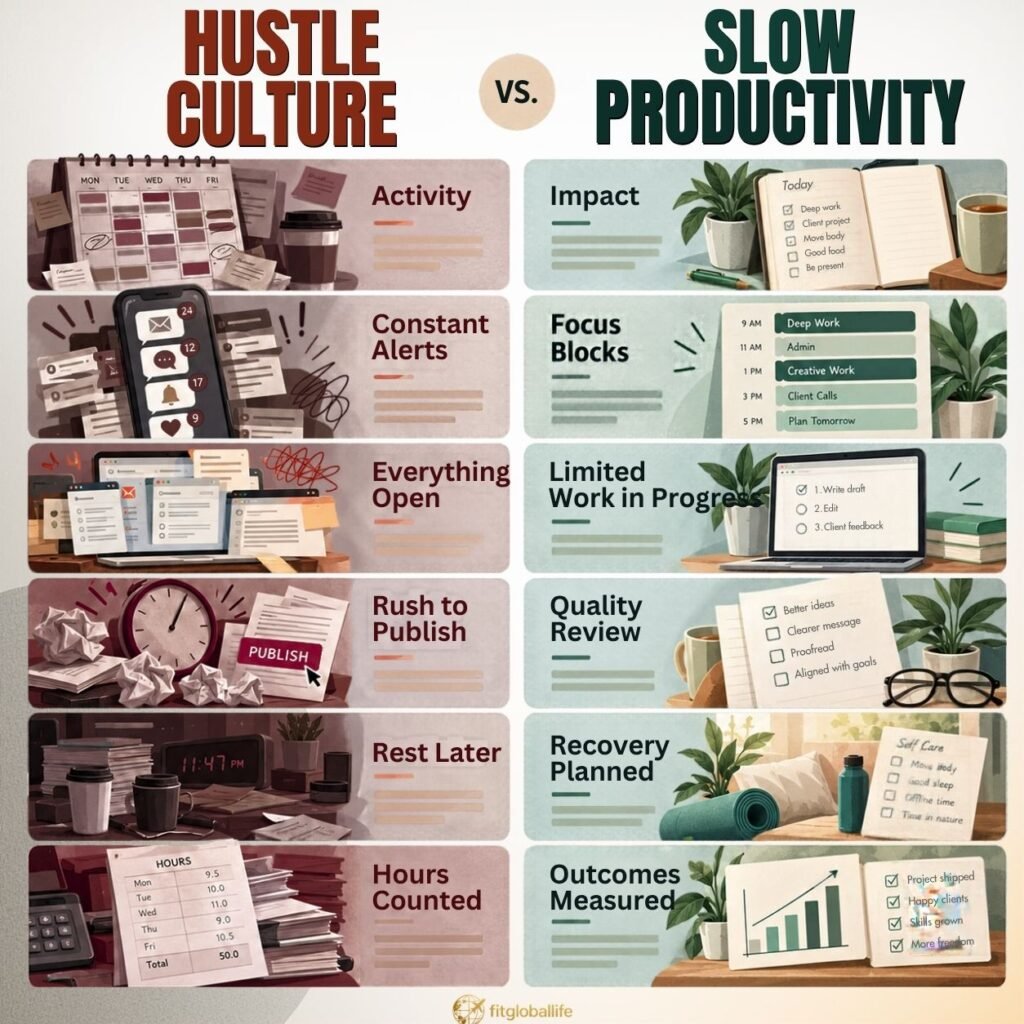
7 Reasons Slow Productivity Is Replacing Hustle
1. Being busy has become a poor proxy for progress
A full calendar can reveal demand, not necessarily achievement. When every request becomes a priority, employees can spend their best hours proving availability instead of solving the problems they were hired to solve. This is particularly visible in knowledge work, where the result may be a stronger decision, a clearer article, or a preventable error—none of which looks impressive on a dashboard of sent messages.
Gallup’s 2026 State of the Global Workplace report found that 20% of employees worldwide were engaged in 2025. That number is a signal of a workplace engagement problem, not proof that slow productivity causes better engagement. It does, however, make a strong case for questioning systems that equate employee commitment with perpetual motion.
Try a weekly “proof of progress” review: name three concrete results, the people they benefited, and the work you deliberately did not start. Someone publishing content might count a thoroughly researched evergreen article and a useful reader response more highly than seven rushed posts. Our earlier exploration of how remote work reshapes healthy routines provides broader context for that shift in measurement.
2. Interruptions are consuming the time needed for thoughtful work
The office is not the only place where attention fragments. Notifications travel with us to kitchens, trains, and hotel rooms. Microsoft reported that the top 20% of users receiving the most digital pings in its 2025 telemetry sample averaged 275 meeting, email, and chat interruptions across a 24-hour day. The accompanying two-minute estimate describes the average interval between pings during core work hours—not a statistic for every worker. That distinction matters when citing Microsoft’s analysis of the infinite workday.
A slow-productivity response is not to disappear from colleagues. It is to distinguish work that requires synchronous coordination from work that needs uninterrupted thinking. Reserve a 45–90 minute block for drafting, analysis, planning, or problem-solving; move ordinary messages into scheduled check-in windows; and publish clear contact rules for actual emergencies.
If the inbox still takes over, pair this approach with a more specific routine for reducing accumulated attention friction. And when online feeds become the default between tasks, these ways to interrupt compulsive news scrolling can help protect the transition back into focused work.
3. Long hours can undermine both health and eventual output
The strongest argument against constant overwork is not aesthetic. It is health-related. A WHO/ILO analysis estimated that working 55 hours or more per week was associated with a 35% higher risk of stroke and a 17% higher risk of death from ischemic heart disease compared with working 35–40 hours. The headline estimate of 745,000 attributable deaths referred to 2016, not a 2026 death count; the agency explains these findings in its joint release on long working hours.
Productivity itself can also become less efficient with extreme schedules. Economist John Pencavel’s research on hours and output documented diminishing marginal output as hours increased in a historical sample of munitions workers. It would be a mistake to treat that sample as a universal cutoff for today’s creative professions, but the direction is worth considering: one more hour is not always one more hour of useful work.
A sustainable schedule needs buffers for meals, movement, sleep, relationships, and ordinary disruptions. Our piece on why genuine rest supports health explores the recovery side; here, recovery is treated as an input to the workload plan, not the cleanup operation after exhaustion.
4. Better work increasingly depends on depth, judgment, and revision
Speed helps when a task is repetitive and quality is easy to verify. It helps less when the assignment is ambiguous: choose a research angle, understand a reader’s problem, negotiate a trade-off, or spot an error that a polished draft hides. These jobs benefit from judgment and from enough time to compare alternatives.
Consider two hypothetical creators. One produces five interchangeable articles in five days. The other produces one carefully reported guide, checks the sources, interviews an expert when appropriate, and updates it after questions arrive. There is no guarantee the second piece will outperform the first. But it has more opportunities to become genuinely useful rather than merely new.
That is why slow productivity emphasizes an explicit quality loop: draft, test, revise, publish, listen, and improve. For a smaller starting point, use simple focus exercises that support sustained attention rather than trying to force a perfect three-hour deep-work session on day one.
5. AI has made the attention problem more complicated—not obsolete
AI can reduce the effort required to summarize, format, brainstorm, or check routine material. Yet a faster first draft can also create more drafts to review, more meetings to consider, and more expectations for instant delivery. In other words, reducing task friction does not automatically reduce workload.
A vendor study offers a timely illustration. ActivTrak’s 2026 analysis of digital work patterns, based on activity data from participating organizations, found a shorter average workday alongside increasing collaboration, multitasking, and work intensity. Because the sample comes from its customer environment, it should not be generalized to the entire workforce. Still, it challenges the comforting idea that smarter tools inevitably produce calmer days.
Use a two-part AI test: What repetitive step did the tool remove? Then ask, What new review, verification, privacy, or coordination step did it create? Keep the tool if net effort falls and the quality standard holds. A practical comparison of AI assistants within a real work workflow may be useful when deciding whether another automation deserves a place in your stack.
6. Recovery is becoming a performance condition, not a personal indulgence
Most of us can recall a day when a simple problem looked impossible in the evening and manageable the next morning. That is not a mystical productivity hack. Fatigue can affect attention, short-term memory, judgment, and reaction time, according to the CDC/NIOSH overview of work-related fatigue. Neither a break nor a vacation cures every form of stress, but rest belongs in any responsible performance conversation.
The important shift is from heroic recovery to predictable recovery. Put realistic stop times, transitions between meetings, and recovery after intense delivery periods into the calendar before it fills. Someone with caregiving responsibilities may need a different rhythm from a solo consultant; the goal is a rhythm that survives real life.
For people who cannot take long breaks, start with repeatable recovery cues that do not depend on motivation or a few grounding methods during the workday. These are supporting practices, not substitutes for fixing excessive workloads or unsafe conditions.
7. People want careers that still leave room for a life
Hustle culture often asks people to optimize one dimension of life while borrowing time from everything else. Slow productivity starts with a less glamorous question: what pace can a person sustain across twelve months, not merely across a dramatic two-week sprint? Parents, mid-career professionals, caregivers, entrepreneurs, and remote workers may answer differently. That variation is a design constraint, not a character flaw.
The point is not to romanticize flexibility. Someone on hourly wages may not control shift length. A new freelancer may need to accept difficult assignments. A team spread across time zones may face unavoidable communication gaps. In those settings, the most ethical improvements often come from managers: smaller queues of active projects, realistic staffing, clear handovers, predictable time off, and permission to flag capacity early.
Time autonomy also connects to rethinking what counts as real luxury, and the experience of using small retreats to regain perspective can help reveal what is missing from an overloaded schedule. For location-independent professionals, travel planning is another workload reality: compare the terms, exclusions, and eligibility of any cover rather than assuming remote freedom removes risk. If relevant, review SafetyWing travel coverage options before choosing a policy.
The Capacity Ledger: A More Useful Way to Measure a Week
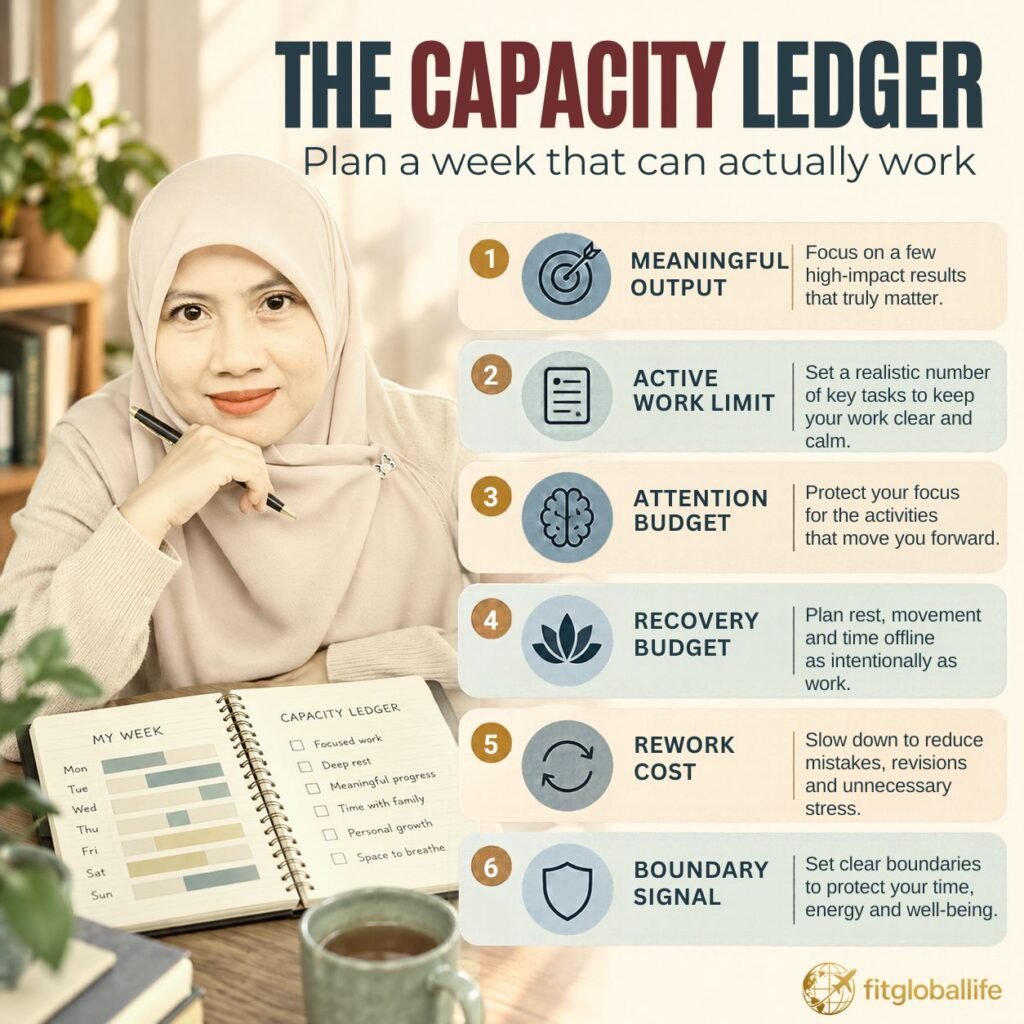
To turn the idea into something testable, use a simple editorial framework: a capacity ledger. It is not a validated psychological scale and should not be sold as one. It is merely a lightweight planning exercise that records what the week can realistically hold. Many productivity systems track completed tasks; this one also tracks the cost of keeping those tasks active.
| Ledger field | Question to ask | Example |
| Meaningful output | What is the deliverable? | A verified 1,800-word reader guide |
| Active work limit | How many complex tasks at once? | Two active projects |
| Attention budget | When will deep work happen? | Three 60-minute blocks |
| Recovery budget | What protects energy? | Lunch away from screens; free evening |
| Rework cost | What had to be fixed? | Two hours of avoidable corrections |
| Boundary signal | What can wait or be delegated? | Non-urgent replies batched twice daily |
The ledger exposes a quiet but common failure: a schedule that looks efficient until rework, interruptions, and sleep loss are included. It also makes trade-offs visible to collaborators. Instead of saying “I am overwhelmed,” a manager or creator can say “I can deliver the research summary by Thursday, or I can attend three extra planning calls; doing both would delay quality review.”
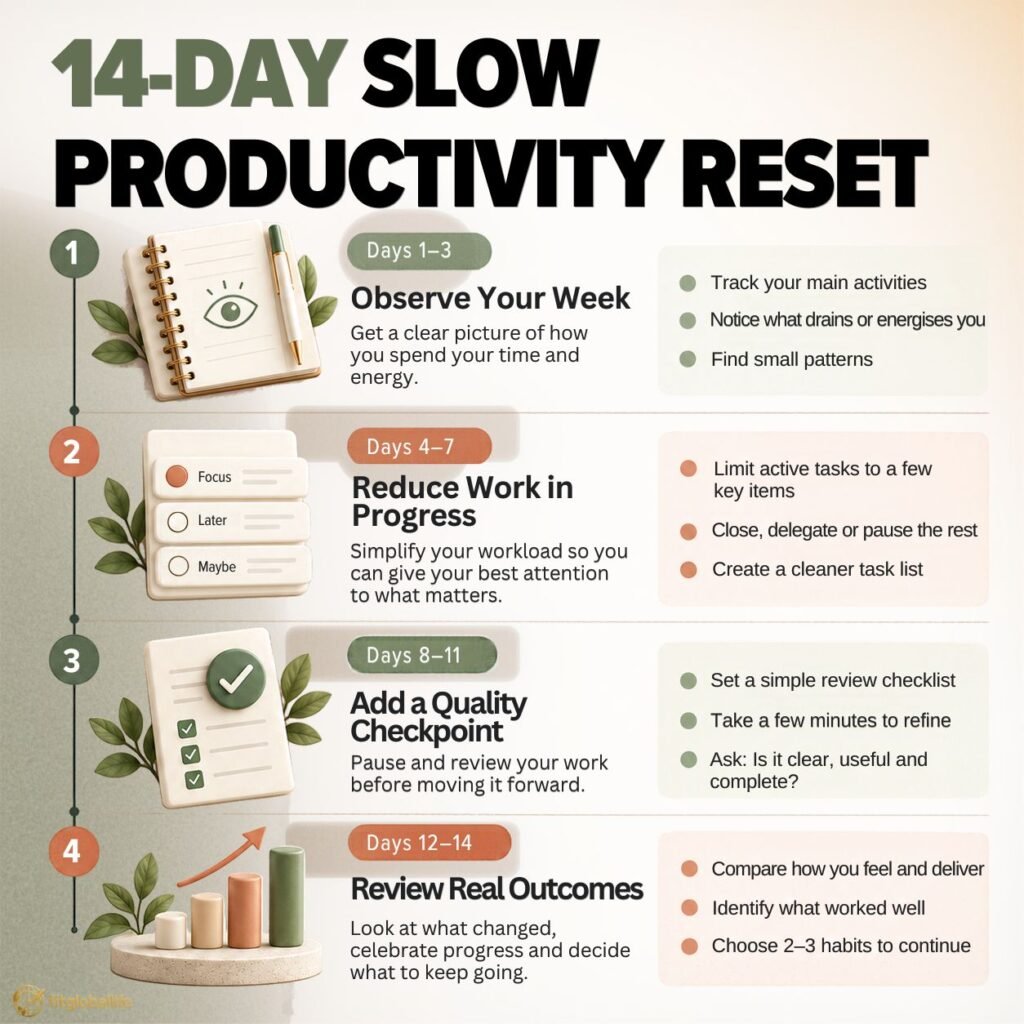
A 14-Day Slow Productivity Experiment You Can Actually Keep
Days 1–3: Observe without optimizing
Track time spent in meetings, messages, meaningful creation, administration, and recovery. Write down the point in the day when attention becomes scattered. Do not shame yourself for the results. The first step is to identify whether the biggest barrier is too many commitments, poor coordination, noisy technology, or too little rest.
Days 4–7: Reduce work in progress
Choose one high-value deliverable and one supporting responsibility. Park or renegotiate the rest where possible. Create two protected work blocks and tell relevant colleagues how to reach you for genuine emergencies. If screens distract you even outside work, making a realistic digital detox plan can make the boundary easier to maintain.
Days 8–11: Introduce a quality checkpoint
Before sending work, use a three-question review: Is it accurate? Is it useful to the intended person? What would be costly to revise later? Writers can verify primary sources; managers can test assumptions; designers can ask a user to complete the intended task. For especially scattered days, adopt a small ritual for returning to focus rather than trying to recover lost concentration through self-criticism.
Days 12–14: Compare outcomes—not feelings alone
Compare deliverables completed, preventable rework, hours of uninterrupted work, and whether the schedule remained livable. Include missed deadlines and dissatisfied colleagues if they occurred. The result may be mixed; slow productivity is an approach to test, not a promise of instant improvement.
If a small pilot helps, discuss work-in-progress limits and response windows with the people who depend on your work. An individual cannot fix a company’s staffing model by turning off notifications. For bigger lifestyle adjustments, restorative self-care practices built around daily habits can support the personal side of change.
When Slow Productivity Is the Wrong Tool—or Not Enough
This approach is poorly suited as a standalone solution for crisis response, chronically unsafe staffing levels, exploitative management, or workplaces where workers have no control over schedules. A slower personal routine cannot offset an unreasonable production quota, and delayed answers can create safety problems in time-sensitive jobs. In such cases, the priority is adequate staffing, clear escalation, fair scheduling, and occupational safeguards.
It is also possible to misuse the idea. Perfectionism can dress itself up as “quality,” and procrastination can masquerade as “natural pace.” An effective slow-productivity practice still sets delivery dates, asks for feedback, and makes difficult choices. The aim is thoughtful throughput, not indefinite preparation.
Conclusion: Less Visible Effort, More Meaningful Progress
Slow productivity is gaining ground because the old bargain—more hours, more messages, more visibility, more success—often fails to account for the true costs of attention and recovery. The evidence does not prove that one philosophy has won the future of work. It does show why excessive hours and fragmented schedules deserve scrutiny.
Start with one week. Protect a meaningful project, make its quality criteria explicit, and notice what changes when you stop counting every notification as progress. Ambition does not need a permanently overcrowded calendar to be real.
Frequently Asked Questions About Slow Productivity
Nope. Whether that means less concurrent projects or less low-value tasks, the goal is higher quality, sustainable output. There are still times when periods are intense and the work really needs it.
Often, in a modified form. Protect a short planning window, limit unnecessary work in progress, and clarify what counts as done. For safety critical or emergency work, you want immediate response procedures, not generic advice to disconnect.
Time management typically asks how to fit tasks into available hours. Slow productivity also asks whether the tasks should exist, how many should be active at once, and whether the chosen pace permits careful work and recovery.
Reducing avoidable overload and improving recovery may help some people, but no productivity framework is a clinical treatment or a guaranteed way to prevent burnout. Ongoing distress needs to be addressed with appropriate professional help and where appropriate workplace intervention.
Limit active projects. Set a realistic publishing calendar. Before you publish, run a single, simple quality checklist. Success isn’t measured by posts completed in one day, but by results evaluated over several weeks, including revisions and reader value.
Disclaimer
This article provides general educational information about work habits, occupational wellness, and productivity. It is not medical, psychological, employment, insurance, or legal advice. Research findings apply to the studied populations and do not establish that adopting slow productivity will produce a particular health or business outcome. If work is affecting your health or safety, consult a qualified professional and your organization’s appropriate support channels. This article contains one affiliate link; if you buy or enroll through it, FitGlobalLife may earn a commission at no additional cost to you. Eligibility and policy terms should always be checked directly with the provider.