

Focus rituals are useful for a very specific kind of bad day: not the day when you have nothing to do, but the day when you have so many partially open things that your attention feels like it has been divided into tiny tabs. You answer half an email, remember a bill, open a document, glance at a message, search for one fact, and suddenly twenty minutes have been spent without any single task receiving your full mind.
The standard recommendation is to “focus harder.” That is not really beneficial. Scattered attention is more commonly caused by too many incomplete transitions than by a lack of ambition. Your mind is trying to be ready for what's about to happen while also carrying the remnants of what you just left behind. A heroic two-hour deep work block isn't always the answer. Learning to land, choose, enter, return, and close is frequently a more helpful skill.
That is the job of the six focus rituals in this guide. They are intentionally small. They do not require a new app, a perfect morning, a silent house, or a personality transplant. They also do not replace the broader attention training in FitGlobalLife’s guide to mental fitness drills for stronger focus. Think of the drills as training capacity. These rituals are the doorways that help you use that capacity when real life is noisy.
Affiliate disclosure: There may be affiliate links in this article. FitGlobalLife may receive a commission at no extra cost to you if you make a purchase via a marked link. Recommendations are not medical, psychological, or productivity guarantees; they're included only when they reduce practical friction.
Why Focus Rituals Are Important When Your Attention Is Disorganized
It is not a diagnosis to feel disorganized. It is a common term for a mind that is always changing goals, keeping unfulfilled promises, or responding to demands. That distinction is important. Workload, sleep, stress, health, environment, caregiving, technology, mood, and a host of other things can all have an impact on concentration. A challenging Tuesday shouldn't be labeled as neurological by a lifestyle magazine.
At the same time, the modern work environment gives people plenty of opportunities to fragment their attention. Microsoft’s 2025 telemetry report on the “infinite workday” found that the highest-ping 20 percent of Microsoft 365 users were receiving enough meetings, emails, and chats to average an interruption roughly every two minutes during core work hours, with 275 pings across a 24-hour day. That number is not a universal average for every worker, but it is a useful picture of what high-interruption knowledge work can look like. See the Microsoft Work Trend Index analysis.
The cognitive issue is not that your brain is actually performing multiple difficult things concurrently. You usually switch when two tasks need conscious control. The American Psychological Association review of task-switching costs summarizes research showing that even short shifts create mental costs, especially when the tasks are difficult or unfamiliar. Practically speaking, a “quick check” is almost never free. Recalling what you were doing, determining where you left off, and reloading the pertinent data into working memory are all necessary.
FitGlobalLife has already studied the broader pattern of attention debt, fractured concentration, and the role of digital slowdown in serious labor. This article has a more focused, practical approach. Rather than attempting to eliminate distraction, it poses a more modest query: is it possible to reduce the cost of the return?
For this reason, ritual is significant. A ritual is a pattern that is repeated and connected to a specific event. It removes options when you already have a lot on your plate. Just as a familiar kitchen sequence makes coffee conceivable before your personality has fully loaded, a concentrate routine can tell your mind what will come next without an inspirational speech.
The Focus Recovery Loop: Not Another Productivity Makeover, Just Six Rituals
LAND → NAME → GATE → CUE → BOOKMARK → CLOSE are the six rituals that make up the loop. You don't always need all six. The purpose of the framework is to identify the point at which you typically lose attention.
| Ritual | Use it when… | Minimum version | What it protects |
| LAND | Your head feels crowded before you begin | 90 seconds of capture | Working memory from open loops |
| NAME | Everything feels equally urgent | One outcome + one first action | Priority clarity |
| GATE | Inputs keep pulling you away | Remove one distraction channel | Attention from easy switching |
| CUE | You procrastinate at the starting line | Repeat one stable start signal | Entry into the task |
| BOOKMARK | Breaks or interruptions make you lose your place | Write the next exact step | Fast re-entry |
| CLOSE | Work follows you mentally after stopping | Done / Open / Next in three lines | Closure and tomorrow’s restart |
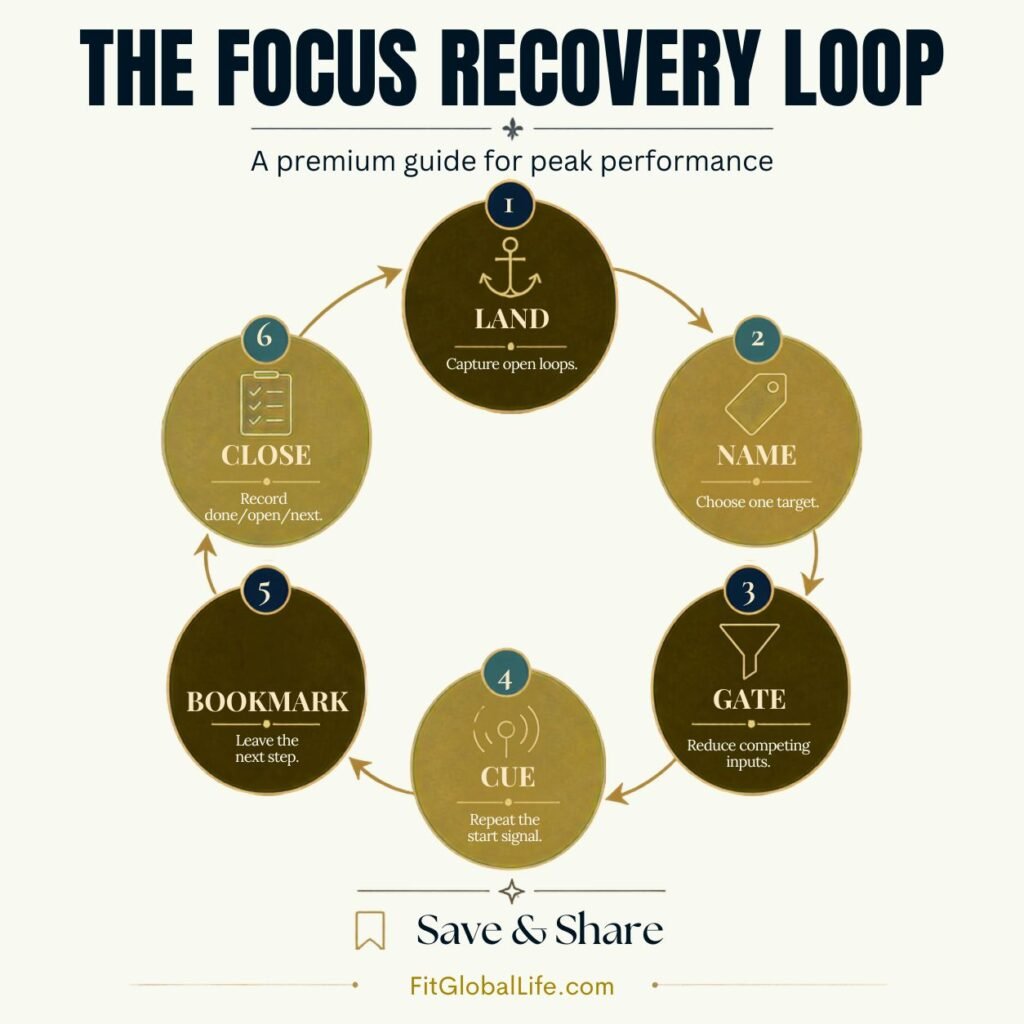
Rituals for beauty are not the point. There's no need for a candle named Executive Function. The point is that the spacing works. Every ritual helps your brain make a change that it would have to make up on the spot otherwise.
1. LAND: The 90-second landing pad
The first focus ritual is for when you sit down, and your mind comes together in bits and pieces. Give the loose parts a place to go before you choose a task. Set a timer for 90 seconds and write down whatever is taking up your attention right now: “reply to Maya,” “make an appointment with the dentist,” “check the data source,” “buy detergent,” “idea for next article,” “ask about Friday.” Do not put it together. Don't figure it out. Get it down.
How to do the landing pad
- Use one piece of paper, one note, or one list of trusted records. If you like analog tools, a simple pocket notebook will do.
- Don't finish your work; write bits and pieces. This is fine: “Tax document.” You are unloading, not managing a project.
- Stop when the timer ends. Circle only anything that is truly urgent enough to change the next hour.
- Move the page out of your direct line of sight and begin the NAME ritual.
This is deliberately lighter than journaling. If the issue is emotional confusion or you need to examine a decision more deeply, FitGlobalLife’s journaling prompts for better self-trust are the better tool. The landing pad has one job: reduce the number of reminders your working memory is trying to babysit.
Why it helps
Unfinished goals have a way of staying mentally active. In a series of studies, researchers E. J. Masicampo and Roy Baumeister found that making a specific plan for an unfulfilled goal could reduce the intrusive cognitive effects associated with that goal. The paper, “Consider It Done! Plan Making Can Eliminate the Cognitive Effects of Unfulfilled Goals”, does not prove that a 90-second brain dump cures distraction. It does support the broader idea that the mind can quiet down when an open commitment has a credible place and plan.
You should trust that you will look at the list later when you use a landing pad. Your brain may have a good reason not to believe you if your capture system is a digital graveyard of 4,812 unlabeled notes. Keep the box small enough to look over.
2. NAME: The One-Target Contract
Once the thoughts are out of your head, pick one thing to focus on. This seems clear at first, but then you see a typical afternoon. A category, like “work on presentation,” “do admin,” or “write article,” is often used instead of a finish line to start with. The categories aren't clear. When the brain knows what “enough for now” looks like, it works better during a focus block.
Set a goal and the first action that can be seen.
Type two lines. First, say, “I will _____ by the end of this block.” Second: “The first action that can be seen is _____.” As an example: “I will have written the introduction and outline by the end of this block.” The first thing that can be seen is writing down the reader's problem in three sentences. Or: “I will add up all the bills for July.” The first thing you need to do is open the bank account and the expense report next to each other.
The word “visible” is important. You can't see “Think about strategy.” “Name three possible audiences” is what it means. “Study” can't be seen. “Read pages 18–28 and make five notes in the margins” is. “Get healthier” isn't clear; a big goal like that works better with the small action design found in “tiny wellness wins you can repeat.“
If you know what will happen in the day, you can use an if-then statement: “If the 10 a.m. meeting ends, I will work on the proposal for 30 minutes before checking chat.” This kind of planned action has been looked at many times in research on implementation intentions. There isn't a magic law of behavior behind the evidence, but the basic idea is useful: planning when and how you will act makes it easier to not have to improvise when you need to.
The One-Target Contract doesn't mean that you won't deal with problems. It's okay to stop arguing about importance every three minutes. If something really does change, you should change the contract on purpose. Do not let every notice turn into a change to the constitution.
3. GATE: The Gate for the Disk Brake
The third focus routine changes the place where you are before you ask your willpower to do something. Choose the channel that will take your attention away from the next block the most and make it a little less useful. Not impossible. Not easy to do.
Making distractions less easy to get to without leaving life
The gate is putting the phone in a bag across the room for one person. Also, email and chat will be closed for 25 minutes. For a parent waiting for a call from the school, the gate could mean letting calls from favorite numbers through but turning off social apps. It could mean that a writer needs to do research in one browser profile and write in another. The plan is based on the real risk you face.
This isn't as broad as a full tech detox plan. You don't have to stop being available for half a day. The question is: what can I gate for this one block so that switching doesn't just require moving your thumb?
There are three things that make a friction gate useful: it can be turned around, it saves important human contact, and it targets a known behavior instead of making technology the bad guy. This also fits with FitGlobalLife's main point that wellness technology should be guided by people's skills instead of having tools decide what needs attention.
If you keep getting around the gate, don't feel bad about it. Make it rough. Leave your account. Put the thing farther away. Make a different account for work. Print the stuff. Or, cut the focus block down until it makes sense. A more dramatic promise to “be disciplined” isn't always better than designing the environment.
4. CUE: The cue for the same start
Starting something new is often its own kind of distraction. It feels like an archeological dig as you move the chair, get more water, look for a song, check the weather, change the name of a folder, and look around your screen. When you use the Same-Start Cue, the beginning always takes the same shape.
Make a doorway into focus that you can use again and again.
Put on the same neutral headphones, turn on the same work lamp, open the task document in full screen, make one drink, or start the same instrumental track. These are some stable cues. Then start in sixty seconds. There's no reason for the cue to make you feel magical. It's meant to cut down on pre-task wandering.
Stable context is always emphasized in studies on habits. If you repeat a behavior in a stable environment, it's more likely to become automatic and help you reach your goals, according to a study published in 2022. That proof comes from the fact that habits are formed in general, not from testing desk lamps in a lab. In real life, the translation is simple: if the doorway stays clear, you might not have to think as hard about how to get in.
Make the cue boring enough to take with you. You have created a focus hostage situation if your ritual only works with a certain café table, an expensive candle, a noise-canceling headset, and a certain type of weather. A cue should work in your normal setting and also when you move, change offices, or have a bad morning.
FitGlobalLife's guide to mindfulness during busy workdays is a good addition for people who want a more awareness-based shift. The Same-Start Cue is just the behavioral version, which says, “I start when this signal appears.”
5. BOOKMARK: The Second Entry Bookmark
You don't always have to interrupt. A coworker asks an important question. A kid needs help. A meeting starts. The package arrives. You should eat lunch. Instead of thinking you can build a monastery on a Tuesday afternoon, a good focus system should be able to handle interruptions.
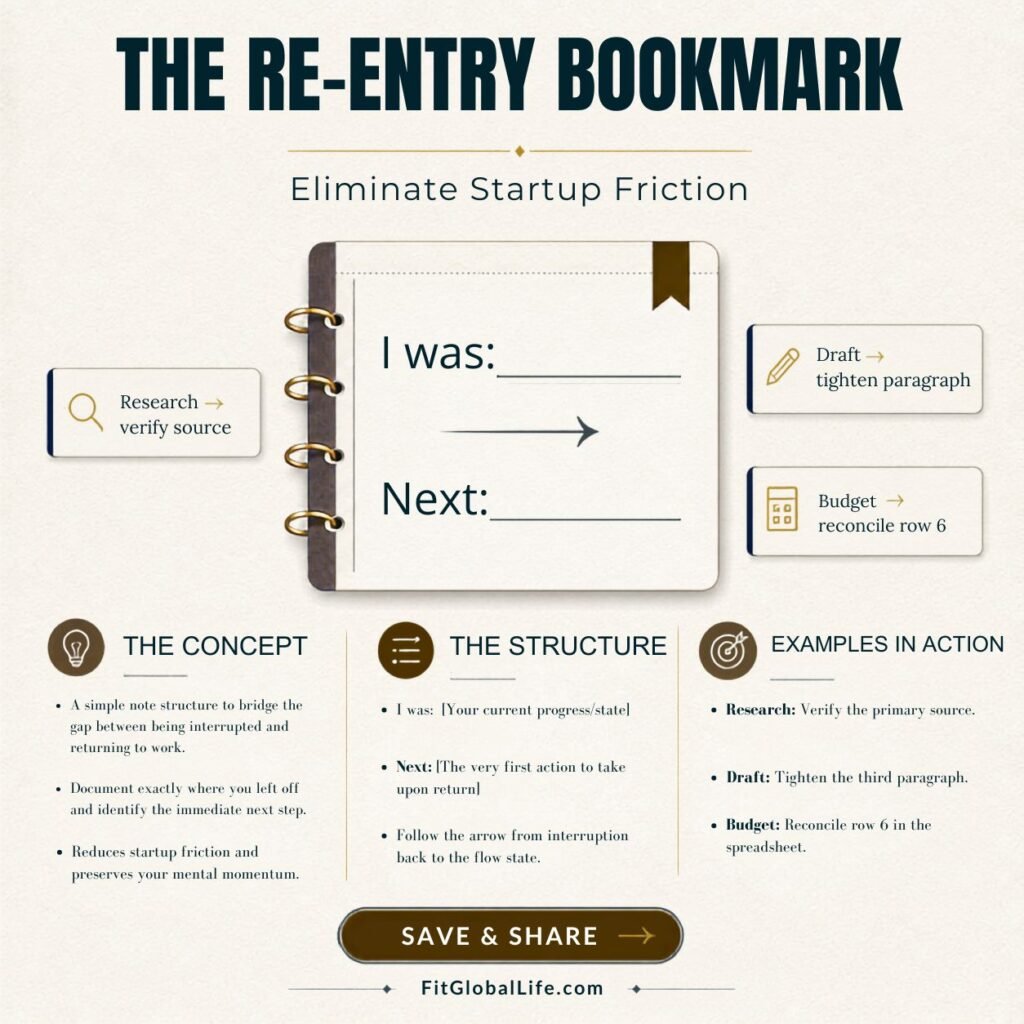
Leave a trail for your future attention
Before you switch away—when you have even fifteen seconds—write a Re-Entry Bookmark. Use this sentence: “I was ______. Next I need to ______.” Example: “I was comparing source A with the claims table. Next I need to verify the 2025 statistic in row 6.” Or: “I was editing the introduction. Next I need to tighten the paragraph beginning ‘The usual advice…’.”
If someone cuts you off in the middle of writing, say the next step out loud to yourself or mark the line where you stopped. It has the same goal: to keep the state. You're leaving clues for a future self that will come back with less information.
This is where a lot of systems for getting things done fail. They say a lot about re-entry but not much about continuous work. Still, going back is a big part of normal work. When you come back from a break, a Re-Entry Bookmark makes it easier to get back on track. It also helps you rest better because you don't have to keep repeating “don't forget where you were” in your head.
Not taking breaks is not a bad thing. A thorough study and meta-analysis of micro-breaks at work discovered that they consistently improve health, especially in terms of energy and fatigue. However, the effects on performance were different depending on the task and the type of break. “Take a break every X minutes” is not the lesson. The point is that breaks can be helpful, and the note makes going back easier.
It's possible that your body is too alert to go back to work even when the task is clear. To help calm down, read nervous system habits for a calmer week or do everyday mind-body recovery practices. A note can help you find things when you lose them, but it can't fix all kinds of stress.
6. CLOSE — The Shutdown Receipt
The final focus ritual happens when you stop. The goal is not to finish everything. That is an excellent way to never stop. The goal is to close the current loop well enough that tomorrow has a starting point.
Don't act like everything is done when you close the loop.
Write three lines: Done: what got done. Open: what hasn't been solved yet. Next, the first move that can be seen in the next session. For example: “Done: the research table is full.” Open: Two of the citations need first-hand sources. Next, open the code from the CDC and change paragraph 4. After that, close the file.
In a way, this is like FitGlobalLife's recovery rituals that don't depend on motivation, but the goal here isn't evening wellness. It's consistency of thought. It tells your mind, “I know what needs to be done and where I'm going next.”
This idea is similar to the study on making plans that we talked about earlier: having a realistic plan for your unfinished goals makes them less annoying to think about. A shutdown receipt won't make you forget about work for good, but it will take away one common reason why people keep opening the file again: they don't want to lose the thread.
Cut the ticket down even more when things are busy. When starting over tomorrow is easier than starting over today, it's enough to say, “Next time, check the chart labels first.”
Which Focus Ritual Should You Use First?
Do not install all six because an article gave you six. That would be an admirably efficient way to turn anti-overwhelm advice into another source of overwhelm. Start with the point where your attention most often breaks.
| If this sounds like you… | Start with | Why |
| “I sit down with ten unrelated things in my head.” | LAND | Externalize open loops before asking for concentration. |
| “I work all day but never know what mattered.” | NAME | Give the block a clear finish line and first action. |
| “I keep checking messages without deciding to.” | GATE | Change access before relying on restraint. |
| “I lose 15 minutes preparing to begin.” | CUE | Standardize the doorway into the task. |
| “Every interruption destroys my momentum.” | BOOKMARK | Preserve the next step before switching. |
| “Work stays open in my head after I stop.” | CLOSE | Create a credible record of what is done, open and next. |
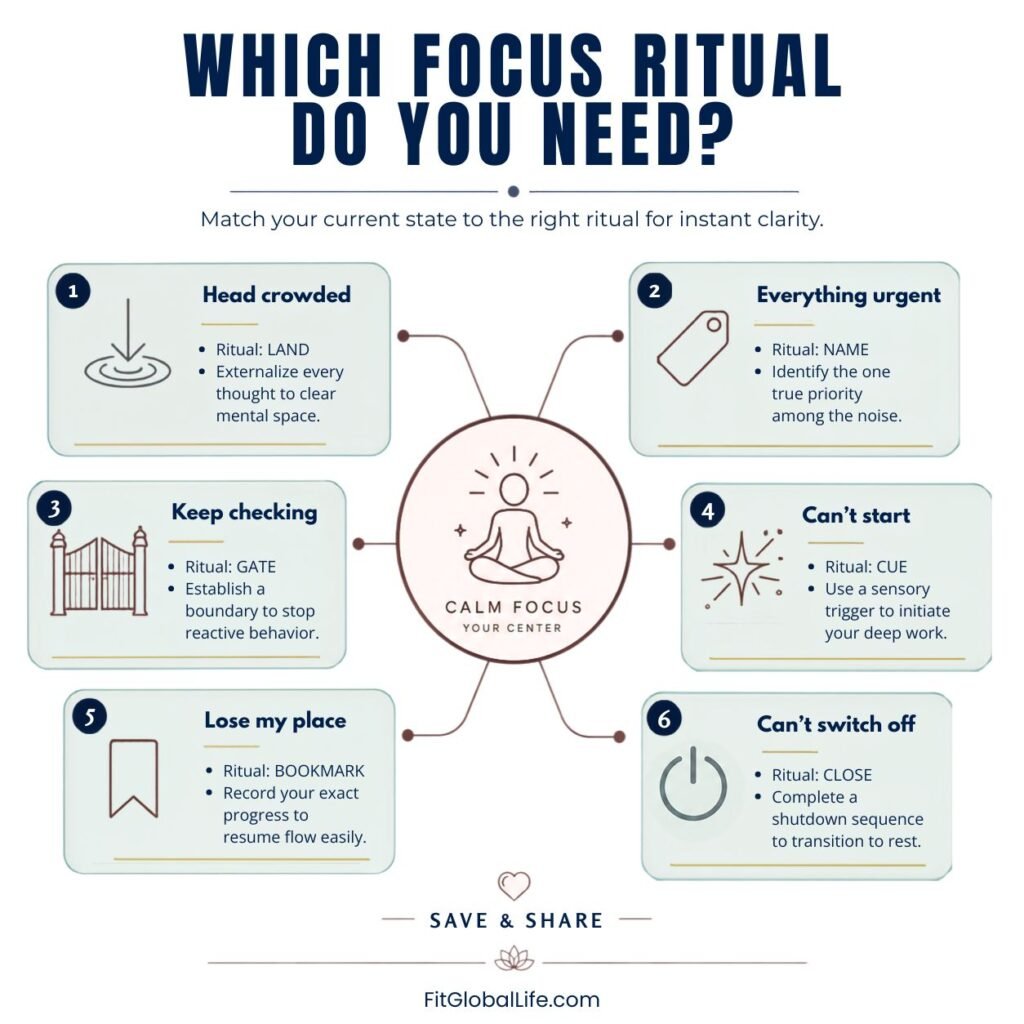
Moving upstream is what you should do if the main problem is energy instead of understanding. If you want to focus, reading about healthy habits that give you energy every day or health habits that stay good for decades may be more helpful than another method. Focus isn't separate from the body.
A 7-Day Test of a Focus Ritual
Make the first week a trial in where you should be, not a test of your character. The point is to find the routine that makes things easier in your real life.
| Day | Experiment | Minimum action |
| 1 | LAND | Do one 90-second capture before the hardest task. |
| 2 | NAME | Write one outcome and one first visible action. |
| 3 | GATE | Block the single most tempting distraction channel for 25 minutes. |
| 4 | CUE | Use the same start signal twice in the day. |
| 5 | BOOKMARK | Leave a re-entry note before every planned break. |
| 6 | CLOSE | Write Done / Open / Next before ending work. |
| 7 | Review | Keep the two rituals that created the clearest benefit; drop or redesign the rest. |
Move things around when they need it instead of making them stand still as a moral achievement. The CDC says that exercise can help with memory, learning, problem-solving, thinking, and keeping your emotions in check. Even short workouts can be good for your brain. Check out the latest CDC report on the link between exercise and brain health. Maybe it's better to take a five-minute walk between hard blocks than to push through fog for an extra twenty minutes.
The test should be over by the end of the week. If it has led to six trackers, four timers, a new subscription, and a dislike for your work, it's time to simplify. The same point is made by FitGlobalLife's larger “tiny wins” approach to health: starting with the bare minimum is often the best way to go.
Mistakes People Often Make When They Try to Focus
1. Making the practice into a way to put things off
A focus ritual shouldn't take up too much time so that it turns into a new task to avoid. If you set up your workspace for twenty minutes before a twenty-five-minute attention block, the ritual has already eaten the patient. Don't let people spend more than two or three minutes getting ready for each block.
2. Using length as proof of quality
There is no rule that says 90 minutes of focused work is better than 30 minutes of honest work. What's going on around you, your energy, your experience, and how hard the task is all change things. Set a time limit that you can stick to. You should only change the time if the work itself keeps you from finishing on time, not because the clock says so.
3. Getting tools before planning how to behave
Apps, notebooks, timers, and headphones can all make things easier, but they can't decide what's important. First, make the sequence. You should only buy something if you can spell out the exact problem it solves. This makes sure that the article stays true to the same anti-hype concept in human-centered wellness skills.
4. Seeing every distraction as a failure on your part
There are environments that are objectively interruptive. Some roles need you to be able to respond. There are times in life when you have to care for someone, get sick, travel, have unstable work, or share a space. A ten-minute safe window might be the right ritual instead of a four-hour deep-work fantasy. Before you blame yourself for not living in a productivity book, build around what's really going on.
5. Using a focus article to try to diagnose yourself
There are many reasons why people have trouble focusing, and a web page can't tell you which one is true for you. Focus rituals are ways to control your attention in everyday life. They are not a way to check for ADHD, anxiety, sadness, sleep problems, problems with medications, or any other health problem. If your focus problems are new, last a long time, are very bad, or get in the way of your daily life, you should see a professional instead of doing another ritual stack.
For When Rituals of Focus Are Not Enough
A ritual can help people get along better, but it can't make work that isn't doable seem fair. It can't fix long-term sleep loss as long as you keep planning things that will keep you from sleeping. It can't make a place of work safe that is dangerous. Stationery alone can't make childcare, financial stability, medical care, or a quieter home happen.
This line between E, E, A, and T is very important. Wellness content that is useful should help readers tell the difference between a personal habit and a problem with the way things are set up. You might need to come to an agreement with your team about response times if you keep losing focus because urgent requests keep popping up during your work blocks. If you are responsible for more than one person during the day, the intervention could be help, delegating tasks, or setting lower expectations. If you are tired and your mind is foggy, you may need to rest before you can concentrate.
FitGlobalLife's advice on mind-body healing and its approach to long-lasting healthy habits are both based on the same idea: practices work best when they fit the circumstances rather than pretending that the circumstances don't exist.
Conclusion: Make it easier to come back
What might help you focus the most might not be the same thing that helps you focus the longest. It could be the one that makes coming back less exciting. That is a more realistic goal for modern work, family life, study, and creative projects, since interruptions won't go away and perfect conditions won't show up on time.
LAND what's hurting your head, NAME one finish line. GATE is the easiest way to get away. CUE the beginning. BOOKMARKS where you want to switch before you do it. CLOSE with a ticket that tells you where to start the next day. They build trust that you won't lose the day if you lose focus. Six small changes do more than just help you get things done.
Pick one habit to start this week. Land if your mind is full. Name is a good way to make your priorities clear. When your phone keeps winning, gate. Cue if it takes a long time to begin. Mark the break if it gets in the way of the flow. Do not go anywhere with work following you. You can have focus or not have focus. In real life, there are usually a number of returns, and returns can be planned.
FAQ
Focus rituals are short steps that you do over and over again to make it easier to start, stay with, come back to, or finish a task. Setting one goal, getting rid of one source of distraction, using a solid start cue, leaving a note for re-entry, or writing a shutdown receipt are all examples of this.
Focusing exercises should only take a few seconds to a few minutes at most. The ritual is not the work itself; it's the start or end of the work. If getting ready takes longer than the useful task block, make it shorter.
No, use the ritual that fits your main point of conflict. For many, two may be enough: a One-Target Contract before they start and a Re-Entry Bookmark before they switch. But only add another one if it fixes a problem that keeps coming up.
No, Pomodoro is mostly a way to plan when to work and when to rest. The focus routines help with transitions. You can use them with Pomodoro, longer blocks of deep work, study sessions, creative work, housework, or any other plan that would benefit from having a clearer start and end point.
Some of these environmental and planning tools may be useful to many people, but this article is not treatment guidance and does not establish what will work for a specific condition. If attention difficulties are persistent or significantly impair daily life, discuss them with a qualified health professional who can consider your full history and circumstances.
Disclaimer
You can only use this article to learn about general topics like education and lifestyle. It's not medical help, diagnosis, therapy, or treatment, and you shouldn't use it to figure out if you have a mental or attention disorder on your own. There are many things that can lead to concentration problems. If your symptoms are new, last a long time, get worse, or make it hard to work, study, sleep, or do other things in your daily life, you should talk to a qualified expert.
Affiliate notice: Some of the links in this page may be affiliate links. FitGlobalLife may get paid a commission when certain purchases are made, but the reader doesn't have to pay extra. Mentions of products are included for practical reasons and because they are relevant to the article. They are not meant to be health or performance guaranties. As an Amazon Associate, FitGlobalLife gets paid when you buy certain things.