

A text comes in without a greeting: “We need to talk”. Your shoulders tighten before you’ve read another word. You replay yesterday’s conversation, draft a defensive reply then delete it and draft another. Fifteen minutes later nothing has happened except lots of internal noise. If that sounds familiar mindset shifts for less reactive life aren’t about never feeling upset — they are about stopping the journey from difficult moment to automatic action.
Reactivity can look loud (snapping at a partner; writing an angry email or answering a question like it’s an accusation); reactivity can look quiet too (drawing back, agreeing when you don’t mean to; rehearsing arguments in your head; spending the evening checking replies): all cases where the problem isn’t emotion — it’s losing room to choose what to do next.
That’s why it matters in 2026 — when stress isn’t just someone not managing time. In the 2026 Stress in America survey, the American Psychological Association found that 77% of U.S. adults surveyed said the cost of living was a big source of stress; the same report found that 47% pulled back at least one form of social participation last year because of stress, uncertainty, or feeling overwhelmed. These are U.S. survey numbers, not global prevalence estimates or evidence that everyone reacts the same way, but they do describe the crowded emotional backdrop against which ordinary conversations now take place.
The useful aim is small but important: catch the trigger earlier; separate what happened from what you assume; choose a response that protects your values and relationships. The five shifts below are not a promise of calm forever but field guide.
What Reactivity Actually Is—and What It Is Not
An emotional reaction is part of being human. Racing heart before a hard call, irritation when boundary has been crossed or sadness after disappointment may all be perfectly normal but is the response appropriate to the situation and long term interests?
Researchers define emotion regulation as efforts to influence emotions in ourselves or other people. If we look at the emotion-regulation process model again, strategies can work at different stages (choosing situations and directing attention; changing interpretations and modifying outward responses). That’s better than saying every difficult feeling can be fixed by taking three deep breaths.
Imagine four links in your everyday reaction chain: event → interpretation → body state → action. Your colleague writes “Please revise this”. Event is request. Interpretation might be “My work is never good enough.” Body tense up. Action send sarcastic reply, avoid task or overwork to prove worth. No link is automatically wrong but whole chain can cost if interpretation isn’t questioned.
Sometimes the problem is real threat or mistreatment — not distorted thought. Not reacting can’t be letting intimidation, violence over time or disrespect or unsafe conditions slide by; a considered response might be to end the conversation; document behavior; get support; set boundary firmly. Calm isn’t compliance.
For readers whose days are already full of alerts, meetings, and mental clutter, this is an approach to FitGlobalLife’s guide to reducing cognitive load instead of thinking harder. Less reactivity is partly an attention problem — if you can’t notice when you’re being pulled into a story, then you can’t decide whether that story deserves your next action.
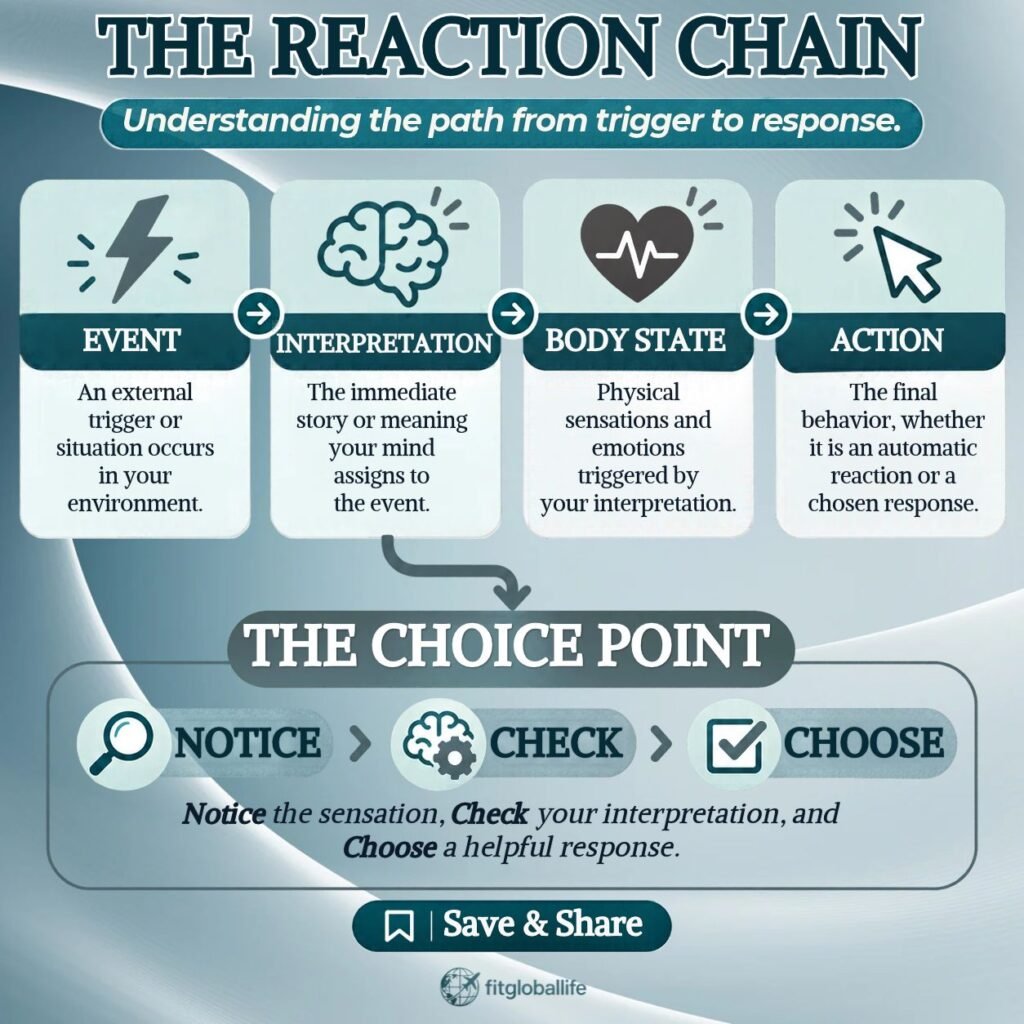
Why Mindset Shifts for a Less Reactive Life Begin Before the Trigger
Most advice starts at the instant you feel angry. That is useful, but incomplete. By then, you may be hungry, underslept, rushed, and carrying the residue of three previous conversations. A better approach works both upstream and downstream: reduce the conditions that amplify reactions, then practice making a more deliberate choice when the trigger appears.
The U.S. National Institute of Mental Health’s self-care guidance includes sleep, regular meals, movement, relaxation, goals, and social connection as practical supports for mental health. These behaviors do not cure complex emotional difficulties, but they make the everyday work of responding thoughtfully more realistic. Think of them as preparing the ground rather than forcing a personality change.
The shifts below share one test: Does this idea help me act more appropriately in the moment I am actually in? If it only helps you sound wise after the fact, it needs another round of practice.
Shift 1: From “My First Interpretation Is the Truth” to “My First Interpretation Is a Hypothesis”
Learn to separate the event from the story
Your mind is quick to explain things because uncertainty isn’t comfortable. Short answer = rejection. Late payment says something bad is coming. Feedback on a proposal sounds like a verdict on your abilities. Interpretation feels like observation although it is partly prediction.
The first shift isn’t to replace every negative thought with a cheerful one. It’s holding your explanation lightly enough that you can test it. What do I know? What am I assuming? What information would change my view? There may be a perfectly reasonable concern to address. Don’t turn uncertainty into certainty before you have enough evidence.
Here’s a three column exercise: write what you see in one sentence without adjectives. Write the story your mind told itself next. List at least two plausible alternative explanations — not because they have to be true but because it shows first story is not the only story possible.
A real-life example: the unanswered message
Event: “I sent a message this morning. It’s evening now and there is no reply.” Story: “They are ignoring me because I offended them”. Alternatives: “Maybe they are busy or overwhelmed or don’t know what to say”. Action: If time sensitive I will send one clear follow up tomorrow (if possible) instead of four anxious messages tonight.
None of those other explanations guarantees a happy ending. Maybe the other person is really mad. But even then you’ve given up mind-reading for something more proportional to what you know.
This is the practical side of cognitive reappraisal — think about how a situation is construed before you decide what to do. Classic review comparing reappraisal vs suppression shows reappraisal is more often positive than hiding outward signs of feeling but shouldn’t be used as an excuse for problems: If manager keeps ignoring written agreement, documentation and clear request right response may be that; not endlessly more charitable interpretation.
If you make self-critical conclusions (and they are a lot), then a separate post on thought habits that quietly chip away at confidence might help you figure out which assumptions you’re making without turning it into another general guide to positive thinking.
Try the “maybe, not definitely” sentence
Before you respond finish the sentence: My mind is telling me ___; that might be true but I don’t know yet. Little thing but in practice it bridges thought to fact — you can still do things promptly when you need to but no longer ask a guess to do the job of evidence.
Shift 2: From “An Emotion Is an Order” to “An Emotion Is Information”
Name the signal without handing it the steering wheel
Anger might say you’ve crossed a line. Fear might say there’s uncertainty or danger possible. Shame might signal fear of social rejection. None of those feelings tell you what’s safest next move to make or best next move to fire off message about. To shoot out a message prove yourself or disappear — that’s an impulse not a decision you have to obey.
A practical way to do this is to name what you’re feeling (I feel dismissed” or “I feel embarrassed” or “I feel scared that I will disappoint someone”). A 2025 scoping review of 98 studies on emotional granularity found that the ability to distinguish between emotions was related to a range of psychological and functional outcomes — but that doesn’t mean naming a feeling will change it instantly!
Earlier experiments putting feelings into words also looked at how affect labeling changes responses to emotional stimuli. The practical takeaway is tempered: short, accurate labeling may be part of regulation but not the whole thing — it’s not therapy, conflict resolution, or safety planning.
Use a two-part check: signal and need
What’s the feeling pointing at and then what would help? If you feel disrespected maybe a boundary. If you feel excluded maybe clarification or connection. If you feel overloaded maybe fewer commitments not more motivational quote. The answer might be other people or resources or conditions (not mindset).
Imagine a parent comes home from a hard day. Child asks the same question three times and he/she snaps at him/her — underneath that irritation is fatigue or sensory overload or worry about an unfinished task. The child’s question is real but it may not be what’s causing emotional intensity. Say “I want to answer you properly. Give me ten minutes to settle then we can talk” and then actually come back.
People who don’t know what their body is telling them might want to read how internal body signals help stress awareness. You don’t need to diagnose your nervous system. Just notice jaw tension, shallow breathing, restlessness, or sudden urgency.
Use the shortest honest label
Long analysis = another kind of rumination. Short description (hurt and defensive) vs full account of every past disappointment? Then ask what action would fit the need without creating a second problem. That shift happens when you can feel an emotion completely but still choose how to express it.
Shift 3: From “I Must Win This Moment” to “I Want a Useful Next Step”
Replace the urge to prove with a question about purpose
Reactive moments always have an invisible competition behind them. You want to win. You want the other person to say you’re right. You want the comment section to see that you have an answer. Those impulses are understandable especially when you feel misrepresented but being right and being effective aren’t always the same thing.
Try “What result would I still respect tomorrow?” Maybe clear decision repaired misunderstanding upheld boundary calm exit written record etc. That framing gives you more options than attack retreat surrender etc.
If someone criticises your work in a meeting you might want to first defend your reputation. Better next step might be “Which part do you want me to change and what success looks like?”. If criticism is unfair or inappropriate then address that separately. Not choosing productive first move doesn’t mean accepting humiliation.
Match the response to the actual stakes
The same strategy will not suit every situation. A casual misunderstanding might be resolved with a clarifying question. A pattern of missed deadlines might require a documented agreement. A threatening exchange may call for distance and outside help. A review of regulatory flexibility argues against assuming that any single coping strategy is always best. More recent research on strategy switching in stable and changing contexts likewise cautions against equating frequent switching with genuine flexibility. The point is not to collect calming tricks; it is to select a response that fits the situation.
Use a four-option menu when you notice an urge to react: clarify, communicate, create distance, or take concrete action. Clarify what was meant. Communicate a need or boundary. Create distance when more discussion would be unhelpful or unsafe. Take action when a practical problem can be solved without more emotional debate.
Social media makes this shift especially relevant. When a post provokes you, it is worth remembering that your attention has a cost. If a comment requires no meaningful decision, you may choose not to answer. If misinformation could harm people, a brief factual correction may be appropriate. FitGlobalLife’s guide to leaving the doomscrolling loop before it consumes your evening offers complementary tactics for making those choices earlier.
The “tomorrow test”
Before you send that high stakes reply ask yourself three things: Would I say that tomorrow? Does this fix the problem or does it advertise my frustration? If posted without context would it represent me fairly? This isn’t an invitation to edit every text message. It’s a brake for those moments when consequences trump satisfaction with immediate release.
Shift 4: From “Self-Control Is Pure Willpower” to “My Environment Shapes My Reactions”
Build buffers before you need them
A less reactive life doesn’t start with perfect discipline. It might start with not putting work notifications on the dinner table; not talking seriously while driving; eating lunch before a tough meeting; deciding not to answer emotionally charged messages at night.
A CDC overview of healthy sleep says adults 18–60 need at least seven hours and links sleep to mood, attention and health. Not that an hour extra won’t fix conflict — it just means chronic lack of sleep isn’t a fair baseline from which to judge your emotional skill.
The same goes for attention. If you’ve been bouncing messages, news and urgent tasks around all day you might think cognitive fatigue is a personality trait — which is why we need to look at how attention debt affects concentration — especially if your most regretted replies are at the end of busy days.
Create a response protocol for your predictable triggers
Choose one recurring situation and decide what you will do before it happens. If you tend to become defensive after feedback, prepare a question: “Can you give me an example?” If you often argue over family logistics when everyone is tired, agree on a time to discuss plans. If financial uncertainty drives sharp conversations, create a short weekly money check-in instead of raising every worry during an unrelated disagreement. For that last example, see our dedicated resource on staying steady while dealing with financial pressure.
A response protocol is not a rigid rule. It is a default you can adapt. A simple version is: notice one cue → create one buffer → choose one sentence. Your cue might be a clenched jaw. Your buffer might be standing up for water. Your sentence might be, “I need a moment to think before I answer.” For some people, breathing gently or walking briefly is helpful; other people prefer quiet, movement, or speaking with a trusted person. FitGlobalLife’s article on practical breathing options for short pauses can support those who enjoy that approach.
There is no evidence-based universal timer that guarantees a reset in ninety seconds, three breaths, or five minutes. Give yourself enough time to be safe and purposeful, then return when you said you would. In a workplace or relationship, following through on the return matters as much as taking the pause.
Protect recovery instead of pretending capacity is infinite
When your calendar has no margin small disruption feels like an attack. Ten minute shift between demanding roles? End of workday ritual? Regular time to process difficult decisions? You can read about simple mind-body recovery practices for ordinary days without treating wellness as another performance target.
A healthy environment has other people’s boundaries too. You can’t take away all the conflict and neither should everyone around you have to adapt to every preference of yours either — you want a fairer set of conditions for people to communicate well — not a world where nothing ever irritates you.
Shift 5: From “If I Reacted, I Failed” to “Repair Is Part of Emotional Strength”
Stop measuring progress by never getting upset
There’s a perfection trap in many self help articles too — calm down then never lose your patience again. That’s unrealistic and unhelpful — one bad response can become shame or defensiveness or belief change isn’t possible.
A better question is “How quickly can I notice, take responsibility and repair?” Not excuse harmful behaviour. Just treat a mistake as information about what you need to change next time. You say sorry clearly but not make the other person responsible for reassuring you.
An effective repair has four parts. First describe what happened (I raised my voice). Second take responsibility — not blame the other person for behaving that way (“That was not okay”). Third acknowledge impact (“I can see it made the conversation harder”). Fourth name change (next time I will ask for a pause before continuing). Then listen. The other person might need to process this and they don’t have to accept your apology right away.
Make your recovery measurable, not theatrical
Imagine you interrupted your partner in a heated discussion. Old pattern was argue an hour; walk away pretending nothing happened. New pattern might still be interrupting — but notice that you stopped; apologized; came back to the question with a more respectful tone. That’s progress even if it wasn’t perfect.
You can measure three everyday indicators — time to notice; time back to useful conversation and whether repair was made. These aren’t psychological tests or clinical scores — personal reflection prompts; they aren’t flattering numbers but patterns to notice.
For a more thoughtful review of what you can influence try some journaling prompts for self-trust. Self trust is built from repetition — not convincing yourself every decision was good enough.
Know when repair is not enough
An apology won’t stop intimidation, threats or abuse from happening again — accountability, outside support and safety planning are more than a good script in those cases. No one has the right to keep giving someone access who is still harmful — emotional maturity is respecting consequences AND that trust may take time to rebuild.
This fifth shift is the quietest and maybe also most durable too — you can have a hard moment without it being the last definition of who you are but still accountable for what you did.
Five Mindset Shifts at a Glance
| Old automatic belief | More useful mindset | Small behavior to practice |
| My first interpretation is the truth. | My first interpretation is a hypothesis. | Separate facts from assumptions before replying. |
| If I feel it, I must act on it. | Emotions are information, not instructions. | Name the feeling and identify the actual need. |
| I need to win this exchange. | I need a useful next step. | Choose clarity, a boundary, distance, or action. |
| I should be able to control myself through effort alone. | Capacity is shaped by conditions. | Prepare a buffer around predictable triggers. |
| One bad reaction means I have failed. | Repair and follow-through are part of progress. | Acknowledge harm and make one concrete change. |
The table isn’t diagnostic. Cultures, families and workplaces communicate emotion differently; a firm tone may be right in one context but not another; there is no style of calm to aim for — proportionate ethical effective behaviour instead.
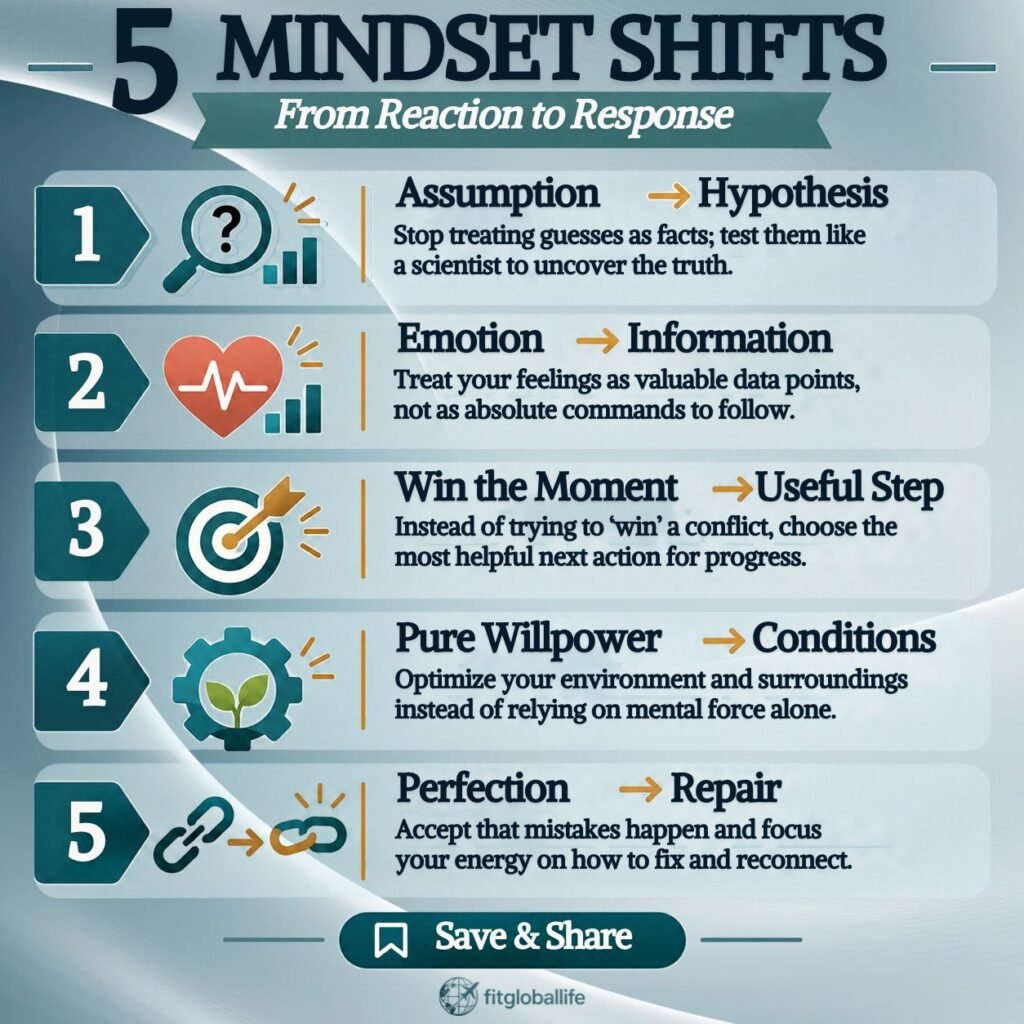
How These Shifts Work in Three Everyday Situations
At work: feedback that feels personal
Your supervisor says “I need this section revised”. First story is you’re being judged. Heat in your face and you want to explain yourself but ask instead which outcome does the supervisor want? Later if criticism was delivered disrespectfully then say that directly (you can do this with mindful transitions between demanding work tasks so next conversation doesn’t take on tension of last one).
At home: a small request at the end of a long day
Someone asks you to do another chore in the house. You hear “No one sees what I already do”. Call it stretched not mean; say what can be done (“I can do that after dinner or we could divide it differently”; if your response has been sharp enough sharpen it). This is not about silencing resentment — this is about making workload visible enough for negotiation with.
Online: a comment that begs for a comeback
A stranger misread you. I want to write a long reply. Will that help readers understand an issue or prolong the exhausting exchange? Maybe just once clarify and move on. Maybe moderate hostile thread. Maybe say nothing. You’re choosing communication goal not right to have opinion. Outside social media focus rituals for scattered days work when screen is closed.
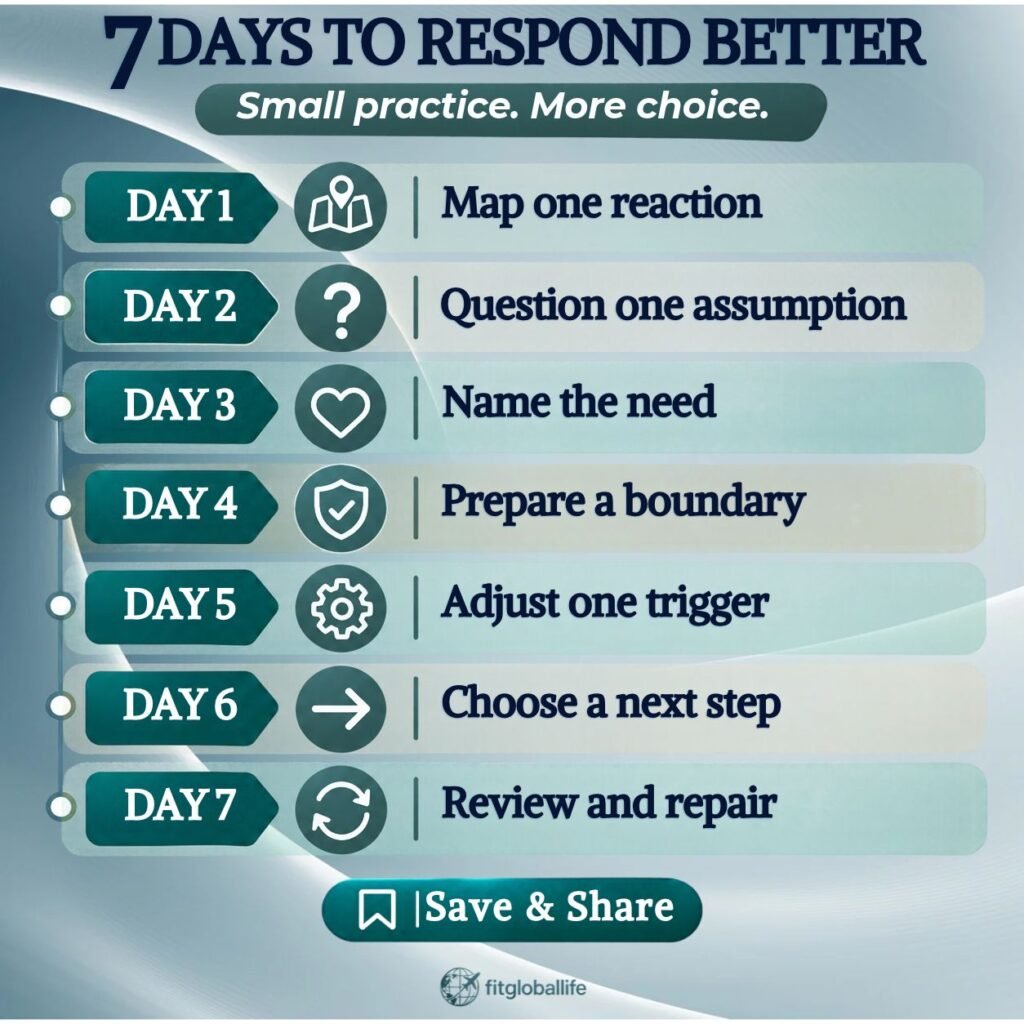
A Seven-Day Practice Plan You Can Actually Repeat
The routine above isn’t a clinical protocol or trial-tested intervention. It only takes a few minutes a day (however long real conversation takes). One page in notebook or one digital note. If writing makes you ruminate then do brief mental check-ins instead.
Day 1 — Map one reaction chain
Write down a recent low stakes incident — event, interpretation, body cues and action. Don’t judge yourself — it isn’t whether you were good or bad but where could you have had another choice? If dangerous/abusive get support there not self improvement.
Day 2 — Test one assumption
Pick a trigger that isn’t yet a conflict. Write What I know and What I am guessing. Add one clarifying question you could ask. Learn to tolerate some uncertainty without filling it immediately with the worst explanation possible.
Day 3 — Name a feeling and identify a need
When you are irritated pick two accurate emotion words and ask what they signal. Rest? Fairness? Clarity? Privacy? Practical help? Don’t have to fix it there but see if that changes the action you consider taking.
Day 4 — Prepare a boundary sentence
Write one sentence that says what you’re limiting (“I can talk about this when we can both speak without shouting”) or (“I need the request in writing before I commit”). Say it out loud. Boundaries work better if they are specific and backed up by behavior (not demands another person makes right now)
Day 5 — Adjust the environment
Find one avoidable cause of emotional friction (late night notifications, rushed transitions, inconsistent meals or arguments via short messages). Make one realistic change. FitGlobalLife has a post on recovery rituals that last longer than a short burst of motivation if your routine doesn’t have breathing room.
Day 6 — Practice a useful next step
When a small disagreement arises choose the goal before you choose the words. Would that be enough of a question? Do we need a boundary? Is this right setting? Can we do it practically? Don’t measure success by whether other person agrees; measure success by whether your behavior matched values.
Day 7 — Review and repair
Look back over the week. Identify one moment you handled better, one moment you wish to revisit, and one condition you want to change next week. If someone was hurt by your behavior, consider a specific apology or follow-through. If nothing dramatic happened, that is fine. You are practicing for ordinary life, not producing a before-and-after advertisement.
A slower pace of work may also reduce needless emotional spillover. Read about why sustainable productivity depends on fewer simultaneous demands if your reactions are closely tied to overcommitment.
For readers who would like a book-length introduction to acceptance, values, and practical exercises, Russ Harris’s The Happiness Trap offers an accessible introduction to Acceptance and Commitment Therapy. A book can support reflection; it is not a substitute for individual treatment when needed.
How to Tell Whether You Are Becoming Less Reactive
You don’t have to give yourself a calmness score every day. Watch for changes that would matter if people lived and worked with you. Maybe you ask more questions before assuming intent. Maybe arguments are shorter because you can go back to the issue without escalating it. Maybe you say no sooner instead of resentfully agreeing. Maybe you admit a mistake without explaining it away.
Progress is not linear. Sleep, grief, financial stress, illness, caregiving, discrimination, and conflict all take away emotional resources a person has available to them. A bad day isn’t proof that learning earlier went away. Your conditions may need attention too. The larger practice of building self-care from small, repeatable habits works here because a calmer response often comes with many unremarkable choices made earlier.
When a tool stops working, change the tool. Some people need to pause; some need direct conversation, structured planning, or professional help. Good self-regulation isn’t ceremonial — it’s flexible.
When Self-Help Is Not Enough
Frequent angry outbursts; constant irritability; intense fear; relationship breakdown or inability to cope with day-to-day life all need more than an article. NHS guidance on anger and when to get help says that if anger is affecting your life (or causing aggressive behavior), then support should be sought, but care may also be needed where reactions are linked to trauma, mood symptoms, substance use, ongoing safety concerns, etc.
Mindfulness and relaxation can help, but research is mixed across conditions and practice types. The U.S. National Center for Complementary and Integrative Health evidence review specifically states that meditation should not be used as a replacement for established care. If it makes you more distressed, then stop and talk to someone qualified.
Conclusion: A Less Reactive Life Is a More Deliberate Life
A less reactive life isn’t one without strong emotions, difficult people, or disappointing days. It is a life where one uncomfortable moment doesn’t have more power than another to decide the next ten minutes, the next conversation, or the next relationship.
You can question first interpretation without denying it happened. You can respect emotion without obeying every impulse it makes. You can pick a useful next step without having to win it first. You can set up supportive conditions without demanding perfection from yourself. And when you get something wrong you can fix it with honesty and follow through.
Pick one predictable trigger this week. Name the story it sets off, the cue you feel in your body, and the response you would respect tomorrow. Repeat. The best proof of change isn’t that you never react again. It’s the extra room you create to respond.
Frequently Asked Questions
To express yourself emotionally is to show or share what you feel. Reactivity is a response so automatic or disproportionate that you lose choice (angry enough but not needlessly reactive; calm outwardly but reacting — avoidance, rumination, or resentment). You don’t want to look calm for other people; you want to respond in ways that reflect facts and the situation’s needs.
There is no one-size-fits-all timeline — some people have small changes after practicing a pause or asking a clarifying question; durable change takes longer and depends on stressors, safety, relationships & health too. Think of seven days as an introduction — not a cure or guarantee. Signs: earlier triggers noticed; less impulsive reply; more consistently repairing misunderstandings.
Slow, comfortable breathing may settle some people enough to think, but no breathing pattern will reset you instantly or solve every problem. Some people with health conditions or panic history might find some techniques uncomfortable, so don’t force breath-holding or use breathing as a way of staying in an unsafe situation — walk away instead, take a break, ask a clarifying question, call someone for support, etc.
First, distinguish between everyday friction and pattern of disrespect, coercion or threats. You can ask clearly (write agreements and boundaries) but you cannot police someone else’s behaviour on your own. If safety is an issue distance first; document where possible; trusted people or professionals support when needed. Not being reactive doesn’t mean accepting harmful treatment or keeping quiet to keep the peace.
Reflection, communication skills, routine changes, and small pauses are all general well-being practices people can use. No one needs therapy to learn every emotional skill, but if distress continues, a trauma reaction occurs, severe symptoms develop, or safety is at risk, individualized care is needed. An article cannot tell you if your experience is related to a mental health condition, so don’t be surprised if you talk with a licensed professional if symptoms affect relationships, work, sleep, daily functioning, etc.
Disclaimer
This article is for general education and wellness only. It is not medical advice, psychotherapy diagnosis, or a treatment plan. Emotional reactivity can be caused by stress, physical health problems, trauma, medication effects, mental health problems, etc. Don’t use these suggestions as an excuse to be aggressive, tolerate abuse, or put off care. If symptoms persist, are severe, or interfere with safety or functioning, see an appropriately qualified healthcare professional or mental health professional if you are in danger, call local emergency services
Affiliate disclosure: Some product links may be monetized after an approved affiliate link is added. If you purchase something through one of these links, FitGlobalLife will receive a commission at no cost to the reader. Recommendations are chosen for relevance only—compensation is not received.