
Protein timing for active adults sounds like a stopwatch problem: drink a shake the moment the last rep ends, or risk wasting the workout. In daily life, it is usually a planning problem. The useful questions are when you last ate a meaningful protein portion, when you are training, and when you can realistically eat again.
For most people, meeting an appropriate daily amount and eating enough to support training matter more than hitting a narrow post-workout deadline. Timing can still help: it may make a long training day easier to fuel, solve a low-protein breakfast, or bridge a long gap between meals. The aim is a repeatable pattern, not a perfect minute.
Protein Timing for Active Adults: What the Evidence Says
A 2025 systematic review directly compared protein taken before versus after exercise. It included five studies reported in six papers. The review found no meaningful difference in lean body mass between the timing groups; one leg-press result favored pre-workout protein, but the review did not find a significant overall difference between upper- and lower-body results. That is useful evidence against a universal post-workout rush, but the small number of direct comparisons means it should not be read as proof that timing never matters. The 2025 review and its limits
The NIH Office of Dietary Supplements also summarizes mixed results: a meta-analysis found no clear strength or size advantage from taking protein within an hour before or after exercise. It notes that the body remains responsive to protein during the recovery period, rather than switching off after a brief “window.” In practical terms, a normal meal before training can reduce the urgency of a shake afterward; a fasted session followed by several hours without food is a different situation. NIH’s exercise and athletic performance fact sheet
Evidence in older adults points in a similar direction, though it answers a slightly different question. A 2024 review of protein supplementation studies in community-dwelling older adults found no significant difference in muscle-mass effects between dose, frequency, and timing subgroups. That does not make protein timing irrelevant for every person; it suggests that consistent intake and an appropriate overall plan deserve attention before fine-tuning the clock. The 2024 review of protein dose, frequency, and timing in older adults
Set a Daily Protein Context Before You Set the Clock
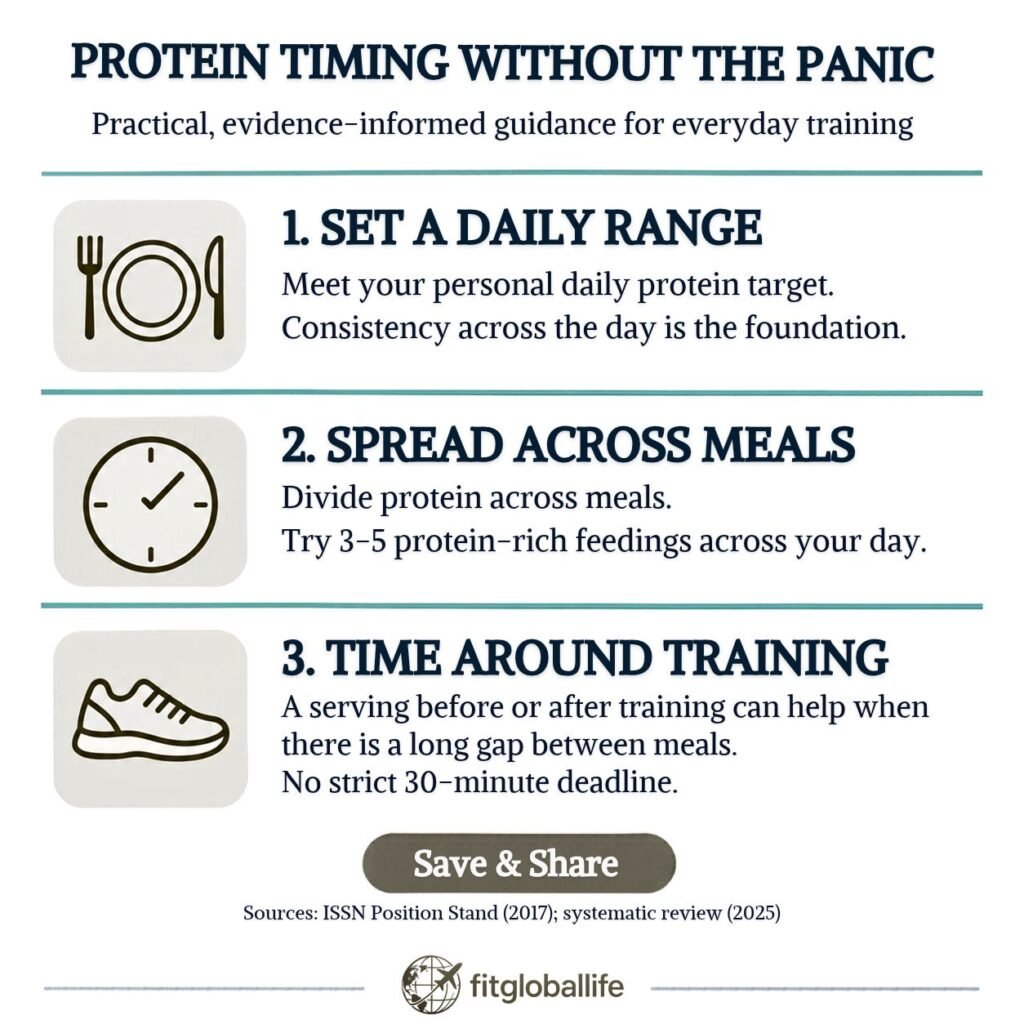
Timing advice makes little sense without a daily context. The 2025–2030 U.S. Dietary Guidelines list 1.2–1.6 grams of protein per kilogram of body weight per day for most adults. Sports nutrition guidance for healthy exercising people has often used a broader 1.4–2.0 g/kg/day range. These ranges have different audiences and purposes; neither should be treated as a personal prescription. Training volume, body size, age, energy intake, health conditions, and local dietary guidance all matter. The current U.S. protein guidance and the ISSN position stand for healthy exercising individuals provide useful context.
For a simple illustration, a 70-kg adult would calculate 84–112 grams per day using the 1.2–1.6 g/kg general range. That arithmetic is a starting point, not a diagnosis or a muscle-building promise. If you have kidney disease, another condition that affects protein needs, are pregnant, or have a history of disordered eating, get individual advice from a qualified clinician or dietitian before changing your intake.
| Body weight | Illustrative daily range |
| 60 kg | 72–96 g |
| 70 kg | 84–112 g |
| 80 kg | 96–128 g |
7 Protein Timing Tips for Active Adults
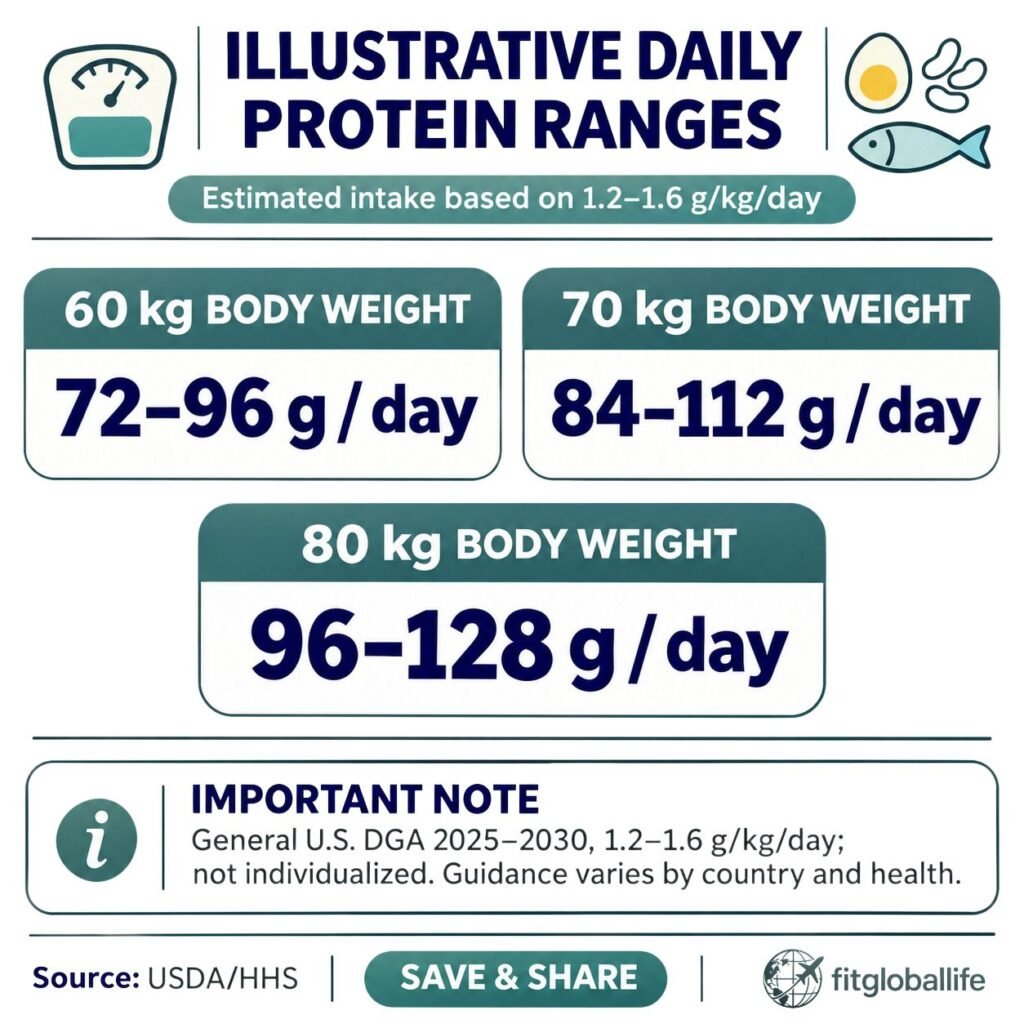
1. Set the daily target before arranging the meals
Start by estimating a reasonable daily range with current guidance or help from a registered dietitian. Then look at what you already eat for a few ordinary days. Many active adults do not need another complicated tracking system; they need to notice whether breakfast is mostly coffee, whether lunch contains a real protein source, and whether dinner is carrying nearly the entire day.
A useful planning check has three questions: What protein-containing meal did I last eat? How long until I train? When is my next likely meal? If you are doing a short movement break rather than a full workout, you do not need to treat each bout like a separate recovery emergency. Protein needs are about the day and the training program, not every five-minute activity. Our guide to short exercise snacks explains how brief bouts can fit into a broader movement routine.
2. Spread protein across the day in a pattern you can repeat
A practical pattern is to include a useful protein serving at three meals, then add a snack if your daily target or schedule calls for it. Sports nutrition references commonly describe roughly 0.25 grams per kilogram at an eating occasion, often around 20–40 grams for many adults, with servings spaced across the day. That is a flexible guide, not a minimum that every meal must hit. Appetite, body size, food choice, and total daily intake change the picture.
Breakfast is a common place to improve the pattern. In a pooled analysis of 814 community-dwelling adults over age 55 from eight studies, protein intake was lowest at breakfast across the intake groups. The study describes eating patterns; it does not prove that every older adult needs a high-protein breakfast. Still, adding Greek yogurt, eggs, tofu, soy milk, cottage cheese, or beans to a meal that currently has little protein can make the rest of the day easier. See a few fiber-rich breakfast ideas if you want options that do not rely on a shake. The pooled analysis of older adults’ protein patterns provides the study details.
3. Let your last meal guide pre-workout protein
If you ate a protein-containing meal a couple of hours before lifting, you may already have covered the pre-workout opportunity. There is no need to add a second meal simply because a workout is starting. If it has been several hours, you are hungry, or training early leaves you feeling flat, a small snack one to three hours beforehand can be more comfortable than trying to eat a large meal close to exercise.
Pairing protein with a familiar carbohydrate food can make sense before a demanding session, especially if the meal has been delayed. Examples include yogurt and fruit, toast with eggs, soy milk and oats, or a small sandwich. Keep portions and timing comfortable for your stomach; a plan that causes nausea is a bad plan even if the macros look tidy. For quick combinations, browse portable snack ideas for busy days.
4. Use the next normal meal as your post-workout plan
After training, aim to eat a protein-containing meal or snack when it fits your day. If dinner is ready soon, dinner can do the job. If you trained after lunch and dinner is still hours away, a portable snack may be useful. The practical goal is to avoid turning a long gap into a routine, not to beat a 30-minute countdown. The NIH fact sheet’s review of post-exercise protein guidance supports a flexible recovery period and notes that protein before or after can be useful depending on the meal already eaten.
This is also where convenience matters. A container of yogurt, milk, a tuna sandwich, edamame, or leftover tofu may be easier than buying a supplement. If a leak-resistant shaker helps you carry a drink on the commute, it is optional equipment, not a requirement: view a protein shaker bottle on Amazon.
As an Amazon Associate I earn from qualifying purchases. This link may earn a commission at no extra cost to you. A shaker is not necessary to meet protein needs.
5. Give tighter recovery windows more attention
The calendar matters more when the next demanding session is close. A person training once in the evening can usually use ordinary meals to cover recovery. Someone completing two hard sessions in one day, or doing high-volume training with limited recovery time, has a stronger reason to plan the first meal after the earlier session instead of leaving it to chance. Protein supports tissue repair; carbohydrate and fluids may be just as important when the next session depends on replenishing fuel.
That distinction is useful for endurance as well as strength work. Protein is not a substitute for carbohydrate during prolonged or demanding exercise. If your week includes steady aerobic sessions, read about how Zone 2 training differs from simply chasing step counts and plan food around the session’s duration and intensity. Carbohydrate choices for steadier energy can help keep the recovery conversation from becoming protein-only. Sports nutrition guidance on timing emphasizes that total intake, training demands, and the time until the next bout all shape what is useful. The ISSN nutrient-timing position stand discusses those conditions.
6. Choose protein sources that fit the meal and the schedule
Protein timing does not require a particular powder. Dairy, eggs, fish, poultry, meat, tofu, tempeh, beans, lentils, soy foods, and combinations of plant foods can all contribute. Choose portions that make it realistic to meet your day’s needs, and include enough total food to support training. If a plant-based meal has less protein per usual serving than the animal-food option you would otherwise choose, adjust the serving size or add another source across the meal.
For a deeper comparison of plant sources and practical serving ideas, see the existing plant-based protein guide. Build the plate from foods you enjoy rather than chasing a theoretical “perfect” protein. A varied, minimally processed pattern can also provide fiber and micronutrients alongside protein; weekday meal ideas built around whole foods can help with that broader picture.
7. Treat bedtime protein as optional, not a rule
A small protein-containing snack before bed can be convenient if dinner was early, evening training ends late, or you still need to fill a gap in the day. Some studies have examined casein before sleep and overnight muscle protein synthesis, but that does not make a bedtime shake mandatory for everyone. If you already ate enough and feel better without food close to bed, there is no need to force it.
Older active adults may have different appetite, health, and muscle-maintenance considerations. A clinician or dietitian can help tailor portions and timing, especially when a medical condition or medication is involved. Protein is only one part of maintaining strength over time; health habits that can age well are a useful companion read.
Two Example Protein Timing Schedules
These examples show how timing can follow a routine. They are not prescribed meal plans. Adjust the foods, amount, and clock times to your appetite, culture, budget, training, and personal needs.
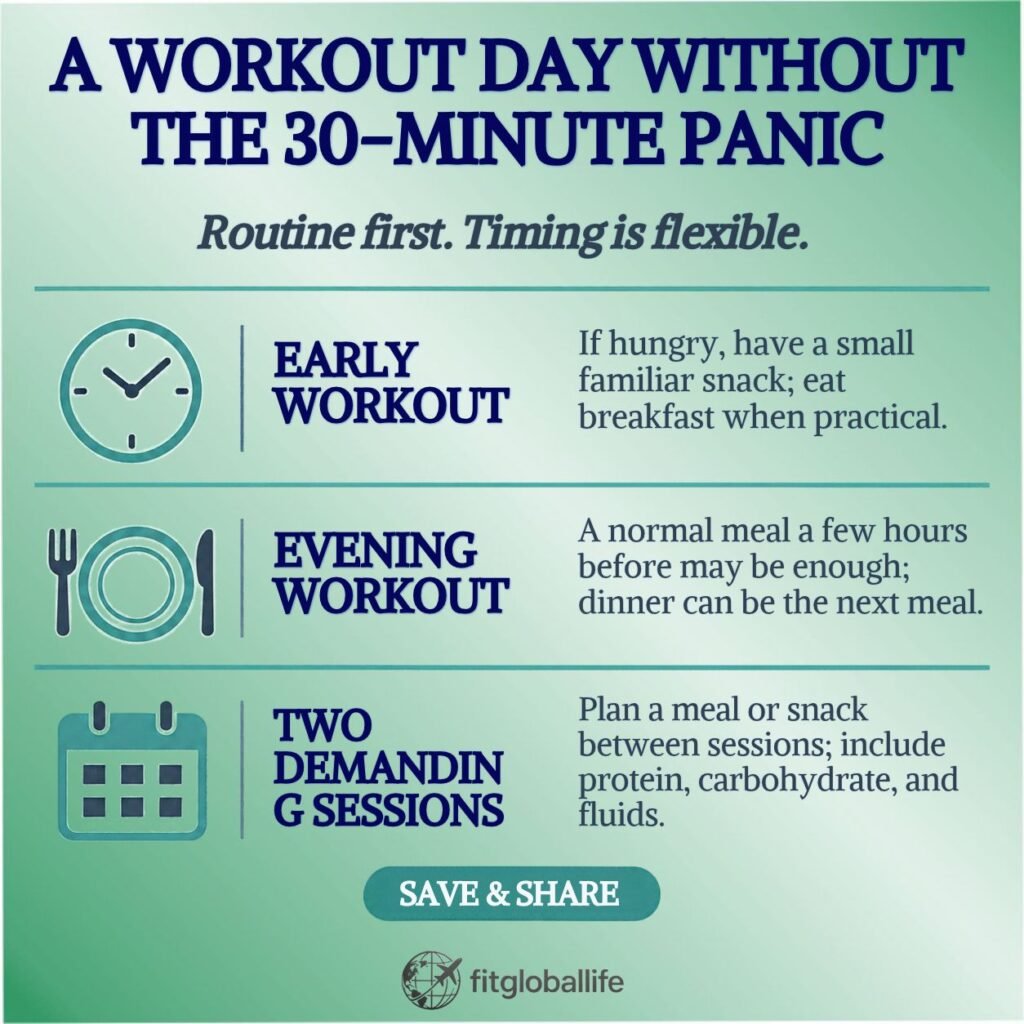
| Routine | Before training | After training |
| Early workout | If you feel good training before breakfast, do not force a large meal. If hungry or training hard, try a small familiar snack. | Have breakfast with a protein source when practical. If breakfast is delayed, use a portable snack. |
| Evening workout | Use lunch or a mid-afternoon snack to avoid arriving very hungry. A normal meal a few hours earlier may be enough. | Eat dinner with a protein source; add a snack only if dinner is delayed or the day’s intake is short. |
| Two demanding sessions | Plan the day before it starts, including a meal or snack between sessions. | Give the earlier recovery meal more attention; include protein and enough carbohydrate and fluids for the next session. |
Common Protein Timing Mistakes to Avoid
- Treating a 30-minute post-workout deadline as a make-or-break rule. The meal you ate before training and your overall daily intake change how urgent the next serving is.
- Eating almost all of the day’s protein at dinner while breakfast and lunch contain very little. A steadier pattern may be easier to meet and sustain.
- Using protein as the only workout fuel. A hard or long session may need carbohydrate and fluids, too; mobility habits that protect long-term health can also complement strength and conditioning rather than replacing them.
- Buying supplements before checking the basics. A supplement can be convenient, but it cannot compensate for too little total food, an inconsistent training plan, or inadequate rest. For recovery beyond nutrition, see simple recovery rituals that support consistency.
- Assuming low energy automatically means low protein. Fatigue can have many causes. Protein is one part of a meal pattern, not a stimulant; other ways to build energy without more caffeine may help you assess the broader routine.
Conclusion
The best protein timing strategy is the one that helps you meet an appropriate daily intake without making meals harder to live with. Start with the day’s total, notice the meals that are consistently low in protein, and place a familiar meal or snack around training when the schedule leaves a long gap. For most ordinary workouts, the next normal meal is enough. For fasted training, demanding double-session days, or a day when meals are scattered, planning ahead can make recovery easier. Consistency beats a stopwatch.
Frequently Asked Questions
Usually, no. A narrow 30-minute deadline is not supported as a universal rule. If you ate a protein-containing meal before training, your next usual meal can work. If you trained fasted or will not eat for several hours, a convenient protein-containing snack sooner may be practical.
For long-term muscle gain, current direct comparisons have not shown a meaningful general advantage for before versus after when the broader diet is considered. Choose the timing that feels comfortable and helps you meet your daily plan. People training fasted or twice in a day may benefit from more deliberate scheduling.
There is no universal exact amount. Many sports nutrition references use about 0.25 g/kg per eating occasion, often roughly 20–40 g for many adults, while total daily needs and food quality matter more than a fixed per-meal threshold. A dietitian can personalize the amount.
A broadly consistent pattern across the week is sensible because recovery and tissue remodeling do not stop when a workout ends. Your appetite and meals may differ on rest days, but there is no need to reserve all your protein for training days.
Yes. The same planning questions apply: daily total, last protein-containing meal, next training session, and next chance to eat. Use portions and combinations that make your protein target realistic, and vary sources such as soy foods, legumes, nuts, seeds, and grains.
Disclaimer
This article is for general educational purposes and is not medical advice. Protein needs vary by age, health status, training, and energy intake. People with kidney disease or other conditions that affect protein needs, those who are pregnant, and anyone with a history of disordered eating should consult a qualified healthcare professional or registered dietitian before changing their diet. Do not use this article to diagnose or treat a condition.