

The best mobility habits are not impressive enough to go viral. They look like getting up before your hips feel glued to a chair, walking often enough that stairs stay ordinary, keeping enough leg strength to rise from the floor, and moving your joints through ranges you still want to own ten or twenty years from now. That sounds almost too simple. It is also the point.
Modern wellness often treats mobility as a warm-up category—something you do for five minutes before the “real” workout. Long-term health asks a better question: what movements do you want to remain available to you as life changes? Walking through an airport. Carrying groceries. Turning to look behind you while driving. Reaching a high shelf. Getting down to the floor and back up. Recovering from a long workday without feeling as if your body has been shrink-wrapped.
That broader definition matters because the global movement picture is not great. In 2022, about 31% of adults worldwide—roughly 1.8 billion people—did not meet recommended physical-activity levels, according to the World Health Organization. Physical inactivity tends to rise after age 60, while long periods of sitting have become normal for office workers, creators, drivers, and anyone whose day is organized around screens.
This guide is not a promise that six habits will prevent every injury, chronic condition, or age-related change. Bodies are more complicated than a carousel post. The goal is more practical: build enough movement variety into ordinary life that you keep practicing the capacities health and independence depend on. That idea complements FitGlobalLife’s broader guide to health habits that age well, but here we zoom in on one system only: usable physical mobility.
Why Mobility Habits Matter More Than “Being Flexible”
Mobility and flexibility are related, but they are not identical. Flexibility describes how far a tissue or joint can be moved. Mobility is more useful as a real-world concept: can you control a range, produce force in it, move through it with confidence, and use it when life asks? A person can touch their toes and still struggle to climb stairs. Another person may not win a yoga contest but can walk briskly, squat to a low chair, carry luggage, and balance on one leg. The second profile often tells us more about practical function.
Public-health guidance supports this wider view. WHO recommends 150–300 minutes of moderate aerobic activity per week for adults, or 75–150 minutes of vigorous activity, plus muscle-strengthening work on two or more days. For older adults, balance and multicomponent movement become especially important. The WHO physical activity guidance and current CDC guidance for older adults both make the same basic point: health protection comes from a mix of capacities, not one favorite exercise.
That is why this article uses a “mobility map” instead of a stretch list. Think of six lanes: interrupt sitting, walk, keep usable strength, maintain joint range, practice balance, and rehearse real-life transitions. None is magical alone. Together they create redundancy. If one capacity dips temporarily—because of travel, workload, weather, or recovery—you still have other ways to move.
A Practical Mobility Map: The 6 Capacities to Protect
| Habit | Capacity protected | Minimum practical cue | Progression idea |
| Break up sitting | Position change, circulation, glucose handling | Stand or walk briefly every 30–60 minutes | Add stairs, squats, or a short walk |
| Walk daily | Gait, aerobic base, lower-body endurance | Accumulate purposeful steps | Vary pace, hills, terrain, or duration |
| Keep usable strength | Rising, carrying, climbing, deceleration | 2 strength sessions per week | Load squats, hinges, pushes, pulls, carries |
| Use joint range | Ankles, hips, spine, shoulders | 5 minutes most days | Add controlled end-range work |
| Practice balance | Single-leg control, fall resilience | 1–3 minutes near support | Narrow stance, head turns, uneven surface |
| Rehearse transitions | Floor transfers, stairs, luggage, travel | Practice one real-life pattern daily | Add load, speed, or complexity gradually |
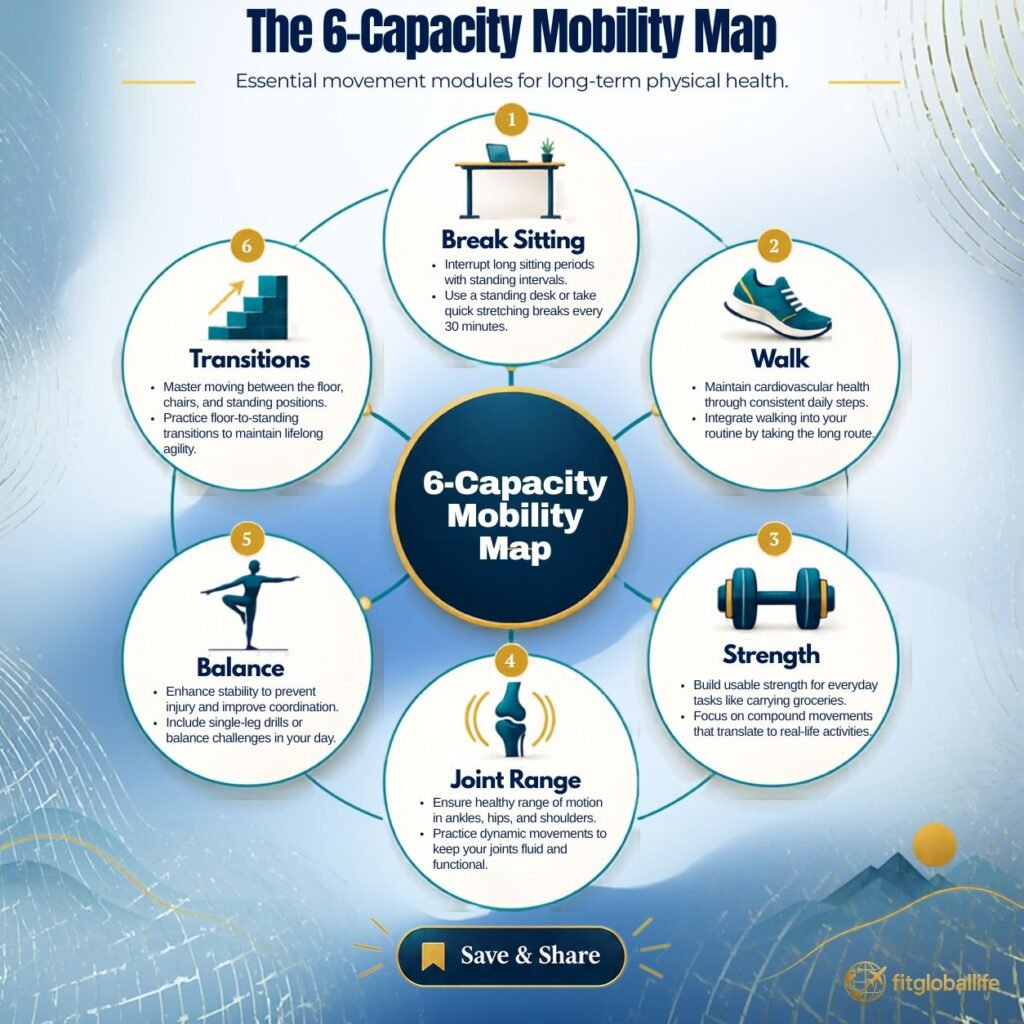
1. Break Up Long Sitting Before Stiffness Becomes Your Default
A workout does not erase the rest of your day. You can train for forty-five minutes in the morning and still spend nine hours barely changing position. That is why one of the most useful mobility habits is not an exercise at all; it is a pattern of interruption.
A 2024 systematic review and meta-analysis of randomized crossover trials found that more frequent interruptions to prolonged sitting may improve post-meal glucose control, with the authors suggesting that breaking sitting at least every 30 minutes may be a useful strategy. The certainty of evidence was low for several outcomes, so this is not a medical command to set a timer every half hour. It is a reminder that frequency matters. Read the sitting-break meta-analysis for the study details.
FitGlobalLife has already explored short movement bursts in its guide to exercise snacks and micro-dosed movement. The distinction here is important: you do not need every break to become a mini workout. Sometimes the best break is simply standing, walking to refill water, doing five calm sit-to-stands, or taking a two-minute lap before the next call. The habit is position change first, intensity second.
A simple interruption rule
Use environmental cues instead of heroic willpower. Stand after a video meeting. Walk while taking a low-stakes phone call. Put the printer or water bottle somewhere that requires a few steps. After lunch, take a short walk before reopening the laptop. If you like timers, use them; if timers make you want to throw your watch into the sea, use transitions in your day instead.
The key is to avoid confusing stiffness with damage. Feeling tight after sitting does not necessarily mean something is structurally wrong. Often the body is simply asking for a different input. If discomfort is persistent, sharp, worsening, accompanied by weakness or numbness, or follows an injury, that is a different conversation and deserves professional assessment.
2. Walk Enough to Keep Your Body Practicing Forward Motion
Walking is the most democratic mobility drill on the planet. It trains repeated single-leg support, ankle motion, hip extension, coordination, low-level aerobic work, visual scanning, and the ability to move through an environment. It can also be social, restorative, or simply transportation. That is why walking deserves to be treated as a foundational movement skill rather than only a calorie-burning tactic. Compared with 2,000 steps per day, a daily step count of ~7,000 steps was associated with significantly lower risk of a range of outcomes, including all-cause mortality, cardiovascular disease, dementia, depressive symptoms and falls. The authors also emphasised that 10,000 steps can still be beneficial, but it is not a magic number. See the 2025 step-count meta-analysis for full estimates and limitations.
That is good news for anyone who has ever looked at 10,000 steps at 9:47 p.m. and considered pacing the kitchen like a confused security guard. The health signal appears to rise well before perfection. For a practical travel version of this principle, FitGlobalLife’s guide to walkable cities for a healthier travel reset shows how movement can be built into the environment instead of added as a separate chore.
Why step count is a floor, not a personality
Do not turn steps into a morality score. A low-step day during illness, caregiving, a long flight, or a deadline is not failure. Use your average as information. If you are currently at 3,000 daily steps, moving toward 4,000 or 5,000 can be meaningful. If you already walk a lot, progression may come from pace, hills, uneven terrain, longer continuous walks, or carrying a light backpack when appropriate.
Walking speed also matters as a window into function, especially with age. Research has consistently linked slower gait speed in older adults with poorer health outcomes; a large meta-analysis found that each 0.1 m/s reduction in gait speed was associated with higher risk of mortality and cardiovascular disease. That does not mean you should race strangers at the supermarket. It means the ability to walk at a comfortable, purposeful pace is worth preserving. Review the gait-speed meta-analysis here.
3. Keep Strength in the Positions Daily Life Actually Uses
Mobility without strength can become passive range you cannot use. Long-term physical independence depends on being able to create force: stand up from a chair, climb stairs, lower yourself under control, carry bags, push a heavy door, pull luggage from a trunk, and recover balance when a step goes wrong.
This is why “mobility work” should not live in a separate wellness universe from resistance training. Current guidelines recommend muscle-strengthening activity at least twice per week, and recent long-term cohort research continues to associate regular resistance training with lower mortality risk. A 2026 analysis of more than 147,000 participants followed for up to 30 years found lower all-cause and several cause-specific mortality risks among people reporting regular resistance training, even after accounting for aerobic activity. As always with observational data, association is not proof of causation. The 2026 resistance-training study is useful context, not a prescription.
The simplest translation is to train movement patterns your life keeps asking for: squat or sit-to-stand, hinge, push, pull, carry, step, and rotate under control. You do not need to max out a barbell. Bodyweight work, resistance bands, dumbbells, machines, gardening, hill walking, and carrying groceries can all contribute depending on your starting point.
Train the “get up, carry, climb, lower” patterns
A useful twice-weekly template could be: a sit-to-stand or squat pattern, a hip hinge, a push, a pull, a loaded carry, and a step-up. Keep the range comfortable and controlled. Progress by adding a little resistance, one or two repetitions, or slightly more range—not by turning every session into a test of character.
This approach fits the bigger idea in FitGlobalLife’s decade-proof health habit framework: build systems that can scale up and down across life. Strength is especially valuable because it gives mobility “ownership.” A deep squat you can relax into is one thing. A squat you can enter, control, and rise from is a different level of capacity.
4. Use Your Joint Range Before You Lose Access to It
The phrase “use it or lose it” is oversimplified, but it points in the right direction. If your week rarely asks your ankles to bend, hips to extend, upper back to rotate, or shoulders to reach overhead, those ranges can begin to feel unfamiliar. The answer is not aggressive stretching. It is regular exposure to comfortable, controlled movement.
A 2024 systematic review and meta-analysis of 77 studies found that long-term stretch training can increase range of motion, with static stretching and proprioceptive neuromuscular facilitation showing strong effects in the included research. The bigger lesson for everyday readers is not to copy a laboratory protocol. It is that range of motion is trainable. See the range-of-motion meta-analysis for details.
A five-minute mobility practice can be enough to maintain the habit channel. Try ankle rocks, a supported deep squat, hip flexor movement, gentle thoracic rotation, and shoulder circles or wall slides. Choose ranges that feel like useful exploration, not punishment. If a joint consistently pinches, catches, swells, locks, or becomes more painful with movement, stop treating it as a content challenge and get it assessed.
Build a five-minute range practice
One useful rule is “move the joints your day ignores.” Laptop-heavy days often underuse overhead shoulder motion, thoracic rotation, hip extension, and ankle dorsiflexion. Long driving days create a similar pattern. Travel can amplify it, which is why FitGlobalLife’s healthy-travel guide and wellness train-trip ideas pair naturally with a mobility routine built around position changes rather than perfect workouts.
Keep the practice exploratory. Breathe normally. Use support when needed. Re-test how you feel afterward: easier, the same, or irritated? Good mobility training should usually leave you feeling more available, not more threatened.
5. Practice Balance Before You “Need” Balance Training
Balance is often ignored until it becomes a problem, which is a little like learning passwords only after being locked out. The body maintains balance by integrating vision, the vestibular system, sensation from the feet and joints, muscular strength, reaction speed, and attention. That system benefits from practice.
For adults 65 and older, balance activities are explicitly included in current CDC physical-activity recommendations. But younger adults should not read that as permission to ignore balance for four decades. Single-leg control shows up in walking, stairs, hiking, stepping over obstacles, and recovering from a slip.
Start boring. Stand near a countertop and hold a single-leg stance for 10–30 seconds. Try heel-to-toe standing. Walk slowly in a straight line. When that is easy, add a head turn, reduce hand support, or change the surface. Progress one variable at a time. The goal is skill, not a viral wobble.
Make balance progressive, not dramatic
Balance practice becomes more useful when it resembles life. Carry a light object while walking. Step around an obstacle. Turn and reach. Practice getting on and off a curb. If you hike, train on modest uneven terrain before the big trip. If you are recovering from a fall, dealing with dizziness, neuropathy, or a neurological condition, individualized guidance matters.
This is also where mental and physical health overlap without needing mystical claims. Attention affects movement quality. Fatigue affects reaction time. Stress can make you rush. FitGlobalLife’s guides to nervous-system habits for a calmer week and focus rituals for scattered days can support the same broader goal: a body that is not only capable, but present.
6. Rehearse Transitions: Floor, Stairs, Carries, and Travel Days
Here is the mobility habit most articles skip: practice moving between positions. Health is not lived in isolated poses. You stand up from the floor. Turn to reach the back seat. Carry a suitcase up stairs. Lower into a chair. Step over a curb. Get out of a car after two hours. These transitions combine range, strength, balance, coordination, and confidence.
Pick one transition and keep it familiar. Sit on the floor for a few minutes while reading, then practice getting up using as much or as little hand support as you need. Take stairs when it is reasonable. Carry groceries evenly. Practice a suitcase lift with a neutral, comfortable strategy before travel day instead of discovering your technique beside carousel number seven.
These habits also make travel less physically expensive. Long airport walks, train platforms, unfamiliar stairs, luggage, and hours of sitting expose mobility gaps quickly. FitGlobalLife’s nature-first escapes for screen-tired travelers and healthier travel routines can inspire the destination; your daily movement habits determine how comfortably you move through it.
If international travel is part of your plan, it is also worth thinking beyond mobility alone. Before departure, review the medical, evacuation, activity, destination, and policy limitations of any travel insurance you are considering. You can review current SafetyWing travel insurance options as one option and compare the coverage with your own trip needs before purchasing. This is an affiliate link, which means FitGlobalLife may earn a commission if you purchase through it, at no additional cost to you.
Functional mobility is movement between positions
This is the most important distinction in the entire article. Mobility is not a collection of shapes. It is access. Can you get where you need to go, change levels, carry what life hands you, and recover when the environment is imperfect? That is why a daily floor transfer may be more relevant to long-term independence than adding another exotic stretch to your saved folder.
If you prefer tiny entry points, borrow the philosophy from FitGlobalLife’s tiny wellness wins: make the minimum version almost too easy. One floor transfer. One flight of stairs. One carry. One five-minute walk. Then let consistency earn the right to progress.
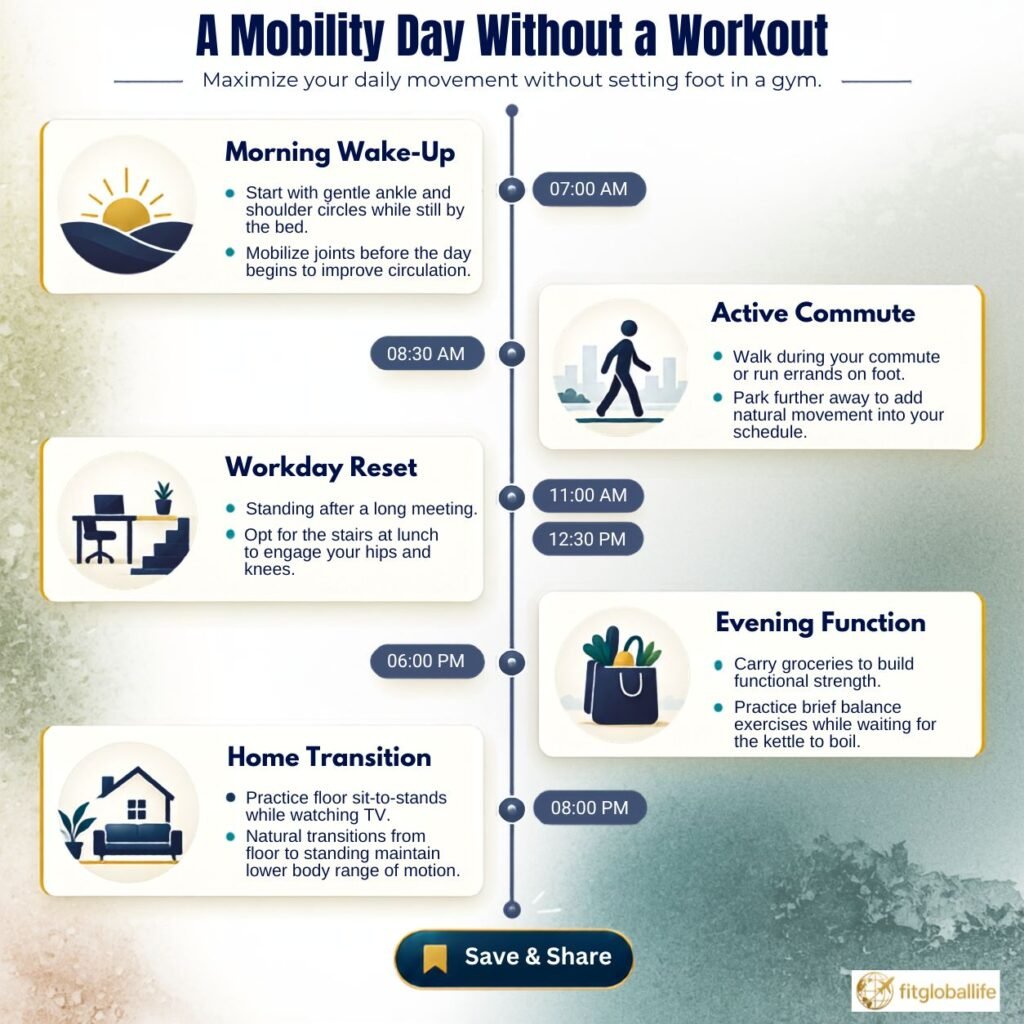
How to Build a Weekly Mobility System Without Living in the Gym
The six habits work best when they are distributed through the week rather than trapped inside one heroic “mobility day.” A practical system could look like this:
- Daily: change position frequently; accumulate walking; spend five minutes moving commonly neglected joints.
- Twice weekly: strength work that includes squatting or sit-to-stand, hinging, pushing, pulling, carrying, and stepping.
- Three or more days weekly: a short balance practice, especially as you get older or if balance is already a weak link.
- Once weekly: a longer walk, hike, dance session, bike ride, swim, or other enjoyable movement that expands endurance.
- As needed: recovery days with gentle movement instead of complete stillness, unless rest has been medically advised.
This is intentionally flexible. The WHO physical-activity fact sheet gives population-level targets, but your actual plan should account for health status, disability, pain, pregnancy, medication, prior injuries, environment, and current fitness. “More” is not automatically better. The better plan is the one that produces enough stimulus while still allowing recovery and a normal life.
Recovery is part of mobility because tired tissues and a tired nervous system do not move the same way. FitGlobalLife’s guide to recovery rituals that work better than motivation is a useful companion here, as is the deeper piece on mind-body recovery. Movement quality improves when recovery is not treated as laziness.
What Mobility Habits Cannot Promise
A trustworthy health article should be clear about limits. Mobility habits cannot guarantee that you will avoid arthritis, back pain, falls, surgery, or disability. They cannot diagnose the cause of stiffness. They cannot replace rehabilitation after an injury or medical care for neurological, cardiovascular, inflammatory, or musculoskeletal conditions.
They also should not be used to turn normal aging into a personal failure. Bodies change. Some ranges decrease, some tasks require adaptation, and some people live with permanent limitations. Health is not measured by whether every person can perform a deep squat or touch the floor. The more useful question is whether your movement plan supports the best function available to your body and circumstances.
That is also consistent with the people-first philosophy behind FitGlobalLife’s science of self-care and its recent look at future health signals hidden in daily life: use everyday observations as information, not as a reason to self-diagnose.
Conclusion: Protect Options, Not Perfection
The most valuable mobility habits are not the ones that make you look flexible for thirty seconds. They are the ones that preserve options. The option to walk farther. Sit on the floor. Carry something awkward. Turn, reach, climb, travel, garden, play, or recover from a long day without your body feeling like a set of locked doors.
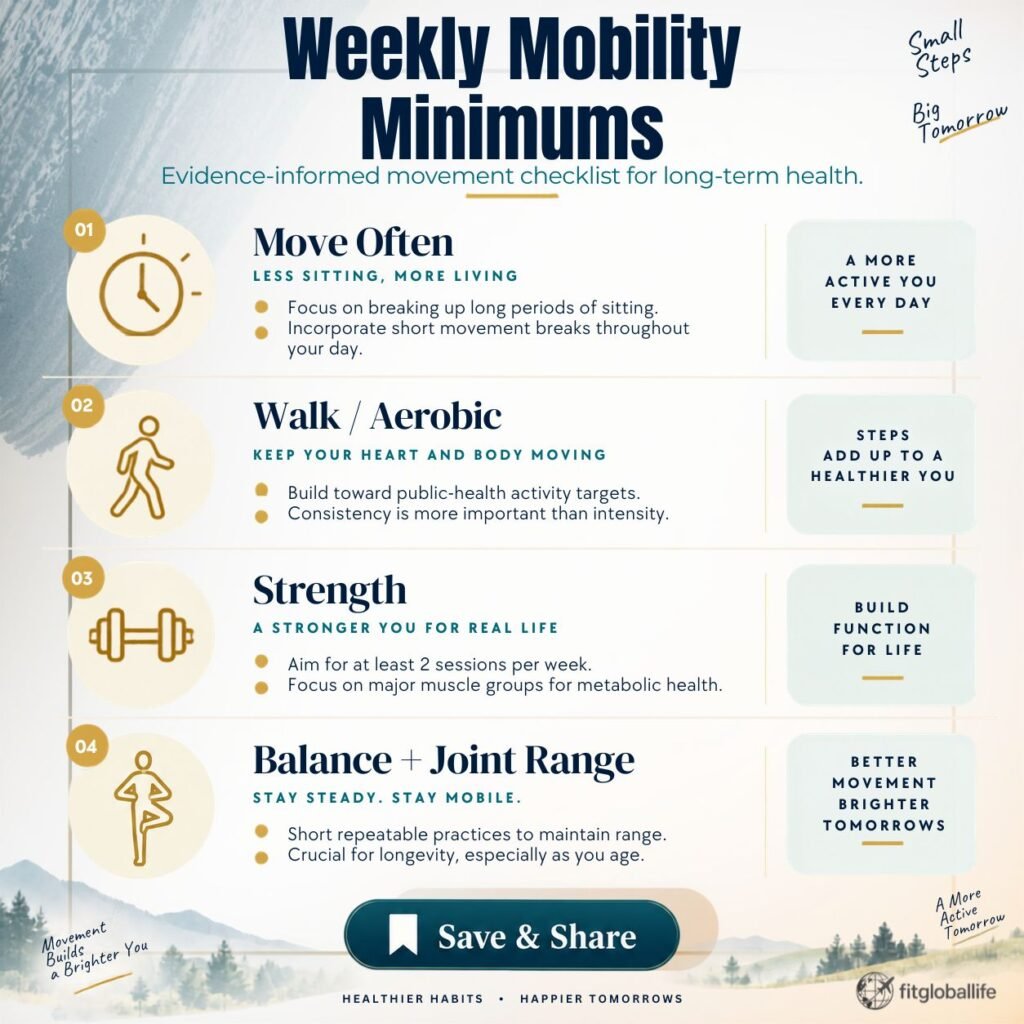
Start with the lane that is currently weakest. If you sit for hours, interrupt sitting. If you barely walk, add steps. If getting out of a chair feels harder than it used to, build strength. If your joints only visit the same small ranges all day, move them gently. If balance feels uncertain, practice before uncertainty becomes avoidance. If travel or floor-level tasks feel increasingly complicated, rehearse the transitions.
Long-term health is rarely protected by one perfect routine. It is protected by repeated signals that tell the body, “We still use this.” Mobility is one of those signals. Keep it ordinary enough to repeat, varied enough to matter, and flexible enough to stay with you when life changes.
FAQ
Mobility habits are repeated behaviors that preserve usable movement capacity. They include breaking up long sitting, walking, strength training, controlled movement of joints, balance practice and transitions in real life, for example going up or down stairs or getting up from the floor.
There is no universal daily mobility minute target. Five to ten minutes of intentional joint movement can be useful, but it should sit inside a broader activity pattern that includes regular walking or aerobic activity, muscle strengthening, and less prolonged sitting.
Not like that. Stretching can improve range of motion, but practical mobility also requires strength, balance, coordination, and the ability to use range during real tasks.
No step numbers needed. Health benefits were found at about 7,000 steps a day versus very low step numbers in meta-analyses in 2025 but benefits may start at lower levels. Your baseline and gradual progression matter more than chasing a universal number.
If there is persistent or worsening pain, swelling, locking, recurrent falls, unexplained weakness, numbness, significant dizziness, sudden loss of function, or changes in mobility after an injury, professional assessment is warranted. People with chronic conditions or disabilities may also benefit from individualized exercise guidance.
Medical Disclaimer
This article is for general educational purposes only and is not medical advice, diagnosis, treatment, or individualized rehabilitation guidance. Exercise and mobility needs vary according to age, health status, medications, pregnancy, disability, pain, injury history, and fitness level. If you have a chronic condition, significant pain, recent injury, balance problems, neurological symptoms, cardiovascular concerns, or uncertainty about what activity is appropriate, consult a qualified healthcare professional or physical activity specialist before making substantial changes to your routine.