
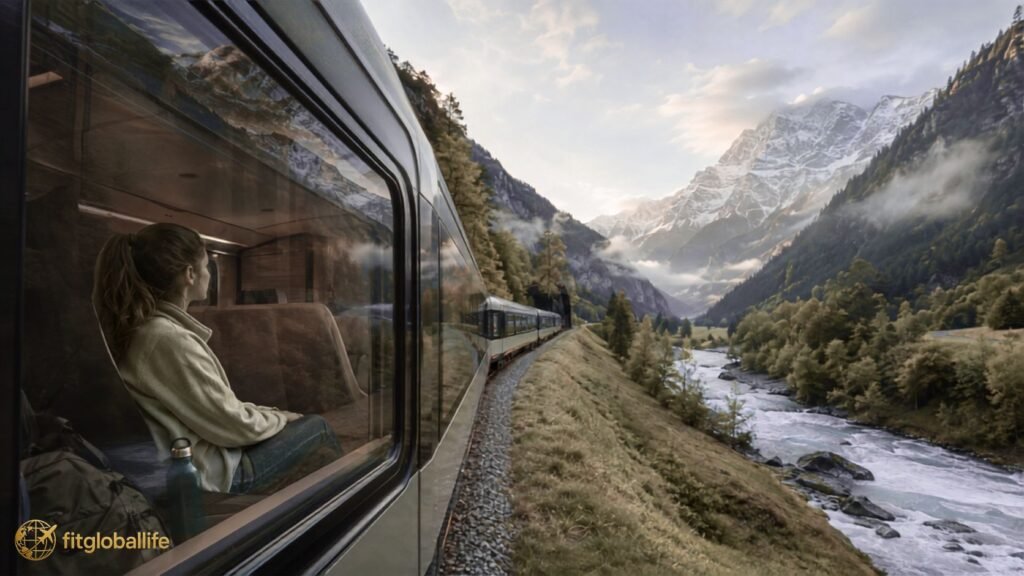
The best wellness train trips do something surprisingly rare in modern travel: they remove decisions. You board, put your bag away, sit down, and the landscape starts moving for you. There is no rental-car counter, no repeated security line, no need to stare at a navigation app while a mountain range, fjord, forest, or desert is unfolding outside the window.
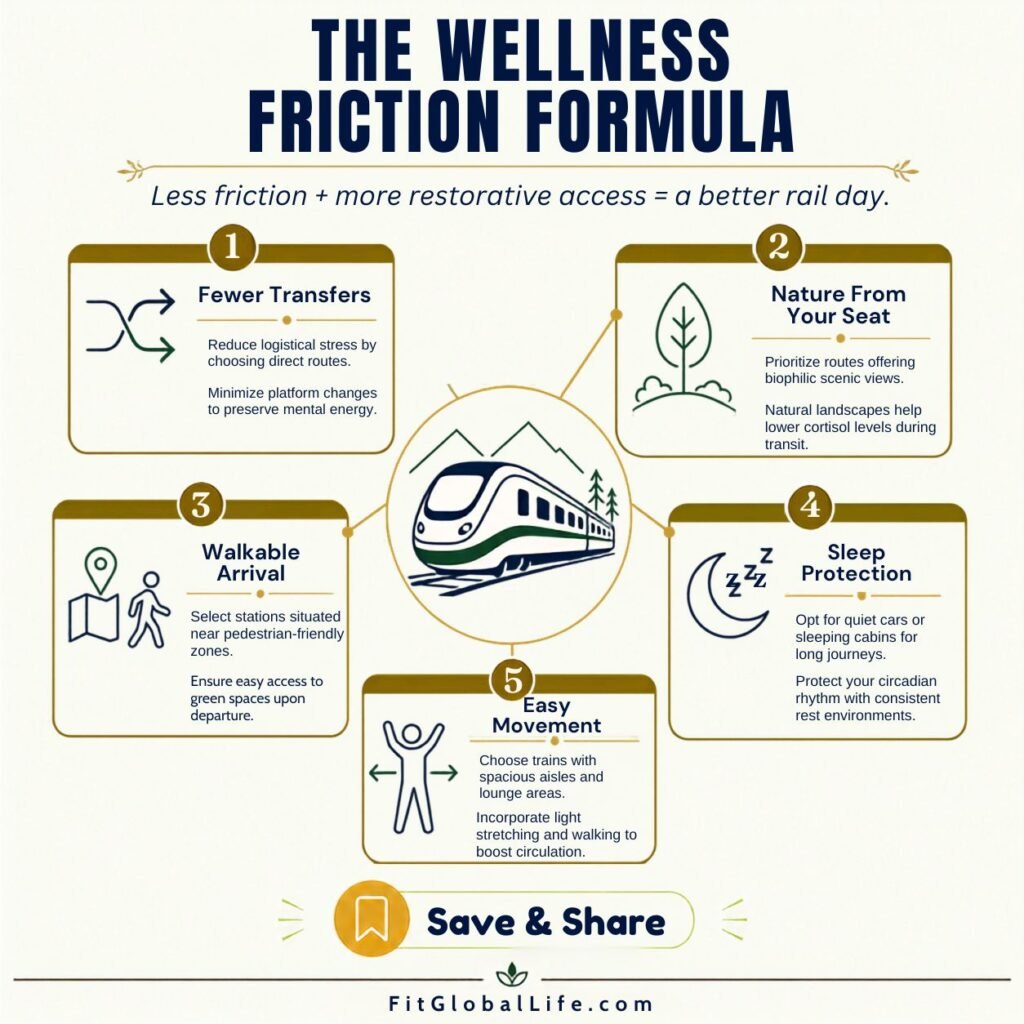
That does not mean every train ride is automatically healthy. A cramped overnight seat, a missed connection, or twelve hours without moving can turn “slow travel” into a lower-back negotiation. Wellness is not a property of the vehicle. It is the result of how the trip is designed: how many transitions you manage, whether you can sleep, how easily you can walk at the destination, how much nature you encounter, and whether the schedule leaves room to recover rather than perform.
This guide uses that more practical definition. Instead of ranking trains by luxury or Instagram drama, it looks for routes where the journey itself carries part of the wellness load. That idea fits the broader definition of wellness as an active pursuit of choices that support holistic health, as described by the Global Wellness Institute. It also connects naturally with the reason many travelers are starting to slow down enough to notice the place rather than treating transit as dead time.
As of August 2026, the nine routes below are operating or actively marketed by their official rail operators. Timetables, seasonal services, fares, rolling stock, engineering work, and border requirements can change, so always recheck the official operator before you book.
Affiliate disclosure: This article may contain affiliate links. If you purchase through them, FitGlobalLife may earn a commission at no extra cost to you. Recommendations remain editorially independent.
Why Wellness Train Trips Can Feel Better Than “Wellness Travel”
A spa reservation can be restorative, but the trip around it may still be chaotic. Rail can flip that equation. On the right route, transit becomes the quiet middle of the experience rather than the stressful gap between experiences. You can read, nap, eat, talk, watch weather move across a valley, or do nothing without feeling that you are “wasting” a day.
There is also a useful environmental side benefit. The European Environment Agency reports that rail is among the most greenhouse-gas-efficient motorized transport modes, substantially outperforming road and aviation on a per-distance basis in Europe. That does not make every rail journey carbon-free, but it supports a wider shift toward lower-impact travel choices when rail is practical. See the EEA’s comparison of rail and waterborne transport emissions.
The wellness case is less about “train vibrations heal you” and more about what the route makes easier. Research reviews associate nature exposure with benefits across mental health, cognitive function, physical activity, and other health outcomes, although the size and mechanism of those effects vary. A broad review available through the U.S. National Institutes of Health summarizes that evidence. A panoramic rail line will not replace a forest walk, but it can give you hours of visual contact with natural landscapes before you even reach the trailhead.
Finally, rail can pair well with walking. Stations often put you in the middle of towns rather than at an airport outside them. That can turn “arrival logistics” into an ordinary walk to a hotel, café, waterfront, or trail connection. If your trip already includes regular walking, it becomes easier to support the World Health Organization’s physical-activity guidance, which recommends at least 150 minutes of moderate-intensity activity per week for adults. The train is not the workout; it is the piece of transport that can make the workout easier to fit in.
This is the lens used below: scenic exposure, transition load, movement access, sleep compatibility, and decision load. It is essentially a “wellness friction” score. Low friction means the trip asks less from you while still giving something back.
| Route | Typical time | Best wellness asset | Main friction | Best for |
| Glacier Express | ~8 hours | Panoramic Alpine scenery + car-free endpoints | Reservation and premium pricing | A one-day scenic reset |
| Bernina Express | ~2¼–4½+ hours by segment | Fast glacier-to-palm landscape shift | Popular seats sell out | Short cross-border nature immersion |
| Bergen Line | ~6½–7½ hours | High plateau, fjords, optional sleep products | Long seated day | Nordic slow travel without a car |
| West Highland Line | ~5–6 hours to Mallaig | Remote moorland, lochs, sea arrival | Weather and service disruption risk | Quiet landscape lovers |
| TranzAlpine | ~4h55 | Southern Alps + open-air viewing | Limited frequency | A compact micro-retreat day |
| The Canadian | Multi-day | Sleep, dining, vast scenery in one booking | Time + price + potential delays | Deep decompression |
| California Zephyr | ~52 hours end to end | Rockies, canyons, lounge views | Long duration and delay risk | Travelers who enjoy unscheduled slowness |
| The Ghan | 3 days / 2 nights (core journey) | All-inclusive logistics + outback immersion | Premium cost | A low-decision splurge |
| Alishan Forest Railway | ~5 hours through service | Forest ascent + easy mountain immersion | Booking window and weather | Gentle forest-focused escape |
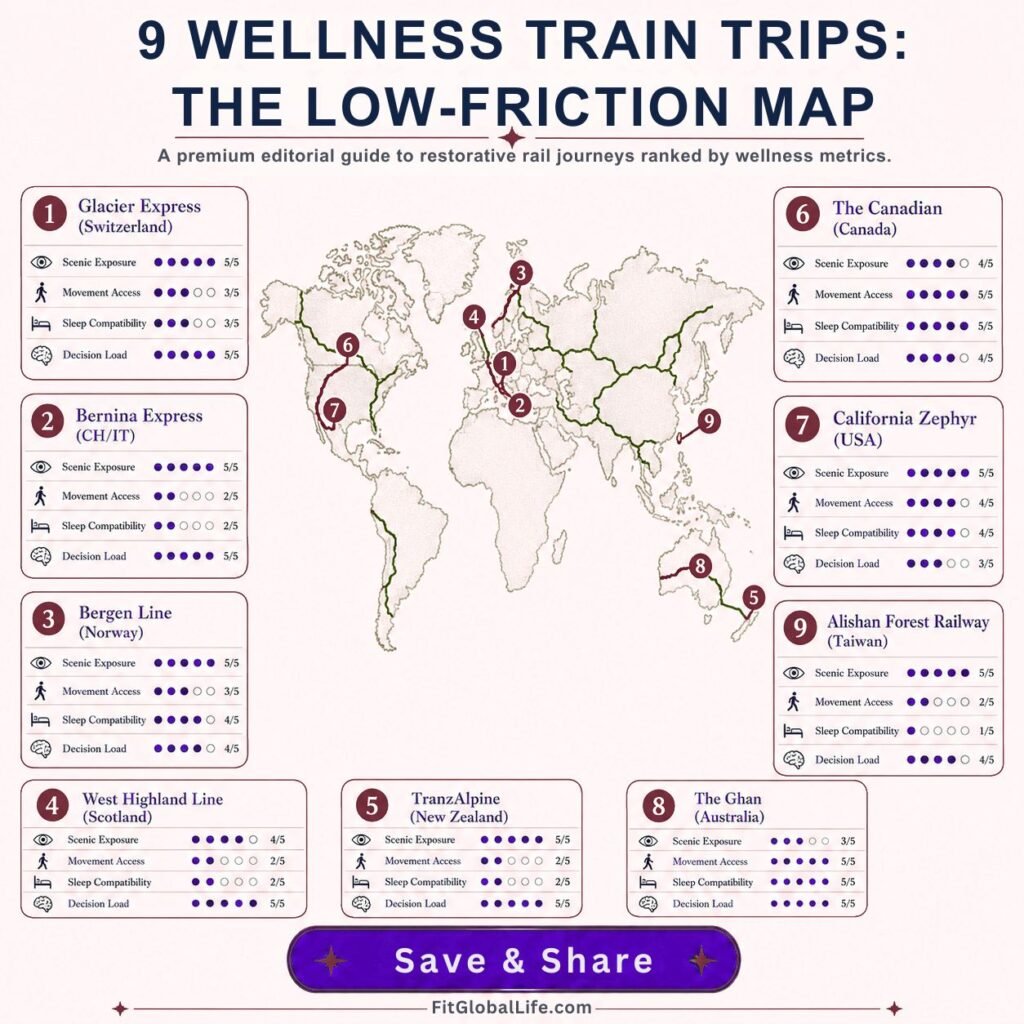
9 Wellness Train Trips That Lower Travel Friction
1. Glacier Express, Switzerland — Zermatt to St. Moritz
The Glacier Express is the obvious opener because the route is practically a moving argument for unhurried travel. The official journey between Zermatt and St. Moritz takes about eight hours, crossing high Alpine terrain, the Oberalp Pass, the Rhine Gorge, and the Albula landscape. The wellness advantage is not speed. It is permission to stop optimizing. Once you have your reserved seat, the day has a single job: travel east or west while the scenery keeps changing.
Both endpoints help. Zermatt is car-free, so walking is built into the experience almost by default. St. Moritz sits inside an Upper Engadin landscape of lakes and mountain paths. That makes the train day easy to sandwich between two active days without adding a driving day in the middle. It also pairs well with a walkable-city reset mindset: the goal is not to accumulate steps obsessively but to let ordinary movement return to the trip.
Wellness move: Do not plan a hard workout on arrival. Take a lakeside walk, eat early, and let the scenery be the “event” of the day. If you are prone to motion sickness, book conservatively, hydrate, and avoid turning the panoramic windows into eight hours of close-up phone scrolling.
2. Bernina Express, Switzerland to Italy — St. Moritz/Chur to Tirano
The Bernina Express delivers a different kind of restoration: compression. In a few hours you can move from high Alpine landscapes and glacial scenery toward the warmer Italian side of the border. Rhätische Bahn’s 2026 timetable shows multiple seasonal departures, and the route is part of the UNESCO-listed Albula/Bernina railway landscape.
This is one of the best choices when you want the emotional impact of a “big trip” without spending a full day in transit. The route is visually dense, but it does not require you to hike for the payoff. That makes it useful for travelers who are tired, between active itineraries, or want an accessible dose of landscape. It is also a good reminder that awe can change how a trip feels without needing a packed activity schedule.
Wellness move: Treat Tirano as a soft landing rather than an immediate transfer station. A meal, a short walk, and one night can turn a scenic ride into a genuine reset. In late October and November 2026, RhB has published specific routing changes for construction, so check the current operating notice before locking hotels around tight connections.
3. Bergen Line, Norway — Oslo to Bergen
Norway’s Bergen Line runs between Oslo and Bergen in roughly 6.5 to 7.5 hours and crosses Hardangervidda, the vast high-mountain plateau. Vy lists multiple daily departures, café service, bike space, more-comfortable seating options, and night products including lie-flat or sleeper choices on selected services. That mix is exactly why the line works for wellness-focused travel: you can choose scenery, sleep, budget, or social space depending on what your body actually needs.
The line also makes it easy to design a no-car trip around Geilo, Voss, or Myrdal. Instead of trying to “do Norway” in one heroic day, stop where movement is naturally available. A short hike, lake walk, sauna session, or quiet meal can provide more restoration than adding another sightseeing checklist. This is where the regenerative travel mindset matters: leave enough time to participate in a place instead of merely photographing it.
Wellness move: In winter, choose a daylight departure if scenery is the point. Vy notes that daylight across Hardangervidda is limited in the darkest months. Your best seat is not worth much if the “panorama” is your own reflection in the glass.
4. West Highland Line, Scotland — Glasgow to Mallaig
ScotRail describes the West Highland Line as one of the world’s great scenic rail journeys, running from Glasgow toward Oban or through Fort William to Mallaig. The appeal is not polished perfection. It is remoteness: lochs, moorland, mountains, small stations, and a final approach toward the sea.
For travelers who feel overstimulated by city breaks, this route can work like a long visual exhale. There is a conceptual overlap with acoustic tourism, but the useful point is simple: fewer alerts, fewer transport decisions, and more time looking at landscape can create a quieter day. You do not need to claim that silence “boosts longevity” to appreciate what a lower-noise environment can do for attention.
Wellness move: Keep at least half a day of slack around this route. Highland weather and rail operations are not a wellness app; they do not care about your perfect itinerary. When you build buffer time, a delay becomes an inconvenience rather than a crisis.
5. TranzAlpine, New Zealand — Christchurch to Greymouth
New Zealand’s TranzAlpine crosses the South Island between Christchurch and Greymouth in just under five hours. Great Journeys New Zealand highlights braided rivers, mountain plains, gorges, lakes, and the Southern Alps; the service also offers a scenic café and open-air viewing carriage.
That duration is a sweet spot. It is long enough to downshift, short enough that your body does not feel like it has moved into the seat permanently, and dramatic enough to make the day memorable without multiple attractions. It is basically a transport version of a micro-retreat: a bounded period where the environment changes and your normal routine temporarily loosens its grip.
Wellness move: Use the open-air carriage for short sensory breaks rather than spending the whole journey chasing photos. Then sit down. Watch. Let some moments remain undocumented. Radical, I know.
6. The Canadian, Canada — Toronto to Vancouver
VIA Rail’s The Canadian is not a quick scenic ride; it is a multi-day crossing. That changes the wellness equation. Economy can be demanding, while Sleeper Plus and higher categories add beds, meals, and access to spaces designed for long-distance travel. The result can feel less like transportation and more like a moving pause button—if the schedule and fare fit your life.
The strongest reason to choose it is continuity. Instead of airports, hotel changes, rental cars, and repeated unpacking, you stay inside one travel system for days. That can reduce decision load dramatically. But there is a trade-off: long-distance passenger rail can run late, and you should not build a fragile same-day flight connection at the end. The trip rewards people who can tolerate uncertainty.
Wellness move: If you have the budget, spend on sleep before spending on status. A private sleeping setup is more likely to improve the experience than upgrading for prestige alone. Think of the route as travel with purpose: the purpose is the crossing itself, not merely Vancouver or Toronto.
7. California Zephyr, United States — Chicago to the San Francisco Bay Area
Amtrak’s California Zephyr runs daily between Chicago and Emeryville in the San Francisco Bay Area, crossing the Rockies, Utah, Nevada, and the Sierra Nevada. The current timetable is roughly 52 hours end to end. Private rooms, dining, and lounge space can make the journey comfortable; coach is far more economical but requires a realistic tolerance for long sitting and imperfect sleep.
This is the least “effortless” route on the list if you demand punctuality. It can also be one of the most effortless if you enjoy surrendering the clock. That paradox is important. Wellness travel often becomes another performance project—wake at 5:00, hike at 6:00, smoothie at 8:00, spa at 10:00. The Zephyr works when you stop asking every hour to produce something.
Wellness move: Build movement into station stops when permitted, walk the train periodically when safe, and stretch gently. Use the same commonsense habits you would use to stay healthy while traveling: hydration, regular movement, balanced food where practical, and enough sleep. Do not use a scenic train as an excuse to sit motionless for two days.
8. The Ghan, Australia — Adelaide to Darwin
The Ghan is the splurge entry. Journey Beyond’s core 2026 Adelaide–Darwin experience runs for three days and two nights, with meals and off-train experiences bundled into the fare. That is expensive, but the wellness advantage is operational simplicity. You make fewer decisions because much of the trip has already been choreographed.
The landscape does something equally valuable: it changes your sense of scale. The route moves through the Australian interior toward Alice Springs and Katherine, trading urban density for huge distances and open horizons. If your everyday life is tabs, pings, meetings, and tiny rectangles of information, that scale can feel almost medicinal. Even though, to be precise, a desert view is not medical treatment.
Wellness move: Use the included structure rather than trying to add extra excursions at both ends. This is one of those trips where “more” can make an expensive experience worse. The same principle appears in affordable wellness escapes too: value comes from choosing the right amount, not simply buying the most.
9. Alishan Forest Railway, Taiwan — Chiayi to Alishan
Taiwan’s Alishan Forest Railway is the most forest-focused trip in this guide. The official railway site showed the main and branch lines operating normally on 11 August 2026, with daily Alishan Express services listed from Chiayi into the mountains. A through service takes roughly five hours, climbing from the lowlands through changing forest zones toward Alishan.
This route earns its place because it connects transport and nature without forcing a physically demanding arrival. Once in Alishan, you can choose short forest walks, viewpoints, or the famous sunrise branch service depending on energy and weather. It is a strong option for travelers who want the “nature reset” feeling described in gentle nervous-system reset trips without booking a formal retreat.
Wellness move: Book when the official reservation window opens and keep weather flexibility. Mountain railways are sensitive systems. Also resist the urge to chase every sunrise, tea trail, forest path, and viewpoint in 24 hours. True unplugging works better when you leave some blank space.
How to Turn Rail Travel Into a Low-Friction Wellness Day
Book for your nervous system, not for status
The highest cabin class is not automatically the healthiest choice. Ask what actually creates friction for you. If poor sleep wrecks the next day, prioritize a bed. If crowds make you tense, choose a quieter class or off-peak departure. If motion sickness is the issue, seat location and medication guidance matter more than champagne. If cost anxiety follows you through the entire trip, a premium “wellness” upgrade has failed its assignment.
This is also where simple stress-free travel habits beat elaborate hacks: allow transfer time, save offline tickets, know the luggage rules, pack a snack, and confirm whether your destination station has late-night transport.
Pack to eliminate micro-stress
For rail trips, the best bag is usually one you can lift into a rack without negotiating with gravity. A compact 18–24L travel daypack can hold water, medication, a light layer, charger, eye mask, snacks, and the small items you do not want buried in a suitcase. Keep valuables on your body or within reach, and check each operator’s baggage limits before departure.
The goal is not minimalist aesthetics. It is fewer tiny problems: no rummaging for a cable, no dehydration because the bottle is inaccessible, no freezing carriage because the jacket is checked away. Wellness often looks less like a ritual and more like competent logistics.
Build movement into stations and stopovers.
Long train rides are still sedentary time. Walk the carriage when permitted, stand periodically, and use longer stops for movement only when the operator makes it safe to step off. At destinations, choose a hotel that lets you walk to dinner, a park, a waterfront, or a trail connection. That is one reason rail pairs so well with the idea of hidden destinations worth lingering in: the station can become the center of a small radius rather than the start of another two-hour drive.
Protect sleep and hydration on longer routes.
Overnight rail can save a hotel night, but “sleep while moving” is not effortless for everyone. Bring an eye mask, earplugs, a layer for temperature swings, and any personal sleep supports you already know work for you. Avoid testing a new supplement, sedating medication, or aggressive sleep hack on a train. Hydrate steadily rather than trying to catch up all at once.
For multi-country or long-duration trips, consider whether travel medical cover for longer journeys fits your needs. Read exclusions, geographic limits, pre-existing-condition language, trip-delay provisions, and eligibility carefully; insurance is not interchangeable with comprehensive health coverage.
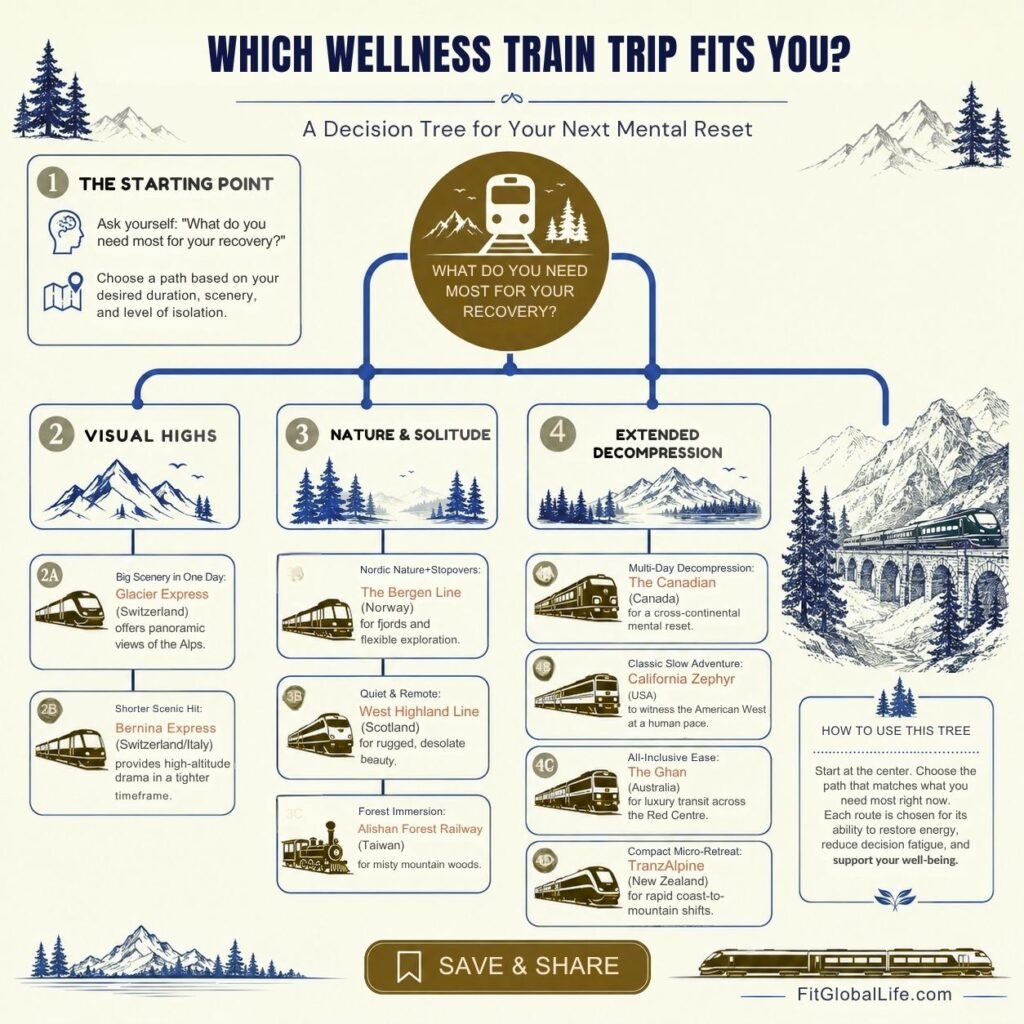
Which Wellness Train Trip Fits Your Recovery Style?
| If you want… | Choose first | Why |
| One spectacular day with minimal planning | Glacier Express | A single reserved-seat day between two mountain bases |
| Maximum scenery in fewer hours | Bernina Express | High visual return without an all-day commitment |
| Nordic nature with flexible stopovers | Bergen Line | Easy access to Geilo, Voss, Myrdal and Bergen |
| Quiet, moody landscapes | West Highland Line | Remote Scottish scenery and a small coastal finish |
| A short rail micro-retreat | TranzAlpine | Under five hours and strong landscape density |
| A true multi-day decompression | The Canadian | Sleep, meals, distance and long stretches off the clock |
| A classic American slow-travel challenge | California Zephyr | Huge scenery with deliberate tolerance for delays |
| All-inclusive low-decision luxury | The Ghan | Most logistics are bundled into the experience |
| Forest immersion with gentle walking options | Alishan Forest Railway | Mountain rail plus easy access to forest paths |
A useful rule: choose the route that removes the kind of friction you personally feel most. For one traveler, that is driving. For another, it is airports. For someone else, it is planning meals, changing hotels, or being constantly online. A wellness trip should not require you to become a different person before it starts.
Final Thoughts: Let the Journey Do Some of the Work
Train travel is having a cultural moment in 2026, but the interesting part is not nostalgia. It is design. Rail can make a journey feel better because it can reduce transitions, place you close to walkable centers, give you long views of natural landscapes, and create time where there is genuinely nothing urgent to do.
The trick is to avoid turning that simplicity into another optimization contest. You do not need the perfect window seat, the perfect camera, the perfect supplement stack, and a spreadsheet of “restorative activities.” Pick one route that fits your energy, protect your sleep, move when you can, and leave enough margin for the schedule to be human.
That is the real advantage of these wellness train trips: they make it possible for the journey to carry some of the weight. You arrive having already experienced something, rather than arriving exhausted and waiting for the vacation to begin.
Frequently Asked Questions
Not automatically. Trains can reduce airport-style transitions and may make walking and nature access easier, but a long, crowded, sleepless train ride can be stressful too. Choose based on total travel time, sleep needs, mobility, budget, and the number of connections.
The Glacier Express, Bernina Express, Bergen Line, and TranzAlpine are strong first choices because the scenic payoff is high and the journey structure is relatively easy to understand. The best choice depends on where you are already traveling.
Stand and walk periodically when it is safe, use station stops only according to operator instructions, stretch gently, and plan a walk after arrival. If you have a medical condition that affects circulation or mobility, ask a qualified clinician for personal advice before a long trip.
Rail is often substantially lower-emission than aviation, especially on electrified networks with clean power. Still, results vary by country, energy mix, occupancy, route, and the infrastructure included in the calculation. Treat “lower carbon” as route-specific rather than a universal zero-emissions claim.
It varies. Premium panoramic trains and sleepers can sell out months ahead, while some mountain railways use short booking windows. Check the official operator as soon as your dates are firm, then recheck for timetable changes, engineering work, or seasonal operating notices before departure.
Disclaimer
This article is for general travel and wellness information only and is not medical, insurance, legal, or financial advice. Route schedules, fares, seat products, seasonal services, border requirements, accessibility arrangements, and operating conditions can change without notice. Always check details with the official rail operator and relevant authorities when booking.
The wellness benefits discussed here relate to travel design, comfort, exposure to nature, opportunities for movement and personal experience; a train journey is not a medical treatment. If you have any concerns about your health, mobility, circulation, pregnancy, sleep or medication in relation to long-distance travel, seek advice from a qualified health care professional.