

As 2026 moves into its second half, affordable wellness retreat ideas are becoming more relevant as wellness travel expands—and many price tags expand with it. The Global Wellness Institute reports that the wider wellness economy reached USD 6.8 trillion in 2024 and is projected to approach USD 9.8 trillion by 2029. That growth has created more choice, but it has also created a strange assumption: if a retreat is meaningful, it must involve a beautiful resort, a branded method, a long flight, and a bill that requires its own breathing exercise.
That assumption is exactly what these affordable wellness retreat ideas are designed to challenge. A useful retreat is not defined by marble treatment rooms or a menu that uses the word “detox” seventeen times. It is defined by protected time, lower stimulation, a setting that supports your real need, and a return plan that survives Monday morning. FitGlobalLife’s broader look at functional rather than appearance-first wellness points in the same direction: the most credible wellness choices are increasingly practical, personalized, and connected to daily life.
This guide does not rank “the cheapest retreats in the world,” because live prices, exchange rates, airfares, visa rules, and program schedules change too quickly. Instead, it gives you nine retreat formats with realistic 2026 planning ranges in U.S. dollars. The estimates are not quotes; they are budgeting bands designed to help you compare options before you fall in love with a photograph of a hammock.
The central idea is simple: a USD 250 retreat near home may deliver more recovery than a USD 700 package that requires two airports, a midnight transfer, three paid add-ons, and a heroic return to work six hours later. Affordable is not the lowest advertised price. Affordable is the lowest total cost that still gives you the kind of recovery you actually need.
| Affiliate disclosure This article contains affiliate links. FitGlobalLife may earn a commission from eligible purchases or sign-ups at no extra cost to the reader. Product and insurance terms should always be checked directly before purchase. |
Why Affordable Wellness Retreat Ideas Matter in 2026
The Global Wellness Institute’s 2026 wellness-tourism trends emphasize urban recovery, nervous-system resets, privacy, and deep rest. Those themes are important because they move the conversation away from spectacle. People are not only looking for dramatic transformations; many are looking for sleep, quiet, less decision-making, gentle movement, and a few days in which nobody says “quick call?”
This is also why the article you are reading should not duplicate FitGlobalLife’s destination and format guides. Readers who need a full pre-booking checklist can use these questions to ask before choosing a wellness retreat. Readers specifically exploring short resets can go deeper into how micro-retreats work over 12 to 72 hours. Here, the question is different: how can you buy or build enough protected recovery without paying for services you do not need?
Three changes make this question especially relevant now. First, people are more aware of burnout and digital overload, but many cannot take a full week away. Second, wellness marketing has become more sophisticated, which means ordinary rest is often repackaged as a premium protocol. Third, travel costs are no longer just the hotel and flight. Transfers, baggage, food supplements, mandatory treatments, equipment, insurance, and lost work can turn a “budget” retreat into a financial stress test.
A genuinely affordable retreat therefore protects two resources at once: money and attention. It limits the number of purchases, transfers, choices, and commitments required to feel better. That is not a downgrade. It is good design.
Define “Affordable” by Total Trip Cost
Before comparing the nine ideas, calculate the door-to-door cost. The advertised fee is only one line in the budget. Use this simple equation:
Total retreat cost = accommodation or program fee + transport + food + local transfers + equipment + insurance + visa or park fees + unpaid time + re-entry cost.
The last two items are easy to ignore. If attending a four-day retreat requires two unpaid workdays, those days have a real financial value. Re-entry has a cost too: airport meals, laundry, an emergency taxi, or a recovery day after an exhausting route. A cheap retreat that leaves you depleted can be expensive in disguise.
This approach complements FitGlobalLife’s earlier analysis of wellness-economy shifts in 2026, but it is deliberately personal. Industry growth does not tell you what is affordable for your household. Your budget should be based on disposable income after essential expenses—not on what a retreat company calls “accessible.”
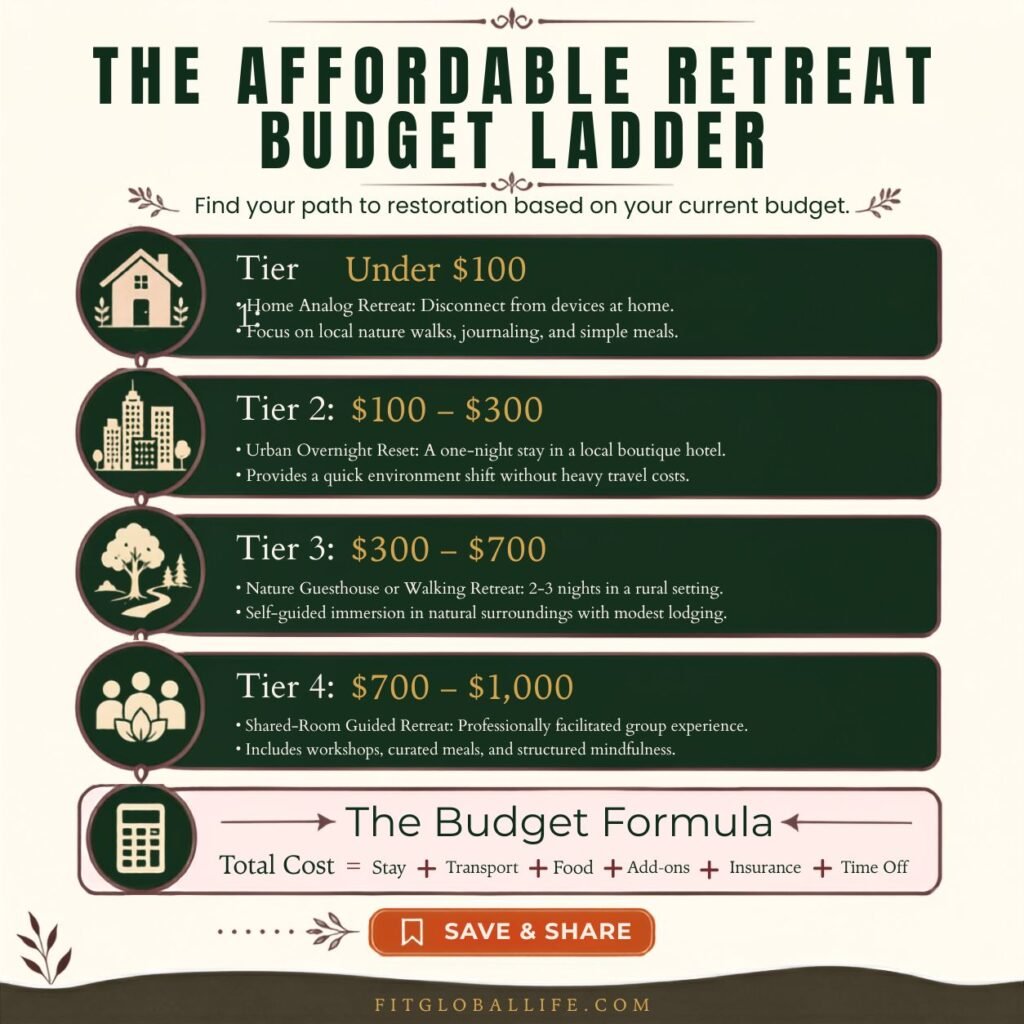
Use the four budget bands
- Under USD 100: home retreat, local day retreat, community or donation event with no overnight travel.
- USD 100–300: one-night urban reset, nearby guesthouse, shared cabin, or low-cost contemplative stay.
- USD 300–700: two-to-four-night regional retreat with simple accommodation and limited transfers.
- USD 700–1,000: small-group program, shoulder-season coastal retreat, or longer stay with most meals included.
Long-haul airfare is excluded from these bands. Once a retreat requires an intercontinental flight, “affordable” depends far more on where you live than on the program price. The smartest first search radius is usually three hours from home by ground transport or one short direct flight.
The affordable-retreat value equation
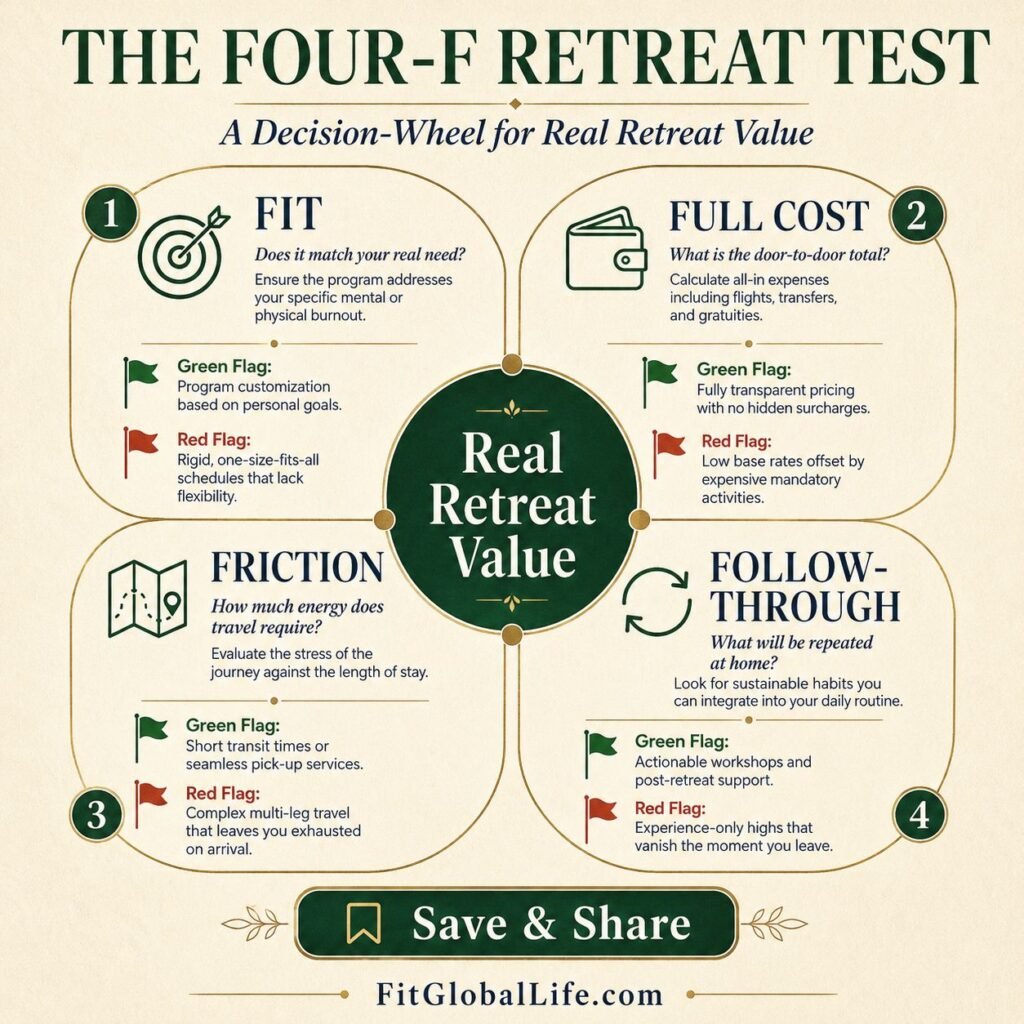
Price alone is not enough. Evaluate four variables: recovery fit, protected hours, travel friction, and repeatability. A retreat has strong value when it matches your need, gives you enough uninterrupted time, does not exhaust you to reach it, and could realistically be repeated. This is an editorial planning tool, not a medical score, but it prevents a common mistake: choosing the most impressive option instead of the most useful one.
| Factor | Ask this | Affordable green flag | Costly red flag |
| Fit | Does it match my actual recovery need? | Specific outcome; realistic schedule | Vague transformation claims |
| Full cost | What is the door-to-door total? | Taxes, meals, transport and add-ons disclosed | Low headline price; mandatory extras hidden |
| Friction | How much energy is required to reach and use it? | Direct route; few decisions; recovery buffer | Multiple transfers; rushed arrival and return |
| Follow-through | What will I repeat within seven days? | One or two small habits | All-or-nothing lifestyle overhaul |
9 Affordable Wellness Retreat Ideas for the Rest of 2026
1. A 24-Hour Home-Based Analog Retreat
Estimated planning range: USD 20–90
The cheapest retreat idea is not “stay home and do nothing.” That usually collapses into errands, streaming, and checking work “for five minutes.” A home-based retreat needs a boundary strong enough to make familiar space behave differently. Choose a 24-hour window, tell the people who need to know, prepare simple food, remove work devices, and decide what is allowed before the retreat begins.
The most useful version borrows from self-care rituals from different cultures without turning your living room into a wellness theme park. Use a small sequence: a phone-free breakfast, an unhurried walk, twenty minutes of breath or meditation, one nourishing meal, a nap or quiet reading block, and an early night. A simple refillable travel journal can hold your retreat intention and re-entry plan, but a notebook you already own works perfectly. No need to buy enlightenment with two-day shipping.
This option is best for parents, caregivers, creators, remote workers, and anyone whose main barrier is time rather than location. The hidden cost is interruption. If your home is noisy, crowded, unsafe, or emotionally demanding, a home retreat may not provide enough separation. In that case, use the same structure in a library, botanical garden, quiet day room, or one-night guesthouse.
A practical schedule is 6:00 p.m. to 6:00 p.m. Finish work, eat a simple dinner, place the phone outside the bedroom, sleep, take a morning walk, eat without screens, spend midday reading or resting, and close with a two-sentence plan for the week. Do not use the retreat to reorganize the entire house. Decluttering one drawer is fine. Becoming the unpaid operations director of your own recovery is not.
2. A One-Night Urban Recovery Staycation
Estimated planning range: USD 90–280
Urban recovery is one of the clearest 2026 trends because it reduces travel friction. A hotel or guesthouse near public transport can create distance from routine without an airport. FitGlobalLife’s guide to weekend reset retreats near Jakarta shows how this can work in and around a large city, while the earlier collection of urban wellness escapes expands the idea globally.
The budget version is not a luxury spa weekend. Book one night, preferably Sunday to Monday or another low-demand date, and choose a property based on sleep, walkability, and quiet—not lobby glamour. Bring your own simple breakfast or choose a rate with breakfast included. Replace a full spa package with one service you genuinely value, such as a massage, sauna session, or yoga class. The rest of the time is unscheduled.
This option works well for people who need physical separation but cannot manage a long trip. It is also useful as a couple or friendship retreat if expectations are explicit. Agree on phone rules, spending limits, and whether conversation or silence is the goal. “We will just see how it goes” is romantic until one person wants deep conversation and the other wants eight hours of horizontal silence.
Hidden costs include parking, room-service premiums, late checkout, and hotel taxes. A cheaper property two blocks from a park can be better than a wellness-branded property that requires expensive meals on site. Search the total price, not the nightly rate, and check whether noise, construction, weddings, or nightlife could undermine the point of the stay.
3. A Donation-Based Meditation or Monastery Retreat
Estimated planning range: USD 50–300, plus transport
Donation-based contemplative retreats can offer remarkable value because accommodation, meals, and teaching may be supported by voluntary contributions or sliding-scale fees. FitGlobalLife’s guide to established silent meditation retreat centers includes traditions where participants contribute according to their means. Before choosing one, compare the five major silent retreat styles and who they suit; “silent” can mean anything from a gentle guided weekend to ten hours of meditation per day.
Research is promising but should not be oversold. A systematic review of traditional meditation retreats found moderate-to-large improvements across several psychological outcomes, while the U.S. National Center for Complementary and Integrative Health emphasizes that evidence varies and that meditation is not a substitute for conventional care. That balance matters. A low fee does not make an intensive retreat low risk.
Ask about the daily schedule, sleep, posture, meals, teacher access, language, medical support, and rules for leaving. Donation-based does not mean free labor, and it does not mean you should give beyond your means. Budget a fair contribution, transport, basic supplies, and an emergency reserve. If the center requires a specific uniform, cushion, or book, verify whether it can be borrowed.
This format is best for people seeking structure, reflection, spiritual practice, or a serious digital break. It is a poor choice for someone in acute distress who mainly needs sleep, clinical support, or social reassurance. The affordable choice is the option that matches your current capacity, not the option with the fewest zeros on the payment page.
4. An Off-Season Nature Guesthouse Reset
Estimated planning range: USD 180–550 for two or three nights
A rural guesthouse, eco-lodge, cabin, or homestay can become a retreat without selling a retreat package. Choose one natural feature—forest, lake, mountain, farmland, or quiet coast—and build the schedule around sleep, daylight, walking, and simple meals. This differs from FitGlobalLife’s full guide to nature retreats matched to different nervous-system needs: here, the emphasis is on creating the lowest-friction version near you.
The scientific case for nature is broader than a single wellness claim. A review of nature exposure and health found evidence linking natural environments with cognitive, cardiovascular, mental-health, physical-activity, and sleep outcomes. That does not mean a cabin cures burnout. It means nature can support behaviors that recovery already depends on—movement, quiet, daylight, sensory variation, and less screen time.
Book shoulder nights rather than peak weekends. Look for a kitchenette or included meals so you can control food costs. Pack layers, basic medication, and a travel sleep mask and earplug set if unfamiliar light or sound affects your sleep. The largest hidden expense is usually transport. A beautiful remote property requiring a private driver may cost more than a modest guesthouse near a bus or train station.
This retreat is best for overstimulation, shallow sleep, creative fatigue, and people who recover through gentle solitude. Avoid making the itinerary “productive.” One main walk, one rest block, one analog activity, and one early evening are enough. Nature does not need a content calendar.
5. A Walking Retreat in a Small, Walkable Town
Estimated planning range: USD 250–650 for three nights
A walking retreat is one of the most underrated affordable wellness retreat ideas because the primary activity is free. Choose a safe, compact town with sidewalks, parks, waterfront paths, public transport, and inexpensive local food. FitGlobalLife’s guide to walkable cities for a healthier travel reset can help you identify the features that matter more than a famous wellness address.
The World Health Organization’s physical-activity guidance notes that walking and cycling are accessible ways to be active and that both moderate and vigorous activity support health. A retreat does not need boot-camp intensity. Two or three unhurried walks, separated by meals and rest, can create a steady rhythm without the cost of classes or treatments.
Design the route around themes rather than attractions: morning light, green space, local market, water, quiet architecture, or a long lunch. Keep the daily radius small. The purpose is not to collect landmarks; it is to reduce transport decisions and let movement organize the day. A town with five excellent places within fifteen minutes is more retreat-friendly than a city with fifty places spread across two hours of traffic.
Hidden costs include attraction tickets, café hopping, and “just one more” taxi when the itinerary is too ambitious. Set a daily discretionary limit and schedule one no-spend block. This format works especially well for travelers who dislike formal wellness programming, solo travelers who feel safer around ordinary city life, and people who think better while moving.
6. A Shared Digital-Detox Cabin or Guesthouse
Estimated planning range: USD 220–700 for two people
A digital-detox retreat can be expensive when the property charges a premium for the revolutionary service of not providing Wi-Fi. The budget alternative is to rent a simple cabin or guesthouse with one trusted friend and create your own protocol. FitGlobalLife’s guide to true digital-free retreat environments explains what serious unplugging looks like, while this practical digital-detox protocol provides rules you can test before leaving home.
Agree on the system in writing: devices off except for a scheduled emergency check, no work, no social posting, paper directions or downloaded maps, and a shared emergency contact. Build the day around analog activities—cooking, walking, cards, reading, stretching, drawing, or sitting outside. Split accommodation and groceries, but do not split responsibility for safety. Each person should know the address, transport options, weather forecast, and emergency plan.
For friends, siblings, couples, or creative collaborators who want less stimulation and no formal teaching, this is the best option. The biggest risk is mismatch: one person may treat the weekend as silence, the other as a podcast marathon. On conversation, alcohol, music, meals, sleep and social media. Before you pay. Boundaries are cheaper than resentment.
The hidden costs are firewood, cleaning fees, vehicle rental, groceries bought without a plan, and remote-location surcharges. Choose a place close enough that you can leave if weather, safety, or interpersonal dynamics change. A remote cabin is not automatically healing; sometimes it is just a difficult checkout with trees.
7. A Farmstay or Community Work-Exchange Retreat
Estimated planning range: USD 120–500, excluding long-haul travel
Farmstays, community gardens, conservation projects, and carefully vetted work exchanges can combine simple accommodation, regular meals, outdoor movement, and social rhythm. They fit the principles of slower travel with fewer transfers and deeper local contact and can cost less than a conventional retreat. The trade-off is that this is not passive rest. The work, expectations, and living conditions must be clear.
Social connection is not a decorative benefit. The U.S. Surgeon General’s advisory on social connection describes connection as a major contributor to health and notes that social isolation is associated with higher mortality risk. A community-based retreat can be restorative for people whose stress comes partly from loneliness or screen-heavy work, but only when the environment is respectful and safe.
Ask for exact hours, tasks, room arrangements, meal details, days off, accessibility, insurance requirements, and how disputes are handled. Avoid programs that use “community” to blur labor boundaries or pressure guests into unpaid work beyond the agreement. Read recent independent reviews and verify the host through the platform or organization you use.
This format suits people who recover through purposeful activity, shared meals, soil, animals, and ordinary routines. It may not suit someone who is physically depleted, needs privacy, or has allergies and mobility limitations. The affordable version is a short regional stay with clear duties—not a long international journey chosen only because the accommodation is technically free.
8. A Shoulder-Season Coastal Slow Retreat
Estimated planning range: USD 350–900 for four nights
Coastal retreats become expensive when you choose a famous beach in peak season. The affordable strategy is to travel during a shoulder month, choose a low-crowd area, stay several nights in one place, and make the coast the activity. FitGlobalLife’s guide to low-crowd islands for slow travel in 2026 offers useful criteria: fewer transfers, local transport, realistic infrastructure, and respect for environmental limits.
Build the retreat around dawn or late-afternoon walks, swimming only where conditions are safe, long meals, reading, and early sleep. Avoid the itinerary inflation that turns every boat, beach, and viewpoint into a paid mission. One base and one main outing are enough. The ocean is already doing a lot of production value.
For international travel, review exclusions and eligibility before buying any policy. A provider such as SafetyWing Nomad Insurance may be relevant for some travelers, but coverage, pricing, age bands, destination rules, sports, pre-existing conditions, and U.S. coverage can change. Read the current policy wording rather than relying on a blog summary or a checkout-page headline.
Hidden costs include ferries, airport transfers, marine activities, imported food, weather disruption, and limited cash access. The best value often comes from a mainland coastal town or an island with direct public transport—not the most remote location. Remote beauty is wonderful. Three separate speedboats are not a nervous-system reset.
9. A Small-Group Local Retreat With a Shared Room
Estimated planning range: USD 400–950 for two to four nights
A formal retreat can still fit a moderate budget when it is local, scheduled off peak, and priced with shared accommodation. The advantage is structure: teaching, meals, activities, and community are bundled. The risk is paying for a packed schedule that recreates the pressure you are trying to leave. FitGlobalLife’s article on retreat lessons that genuinely transfer into self-care is a useful reminder that more programming does not automatically create more change.
Choose a retreat with named facilitators, transparent credentials, a complete schedule, a clear cancellation policy, and realistic claims. Ask what is optional. A restorative program should permit rest without making guests feel they failed the syllabus. If the retreat includes breathwork, review simple practices such as these gentle breath techniques for nervous-system regulation first, especially if you have respiratory, cardiovascular, pregnancy, panic, or trauma-related concerns.
This format works for beginners who want guidance and for solo travelers who value community. Shared rooms lower the fee but increase the importance of sleep arrangements, bathroom access, temperature, snoring, gender policies, and quiet hours. Recent U.S. data found that 30.5% of adults reported less than seven hours of sleep in 2024; paying for a wellness retreat that guarantees poor sleep is a deeply on-brand modern mistake.
The hidden costs are mandatory add-ons, airport transfers, single-supplement pressure, special equipment, and nonrefundable deposits. Request the final price in writing. If the organizer avoids direct answers about teachers, refunds, safety, or the schedule, the affordable decision is not to book.
Affordable Wellness Retreat Ideas Compared
The table below is a planning tool, not a live price list. Ranges assume regional travel, simple accommodation, and no long-haul airfare. Prices can vary significantly by country, season, exchange rate, occupancy, and personal needs.
| Idea | Typical duration | Planning range* | Best for | Main cost lever | Watch for |
| Home analog retreat | 24 hours | USD 20–90 | Time-poor readers; caregivers | No accommodation or long transport | Interruptions and household labor |
| Urban recovery staycation | 1 night | USD 90–280 | Need for separation with low friction | Off-peak night; public transport | Taxes, parking, spa upsells |
| Donation-based retreat | 2–10 days | USD 50–300 + transport | Structure, meditation, spiritual practice | Donation or sliding scale | Intensity, suitability, travel cost |
| Nature guesthouse | 2–3 nights | USD 180–550 | Sleep, quiet, sensory reset | Shoulder dates; kitchenette | Private transfers and remote fees |
| Walkable-town retreat | 3 nights | USD 250–650 | Gentle movement; solo travelers | Free walking; compact itinerary | Tickets, cafés, taxis |
| Shared detox cabin | 2–3 nights | USD 220–700 for two | Friends, couples, creators | Split lodging and groceries | Cleaning, vehicle, mismatch |
| Farmstay / work exchange | 3–7 nights | USD 120–500 | Purpose, community, outdoor rhythm | Meals/lodging partly included | Labor terms and living standards |
| Coastal slow retreat | 4 nights | USD 350–900 | Longer decompression; nature | Shoulder season; one base | Ferries, weather, activities |
| Shared-room group retreat | 2–4 nights | USD 400–950 | Beginners wanting guidance | Local program; shared room | Add-ons, deposits, poor sleep |
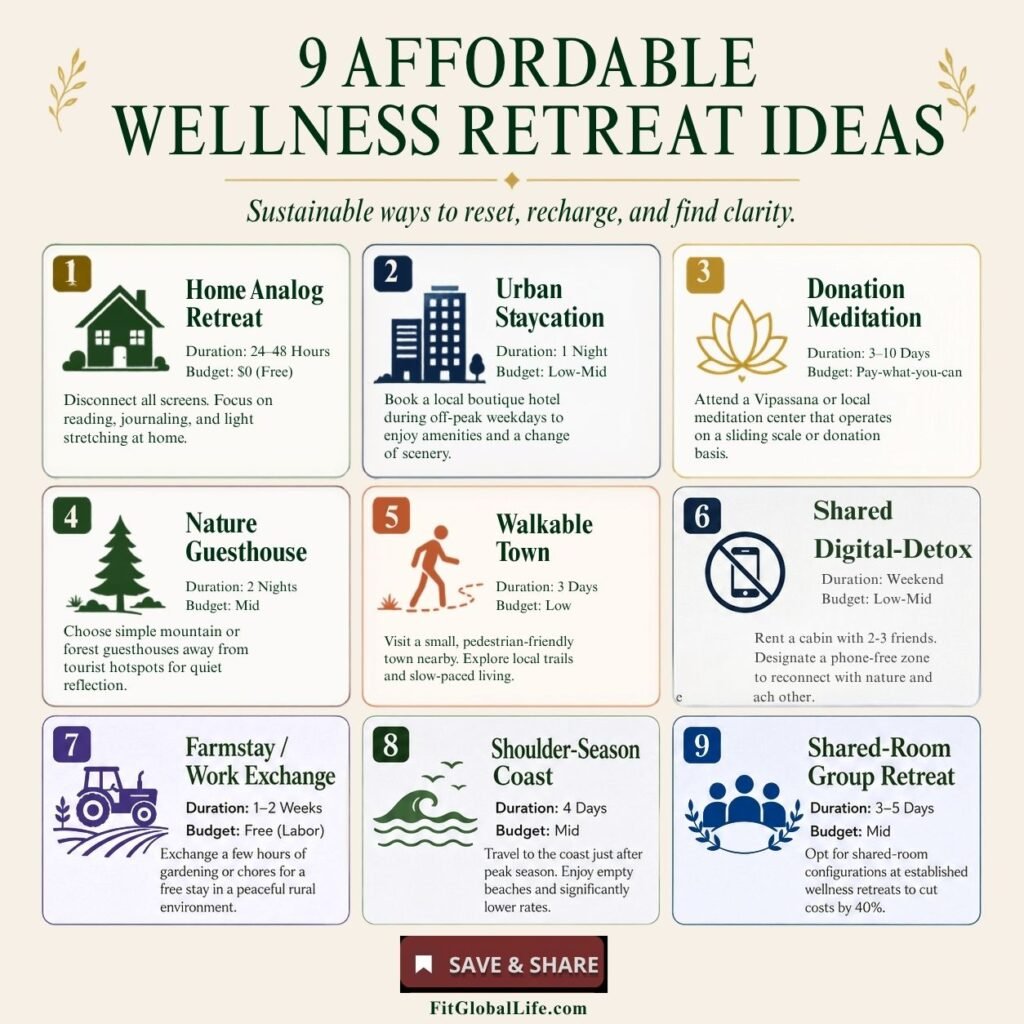
*Planning ranges exclude long-haul airfare and are not live quotes.
The Four-F Test Before You Book
A retreat is not affordable simply because you can pay for it. It should also make sense for your body, schedule, household, and return to normal life. Use the Four-F Test before sending a deposit.
1. Fit: What problem are you actually solving?
Name the need in one sentence: “I need uninterrupted sleep,” “I need distance from work,” “I need structured meditation instruction,” “I need gentle movement,” or “I need safe social connection.” Then reject options that solve a different problem. A fitness camp is not a sleep retreat. A silent monastery is not automatically the right place for loneliness. A luxury spa is not necessarily rest if financial anxiety follows you into the treatment room.
2. Full cost: What will the trip cost door to door?
Add every category before booking. Use realistic transport, not the lowest fare you may never find. Include taxes, baggage, transfers, food, equipment, tips, data, insurance, and one contingency line. If the retreat is international, budget for exchange-rate movement. If you cannot fund a small emergency reserve, the trip may be affordable on paper but fragile in practice.
3. Friction: How much energy does it take to get there?
Count transfers, travel hours, early departures, border steps, language barriers, mobility demands, and decision load. A three-night retreat with twenty hours of transit may offer fewer usable recovery hours than one quiet night near home. Friction is not always bad—some people enjoy the journey—but it must be chosen rather than hidden.
4. Follow-through: What can you repeat at home?
The retreat should produce one or two sustainable behaviors, not a new identity. FitGlobalLife’s guide to recovery rituals that work better than motivation makes this practical: choose cues and actions you can maintain when energy is low. A ten-minute walk after lunch may matter more than a perfect sunrise routine you perform twice.
A Three-Day Budget Retreat Blueprint
This structure works for an urban stay, nature guesthouse, walking town, cabin, coastal base, or small-group program. Adjust for safety, mobility, culture, weather, and medical needs.
| Time | Action | Budget logic | Recovery purpose |
| Before departure | Set phone rules, out-of-office, food plan, route and emergency contacts | Prevents last-minute purchases and taxis | Reduces anticipatory stress |
| Day 1 afternoon | Arrive early; orientation walk; simple meal | Avoids paid activities on arrival | Lets the body land |
| Day 1 evening | Dim lights; no major processing; early bed | Uses accommodation rather than add-ons | Prioritizes sleep |
| Day 2 morning | Daylight, gentle movement, nourishing breakfast | Free or included activities | Supports rhythm and energy |
| Day 2 midday | One main practice: walk, meditation, class or nature immersion | Choose one paid activity at most | Creates sustained focus |
| Day 2 afternoon | Rest, read, journal or nap | No-spend recovery block | Prevents overscheduling |
| Day 2 evening | Simple dinner; offline night | Avoids nightlife and impulse spending | Deepens downshift |
| Day 3 morning | Repeat the best practice; write integration plan | Converts value into a repeatable habit | Supports follow-through |
| Return | Keep a two-hour buffer; unpack and eat before opening work | Reduces re-entry spending and stress | Protects the benefit |
The schedule intentionally looks simple. That is the feature. Many people arrive at a retreat already exhausted and immediately ask the new environment to host a personal transformation summit. Let the first evening be boring. Boredom is often where the nervous system realizes nobody is chasing it.
What to Pack Without Buying a New Personality
A budget retreat becomes less affordable when the packing list turns into a lifestyle rebrand. Use what you own. The essentials are identification, medication, weather-appropriate clothing, comfortable shoes, water, a basic first-aid kit, chargers for emergency use, and any accessibility items you rely on.
For movement-based stays, a foldable travel yoga mat can be useful when the venue does not provide clean equipment, but a towel or bare floor may be enough for gentle stretching. Check the program first. Buying gear “just in case” is how a USD 90 home retreat wakes up wearing a USD 240 outfit.
- Bring one book, not five aspirational books that make rest feel like homework.
- Pack simple snacks if food access is uncertain, while respecting customs and accommodation rules.
- Download maps, tickets, policy documents, and emergency contacts before switching off data.
- Carry essential medication in original packaging and enough for delays.
- Leave expensive jewelry, unnecessary electronics, and productivity guilt at home.
How to Keep the Benefits After You Return
Re-entry determines whether a retreat becomes a memory or a useful intervention. FitGlobalLife’s explanation of why rest is biologically necessary helps frame this correctly: recovery is not a reward for finishing everything. It is part of maintaining attention, emotion, and physical health.
Protect the first two hours after returning. Do not schedule a difficult meeting, major family obligation, or full inbox cleanup if you can avoid it. Eat, shower, unpack essentials, and sleep. Then write three things: what helped, what did not, and what you will repeat within seven days.
For body-based integration, use gentle practices from this guide to everyday mind-body recovery rather than trying to recreate the full retreat. Choose one environmental change, one time boundary, and one social action. For example: phone outside the bedroom, a twenty-minute Sunday walk, and one meal with a friend.
Finally, review the spending. Compare your estimated budget with the final cost. Which expense supported the retreat? Which one added little? This turns every trip into better planning data. Affordable wellness is not about never spending. It is about learning, which costs produce real value for you.
Final Thoughts
The best affordable wellness retreat ideas are not the most photogenic or the most aggressively transformational. They are the ones you can reach without exhausting yourself, pay for without creating financial stress, and translate into ordinary life.
For one person, that may be a donation-based meditation retreat. For another, it may be a one-night hotel near a park, a quiet coastal guesthouse, a shared cabin, or a phone-free day at home. The location matters, but the architecture matters more: clear boundaries, low friction, enough sleep, simple movement, nourishing food, and a realistic return plan.
Start with the smallest format that could genuinely meet your need. If it works, repeat it or move one level up the budget ladder. Wellness does not become more legitimate when it becomes harder to afford. Sometimes the smartest retreat is the one that leaves both your nervous system and your bank account able to breathe.
Frequently Asked Questions
A structured home-based micro-retreat is usually the cheapest, often costing only food, local transport, or one modest activity. Donation-based community or meditation retreats can also be low cost, but transport, contribution expectations, and program intensity must be considered.
For regional travel without long-haul airfare, a useful planning range is USD 100–700. Home retreats may cost less than USD 100, while small-group programs with shared rooms may approach USD 1,000. Always calculate the final door-to-door cost rather than relying on the advertised program fee.
A program's cost is no indication of safety. Check for evidence of research support, independent reviews, emergency procedures, accessibility, standards of food and lodging, insurance requirements, refund policies and whether health claims are realistic. If you are pressured to discontinue medication or to ignore symptoms, walk away.
It can be long enough to interrupt routine, improve sleep opportunity, reduce digital input, and create a practical reset. It is not guaranteed to resolve burnout, anxiety, grief, or a medical condition. A short retreat works best when it has a narrow goal and a clear integration plan.
Shoulder season, midweek dates, Sunday nights, early-bird windows, shared-room options and programs within ground-transport distance often offer better value. Verify climate, closures, safety, and cancellation rules; the cheapest date is not useful if extreme weather or limited services make the trip stressful.
Disclaimer
This article is for general educational and travel-planning purposes only. It does not provide medical, psychiatric, psychological, nutritional, insurance, legal, financial, or individualized travel advice. Wellness retreats, meditation, breathwork, fasting, heat, cold, hiking, isolation, dietary changes, and intensive group programs may not be appropriate for everyone. Consult qualified professionals when you have relevant health conditions, take medication, are pregnant, have a history of trauma or psychiatric symptoms, or are uncertain whether a program is suitable.
Prices and availability are planning indications for 2026 and neither quotes nor guarantees. Please confirm current program fees, taxes, transport, visa rules, destination advisories, cancellation policies, insurance terms, exclusions and accessibility directly with the provider before booking.
Affiliate disclosure: This post contains affiliate links. FitGlobalLife may receive a commission on qualifying purchases or sign-ups at no additional cost to you. Recommendations and examples should be checked against your needs, eligibility, destination, policy wording and local laws. As an Amazon Associate, FitGlobalLife earns from qualifying purchases once its approved tracking links are correctly installed.