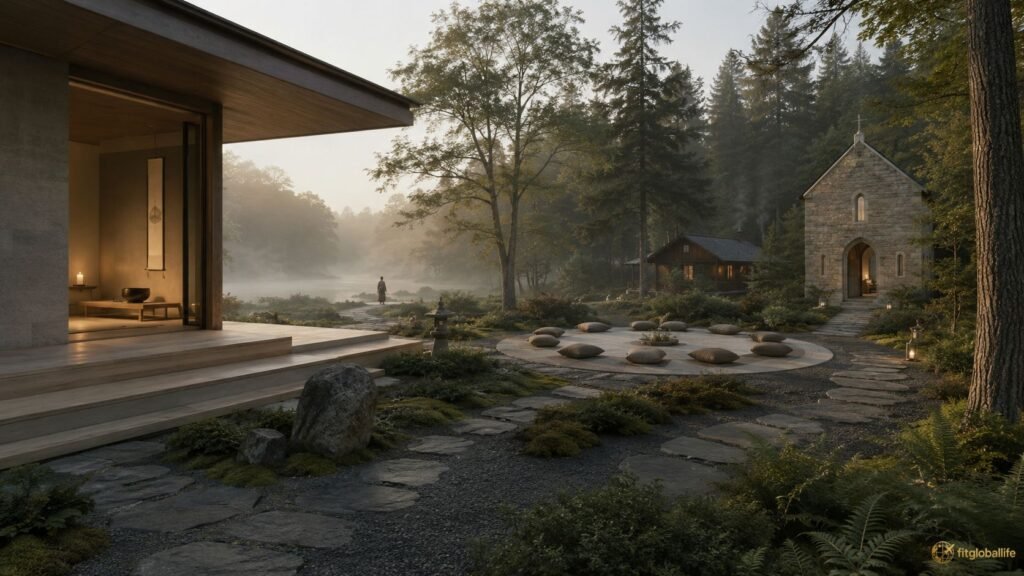
Silent retreat styles can appear almost identical in a photograph: a meditation hall, simple meals, muted clothing, and perhaps a misty path through the trees. In practice, they can feel like five completely different worlds. One may ask you to meditate for roughly ten hours a day and avoid reading, writing, gestures, and eye contact. Another may include gentle movement, teacher check-ins, journaling, and a few hours of silence. A third may be built around prayer rather than meditation at all.
That distinction matters because silence is not the intervention by itself. The real experience is created by the combination of schedule, method, worldview, social rules, physical demands, teacher access, and the reason you came. Choosing by scenery or reputation alone is how a restorative idea becomes an expensive endurance test.
Interest in contemplative practice is no longer niche. U.S. public-health data reported that adult meditation use rose from 4.1% in 2012 to 14.2% in 2017, according to the National Center for Health Statistics. A later analysis of 2022 survey data estimated that about one in five U.S. adults—roughly 60.5 million people—used meditation. Those numbers are U.S.-specific, not a global headcount, but they help explain why retreat options now range from rigorous monastic forms to design-led digital-detox escapes.
This guide does not rank destinations. FitGlobalLife already has a separate guide to places built around intensive silent practice. Here, the question is more personal and more useful: Which retreat container is likely to support the way you learn, regulate stress, relate to belief, and handle structure?
A necessary reality check: meditation and silence can be helpful, but they are not automatically gentle. The U.S. National Center for Complementary and Integrative Health notes that evidence varies by condition and that safety research is still limited. Its practical advice is refreshingly unglamorous: do not use meditation to replace conventional care, and ask about an instructor’s training and experience. That is the standard this article uses—curious, hopeful, and not allergic to caution.
Why Silent Retreat Styles Are Not Interchangeable
A retreat is often marketed by duration and location: three days in the mountains, seven days by the sea, ten days in a rural center. Duration matters, but it is a weak predictor of how demanding the experience will feel. A carefully supported five-day secular retreat may be easier for a first-timer than a rigid two-day program with long sits, limited sleep, and little access to the teacher.
Before comparing styles, evaluate five hidden variables:
- Silence rigidity: Does “silence” mean no conversation, or no reading, writing, phones, gestures, music, and eye contact?
- Practice density: How many hours are scheduled for sitting, walking, prayer, movement, work, or instruction?
- Interpretive frame: Is the retreat Buddhist, Christian, interfaith, secular, therapeutic, or intentionally undefined?
- Guidance density: Can you speak with a teacher privately? Is there mental-health screening, an opt-out process, or on-site medical support?
- Body load: How much sitting, kneeling, early rising, fasting, hiking, heat, cold, or sleep restriction is involved?
Those variables are more predictive than the word “silent.” They also explain why a good general booking checklist—such as these questions to ask before choosing a wellness retreat—should be expanded when silence and intensive practice are involved.
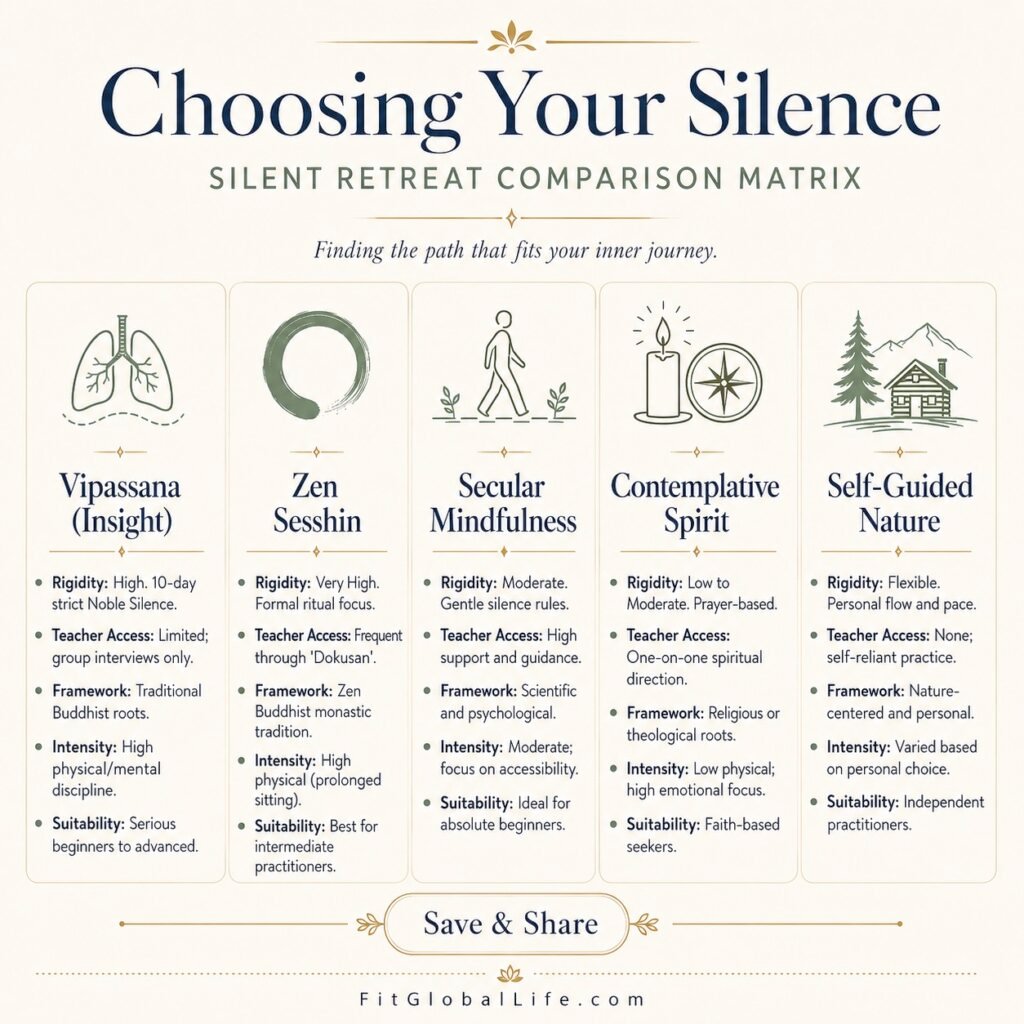
Silent Retreat Styles at a Glance
| Style | Typical structure | Best suited to | Main caution |
| Vipassana / insight | Usually highly structured; long daily meditation; noble silence; limited reading and writing | People seeking intensive insight practice who can follow a strict container | High cognitive and physical intensity; not a casual detox |
| Zen sesshin | Formal sitting and walking meditation, silent meals, work practice, ritual, teacher interviews | People who respond well to rhythm, precision, embodiment, and tradition | Formality and posture demands can be challenging |
| Secular mindfulness | Guided sitting, body scan, walking, mindful movement, teaching, check-ins | Beginners, professionals, and people who prefer evidence-informed language | Quality varies; “secular” does not mean clinically supervised |
| Contemplative spiritual | Prayer, scripture or sacred reading, reflection, spiritual direction, silence | People seeking discernment, faith renewal, grief support, or vocation clarity | Poor fit when the tradition conflicts with personal beliefs |
| Self-guided nature silence | Flexible schedule, digital disconnection, walking, rest, journaling or meditation | Experienced self-directors, creatives, and overstimulated travelers | Little support if anxiety, dissociation, or distress intensifies |
The useful question is not “Which style is strongest?” It is “Which degree and type of pressure is productive for me right now?” A retreat can be profound without being maximal. In fact, choosing the most intense option to demonstrate commitment is often a sign that the decision is driven by performance rather than wisdom.
1. Vipassana or Insight Retreat: The High-Structure Deep Dive
What the experience is usually like
Vipassana is often the first format people picture when they hear “silent retreat.” Yet even within insight traditions, schedules and teachings differ. The widely known S. N. Goenka format is especially clear and demanding: a ten-day residential course, strict boundaries, a prescribed technique, and “noble silence.” The official Vipassana code of discipline explains that participants commit to remaining for the full course and that the ten-day program spans twelve calendar days, including arrival and departure.
The same tradition describes a day beginning at 4:00 a.m. and continuing until 9:00 p.m., with about ten hours of meditation broken by meals and rest. Communication with other students is prohibited, but participants can speak with teachers about practice and with management about practical or health concerns. Reading, writing, outside contact, and mixing techniques are restricted. In other words: this is a training environment, not a quiet hotel with optional meditation.
The practice typically moves from attention on breathing toward close observation of bodily sensations and reactivity. For someone already curious about internal signals, FitGlobalLife’s explanation of how interoception shapes stress awareness can provide useful context before attending—without pretending that an article can teach a retreat method.
Who it suits — and who should pause
Vipassana may suit people who are comfortable with repetition, can accept a method without constantly customizing it, and want a direct encounter with habit, sensation, discomfort, craving, and aversion. It can also suit travelers who prefer a non-luxury environment and who do not need entertainment, networking, or a packed menu of wellness treatments.
It is a weaker fit for someone mainly seeking sleep, light stress relief, social connection, or a soft introduction to meditation. It can also be a poor first experiment for a person in acute grief, severe burnout, active psychiatric instability, or a period of frequent panic or dissociation. The official Goenka code itself warns that significant mental-health symptoms may resurface and states that Vipassana is not a substitute for medical or psychiatric treatment.
A common misconception is that intensity guarantees transformation. It does not. Intensity increases exposure. Whether that exposure becomes useful depends on preparation, guidance, timing, physical capacity, and the ability to integrate what arises after the retreat.
2. Zen Sesshin: Silence Through Form, Rhythm, and Discipline
What the experience is usually like
A Zen sesshin is not simply a Vipassana retreat with different vocabulary. The texture is often more visibly formal and embodied. Days may include zazen (seated meditation), kinhin (walking meditation), silent or ritualized meals, work practice, Dharma talks, chanting in some programs, and private interviews with a teacher. The San Francisco Zen Center’s description of sesshin frames it as three-, five-, or seven-day periods of meditating, eating, and working in silence, with the whole day treated as practice.
That “whole day” idea is the key. The retreat is not divided neatly into meditation time and normal time. How you enter a hall, hold a bowl, stand in line, walk, clean, and respond to a bell may all be part of the form. For people whose minds scatter in open-ended environments, this can be unexpectedly freeing: fewer decisions, fewer negotiations, fewer opportunities to invent a more comfortable plan.
Zen forms vary by lineage and center. Some are strict about posture, robes, chanting, meal etiquette, and attendance. Others offer chairs, mobility alternatives, introductory instruction, and lighter schedules. Never assume the label tells you the accessibility level. Read the actual timetable and ask what happens when your body cannot maintain the standard posture.
Who it suits — and who should pause
Sesshin may suit people who learn through rhythm and physical form, appreciate tradition, and want to experience discipline without making the retreat about personal optimization. It can be a particularly good fit for someone who is tired of narrating every feeling and wants a practice that repeatedly returns attention to posture, breath, action, and relationship to the group container.
It may not suit people who dislike ritual, require a highly individualized schedule, or experience pain that worsens during prolonged sitting. It can also frustrate participants who expect continuous explanations. Zen instruction is often concise; the form itself is part of the teaching. If that feels like unnecessary opacity rather than a meaningful container, a secular mindfulness retreat may be a better starting point.
3. Secular Mindfulness Retreat: Guided Silence Without a Religious Frame
What the experience is usually like
Secular mindfulness retreats are usually the easiest bridge between app-based practice and traditional retreat life. They may include sitting meditation, body scans, mindful walking, gentle yoga or stretching, teacher talks, question periods, and scheduled silence. Some are connected to Mindfulness-Based Stress Reduction (MBSR) or professional teacher-training pathways; others simply use mindfulness language without a standardized curriculum.
The University of Massachusetts Center for Mindfulness traces MBSR to Jon Kabat-Zinn’s work beginning in 1979 and describes its approach as evidence-informed and instructor-led. A related clinical overview notes that standard MBSR programs include weekly classes and a silent retreat day, with practices such as sitting, walking, body scans, and mindful yoga. A residential retreat may extend that daylong experience across several days, but programs vary widely.
This style often makes room for practical translation: how to respond to stress, relate differently to thoughts, notice body signals, and bring attention back into work and relationships. Readers who struggle with constant switching may benefit from reviewing simple ways to stay present during busy workdays or understanding how attention debt accumulates before expecting a retreat to solve an overloaded calendar.
Who it suits — and who should pause
A well-run secular retreat can suit beginners, healthcare or education professionals, skeptical meditators, and people who want clear explanations without adopting a religious identity. It may also suit participants who need more movement and teacher contact than a strict insight retreat provides.
The caution is the word “secular.” It describes the presentation, not automatically the safety standard. A luxury resort can use neuroscience vocabulary and still provide weak screening, inexperienced facilitators, or no plan for distress. Ask whether the lead teacher has recognized training, how many retreats they have led, whether assistants are available, and what happens when a participant experiences panic, insomnia, trauma memories, or dissociation.
For some people, the most therapeutic element is not silence but the removal of digital interruptions. In that case, start with a home-based digital detox protocol for reducing screen anxiety before paying for an intensive program. If two phone-free evenings feel impossible, ten silent days are probably not the next logical step. No shame; that is useful data.
4. Contemplative Spiritual Retreat: Silence for Prayer and Discernment
What the experience is usually like
Not every silent retreat is primarily about meditation. Contemplative spiritual retreats use silence to deepen prayer, sacred reading, discernment, confession, gratitude, grief work, or a sense of relationship with the divine. The container may be Christian, Buddhist, Jewish, Hindu, Sufi, interfaith, or rooted in another living tradition. The methods and theology are not interchangeable, so the retreat’s stated worldview deserves the same attention as its accommodation and schedule.
Ignatian retreats provide a clear example. Jesuit guidance on Ignatian retreats describes formats ranging from three- or four-day weekends to eight-day retreats and a thirty-day “long retreat,” typically supported by trained spiritual directors. A retreat in daily life can also extend over a month while the participant continues ordinary responsibilities. Silence here is not emptiness for its own sake; it creates space for prayer, reflection, and discernment.
This style may include daily one-to-one spiritual direction, scripture contemplation, liturgy, journaling, or periods of walking and rest. Compared with a meditation-intensive retreat, the daily schedule may contain fewer continuous hours of seated practice and more explicit meaning-making. That can be supportive for people who need a coherent spiritual frame, especially during transition, grief, vocational questions, or ethical decision-making.
Who it suits — and who should pause
A contemplative spiritual retreat suits people who want silence to deepen an existing faith, explore belief honestly, or make a decision in conversation with a trusted tradition. It may also suit someone who finds purely clinical language emotionally thin and prefers symbols, scripture, ritual, or spiritual companionship.
It is a poor fit when the retreat’s beliefs conflict with your values, when participation in worship is mandatory but unwanted, or when the center uses spiritual explanations to dismiss medical or psychological concerns. A healthy spiritual container should allow questions, protect confidentiality, clarify the director’s role, and avoid claiming that every difficult experience is proof of spiritual progress.
This is where the broader lesson from retreat-based self-care that actually carries over at home matters: the value of a retreat is not measured by how dramatic it feels inside the container. It is measured by whether you return with more honesty, steadiness, compassion, and capacity for ordinary life.
5. Self-Guided Nature Silence: Flexible, Restorative, and Easy to Misjudge
What the experience is usually like
The self-guided nature retreat is the least formal style and therefore the easiest to underestimate. It may be a cabin without Wi-Fi, a quiet guesthouse, a national park stay, or a rural homestay where you set your own rhythm. Silence can mean no social media and minimal conversation rather than a total ban on reading, journaling, music, or contact.
A simple day might include an early walk, twenty to forty minutes of meditation, breakfast without a screen, a nap, unhurried reading, a second walk, journaling, and an evening without artificial stimulation. This is closer to intentional recovery than intensive contemplative training. For many overstimulated people, that is exactly the point.
The strongest versions of this retreat are not packed with self-improvement tasks. They use nature, repetition, sleep, daylight, gentle movement, and reduced information load to create space. FitGlobalLife’s guides to truly digital-free retreat destinations, nature retreats designed for a gentler nervous reset, and short micro-retreats with realistic mental-health benefits offer useful alternatives to the “go harder” mindset.
Who it suits — and who should pause
Self-guided silence can suit experienced meditators who do not need technique instruction, creatives who need cognitive space, couples or friends who agree on quiet boundaries, and people recovering from a season of relentless input. It can also work as a low-risk experiment before a formal retreat: one silent morning, then one day, then a weekend.
It is less suitable for someone who becomes unsafe when isolated, has unstable mental-health symptoms, or expects the environment to provide motivation and emotional containment. Without a teacher or group schedule, it is easy to replace digital stimulation with rumination. If your mind becomes more foggy rather than clearer, structured activity, social support, and sleep may be more helpful than additional silence. A nature stay designed around recovering from brain fog without chasing productivity may be a better model than solitary endurance.
Travel style matters too. A self-guided retreat works best when the journey itself is not frantic. The principles of slower, less rushed travel—fewer transfers, longer stays, and less itinerary compression—protect the very nervous-system space you are trying to create.
How to Choose the Right Silent Retreat Style
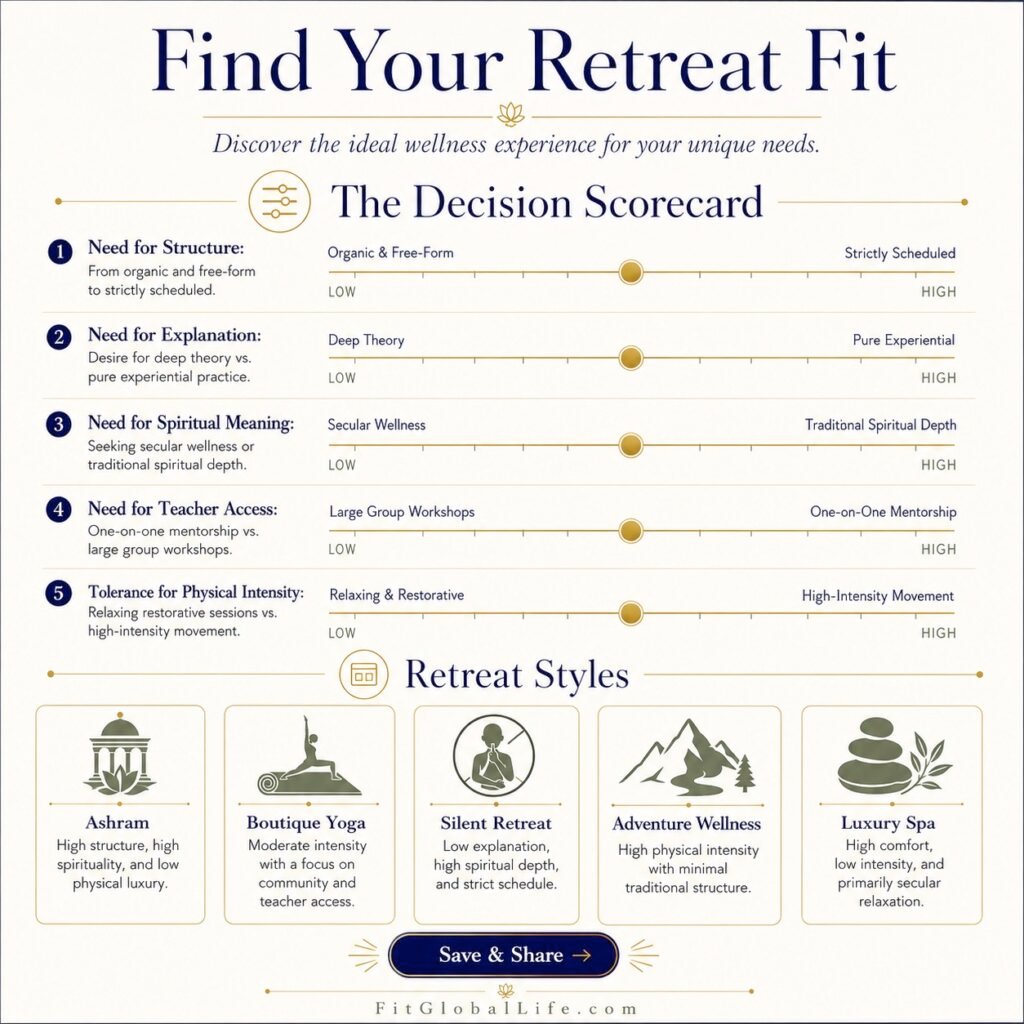
The wrong question is “Which retreat will change me the most?” That question invites fantasy, marketing, and self-punishment. A better selection process starts with five dimensions. Score each from one to five, where one means “I need very little” and five means “I need a great deal.”
| Dimension | Low score points toward | High score points toward |
| Need for structure | Self-guided nature silence | Vipassana or formal Zen sesshin |
| Need for explanation | Zen form or self-guided practice | Secular mindfulness with teaching and Q&A |
| Need for spiritual meaning | Secular mindfulness or nature retreat | Faith-based contemplative retreat |
| Need for teacher access | Independent nature retreat | Secular retreat, guided insight retreat, or spiritual direction |
| Tolerance for physical intensity | Gentle mindfulness or restorative nature stay | Long-sit Vipassana or rigorous sesshin |
Then ask what outcome you actually need:
- For deep technique training: choose an established Vipassana or insight program with clear screening and teacher access.
- For discipline through embodied form: consider a Zen sesshin, ideally after an introductory sitting day.
- For stress skills and accessible language: choose a secular mindfulness retreat led by qualified instructors.
- For prayer, grief, purpose, or discernment: choose a retreat aligned with your faith and supported by trained spiritual direction.
- For rest from noise and information overload: choose a gentle, self-guided nature retreat with a realistic schedule and a contact person.
Finally, choose for your current nervous system rather than your aspirational identity. Someone who has slept five hours a night for three months may not need a 4:00 a.m. bell. They may need three nights of uninterrupted sleep, morning light, nourishing food, a phone boundary, and a walk. The practical habits in a calmer-week nervous-system routine can help you distinguish a training goal from a recovery need.
What the Evidence Can—and Cannot—Tell You
Research supports cautious interest rather than miracle language. The NCCIH summarizes possible benefits for anxiety, depression, pain, blood pressure, and other concerns, while emphasizing that many studies are preliminary, heterogeneous, or difficult to interpret. “Meditation” is not a single standardized treatment, and a retreat adds sleep changes, diet, social isolation, teacher influence, travel, expectations, and group dynamics. That makes sweeping claims especially shaky.
A 2021 study comparing vacations and meditation retreats found that the meditation groups showed more sustained improvements in mindfulness, fatigue, and well-being at later follow-up than ordinary vacationers. The finding is encouraging, but it does not prove that every retreat is superior to every vacation. Participants, programs, expectations, and baseline experience differ. The useful takeaway is narrower: structured contemplative practice may influence how long recovery benefits last.
Adverse experiences deserve equal visibility. In a 2019 cross-sectional survey of 1,232 regular meditators, 25.6% reported a particularly unpleasant experience they believed may have been caused by meditation. The study could not establish causality or severity and relied on a broad self-report question, so it should not be used as a scare statistic. It does, however, challenge the assumption that meditation is uniformly soothing. Retreat experience and deconstructive practices, such as insight meditation, were associated with higher reporting rates, which strengthens the case for screening, skilled guidance, and honest informed consent.
A retreat should never pressure you to interpret panic, dissociation, insomnia, trauma memories, or loss of functioning as a badge of spiritual advancement. Difficulty can be part of practice; harm should not be romanticized. The difference is assessed through duration, intensity, functioning, safety, consent, and access to qualified support.
Safety Questions to Ask Before You Book
A beautiful website can tell you the menu and mattress type while saying nothing about the issues that matter most. Send the center a short, direct email and ask:
- Who is the lead teacher, what training do they have, and how many residential retreats have they led?
- Is there a health or mental-health screening process, and who reviews the information?
- How many hours of formal practice are scheduled each day, and what time do participants wake and sleep?
- Can chairs, benches, cushions, walking meditation, or rest periods replace floor sitting when needed?
- How can a participant contact a teacher privately during silence?
- What is the process for panic, dissociation, severe insomnia, medication issues, injury, or a desire to leave?
- Is phone access available for emergencies, and can family members reach the center?
- Are dietary needs, allergies, mobility limitations and chronic conditions considered?
- Are participants ever encouraged to stop medication, fast, or ignore medical advice?
- What integration or aftercare support is available after the retreat?
Treat evasive answers as information. “Trust the process” is not an emergency protocol. “Everyone can do it” is not accessibility. “We have never had a problem” may simply mean the center does not track or disclose problems.
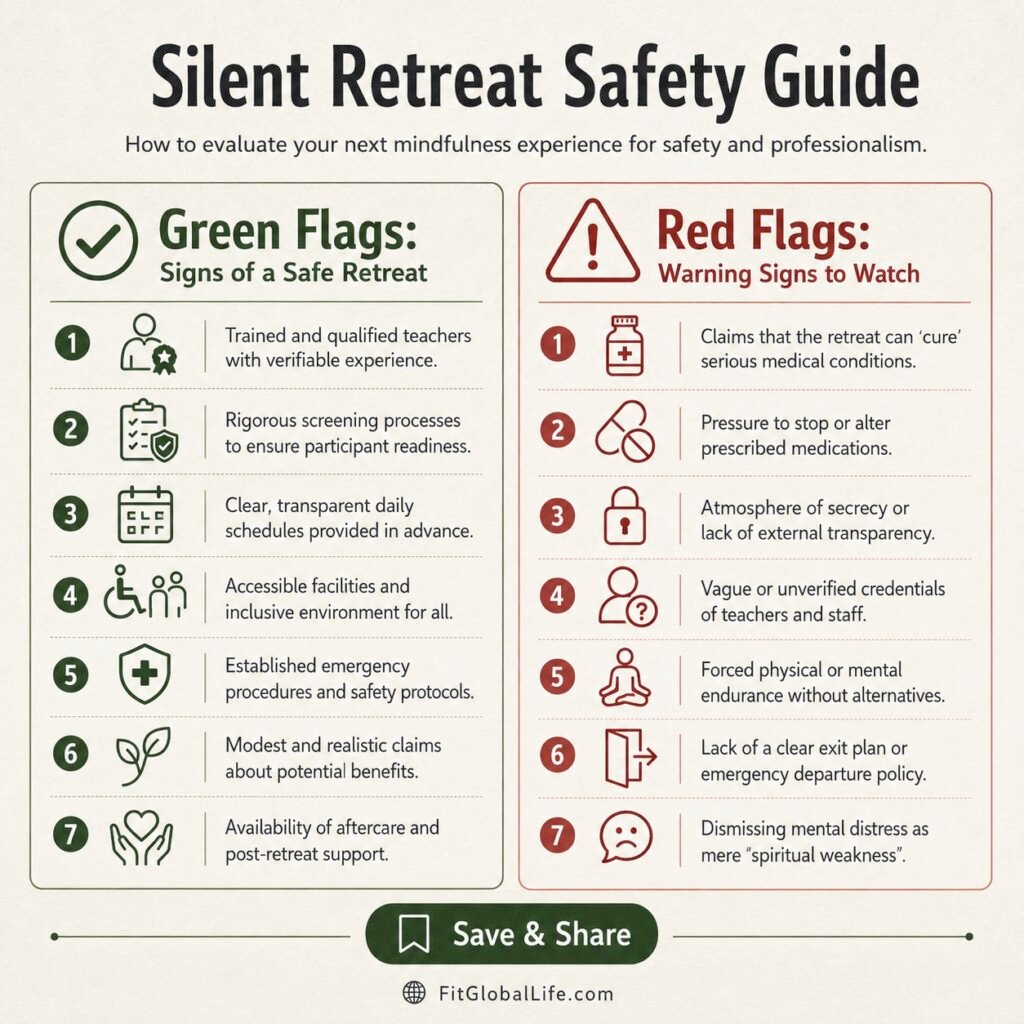
| Green flags | Red flags |
| Clear schedule, teacher biographies, screening, accessibility options, emergency contacts | Vague schedule, no named teachers, no screening, no way to leave or contact support |
| Benefits described modestly; risks and limitations acknowledged | Claims to cure trauma, depression, chronic illness, or addiction |
| Questions welcomed; consent and confidentiality explained | Doubt framed as weakness, resistance, ego, or lack of faith |
| Medication and healthcare decisions left to licensed clinicians | Pressure to stop medication, fast, or avoid conventional treatment |
| Transparent fees, refund policy, and affiliate relationships | High-pressure upsells, secrecy about costs, or status-based packages |
How to Prepare Without Turning Preparation Into Another Project
Preparation should reduce surprises, not create a second job. Four weeks is enough for most first-time retreatants to test the basics.
- Practice the posture you will actually use. Try 20 to 40 minutes on a chair, bench, or cushion, and notice any numbness, sharp pain, agitation, and recovery time.
- Test a low-stimulation day. Take six to twelve hours off social media, streaming, podcasts, news, and unwarranted messaging.
- Stabilize sleep before decreasing stimulation. Sleep deprivation can make emotional regulation and pain tolerance worse.
- Tell a trusted person where you will be, how the center handles emergencies, and when you expect to reconnect.
- Review medication, chronic-condition, dietary, mobility, and allergy needs with appropriate professionals and the retreat center.
- Arrange a buffer day after travel. These stress-reducing travel planning habits are more valuable than squeezing in one extra sightseeing stop.
- For international retreats, check entry rules, emergency contacts and healthcare access. A practical travel medical coverage option for people spending time abroad may be worth reviewing before departure.
Pack for function, not an imagined enlightened version of yourself: layered modest clothing, required medications, a refillable bottle, sun or rain protection, simple footwear, earplugs if allowed, a watch if phones are surrendered, and any approved posture support. Ask before bringing books, journals, religious items, fitness devices, supplements, or scented products; some centers prohibit them.
For general travel health, keep the basics boring and reliable: hydration, hand hygiene, safe food choices, adequate sleep, and a plan for existing conditions. FitGlobalLife’s guide to staying healthy while traveling is a useful companion to the retreat-specific questions above.
During the Retreat: Do Not Chase the Breakthrough
Retreat culture can create a subtle competition: longest sit, deepest insight, least sleep, most discomfort tolerated. That mindset turns silence into performance. A safer goal is accurate participation. Follow the method, notice what is happening, use available support, and distinguish ordinary discomfort from signs that require modification or help.
Ordinary discomfort can include boredom, restlessness, self-consciousness, mild frustration, or temporary muscle fatigue. Seek help for sharp or escalating pain, fainting, inability to sleep for multiple nights, panic that does not settle, disorientation, intrusive trauma memories, suicidal thinking, hallucination-like experiences, severe dissociation, or a meaningful decline in functioning. Do not wait for a scheduled interview if you feel unsafe.
Silence does not make every thought true. It often makes thoughts louder because external inputs are quieter. The practice is not to obey every insight but to observe, test, and integrate it. Major relationship, career, financial, or medical decisions usually benefit from time outside the retreat atmosphere.
Re-Entry: The Part Most Retreat Marketing Forgets
The nervous system does not move from a quiet retreat to airports, traffic, notifications, family needs, and work demands without friction. Protect the first twenty-four to forty-eight hours when possible. Keep the schedule light, delay unnecessary social media use, eat familiar foods, sleep, and avoid presenting your retreat experience as a final verdict on your life.
Use a simple 3-2-1 integration review:
- Three observations: What did you repeatedly notice about attention, body, emotion, or habit?
- Two practices: Which two actions are realistic enough to repeat at home for the next fourteen days?
- One conversation: Who is the grounded person with whom you can discuss the experience without turning it into either a miracle story or a failure story?
Choose practices that survive ordinary life. Ten minutes before breakfast may be more transformative than a heroic ninety-minute plan abandoned by Tuesday. The same principle appears in recovery rituals that work when motivation disappears: consistency is often built from reduced friction, not elevated inspiration.
If distress persists after the retreat—especially insomnia, panic, dissociation, intrusive memories, depression, or impaired functioning—contact an appropriate healthcare or mental-health professional. Returning to normal conversation, movement, meals, sleep, and social support can be part of integration, not evidence that you failed at silence.
Final Thoughts
The best silent retreat style is not the one with the strictest rules, the longest lineage, the most luxurious rooms, or the most dramatic testimonials. It is the one whose demands, teachings, support, and worldview match your current capacity and honest intention.
Choose Vipassana when you want rigorous insight training and can commit to the container. Choose Zen sesshin when form, rhythm, and embodied discipline help you settle. Go for secular mindfulness in the guided practice, and accessible language. Choose a contemplative spiritual retreat when silence is part of prayer or discernment. Choose self-guided nature silence when your primary need is spacious recovery rather than intensive technique.
And remember: silence is not an escape hatch from being human. At its best, it gives you enough room to meet ordinary life with less noise, less reflex, and a little more choice.
Frequently Asked Questions
A short, teacher-led secular mindfulness retreat or a gentle self-guided silent weekend is usually the most accessible starting point. Look for clear instruction, movement options, teacher check-ins, reasonable sleep, and permission to modify practice. A rigorous ten-day retreat can be appropriate for some beginners, but “open to beginners” does not mean “easy.”
There is no universal ideal. One day can reveal how you respond to silence; two or three days provide a more realistic taste of retreat rhythm; five to ten days create greater intensity and require more preparation. Choose duration after reviewing daily practice hours, sleep, mobility demands, and support—not duration alone.
Possibly, but the answer depends on current symptom stability, treatment, retreat intensity, teacher qualifications, and access to support. Speak with an appropriate healthcare professional and the retreat organizer. Do not treat a retreat as a replacement for therapy, medication, or medical care.
Some are explicitly Buddhist, Christian, or rooted in another faith; some are secular; others are interfaith or loosely spiritual. Read the curriculum and ask whether chanting, worship, scripture, ritual, ethical precepts, or doctrinal teaching is required. “Meditation retreat” and “silent retreat” do not guarantee a neutral worldview.
Most reputable programs allow necessary communication with teachers, managers, medical staff, or emergency contacts. The rules should explain how to request help. Silence is a practice agreement, not a reason to ignore pain, panic, safety concerns, medication issues, or urgent family situations.
Disclaimer
This article is for general educational and travel-planning purposes only. It does not provide medical, psychiatric, psychological, spiritual, or individualized travel advice. Meditation retreats can involve physical discomfort, emotional distress, sleep changes, isolation, dietary changes, and intensive contemplative practice. Consult qualified professionals when you have relevant health conditions, take medication, are pregnant, have a history of trauma or psychiatric symptoms, or are unsure whether a program is appropriate. Call your local emergency services immediately if you are in danger or may cause injury to yourself or another person.
Affiliate disclosure: This article contains affiliate links. FitGlobalLife may earn a commission if you make a purchase or sign up through an eligible link, at no extra cost to you. Recommendations should be judged based on your needs, policy terms, eligibility, destination and local regulations.