

Wellness advice has a scale problem. It often arrives as a total lifestyle renovation: wake before sunrise, cook every meal, train for an hour, meditate without thinking, drink an impressive green liquid, and somehow remain cheerful while doing it. Real life is less cooperative. That is where tiny wellness wins become useful. They are small, concrete actions that support health without demanding a perfect schedule, a new identity, or a dramatic burst of motivation.
A tiny win is not a promise that sixty seconds will transform your biology. It is a repeatable vote for the direction you want your life to move. Two minutes outside can become a reliable morning cue. Five minutes of walking can interrupt a long sitting block. One extra plant food can improve the structure of a meal. A short message can keep a relationship warm. None of these actions is a substitute for adequate sleep, regular physical activity, medical care, nutritious food, or structural changes when your life is genuinely overloaded. They are the smallest useful versions of those priorities.
This guide takes a deliberately practical approach. Each win has three layers: a floor that is easy enough to do on a difficult day, an anchor that tells you when to do it, and a receipt that lets you notice it happened. The goal is not to collect eight gold stars before breakfast. The goal is to build a few reliable signals that survive ordinary Mondays, travel days, deadlines, family responsibilities, and the occasional day when your brain has forty-seven tabs open, and none of them will stop playing audio.
What Tiny Wellness Wins Actually Mean
A tiny wellness win is a health-supporting action with a deliberately low entry cost. It should be specific, safe for your circumstances, and useful even when performed in its minimum form. “Take better care of myself” is an intention. “Step outside after I make my morning drink” is an action. “Exercise more” is a direction. “Walk for five minutes after the longest sitting block of my workday” is a repeatable instruction.
The word tiny describes the starting dose, not the total ambition. Public-health guidance still matters. Adults are generally encouraged to work toward at least 150 minutes of moderate-intensity activity each week and muscle-strengthening activity on two days, while the CDC’s adult activity guidance also makes an important point: some activity is better than none, and smaller chunks can contribute. The tiny win is the doorway into the larger pattern.
This distinction protects the idea from becoming wellness theater. A one-minute stretch does not cancel ten hours of sitting. A glass of water does not repair chronic sleep loss. Three slow breaths do not treat an anxiety disorder. Tiny wins matter because they lower friction, create cues, and make the next healthy action more likely. They work best as honest building blocks, not magical loopholes.
Why Repeatability Matters More Than Intensity
Health habits are often discussed as if they should become automatic after a tidy number of days. The evidence is messier and more human. A 2024 systematic review and meta-analysis of health habit formation found wide variation: median estimates in included studies were around 59 to 66 days, while individual results ranged from a few days to many months. The behavior, timing, enjoyment, repetition, and stability of the context all influenced how strongly a habit formed.
That variability is good news disguised as inconvenience. It means you are not “bad at habits” because a routine still requires thought after three weeks. It also means the most intelligent question is not, “How quickly can I automate this?” A better question is, “What version can I repeat long enough for my environment and memory to start helping me?”
The minimum dose is a floor, not the finish line
A floor protects continuity. On a high-capacity day, your five-minute walk may become thirty minutes. On a low-capacity day, five minutes keeps the pattern alive. Both days count, but they do not have to look identical. This flexible approach fits the larger philosophy in health habits that age well across decades: durable routines adapt to changing bodies, schedules, and seasons instead of collapsing whenever life changes shape.
The floor also reduces the all-or-nothing thinking that quietly kills consistency. When the only acceptable workout is an hour, a busy person often does zero. When the floor is five minutes, the choice is no longer “perfect session or failure.” It becomes “minimum useful action or more.” That is a much friendlier decision architecture.
Stable cues beat motivational speeches
A cue is something that already happens: turning on the kettle, finishing lunch, closing a laptop, brushing your teeth, or placing your phone on charge. Research on context stability and habit building found that repeating a behavior in a stable context was associated with greater automaticity and better goal attainment. In plain English, the brain learns faster when it can recognize the doorway.
That is why this article does not ask you to “remember to be well.” It asks you to attach small actions to moments your day already contains. Motivation can visit. The cue should have a key.
Quick View: The 8 Tiny Wellness Wins
| No. | Win | Purpose | Minimum version |
| 1 | Outdoor light | Support a clear daytime signal | Two minutes after the first drink |
| 2 | Movement break | Interrupt prolonged sitting | Five minutes after the longest sitting block |
| 3 | Hydration cue | Make water easier to remember | Drink at one fixed daily event |
| 4 | Fiber upgrade | Improve one meal by addition | Add one plant food |
| 5 | Slow-breath transition | Create a pause before the next choice | Three gentle breaths; build toward five minutes |
| 6 | Input-free gap | Give attention and senses less incoming material | Ten minutes without content |
| 7 | Social signal | Maintain meaningful connection | One sincere message |
| 8 | One-line receipt | Close the day with evidence, not self-criticism | Write one factual sentence |
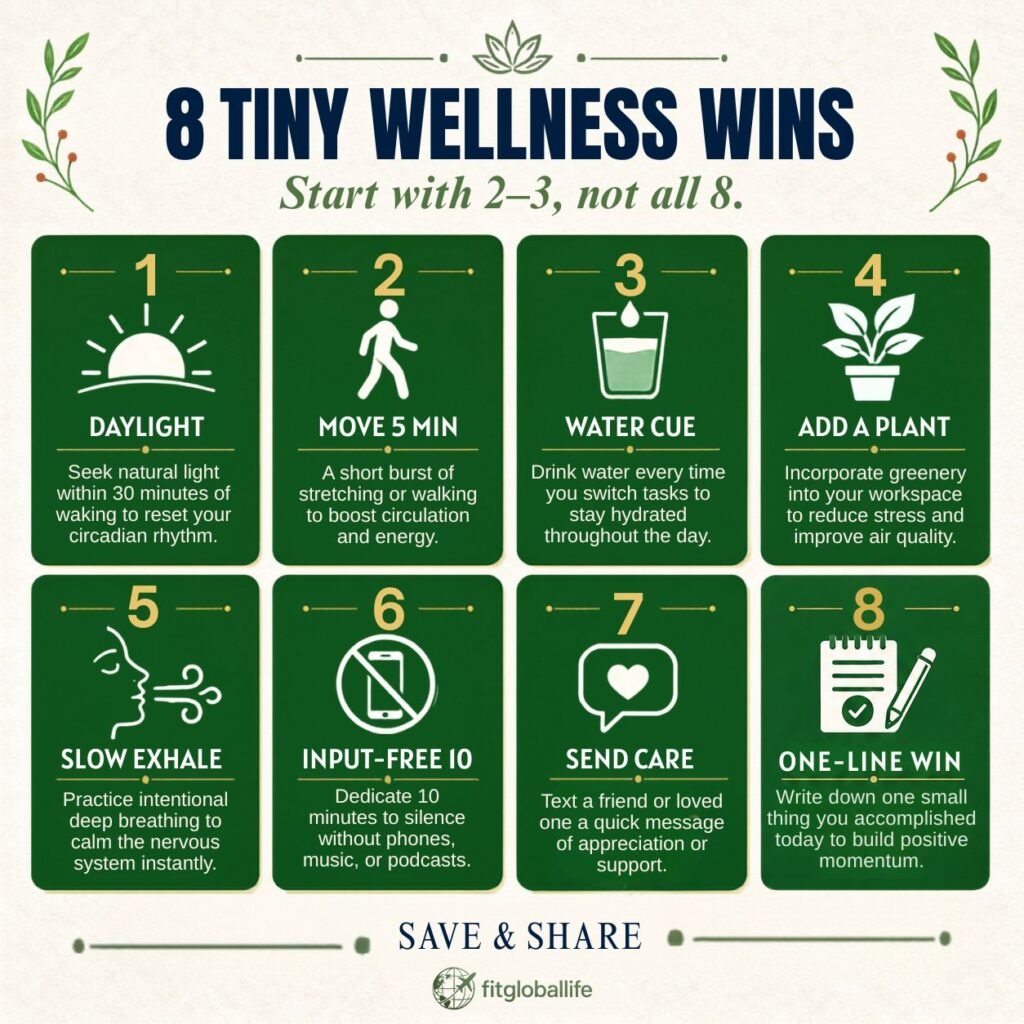
You do not need to perform all eight every day. Most people will get more value from choosing two or three that solve a current friction point, repeating them for a couple of weeks, and adding another only when the first set feels believable. Wellness is not a scavenger hunt. The list is a menu.
1. Get a Small Dose of Outdoor Light Early
Your first tiny win is simple: step outside or move to the brightest practical daylight available after waking. Light is one of the strongest environmental signals for the body’s circadian system. The National Heart, Lung, and Blood Institute explains that light and darkness help align the internal body clock with day and night, while bright artificial light late in the evening can interfere with the normal preparation for sleep.
There is no universal “magic” number of morning-light minutes that fits every latitude, season, skin sensitivity, work schedule, eye condition, or living situation. Avoid turning daylight into another precision contest. The tiny win is exposure to a clear daytime signal, not staring at the sun, skipping sun protection, or buying a gadget before opening the curtains.
A useful floor is two minutes outside while you breathe normally and look around. Notice the temperature, cloud cover, sounds, and distance. This adds an orienting component that helps the moment feel like a transition into the day rather than another task. On a comfortable day, extend it into a short walk. For a wider morning structure, pair this with well-being rituals from different cultures or use the home-environment ideas in a practical guide to circadian lighting.
Make it repeatable
Floor: Two minutes near outdoor daylight.
Anchor: Immediately after making your first drink or opening the front door.
Receipt: Mentally name one thing you noticed: “bright,” “cool,” “windy,” or “quiet.”
If you work nights, manage a circadian disorder, take light-sensitive medication, or have an eye condition, individualized guidance matters. Daylight is powerful precisely because timing can affect the body clock.
2. Interrupt Sitting With Five Minutes of Movement
A workout and a movement break are related, but they solve different problems. A workout develops fitness. A movement break interrupts a long period of stillness and gives joints, muscles, circulation, attention, and posture a change of input. The CDC advises adults to move more and sit less, and notes that activity can be broken into smaller chunks. This makes a five-minute movement break a legitimate building block, even though it is not the entire weekly plan.
Choose movement that matches the moment. Walk the hallway. Climb stairs at an easy pace. Perform ten controlled chair squats. Mobilize the hips and upper back. Carry groceries with intention. Put on one song and move until it ends. The best option is the one you can perform safely without needing a costume change, equipment setup, or motivational documentary.
This is where the “exercise snack” concept becomes useful. Short exercise snacks throughout the day can help readers rethink activity as something that only counts when it happens inside a formal workout. The mistake is using micro-movement to avoid progressive exercise forever. Use the five-minute win to reduce zero days and long sitting blocks, then build toward the broader mix of aerobic, strength, mobility, and balance work your body needs.
Make it repeatable
Floor: Five minutes of easy movement.
Anchor: After your longest meeting, commute, writing block, or screen session.
Receipt: Put a small mark on paper or say, “Sitting interrupted.”
If you have pain, dizziness, cardiovascular symptoms, recent surgery, balance concerns, pregnancy-related restrictions, or a condition that changes exercise safety, ask a qualified professional what type and intensity are appropriate.
3. Attach Water to a Cue You Already Have
“Drink more water” sounds simple until it becomes another vague instruction floating around the day. A better tiny win is to connect water with a predictable event: after brushing your teeth, when you begin work, with a meal, or when you return home. The CDC’s hydration guidance emphasizes that water supports normal body function and that needs vary with age, sex, pregnancy or breastfeeding status, activity, illness, climate, and other factors. Food and other beverages also contribute to total fluid intake.
That variability is why this guide avoids a universal bottle-count rule. More is not automatically better, and people with heart, kidney, endocrine, or fluid-balance conditions may need specific advice. The tiny win is not to chase a heroic number. It is to prevent the whole day from passing before you remember fluids exist.
Make the environment do some of the work. Keep water visible where you regularly pause. Use a cup you like. Refill before it is empty if that reduces friction. A practical reusable insulated water bottle can help when you commute or travel, but the product is optional; a normal glass has excellent battery life and no app subscription.
Make it repeatable
Floor: Drink a comfortable amount of water at one fixed cue.
Anchor: The first meal, the start of work, or returning from outside.
Receipt: Refill the glass or bottle immediately so the next action is easier.
Hydration supports a routine; it does not replace food, sleep, or medical evaluation for persistent thirst, frequent urination, dizziness, swelling, or unexplained fatigue.
4. Add One Plant-Based Fiber Upgrade
Instead of rebuilding your entire diet, upgrade one meal by adding one plant food that contributes fiber, color, texture, or micronutrients. Add berries to oats, beans to soup, a handful of greens to eggs, sliced fruit beside a sandwich, seeds to yogurt, frozen vegetables to rice, or lentils to a familiar sauce. This is an “add before subtract” strategy: it improves meal structure without requiring a dramatic diet identity.
Dietary fiber supports digestive function and is associated with broader metabolic and cardiovascular benefits, but many adults consume less than recommended. The National Library of Medicine’s overview of dietary fiber also gives an important practical warning: increase fiber gradually, because a sudden jump can cause gas, bloating, or cramps. Water intake and individual tolerance matter, especially for people with gastrointestinal conditions.
For breakfast, use one of these fiber-rich breakfast templates instead of relying on a vague promise to “eat clean.” For workdays, nutrient-dense snack ideas can reduce the gap between good intentions and the nearest ultra-processed option. When you have more planning capacity, rotate meals from this collection of anti-inflammatory weekday ideas rather than forcing the same “perfect” bowl every day.
Make it repeatable
Floor: Add one fruit, vegetable, legume, whole grain, nut, or seed to one meal.
Anchor: While plating the meal, before you sit down.
Receipt: Name the plant: “beans added,” “apple added,” “greens added.”
People with food allergies, eating disorders, swallowing issues, kidney disease, inflammatory bowel conditions, diabetes, or medically prescribed diets may need tailored guidance. A tiny upgrade should support your care plan, not compete with it.
5. Use Slow Breathing as a Transition, Not a Cure-All
Breathing practices are often marketed with impossible certainty. A few breaths may help you slow the pace of a moment, but they do not erase trauma, resolve unsafe circumstances, or treat every cause of anxiety. The useful tiny win is more modest: use slower, comfortable breathing to create a transition between demand and the next choice.
A 2023 systematic review of breathing practices for stress and anxiety reviewed 58 studies and 72 interventions. Many interventions reported benefits, but study quality varied, and the review found that effective programs were generally not built around fast-only breathing or ultra-short, one-off sessions. That nuance matters. Three slow breaths can be a helpful doorway; a consistent five-minute practice may be a more realistic training dose for stress reduction.
Try breathing gently through the nose if comfortable, allowing the exhale to become slightly longer than the inhale without forcing it. For example, inhale for about four comfortable counts and exhale for about six. Stop if you become light-headed, panicky, numb, or uncomfortable. Some people regulate better through walking, humming, stretching, or looking around the room than through breath focus. Bodies are allowed to have preferences.
For more techniques and cautions, see simple breathwork methods for nervous-system reset and everyday mind-body recovery practices.
Make it repeatable
Floor: Three unforced breaths with a slightly longer exhale.
Standard: Five minutes of comfortable paced breathing.
Anchor: Before sending a difficult reply, starting a meeting, or entering your home after work.
Receipt: Relax one visible area: jaw, hands, shoulders, or forehead.
Breathing difficulty, chest pain, fainting, severe panic, or new cardiopulmonary symptoms require proper medical attention, not another breathing tutorial.
6. Protect a Ten-Minute Input-Free Recovery Gap
Many breaks are not actually breaks. We stop one form of input and immediately begin another: close the spreadsheet, open social media; leave the meeting, play a podcast; finish dinner, answer messages; get into bed, begin scrolling. The nervous system never receives clear punctuation.
A ten-minute input-free gap means no work, news, social feed, video, or problem-solving. Sit near a window. Walk slowly. Make tea without consuming content. Water a plant. Look at the sky. Stretch on the floor. Let boredom arrive without treating it as a technical failure. The purpose is not to achieve a blank mind. It is to stop adding material long enough for the current material to settle.
If you can take the break outside, research suggests nature exposure can support stress recovery. A 2019 field study on urban nature experiences and cortisol observed the most efficient cortisol reduction after roughly 20 to 30 minutes. A ten-minute gap should not be advertised as equivalent. It is the repeatable floor that may grow into a longer nature break when time allows.
This tiny win builds on the science of genuine rest, while the boundaries in a simple digital detox protocol can help if your break keeps getting hijacked by notifications. On depleted days, use one of the recovery rituals that do not depend on motivation to give the pause a clear beginning and ending.
Make it repeatable
Floor: Ten minutes without incoming content.
Anchor: After lunch, after closing work, or before the evening routine.
Receipt: Write or say one word describing your state before and after: “crowded → clearer,” “tense → softer,” or simply “same.”
A recovery gap is support, not permission to endure chronic overload forever. If the environment is structurally harmful, the larger win may be a boundary, a workload conversation, professional care, financial support, or a safety plan.
7. Send One Genuine Social Signal
Wellness is often packaged as a private project: your tracker, your supplement stack, your perfect morning. Human health is also relational. The U.S. Surgeon General’s advisory on social connection describes connection as a meaningful health factor and reports that social isolation is associated with a 29 percent higher risk of premature mortality. That does not mean one text message can be converted into a lifespan formula. It means social care deserves a place beside sleep, food, and movement.
A social signal is a small action that says, “You exist in my world.” Send a voice note. Ask a specific question. Thank someone for something concrete. Share a photo that has personal meaning. Tell a friend, “No need to reply quickly; I was thinking of you.” Invite a colleague to walk for five minutes. Repair a small misunderstanding before it hardens.
Avoid turning connection into another performance metric. The goal is not eight messages to eight people. It is one real bid for contact. Quality and safety matter. Some relationships drain, manipulate, or harm. A wellness practice should not pressure you to reconnect with someone unsafe.
For a broader view of belonging, read how micro-communities support mental longevity and why human skills still matter in technology-heavy wellness.
Make it repeatable
Floor: Send one sincere, specific message.
Anchor: When you think of someone, after lunch, or while waiting for a routine task.
Receipt: Ask, “Was this contact, care, or merely content forwarding?”
If loneliness is persistent, painful, or linked with depression, grief, abuse, or thoughts of self-harm, small social bids may help but professional and community support are important.
8. Close the Day With a One-Line Receipt
Many people end the day by reviewing what remains unfinished. The brain receives a final message: not enough. A one-line receipt changes the closing question from “Did I complete everything?” to “What evidence shows I cared for tomorrow’s capacity?”
Write one sentence: “Today’s win was walking after lunch.” “I paused before replying.” “I added beans to dinner.” “I went to bed instead of opening another episode.” “I asked for help.” The sentence should be factual, not inspirational. You are collecting evidence, not auditioning for a gratitude journal commercial.
Then add an optional next-step clause: “Tomorrow, I will put my shoes by the door.” This turns reflection into environmental design. A small pocket notebook can make the ritual portable, but a note app or scrap of paper works just as well.
This receipt supports self-trust because it records promises kept at a realistic scale. Use the deeper questions in journaling prompts for better self-trust when you want more reflection, and use mental fitness drills for stronger focus when the main challenge is attention rather than emotional closure.
Make it repeatable
Floor: One factual sentence about a completed wellness action.
Anchor: When plugging in your phone, brushing your teeth, or turning off the final light.
Receipt: The sentence itself.
Skip the ritual if tracking becomes compulsive, perfectionistic, or punishing. The receipt exists to reduce shame, not create a new scoreboard.
The Floor-Anchor-Receipt Method
The eight wins become more useful when you stop treating them as isolated tips and start treating them as a small behavior system. The system has three parts.
| Win | Floor | Anchor | Receipt |
| Outdoor light | Two minutes outside | After the first drink | Name one sensory detail |
| Movement | Five minutes | After longest sitting block | Mark “sitting interrupted” |
| Water | One comfortable drink | At the start of work or a meal | Refill the container |
| Fiber | One plant addition | While plating food | Name the plant |
| Breathing | Three gentle breaths | Before a transition | Relax one body area |
| Input-free recovery | Ten minutes | After lunch or work | One before/after word |
| Connection | One sincere message | When someone comes to mind | Identify contact or care |
| Closure | One sentence | When the phone charges | The sentence is the receipt |
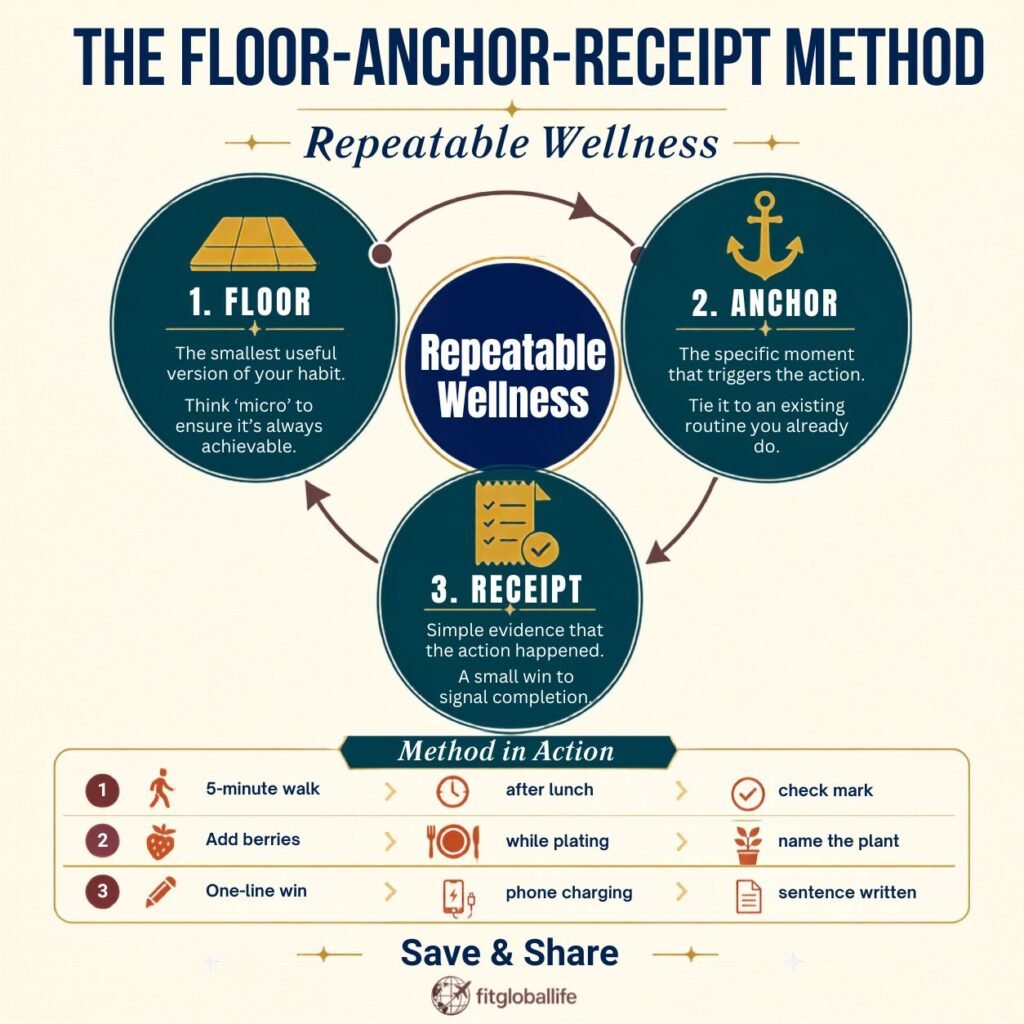
1. Floor: Define the version that survives a difficult day
The floor should be almost embarrassingly doable. Two minutes of daylight. Five minutes of walking. One plant adds three comfortable inhales. One message. One sentence. If the floor still creates resistance, make it smaller or move it to a better moment. The floor is successful when it protects continuity without pretending to be the full recommendation.
2. Anchor: Place the action after something reliable
“Whenever I have time” is not an anchor. Use a visible event: after coffee, after lunch, after a meeting, when work closes, when the phone charges. The best anchor already occurs most days and happens close to where the action is possible. This is also why mindfulness during busy workdays is easier when attached to transitions rather than assigned to a vague future version of you who has no meetings.
3. Receipt: Make completion visible without building a surveillance system
A receipt can be a check mark, a moved object, a short note, or a simple sensory observation. It should answer, “Did this happen?” It should not require a dashboard, wearable, subscription, or color-coded moral judgment. Measurement is useful when it improves awareness. It becomes noise when tracking the habit takes more energy than doing the habit.
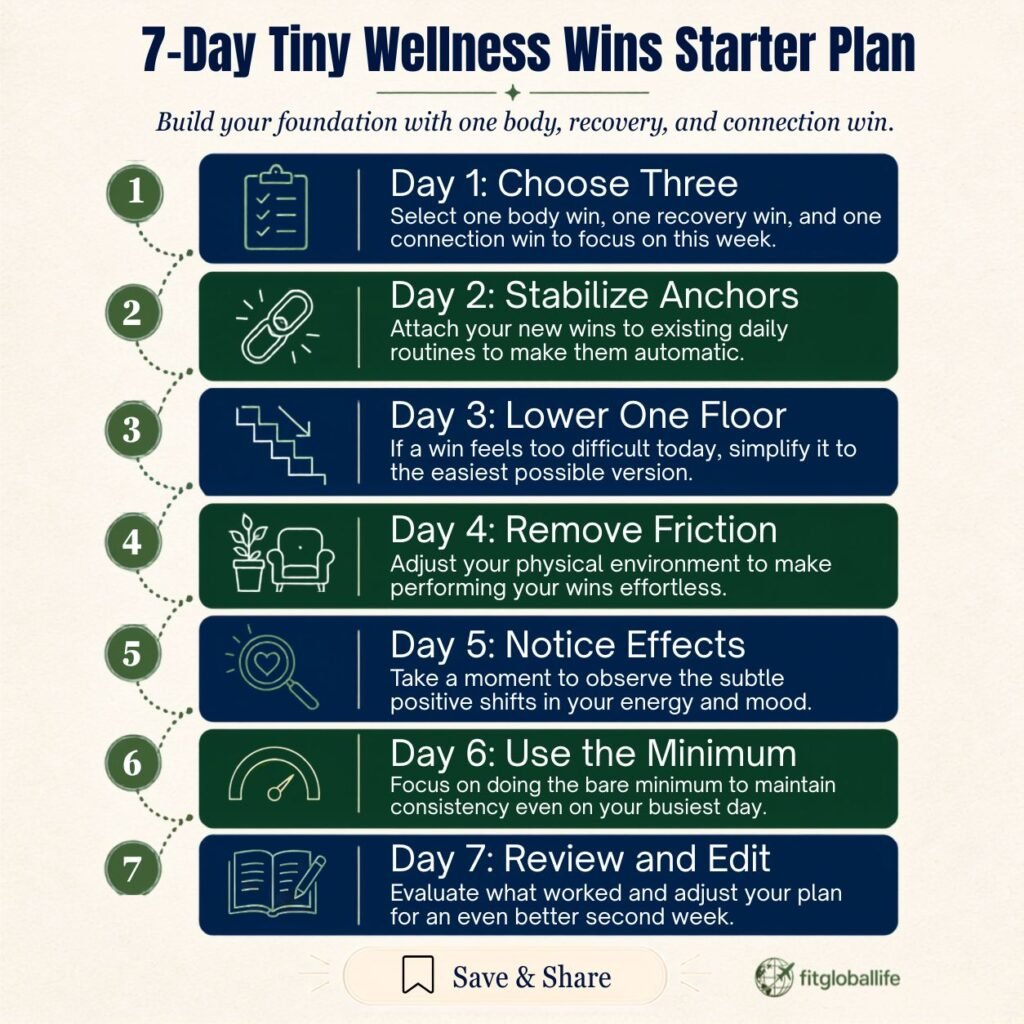
A Realistic 7-Day Starter Plan
Begin with three wins: one for the body, one for recovery, and one for connection or closure. Keep the same anchors for seven days. The first week is not a test of character; it is an experiment in placement. Notice which cue is reliable, which action feels supportive, and which version is too ambitious.
A simple starting trio could be daylight after the first drink, five minutes of movement after lunch, and a one-line receipt when the phone goes on charge. Someone dealing with tension may prefer movement, breathing, and an input-free gap. Someone whose meals are chaotic may choose water, one fiber upgrade, and sleep protection.
Remember that sleep is not included as a “tiny” win because adequate sleep is a major biological need. You can, however, use a tiny action to protect it: dim lights, set a bedtime alarm, or close work ten minutes earlier. The CDC recommends seven or more hours for most adults aged 18 to 60, with age-related variation. A two-minute bedtime cue is valuable when it helps create room for the real sleep duration; it is not a substitute for it.
| Day | Focus | Action |
| Day 1 | Choose three wins | Select one body, one recovery, and one connection/closure action. |
| Day 2 | Stabilize the anchors | Move each action directly after an existing daily event. |
| Day 3 | Lower one floor | Make any skipped action smaller or easier to reach. |
| Day 4 | Remove friction | Place shoes, water, fruit, notebook, or reminders where the action happens. |
| Day 5 | Notice effects | Record one word before and after, without forcing a positive result. |
| Day 6 | Use the floor | Practice the minimum version on purpose; prove the routine can survive a busy day. |
| Day 7 | Review and edit | Keep what helped, move weak anchors, and add nothing unless the system feels light. |
Common Mistakes That Make Tiny Wellness Wins Fail
Trying all eight at once
Enthusiasm loves a full launch. Habit formation usually prefers a smaller cast. Start with two or three actions that solve current problems. Add another after the first set feels stable. More habits do not automatically mean more health if the system becomes tiring to maintain.
Confusing the floor with the complete goal
Five minutes of movement is a floor. It does not replace progressive strength, aerobic fitness, mobility work, or rehabilitation when those are needed. One plant addition improves a meal but does not guarantee overall dietary adequacy. Tiny wins are honest starts, not permission slips for permanent underinvestment.
Choosing actions for their aesthetic value
A habit is not more effective because the bottle matches the yoga mat. Products can reduce friction, but they can also become procrastination in premium packaging. Design the action first. Buy only when an item clearly makes the action easier, safer, or more enjoyable.
Using the same win for every body and every season
A daylight routine changes with geography and shift work. Hydration changes with climate and medical needs. Movement changes with injury, pregnancy, disability, age, and training history. Food tolerance changes. Social capacity changes. Keep the function, adapt the form.
Turning missed days into evidence of failure
Missing once is information. Missing repeatedly is design feedback. Perhaps the cue is unstable, the action is too large, the environment blocks it, or the habit does not solve a problem you currently care about. Edit the system. Shame is a noisy consultant and rarely improves the workflow.
When Tiny Wellness Wins Are Not Enough
Tiny actions are most useful for prevention, maintenance, transitions, and low-friction support. They are not sufficient for every problem. Persistent fatigue, unintentional weight change, severe insomnia, chest pain, fainting, eating concerns, panic, depression, substance dependence, ongoing gastrointestinal symptoms, or rapidly changing physical or mental health deserves assessment by a qualified professional.
The same is true for structural stress. A breathing practice may help you respond to a difficult email, but it cannot make an abusive workplace safe. A nature break may reduce overload, but it cannot replace financial assistance, caregiving support, medical leave, therapy, or legal protection when those are needed. Wellness advice becomes harmful when it asks individuals to self-regulate around conditions that require collective or professional action.
Use tiny wins to increase capacity and agency. Do not use them to explain away suffering.
Final Thoughts: Build Proof, Not Pressure
The most underrated wellness strategy is not intensity. It is return. Returning to daylight after a dark week. Returning to movement after travel. Returning to water after a rushed morning. Returning to a real meal, a slower breath, a quiet ten minutes, a friend, or one honest sentence at the end of the day.
Tiny wellness wins work because they make return easier. They reduce the distance between intention and action. They give your environment a job. They help you build evidence that care can happen in ordinary moments, not only during ideal routines.
Choose one win that your current life can carry. Give it a stable anchor. Define the floor. Keep a gentle receipt. When it becomes easier, expand it or add another. Health is not built by winning every day. It is built by creating enough small doorways that you can find your way back.
Frequently Asked Questions
Tiny wellness wins are small, specific actions that support physical, mental or social well-being and are simple enough to be repeated. Examples include two minutes of outdoor light, a five-minute movement break, adding one plant food to a meal or sending one sincere message. They are starting doses, not substitutes for full health habits or medical care.
Small actions can accumulate into larger health patterns , especially if they eliminate inactivity , enhance meal structure , support recovery , or provide stable cues for repetition . Their value is in accumulation and follow-through . A tiny action should be tied to a meaningful direction and extended when your capacity allows .
No. Choose two or three that address your current needs and fit your schedule. Repeat them with stable cues for at least one or two weeks, then review what helped. Adding every action at once can recreate the overwhelm the method is designed to prevent.
There is no one-size-fits-all timeline. Studies of health habits show that the time it takes to create a habit can be very different depending on the behavior, the person, the setting, the repetition and the pleasure. Some habits may take weeks to strengthen, some months. Focus on stable cues and a realistic floor rather than chasing a deadline.
Start with the action that removes your biggest daily friction. If you sit for long periods, choose movement. If mornings feel foggy, choose daylight. If meals are inconsistent, choose one plant-based addition and a hydration cue. If your mind carries work into the evening, choose an input-free gap or a one-line closure receipt.
Disclaimer
This article is for general educational and lifestyle information only. It is not medical advice, diagnosis, treatment, psychotherapy, nutrition therapy, or a substitute for care from a qualified professional. Individual needs differ based on health conditions, medications, disability, age, pregnancy, climate, work schedule, fitness level, and other factors. Seek professional guidance before making significant changes if you have symptoms, chronic conditions, a history of disordered eating, exercise restrictions, or concerns about sleep, mood, breathing, hydration, or nutrition.
Affiliate disclosure: This article contains affiliate links. If you purchase through them, FitGlobalLife may earn a commission at no additional cost to you. Recommendations are included for convenience and editorial relevance, not as medical endorsements. As an Amazon Associate, FitGlobalLife earns from qualifying purchases.