
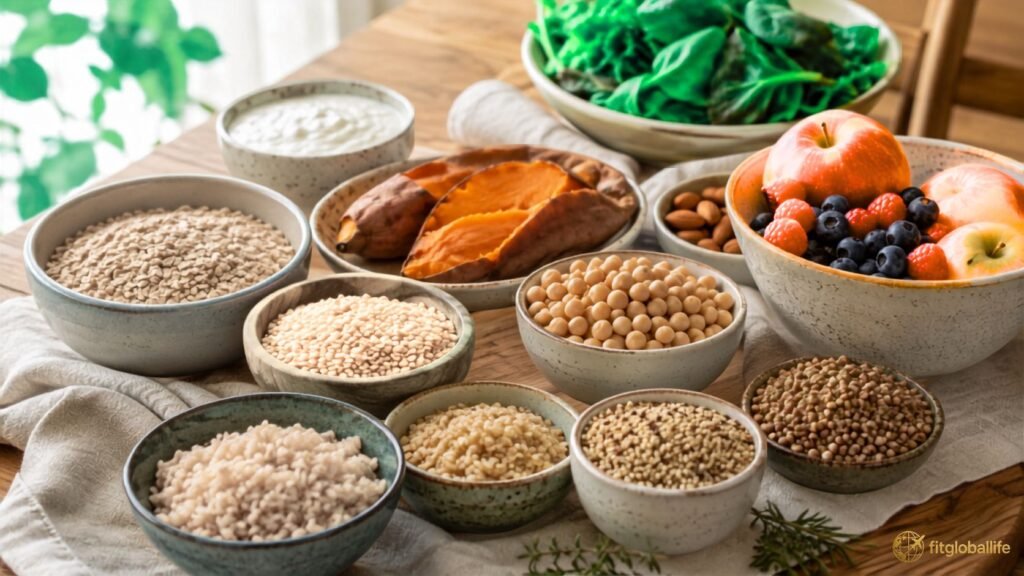
For years, carbohydrates have been portrayed as the nutrition villain—the food to cut when blood sugar rises, weight fluctuates, or energy declines. It's too basic a framing. This approach to smart carbs for consistent energy begins with a more practical premise: your body can use carbohydrates as an effective fuel source, but what occurs next depends on the type of carbohydrate, the amount, the level of processing, and the rest of the meal.
For this reason, rather than focusing on “good carbs” or “bad carbs,” this program emphasizes smart carbs for consistent energy. A perfectly flat glucose curve is not the aim. It involves choosing carbohydrate-rich foods that offer benefits such as fiber, intact food structure, protein, micronutrients, or a slower eating pattern, and using them in meals filling enough to move on to the next one.
The primary sources of carbs should be whole grains, fruits, vegetables, and legumes, according to the most recent World Health Organization guidelines on optimal carbohydrate quality. Instead of concentrating on a single macronutrient as the problem, the course fits in well with FitGlobalLife's larger strategy of selecting minimally processed foods more frequently.
The fact that different people respond differently to the same foods heavy in carbs is another useful reality check. Significant individual variation in post-meal glucose reactivity to standardized carbohydrate meals was discovered in a 2025 Nature Medicine study. In other words, there isn't a single “perfect carb.” Which carbohydrate gives you a sufficient amount of nutrients, useful fuel, a portion that is acceptable, and a meal that you can actually repeat? is a more clever question.
That is the standard used here.
What Makes a Carb “Smart” for Steady Energy?
“Smart carb” is not a clinical category. It is an editorial shorthand for a carbohydrate-rich food that performs well on four practical checks.
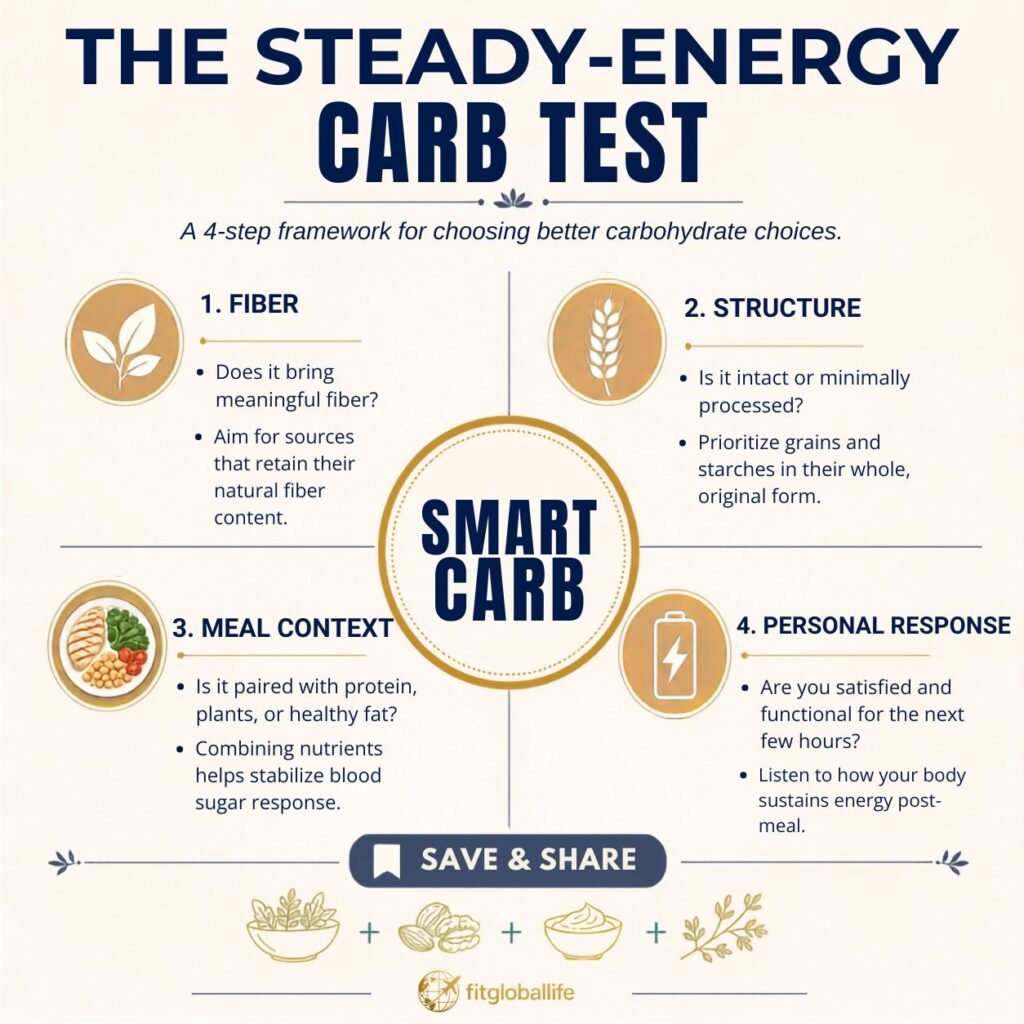
1. It contains fiber rather than merely sugar or carbohydrates.
Fiber gives food more bulk and texture while also altering the rate of digestion. According to Harvard's Nutrition Source, one reason intact grains behave differently from highly refined ones is that the bran and fiber in whole grains inhibit the conversion of starch into glucose.
Fiber-rich carbohydrate sources are also given specific attention in the WHO's current healthy-diet guidelines. Its more comprehensive carbohydrate guidelines advise individuals to consume at least 25 grams of naturally occurring dietary fiber per day. That is a helpful standard, particularly since many contemporary meals are made up of convenience foods and processed grains, which add calories more quickly than fiber.
2. Its structure has not been pulverized away
A grain can be technically “whole” while still being finely milled. Food structure matters. Steel-cut oats, chewy barley, lentils, chickpeas, and intact grains require more chewing and generally take longer to eat than sweet drinks, white-flour snacks, or puffed cereals.
Processed food is not inherently unhealthy because of this. It just indicates that processing should be included in the discussion. If your breakfast vanishes in five spoonfuls and you're left looking for a snack an hour later, it might be more about the meal's lack of structure, protein, fat, and fiber than it is about “carbs.”
3. It goes well with plants, protein, or good fat.
Eating carbohydrates with protein, fat, or fiber helps delay the rate at which blood sugar rises, according to the CDC's diabetes meal planning guidelines. This does not imply that macro math is required for every meal. It means that fruit lasts longer when combined with nuts; rice becomes more fulfilling when combined with fish or tofu and veggies; and oats become more useful when combined with yogurt and seeds.
FitGlobalLife has explored this idea in more depth through food pairing as a practical glucose strategy. In this article, pairing is a supporting tool rather than the main event.
4. It works in real life
A “perfect” grain you never cook is not especially smart. A good carbohydrate should fit your schedule, budget, cooking skills, and culture. The best choice may be oats at 7 a.m., lentils in a workday soup, brown rice with a family dinner, or a banana before a long walk.
This real-world test matters because consistent energy comes from recurring patterns rather than a single nutritious meal.
A Brief Comparison of 9 Wise Carbs for Consistent Energy
The numbers below are estimates and vary by preparation, variety, and brand. USDA FoodData Central is a helpful resource for verifying food composition.
| Smart carb | Typical practical serving | Approx. fiber | Why it earns a place | Easy pairing |
| Steel-cut or old-fashioned oats | 1 cup cooked | ~4 g | Beta-glucan fiber, affordable, versatile | Greek yogurt + berries + seeds |
| Hulled barley | 1 cup cooked | ~5–7 g | Chewy, fiber-rich whole grain | Roasted vegetables + chicken/tofu |
| Lentils | 1 cup cooked | ~15 g | Fiber + plant protein | Greens + olive oil + eggs/fish |
| Chickpeas or beans | 1 cup cooked | ~10–13 g | Fiber + protein + resistant starch | Salad vegetables + tahini |
| Quinoa | 1 cup cooked | ~5 g | Carbohydrate plus useful protein | Salmon/tofu + leafy greens |
| Buckwheat groats | 1 cup cooked | ~4–5 g | Intact pseudograin, naturally gluten-free | Mushrooms + egg + herbs |
| Sweet potato | 1 medium | ~4 g | Starch plus fiber and carotenoids | Yogurt/tahini + beans |
| Brown or wild rice | 1 cup cooked | ~3–4 g | More intact than refined white rice | Protein + non-starchy vegetables |
| Whole fruit | 1 medium fruit or 1 cup berries | ~3–6 g | Water + fiber + natural sweetness | Nuts, cheese, yogurt |
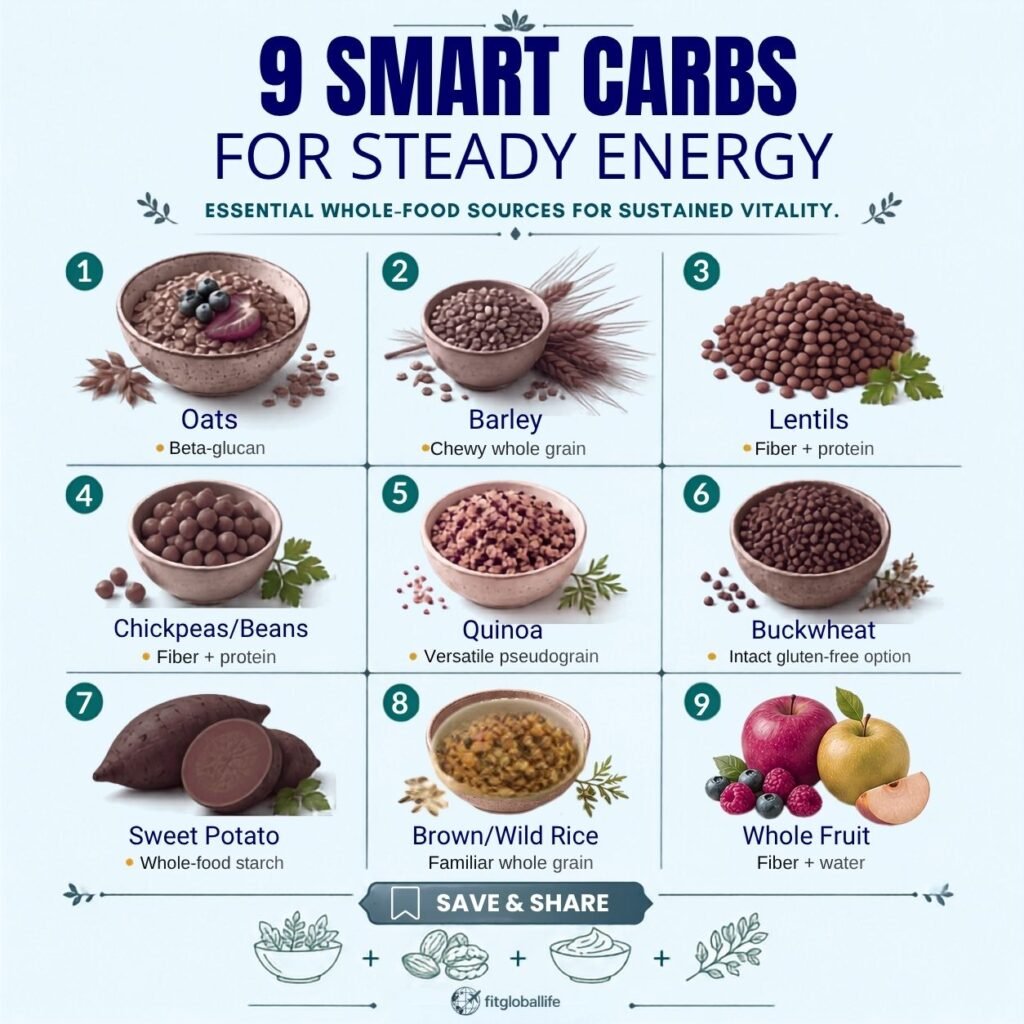
9 Smart Carbs for Steady Energy
1. Steel-Cut or Old-Fashioned Oats
Oats are the rare “healthy breakfast” cliché that deserves most of its reputation. They are inexpensive, globally available, and easy to build into either sweet or savory meals.
Beta-glucan, a soluble fiber that creates a thick gel in the digestive tract, is what makes them most unique. A comprehensive review and meta-analysis of oat beta-glucan revealed that in controlled trials, adding sufficient amounts to meals containing carbohydrates decreased peak glucose and post-meal glucose exposure. Another reminder that dietary effects are rarely binary is the fact that the effect's magnitude relied on dose, molecular weight, and the comparison meal.
For everyday use, choose steel-cut or old-fashioned rolled oats more often than heavily sweetened instant packets. Then add what oats are naturally missing: protein and texture.
A strong bowl looks like this: oats + plain Greek yogurt or soy yogurt + berries + chia or walnuts. If you prefer savory breakfast, try oats with spinach, an egg, mushrooms, and black pepper.
FitGlobalLife's guide to fiber-rich breakfasts that support gut health offers extra strategies to make that first meal actually work if mornings are your weakest nutrition window.
Ideal for: simple pantry planning, breakfast, overnight oats, and post-workout meals.
Keep an eye out for: flavored packets that turn a fiber-rich base into a dessert with a lot of added sugar.
Affiliate disclosure: At no additional cost to you, FitGlobalLife may earn a commission from qualifying purchases made through marked links. You can compare steel-cut oats on Amazon if you're looking for a pantry shortcut.
2. Hull-covered barley
For some reason, barley is more appealing than quinoa since it is less fancy. It is cheap, chewy, filling, and excellent in soups, grain bowls, and batch-cooked dishes.
When possible, select hulled barley. Although more of the outer layers are removed, pearled barley cooks more quickly. Both can fit into a balanced diet, although the “intact structure” concept of this guide is more suited to hulled barley.
You can also change the kinds of fibers that enter your digestive tract by using barley. A more diverse dietary pattern can be achieved by switching between oats, barley, legumes, vegetables, fruit, and seeds, even tho eating the same grain every day is not necessarily harmful. This diversity supports the idea that your gut microbiota responds to the entire food ecosystem, not just one miraculous ingredient.
Try using barley as a 50/50 base with chopped herbs, white beans, roasted veggies, and a source of protein. Surprisingly, it also makes a great morning porridge with yogurt, apple, and cinnamon.
Ideal for: winter breakfasts, soups, cold grain salads, and meal preparation.
Watch for portion creep. A large bowl of any grain can still provide more carbohydrates than you need for the meal.
3. Lentils
Lentils would be a strong candidate for “steady energy”‘s pantry mascot. They are inherently harder to reduce to “just carbs” because they mix starch with exceptionally high fiber and a significant amount of plant protein.
That combination makes lentils useful for people trying to eat more plant-forward meals without feeling as if lunch disappeared 45 minutes after eating it. They also cook faster than many dried beans, especially red lentils.
Lentils can be served with chopped vegetables, leafy greens, olive oil, lemon, and, if necessary, a protein supplement for a weekday meal. Instead of preparing rice for dinner, use red lentils in a curry with non-starchy veggies and serve a smaller scoop of rice alongside.
This is also where carbohydrate and protein categories blur in a useful way. If you are building more meatless meals, the guide to plant-based protein for active lifestyles can help you balance the rest of the plate.
Ideal for meal preparation, soups, curries, salads, and meatless meals.
If your digestive system isn't accustomed to consuming a lot of fiber, watch out for abruptly tripling your consumption of legumes. Drink adequate water and increase gradually.
4. Beans & Chickpeas
Despite being theoretically high in carbohydrates, chickpeas, black beans, kidney beans, cannellini beans, and similar pulses don't act like sweets or sugary drinks. They provide a healthy dietary matrix, fiber, plant protein, and minerals.
The nutritional value of canned versions is not compromised. Use them in grain bowls, salads, soups, wraps, or quick skillet meals after rinsing them to lower the sodium content. When convenience takes the role of a lunch composed solely of refined snacks, it can be advantageous.
A smart, consistent-energy dinner would include chickpeas, cucumber, tomatoes, greens, tahini dressing, and a tiny whole-grain pita. Another is black beans, brown rice, cabbage slaw, avocado, and salsa. The meal's ingredients slow you down, increase volume, and distribute energy across fiber, protein, and fat—not because any one of them is particularly beneficial.
Beans also slide naturally into the kind of anti-inflammatory weekday meals built around plants, fiber, and healthy fats that are easier to repeat than a restrictive “clean eating” plan.
Best for: salads, wraps, bowls, tacos, soups, portable lunches.
Keep an eye out for toppings and sauces. Depending on its surroundings, a nutritious bean base can become extremely high in calories or sodium.
5. Quinoa
Although quinoa is marketed as a superfood, its actual advantages are more commonplace and useful: compared to many refined grain options, it is a convenient carbohydrate basis that has higher levels of protein, fiber, and minerals.
It is also naturally gluten-free, which makes it helpful for people who need to avoid gluten. For everyone else, gluten-free is not automatically healthier; quinoa simply offers variety.
Use it where you might otherwise default to a huge serving of white rice or refined pasta. A cup of cooked quinoa with grilled vegetables and salmon, tofu, chicken, or tempeh creates a meal that feels substantial without making the carbohydrate the only thing on the plate.
Quinoa also fits well into meals designed for mental work because stable energy is not only about avoiding sleepiness. It is about arriving at 3 p.m. without the distracting combination of hunger, caffeine dependence, and snack grazing. FitGlobalLife’s guide to nutrition for mental clarity explores that broader relationship between food patterns and cognitive performance.
Ideal for: gluten-free cooking, lunch bowls, side dishes, and travel-friendly meal preparation.
Keep an eye out for: pricey “quinoa snack” items that add a lot of sugar, oil, or refined starch under the guise of health.
6. Groats of Buckwheat
Buckwheat is not wheat, despite its name. It is a naturally gluten-free pseudocereal. Compared to finely ground breakfast goods, whole buckwheat groats maintain more physical structure and have a delightfully nutty flavor.
Because it breaks up the “oats-rice-quinoa repeat” without requiring complex prep, buckwheat is beneficial. After cooking it like a grain, serve it with roasted vegetables, eggs, herbs, mushrooms, yogurt, and fruit.
This is a good example of why “smart carbs” should not become another rigid food list. The point is not that buckwheat has a secret metabolic property nobody else has discovered. The point is diversity: another minimally processed carbohydrate source, another texture, another set of micronutrients, another meal you may actually enjoy.
It is simple to overlook the larger nutrient picture if you purchase grains only based on a wellness claim on the front of the container. A helpful reminder that variety and total nutritional adequacy are more important than pursuing one trendy label is provided by FitGlobalLife's discussion of mineral shortages in ostensibly healthy diets.
Ideal for: gluten-free meal rotation, porridge, grain salads, and savory breakfast bowls.
Keep an eye out for sweetened buckwheat cereals or pancakes that have far more sugar and refined flour than buckwheat.
7. Sweet Potatoes
Sweet potatoes deserve their place because, particularly in orange-fleshed forms, they are a whole-food starch that also contains fiber, potassium, and carotenoid pigments.
However, this is the point at which the article rejects the notion that “healthy food means unlimited portion.” Sweet potatoes remain starchy. A medium sweet potato can be a good source of carbohydrates; two massive loaded sweet potatoes plus a sweet beverage make for a quite different dinner.
Instead of deep-frying the potato, try to save the skin, bake, steam, or roast it, and serve it with protein and non-starchy veggies. Try cooked sweet potatoes with black beans, plain yogurt, salsa, and herbs on top, or roasted wedges with fish and a large salad.
The nutrient value of produce also starts long before it reaches your kitchen. If that interests you, FitGlobalLife’s look at how soil practices can shape the nutrient story of food adds a wider food-system perspective.
Ideal for pre-activity meals, family meals, dinner, and batch-cooked lunches.
Keep an eye out for: considering fries as having the same nutritional value as a cooked whole sweet potato; large servings; and sweet toppings.
8. Brown Rice or Wild Rice
Because “eat a completely different grain” is unrealistic advice for billions of people, rice is important. Changing the type, size, and meal around a well-known staple is frequently a wiser move.
Brown rice keeps the bran and germ layers that are eliminated when white rice is refined. By offering chew and fiber, wild rice can fulfilll a similar culinary function although having a different botanical composition. Neither is intrinsically “low impact” in every person, and portion size still matters.
A 2025 Nature Medicine study on people's glycemic reactions to diets high in carbohydrates is particularly helpful for this reason. Responses to standardized foods varied significantly among participants, as did the impact of increasing fiber, fat, or protein. The lesson is to “do not turn population-level guidance into a guaranty for one individual,” not to “ignore nutrition science.”
One moderate portion of brown or wild rice, lots of veggies, and a clear protein source make up a practical rice lunch. You don't have to worry if you personally or culturally like white rice. You can still increase the amount of protein, veggies, and legumes on the dish while decreasing the amount of rice.
That adaptable way of thinking is more compatible with metabolic flexibility than strict abstinence of carbohydrates.
Ideal for: stir-fries, bowls, side dishes, meal prep, and culturally recognizable cuisine.
Be wary of believing that all brown rice products are less processed or that “brown” implies portion-free.
9. Whole Fruit
Because fruit includes naturally occurring sugars, it is sometimes associated with a fear of carbohydrates. However, full fruit contains plant chemicals, water, fiber, chewing, vitamins, and minerals. Juice is quicker to drink and eliminates a lot of that structure.
The CDC’s guidance on choosing healthy carbohydrates makes a similar distinction between whole-food carbohydrate sources and refined options. For steady energy, whole fruit is especially useful when it replaces a sweet drink, pastry, or candy bar.
Oranges, bananas, berries, pears, apples, and kiwis can all fit. The context determines the best option. Before going for a stroll or working exercise, a banana by itself might be just fine. Combine fruit with cheese, yogurt, or almonds if you need a snack to get you during a lengthy meeting.
Morning routines are important here as well. A breakfast consisting of fruit, protein, and a slower carbohydrate can feel considerably different than one that consists of coffee and pastries. Small adjustments from well-being-focused morning routines can simplify food choices without making breakfast a chore if your mornings are hectic.
Best for: snacks, breakfast, pre-activity fuel, dessert replacement.
Watch for: confusing whole fruit with large servings of juice, dried fruit, or fruit-flavored snacks.
Why “Steady Energy” Is Bigger Than Glycemic Index
The Glycemic Index is not a comprehensive rating system for your life, but it might be helpful. Under carefully monitored circumstances, it assesses the blood-glucose reaction to a fixed quantity of accessible carbohydrates from a meal. Meals in real life are messier.
It matters how much you eat. The physical structure of the meal is important. Ripeness may be important. Cooking techniques can be important. It matters what you eat with it. The reaction can be altered by sleep, stress, recent exercise, insulin sensitivity, drugs, and even the time of day.
That is why this article uses a broader Steady-Energy Carb Test instead of simply sorting foods from low GI to high GI.
A better four-question filter is:
1. Fiber: Does this food provide me with significant fiber?
2. Structure: Can I chew it and break it down more slowly if it is intact or only slightly processed?
3. Meal context: Am I serving it with vegetables, healthy fat, or protein?
4. Individual reaction: Will I feel content and productive for the next few hours, or will I soon become hungry and dizzy again?
Medical testing cannot be replaced by that final inquiry. It's simple self-observation. Personalized advice is significantly more important than a generic online list if you have diabetes, prediabetes, reactive hypoglycemia, or another illness that affects glucose regulation.
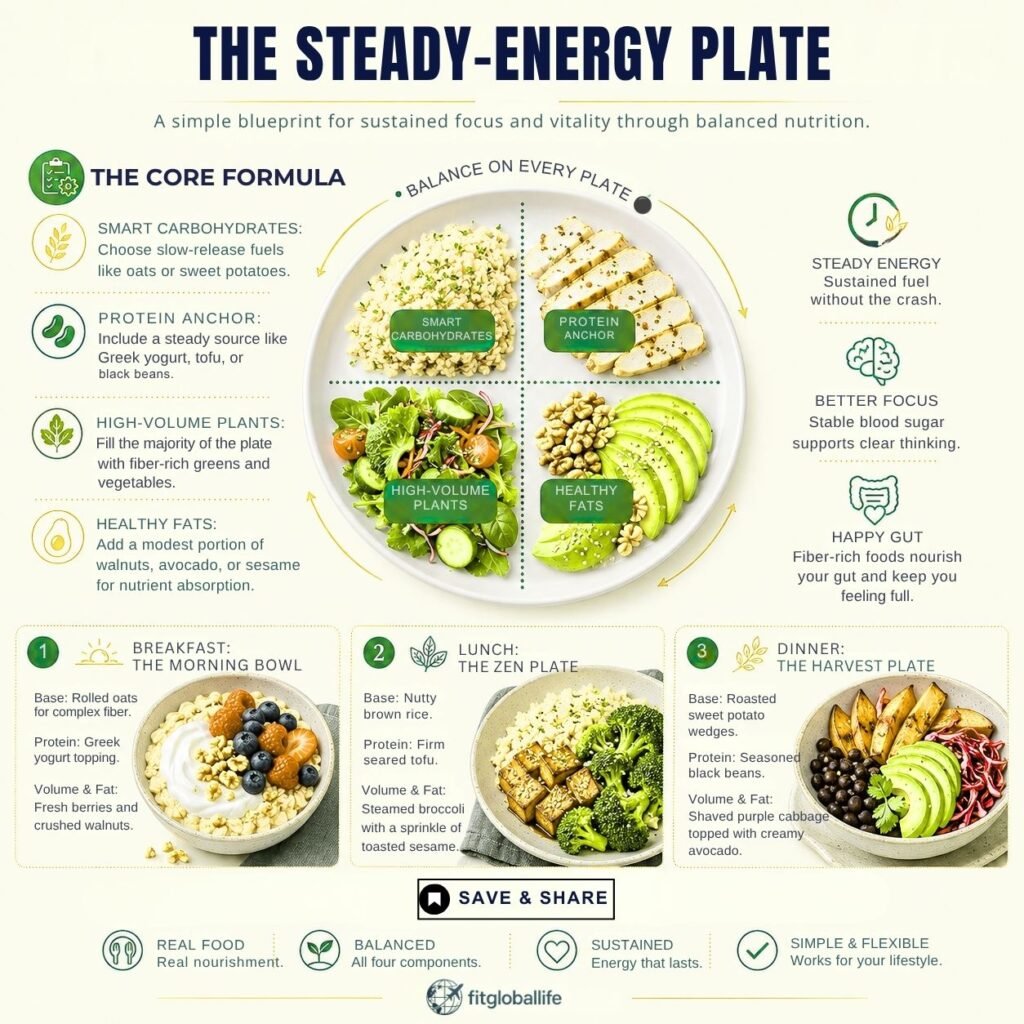
The Formula for Steady-Energy Plates
You don't have to figure out the ideal macronutrient ratio. Start with a plate that may be repeated:
One protein anchor, one smart carb, one or two high-volume plant items, and one moderate source of good fat.
For instance:
- Greek yogurt, oats, berries, and walnuts
- Egg, olive oil, roasted veggies, and lentils
- Broccoli, tofu, brown rice, and sesame
- Black beans and sweet potatoes + avocado + cabbage
- Quinoa, salmon, leafy greens, and tahini
- Almonds, apple, and plain yogurt
Notice what is missing: naked carbohydrates as the default. A bowl of rice can be part of a strong meal. A bowl of rice alone is a different nutrition problem.
For between-meal hunger, the same logic applies. FitGlobalLife’s smart-snacking framework for avoiding the quick-hit/quick-crash pattern is a natural next step if afternoons are where your eating pattern tends to unravel.
Smart Carb Swaps That Do Not Feel Like Diet Food
| Instead of | Try | Why it may work better |
| Sugary breakfast cereal | Old-fashioned oats + yogurt + berries | More fiber, protein, and texture |
| Large white-rice bowl | Smaller brown-rice portion + beans + vegetables | More fiber and meal volume |
| Pastry-only breakfast | Whole fruit + yogurt + oats | Less added sugar, more protein and fiber |
| Chips as the main snack | Roasted chickpeas + fruit | More fiber and protein |
| Refined side dish | Barley, lentils, or quinoa | More intact structure and nutrient density |
| Fruit juice | Whole fruit | More fiber and slower eating |
These are exchanges, not orders. If your family produces white rice, noodles, bread, or potatoes, you don't need to have a serious problem with food identity. Improve the meal architecture first. Add the vegetables. Add some protein. Cut back on the dish's refined starch content. Use more legumes. Choose whole-grain substitutes when they really fit your needs.
Instead of making every carbohydrate a moral choice, that strategy is more sustainable.
How to Make Use of Smart Carbs During a Typical Day
Breakfast
Select whole fruit, oats, buckwheat, or leftover sweet potatoes, and make sure protein is included as well. This is the meal where a lot of individuals unintentionally stack quick carbohydrates: pastry + sweetened latte, or sweet coffee + cereal + juice.
Sweetness does not have to be eliminated. Simply add more structure to the food.
Lunch
Because they cook nicely in batches, lentils, chickpeas, barley, quinoa, and brown rice are particularly helpful. Before adding the carbohydrate basis, construct the container around the veggies and protein.
If you rely on plant proteins, remember that legumes can serve two jobs at once: carbohydrate and protein. That makes them particularly efficient for meal prep.
Afternoon snack
Whole fruit is the simplest smart carb here, especially with yogurt, nuts, cheese, or nut butter. If you are constantly hungry at 4 p.m., look backward at lunch too. A “healthy” lunch that was mostly vegetables with very little energy may be the real cause.
Dinner
Make use of the appropriate carbohydrate for the dish. You can use barley, quinoa, sweet potatoes, brown rice, beans, or lentils. “Carbs at nite are bad” is not the rule. The guideline is to prepare a balanced meal while taking hunger, quantity control, and sleep comfort into consideration.
When Your “Healthy Carb” Still Leaves You Tired
Sometimes the food is not the main issue.
Persistent fatigue can be related to inadequate sleep, iron deficiency, B12 deficiency, thyroid disorders, low total energy intake, dehydration, stress, medications, infection, depression, and many other causes. A nutrition article should not turn unexplained tiredness into a carbohydrate problem.
It is also possible to eat a very “clean” diet and still miss nutrients or total energy. FitGlobalLife’s exploration of personalized nutrition and genetic context is useful here because it reinforces a broader point: nutrition is not one-size-fits-all, and more personalization is not always better unless it is evidence-based and clinically meaningful.
Instead of attempting to treat exhaustion with a new breakfast grain, get medical attention if it is new, severe, chronic, or accompanied by symptoms like dizziness, shortness of breath, fainting, unexplained weight change, extreme thirst, or frequent urination.
A Useful 7-Day Intelligent Carb Rotation
All nine foods are not necessary every week. This straightforward rotation demonstrates how variation may be achieved without intricate meal preparation.
- Oats for breakfast on Monday
- Lentil soup for lunch on Tuesday
- Brown rice with veggies and protein on Wednesday
- Thursday: wrap or chickpea salad
- Quinoa bowl on Friday
- Sweet potatoes, beans, and greens on Saturday
- Barley or buckwheat for a leisurely weekend dinner on Sunday
Whole fruit may appear at any time during the week.
Rotation for its own sake is not the objective. The goal is to avoid the widespread belief that “carbs” only refer to bread, white rice, sugary drinks, and sweet snacks. There are typically more options for fiber, minerals, plant chemicals, and other textures when there is greater diversity.
Conclusion: Avoid Carb Fear and Choose Better Carbs
Carbohydrates are neither inherently problematic nor inherently invigorating. Quality, structure, portion size, meal setting, and the individual consuming them are frequently what make a difference.
The nine smart carbs in this guide—oats, barley, lentils, chickpeas and beans, quinoa, buckwheat, sweet potatoes, brown or wild rice, and whole fruit—work because they bring more to the table than carbohydrate alone.
Start with one change. Replace the cereal with oats. Add lentils to lunch. Make rice a quarter of the plate instead of most of it. Pair fruit with yogurt. Try barley once this week.
You do not need a zero-carb identity to have more stable-feeling days. You need meals that are structured well enough to support the life you are actually living.
FAQ: Consistent Energy from Smart Carbs
No, foods containing carbohydrates can raise blood glucose levels; however, the amount and speed of this reaction vary based on the item, portion, processing, meal composition, and physiology of the individual. Current public health guidelines specifically emphasize whole grains, legumes, fruits, and vegetables since carbohydrate quality is crucial.
Because they are cheap, high in fiber, and simple to combine with healthy fat and protein, oats are among the most sensible options. You can also use leftover sweet potatoes, whole fruit, and buckwheat. The ideal breakfast is realistic enough to repeat and healthily balanced.
Brown rice retains more of its fiber and grain structure, but “always better” is too rigid. Cultural preference, digestion, portion size, individual glycemic response, and overall meal composition all have an impact. White rice can still contribute to a balanced meal when it is eaten in moderation and paired with vegetables, lentils, or another protein source.
While many of these items can be included in diabetic meal plans, each person's demands for carbohydrates, medications, glucose targets, and reactions are unique. Individualized carbohydrate planning should be done with a clinician or certified dietitian, and people with diabetes should use this article for general education.
Not always. For many people with diabetes, CGMs are vital medical devices, but healthy individuals do not always need one to choose wholesome carbohydrates. Start with well-established concepts of food quality, frequent meals, whole foods high in fiber, and your emotional state. Adhere to expert advice if you need to check your blood sugar for medical reasons.
Medical Disclaimer and Nutrition
This article does not provide medical advice, diagnosis, or treatment; it is solely intended for general educational purposes. Dietary requirements and glycemic reactions differ. Before making significant dietary changes, speak with a trained healthcare provider or registered dietitian if you have diabetes, prediabetes, a gastrointestinal disorder, food allergies, are pregnant, take glucose-lowering medication, or have chronic lethargy or other worrying symptoms.