A practical 2026 guide to choosing places where attention can widen, movement becomes natural, and your phone stops being the most interesting object in the room.
If you come home from vacation with 2,000 photos, twelve open restaurant tabs, three unanswered work threads, and the strange feeling that you never actually arrived, you are not alone. Nature-first escapes offer a different kind of trip for screen-tired travelers: instead of choosing a hotel and then adding nature as a half-day activity, you choose the environment first and let the accommodation, transport, meals, and technology rules fit around it.
This is not a crusade against phones. A phone can be a map, translator, weather alert, boarding pass, emergency tool, camera, and lifeline. The problem is when the same device becomes the default response to every idle second. FitGlobalLife already has a stricter guide to digital-free destinations and a practical digital detox protocol for everyday life. This guide takes a softer, more travel-specific route: keep the useful technology, remove the unnecessary digital friction, and put yourself somewhere that rewards looking up.
The timing is right. A 2026 study in Frontiers in Psychology followed 500 travelers using a three-wave design and found that digital-detox exposure was associated with stronger perceived environmental restorativeness; that restorative appraisal, through mindfulness, was linked with better subjective attention restoration, life satisfaction, and positive affect. The authors were careful about the limits of causal inference, but the mechanism is useful: the benefit may not come from “phone bad, forest good.” It may come from creating enough psychological and physical distance for the environment to become engaging again. You can read the 2026 study on digital detox tourism and attention restoration.
Screen habits also travel into the night. In a 2025 JAMA Network Open analysis of 122,058 adults, electronic screen use before bed was associated with shorter sleep duration and worse self-reported sleep quality. Association is not proof that your phone single-handedly wrecked your sleep, but it is a good reason to stop treating vacation evenings as an extension of the feed. See the large adult study on pre-bed screen use and sleep.
The goal is not to win a “no-screen” contest. The goal is to return with your attention feeling less rented out.
Why Nature-First Escapes Work Better Than a Forced Digital Detox
Screen-tired is a useful description, not a diagnosis
“Screen-tired” is shorthand for a bundle of ordinary experiences: tired eyes, restless attention, the urge to check, mental clutter after long knowledge-work days, shallow breaks that turn into scrolling, and evenings that remain cognitively busy even when work is technically over. It is not a medical diagnosis, and persistent headaches, visual changes, sleep problems, anxiety, depression, or severe fatigue deserve appropriate professional assessment rather than a plane ticket dressed as treatment.
Still, travel can change the inputs around you. Natural settings make room for what attention researchers sometimes call soft fascination: stimuli interesting enough to hold awareness without demanding the narrow, effortful focus of a spreadsheet, inbox, or fast-cut video feed. The evidence is promising but not magical. A widely cited Scientific Reports study involving 19,806 adults found that at least 120 minutes of weekly nature contact was associated with better self-reported health and well-being. The researchers themselves treated the result as an association, not a prescription or cure. Read the original study on weekly nature contact.
A meta-analysis of 36 forest-bathing studies involving 3,554 participants also reported reductions in depression and anxiety symptoms, while noting that physiological findings were less consistent. That nuance matters. Nature is not a substitute for care; it is a setting that can make supportive behaviors easier—walking, daylight exposure, quiet conversation, regular meals, curiosity, sleep, and the occasional radical act of doing nothing. The forest-bathing systematic review and meta-analysis is a useful reality check against overblown wellness claims.
If your current issue is less “I need a trip” and more “my focus is scattered every day,” start with FitGlobalLife’s six practical focus rituals and nervous-system habits for a calmer week. A destination works better when it reinforces a behavior you can continue at home.
The Nature-First Filter: five things to look for
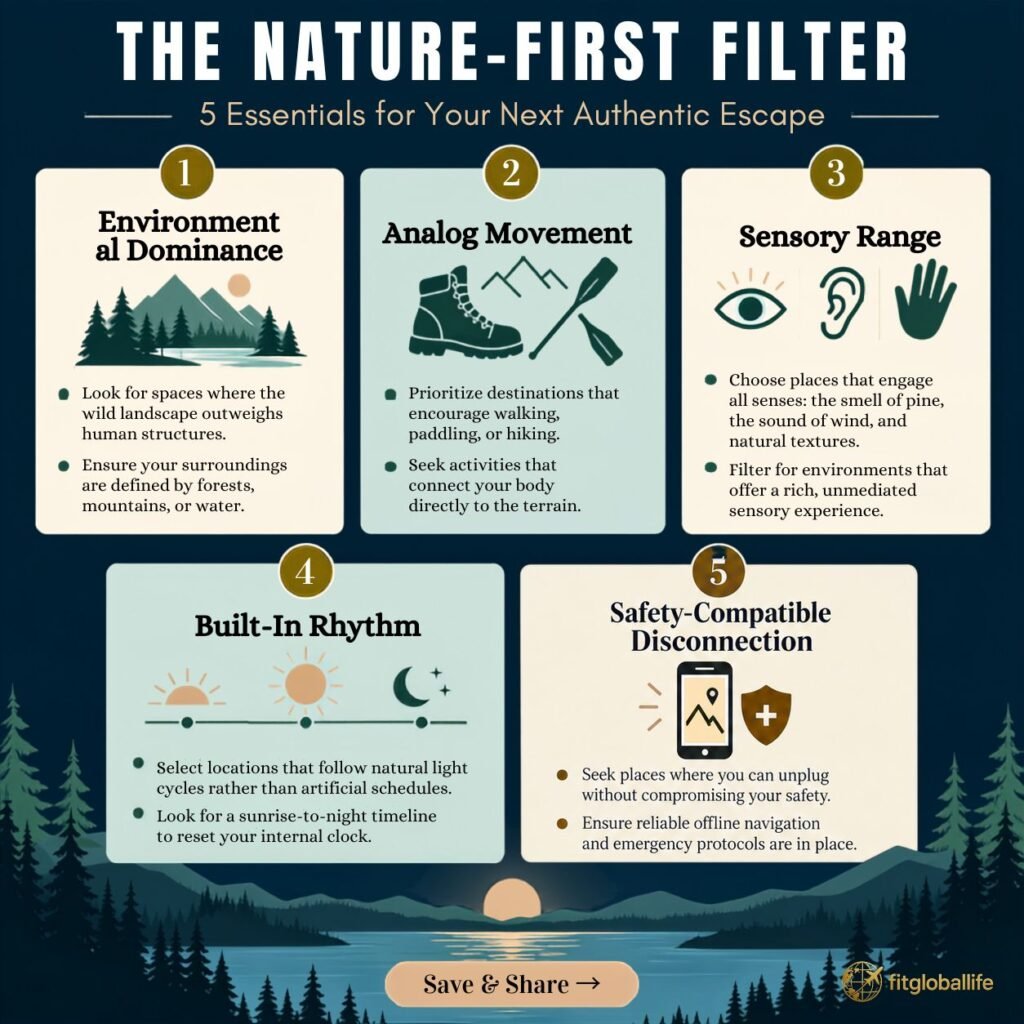
The destinations below were selected using five filters rather than a luxury score or a “weak Wi-Fi” gimmick:
- Environmental dominance: the landscape is not decoration around a resort; it is the main reason to be there.
- Analog movement: walking, paddling, wildlife watching, trail travel, or stargazing naturally fill time that might otherwise become screen time.
- Sensory range: the place offers depth—changing sound, texture, temperature, light, horizon, vegetation, or wildlife—without needing constant entertainment.
- Built-in rhythm: daylight, trail distances, boat schedules, meals, weather, and darkness create a day with fewer micro-decisions.
- Safety-compatible disconnection: you can reduce notifications without pretending that emergency communication, weather information, permits, or navigation do not matter.
This makes the concept different from a seven-day digital detox, a commercial retreat, or a “dead zone” challenge. The ideal nature-first trip is not technologically primitive. It is attention-rich enough that the phone becomes secondary.
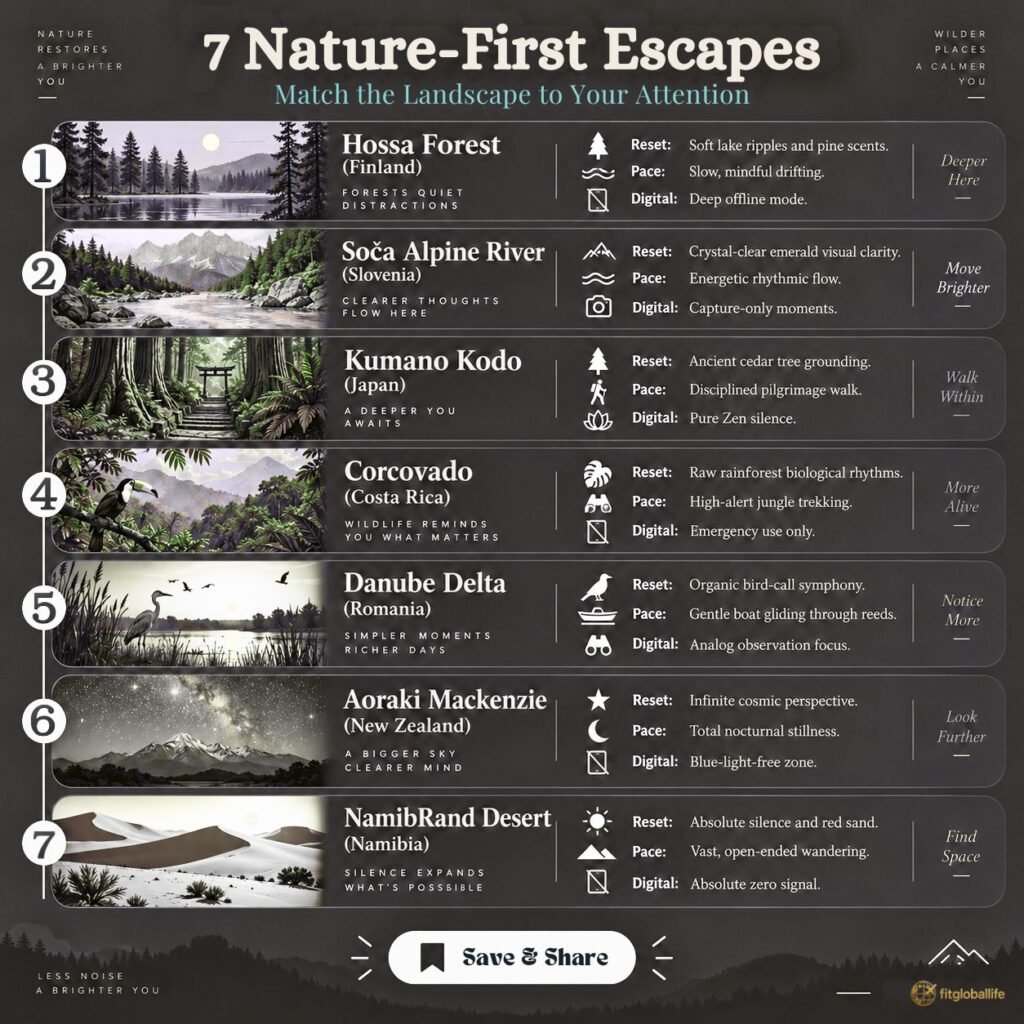
Quick Comparison: 7 Nature-First Escapes
| Escape | Best sensory reset | Ideal pace | Digital boundary | Watch-out |
| Hossa, Finland | Pine forest + clear lakes | 2–4 slow days | Offline blocks; maps saved | Winter trail conditions |
| Soča Valley, Slovenia | River sound + alpine walking | 3–5 days | Phone stays packed on walks | Mountain weather / crowds |
| Kumano Kodo, Japan | Pilgrimage rhythm + cedar forest | 3–6 days | Check only at lodging | Route notices / terrain |
| Corcovado, Costa Rica | Rainforest complexity + wildlife | 2–4 days | Airplane mode during guided walks | Heat, rain, permits, guides |
| Danube Delta, Romania | Waterways + birdlife + reed sound | 2–4 days | One planned check window | Permits / protected zones |
| Aoraki Mackenzie, New Zealand | Alpine scale + dark sky | 2–4 days | No-feed evenings | Fast weather changes |
| NamibRand, Namibia | Silence + desert horizon + stars | 3–5 days | Emergency-only after dusk | Remoteness / heat / logistics |
1. Hossa National Park, Finland: a forest-and-lake attention reset
Hossa works because the landscape offers many low-drama ways to be occupied. Pine ridges, clear lakes, paddling routes, campfire sites, and a network of walking trails create an environment where attention can move between distance and detail. Finland’s official outdoor service lists roughly 90 kilometers of trails in the national park, many of them easy to walk, with accessible options as well. Check official Hossa National Park hiking information before choosing a route.
For a screen-tired traveler, the best version of Hossa is not a heroic mileage week. Pick one lake-facing base, make the first morning deliberately boring, and walk without audio. On day two, switch the visual rhythm by paddling if conditions and your skills allow. A forest gives you near-field detail—moss, bark, shadow, roots—while a lake opens the visual field. That alternation is useful after days spent staring at a fixed-distance screen.
Try a simple rule: no scrolling before the first outdoor hour. You can still check weather, trail information, transport, and messages from family. Then put the device away rather than carrying it in your hand. If you have been trying to recover from mental overload, this is a gentler travel version of FitGlobalLife’s recovery rituals that work better than motivation: design the environment so the desired behavior requires less willpower.
Best for: professionals who want nature without extreme isolation, travelers who like walking and paddling, and people who respond well to repetitive quiet. Winter changes the risk profile; official guidance notes that park trails are not maintained in winter, so seasonal conditions should shape your plan rather than your aesthetic mood board.
2. Soča Valley, Slovenia: follow water instead of notifications
The Soča Valley offers something screens struggle to imitate: a landscape with continuous directional movement. The emerald river, tributaries, gorges, forests, and Julian Alps keep the eye moving through depth instead of bouncing between flat windows. The official Soča Valley site describes hiking options ranging from relaxed riverside walking to serious mountain routes, with the unspoiled nature of Triglav National Park forming part of the setting. Explore official hiking guidance for the Soča Valley.
For this trip, let the river become the itinerary. Choose one longer riverside walk, one short gorge or waterfall outing, and one afternoon with no objective beyond sitting near moving water. That sounds almost suspiciously unproductive—which is exactly why it works. Screen fatigue often grows from constant task switching; an afternoon organized around one physical place removes dozens of choices.
The trick is not to turn the valley into a checklist. If every trail becomes a reel, the scenery is now working for your content calendar. Use a capture window instead: take photos for five minutes at the start or end of a walk, then return the phone to your bag. If slow travel appeals to you, pair this with FitGlobalLife’s older guide to exploring the world without rushing.
Mountain safety remains non-negotiable. The Soča Valley’s official guidance recommends checking hut opening times, booking scarce mountain accommodation in advance, and considering licensed guides for high-mountain trips. “Digital wellness” is not a reason to skip the forecast. The smart version of unplugging keeps logistical information available and removes only the compulsive layer.
3. Kumano Kodo, Japan: let a walking route structure the day
The Kumano Kodo is powerful for screen-tired travelers because it gives the day a physical sequence: wake, eat, walk, climb, pause, arrive, bathe, eat, sleep. You do not need a productivity app to know what comes next. The pilgrimage routes pass through the Kii Peninsula’s forests and sacred landscapes, and Wakayama’s official tourism site emphasizes their long connection with nature worship. Start with official information on the Kumano Kodo pilgrimage routes.
This is not “forest bathing with a passport stamp.” The cultural meaning of the route matters. Walk with respect, keep to local rules, and resist reducing shrines, villages, or sacred paths to wellness props. The official tourism board also publishes Kumano Kodo rules and etiquette, including guidance intended to protect the landscape and local communities.
A nature-first approach here is simple: let the route do the scheduling. Download or print the maps you need, confirm accommodation and luggage arrangements, then give yourself long sections of the day in airplane mode. Check in when you reach the next lodging. If you are used to measuring every day by notifications, steps, unread messages, and “minutes productive,” a pilgrimage rhythm can be pleasantly unimpressed by your dashboard.
This destination also adds a dimension missing from many digital-detox lists: meaning. Nature is not only visual relief; it can be a context for history, reverence, and attention. For a related FitGlobalLife angle, read why experiences of awe can change how we perceive scale and attention. Just keep the claim bounded: a meaningful walk can support reflection; it is not guaranteed transformation.
4. Corcovado National Park, Costa Rica: trade feeds for living complexity
A tropical rainforest is not quiet in the way a Nordic lake is quiet. Corcovado’s advantage is the opposite: biological complexity that keeps attention outward. The Osa Peninsula park combines wet forest, rivers, beaches, marshes, and dense wildlife habitat. Costa Rica’s National System of Conservation Areas requires advance planning and, for several routes, authorized guiding. Check the official Corcovado National Park visitor information for current reservations, opening conditions, and safety requirements.
Here, the nature-first behavior practically writes itself. During a guided walk, your job is to listen, scan, and follow instructions. A rustle can matter. A branch can hold a bird you would miss if you were typing. Humidity, mud, insects, rain, and wildlife make the environment too present to become wallpaper. This is not low stimulation; it is non-digital stimulation with ecological meaning.
That makes Corcovado a good fit for people who do not relax by sitting still. If a silent cabin leaves you reaching for your phone after twelve minutes, a guided rainforest day may work better because your senses have a job. The goal is not calm at all costs. It is to replace algorithmic novelty with embodied curiosity.
Be conservative about safety. The park’s official guidance highlights changing weather, difficult routes, currents, wildlife, and the need for appropriate clothing, footwear, hydration, and guides. Do not copy the “go offline” aesthetics of travel content and then ignore the practical infrastructure that keeps remote trips safe. If your preferred recovery style is much gentler, FitGlobalLife’s nature retreats for a gentle nervous reset offers lower-intensity alternatives.
5. Danube Delta, Romania: slow your attention to wetland speed
Wetlands reward a different kind of attention. Nothing needs to tower over you. Instead, the landscape asks you to notice reeds, channels, bird movement, reflections, wind direction, and changes in water. UNESCO describes the Danube Delta as a vast transboundary biosphere reserve of lakes, channels, islands, wetlands, and exceptional birdlife. See the UNESCO profile of the Danube Delta Biosphere Reserve.
For screen-tired travelers, the best trip is boat- and village-based rather than speed-based. Use an authorized local guide or operator, pick one or two legal routes per day, and let waiting become part of wildlife watching. This is a place where “nothing happened for twenty minutes” can actually mean your eyes were learning how to see again.
The Delta also illustrates an important principle: nature-first does not mean access-everywhere. Protected zones have rules, permits, and limits because wildlife needs distance more than visitors need a dramatic shot. Official visitor information lists authorized waterways and access requirements. Review tourist routes in the Danube Delta before planning independent exploration.
A simple digital boundary works well here: check messages once after breakfast and once after dinner; during the day, keep the phone for photography and emergencies only. If you are attracted to low-crowd travel, you may also like FitGlobalLife’s guide to slower island trips away from heavy crowds. The common thread is not emptiness. It is enough space for attention to stop performing.
6. Aoraki Mackenzie, New Zealand: use darkness as part of the itinerary
Most travel articles treat the evening as leftover time for dinner, drinks, streaming, and another hour of planning tomorrow. Aoraki Mackenzie makes the night itself part of the destination. The Aoraki Mackenzie International Dark Sky Reserve covers Aoraki/Mount Cook National Park and the Mackenzie Basin and exists specifically to protect the quality of the natural night sky. Learn about the Aoraki Mackenzie International Dark Sky Reserve.
That matters for screen-tired travelers because an intentional dark-sky evening gives you a reason to stop feeding your eyes bright, close-range content. You do not need to claim that one night under the stars “resets your circadian rhythm.” A more defensible goal is behavioral: finish dinner, reduce indoor light, put the phone away, go outside safely, look far away, and let the night be visually different from your normal evening.
During the day, choose accessible walks rather than chasing the most technical route. New Zealand’s Department of Conservation warns that Aoraki/Mount Cook weather can change rapidly in any season and that alpine conditions can include strong winds, rain, snow, ice, and sharp temperature shifts. Review current Department of Conservation guidance for Aoraki/Mount Cook before you set out.
This is also where an earlier FitGlobalLife theme becomes useful: wellness can feel effortless when the journey itself reduces friction. Apply the same logic on the ground. Stay close enough to the landscapes you want to experience that you are not spending the entire trip in a vehicle, searching for parking, or optimizing routes on a screen.
7. NamibRand Nature Reserve, Namibia: experience quiet as a landscape
NamibRand is the strongest example on this list of quiet as an environmental feature, not just an absence of people. The private reserve protects a large desert landscape and limits tourism density; it is also recognized for dark-sky protection and, since 2024, as a Wilderness Quiet Park. The reserve describes low-impact tourism through guided walking, wildlife experiences, and other activities. Read NamibRand’s conservation and quiet-park information.
Desert attention is different from rainforest attention. There is less visual clutter, more horizon, larger gaps between events, and an acoustic environment where small sounds gain importance. For travelers whose workday is a wall of tabs, chats, alerts, dashboards, and calls, that spaciousness can feel almost confrontational at first. Boredom may arrive before relief. Let it.
A nature-first desert stay should be deliberately simple: one guided activity in the morning, a long midday rest, another walk or wildlife activity later, then sunset and dark-sky time. Do not fill the heat of the day with doomscrolling because “nothing is scheduled.” That empty middle is part of the architecture.
NamibRand is also remote, and remoteness raises the value of competent planning. Confirm transfers, weather, hydration, emergency procedures, medical needs, and the exact support provided by your accommodation or operator. For travelers comparing commercial programs or remote stays, FitGlobalLife’s six questions to ask before booking a retreat offers a useful due-diligence framework even when your trip is not technically a retreat.
How to Build a Nature-First Escape Without Going Fully Offline
Use a low-friction digital boundary
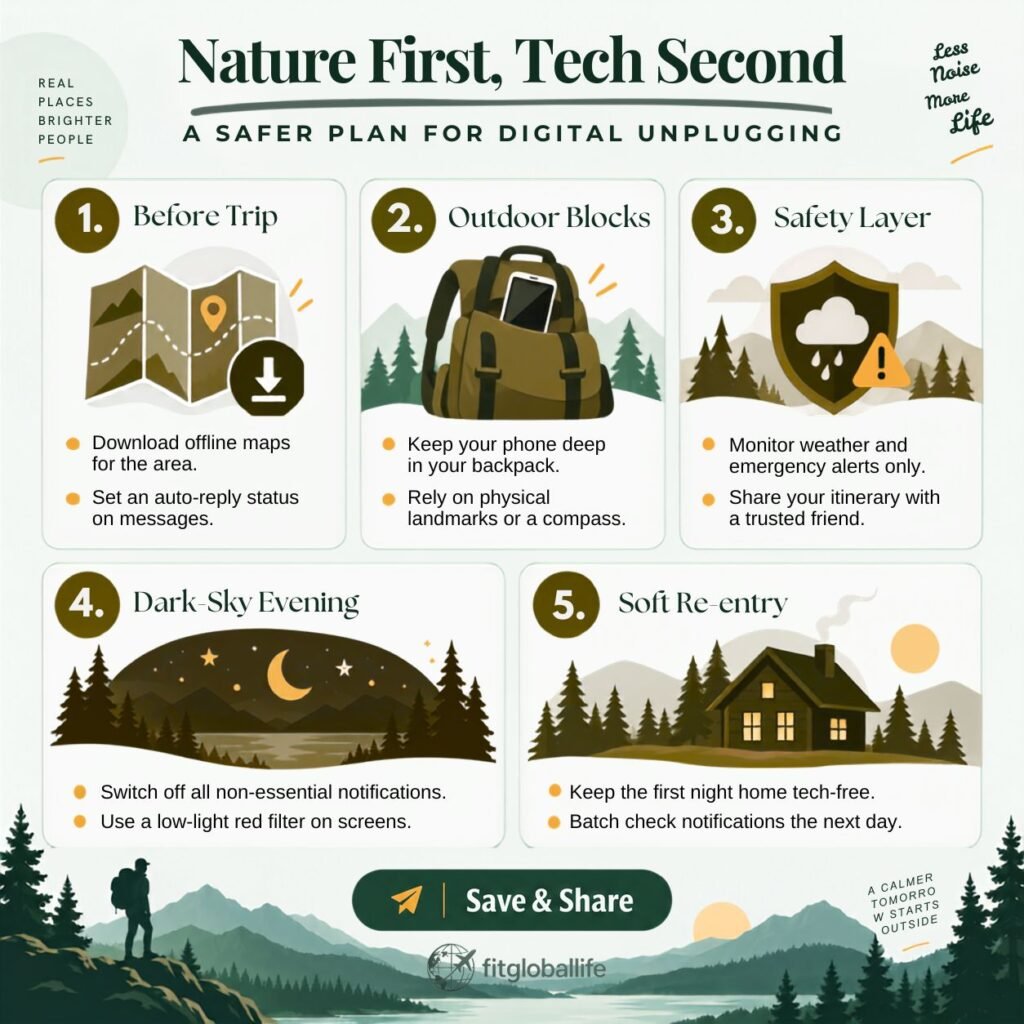
The most sustainable rule is usually specific, not absolute. “I will never use my phone” turns the device into forbidden fruit and can create practical problems. “I will check messages at 8 a.m. and 6 p.m., keep navigation and weather available, and avoid social feeds during outdoor blocks” is easier to follow and safer.
Before departure, remove the biggest friction: download offline maps, save booking confirmations, tell key people when you will be reachable, disable nonessential notifications, and move social apps off the home screen. If you are worried about focus rather than travel itself, FitGlobalLife’s guide to human skills that beat tech hype is a useful companion: attention, judgment, communication, and self-regulation still matter when the gadgets get smarter.
Design around daylight, movement, and natural sound
A nature-first day should have a physical skeleton. Go outside early enough to experience daylight. Build in walking, paddling, cycling, or another activity appropriate to your fitness and the destination. Leave one unstructured block long enough for the environment to stop feeling like a background image. At night, lower the sensory volume rather than replacing the day’s notifications with streaming.
Do not chase a magic “dose.” The 120-minutes-per-week nature study is useful population-level evidence, not a vacation timer. Likewise, a 2025 meta-analysis of nature exposure doses found meaningful mental-health benefits across varied exposure patterns but did not establish one universal ideal for every person. The better principle is repeated contact with low logistical friction. If your trip repeatedly makes nature the easiest option, you have designed well.
Keep the safety layer digital
This is the part many romantic unplugging articles skip. Keep access to weather alerts, official park notices, local emergency numbers, transport updates, permits, and navigation. On remote or technical routes, carry whatever backup communication the destination and activity warrant, and do not rely on a phone signal that may not exist. Tell someone your plan. Respect guide requirements and seasonal closures. If you have health conditions or medications, plan continuity before you travel.
Travel insurance should be considered after you understand the trip’s actual risks, exclusions, activities, evacuation realities, destination rules, and your existing coverage. If you want to compare one option after doing that independent check, you can review current SafetyWing travel insurance options. Policies, eligibility, covered activities, exclusions, pre-existing-condition rules, age limits, and evacuation provisions can change, so verify the current wording before purchase.
Plan a softer re-entry
The worst ending to a restorative trip is landing, turning on everything, and inhaling a week of notifications before baggage claim. Give yourself a re-entry buffer. Keep the first evening home low-demand if possible. Choose one behavior from the trip that survives ordinary life: a morning walk without audio, a phone-free dinner, a weekly green-space block, or a darker final hour before bed. FitGlobalLife’s tiny wellness wins you can repeat daily is built around that same principle of repeatability.
You can also use travel as data. Notice what changed when you had more daylight, walking, quiet, social connection, regular meals, or less notification traffic. The point is not to return convinced that civilization is the problem. It is to identify which environmental inputs your normal week is missing. That mindset pairs naturally with FitGlobalLife’s guide to future health signals hidden in daily life: small patterns often tell you more than dramatic interventions.
Which Nature-First Escape Fits You?
| If you feel… | Try… | Because… |
| Overstimulated but low-energy | Hossa | Easy forest/lake options allow sensory downshifting without demanding a heroic itinerary. |
| Restless and unable to sit still | Soča Valley | River walks and varied terrain give attention a physical direction. |
| Mentally scattered and craving structure | Kumano Kodo | A walking route organizes the day around simple sequential tasks. |
| Bored by “relaxing” vacations | Corcovado | Guided rainforest complexity gives the senses meaningful work. |
| Needing slowness and observation | Danube Delta | Boat pace and birdlife reward patient attention. |
| Stuck in late-night screen habits | Aoraki Mackenzie | The protected night sky makes darkness an actual activity, not dead time. |
| Craving silence and scale | NamibRand | Desert space, quiet, and dark skies strip away visual and acoustic clutter. |
If a long-haul trip is unrealistic, do not wait for the perfect destination. A nearby coast, forest, botanical reserve, lake, or even a green, walkable city can use the same design principles. FitGlobalLife’s guide to walkable cities for a healthier travel reset is the practical urban version: reduce transit friction, move more, and let the place be experienced at human speed.
Conclusion: Make the Landscape the Main Interface
The best nature-first escapes are not the places with the weakest Wi-Fi. They are the places with the strongest alternative to the feed. A pine forest gives you layers. A river gives you direction. A pilgrimage trail gives you rhythm. A rainforest gives you living complexity. A wetland teaches patience. A dark-sky reserve changes the evening. A desert gives you silence and scale.
That is the useful shift for screen-tired travelers in 2026: stop treating disconnection as deprivation. Design a trip where the physical world is interesting enough to compete. Keep the technology that protects you, guides you, and connects you when needed. Remove the technology that turns every pause into consumption.
You do not need to come home as a new person. A better outcome is smaller and more believable: you remember what sustained attention feels like, you notice which habits were easier in the right environment, and you bring one of those conditions home. The inbox will survive. Annoyingly, it has excellent endurance.
FAQ
A nature-first escape is a trip planned around the natural environment and the behaviors it enables—walking, paddling, wildlife watching, daylight, quiet, stargazing, or slow observation—rather than around a hotel, content itinerary, or strict digital-detox program. Technology remains available for safety and logistics but is intentionally made secondary.
No. For most travelers, a selective boundary is more practical: keep navigation, weather, transport, translation, emergency contacts, and necessary messages available while limiting feeds, work apps, and nonessential notifications during nature blocks.
There is no evidence-based universal vacation length. A two- or three-night trip can work if nature is easy to access and the itinerary is not overloaded. Longer trips may allow routines to settle, but duration matters less than whether the landscape genuinely dominates the day.
No. Remoteness can help to reduce digital temptation, but can also bring stress of transport, safety concerns, expense and decision fatigue. A nearby forest or coast that is easy (low friction) to access might be more restorative than an extreme off-grid trip that requires constant logistical management.
It should not be presented as treatment. Nature exposure and reduced digital strain may support attention, mood, movement, sleep-friendly routines, and subjective well-being for some people, but persistent or severe symptoms deserve assessment from an appropriate qualified professional.
Disclaimer & Affiliate Disclosure
This article is for educational and travel-planning purposes only. It does not provide medical, psychological, sleep, ophthalmic, or other professional health advice, and it does not promise that nature travel or reduced screen use will prevent, diagnose, treat, or cure any condition. Travel conditions, trail access, permits, weather, wildlife risks, transport, connectivity, insurance terms and local regulations are subject to change. Check with the official authorities and qualified local operators to verify the current information before you leave.
Some of the links may be affiliate links, meaning that if you purchase through them, FitGlobalLife.com may earn a commission at no additional cost to you. Independent evaluation is not substituted with affiliate relationships. Compare coverage, exclusions, who is covered, cancelation terms, evacuation provisions, activity restrictions and other policy details side-by-side before buying any travel product or insurance.