
The best walkable cities do something quietly powerful: they turn movement into the background music of your trip. You do not need to schedule a punishing workout, chase a sunrise hike on three hours of sleep, or pretend that 25,000 steps in bad shoes is a personality trait. In a genuinely walkable city, health becomes almost frictionless. You step out for coffee, wander through a market, cross a bridge, sit in a park, follow a canal, and by sunset your body has moved, your nervous system has softened, and your phone has spent more time in your pocket than in your hand.
That is the travel reset this guide is built around. Not luxury detox theatrics. Not “optimize every second” wellness travel. Just cities where walking is useful, beautiful, safe enough to feel natural, and emotionally restorative. The World Health Organization explains that regular physical activity helps prevent and manage noncommunicable diseases, supports mental health, and improves overall well-being, while the CDC notes that adults need at least 150 minutes of moderate-intensity activity each week. Walking is not a hack; it is the oldest operating system we have.
For FitGlobalLife readers, this article is designed as a practical bridge between travel and wellness. It pairs neatly with our broader guide to long-term health habits, but it stays focused on one specific idea: choosing destinations where healthy movement is built into the day instead of bolted onto the itinerary. If your recent trips have felt like airport stress, taxi queues, crowded attractions, restaurant overbooking, and late-night scrolling in hotel rooms, a walkable city can feel like a software update for the body.
The seven cities below are not ranked as “the healthiest cities in the world.” That would be too neat, and honestly, the internet already has enough ranking lists wearing fake lab coats. Instead, each city earns a place here because it offers a distinct kind of walking reset: calm infrastructure, compact neighborhoods, car-light centers, green corridors, cultural routes, or urban design that lets you move at human speed.
Why Walkable Cities Make Travel Feel Healthier
A walkable city changes the basic math of a trip. Instead of separating “exercise” from “sightseeing,” it fuses the two. Your morning walk becomes your orientation session. Your museum transfer becomes your step count. Your dinner route becomes a digestion ritual. This matters because travel often disrupts the habits that keep people steady: sleep timing, meal rhythm, hydration, movement, sunlight exposure, and mental boundaries. A walkable city does not solve all of that, but it gives you a surprisingly strong base.
There is real evidence behind the intuition. Public health guidance from WHO physical activity guidance and the CDC adult activity guidelines consistently points toward regular moderate activity as a foundation for cardiovascular, metabolic, and mental health. In 2023, a systematic review of walkability and the urban built environments found that improvements in walkability can affect a range of health outcomes, including physical activity and risk of noncommunicable diseases. Translation: the shape of a city can either support your body or make every healthy choice feel like a negotiation.
For travelers, walkability also lowers cognitive load. When a place is legible on foot, you make fewer micro-decisions. You are not constantly opening ride apps, calculating fares, or wondering whether a transfer will ruin the day. You learn the city through landmarks, smells, benches, bakeries, trees, and street corners. This is where travel starts feeling less like logistics and more like presence.
It also supports a more humane version of sustainable travel. The WHO describes walking, cycling, and wheeled active mobility as low-cost ways to be active for transport and recreation. Choosing compact neighborhoods, public transit, and walking routes can reduce dependence on cars while giving travelers a closer relationship with local streets. That mindset pairs naturally with FitGlobalLife’s guide to eco-conscious travel choices and the deeper idea of a regenerative travel mindset.
How We Chose These Walkable Cities
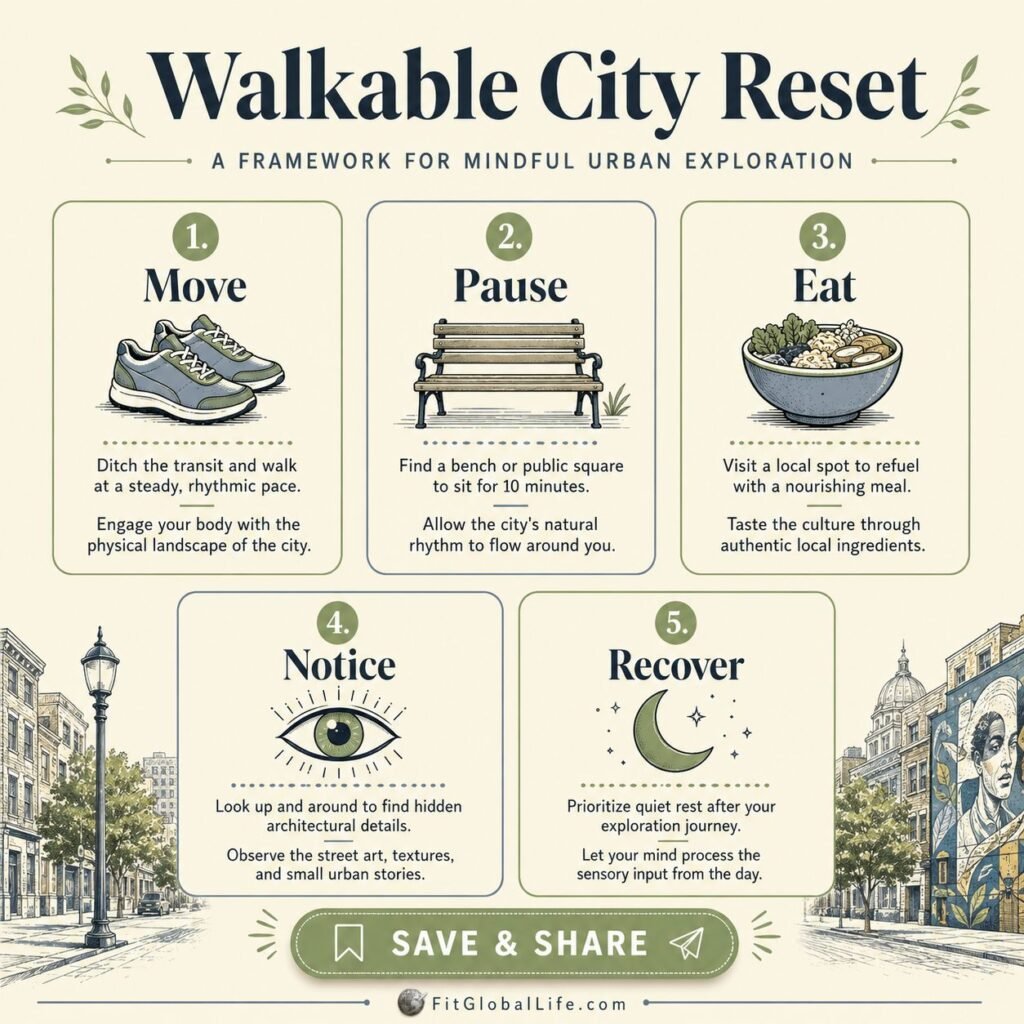
This list uses a wellness-travel lens rather than a generic tourist ranking. The selection considers:
- Compactness: key areas can be explored without long transfers.
- Everyday usefulness: walking is not just scenic; it helps you reach food, parks, museums, transit, and neighborhoods.
- Restorative quality: the city offers green space, water, quiet routes, cultural texture or human scale streets.
- Responsible Travel Fit: The city rewards slower, more respectful exploration over checklist tourism.
- Practical accessibility: strong public transport can support walkers when distances, weather, hills, or fatigue become a factor.
That last point matters. A walkable city does not mean every traveler must walk everywhere. Good walking trips include exits: trams, trains, ferries, buses, shaded pauses, hotel breaks, and the humility to stop before the body starts filing complaints. For more general preparation, use our guide to stay healthy while traveling before planning long walking days.
Quick Comparison: 7 Walkable Cities for a Healthier Travel Reset
| City | Best Reset Style | Ideal Traveler | Easy Walking Zone | Watch-Out |
| Copenhagen | Calm movement + waterfront air | Design lovers, cyclists, low-stress urban explorers | Indre By, Nyhavn, waterfront bridges | Wind and weather can shift quickly |
| Amsterdam | Canal loops + everyday mobility | Culture walkers, café hoppers, slow travelers | Canal Ring, Jordaan, Museum Quarter | Bike lanes require attention |
| Ljubljana | Car-free small-capital pause | First-time Europe travelers, couples, solo reset trips | Old Town, riverbanks, Tivoli Park | Compact; better for a short reset than a long city sprint |
| Barcelona | Sunlight + superblock-style street life | Food, architecture, beach, and urban wellness fans | Eixample, Gràcia, Gothic Quarter, waterfront | Heat and crowds require smart timing |
| Kyoto | Temple paths + mindful attention | Culture seekers, contemplative walkers | Higashiyama, Gion public streets, Philosopher’s Path | Overtourism etiquette matters |
| Singapore | Garden corridors + tropical recovery | Safety-focused travelers, families, transit users | Marina Bay, Botanic Gardens, PCN routes | Humidity: walk early or late |
| Melbourne | Laneways + river paths + creative pacing | Coffee lovers, urban creatives, casual walkers | CBD laneways, Yarra River, Carlton | Weather changes fast |
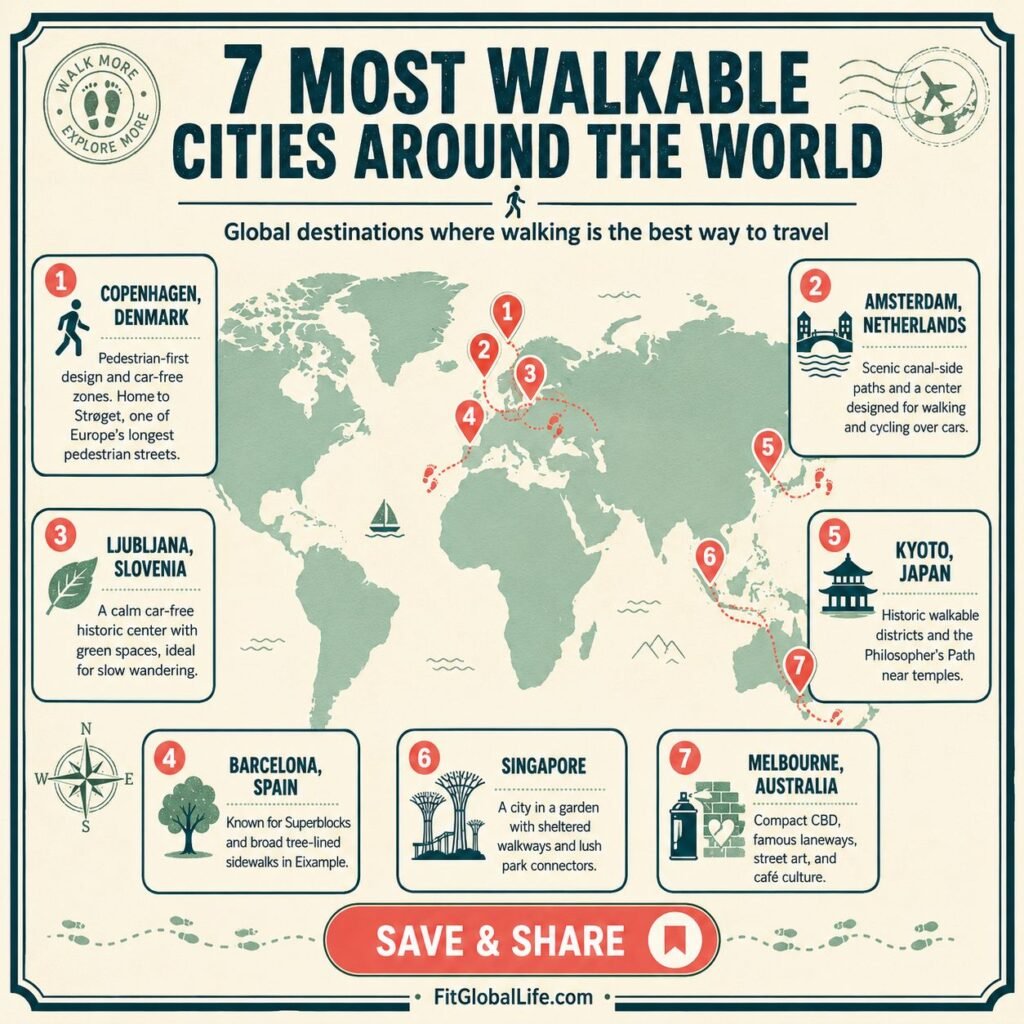
1. Copenhagen, Denmark: The Calm Movement City
Copenhagen is the kind of city that makes movement feel civilized. That sounds small until you have traveled through places where every street crossing feels like a negotiation with destiny. Here, walking and cycling sit close to the city’s identity. The city government describes Copenhagen as known worldwide for cyclists and cycle tracks, with more than every second Copenhagener biking to work or school, and the inner city seeing more bicycles than cars. Even if you are not cycling, that active-mobility culture changes the feel of the street.
For a healthier travel reset, Copenhagen works because it does not ask you to choose between design, food, water, and movement. You can start near the lakes, wander toward Torvehallerne for breakfast, curve through the historic center, cross toward Nyhavn, and keep going along the harbor. It is active, but rarely frantic. The city’s strong public spaces give you something many travelers secretly need: permission to slow down without becoming bored.
The reset here is not about chasing steps. It is about rhythm. You walk, sit, look, drink coffee, walk again, cross a bridge, notice cyclists flowing by with the calm confidence of people who have not made transport their enemy. If your normal life involves dashboard time, elevator time, and too much blue light, Copenhagen quietly reintroduces the body to everyday locomotion.
Best walking reset route
Begin around Nørreport or the lakes, walk through Torvehallerne, continue toward the Round Tower and Strøget, then drift to Nyhavn and the harbor. Add a slower waterfront loop near Christianshavn if your energy is good. Keep the first day moderate; Copenhagen rewards repeat wandering more than heroic mileage.
Wellness angle
Copenhagen is best for rebuilding baseline movement. It pairs beautifully with morning light, a clean breakfast, waterfront air, and a gentle evening walk after dinner. If you want a deeper fitness angle, connect it to our guide on how to walk beyond 10,000 steps.
Official city information on Copenhagen mobility is useful context for understanding why the streets feel unusually human-scaled. Source: Copenhagen cycling and mobility.
2. Amsterdam, Netherlands: Canal Loops and Everyday Mobility
Amsterdam is often described as a cycling capital, but it is also a walker’s city if you respect its street logic. The canal ring gives the city a natural rhythm: curve, bridge, pause, repeat. Instead of one grand boulevard experience, Amsterdam offers loops. You can move through neighborhoods in layers, letting the water organize your attention.
This is one of the reasons Amsterdam suits travelers who want a reset without disappearing into the wilderness. You can be in a museum, a quiet canal lane, a brown café, a design shop, and a park within the same gentle day. I amsterdam notes that its city map covers neighbourhoods, walking routes, museums, attractions, major sights, and hidden gems, while the City of Amsterdam’s own mobility model highlights bikes, trams, boats, and public transport as part of the city’s constant movement.
The health value is partly physical and partly psychological. Walking Amsterdam teaches micro-attention. You notice reflections, windows, bells, bikes, bridges, and the small drama of people trying to exist gracefully in narrow space. It also asks for awareness. Bike lanes are real lanes, not decorative red carpets. Look both ways, then look again, because the Dutch move like they received a secret mobility update at birth.
Best walking reset route
Start early in the Canal Ring, loop through Jordaan before peak crowding, continue toward the Nine Streets, then use Vondelpark or the Museum Quarter as a soft landing. Keep the afternoon flexible so you can pause indoors if rain arrives.
Wellness angle
Amsterdam is ideal for travelers who want culture without over-planning. It fits the logic of slow travel rhythm.
The official Amsterdam city model is useful for understanding how bikes, trams, trains, and reduced car dominance shape movement. Source: Amsterdam mobility model.
3. Ljubljana, Slovenia: The Car-Free Small-Capital Reset
Ljubljana is the city on this list that may surprise the most people, which is exactly why it belongs here. It is compact, gentle, green, and unusually easy to understand on foot. For travelers who feel overwhelmed by giant capital cities, Ljubljana offers a reset without sensory overload. The city center has been closed to motor traffic since 2007, and Visit Ljubljana describes a 20-hectare pedestrian zone that it calls the largest car-free area in the European Union.
That changes the mood immediately. Instead of dodging traffic, you follow the Ljubljanica River, cross small bridges, sit in café terraces, and wander toward the castle views or Tivoli Park. The city feels less like a destination you conquer and more like a place that lets your shoulders drop. That is a rare travel quality.
Ljubljana also works as a wellness city because its scale protects you from itinerary greed. There is only so much you can force into a day before the city gently tells you, “Friend, maybe have tea.” The best trip here is not packed. It is spacious. Morning river walk, market, castle or museum, lunch, park, evening stroll. No complicated heroics.
Best walking reset route
Use the river as your spine. Start around Prešeren Square, follow the Ljubljanica banks, cross the Triple Bridge and Dragon Bridge, then continue toward the market and castle area. Add Tivoli Park when you want a greener, quieter reset.
Wellness angle
Ljubljana is perfect for travelers who need nervous-system decompression rather than stimulation. It pairs well with our guide to body-mind recovery.
Visit Ljubljana’s sustainable mobility page provides helpful background on its car-free center and pedestrian areas. Source: Ljubljana sustainable mobility.
4. Barcelona, Spain: Superblocks, Sunlight, and Soft Urban Energy
Barcelona is not always calm. Let’s say that upfront before anyone books a July weekend on pure fantasy. It can be crowded, hot, loud, and wildly popular. But planned well, it is also one of the most interesting cities in the world for understanding how urban design can support healthier movement. The city’s superblock model has drawn global attention because it reorganizes streets to reduce through-traffic and give more room back to people.
Research on Barcelona superblocks has connected these interventions with environmental and health benefits. A 2025 study reported decreased air pollution in the Sant Antoni superblock, including a statistically significant reduction in nitrogen dioxide levels. That does not mean every visitor should treat Barcelona like a medical intervention. It means the city offers a real-world example of how street design, air quality, noise, shade, and public life are linked.
For travelers, Barcelona’s walking reset is about timing and texture. Start early. Walk Eixample when the light is soft. Move through Gràcia when neighborhood life wakes up. Save the Gothic Quarter for moments when you can handle density. Use the waterfront as a pressure valve. Eat slowly. Hydrate like an adult. This city gives a lot, but it also asks you not to act like a dehydrated checklist machine.
Best walking reset route
Build a morning route through Eixample and Sant Antoni, then use Gràcia for a slower neighborhood walk. On another day, combine the Gothic Quarter with the waterfront and a long lunch break. Avoid peak heat and use the metro strategically.
Wellness angle
Barcelona is best for travelers who want an active city break with food, sunlight, architecture, and public-space curiosity. It links naturally with our guide to hidden urban retreats.
The Barcelona superblocks evidence base is useful for supporting claims about traffic calming, public space, and environmental exposures. Source: Barcelona superblocks health evidence.
5. Kyoto, Japan: Temple Paths and Attention Restoration
Kyoto is a reminder that walkability is not only about sidewalks and transit. It is also about attention. The city invites a different pace: temple approaches, garden paths, river walks, stone lanes, small shops, seasonal colors, and long pauses that feel culturally appropriate rather than lazy. Kyoto’s official travel guide highlights sample itineraries, responsible travel guidance, nature, culture, and getting-around resources, which is exactly what visitors need in a city balancing beauty with overtourism pressure.
The healthier reset here comes from sensory focus. A good Kyoto walking day is not about distance; it is about noticing. The sound of gravel. The edge of a tiled roof. Incense in the air. The way a path bends just enough to slow the mind. If you normally live in tab overload, Kyoto can train your attention back toward the world.
But Kyoto also demands manners. Some areas, especially around Gion, include private lanes and residential spaces where tourism has created tension. Healthy travel is not just about your nervous system; it is also about the city’s nervous system. Stay on public streets, follow signs, keep voices low, do not photograph people without consent, and treat local life as real life, not a movie set. The reset works better when respect is part of the route.
Best walking reset route
Choose one focused walking area per day: Higashiyama and public Gion streets, the Philosopher’s Path, Arashiyama early in the morning, or a quieter temple cluster away from peak routes. Use trains and buses between zones rather than trying to walk the entire city.
Wellness angle
Kyoto is ideal for attention restoration, gentle pacing, and reflective travel. It pairs with FitGlobalLife’s guide to morning rituals.
Kyoto’s official tourism site is a reliable starting point for responsible travel guidance and route planning. Source: Kyoto official travel guide.
6. Singapore: Garden Corridors and Tropical Recovery Walks
Singapore is one of the easiest cities in Asia for first-time wellness travelers because it combines safety, public transport, food access, greenery, and serious walking infrastructure. It is not “effortless” in the sense of weather; the humidity is absolutely a main character. But if you walk early, hydrate well, and use shade intelligently, Singapore offers a uniquely polished urban nature reset.
The National Parks Board describes the Park Connector Network as island-wide routes across Singapore that include park connectors, trails, and footpaths. That matters because the healthiest walking trips are not only about the center. Singapore lets you connect gardens, waterfronts, neighborhoods, and food stops in a way that feels surprisingly restorative for such a dense city.
The key is not to copy a local runner’s routine on day one. Build soft loops. Marina Bay at sunrise. Botanic Gardens before breakfast. A shaded park connector walk when energy is good. Hawker food afterward because wellness without joy is just punishment with branding. Singapore’s food culture also makes it easy to build a practical recovery meal if you know what you are looking for: protein, vegetables, fluids, and not turning every stop into a fried noodle summit.
Best walking reset route
Start with Marina Bay or the Singapore Botanic Gardens for an accessible first walk. On a second day, choose one Park Connector Network segment and pair it with nearby food and MRT access. Avoid long midday walks unless you are heat-adapted.
Wellness angle
Singapore is best for travelers who want urban nature, safety, transit backups, and flexible food options. For meal planning while moving, connect it with smart travel habits.
NParks is the official source for Singapore’s park connector routes and recreational connectivity. Source: Singapore park connector network.
7. Melbourne, Australia: Laneways, River Paths, and Creative Pace
Melbourne is a walking city in a different mood: creative, caffeinated, layered, and weather-confused in a way locals have made into civic personality. It gives you laneways, galleries, gardens, the Yarra River, tram-supported wandering, and neighborhoods that reward slow curiosity. The City of Melbourne’s walking information points to planning actions like reallocating traffic lanes to pedestrian space, reducing crossing distances, and improving the walking environment.
For wellness travel, Melbourne works because it lets you alternate stimulation and recovery. You can start with coffee and laneways, move through the Royal Botanic Gardens, follow the river, then retreat into a bookstore, gallery, or quiet meal. Unlike cities where every attraction shouts at you, Melbourne often works through small discoveries. That makes it good for travelers who need novelty without chaos.
The risk in Melbourne is trying to do too many neighborhoods in one day. Fitzroy, Carlton, Southbank, the CBD, St Kilda, Collingwood, and the gardens all sound close until your feet begin a class-action lawsuit. Use trams as part of the reset. A healthy walking trip is not a purity contest. It is a way of using movement to feel more alive, not a way to prove you are indestructible.
Best walking reset route
Use the CBD laneways as a morning loop, walk toward the Yarra River, then continue to the Royal Botanic Gardens if weather is friendly. On a second day, choose one neighborhood such as Fitzroy or Carlton and explore deeply instead of hopping everywhere.
Wellness angle
Melbourne is ideal for creative decompression, café culture, and walking supported by public transport. It pairs well with our guide to science of rest.
The City of Melbourne’s walking resources support its focus on pedestrian comfort and safer walking environments. Source: City of Melbourne walking plan.
How to Turn a City Walk Into a Travel Reset
The city matters, but the way you walk matters just as much. A travel reset is not created by cramming more movement into an already overloaded itinerary. It is created by using walking as a rhythm-setter. That means you begin the day with a manageable route, create pauses before you are tired, eat in a way that supports energy, and let the city’s texture replace the constant need for digital stimulation.
Start with one anchor route per day. Do not stack five disconnected walking zones just because they look close on a map. Choose a neighborhood, river route, park corridor, or cultural district, then give it time. This approach fits the philosophy of travel with purpose: the point is not to see everything; the point is to return with your attention intact.
Second, use the 20-minute arrival walk. After checking into your accommodation, do not immediately collapse into the bed-scroll vortex. Walk gently for 20 minutes around your block. Find water, transit, a grocery, a café, and one quiet corner. This small orientation walk reduces uncertainty and helps your body understand the neighborhood. It is the travel equivalent of stretching before a workout, except there is probably better coffee.
Third, protect your sleep. Walking helps, but travel sleep can still get wrecked by late meals, alcohol, noise, jet lag, and revenge scrolling. If sleep is a weak point, read our guide to digital detox habits before the trip and consider a lighter evening route instead of a late-night itinerary. The healthiest city walk is the one that helps tomorrow feel possible.
Fourth, treat shoes as equipment, not fashion decoration. Bring one pair already broken in, with enough grip for cobblestones, rain, hills, or long museum floors. Fashion pain is still pain. There is nothing glamorous about limping through a UNESCO district because your shoes were chosen by optimism and bad lighting.
Finally, build recovery into the day. A walkable city gives you more movement, but more movement still requires care. Hydrate, eat protein, sit in shade, stretch calves and hips, and stop before you become heroic. If your body needs a lower-stimulus day, use the principles from our digital-free reset and give yourself permission to travel quietly.
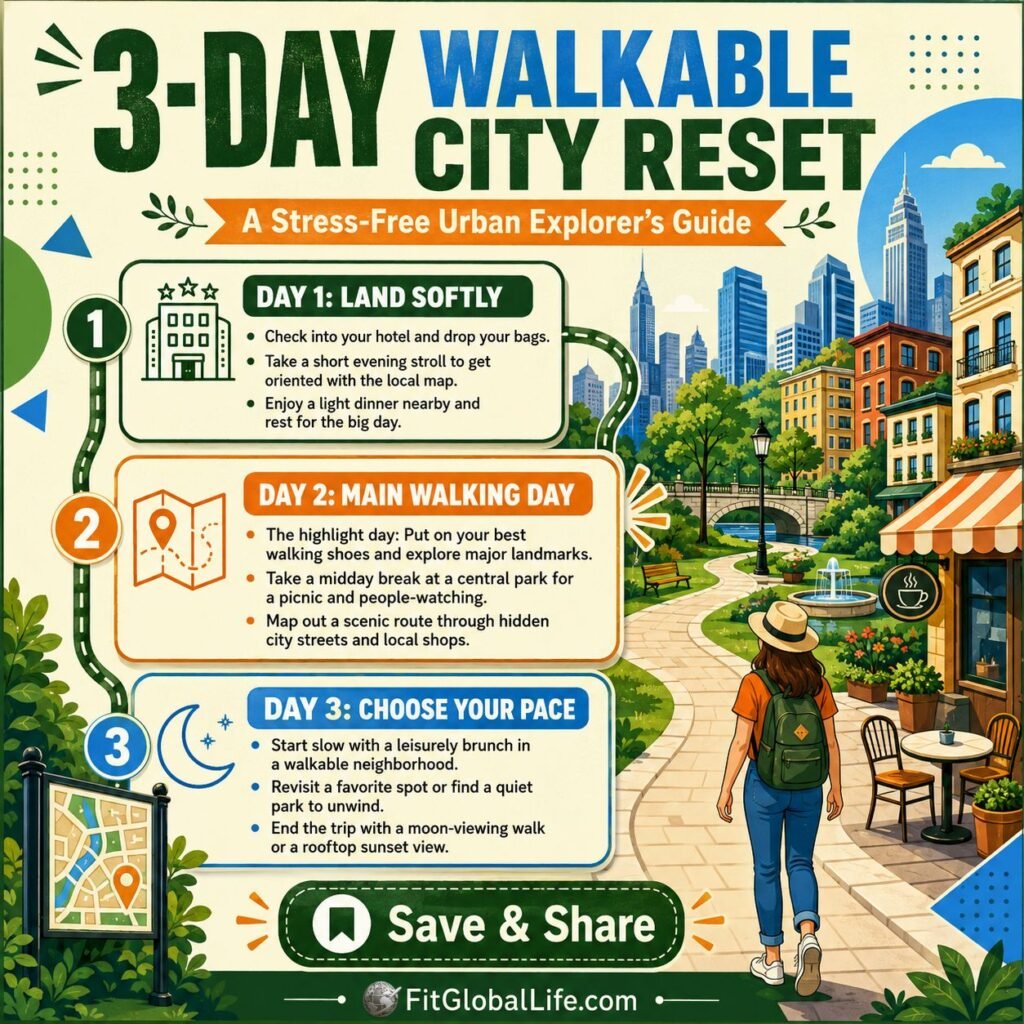
Sample 3-Day Walkable City Reset Itinerary
| Day | Morning | Midday | Evening | Wellness Focus |
| Day 1: Land softly | 20-minute neighborhood orientation walk + breakfast | One compact cultural route, no forced detours | Gentle dinner walk, early wind-down | Reduce travel stress and regain body rhythm |
| Day 2: Main walking day | Primary scenic route before crowds or heat | Long lunch, museum, park, or café pause | Short sunset route or transit-supported return | Build moderate activity without overreaching |
| Day 3: Choose your pace | Green space, river path, or market walk | Free time for one neighborhood | Pack early, hydrate, light meal | Leave restored, not wrecked |
If you are planning a longer trip, combine this template with a broader self-care habits approach: sleep first, movement second, food third, then experiences. That order sounds simple because it is. The hard part is remembering it when the itinerary starts flirting with chaos.
Final Thoughts: Choose a City That Lets Your Body Lead
The best walkable cities are not just pretty places with sidewalks. They are cities where the body becomes part of the itinerary in a natural way. Copenhagen gives movement calm. Amsterdam gives loops. Ljubljana gives softness. Barcelona gives street-life energy. Kyoto gives attention. Singapore gives green corridors. Melbourne gives creative pacing. Different cities, different resets.
The real takeaway is that travel can support health without turning into a wellness performance. You do not need to prove anything. You need a city that lets you move, breathe, pause, eat well enough, sleep reasonably, and pay attention. That is the kind of reset that lasts longer than a hotel robe selfie.
For a deeper foundation, use this guide as a companion to FitGlobalLife’s article on long-term health habits. Walkable travel is one expression of a bigger principle: the healthiest habits are often the ones that fit so naturally into life that you stop negotiating with them.
FAQ
They can be, especially when walking replaces short car trips, supports moderate daily activity, lowers travel stress, and creates more outdoor time. The city alone is not magic; the benefit comes from combining walkable design with pacing, sleep, hydration, and realistic routes.
Ljubljana is one of the easiest first choices because it is compact, calm, and car-light in the center. Copenhagen and Amsterdam are also excellent, but they require more awareness around cycling traffic. Singapore is great for safety and greenery if you can manage humidity.
Do not obsess over one number. Many travelers feel good around 8,000 to 15,000 steps on active days, but fitness level, heat, hills, sleep, and footwear matter. The goal is to return restored, not injured.
Many are good with some smart planning, but accessibility varies from neighborhood to neighborhood. Cobblestones, hills, heat, crowds and long distances can be tricky. Use public transport, choose central accommodation, plan rest stops and check accessibility info before booking.
Sometimes, yes. A walkable city can offer movement, culture, sunlight, food and reflection at a lower cost than many retreats, but if you need structured healing, therapy, medical care or deep rest, then a retreat or professional support may be more appropriate.
Disclaimer
This article is for general travel and wellness education only. It is not medical advice, diagnosis, or treatment. Walking routes, accessibility, safety conditions, weather, public transport and local rules may change. If you have a medical condition, mobility issues, are pregnant, have cardiovascular concerns, are sensitive to the heat or have a history of injuries, consult a qualified health professional before planning long walking days. Always check official local sources before travelling and respect residents, signage, private property, cultural norms and protected spaces.