
Health habits that age well are not the loudest habits on the internet. They rarely arrive with dramatic before-and-after photos, a celebrity routine, or a complicated tracker that turns breakfast into a spreadsheet. They are quieter than that. They are the habits that keep paying you back when your calendar changes, your body changes, your work changes, your family responsibilities change, and your definition of ambition matures.
A habit that works at 25 but breaks at 45 is not a life system. It is a season. There is nothing wrong with seasonal experiments; they make life interesting. But pillar habits need a longer job description. They should support energy without demanding perfection, protect your body without punishing it, improve your mind without turning wellness into another performance contest, and remain realistic when life gets beautifully messy.
This guide is written for people who want a durable approach to healthy aging without treating aging as an enemy. The goal is not to chase youth forever. That storyline is tired, expensive, and honestly a little dramatic. The better goal is to build a body and mind that remain responsive: able to walk, learn, rest, connect, digest, adapt, and recover across decades. That is where real longevity becomes less about biohacking and more about daily architecture.
The science also points in a practical direction. The World Health Organization identifies physical inactivity, unhealthy diet, tobacco use, harmful alcohol use, and air pollution as major risk factors for noncommunicable diseases, while cardiovascular disease, cancer, chronic respiratory disease, and diabetes account for a large share of premature deaths worldwide. Those risks sound huge, but many of the most protective moves are ordinary enough to start this week.
For readers who enjoy the habit side of wellness, this article can sit naturally beside FitGlobalLife’s guide to daily wellness routines, because the best rituals are not just aesthetic. They are repeatable under pressure.
Why Health Habits That Age Well Matter More Than Trends
The wellness world loves novelty. One month the main character is cold exposure. The next month it is glucose curves, nervous system mapping, collagen timing, red-light panels, digital fasting, peptide rumors, or some other protocol with a name that sounds like it came from a spaceship manual. Some of these ideas are useful. Some are overmarketed. Most are not harmful when used sensibly. But novelty has a weakness: it often asks, “What is the most advanced thing I can add?” Healthy aging asks a better question: “What is the simplest thing I can repeat for the next ten years?”
A decade-proof habit has three qualities. First, it has biological leverage. It touches systems that matter across age: muscle, sleep, blood pressure, blood sugar, mood, mobility, cognition, social connection, and recovery. Second, it has emotional realism. It does not assume you will always be motivated, wealthy, rested, single, child-free, pain-free, or living near a perfect gym and an organic market. Third, it is adjustable. You can scale it up during easy seasons and scale it down during hard seasons without abandoning the identity behind it.
This matters because most people do not fail health because they know nothing. They fail because the plan is too brittle. A person starts with a strict meal plan, gets busy, misses two days, feels like the plan is broken, and quietly returns to default living. Another person begins intense training, ignores recovery, gets injured, and associates exercise with pain. Someone else downloads a meditation app, misses the streak, and decides their brain is simply not built for stillness. The pattern is not lack of ambition. The pattern is poor habit design.
Health habits that age well should feel less like a temporary challenge and more like a personal operating system. They become the defaults you return to after travel, illness, deadlines, grief, parenting chaos, or the random Tuesday where everything goes sideways. The question is not whether you can do them perfectly. The question is whether they can still serve you when perfection is unavailable. Spoiler: perfection is unavailable most of the time. Very rude, but true.
That is why this pillar guide focuses on durable behaviors, not fragile hacks. If you want a deeper companion on rest, FitGlobalLife’s article on the science of intentional rest is a strong internal next step, especially for readers who confuse rest with laziness.
The Decade-Proof Habit Framework
Before the nine habits, it helps to define what “ages well” actually means. A habit ages well when it remains useful across multiple life stages. Walking ages well because it can be social, meditative, metabolic, cardiovascular, and accessible in many settings. Sleep consistency ages well because every age group benefits from circadian stability, even when sleep duration changes. Muscle ages well. Strength training is not just about looking fit, it supports mobility, handling glucose, bone health, independence and confidence.
By contrast, a habit ages poorly when it depends on extreme conditions. A diet that only works when every meal is weighed and prepped in advance may not survive travel or family life. A fitness routine that depends on two-hour sessions may disappear when work intensifies. A stress tool that only works in a silent room may fail exactly when stress is loudest. The body does not need a perfect lifestyle. It needs enough good signals, repeated often enough, for long enough.
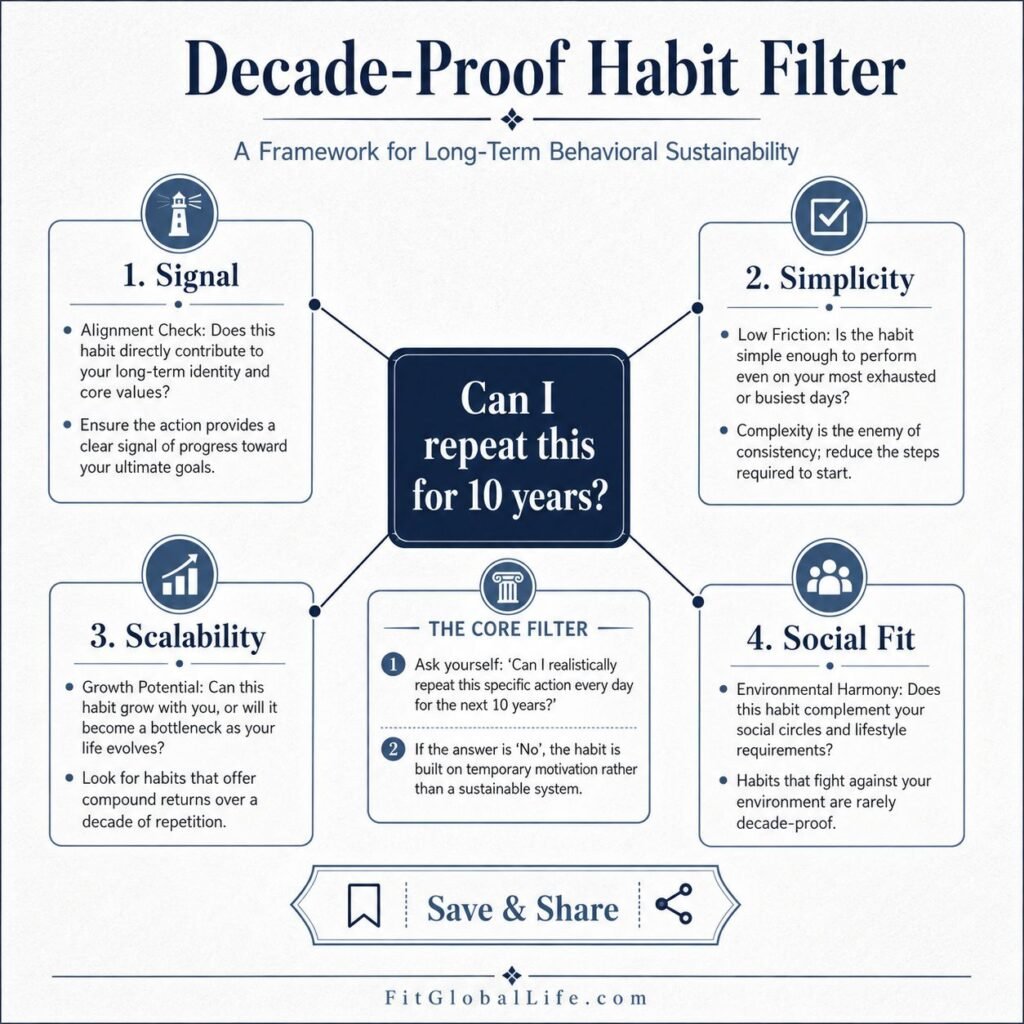
The framework used in this article has four filters: signal, simplicity, scalability, and social fit. Signal means the habit sends a meaningful message to the body: move, repair, nourish, connect, learn, regulate, or prevent. Simplicity means the habit has a low entry point. Scalability means it can grow with capacity. Social fit means it can coexist with real meals, real relationships, real work, and real cultures. A habit that isolates you from life is not wellness; it is a very organized form of stress.
This framework also respects the fact that health is not evenly distributed. Access to safe neighborhoods, fresh food, medical care, time, clean air, supportive relationships, and stable income shapes what is realistic. A trustworthy wellness article should not pretend that everyone starts from the same place. The best advice offers options, not judgment. Start where you are. Adjust for your body, budget, culture, climate, and care responsibilities. Then build upward without turning your life into a guilt machine.
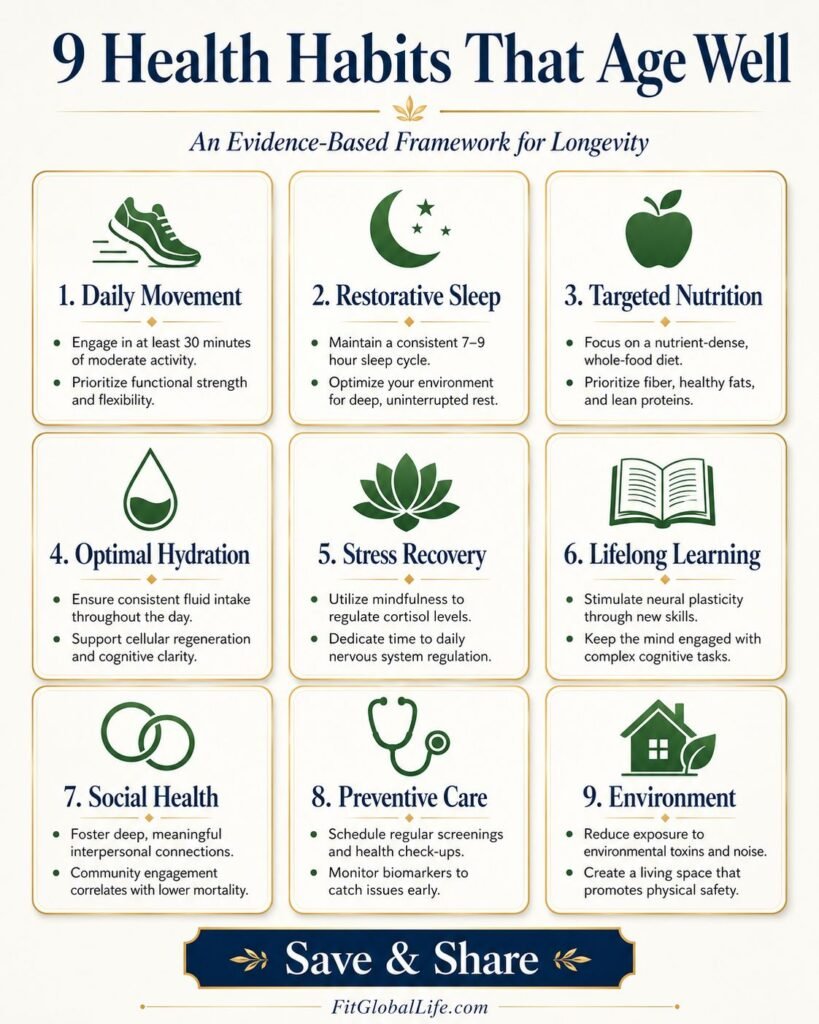
Quick Overview: 9 Health Habits That Age Well
| No. | Habit | Core idea | Decade-proof adjustment |
| 1 | Movement portfolio | Cardio, strength, mobility, balance, and light daily movement | Use short sessions when life is full; increase volume when capacity returns. |
| 2 | Sleep protection | Regular sleep-wake rhythm and quieter evenings | First, protect the timing. Then optimize the bedroom, light, caffeine, and stress. |
| 3 | Food pattern | Protein, plants, fibre, healthy fats and meal rhythm | Build plates, not diet identities. |
| 4 | Hydration Basics | Water, electrolytes as necessary, and less sugar | Start with water before the pricey powders. |
| 5 | Recovering From Stress | Breathing, Boundaries, Rest Breaks and Nervous System Downshifts | Recover Every Day Instead of Waiting for Burnout. |
| 6 | Cognitive training | Learning, problem-solving, creativity and attention exercises | Challenge the brain but don’t overburden it. |
| 7 | Social health | Friendship, community, repair and belonging | Design for connection before isolation becomes the default |
| 8 | Preventive care | Screenings, dental care, blood pressure, labs, early signals | Keep track of useful data without worrying about every metric. |
| 9 | Healthy environment | Home, food, light, movement, and digital defaults | Make the better choice easier than the unhealthy one. |
1. Build a Movement Portfolio, Not a Fitness Personality
The most durable movement habit is not a single workout. It is a portfolio. In your 20s, you may be able to survive on intensity and enthusiasm. In your 40s, recovery becomes louder. In your 60s, balance and strength become non-negotiable. Across every decade, the body benefits from variety: aerobic capacity, muscle strength, mobility, balance, coordination, and low-level daily movement. A portfolio gives you options when one lane is temporarily closed.
The World Health Organization recommends that adults accumulate at least 150 to 300 minutes of moderate-intensity aerobic activity each week, or 75 to 150 minutes of vigorous activity, plus muscle-strengthening activities on two or more days. The exact format can vary. Brisk walking, cycling, swimming, dancing, hiking, resistance bands, bodyweight training, gardening, and stair climbing can all count when done with enough consistency and intention.
For a science-backed way to understand aerobic work without turning every session into a heroic sweat festival, see FitGlobalLife’s breakdown of Zone 2 cardio for longevity. It pairs well with the WHO physical activity fact sheet, which emphasizes that inactivity remains a global health challenge.
The mistake is building a fitness identity so narrow that it cannot age. If you are only a runner, an injury can feel like an identity crisis. If you are only a gym person, travel can derail you. If you only do high-intensity workouts, stress-heavy seasons may make exercise feel like another demand on an already overworked nervous system. A movement portfolio protects you from that brittleness. You are not “a runner” or “a lifter” or “a yoga person.” You are a person who moves in different ways to support different systems.
A simple weekly template could look like this: two strength sessions, two to four walks, one longer low-intensity cardio session, five minutes of mobility most days, and one balance practice tucked into daily life. Balance can be as humble as standing on one leg while brushing your teeth, although please do not turn your bathroom into a circus. Mobility can be a short hip, spine, and shoulder flow. Strength can be squats, hinges, pushes, pulls, carries, and core work. You do not need fancy choreography; you need repeatable patterns.
The most underrated part of movement for aging is not peak performance. It is capacity preservation. Can you carry groceries? Get off the floor? Climb stairs without panic? Walk after meals? Travel with energy? Play with children? Keep posture under a laptop life? Those daily abilities are not glamorous, but losing them changes the texture of life. Movement is not only about adding years; it is about keeping the years usable.
How to practice it in your 20s, 30s, 40s, 50s, and beyond
In your 20s and 30s, build skill and tissue tolerance. Learn good technique, experiment widely, and avoid confusing soreness with success. In your 40s and 50s, protect strength, joints, and recovery. Warm up more honestly, add mobility, and keep intensity but stop worshiping exhaustion. In your 60s and beyond, strength and balance deserve front-row seats, not pity seats. The goal is not to train like a younger person. The goal is to train like someone who expects the future to need them.
When motivation drops, use the two-minute entry rule. Put on shoes and walk for two minutes. Do one set of squats. Stretch one tight area. Often the body continues once started. If it does not, you still voted for the identity. Health is built from votes, not speeches. Tiny reps count because they keep the channel open between who you are and who you are becoming.
2. Protect Sleep Like a Biological Investment Account
Sleep is the habit people praise and then negotiate away. It is treated like leftover time, even though it influences mood, appetite, immune function, learning, memory, blood pressure, and recovery. The reason sleep ages well as a habit is simple: every decade needs repair. You may sleep differently at 55 than at 25, but the need for a steady recovery rhythm does not disappear. The body keeps receipts, and sleep debt is a collector with no chill.
The CDC notes that adults generally need at least seven hours of sleep each day, and short sleep duration is associated with insufficient sleep. But for a practical lifestyle article, the point is not to scare people into bed. Fear is a terrible pillow. The point is to treat sleep as a scheduled biological investment rather than a reward you earn after finishing everything. Everything will not be finished. Your inbox is immortal.
A strong sleep habit begins with rhythm: consistent wake time, morning light, a caffeine cutoff that respects your body, dimmer evenings, and a realistic wind-down ritual. Readers exploring travel-based sleep recovery can also connect this section to FitGlobalLife’s feature on healthy travel routines, while the CDC adult sleep facts provide a useful public-health baseline.
A decade-proof sleep system has three layers. The first is timing. Going to bed and waking up at wildly different times creates circadian confusion. The second is environment. Cooler temperature, lower light, less noise, and a phone that does not behave like a tiny casino can all help. The third is nervous system state. If your body is still in argument mode, deadline mode, or doomscroll mode, the bedroom becomes a place where fatigue and alertness fight for the microphone.
The practical habit is not “sleep perfectly.” It is “protect the runway.” A runway is the 30 to 60 minutes before bed when you reduce stimulation. That may mean stretching, reading something non-inflammatory, writing tomorrow’s priorities on paper, taking a warm shower, or doing simple breathing. It may also mean not solving your entire life at 11:43 p.m. The late-night brain is dramatic. Do not hire it as your strategist.
Sleep also improves when daytime behavior supports it. Morning light helps anchor the body clock. Movement builds sleep pressure. Alcohol may make someone drowsy but can fragment sleep quality. Heavy late meals, emotional conflict, and intense evening work can keep the system activated. None of this requires obsession. It requires pattern recognition. If you wake up tired most mornings, the question is not “What supplement fixes me?” It is “What signals did my day send my night?”
The sleep habit that ages best: consistency before perfection
Consistency beats occasional perfection. A person with a stable seven-hour rhythm may be better served than someone who sleeps five hours on weekdays and attempts a heroic recovery sleep on Sunday. Life will create exceptions: newborns, caregiving, travel, illness, celebrations, deadlines. The goal is not to panic when sleep breaks. The goal is to return gently to rhythm.
Try a weekly sleep audit. Look at wake time, caffeine timing, evening light, alcohol, exercise, bedroom temperature, and mental load. Choose one lever for the next week. This keeps sleep practical and compassionate. It also prevents the common wellness trap of trying to fix ten variables at once, failing by Thursday, and blaming your willpower instead of the ridiculous size of the plan.
3. Eat for Muscle, Microbes, and Metabolic Flexibility
Nutrition ages well when it stops being a costume. Low-carb, high-carb, plant-based, Mediterranean, flexitarian, high-protein, ancestral, fasting-friendly, glucose-aware: each approach can contain useful ideas, but the identity can become louder than the physiology. Across decades, a durable food pattern should support muscle, the gut microbiome, steady energy, cardiovascular health, and a peaceful relationship with eating.
The simplest lens is muscle, microbes, and metabolic flexibility. Muscle needs adequate protein and resistance training. Microbes need fiber, plant diversity, and fermented foods when tolerated. Metabolic flexibility needs a pattern that does not swing wildly between restriction and chaos. The plate does not have to be perfect. It should be legible: protein, plants, fiber-rich carbohydrates when appropriate, healthy fats, flavor, and enough satisfaction to prevent the midnight snack goblin from becoming your nutrition coach.
For readers who want food examples, FitGlobalLife already has practical guides to plant-based protein choices, gut-brain nutrition basics, and nutrient-dense snack ideas. The WHO healthy diet guidance adds a global baseline, including recommendations on fruits, vegetables, salt, and free sugars.
Aging changes nutrition priorities. In younger adulthood, many people focus on body composition or performance. By midlife, blood pressure, cholesterol, glucose, digestion, and inflammation become harder to ignore. Later in life, preserving muscle and appetite can become more important than chasing low calorie intake. That means a habit that ages well cannot be only about restriction. It must also be about nourishment.
One useful practice is the “first plate” method. Before worrying about supplements, ask what appears on your first real meal of the day. Is there protein? Is there fiber? Is there color? Is there fluid? Is there something satisfying enough to reduce grazing later? This is not moral purity. It is metabolic kindness. If breakfast is chaotic, lunch often becomes reactive. If lunch is reactive, dinner becomes a negotiation with fatigue.
Another durable habit is plant diversity. You do not need to eat like a nutrition influencer with twelve bowls and edible flowers. But rotating legumes, greens, berries, citrus, whole grains, nuts, seeds, herbs, spices, and colorful vegetables gives the gut more material to work with. Fermented foods can help some people, but tolerance matters. If a food makes you miserable, forcing it because it is trendy is not health. It is peer pressure with probiotics.
The plate rhythm that survives every diet trend
A practical decade-proof plate rhythm is this: build most meals around a protein anchor, a fiber anchor, a color anchor, and a flavor anchor. Protein might be fish, eggs, tofu, tempeh, beans, lentils, yogurt, poultry, or lean meat. Fiber might be oats, beans, vegetables, berries, chia, whole grains, or root vegetables. Color brings micronutrients and polyphenols. Flavor brings pleasure, and pleasure matters because a joyless diet has the lifespan of a phone battery at 1 percent.
This habit does not require perfection at every meal. It requires a strong default. Travel days, celebrations, and cultural foods belong in a real life. The question is whether your average pattern supports your future body. A healthy diet that cannot share a table with family, travel, or celebration is too fragile. Food should support longevity without making life smaller.
4. Hydrate and Mineralize Before You Optimize
Hydration is so basic that people skip it in favor of more exciting interventions. That is a mistake. Water supports temperature regulation, digestion, circulation, kidney function, cognition, and physical performance. Dehydration can show up as unclear thinking, mood changes, overheating, constipation, or headaches. It is not glamorous, but neither is being cranky because your body is basically a houseplant begging for help.
A decade-proof hydration habit is not about forcing a universal number. Fluid needs vary with body size, climate, activity, sweat rate, pregnancy, breastfeeding, medication, illness, and diet. The better habit is to create cues: water after waking, water with meals, water before caffeine if caffeine tends to dominate your morning, water after exercise, and extra fluids in heat or altitude. Urine color can be a rough cue, but it is not a complete diagnostic tool. Use common sense and medical guidance if you have kidney, heart, or endocrine conditions.
The CDC water and healthier drinks guidance notes that water can help prevent dehydration and can reduce calorie intake when it replaces sugary drinks. For FitGlobalLife readers, this also connects well with simple lifestyle pieces on the science of self-care, because hydration is self-care without the scented candle tax.
Mineralizing matters when sweating is high, food intake is low, or a person trains in heat. Sodium, potassium, magnesium, and other electrolytes help fluid balance and nerve-muscle function. That does not mean everyone needs neon electrolyte powder every day. Many people get enough through food. Others may benefit during long exercise, hot weather, sauna use, or illness. The wise habit is context, not hype.
A simple hydration upgrade is replacing one sweetened drink per day with water, sparkling water, unsweetened tea, or water flavored with citrus, mint, cucumber, or berries. Another is eating water-rich foods: soups, fruit, vegetables, yogurt, and smoothies made with whole-food ingredients. The goal is not to become a hydration monk. It is to stop mistaking thirst, fatigue, and low-grade irritability for personality flaws.
Hydration also supports healthy aging through indirect pathways. When people drink enough, they may move more comfortably, digest better, think more clearly, and rely less on sugary beverages for energy. That cascade matters. Many “big” health changes begin as tiny frictions removed from the day.
Why simple hydration still beats most wellness hacks
The reason hydration ages well is that it has almost no trend risk. It will not become obsolete because a new app launches. It does not require a retreat, a lab test, or a complicated identity. It is a small lever with broad relevance. The main sophistication is learning your context: climate, sweat, medication, caffeine, alcohol, exercise, and medical needs.
Use a practical rule: hydrate before optimizing. Before blaming energy crashes on hormones, productivity, or motivation, check sleep, meals, fluids, movement, and stress. Not because these explain everything, but because they explain enough to deserve first attention. Basic does not mean weak. Basic means foundational.
5. Train Stress Recovery, Not Just Stress Resistance
Modern culture often praises stress resistance: push harder, stay productive, be resilient, keep going, do not complain. There is value in grit, but grit without recovery becomes a slow leak. A habit that ages well does not merely help you tolerate stress. It helps you complete the stress cycle, return to baseline, and notice when the load is becoming too expensive.
Chronic stress has been associated with biological pathways linked to accelerated aging, including inflammation and telomere dynamics. That does not mean every stressful week is destroying you. The body is built to handle challenge. The problem is chronic activation without repair: months or years of poor sleep, emotional suppression, financial pressure, social conflict, overwork, and no reliable downshift. Stress is not just in the calendar. It is in the nervous system.
For practical nervous system tools, FitGlobalLife readers can move from this section into somatic practices for stress relief, breathwork reset techniques, or mindfulness at work. For scientific context, this review on stress and accelerated aging review summarizes several biological mechanisms connecting chronic stress with aging processes.
The decade-proof stress habit has two parts: acute tools and structural honesty. Acute tools are the practices you use in the moment: slow exhale breathing, a walk, grounding, stretching, journaling, music, prayer, meditation, or stepping outside. These are not magic spells. They are signals of safety and regulation. They help the body shift from alarm into recovery.
Structural honesty is harder. It asks whether your life is organized in a way that keeps demanding regulation without changing the source of dysregulation. If your schedule is overloaded, your boundaries are ornamental, your phone is a stress slot machine, and every relationship requires emotional tiptoeing, five minutes of breathing will help but not solve the architecture. Sometimes the healthiest habit is a conversation, a boundary, a budget review, a job change, a therapy appointment, or saying no without writing a legal defense.
Stress recovery also has physical anchors. Movement metabolizes stress chemistry. Sleep restores. Protein and fiber stabilize energy. Social support buffers threat. Nature lowers cognitive noise for many people. Creative play reminds the brain that life is not only output. These are not separate wellness categories; they are a web. Pull one thread and the others move.
The nervous system habit: recover before you collapse
Do not wait for burnout to become obvious. Build recovery into ordinary days. Try a three-minute reset between work blocks. Step outside after a difficult meeting. Use a breathing practice before opening email in the morning. Stretch your jaw, neck, and hips after long sitting. End the day with a simple “what can wait?” list. These small practices sound too humble until you realize they prevent the body from living in a constant emergency broadcast.
The goal is not to become calm all the time. A healthy nervous system is not flat. It can activate, focus, care, grieve, celebrate, protect, and rest. Stress recovery gives you range. That range is one of the most underrated forms of healthy aging.
6. Keep Learning Hard Things, Gently and Repeatedly
Cognitive health is not only about avoiding decline. It is about staying engaged with life. The National Institute on Aging describes cognitive health as the ability to think, learn, and remember clearly, and it is necessary for everyday function. A habit that ages well should challenge the brain without turning learning into another hustle metric. You do not need to become a productivity cyborg. You need to keep asking your brain to adapt.
Learning hard things can mean studying a language, practicing music, taking dance classes, learning photography, writing essays, solving puzzles, improving financial literacy, cooking unfamiliar cuisines, navigating new places, or building a skill for work. The common ingredient is effortful novelty. The task should be challenging enough to require attention but not so humiliating that you quit. The sweet spot is “slightly uncomfortable but still inviting.”
If focus feels scattered, FitGlobalLife’s resources on a simple digital detox protocol and a nature-based brain fog reset can support this habit. The NIA cognitive health overview is also a useful external reference for readers who want a broad public-health explanation of cognitive health.
The brain ages better with use, but use has to be varied. Passive consumption is not the same as learning. Watching ten videos about guitar is not the same as forming chords until your fingers protest. Reading about meditation is not the same as sitting with your thoughts and discovering that your mind has apparently opened seventeen browser tabs. Learning requires feedback. Feedback can be awkward. That is part of the medicine.
Attention is the gatekeeper. If your attention is constantly fragmented, deep learning becomes harder. This is why digital boundaries matter. The goal is not to hate technology. Technology is useful. The goal is to stop letting the most addictive systems in history train your attention for free. Create friction: app limits, notification pruning, phone-free meals, single-task blocks, and intentional boredom. Boredom is not failure; it is often the lobby where original thought waits.
Creative learning is especially powerful because it combines cognition, emotion, identity, and expression. Drawing, writing, music, cooking, gardening, and craft give the brain meaningful complexity. They also offer visible progress, which is motivating across age. You do not need to be good at the beginning. In fact, being bad at something safely is a healthy adult experience. It reminds you that growth is still available.
Cognitive reserve is built in boring reps
Do not over-romanticize cognitive training. Much of it is boring repetition with small improvements. Ten minutes of language practice. One page of writing. One music scale. One recipe. One memory technique. One map learned without GPS. The reps matter because they keep the brain active and self-trusting.
A practical plan is to choose one learning lane per quarter. Keep it small enough to survive real life: three 20-minute sessions per week, one class, one notebook, one project. Measure engagement, not genius. The point is not to become impressive. The point is to stay plastic, curious, and capable of surprise.
7. Build Social Health Before You Need It
Social health may be the most underrated longevity habit because it does not always look like a habit. It looks like texting a friend back. Showing up. Repairing after conflict. Joining a walking group. Eating with people. Asking better questions. Remembering birthdays. Building community before loneliness becomes the default setting. In a hyperconnected era, many people are socially undernourished while digitally overstimulated. Very futuristic, very sad, very fixable.
The CDC describes loneliness and social isolation as widespread concerns that can threaten mental and physical health, and WHO has highlighted links between loneliness, social isolation, and increased risks including stroke, heart disease, diabetes, cognitive decline, and premature death. Social connection is not a decorative lifestyle bonus. It is health infrastructure.
FitGlobalLife’s piece on micro-communities for mental longevity can become an excellent cluster article here, while the CDC social connection health risks gives readers a credible public-health source for why connection belongs inside a wellness pillar.
A social habit that ages well has depth, rhythm, and repair. Depth means at least a few relationships where honesty is possible. Rhythm means connection happens regularly enough that it does not depend on crisis. Repair means conflict does not automatically end the bond. Many adults lose friendships not because they stop caring, but because logistics slowly win. Distance, work, children, caregiving, moves, money, and exhaustion can make friendship feel like an admin task. The answer is not guilt. It is design.
Design can be simple. A monthly breakfast. A Sunday voice note. A walking date. A shared class. A small group chat with actual plans, not just memes. A recurring dinner where the food is easy and nobody performs. A neighbor check-in. A community garden. A volunteer role. A faith group. A hobby club. The format matters less than repetition. Social connection needs a container, or it gets swallowed by busyness.
The quality of connection matters too. Not every relationship is healthy. Some drain, belittle, manipulate, or keep the nervous system on alert. Healthy aging requires both more connection and better boundaries. Longevity is not served by collecting people who make you smaller. Social health includes discernment: who helps you become more honest, alive, generous, steady, and brave? Keep watering those bonds.
Relationships are health infrastructure
The Harvard Study of Adult Development has long emphasized the importance of relationships and life satisfaction in healthy aging. The lesson is not that every person needs a huge social circle. Some people thrive with a few deep bonds. Others need broader community. The key is reliable connection: people who notice when you disappear, celebrate when you grow, and tell you the truth kindly. A readable overview from Harvard is available in this Harvard Study of Adult Development summary.
A simple weekly practice is the two-touch rule: make two meaningful social touches each week. A call, a message, a meal, a walk, a letter, a repair attempt, or an invitation. Keep it human. Algorithms can recommend content. They cannot replace being known.
8. Make Preventive Care a Seasonal Ritual
Preventive care is where many wellness conversations get weirdly quiet. People will discuss supplements, cold plunges, and morning routines for hours, then avoid blood pressure checks, dental care, vaccines, skin checks, medication reviews, or basic screenings. A habit that ages well includes the boring medical maintenance that catches small problems before they become expensive plot twists.
Preventive care is not fear-based living. It is stewardship. Your body sends signals through blood pressure, blood sugar, cholesterol, dental health, vision, hearing, skin changes, menstrual changes, sleep patterns, pain, mood, and energy. Not every signal is an emergency. Not every metric deserves obsession. But ignoring all signals because you feel “mostly fine” is not a strategy. It is suspense.
The American Heart Association Life’s Essential 8 offers a clear framework around eating better, being active, quitting tobacco, healthy sleep, weight, cholesterol, blood sugar, and blood pressure. That framework fits naturally with this article because it turns prevention into everyday behaviors rather than a once-a-decade panic.
A seasonal ritual makes preventive care less intimidating. Once per quarter, review one category: appointments, movement, nutrition, sleep, stress, relationships, and environment. Once per year, review age-appropriate screenings with a qualified clinician. Dental cleanings, eye exams, vaccinations, blood pressure checks, lab work, cancer screenings, and medication reviews will vary by age, sex, history, country, and personal risk. This article cannot prescribe your schedule, but it can encourage you to stop treating preventive care as optional adulthood DLC.
Tobacco cessation deserves special mention because it is one of the most powerful health moves at any age. The CDC states that quitting smoking improves health status, reduces the risk of premature death, and can add as much as ten years to life expectancy. That does not mean quitting is easy. Nicotine dependence is real. Support, medication, counseling, quitlines, and community can matter. Shame is not a treatment plan.
For readers who smoke or used to smoke, the CDC quitting smoking benefits is a credible external link to include in this section. If heat therapy is part of a broader wellness routine, FitGlobalLife’s article on sauna longevity protocols can be internally linked with a reminder that sauna is not a replacement for clinical prevention.
Preventive care also includes mental health. Persistent sadness, anxiety, irritability, trauma symptoms, substance misuse, sleep disruption, disordered eating, and loss of interest deserve support. Therapy, community care, medication when appropriate, and lifestyle support are not signs of weakness. They are signs that the system is being maintained. A car gets maintenance without a moral crisis. Your nervous system can too.
Track signals, not anxieties
The healthiest tracking is useful, proportionate, and actionable. Blood pressure readings can be useful. A sleep trend can be useful. A symptom journal can be useful. But tracking becomes unhealthy when it turns every normal fluctuation into alarm. The question is: will this data help me make a decision, have a better conversation with a clinician, or understand a pattern? If yes, track. If it only feeds anxiety, simplify.
A quarterly “health admin hour” is boring in the best way. Book appointments, refill prescriptions, check insurance or local healthcare options, update emergency contacts, review family history, and note questions for your clinician. Future you will not clap loudly, but they will benefit. Sometimes maturity looks like calendar reminders. Glamorous? No. Effective? Absolutely.
9. Design an Environment That Makes Health Automatic
The final habit may be the most practical: stop asking motivation to do a job that environment can do better. Motivation is moody. Environment is patient. If your shoes are visible, walking is easier. If fruit is washed, snacks improve. If your phone charges outside the bedroom, sleep has a fighting chance. If your calendar has movement blocks, exercise becomes less negotiable. If your friends meet for walks, connection and movement stack together. Good design turns healthy choices into the path of least resistance.
Environment includes physical space, digital space, social space, and food space. A health-supportive home does not need to look like a magazine. It needs cues. A water bottle near your desk. A grocery list that repeats core foods. A bedroom that is darker and cooler. A chair that does not destroy your spine. A walking route you actually like. A kitchen that makes simple meals possible. A phone home screen that does not open with chaos.
This section pairs well with FitGlobalLife’s article on mind-body recovery practices because the body often follows the cues the room provides. Readers interested in time-efficient movement can also use exercise snacks as a practical bridge between environment design and movement.
Digital environment is especially important now. Notifications, infinite scroll, autoplay, and algorithmic outrage are not neutral. They shape attention, stress, sleep, posture, relationships, and self-image. A decade-proof health habit includes digital hygiene: fewer notifications, intentional app placement, screen-free transitions, protected sleep time, and periodic audits of what your feeds make you feel. If an app consistently leaves you anxious, inadequate, or angry, that is data. Do not ignore it because the icon is cute.
Food environment matters too. People often blame discipline when the real issue is exposure. If ultra-processed snacks are the easiest option during fatigue, fatigue will choose them. If basic ingredients are available, visible, and easy to assemble, meals improve without drama. Stock defaults: eggs, yogurt, tofu, beans, lentils, greens, frozen vegetables, fruit, nuts, whole grains, olive oil, herbs, spices, and proteins that fit your culture and budget. The goal is not a perfect fridge. It is a fridge that can rescue you from decision fatigue.
Social environment may be the deepest layer. If everyone around you treats exhaustion as status, you will have to fight harder for rest. If your community normalizes walking, cooking, therapy, sleep, learning, and honest conversation, healthy choices become less lonely. This is why retreats, communities, and group practices can be powerful when they are ethical and accessible. The environment tells the body what kind of life is normal.
Your future self needs fewer decisions, not more motivation
Design one default per habit. Movement: shoes by the door. Sleep: phone outside the bedroom. Food: protein ready. Hydration: water visible. Stress: a two-minute breathing cue. Learning: a book or course tab ready during a protected block. Social health: one recurring touchpoint. Preventive care: quarterly admin hour. Environment: Sunday reset. These defaults are small, but they reduce negotiation. Negotiation is where good intentions go to nap.
The point is to build a life where health is not constantly dependent on heroic self-control. Hero mode is useful in emergencies. It is a terrible lifestyle. Automatic healthy cues make aging feel less like a battle and more like a collaboration with your future body.
The 4-Season Reset Plan for Health Habits That Age Well
A pillar article should not only explain. It should give readers a way to act. The 4-season reset is a simple yearly rhythm that keeps health habits fresh without making life feel like a permanent challenge. Each season, choose one primary habit and one supporting habit. Keep the rest at maintenance level. This prevents the common mistake of trying to overhaul everything every January and quietly quitting by the time the snacks return.
| Season | Theme | Primary habits | Why it works |
| Season 1 | Foundation | Sleep rhythm + hydration | Stabilize energy before adding intensity. |
| Season 2 | Capacity | Movement portfolio + protein/fiber plates | Build strength, aerobic base, meal consistency. |
| Season 3 | Regulation | Digital boundaries + stress relief | Improve recovery + decrease background noise. |
| Season 4 | Connection | Social health + preventive care | Strengthen relationships and handle health admin before year-end. |
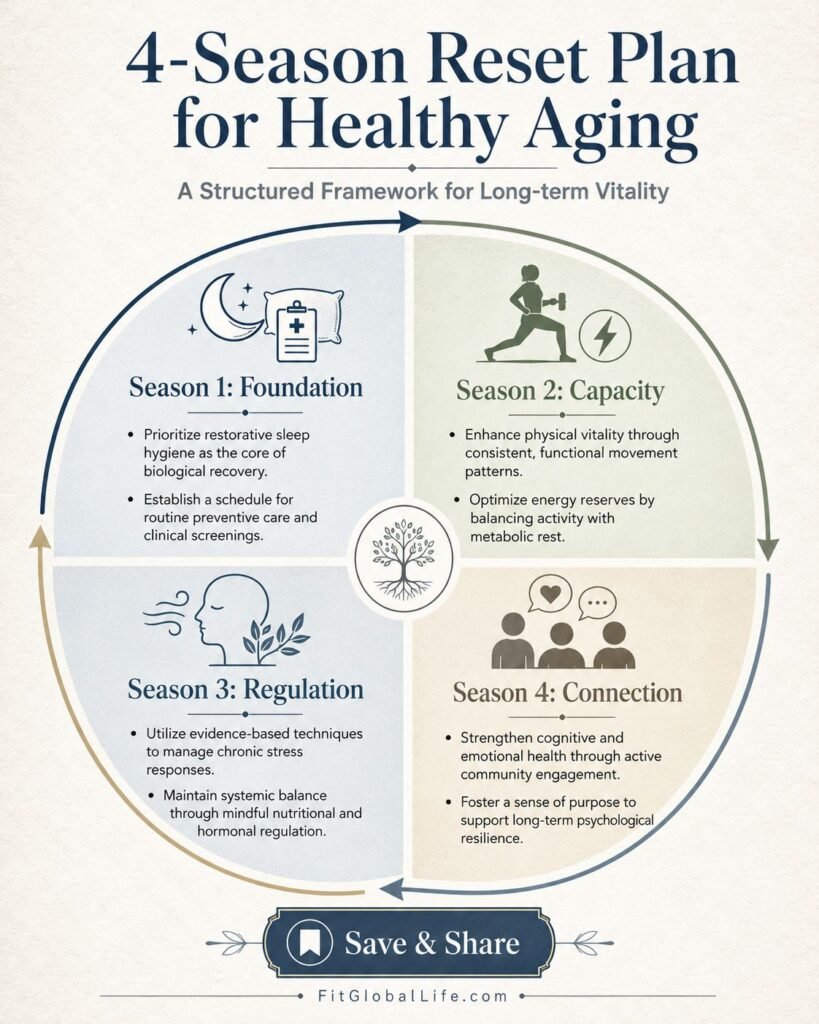
The reset works because it respects attention. Humans can change, but attention is finite. When everything is urgent, nothing becomes embodied. Seasonal focus gives each habit room to become familiar. It also creates a built-in review point. At the end of each season, ask: What became easier? What still feels fragile? What needs a smaller version? What support would make this more realistic?
This is also where cultural and personal adaptation matters. A person in a tropical climate may design movement and hydration differently than someone in a cold city. A caregiver may need micro-sessions rather than long routines. A frequent traveler may need portable defaults. A person recovering from illness may need clinical guidance and slower progress. The best plan is not the most impressive plan. It is the one your real life can carry.
Common Mistakes That Make Healthy Habits Age Poorly
The first mistake is chasing intensity before consistency. Intensity can be useful, but without consistency it becomes a dramatic guest star. A ten-year habit usually begins embarrassingly small. Small is not weak. Small is how the nervous system learns that change is safe.
The second mistake is confusing restriction with discipline. Discipline should create freedom, not fear. If a food plan makes you anxious, socially isolated, or unable to respond to hunger and fullness, it may not be aging well. Nourishment needs structure and flexibility.
The third mistake is outsourcing self-trust to devices. Wearables can help, but they can also make people doubt their own signals. If your watch says recovery is low but you feel good, observe both. If your watch says sleep was fine but you feel terrible, observe both. Data is a conversation, not a dictator.
The fourth mistake is treating rest as a reward instead of a requirement. Rest is not what you do after you have earned the right to be human. Rest is part of the system that allows effort to continue.
The fifth mistake is building habits alone when the environment is working against you. Change becomes easier when the room, calendar, grocery list, phone, and people around you support the identity you are practicing.
Conclusion: Build a Life Your Older Self Can Inherit
Health habits that age well are less about controlling the future and more about becoming a better ancestor to your own body. Your older self will inherit the movement you protected, the sleep rhythms you respected, the meals you repeated, the friendships you watered, the stress you learned to recover from, and the medical signals you did not ignore. They will also inherit your compassion. That part matters.
Aging is not a failure of youth. It is the long unfolding of a life. The goal is not to look unchanged across decades. The goal is to remain connected to your body, useful to your community, curious in your mind, and honest enough to adjust when a habit stops serving you. Some seasons will be strong. Some will be tender. Some will require rebuilding. That is not inconsistency. That is being alive.
Start with one habit this week. Not nine. One. Take a walk. Set a wake time. Add protein and fiber to breakfast. Drink water before the second coffee. Practice one slow exhale. Call someone. Book the appointment. Put the phone outside the bedroom. Make the next healthy choice easier. Then repeat. The future is not built in one cinematic transformation. It is built in small agreements kept with yourself, long after the trend has moved on.
FAQ About Health Habits That Age Well
The best health habits that age well are variety in movement, consistent sleep, nourishing meals, hydration, stress recovery, continuous learning, social connection, preventive care, and environmental design.They are important because they support many systems in the body and can be modified to fit different stages of life.
Start with one primary habit and one tiny supporting habit. For example, begin with a 20-minute walk three times per week and a glass of water after waking. When those feel normal, add another layer. Sustainable health is built through sequencing, not self-ambush.
Yes. Many health habits remain valuable later in life, particularly strength training, balance work, social connection, sleep rhythm, nutrition, hydration and preventive care. The specific plan should be adapted to medical history, fitness level, medications and clinician guidance.
Some people do well with supplements in the context of specific needs or deficiencies, but supplements are no substitute for sleep, movement, nutrition, social connection, stress recovery, and preventative care. Advanced tools may be helpful in some cases, but the basics are worth giving the highest priority as they affect many systems simultaneously.
Some changes — hydration, walking, sleep timing — can boost energy in days or weeks. Strength, metabolic health, social connection, and stress recovery usually compound over months. The deeper reward comes when habits become part of your identity rather than a temporary project.
Medical Disclaimer
This article is for educational and informational purposes only and does not replace professional medical advice, diagnosis, or treatment. Health needs vary by age, medical history, medication use, pregnancy status, disability, and personal risk factors. Always consult a qualified healthcare professional before making major changes to exercise, diet, supplements, sleep treatment, stress management, or preventive care routines, especially if you have a medical condition or symptoms that concern you.