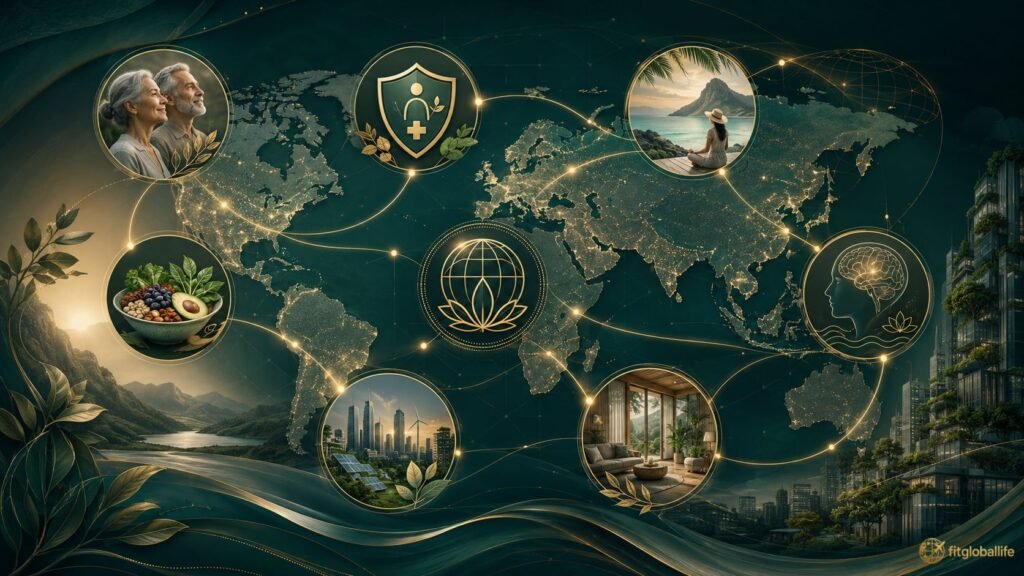
The biggest wellness economy shifts 2026 will not be defined by louder promises, shinier wearables, or another miracle powder with a luxury label. The more interesting shift is quieter: wellness is moving from aspiration to infrastructure. It is becoming part of how people travel, eat, sleep, work, age, recover, build homes, choose communities, and decide what deserves their money.
That does not mean the wellness market is suddenly pure, perfect, or immune to hype. Please, no one needs a $90 bottle of moon-charged water to become a functioning adult. But the category has matured. The Global Wellness Institute reported that the global wellness economy reached $6.8 trillion in 2024 and projected it could approach $9.8 trillion by 2029. That scale changes the conversation. Wellness is no longer a soft lifestyle niche sitting beside the real economy. It is part of the real economy.
For FitGlobalLife readers, the question is not simply, “What is trending?” A better question is: which trends will actually improve daily life, protect long-term health, and survive beyond social media noise? This article reads the wellness economy like a practical map. It connects market data with everyday choices, from health habits that age well to smarter travel, nutrition, recovery, and digital boundaries.
This is a pillar-style guide because the topic is broad enough to connect multiple FitGlobalLife categories: Insights, Wellness, Travel, Mind, Nutrition, and Retreats. Each section can later support more focused cluster articles, but the goal here is to give readers the big picture first.
Why Wellness Economy Shifts 2026 Matter Now
Wellness used to be sold as an upgrade: a retreat, a spa weekend, a premium supplement, a yoga membership, a boutique fitness class. In 2026, it is increasingly being treated as a form of risk management. People are not only trying to look better. They are trying to feel less fragile in a world that keeps asking them to be endlessly available, emotionally resilient, physically productive, and financially careful.
There are three forces underneath the shift. First, people are aging. The World Economic Forum healthy ageing discussion around global demographic change notes that the population aged 60 and above is expected to rise from 1.1 billion in 2023 to 1.4 billion in 2030. That makes healthy aging more than a personal interest. It becomes a labor market issue, a family issue, a housing issue, and a healthcare capacity issue.
Second, chronic disease has become expensive enough that prevention can no longer remain a polite side note. In the United States, the CDC chronic disease costs data shows that people with chronic and mental health conditions account for the overwhelming majority of annual health care expenditures. Even if your audience is global, the lesson travels well: waiting until people break is not an elegant business model.
Third, consumers have become more demanding. The McKinsey Future of Wellness survey found that younger consumers increasingly treat wellness as a daily, personalized practice rather than occasional self-care. Gen Z and millennials are especially influential, driving a larger share of wellness spending than their population share would suggest. That does not mean every TikTok trend is wise. It means the market has learned that younger consumers research, compare, track, question, and remix wellness into identity.
A good 2026 wellness article needs to hold two truths at once. One: the wellness economy is becoming more evidence-driven, preventive, and integrated. Two: parts of the industry still overpromise, overcharge, and overcomplicate basic health. The strongest brands, platforms, retreats, clinics, cities, and media sites will succeed by helping readers separate useful signal from expensive fog.
The 2026 Wellness Economy at a Glance
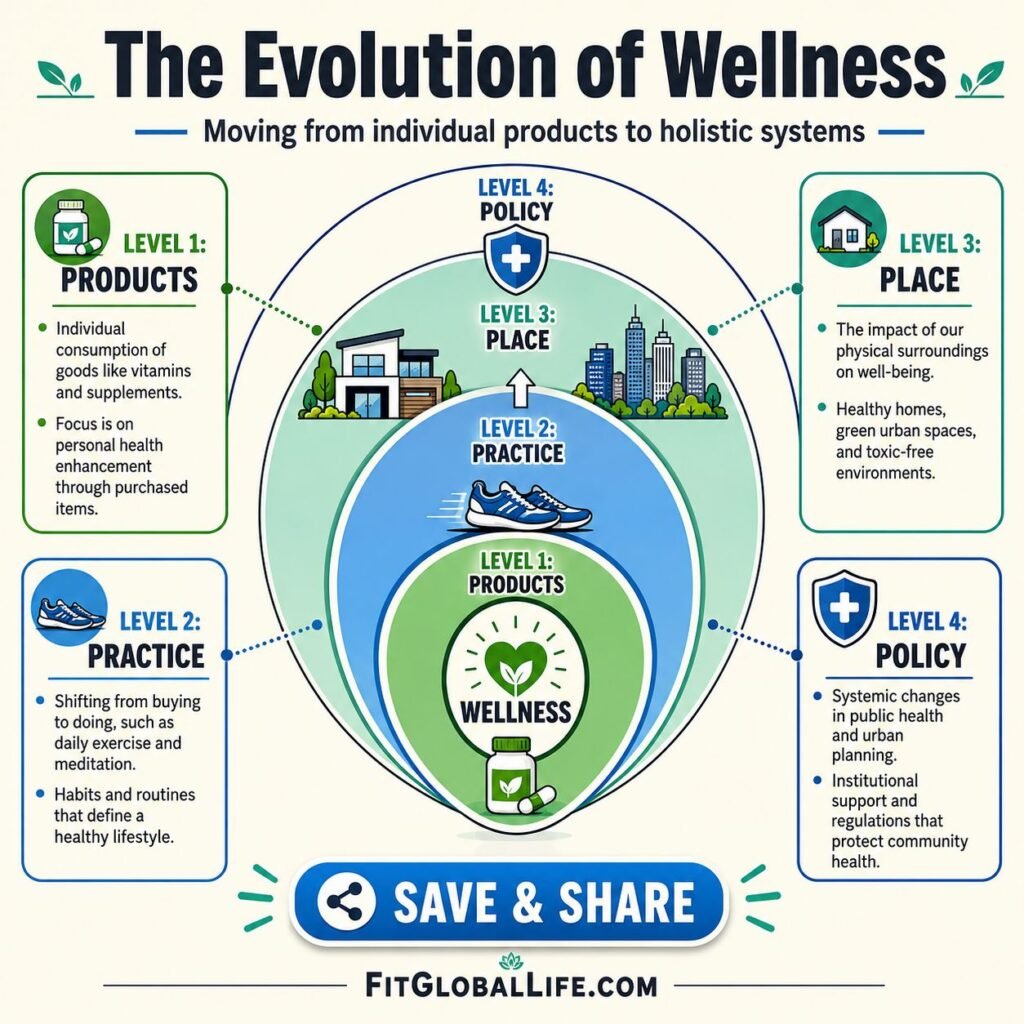
Before diving into the seven shifts, here is the simple version: wellness is moving from products to systems. The market is still full of products, of course, but the deeper growth is in connected routines, built environments, preventive services, travel experiences, data interpretation, and community-based behavior change.
| Signal | What the data suggests | Why it matters |
| Market scale | Global wellness economy reached $6.8T in 2024 | Wellness is now a macroeconomic category, not a niche lifestyle trend. |
| Growth outlook | Projected 7.6% annual growth from 2024-2029 | Brands will chase growth, but readers will need better filters. |
| Fast-growing sectors | Wellness real estate and mental wellness emerge from GWI data | workplaces, cities and emotional regulation become wellness spaces. |
| Consumer behavior | Younger consumers are personalizing wellness daily | Content must be practical, evidence-aware, and not condescending. |
| Economic logic | Preventive health can create major productivity gains | Wellness becomes tied to health systems, employers, and insurers. |
| Cultural tension | Optimization fatigue is rising | The next wave favors humane routines over constant self-surveillance. |
The lesson for readers is refreshingly practical: stop asking whether wellness is “real” or “fake” as a single category. It is both. The better filter is whether a solution improves one of the foundations of health: movement, nutrition, sleep, stress regulation, connection, environment, recovery, access, or meaning. That is also why related FitGlobalLife guides on the science of rest and mindfulness at work matter inside an economy article. The money follows the habits.
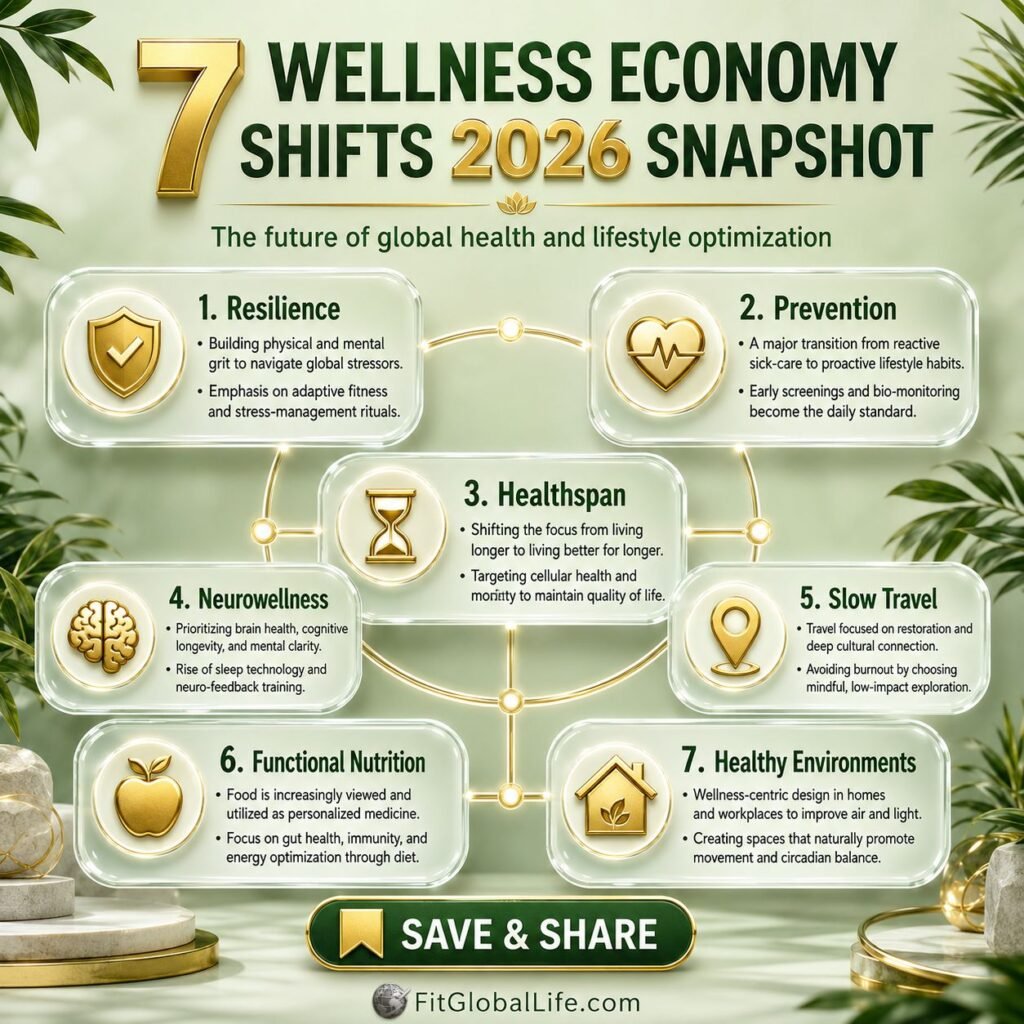
Shift 1: Wellness Becomes Resilience Infrastructure
The first major shift is the move from wellness as personal indulgence to wellness as resilience infrastructure. That phrase sounds corporate, but the human meaning is simple: people want systems that help them stay steady before life gets messy.
The Global Wellness Summit 2026 trends highlighted “Ready Is the New Well,” arguing that climate disruption, anxiety, and crisis preparedness are increasingly becoming part of wellness. That is a serious pivot. It suggests that the wellness economy is no longer just selling calm after stress. It is starting to sell preparedness before stress.
In practical terms, resilience infrastructure can show up in small and large ways. A fitness studio may become a local gathering place during heat waves. A retreat may teach nervous-system regulation and emergency readiness instead of only offering massages and smoothies. You can measure risk of burnout in a workplace by redesigning workload, light exposure, breaks, and meeting culture—not some performative survey. A hotel can market sleep, hydration, and low-stimulation rooms as core service standards—not luxury add-ons.
This is where wellness starts overlapping with urban design, hospitality, public health, and climate adaptation. FitGlobalLife already touches this idea through guides on regenerative travel and slow travel habits. The 2026 version goes further: a healthy trip is not just a trip that makes the traveler feel better. It should also reduce strain on local communities, support real recovery, and respect the environmental reality of the destination.
For readers, the practical filter is this: does a wellness experience make you more capable when ordinary life resumes? A weekend escape that helps you sleep and breathe again is useful. A premium experience that leaves you dependent on expensive add-ons to feel okay may be less useful. The next economy will reward wellness that builds capacity, not just mood.
What to watch in 2026
- More hotels and retreats adding heat, air-quality, sleep, and quiet-room features as basic wellness infrastructure.
- Gyms, studios and community spaces that market themselves as hubs of emotional and physical resilience.
- Wellness brands are changing the conversation from perfection to preparedness, stability and recovery.
- Greater scrutiny of whether wellness tourism truly supports host communities or simply extracts calm from them.
Shift 2: Prevention Becomes the Business Model
The second shift is bigger than any single product category: prevention is becoming an economic argument. For decades, people heard that prevention was better than cure. In 2026, the market is finally starting to behave as if that sentence has a balance sheet.
The McKinsey Health Institute has argued that scaling proven, cost-effective health interventions could generate enormous economic value by 2050, with nearly two-thirds of impact coming from preventive interventions. It also notes that many countries spend a surprisingly small share of health budgets on prevention. That gap is where a more mature wellness economy can either help—or exploit.
Helpful prevention looks boring at first glance: blood pressure control, earlier screening, better sleep, physical activity, nutrition support, smoking reduction, mental health access, muscle-preserving movement, and healthier built environments. But boring is underrated. Boring is where people actually live. The future of prevention is less about a single heroic protocol and more about removing friction from the everyday behaviors that lower risk over years.
That is why prevention overlaps with health habits that age well. The most durable habits are not extreme. They are repeatable across decades: walking, strength work, sleep regularity, protein and fiber at meals, human connection, stress recovery, preventive checkups, and a relationship with technology that does not hijack the nervous system.
This shift also changes how wellness content should be written. A prevention-first article should not shame readers or pretend everyone has equal resources. The OECD prevention and primary care spending discussion reminds us that prevention is hard to isolate in health spending and often sits inside primary care. In plain English: prevention is not just an individual willpower project. It depends on access, affordability, insurance, work schedules, neighborhood design, and medical trust.
For brands, the temptation will be to slap “preventive” onto every premium offer. For readers, the filter should be stronger: Is this supported by credible evidence? Does it reduce a real risk? Is it accessible enough to become a habit? Does it complement, rather than replace, medical care? If the answer is no, it is probably not prevention. It is branding wearing a white coat.
What to watch in 2026
- More wellness clinics offering early diagnostics, metabolic health programs, and personalized prevention packages.
- Employers and insurers testing preventive incentives for sleep, movement and chronic disease risk.
- Consumer skepticism of ambiguous “immune boosting” claims and need for transparent evidence.
- More information connecting normal routines with medical advice, especially about staying healthy on the road.
Shift 3: Longevity Moves From Biohacking to Healthspan
Longevity will remain one of the loudest wellness words in 2026, but the smarter conversation is moving away from the fantasy of never aging and toward healthspan: the years people can live with strength, mobility, clarity, purpose, and independence.
The wellness industry loves an extreme character: the executive with a biometric dashboard, the influencer with a freezer full of supplements, the billionaire chasing cellular youth. Interesting? Sometimes. Useful for ordinary people? Not always. The stronger longevity economy is less about becoming a lab experiment and more about building lives where proven basics are easier to practice.
The Global Wellness Summit 2026 trends also points to women getting a more serious lane in longevity, with attention shifting beyond generic male-centered protocols toward women’s healthspan, menopause, strength, ovarian aging, diagnostics, and life-stage-specific support. That matters because wellness cannot claim to be personalized while treating half the population as an afterthought. Tiny detail, huge market correction.
At the same time, longevity is becoming a lifestyle design issue. FitGlobalLife readers interested in sauna longevity protocols may enjoy emerging research around heat exposure, but a serious longevity lens would still ask: does this practice fit safely with age, cardiovascular status, hydration, sleep, and recovery? A habit that is beneficial for one person can be risky or useless for another. Context is not a buzzkill; it is the difference between wisdom and copy-paste wellness.
Healthspan also turns attention to muscle. Not in a shallow “get shredded” way, but in a basic-function way. Across age groups, the ability to carry groceries, climb stairs, recover from illness, and remain independent is strongly linked to strength, mobility, and metabolic health. That is why the longevity economy will keep crossing into resistance training, protein, bone health, menopause support, physical therapy, and active travel.
The cleanest 2026 prediction is this: longevity will split into two tracks. One track will become more expensive, biometric, and clinic-based. The other will become more humane, practical, and habit-based. The second track is where most readers will find real value. It connects beautifully with guides on plant-based protein for active lifestyles and smart snacking for steady energy, because food and muscle maintenance are not side quests. They are part of aging well.
What to watch in 2026
- More longevity programs built around strength, metabolic health, sleep, cognition, and social connection.
- A larger women-centered longevity market, especially around menopause, bone health, muscle, and diagnostics.
- More pushback against expensive longevity claims that lack strong human evidence.
- Growth in practical healthspan content for people in their 30s, 40s, 50s, 60s, and beyond.
Shift 4: Neurowellness Becomes the New Mental Fitness
The fourth shift may be the most emotionally honest one: the wellness economy is finally admitting that many people are not lazy, weak, or undisciplined. They are overloaded.
Neurowellness emerges as a major trend in the Global Wellness Summit 2026 trends report with regulation of the nervous system becoming mainstream in wellness. This includes technology such as neurofeedback and sleep tools, but it also includes lower-tech practices like breathwork, movement, touch, quiet, ritual, and better recovery design.
This matters because wellness has spent years telling people to optimize more. Track more. Score more. Measure more. Compare more. Be more consistent. Be more disciplined. Be more intentional. Somewhere along the way, the dashboard became another inbox. The result is a strange modern condition: people can know more about their sleep score and still feel less rested.
That is why neurowellness should not be reduced to gadgets. The deeper opportunity is helping people notice when their body is stuck in threat mode and offering simple, safe ways back to regulation. This connects directly to FitGlobalLife pieces on mindfulness at work, digital detox habits, and awe psychology. Mental fitness is not only about thinking better. It is about creating conditions where the brain does not need to fight through constant alarm.
According to the WHO physical activity fact sheet, regular physical activity helps with physical and mental health, including symptoms of depression and anxiety. Meanwhile, the PMC WHO physical activity guidelines summarize global recommendations for adults around moderate and vigorous activity. The point is not that walking fixes everything. The point is that the mental wellness economy becomes stronger when it is rooted in behavior, environment, and access, not just affirmations and apps.
In 2026, expect more brands to speak the language of regulation: low-stimulation travel, nervous-system-friendly workplaces, somatic classes, trauma-informed retreats, rest rituals, sound therapy, and wearable data that tries to reduce stress rather than create another performance scoreboard. The winners will be the ones that keep the science humble and the user experience humane.
What to watch in 2026
- Growth in nervous-system language across retreats, fitness, mental health, and workplace wellness.
- A reaction to over-optimizing, particularly when tracking causes pressure, not clarity.
- More low-stimulation environments: quiet rooms, silent retreats, digital-free spaces, and calmer hospitality design.
- More practical content on recovery, like the science of rest, becoming central rather than soft.
Shift 5: Wellness Travel Gets Slower, Deeper, and More Local
Travel is one of the easiest places to see the wellness economy changing. For years, wellness travel was associated with luxury resorts, yoga decks, spa menus, and beautiful breakfast bowls. Those still exist, and some are excellent. But the deeper shift is toward travel that helps people reset without needing to escape their life entirely.
Wellness travel in 2026 is becoming more layered: restorative city breaks, walkable itineraries, nature-based cognitive resets, affordable micro-retreats, off-season stays, community-oriented retreats, silent spaces, and purpose-driven journeys. This is less about doing everything and more about returning home with a nervous system that no longer sounds like a laptop fan at 2 a.m.
FitGlobalLife already has a strong base here through guides on micro-retreats, choosing the right wellness retreat, and slow travel habits. The opportunity for 2026 is to connect these pieces into a stronger travel philosophy: a healthier trip is not the one with the most activities. It is the one with the right recovery rhythm.
This shift is also partly economic. Not everyone can spend a week at a medical spa. More readers will look for lower-cost ways to get wellness benefits from travel: walkable neighborhoods, parks, food markets, early nights, cultural immersion, train routes, local bathhouses, community classes, and phone-light itineraries. In other words, wellness travel becomes less about exclusivity and more about design.
There is also an ethical layer. As readers become more aware of climate pressure and overtourism, travel brands will need to prove that wellness is not just personal extraction. Guides on regenerative travel and eco-conscious travel will matter because the next wellness traveler may ask tougher questions: Who benefits from my stay? Does this retreat employ local practitioners fairly? Is water use responsible? Am I healing by shifting the burden somewhere else?
The most interesting wellness travel brands will likely become curators of rhythm. They will design mornings for light and movement, afternoons for culture and rest, evenings for sleep, and itineraries with enough space for the body to actually absorb the place. Fewer checklist vacations. More trips that feel like exhaling.
What to watch in 2026
- More wellness city guides built around walkability, green space, sleep, food quality, and low-stress mobility.
- Growth in short retreats and micro-retreats for busy professionals who need recovery but cannot disappear for two weeks.
- More demand for transparent retreat ethics: practitioner credentials, community impact, safety, and environmental responsibility.
- More readers combining travel with nature-based focus recovery as discussed in the brain fog reset approach.
Shift 6: Trust Reset for Functional Nutrition
Functional nutrition isn’t going away. If anything, it’s likely to become more visible in 2026. Protein, fiber, fermented foods, mushrooms, adaptogens, glucose balance, hydration, minerals, personalized nutrition, and food-as-medicine language will keep expanding across grocery aisles, cafés, creator content, and wellness programs.
McKinsey’s wellness research identified functional nutrition as a notable growth area, spanning fresh foods, fermented foods, protein powders, pre- and probiotic drinks, mushrooms, and adaptogens. That breadth creates opportunity, but also confusion. When everything becomes functional, the word starts doing too much work.
A trust reset is coming because consumers are learning to ask sharper questions. Does this product contain enough of the active ingredient to matter? Is the claim based on human evidence or ingredient folklore? Is the food mostly nourishing, or is it ultra-processed candy with a wellness hat? Is the supplement tested for quality? Is the advice appropriate for the person’s age, medication, pregnancy status, digestive health, or budget?
This is where FitGlobalLife can build authority by being useful, not dramatic. Articles on regenerative soil and vitamin intake, plant-based protein for active lifestyles, and smart snacking for steady energy can support a more grounded nutrition cluster. The goal is not to chase every powder. The goal is to help readers understand what actually supports energy, muscle, gut health, cognition, and long-term metabolic stability.
Another major force is the GLP-1 era. Weight-management medications have changed conversations around appetite, body weight, protein needs, muscle preservation, and medical supervision. This can push nutrition content in two directions. The low-quality direction is fear-based or miracle-based. The better direction is practical: protein adequacy, resistance training, digestive tolerance, nutrient density, and sustainable eating patterns that work with medical care rather than pretending to replace it.
In 2026, functional nutrition winners will likely be the ones that become more transparent. Clear labels, credible evidence, realistic claims, affordable options, and culturally flexible meal ideas will beat vague superfood mysticism. Consumers are not tired of nutrition. They are tired of being treated like they cannot read.
What to watch in 2026
- Protein and muscle-support nutrition becoming more mainstream across age groups, not only fitness audiences.
- A stronger gut-brain and metabolic health content ecosystem, with more careful claim language.
- Greater skepticism toward adaptogens, nootropics, and superfood claims that lack dosage clarity or human evidence.
- More medically aware nutrition content for people using weight-management drugs, managing chronic disease risk, or aging actively.
Shift 7: The Home and City Become Health Platforms
The seventh shift is perhaps the most structural: wellness is moving into the places people live. Not just the products they buy. Not just the retreats they visit. The home, workplace, neighborhood, and city are becoming health platforms.
Wellness real estate has been one of the fastest growing wellness sectors from 2019-2024, according to the Global Wellness Institute. The trends from the Global Wellness Summit 2026 also featured longevity residences with embedded preventive medicine, diagnostics, biophilic design, circadian lighting and personalization into daily living. That sounds high-end now, but expensive features often reveal where mainstream expectations may eventually move.
A home that supports health is not necessarily futuristic. It may have better daylight, quieter sleep conditions, cleaner air, safe stairs, space for movement, a kitchen that makes cooking easier, and social design that reduces isolation. A city that supports health may offer walkable streets, shade, public transport, parks, benches, clean toilets, safe cycling, affordable fresh food, and third places where people can gather without needing to buy a $12 drink.
This shift ties back to remote work wellness. If work happens at home, home design becomes workplace wellness. If people sit for long stretches, neighborhood walkability becomes preventive care. If screens are unavoidable, bedroom and lighting design become mental health tools. If aging populations grow, housing must support mobility and connection, not just resale value.
The challenge is equity. Wellness real estate can easily become another luxury island: beautiful, expensive, and irrelevant to most people. The more meaningful future is when health-supportive design becomes ordinary. Better light, safer streets, clean air, noise reduction, community access, and movement-friendly layouts should not be elite upgrades. They should be boring standards. Boring standards save lives. Glamorous chaos usually just photographs well.
For readers, the everyday question is: what part of my environment is making healthy behavior harder than it needs to be? Sometimes the answer is not motivation. It is layout. The phone charger beside the bed. The snack shelf at eye level. The lack of a walking route. The chair that turns every workday into a back complaint. A wellness economy that understands environment will help people design better defaults.
What to watch in 2026
- More interest in circadian lighting, air quality, acoustic comfort, and sleep-focused interiors.
- Expansion of wellness real estate language into rentals, senior living, hotels, and remote-work housing.
- City wellness content measuring destinations by walkability, green space, rest, safety, and food access.
- Stronger links between digital health tools and the built environment, as discussed in AI in wellness without the hype.
How Readers Can Use These Wellness Economy Shifts
Trend articles are useful only if they help readers make better choices. Otherwise, they become fancy weather reports: interesting, forgettable, and weirdly confident. Here is a practical filter for using the 2026 wellness economy without getting swallowed by it.
| Reader filter | Question to ask | Why it matters |
| Ask what problem it solves | Does this trend reduce a real friction point in sleep, movement, food, stress, connection, travel, or access? | Avoid buying the aesthetic before understanding the need. |
| Look for behavior design | Does it make a healthy action easier to repeat? | A good system beats a dramatic burst of motivation. |
| Check the evidence level | Is the claim based on credible research, clinical practice, expert consensus, or mostly vibes? | Vibes are fine for playlists, not medical claims. |
| Consider cost per repeat | Can you afford to repeat the habit without financial stress? | The best wellness habit is often the one you can actually sustain. |
| Watch for dependency | Does it build capacity, or does it make you feel broken without the product? | Good wellness should return agency to the user. |
| Include your context | Age, culture, health status, budget, schedule, and access all matter. | Personalization is not a luxury word; it is basic safety. |
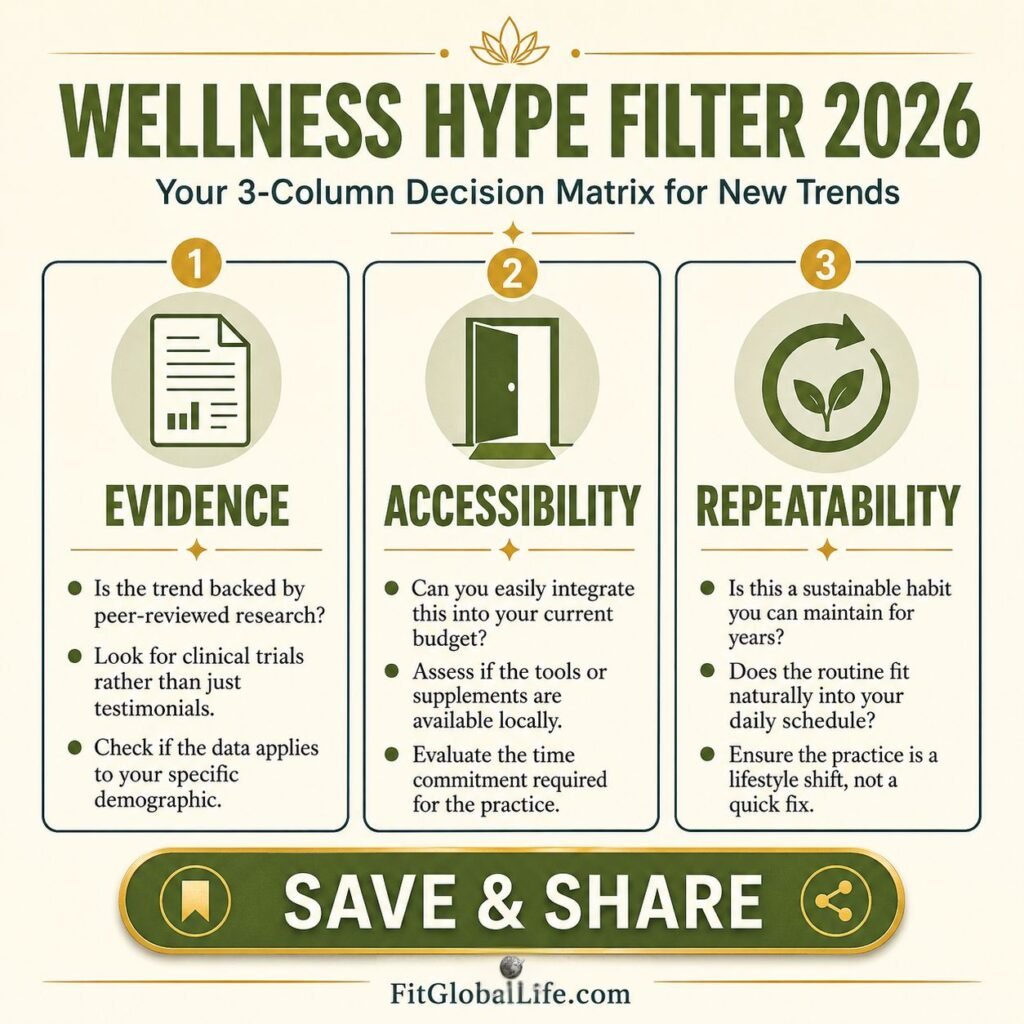
The same filter applies to retreats, supplements, wearables, city breaks, wellness residences, and workplace programs. A meditation app can be helpful. A silent retreat can be transformative. A sauna can support recovery for the right person. A wearable can reveal patterns. But none of these should become a substitute for sleep, nutrition, movement, medical care, relationships, purpose, and rest.
For a reader who wants to act on these shifts without turning life into a spreadsheet, start small. Choose one environmental default, one recovery practice, one food upgrade, one movement habit, and one digital boundary. Then build slowly. If the wellness economy is becoming more complex, your personal wellness system should become simpler. That is the plot twist.
The Decade-by-Decade Lens for Wellness Economy Shifts 2026
A strong trend article should do more than name what is rising. It should help readers understand where a trend fits in the long arc of a life. That is especially important for wellness economy shifts 2026, because the same product or practice can mean very different things at different ages. A sleep tracker may be a curiosity for a 27-year-old, a burnout warning system for a 43-year-old, and a safety signal for a 68-year-old managing recovery after illness. A walkable city break may be a fun weekend reset in one decade and a mobility-preserving travel style in another. The market is changing, but so is the human body that uses the market.
This decade-by-decade lens is also a useful way to avoid shallow trend chasing. Wellness marketing often talks as if every person wants the same optimization stack: more data, more supplements, more protocols, more expensive retreats, more morning routines. Real life is messier and more interesting. A reader may be caring for children, supporting aging parents, recovering from a stressful job, rebuilding fitness after a quiet decade, managing a budget, changing countries, or simply trying to eat dinner before 9 p.m. A credible wellness economy guide has to make room for those realities. Otherwise, it becomes a luxury catalog with a yoga mat attached.
20s and 30s: Choose defaults that compound
For readers in their 20s and 30s, the most valuable wellness shifts are not always the most dramatic ones. The better question is: which defaults will quietly compound for the next 30 years? This is where prevention, functional nutrition, walkable travel, digital boundaries, and nervous-system literacy become powerful. A person does not need a perfect longevity protocol at 29. They need sleep rhythms that survive work pressure, food patterns that do not depend on panic-ordering takeout every night, movement that does not require heroic motivation, and friendships that do not disappear into group chats.
The wellness economy will keep offering new devices and services to this group because younger consumers often shape cultural demand. But the smart play is to treat trends as tools, not identities. A wearable can reveal that late caffeine hurts sleep. A city break designed around walking can turn travel into low-pressure movement. A workplace mental health benefit can normalize early support before burnout hardens into a lifestyle. A plant-forward meal plan can build energy without turning nutrition into a personality test. The goal is not to buy youth preservation. The goal is to build capacity before decline becomes the headline.
40s and 50s: Protect capacity before it feels urgent
In the 40s and 50s, the wellness economy becomes less about experimentation and more about capacity protection. This is often the decade range where sleep debt, stress load, metabolic risk, muscle loss, caregiving pressure, career intensity, and hormonal change start talking at once. They do not always scream. Sometimes they just whisper through lower energy, weaker recovery, mood swings, rising blood pressure, stubborn weight gain, or the quiet feeling that the body needs more negotiation than it used to.
That is why the prevention shift matters so much. Preventive care, strength training, nutrition quality, mental fitness, social connection, and health-supportive environments are not separate lifestyle boxes. They are part of the same capacity system. The best products and services in 2026 will not merely sell escape. They will help people protect the ability to work, rest, travel, think, care, and participate without feeling constantly depleted. This is also where trust becomes more important. Consumers in midlife are often less impressed by viral claims and more interested in what can be repeated safely, affordably, and realistically.
For this audience, wellness travel can move from indulgence to recalibration. A slower trip with walking, nature, local food, and unhurried sleep may be more restorative than an overstuffed itinerary. A retreat may be valuable if it teaches practices that come home with the traveler. But a nutrition upgrade may matter more in supporting blood sugar, gut health and daily energy than in chasing aesthetic promises. The question shifts from ‘What is new?’ to ‘What helps me keep my life usable?’ That is a more mature and frankly more interesting wellness question.
60s and beyond: Design for independence, belonging, and ease
For older adults, the most meaningful wellness economy shifts are often the least flashy. Mobility, fall prevention, sleep quality, medication literacy, social connection, walkable neighborhoods, accessible travel, food security, and trustworthy preventive care can do more for quality of life than any glamorous trend label. The home and city as health platforms become especially important here. A building with stairs only, poor lighting, loud interiors, unsafe sidewalks, or limited grocery access can quietly work against health every day. A neighborhood with benches, parks, transit, safe crossings, clinics, and social spaces can act like a daily wellness program without calling itself one.
This is where the wellness economy has a moral test. If wellness becomes only a premium marketplace, it will miss one of the largest demographic realities of the next decade: aging populations need environments that support independence and dignity. Healthspan is not just a lab term. It shows up as the ability to carry groceries, visit friends, recover after illness, walk through a museum, cook a simple meal, sleep without constant disruption, and stay connected to ordinary life. The future of wellness will be judged not only by luxury retreats and advanced diagnostics, but by whether everyday systems become easier to live in.
| Life stage | Most useful wellness economy signals | Reader question to ask |
| 20s and 30s | Digital boundaries, sleep rhythm, movement defaults, social connection, affordable preventive habits | Will this habit still help me when my schedule gets harder? |
| 40s and 50s | Capacity protection, preventive care, strength, stress recovery, trustworthy nutrition, slower travel | Does this improve energy, resilience, and repeatability without adding more pressure? |
| 60s and beyond | Mobility, accessible environments, food quality, social belonging, safe housing, practical health support | Does this make daily life safer, easier, more connected, or more independent? |
This lens also gives FitGlobalLife a practical editorial advantage. Each shift can become a cluster of deeper guides: one article on preventive wellness, one on walkable travel, one on functional nutrition skepticism, one on neurowellness, one on home design, one on longevity without hype, and one on ethical retreat planning. The pillar article holds the big map; the cluster articles handle the smaller roads. That is how a wellness website earns authority without sounding like it is trying to sell every trend with the same shiny adjective.
The clearest prediction for 2026 is not that one wellness category will dominate all others. It is that readers will become better judges. They will ask harder questions about evidence, accessibility, sustainability, privacy, affordability, and whether a practice actually fits their lives. Brands that answer those questions honestly will age well. Brands that rely on fear, status, and complicated protocols may still make noise, but noise is not the same as trust.
Conclusion: The Next Wellness Boom Will Be More Human
The 2026 wellness economy will be bigger, smarter, more medical, more technological, and more integrated into daily life. It will also be noisier. Bigger markets attract better solutions and louder nonsense at the same time. That is not a reason to reject wellness. It is a reason to become a sharper reader.
The seven shifts point toward a more mature future: resilience infrastructure, preventive business models, healthspan-centered longevity, nervous-system regulation, slower wellness travel, evidence-filtered nutrition, and health-supportive environments. Together, they suggest that wellness is no longer just something people buy after burning out. It is becoming a way to design life before burnout becomes the default.
The best version of this future will not be obsessed with perfect bodies, perfect data, or perfect routines. It will be grounded in capacity: the capacity to move, recover, think, connect, adapt, age, travel, eat, sleep, and belong. That is the wellness economy worth watching in 2026.
For readers building their own roadmap, the simplest next step is to pair this trend map with practical guides on health habits that age well, the science of rest, and choosing the right wellness retreat. The future of wellness is not about doing everything. It is about choosing the few things that make the rest of life work better.
FAQ
The wellness economy includes industries that help people incorporate wellness activities and lifestyles into daily life, from fitness, nutrition, beauty, mental wellness, wellness tourism, and workplace wellness to wellness real estate and preventive health services.
They matter because wellness is being woven into big economic drivers like: healthcare prevention, travel design, aging populations, workplace policy, housing, consumer technology, and food systems. This shapes what people buy, how brands talk, and how readers choose healthier routines.
No, but parts of it are priced that way. The most useful 2026 shift is the move from luxury wellness to everyday health infrastructure: walking, sleep, food quality, social connection, preventive care, digital boundaries, and environments that make healthy behavior easier.
Prevention is probably the most practical trend. It is linked to movement, nutrition, screening, sleep, stress management and chronic disease risk. Neurowellness is also important because many people are dealing with nervous-system overload and digital fatigue.
Use a simple filter. Look for believable evidence, realistic claims, clear safety guidance, transparent pricing, repeatable behavior design, and respect for medical care. Be cautious of any product or service that promises dramatic results with little effort or no context.
Disclaimer
This article is for informational and educational purposes only and is not medical advice, diagnosis, treatment, financial advice or investment advice. Readers should consult qualified healthcare professionals before making significant changes to diet, exercise, supplements, medications, medical treatments, or wellness protocols, especially if they have existing health conditions, are pregnant, are taking medication, or are under clinical care. Market and trend commentary is based on publicly available data and should not be treated as a guarantee of future outcomes.