

Most people do not lose focus in one dramatic moment. They lose it by a thousand small leaks: a notification during breakfast, a half-finished message during a meeting, a browser tab that turns into twelve, and a mind that never gets a clean place to land. That is why mental fitness drills matter. They turn focus from a mood you hope for into a skill you can practice on ordinary days.
This guide is not promising a “limitless brain.” That phrase belongs in supplement ads and superhero movies, not in a serious Mind article. The goal is more useful: build a repeatable training system that helps your attention recover faster, hold steady longer, and return with less drama when the modern world pulls it sideways. Think of it as strength training for your working mind, but with fewer mirrors and less gym music.
The timing matters. Work, learning, travel planning, health tracking, and even rest are becoming more digitally mediated. The Global Wellness Institute’s 2026 trend work points to lifespan brain health and mental wellness as growing priorities, while workplace and public-health sources increasingly connect mental well-being, movement, sleep, and cognitive performance. The point is not to hack the brain harder. It is to design daily drills that respect how attention actually behaves.
This article also connects to FitGlobalLife’s broader framework for long-term health habits, because focus does not live in a separate box from sleep, movement, stress, nutrition, light, social connection, or recovery. A stronger focus practice is not just about doing more work. It is about having enough mental clarity to choose what deserves your best energy.
Why Mental Fitness Drills Matter Now
Focus used to be treated like a personality trait: some people had it, others were “easily distracted.” That story is too lazy. Attention is shaped by biology, environment, sleep, stress, technology, nutrition, social pressure, and the way work is designed. A person who cannot concentrate in a chaotic digital environment is not broken; they may simply be living inside a system that spends all day bidding for their nervous system.
The idea of mental fitness is useful because it shifts the question from “Why am I not focused?” to “What can I train, adjust, and protect?” Physical fitness does not mean you never get tired. It means you recover, build capacity, and know what kind of training suits the goal. Mental fitness works the same way. It does not eliminate distraction. It gives you drills for noticing, returning, prioritizing, and recovering.
Focus is also a public health conversation, not just a productivity trick. The World Health Organization says adults should aim for regular physical activity and notes that inactivity is widespread globally. The CDC also states that physical activity can support thinking, learning, problem-solving, memory, and emotional balance. That matters because the brain is not floating above the body like a CEO in a glass office. It is part of a living system.
Sleep is another non-negotiable. CDC sleep guidance says adults generally need at least seven hours of sleep in a 24-hour period. A tired brain can still push through a deadline, but pushing through is not the same as focused thinking. Sleep loss is consistently associated with weaker attention, memory, and decision-making in the scientific literature. So if someone sells you focus while ignoring sleep, they are basically selling you a sports car with no fuel.
Mental fitness also matters because modern work has become more cognitively fragmented. Knowledge workers manage chats, email, meetings, dashboards, AI tools, documents, and decisions in the same afternoon. Microsoft’s Work Trend Index research describes work as being reshaped by AI, digital labor, and new workflow patterns. That makes focus training more important, not less. When tools get faster, human attention becomes the scarce resource.
Finally, the emotional layer matters. APA’s Stress in America work continues to document stress and disconnection as major themes. Stress narrows attention, increases rumination, and makes the mind search for threat. That is why several drills in this article begin with regulation before execution. You cannot bully a dysregulated nervous system into deep focus for long. It will invoice you later.
For readers who already feel buried under attention debt, this guide is meant to be practical. You do not need a silent cabin, a perfect calendar, or a personality transplant. You need short drills that can be repeated until focus becomes easier to access.
The Evidence Base Behind Focus Training
| Focus factor | What research and public-health guidance suggests | How this article translates it |
| Mindfulness and attention | Meta-analytic and review literature suggests mindfulness practices can support executive function and attention regulation. | Use short awareness drills, breath anchors and attention return reps. |
| Physical activity. | WHO and CDC guidance links movement to physical and cognitive health including problem solving and emotional balance. | Use movement before deep work or at transitions to prime the brain. |
| Sleep | CDC recommends adults get at least seven hours of sleep; reviews of sleep-loss link deprivation with poorer attention and memory. | Choose evening audits. Sleep-protective boundaries over late-night productivity cosplay. |
| Cognitive Load | Your working memory is limited Multitasking can increase stress and strain | Offload open loops before demanding work and reduce task-switching friction. |
| Workplace mental health | WHO workplace mental-health guidance emphasizes prevention, supportive work design, and worker training. | Treat focus as a system design issue, not just personal discipline. |
The evidence does not mean every drill will work equally for every person. It means the overall direction is grounded: attention improves when you reduce noise, regulate the body, train awareness, sleep enough, move regularly, and design friction around distraction. That is the boring truth, which is usually where the useful stuff hides.
The Focus Reset Framework: 7 Drills at a Glance
| Drill | Best for | Time needed | Primary skill trained |
| 1. The 90-Second Attention Check-In | Scattered mornings, task transitions, emotional fog | 90 seconds | Noticing your current attention state |
| 2. Single-Task Reps. | Overload of tab, multitasking, Shallow work. | 10-25 minutes. | Sustained attention and task completion |
| 3. The Cognitive Load Offload. | Overthinking, mental clutter, too many open loops. | 5-12 minutes | Working-memory relief and prioritization. |
| 4. Breath-Anchored Refocusing | Stress spikes, meeting fatigue, anxious urgency | 2-5 minutes | Nervous-system regulation and attention return |
| 5. Environment Friction Design | Phone checking, noisy workspace, impulse browsing | 5-15 minutes setup | Distraction prevention through design |
| 6. Movement-Primed Focus | Afternoon slump, brain fog, low energy | 5-20 minutes | Body-based cognitive activation |
| 7. The Evening Attention Audit | Repeating distraction patterns, weak follow-through | 7-10 minutes | Reflection, learning, and next-day focus design |
These mental fitness drills are intentionally simple. Complexity is often where habits go to die. The aim is to create a low-friction routine that can survive deadlines, travel days, imperfect sleep, noisy homes, and the occasional “I only opened Instagram for one minute” lie we tell ourselves with Oscar-level confidence.
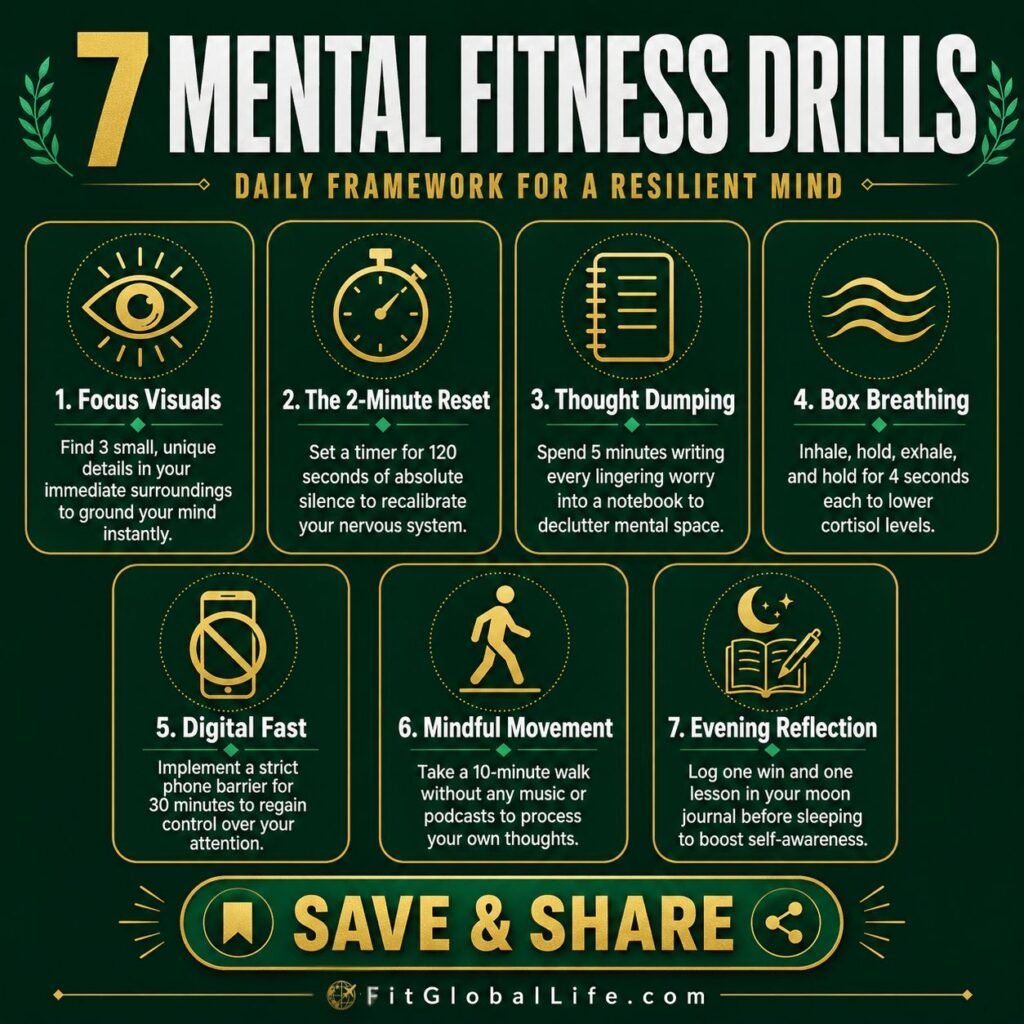
Mental Fitness Drill 1: The 90-Second Attention Check-In
The first drill trains awareness before action. Many people try to force focus without checking what state they are actually in. That is like sprinting without noticing your shoelaces are tied together. The 90-second attention check-in gives you a small pause before choosing how to work.
How to practice it
- Set a timer for 90 seconds before a demanding task.
- Close unnecessary tabs, but do not start the task yet.
- Ask three questions: What is pulling my attention? What is the next honest action? What would make this task 10 percent easier to start?
- Write one sentence that names the task and the next step.
- Begin with that one step, not the whole project.
Why it works
The check-in turns attention into an observable state. Instead of saying “I cannot focus,” you might notice: I am anxious about a reply, hungry, unclear about the first step, or overloaded by too many options. Each state needs a different response. Hunger needs food. Ambiguity needs definition. Anxiety may need regulation. Overload may need a smaller task boundary.
This is where mental fitness differs from motivational content. Motivation often shouts, “Just do it.” Mental fitness asks, “What is blocking the first clean rep?” The latter is less dramatic, but it works better in real life.
Readers who struggle with scattered mornings may also benefit from the site’s guide to neuro-architecting your morning, because physical space often decides whether attention starts clean or starts already bruised.
A useful variation is the “state label.” Before work, write one word that captures your mental weather: foggy, rushed, calm, tense, bored, curious, overloaded. Then choose the smallest focus action that fits that state. The point is not to judge the word. The point is to stop pretending every brain state needs the same strategy.
Mental Fitness Drill 2: Single-Task Reps
Single-tasking sounds obvious until you try it. Most people are not truly working on one task; they are grazing across many partial tasks while calling it efficiency. Single-task reps rebuild the muscle of staying with one target long enough to create depth.
How to practice it
- Choose one task that can move forward in 10 to 25 minutes.
- Write the task in a visible place: “Draft intro,” “Edit section two,” “Review five sources,” or “Plan tomorrow’s workout.”
- Close or hide tools not needed for that task.
- Work until the timer ends. If a new thought appears, write it in a capture note instead of following it.
- After the timer, mark the rep as complete and take a short reset.
Why it works
The brain adapts to what it repeatedly practices. If it practices switching every 90 seconds, switching becomes the default. If it practices returning to one target, returning becomes easier. Single-task reps are not about being monk-like. They are about giving attention a repeatable path back to the same object.
This drill also exposes fake urgency. A surprising number of “urgent” distractions can survive a 15-minute delay. The message will still exist. The world will keep spinning. Your inbox will not file a missing person report.
For a deeper look at this problem, FitGlobalLife’s article on digital deceleration explains why deep focus now requires deliberate slowing, especially in an AI-driven world where input can multiply faster than judgment.
Single-task reps are especially helpful for creators, writers, founders, students, and remote workers because those roles often involve invisible work. When a task does not have a physical endpoint, the mind becomes vulnerable to novelty. A visible rep gives the brain a finish line.
Mental Fitness Drill 3: The Cognitive Load Offload
Cognitive load is the mental weight of what you are holding in working memory. It includes tasks, worries, decisions, unfinished conversations, reminders, tabs, and vague obligations. When working memory is crowded, focus becomes expensive. The offload drill clears mental RAM before the real work begins.
How to practice it
- Take a blank page or note app.
- Write every open loop for three minutes: tasks, worries, reminders, decisions, errands, ideas.
- Circle only the items that matter today.
- Choose one next action for the top one to three items.
- Move everything else to a trusted list or calendar, then stop staring at it.
Why it works
The goal is not to solve your whole life in one sitting. The goal is to stop using your attention as a storage unit. Working memory is not built to hold twenty loose obligations while also doing thoughtful work. Offloading gives the brain permission to focus because it no longer has to keep whispering, “Don’t forget that thing.”
This drill pairs well with the existing FitGlobalLife overthinking blueprint, especially for people whose focus problems are not caused by laziness but by excessive mental loops.
A useful rule is: if the thought appears twice, capture it once. Do not let the same worry knock on the door every ten minutes. Put it somewhere reliable, decide whether it needs action, and return to the work in front of you.
The offload drill is also a kindness practice. Many people blame themselves for weak focus when they are simply carrying too many unresolved loops. A person with thirty browser tabs open does not need more shame; they need a cleanup system.
Mental Fitness Drill 4: Breath-Anchored Refocusing
Breath-anchored refocusing is a short regulation drill for moments when attention is being hijacked by stress, urgency, or emotional noise. It is not meant to replace therapy or medical care. It is a practical reset that helps the body stop treating every task like a tiger in a Slack channel.
How to practice it
- Sit or stand with both feet grounded.
- Inhale gently through the nose for about four seconds.
- Exhale slowly for about six seconds.
- Repeat for five to ten cycles.
- On each exhale, silently say: “return.” Then bring attention back to the task.
Why it works
Breathing is one of the few levers that connects conscious behavior with autonomic regulation. A slower exhale can support downshifting when the body is keyed up. That matters because focus often fails when the nervous system is scanning for threat. The brain cannot do nuanced thinking while the body is voting for emergency mode.
FitGlobalLife’s guide to a quick breathwork reset offers additional techniques for nervous-system regulation, while the article on vagus nerve regulation explores why calm is not a vibe; it is a biological state that can support clearer action.
Breath-anchored refocusing is particularly useful before difficult conversations, creative work, study sessions, or any task that triggers avoidance. It gives the mind a bridge from emotion to execution. The task may still be hard, but it is no longer surrounded by as much internal static.
Mental Fitness Drill 5: Environment Friction Design
Most focus advice overestimates willpower and underestimates room design. If the phone is next to your hand, the most disciplined version of you still has to keep choosing not to touch it. That is exhausting. Environment friction design makes distraction slightly harder and focus slightly easier.
How to practice it
- Move the phone outside arm’s reach during focus reps.
- Keep only the tools needed for the current task visible.
- Use a browser profile or app blocker for deep-work blocks.
- Create a “focus start” cue: headphones, lamp, tea, timer, or a cleared desk.
- End each session by resetting the space for the next session.
Why it works
Humans are cue-driven. A messy digital and physical environment is not neutral; it is a menu of invitations. Each visible cue asks the brain to decide. Decision fatigue then becomes distraction. Friction design removes some decisions before they happen.
This is why a digital detox protocol can be more effective than a motivational promise. The environment does not care how inspired you felt at 8 a.m. It quietly shapes your behavior at 3:17 p.m., when your energy is low and the algorithm is wearing a charming little hat.
Good friction is not punishment. It is architecture. Put the distracting app one extra step away. Put the book or notebook one step closer. Charge the phone outside the bedroom. Create a work surface where the next action is obvious. The brain loves defaults, so choose defaults that protect the person you are trying to become.
For home-based focus, the article on circadian lighting is also relevant because light, timing, and environment can influence alertness, sleep pressure, and the way the mind moves through the day.
Mental Fitness Drill 6: Movement-Primed Focus
Movement-primed focus uses physical activity as a pre-work switch. This does not require a full workout. A brisk walk, stair climb, mobility sequence, or short bodyweight circuit can help transition the brain from dullness or agitation into a more workable state.
How to practice it
- Choose a movement primer that takes 5 to 20 minutes.
- Keep it simple: walk outside, climb stairs, do mobility, or use light strength movements.
- Avoid turning the primer into a performance event.
- After movement, drink water and begin a short single-task rep immediately.
- Track whether movement improves clarity, mood, or task start speed.
Why it works
The CDC notes that physical activity can support thinking, learning, problem-solving, memory, and emotional balance. WHO guidance also frames physical activity as beneficial across ages and types of movement. For focus, the immediate benefit is often practical: movement changes state. It can wake up a sluggish mind, release nervous energy, and create a clean transition from passive consumption into active effort.
Movement also reminds us that attention is embodied. You cannot scroll in a curled-up posture for two hours, sleep poorly, skip breakfast, and expect your brain to deliver cinematic clarity on command. The brain is impressive, yes, but it is not a magician trapped inside a tired body.
If mental fog is the main issue, the site’s brain fog reset can serve as a complementary nature-based framework, especially for readers who feel mentally stale after long periods indoors.
A travel-friendly version of this drill is the “arrival walk.” When you reach a new city, hotel, coworking space, or retreat center, walk for ten minutes before opening your laptop. Let the body arrive before forcing the brain to produce. Simple? Yes. Underrated? Absolutely.
Mental Fitness Drill 7: The Evening Attention Audit
The evening attention audit turns daily distraction into useful data. Instead of ending the day with vague guilt, you gather information: what helped focus, what broke it, and what one adjustment would make tomorrow easier. This is the drill that turns focus from an aspiration into a feedback loop.
How to practice it
- Spend seven to ten minutes at the end of the workday or evening.
- Write three wins, even small ones.
- Write one attention leak: the pattern that stole the most focus.
- Write one adjustment for tomorrow.
- Choose the first focus rep for the next morning before going to sleep.
Why it works
The audit works because attention improves through feedback. Athletes review performance. Musicians listen back. Writers revise. Focus deserves the same treatment. Without review, distraction becomes a mysterious fog. With review, it becomes a pattern you can redesign.
The audit also supports cognitive sovereignty, the idea that people need more intentional control over what gets access to their attention, emotions, and decisions. In 2026, that is not a niche issue. It is basic mental hygiene.
Keep the audit emotionally neutral. You are not writing a courtroom statement against yourself. You are collecting evidence for better design. A good audit sounds like: “Meetings after lunch drain me, so tomorrow I will do creative work before noon.” A bad audit sounds like: “I am hopeless.” One of those creates leverage. The other creates a spiral.
A 7-Day Mental Fitness Drill Plan
A pillar article should not leave the reader inspired but confused. Here is a simple 7-day plan that turns the drills into a realistic sequence. It is not a challenge in the social-media sense. There is no badge, no heroic suffering, and no need to announce it to your entire network. Just practice.
| Day | Primary drill | What to do | Success marker |
| Day 1 | 90-Second Attention Check-In | Use the check-in before two important tasks. | You can name your attention state before starting. |
| Day 2 | Single-Task Reps | Complete two 15-minute single-task sessions. | You finish one clear unit of work without switching. |
| Day 3 | Cognitive Load Offload | Do a 10-minute open-loop dump before work. | Your top three tasks are visible and realistic. |
| Day 4 | Breath-Anchored Refocusing | Use five slow exhales before a stressful task. | You return to the task with less internal noise. |
| Day 5 | Environment Friction Design | Move one major distraction out of reach. | Your space makes focus easier by default. |
| Day 6 | Movement-Primed Focus | Take a 10-minute walk before deep work. | You start faster or feel more alert. |
| Day 7 | Evening Attention Audit | Review the week and choose two drills to keep. | You know which drills actually helped. |
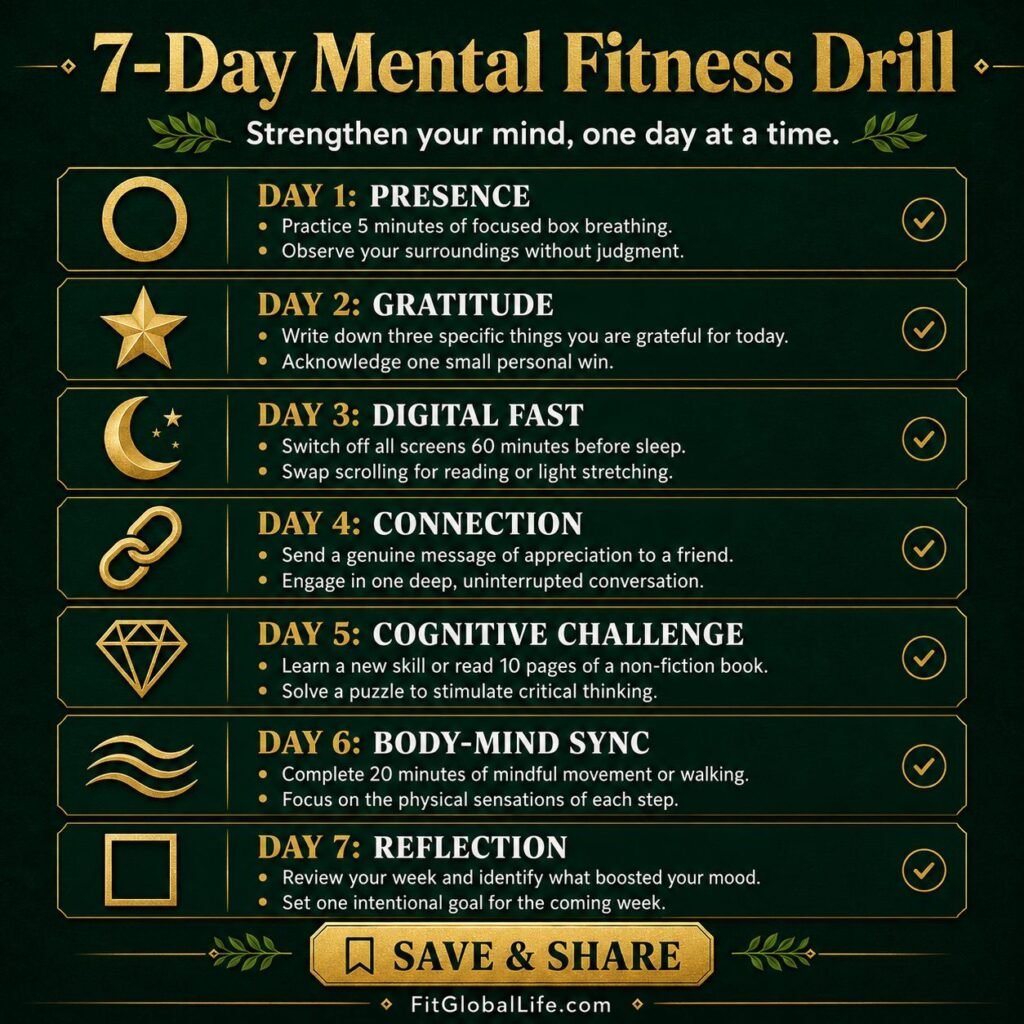
The plan is intentionally modest because consistency beats intensity. The goal is not to become a focus monk in seven days. The goal is to identify your highest-return drills and start building a personal attention system.
If food and focus are connected for you, pair this plan with FitGlobalLife’s guide to nootropic nutrition, which explores how meals can support mental clarity without turning everyday eating into a biohacking spreadsheet from outer space.
How to Measure Better Focus Without Obsessing
Measurement is useful until it becomes another distraction. You do not need a dashboard for every blink. Track a few simple markers for two weeks, then adjust. The most useful focus metrics are behavioral, not dramatic.
| Metric | Question to ask | Why it matters |
| Start speed | How long does it take me to begin the important task? | Focus often improves first at the starting line. |
| Return speed | How quickly do I return after distraction? | No one avoids all distraction; recovery is the real skill. |
| Switch count | How many times did I jump between tasks in one work block? | Task switching is a major attention leak. |
| Completion clarity | Did I finish a meaningful unit of work? | Focus should produce progress, not just time spent. |
| Recovery quality | Do I end the day depleted or clear enough to rest? | Sustainable focus should not wreck the evening. |
A practical tracking method is the three-dot system. At the end of each day, give yourself one dot for starting clean, one for returning after distraction, and one for completing the most important focus rep. Three dots is a strong day. Two dots is solid. One dot still gives you data. Zero dots is not failure; it is a signal that the system needs adjustment.
The article on mindfulness at work can support this measurement approach by helping readers practice presence during busy days rather than waiting for perfect calm that never arrives.
Common Mistakes That Make Focus Training Fail
Focus training fails most often because people treat it like punishment. They build a strict system, break it once, then decide they are undisciplined. That is not training; that is perfectionism wearing productivity shoes.
| Mistake | Why it backfires | Better move |
| Starting too big | Huge routines collapse under normal life pressure. | Begin with one 10-minute rep. |
| Ignoring sleep | A tired brain cannot sustainably focus. | Protect a realistic sleep window first. |
| Using shame as fuel | Shame creates avoidance and rumination. | Use neutral feedback and next-step design. |
| Tracking everything | Over-measurement becomes another cognitive load. | Track only one to three markers. |
| Expecting zero distraction | Distraction is normal and human. | Train the return, not impossible perfection. |
| Copying someone else’s routine | Your work, body, home, and stressors differ. | Build a custom focus stack. |
Another mistake is confusing stimulation with focus. A person can feel busy, caffeinated, and mentally loud without being focused. True focus is quieter. It has a target, a boundary, and a return path. It is not always thrilling. Sometimes it looks like calmly doing the next paragraph, the next calculation, the next email, the next sketch, the next honest rep.
There is also a social layer. The FitGlobalLife piece on micro-communities is relevant because connection can reduce the lonely burden of self-improvement. Focus is easier when your environment and relationships respect what you are trying to protect.
Where Mental Fitness Fits in a Bigger Wellness System
Mental fitness drills work best when they are not isolated from the rest of life. Attention is influenced by sleep timing, daylight exposure, movement, nutrition, emotional regulation, social connection, and the type of inputs you consume. A person can practice all seven drills and still struggle if their day is built on chaos, poor sleep, constant threat, and zero recovery.
This is why the strongest version of focus training is not “do more.” It is “design a life where your best attention has somewhere to go.” That may mean fewer open loops, clearer work blocks, better breaks, calmer mornings, more daylight, better meals, and a sleep routine that does not begin with revenge scrolling at midnight.
For readers interested in the emotional side, the guide to the body-mind connection explains how somatic practices can support stress reduction. For readers who need inspiration, awe psychology explores why witnessing greatness and scale can refresh the mind in ways ordinary productivity advice often misses.
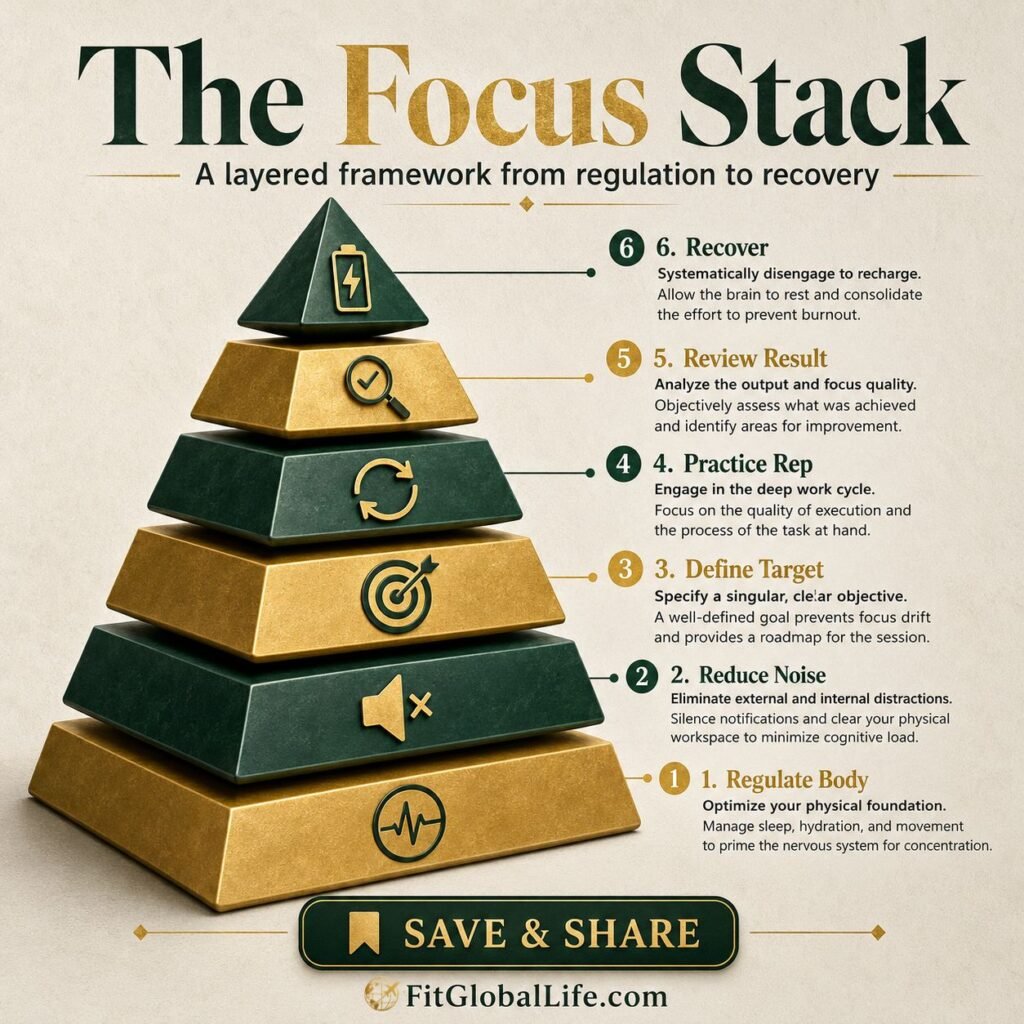
A useful way to think about mental fitness is the “focus stack”: regulate the body, reduce the noise, define the target, practice the rep, review the result, and recover. Most people skip the first two and then wonder why the fourth feels impossible. The stack puts the steps in a more human order.
Conclusion: Train Focus Like a Living Skill
The future of focus will not be won by the person with the most extreme routine. It will be won by people who understand their attention well enough to protect it, train it, and repair it when it gets scattered. That is the real promise of mental fitness drills.
The seven drills in this guide are not glamorous. They are small, repeatable, and deliberately ordinary: check in, single-task, offload, breathe, design the environment, move, and audit. But ordinary is exactly the point. A focus system that only works on perfect days is not a system. It is a vacation fantasy with a timer app.
Start with one drill today. Not seven. One. Choose the drill that matches your biggest attention leak. If your mind is crowded, offload. If your body is tense, breathe. If your phone keeps winning, redesign the environment. If your energy is flat, move. If your day disappears without insight, audit it. Focus gets stronger when it has a practice path.
In a world that profits from your scattered attention, building stronger focus is more than productivity. It is a form of self-respect. Quiet, practical, deeply useful self-respect.
FAQ
Mental fitness drills are short, repeatable practices that train attention, emotional regulation, cognitive load management, and recovery. They are not medical treatments. They are practical exercises that help the mind return to a chosen target more reliably.
Some people feel a difference after a single session because the first benefit is often reduced noise. More stable focus usually takes consistent practice over several weeks. The best marker is not perfection; it is faster return after distraction.
Not exactly. Meditation can be one mental fitness practice, especially for awareness and attention return. But mental fitness training is task design, cognitive offloading, movement, friction of environment and reflection.
They may help with attention routines for some people, but they are not a substitute for diagnosis, treatment, coaching or professional care. Readers with ADHD symptoms or significant impairment should consult a qualified clinician.
Start with the 90-second attention check-in or the cognitive load offload. Both are easy to practice, require no equipment, and quickly reveal what is actually blocking focus.
Disclaimer
This article is for educational and informational purposes only. It is not a substitute for professional medical, psychological, psychiatric, or clinical advice and should not be used to diagnose, treat, or manage any condition. If you have ongoing concerns about your attention, anxiety, depression, sleep, burnout, ADHD-like symptoms, cognitive changes, or any mental health condition, please seek guidance from a licensed health or mental health professional. Always consult a professional before making any major changes to your treatment, medication, sleep habits, exercise routine or stress management techniques.