Some vacations seem to create a second job: collect the views, book the activity, make the video, get to the next place before the light changes. Then there are blue space destinations—places where a river, lake, wetland, or stretch of coast gives you permission to do less. You might walk slowly, watch the surface change color, listen to water move through reeds, or simply sit somewhere safe without needing to turn the moment into content.
The appeal is real, but it deserves better than a miracle claim. Research suggests that spending time around water can be linked to better well-being, while also showing that the setting, the visitor, and how people actually use the place all matter. This guide takes a practical route: six specific destinations, six different water experiences, and a realistic way to decide which one fits your energy, mobility, budget, and tolerance for crowds.
You do not need to swim, paddle, or take an expensive retreat to benefit from a beautiful waterfront. You may only need a bench, a safe path, and a little unclaimed time.
What Are Blue Spaces, and What Does the Evidence Really Say?
Blue spaces are outdoor places in which water is a defining feature: shorelines, rivers, lakes, wetlands, estuaries, and even urban waterfronts. Their value is not necessarily tied to postcard-blue water. A gray river on a drizzly morning is still a blue space; so is a tidal marsh that smells faintly of salt and mud.
The World Health Organization’s review of green and blue spaces describes a broadly positive relationship with mental health, while warning that the evidence does not identify one universally superior kind of setting. A 2021 survey spanning 18 countries and 16,307 respondents found that visits to green, inland-water, and coastal spaces were associated with higher positive well-being and lower mental distress. Those findings are associations—not proof that a particular trip caused a psychological improvement.
More recent work sharpened that caution. A 2026 evidence map of 139 blue-space studies reported that 94 studies examined coastal environments, but only six directly compared different blue-space types. That is an important reality check: there is not enough comparable evidence to rank a beach above a riverbank or a lake above a marsh for mental health. Another 2026 review of 44 experimental studies of blue and green environments found encouraging short-term stress and mood results, but highlighted differences among study designs and a relative shortage of experiments focused specifically on water.
A useful dose, not a medical prescription
In a well-known 2019 population study of time spent in nature, spending at least 120 minutes a week in natural settings was associated with better self-reported health and well-being. That finding applies to nature broadly, not a proven 120-minute prescription for blue spaces. Likewise, a review of 50 nature-based intervention studies found potential mental-health benefits from structured outdoor activities, but it cannot tell us that any of the six destinations below will treat a mental-health condition.
For travel planning, a more helpful question is simple: What kind of water environment makes it easier for me to slow down safely? If you have already tried a gentle nature-based reset, consider this guide its more place-specific companion, focused on the practical realities of six waterways rather than seven retreat styles.
Compare the 6 Blue Space Destinations at a Glance
| Location | Water experience | A low-pressure way to visit | Main planning reality |
| Lake Bohinj, Slovenia | Still alpine lake | Short shoreline stroll and a long pause | Mountain weather; protected shoreline |
| Ria Formosa, Portugal | Tidal lagoon and marsh | Birdwatching from an approved path | Tides, heat, and protected habitat |
| Kamo River, Kyoto, Japan | Everyday city river | Early walk near the river confluence | Heat, seasonal crowds, wet stepping stones |
| Abel Tasman, New Zealand | Sheltered coastal coves | One manageable beach-and-bush section | Tides, transport, track conditions |
| Vancouver Seawall, Canada | Urban oceanfront | Partial waterside walk with an easy exit | Popular paths and temporary closures |
| Plitvice Lakes, Croatia | Forest cascades and lakes | Marked boardwalks at a gentle pace | Crowding, slippery paths, access limits |
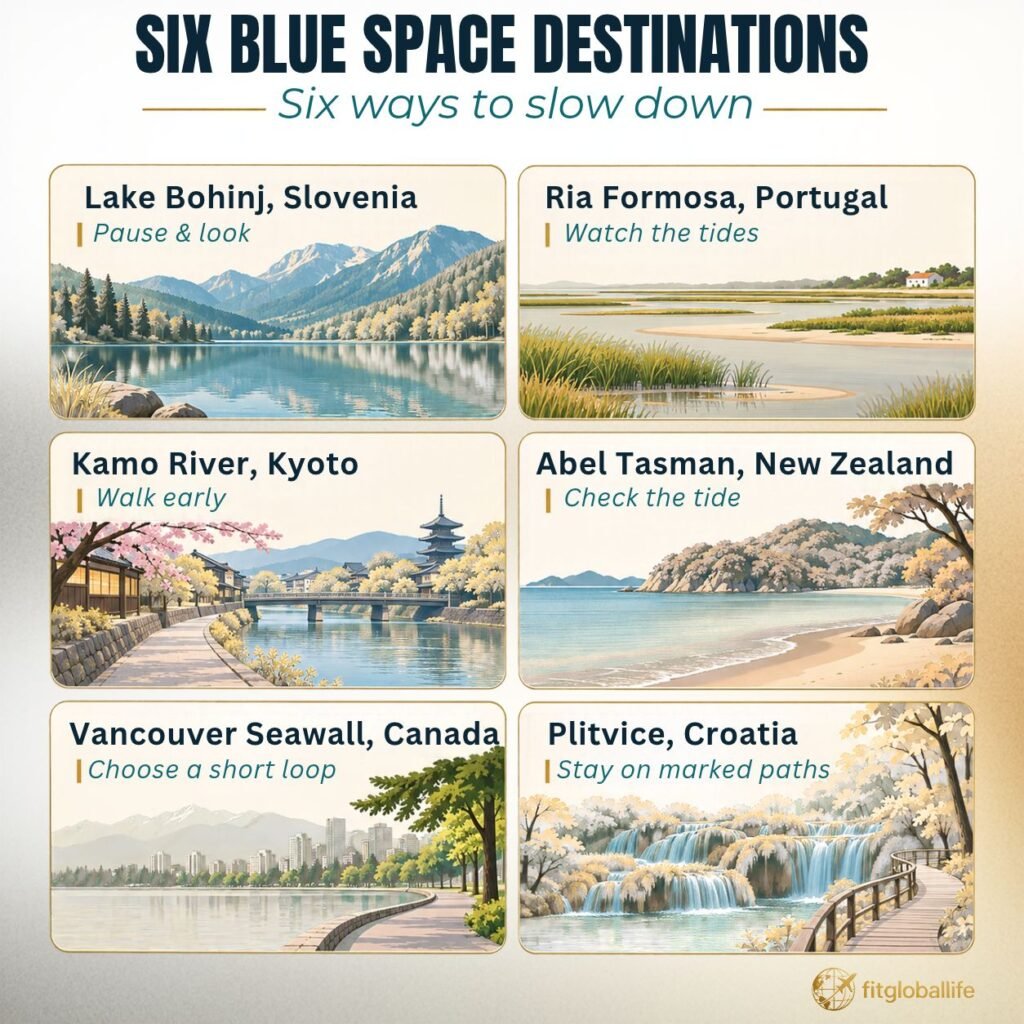
No destination is a scientifically established winner. Treat the table as a fit guide, not a medical ranking. The best trip is the one that does not ask your body or your wallet to perform for the view.
6 Blue Space Destinations for a Calmer Mind
1. Lake Bohinj, Slovenia: For People Who Need a Wide, Still Horizon
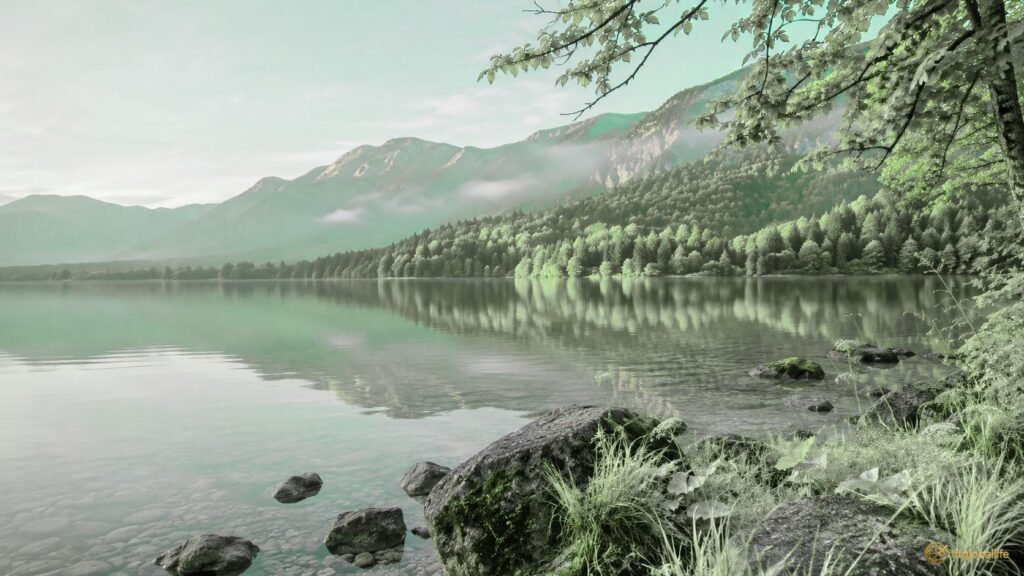
Lake Bohinj, in Slovenia’s Julian Alps, has an appealing lack of urgency. Mountains hold the far side of the frame; water reflects whatever the sky is doing. Some mornings are brilliantly clear. Others are a soft arrangement of cloud and pale green. You do not have to prefer one over the other.
The official Bohinj destination guide lists a shoreline of approximately 11.35 kilometers and describes walking, boating, and seasonal water activities. That shoreline figure is useful context, not an instruction to complete the circuit. For a calmer visit, choose a convenient stretch near Ribčev Laz or Ukanc and give yourself permission to turn back long before the hike becomes an obligation.
Try this: arrive earlier in the day, find a lawful place to pause, and spend five minutes noticing the difference between the distant ridgeline and the tiny movements close to shore. If the water is choppy, listen rather than trying to force a picture-perfect reflection. If you are traveling with someone, agree that you do not have to fill every silence.
Best for: travelers who find open views comforting, prefer gentle walking to scheduled wellness activities, and enjoy mountain scenery without demanding a mountain summit.
Reality check: alpine weather can change quickly, lake water may be cold, and shoreline activities are subject to national-park rules. A full circuit is not required, and accessibility varies by access point. If this trip will involve longer hiking days, consult your own limits rather than making every morning an endurance challenge. This is where the principle of slower travel without the checklist mentality becomes genuinely useful.
2. Ria Formosa, Portugal: For Minds That Settle When They Notice Small Things
Not every restorative water view has waves. The Ria Formosa Natural Park, on Portugal’s Algarve coast, offers a landscape of channels, sandbars, salt marshes, birds, boats, and slow tidal change. You may look across what appears to be the same stretch of water at two different hours and realize it has quietly rearranged itself.
Portugal’s official tourism description of the Ria Formosa wetlands places the protected estuary system along roughly 60 kilometers of coastline and recommends its environmental education center for information on appropriate trails and observation points. This is a place to experience, not a backdrop to occupy carelessly.
Try this: choose a marked observation point and watch one small patch of the lagoon for ten minutes. Notice which birds feed, pause, or move with the water. That sort of modest attention can feel surprisingly absorbing because it gives the mind something specific to notice without asking it to solve anything.
Best for: birdwatchers, curious travelers, people who prefer subtle movement over crashing surf, and visitors who enjoy learning about an ecosystem as part of their rest.
Reality check: paths, boat access, and island conditions depend on the location and tide; exposed sections can be hot and windy. Keep distance from wildlife, stay on permitted routes, and avoid treating sensitive nesting areas as shortcuts. A lower-impact visit is also a more convincing version of environmentally responsible travel: the animals do not owe us a closer photo.
3. Kamo River, Kyoto, Japan: For a Short Reset Inside a Busy City
Kyoto is not usually sold as a city where tourists can avoid effort. Temples, stations, restaurants, and crowds easily turn the day into a series of timed arrivals. The Kamo River offers a gentler counterpoint. Its banks are not a private wellness sanctuary; they are everyday public space, used by residents, walkers, and people who just want to sit.
Kyoto’s official guide to an early riverside nature walk suggests the area around Shimogamo Shrine and the meeting of the Kamo and Takano rivers, where forest, water, and a more ordinary morning rhythm come together. The nearby stepping stones are a recognizable feature, but you can enjoy the place without crossing them.
Try this: leave your accommodation early enough to avoid the hottest or busiest part of the day. Walk for ten minutes without a destination, pause near a safe bank or bridge approach, then continue only if you genuinely want to. Notice the sound of flowing water under traffic and conversation. This is an urban break, not a quest for total silence.
Best for: travelers who have only a free morning, people who feel overwhelmed by packed cultural itineraries, and anyone who wants a water-based pause without leaving the city.
Reality check: summer heat and humidity can be punishing, while spring blossoms attract crowds. Do not enter the water or use stepping stones when conditions are wet, fast-flowing, or unsafe. A riverside pause fits naturally into a walking-friendly travel day and demonstrates why micro-retreats can be surprisingly practical when you cannot disappear for a week.
4. Abel Tasman National Park, New Zealand: For Gentle Coastal Variety
A few coastlines hold more than one mood in the same afternoon. Abel Tasman National Park combines golden beaches, sheltered-looking bays, coastal forest, and open sea. A beach can feel expansive while the bush just behind it creates a small, protected-feeling space. This changing rhythm may suit someone who gets restless sitting in one spot but does not want a physically intense holiday.
New Zealand’s Department of Conservation guide to the Abel Tasman Coast Track explains that visitors can use walking routes and water taxis to arrange different trip lengths. It also makes the major limitation clear: some sections are steep or rough, and a compulsory tidal crossing on the full track must be timed carefully. Overnight huts and campsites require advance booking.
Try this: plan a single suitable beach-and-forest outing rather than attempting to complete a multi-day track for the sake of saying you did. Bring water, sun protection, and a practical turnaround plan. If a water taxi is part of the day, confirm its return schedule before you settle into a bay. A quiet hour is relaxing; missing the last boat is not.
Best for: people who like alternating water views with shaded walking, travelers who appreciate coastal wildlife, and those willing to plan around transport and environmental conditions.
Reality check: never improvise a tidal crossing, and do not assume a beautiful bay is safe for swimming. Check current track alerts, weather, and tides through the park authority. For a similar mindset before departure, stress-reducing travel preparation matters as much as the scenery itself.
5. Vancouver Seawall, Canada: For Water Without Leaving Urban Life Behind
Sometimes the healthiest version of a getaway is not remote. You may want a reliable path, public transport, places to rest, and the freedom to return to your room after twenty minutes. Vancouver’s waterfront offers that possibility: water on one side, urban life and green park space on the other.
The City of Vancouver’s official seawall information describes a 28-kilometer seaside greenway and a nine-kilometer loop around Stanley Park. It also distinguishes pedestrian and cycling routes. Those numbers are not a challenge. Pick a short stretch that you can easily get in and out of, watch the water and leave while you still feel fresh.
Try this: choose a waterfront segment that is easy to reach, walk at a conversational pace for fifteen minutes, then stop somewhere with a view. Let passing boats, changing light, and distant mountain silhouettes be enough. You do not need to optimize your pace or track your steps.
Best for: City-breakers, people who like their amenities predictable, and anyone who enjoys a stroll by the water but doesn’t want a lonely path.
Reality check: City streets can be busy, windy or temporarily blocked. At the time of writing, the city reported a partial Stanley Park Seawall closure from October 26 through November 14, 2026, with possible intermittent closures through November 20. Always check the city’s live notice and choose an open alternative section. This is a useful reminder that a restful journey depends on realistic recovery expectations, not on completing a famous route.
6. Plitvice Lakes National Park, Croatia: For Water That Moves While You Slow Down
Plitvice is not quiet in the sense of being silent. Water drops, threads, and collects among forested lakes. The visual movement can be mesmerizing, especially when you resist the urge to rush from one famous viewpoint to the next. Here, stillness is something you bring to the pace of your visit rather than a condition guaranteed by the destination.
The national park’s official visitor guidance describes eight circular lake-zone routes and additional forest hiking routes. It also notes that more than a million people visit annually, that boardwalks can be narrow and uneven, and that the lake trails are not fully adapted for wheelchairs. These details are not footnotes: they determine whether this place is suitable for a particular traveler.
Try this: book an appropriate route and entry window, wear shoes that grip well, and allow time to pause at safe designated points without obstructing other visitors. Listen for the difference between a small cascade and a broad fall. Skip any viewpoint that requires you to hurry, crowd, or take a risk.
Best for: travelers drawn to layered natural sound and moving water, people comfortable with active walking, and visitors who like a structured park route.
Reality check: this is not the best option for someone who needs a level, barrier-free, crowd-free environment. Rain can make surfaces slippery, and weather may close parts of the park. If sound is central to your sense of ease, the distinction between pleasant natural sound and sensory overload is worth making before you book.
How to Choose a Blue Space That Actually Fits You
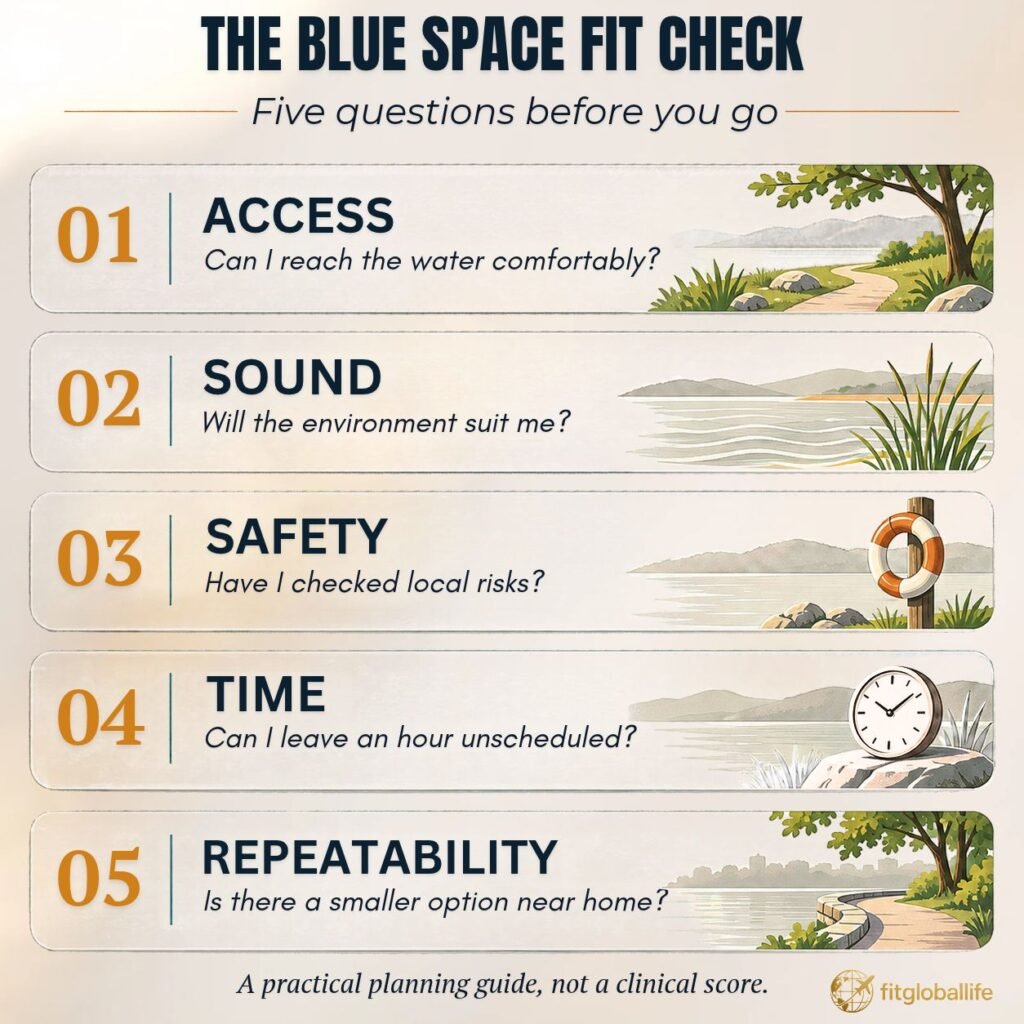
A photograph shows you a destination at its best angle. It cannot show how hot the pavement feels, how noisy the road is, whether you can sit comfortably, or how complicated the journey will be. Before choosing from these blue space destinations, use five questions as a personal fit screen—not a scientifically validated score.
- Can I access it comfortably? Consider gradients, stairs, seating, toilets, transport, and how far you need to walk before seeing water.
- Will the sound level suit me? Some people love waves and waterfalls; others need gentle ripples or quiet bird calls.
- What could make me feel unsafe? Check tides, currents, trail edges, water advisories, isolated sections, heat, and local emergency access.
- Is there room for an unplanned hour? A complicated transfer or a tightly timed tour may outweigh the benefit of the water view.
- Could I repeat a smaller version nearer home? The most durable travel insight is often the one you can bring back into an ordinary Tuesday.
If you are deciding between an organized package and independent travel, ask a few specific questions before paying for a wellness retreat. The best choice is not necessarily the destination with the most dramatic scenery. It is the one where you can be present without managing too many variables.
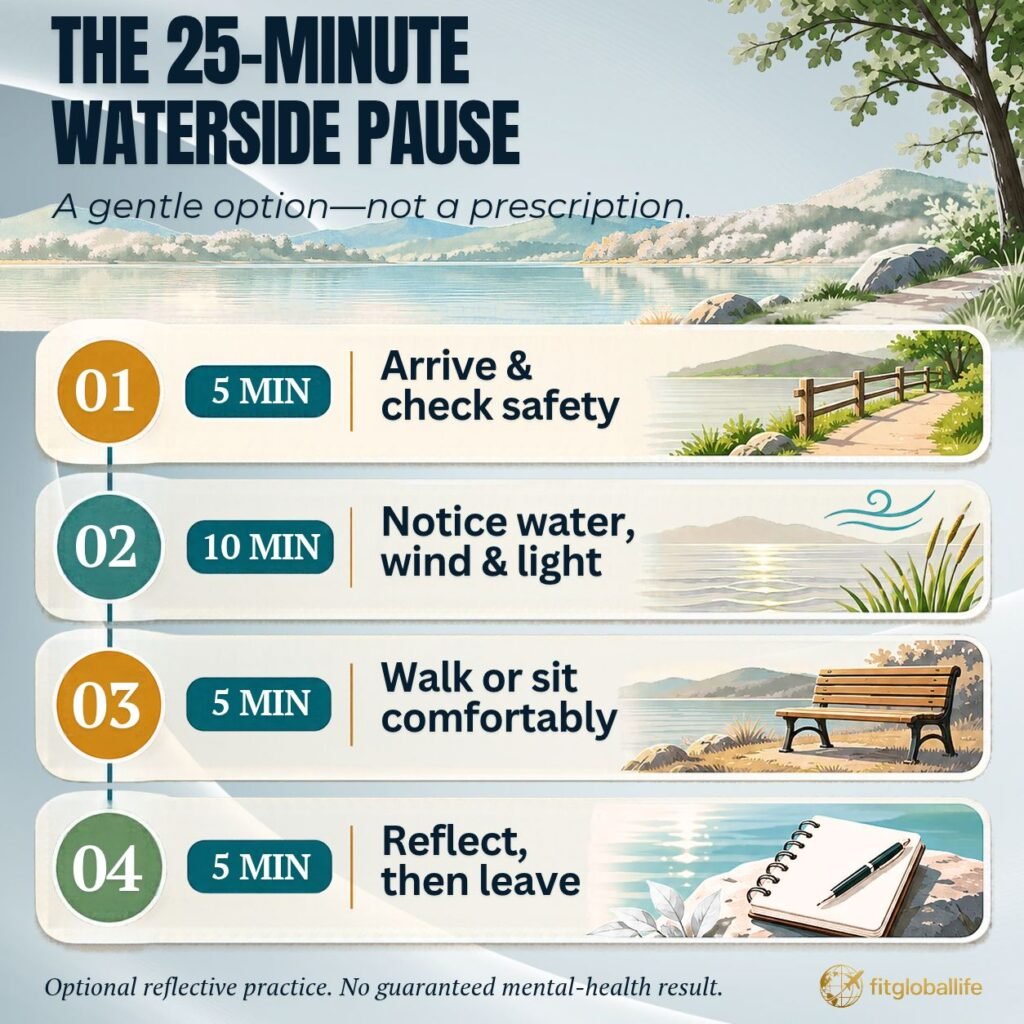
A simple 25-minute waterside practice
This is an optional attention exercise, not a treatment protocol or a claim that 25 minutes has a special clinical effect. Spend five minutes arriving and checking your surroundings. Walk or sit for ten minutes while observing water, wind, light, and sound. Use the next five minutes for slow, comfortable movement or quiet stillness. For the final five, notice how you feel, make a mental note of what helped, and leave without trying to preserve every second on camera.
If deliberate breathing feels helpful, keep it natural rather than forcing breath holds. Our guide to simple breathwork techniques for everyday pauses offers broader context, but you do not need breathwork to enjoy a river. If thoughts stay busy, that is not a failed visit. A pleasant environment can support rest without instantly switching off every worry.
One modest experiment: on three separate waterside visits, note your energy and mood in plain words before and after. Avoid judging the trip by a single score. The aim is to learn whether you prefer open horizons, flowing water, bird activity, or an easy city path—not to manufacture evidence that water has cured something.
The Practical Limits: Safety, Budget, Access, and Expectations
Water invites curiosity, but close access is not the same as safe access. The CDC’s guidance for oceans, lakes, and rivers recommends checking swim-area advisories and avoiding water that is discolored, unusually cloudy, or foul-smelling. For the intent of this article, it is enough to look at water from a safe public place; you do not need to get into the water.
For a more restorative trip, spend money on fewer stressful transfers rather than luxury branding. A guesthouse within walking distance of the water may be more useful than a dramatic resort that requires long drives for every outing. You can also compare affordable ways to plan a wellness escape without assuming that recovery must come with premium prices.
For international travel, review entry requirements, local medical access, and coverage exclusions before booking activities. Travelers comparing policies can examine international travel medical insurance options alongside other providers and policy documents; this is an affiliate link, and coverage depends on the specific plan, destination, activity, exclusions, and eligibility. It is not an endorsement of a particular level of protection.
Also consider the environmental cost of reaching a destination. A long-haul flight to a peaceful beach may be the wrong trade-off for a two-day break. For some travelers, a local waterfront reached by public transport will offer more repeatable rest than an ambitious overseas itinerary.
You Do Not Need to Cross an Ocean for Blue-Space Benefits
A canal beside a neighborhood, a safe lake path, a public harbor, or a city riverbank can be your version of blue space. Begin with access: a place you can reach without a complicated plan and return to without feeling depleted. If every nearby waterfront is loud or inaccessible, choose the most comfortable time of day or pair a brief water view with a green space nearby.
The lesson is not to replace your phone with a new set of location goals. If scrolling has become your default rest break, create one small boundary around phone checking while you are outside. If your mind feels overloaded, a separate guide on using time in nature to interrupt brain fog may help you think about follow-through at home. And if travel isn’t currently possible, a calmer week may still come from small, repeatable, nervous-system-friendly habits rather than a dramatic escape.
You’re not obligated to turn calm into another performance metric. The water does not need to be spectacular. The visit only needs to be manageable, safe, and worthwhile to you.
Conclusion: Choose Your Pace, Not a Promise
The best blue space destinations are not necessarily the bluest, most isolated, or most expensive. They are the ones that make a sensible kind of pause possible: a still lake in Slovenia, a changing lagoon in Portugal, a working river in Kyoto, a coastal bay in New Zealand, a city seawall in Vancouver, or the moving water of Croatia’s forested lakes.
Choose the experience that suits your body, your budget, your season, and the kind of attention you want to bring. Then leave part of the itinerary empty. That may be the most restorative item on the schedule.
Frequently Asked Questions About Blue Space Destinations
Any outdoor destination where water is a defining environmental feature can qualify: a beach, lake, riverbank, estuary, wetland, canal, or public urban waterfront. The color of the water is not the criterion, and swimming is not required.
Research shows positive relations to well-being and some positive effects of nature based interventions. However, the quality of the studies is variable and there is not enough evidence to assure that a visit to a specific blue space will prevent, diagnose or treat anxiety or depression. If you have ongoing or disruptive mental-health symptoms, get professional help.
At this time there is no evidence to support a universal ranking. Very few direct type comparisons were found in a 2026 evidence map. Personal comfort, ease of access, crowding, safety in the environment, and preferences for activities are more helpful than claims of medical superiority for one water setting over another as guides to practice.
There is no established water-specific minimum that guarantees relaxation. Start with a comfortable period—even a short safe visit—and see whether it feels useful. The widely cited two-hours-per-week finding concerns contact with nature generally, not a prescription for waterfront visits.
Yes. Sitting in a spot where you can see a river, taking a walk along an accessible waterfront, watching birds at a wetland, or stopping on a safe public promenade all count as meaningful contact with a water environment. A nearby, repeatable option may be more practical than expensive travel.
Disclaimer
This article provides general travel and well-being information, not medical, psychological, or safety advice tailored to an individual. Blue-space exposure is not a substitute for diagnosis, therapy, or treatment. Conditions, closures, accessibility, entry rules, weather, tides, and water quality can change; check official local guidance before travel or water activities.
Some links may be affiliate links, which may support FitGlobalLife at no additional cost to you, without affecting the editorial selection of destinations.