

These five solo retreat ideas are for the question that you’re constantly asking yourself while you’re washing the dishes, answering emails, or waiting for the kettle to boil. Perhaps you’re considering a change at work. Perhaps you’ve got someone you’ve been meaning to talk to, and you keep going over it in the shower. Give that question some space. You can start at the kitchen table, on a park bench, or somewhere your laundry won’t be able to see you.
A solo retreat is simply a block of time that you spend on your own. The intention is to come away with something tangible that you can then use when the day gets busy again. It might be a question you’ve got for your manager; it might be a date to revisit the decision; it might be a sentence you’re finally ready to say. Each of the retreats below asks for one piece of evidence and one action that you can take within 72 hours.
Choose the retreat that fits your question
Start by asking what’s actually in the way. You may well need quiet. You may have all the quiet you want and still be short of a number, a deadline, or an answer that only someone else can give you. If the question is already a manageable one, then go for the shortest format. You can always build on a good hour next week.
| Too many competing demands | The kitchen-table retreat | 75 minutes | One commitment to keep, pause or renegotiate |
| A worry you keep treating as a fact | The daylight walking retreat | 45–60 minutes | One assumption and a way to check it |
| A choice that needs better information | The library decision retreat | 2 hours | A shortlist, a missing fact and a review date |
| A conversation you keep postponing | The conversation rehearsal retreat | 90 minutes | An opening line, a specific request and a way to follow up |
| A possible change to everyday life | The close-to-home overnight retreat | 1 night | A rehearsal note and a seven-day trial |
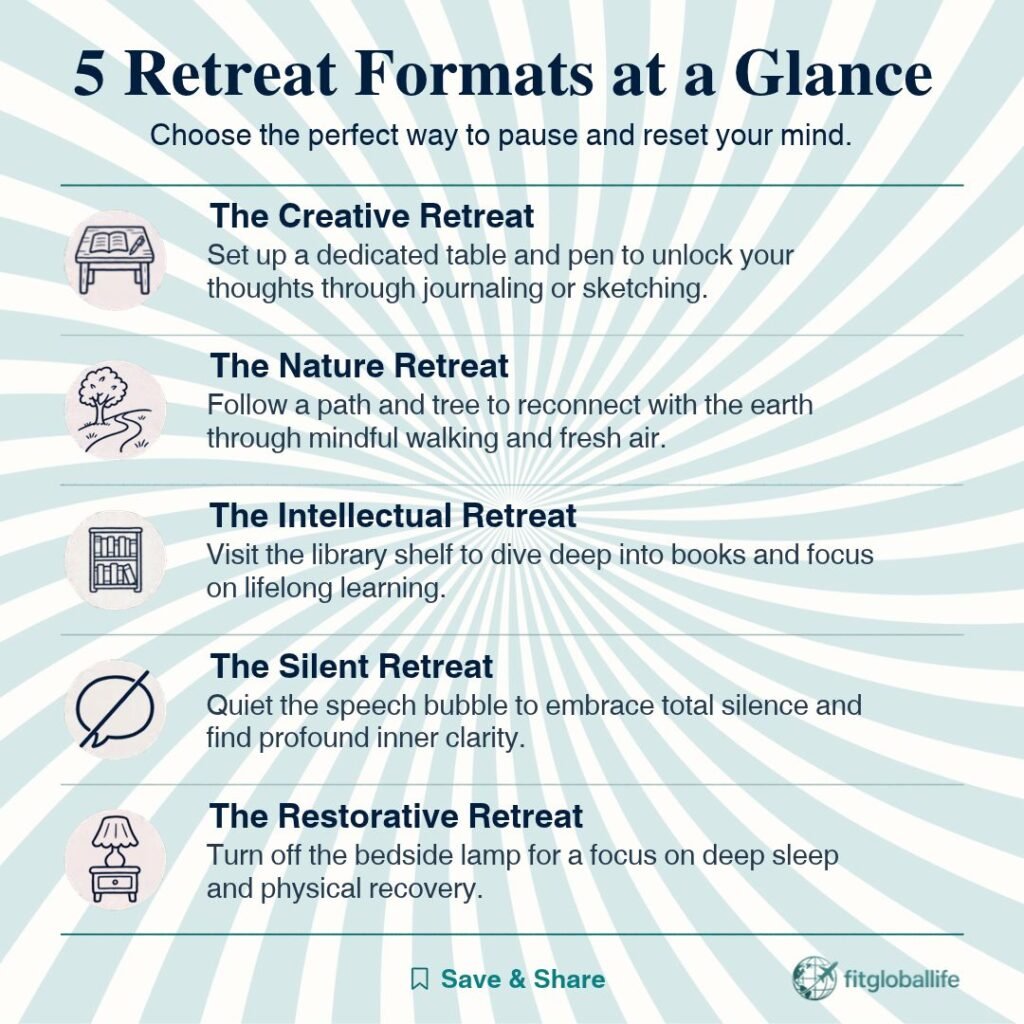
There’s a distinction to be made before you go and clear your calendar. The WHO’s 2025 figures put the proportion of people globally who report feeling lonely at around one in six (15.8%). Loneliness is the pain of the gap between the connection you have and the connection you want. You can absolutely have time alone and still have rich social support. If what you’re after this weekend is company, then a conversation over lunch is likely to be a far better use of your time than another solo stretch.
5 solo retreat ideas you can try this week
1. The kitchen-table retreat for a crowded week
This is all very good when each commitment on its own makes sense, and the week becomes utterly impossible when you add them all up. Pick a window when the table is yours. Take a calendar, a piece of paper, and whatever you need to eat or drink on the schedule. If you’re sharing the space, then let people know when you’ll be back. Keep the essential calls to hand and put the rest of your apps away. If the phone is constantly pulling you back, then go ahead and set a few sensible screen limits before you even start.
Allocate 15 minutes to just go through and list everything that’s currently claiming your time this week. Include the stuff that you wouldn’t normally put on a calendar at all, things like arranging an appointment, picking someone up, remembering to follow up on a repair, etc. Then spend the next 25 minutes going through that list and comparing it to the time you actually have. Pick one obligation that you can keep, one optional thing that you can simply put on hold, and one arrangement that you need to have a conversation about. Take a 10-minute break before you decide what you’re going to change.
Use another 20 minutes to draft the message. “I can send the first two pages by Thursday. Would Monday work for the full draft?” gives them something to say. Save the final 5 minutes to decide when to send it and to note the trade-off. If the obligation is going to cost you a free evening, then write that down. Seeing the price in actual hours can make it much easier to justify the choice. A more general guide to short breaks around the house can help you find another window if it’s hard to arrange 75 minutes at the table.
Take one thing home. Keep the revised commitment somewhere where you’ll see it. If you’ve paused an optional task, then put a review date next to it so it doesn’t just sit on a ‘later’ list forever. If you only have 25 minutes, then spend them on one day in the calendar and one change that you can actually communicate.
2. The daylight walking retreat for a recurring worry
Pick a route you know well and can easily get back on. A public garden, a paved neighborhood loop, a bench facing a patch of trees will all do. If walking is an issue, or the weather makes it not ideal to be out and about, use a covered public space or sit at a window and spend a few minutes looking out. For some more ideas on how to spend time around trees and open space, have a look.
In two experiments, researchers found that participants performed better on an attention task after walking in nature or looking at pictures of nature. A clear answer to the work/family question is quite a different outcome from a test of attention. The change of scene is an opportunity to look at the question again.
Write the worry in one sentence before you leave. “The team will think I’m unreliable if I ask for a later handover date” is specific enough to work with. For the first ten minutes, just be aware of what’s around you. Once you’re in a place where you can stop safely, make two very short lists. One of what you actually know from observation and one of what you’re predicting. You might know the date is tight and that a colleague has, in fact, moved their handover. You might be predicting how your team will read the request. Then pick the very smallest thing you can do to get better evidence. For instance, ask the project lead whether the date is fixed before you go any further and start building a case for moving it.
If you’re going beyond a well-known public space, then check the local conditions and follow park guidance on sharing your trip plan. Bring a fully charged phone, set a return time, and choose a route that fits your mobility and the day’s conditions. A quiet indoor loop is a perfectly acceptable alternative on a bad weather day. If a busy street makes reflection into another task, then a park seat above the waterline is a good option, or you can simply pick an easy afternoon by the water.
Take one thing home. Jot down the assumption you’re testing and the person/source that can clarify it. When that same thought arises again, you’ll have a question to pursue.
3. The library decision retreat for a choice with missing facts
A library is useful if you’re looking for information (a calendar and fewer tabs). A quiet public reading room or community centre will also do. Check the opening hours, check accessibility, and whether you can book a seat. Keep any private information out of earshot and use a private connection for any sensitive accounts. If you’re the type of person who usually starts off with seven tabs open, you’ll need a way of getting going when your attention is all over the place.
Spend the first 20 minutes writing down your choice as a question that you can answer by a specific date. “What training schedule can I realistically sustain for the next eight weeks?” is a good example of such a question. Spend the next 30 minutes working up to three options (including ‘carrying on as you are’ if that’s actually an option). For each of the options you have, work out the consequences in normal terms (e.g. money per month, evenings away from home, notice required). Put a question mark next to any figures that depend on someone else’s actions. A bit of space on the page is far better than a complex scoring system when you’re dealing with estimates.
After a break, spend 25 minutes looking for the one missing fact which is most likely to alter your choice. If an evening course looks good but you’re not sure whether missing one session would rule you out, ask the provider about make-up sessions before you spend the afternoon trawling through course reviews. If you can’t establish the fact today, then draft the question and note when you’ll follow up. In the final stretch, you can put forward a temporary option you’re happy to walk back from (e.g. attend an open session, ask to see the syllabus). You can use prompts to help you separate evidence from self-doubt if you find that the same self-critical comment is cropping up under every option.
Take one thing home. Make a three-line note with your options, the one fact that would change your mind, and the date on which you’ll look at it again. For a decision of a serious financial, legal or health nature, use the retreat to prepare questions for appropriately qualified advice.
4. The conversation rehearsal retreat for a request you keep putting off
Some decisions are already in the offing. The difficult bit is getting another person to actually hear you. A private room at home or a space that you can book in advance is ideal. You need to have a conversation with a genuine purpose in mind (e.g., asking a sibling to do one of their regular errands, or discussing when you can reasonably be expected to get back to work emails). If there is any risk of intimidation or retaliation, then you should absolutely make a support plan with a trusted person or a qualified service prior to having the direct conversation.
Start off by describing the problem as something a camera or a calendar could pick up. “I’ve done every Saturday collection this month” is a far more focused way of putting it than some kind of judgment about what the person cares about. Make one request and give a time frame. “Could you do the 1st and 3rd Saturdays next month?” is specific enough for the other person to say yes, no, or propose an alternative. Then throw in a quick fallback. You might ask for one Saturday and be happy to try a different arrangement for the rest.
Read your opening line out loud twice. If it takes a full minute to get to the request, then strip out the background detail you’d only need if you were actually being asked. Leave space for the other person to respond. A colleague may well come up with a constraint you hadn’t even thought of, and a family member may say yes far more readily than you’d expect. Practicing the art of pausing before you react can go a long way toward creating that space in the actual conversation. Use the final 15 minutes to work out how you’re going to ask for a time to talk and what you’ll do if the issue isn’t resolved. A very short appointment request is often the most useful next step.
Take one thing away. Save your opening/request/fallback on a single card. A scrap of paper will be fine. Allow time between your rehearsal and the actual conversation to check that your request still sounds perfectly reasonable when read at a normal pace.
5. The close-to-home overnight retreat for testing a change
Use an overnight if the question is about the rhythm of your day. Could you give yourself an unhurried breakfast twice a week? Would an earlier evening boundary be workable? An overnight gives you one evening and one morning to try the sequence. It also has a cost, so you need to decide what you’d learn from that sequence before you actually go and pay for it. If it fits into one morning, consider lower-cost ways to plan a retreat.
Pick somewhere with a reasonably predictable trip home, food that suits you, a check-in you can handle, and any room/bathroom access you need. Check the full price (including transport, meals and cancellation terms). The questions you ask before you book will go a long way to establishing those details with the property. Share your plans and a check-in time with someone you trust. An overnight at home is absolutely viable if you can agree on who does the chores and who calls for that period.
If your local getaway takes you across an international border, check your existing travel medical cover and the destination’s requirements before booking. If you’re comparing policies, then you can have a look at a SafetyWing travel medical plan. Always check the current policy wording to confirm your eligibility, exclusions, and coverage for your destination and length of trip.
On arrival, eat and give yourself time to settle. Write one straightforward sentence about the routine you want to test. “I want to stop reading work messages after dinner on two weeknights” is specific enough to try. Do that boundary this evening and note what gets in the way. In the morning, ask yourself what made the routine work away from home. Was it simpler meals? Were there no bags to pack for the next day? Write down which of those conditions you can replicate on a Tuesday. You may need to have some kind of agreement in place about urgent messages or an easier dinner. The point of the experiment is that it’s only meaningful if it accounts for who does the work at home.
Take one thing home. Set up a seven-day trial with an end date and a way of evaluating it. Two completed evenings and one note on what got in the way is all you need to make a decision about whether to continue, modify or drop it. If it was the unstructured space you liked best, then adaptations from a gradual return after a period of creative downtime can help you safeguard that particular space.
Turn one good hour into an action within 72 hours
The return can be the awkward bit. A useful note goes in your bag, you’ve got two messages to deal with and by Wednesday all you can recall is how good it was to have your coffee in peace. Before you go, have a plan that has a very clear point at which you’re going to start. “If I’ve finished the Tuesday budget meeting I’ll fire off the two line question whilst the notes are still open” is a lot more realistic than “I’ll be more assertive this week”.
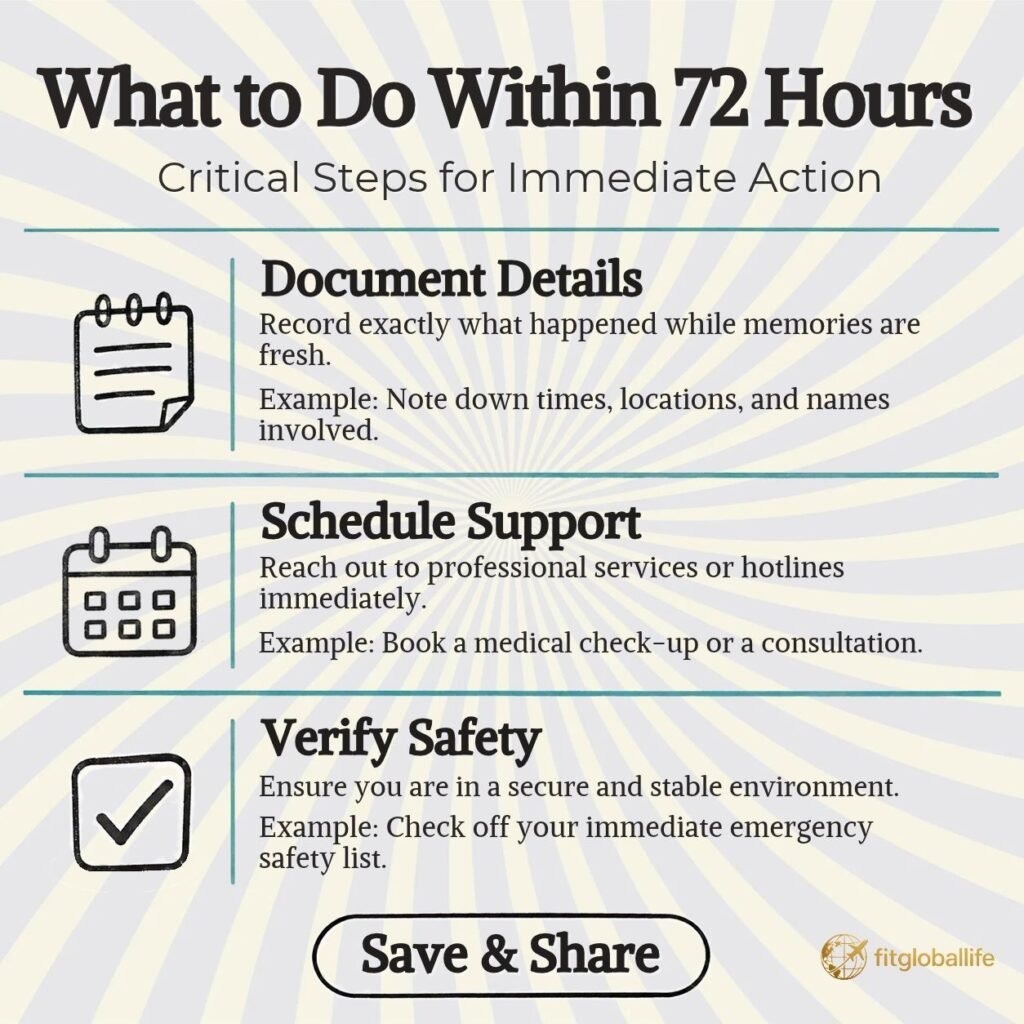
A meta-analysis of 94 independent tests of if–then plans found a standardized effect of d = 0.65 on goal attainment across the studies it included. That’s the overall effect size for the research. Your own plan is, of course, a tiny experiment, and the 72-hour window is a perfectly reasonable timeframe to work with. If you’re on weekends or have someone on a rotating shift, you’ll obviously want to use the first practical opening that you can.
Just carry forward three lines. First, write the sentence you want to remember. Then put the smallest possible action somewhere you’ll actually see it. Finally, pick a date to go back and see what actually happened. A walk might reveal you were just guessing how the other person would respond. Your action might be to ask for ten minutes on Thursday. At the point of check-in, you can then record what the other person actually said, whether the question has changed, and what decision still needs time. The outcome may be a better question. For a fuller picture of returning to fewer competing tasks, try reducing the number of things you have open at any one time.
When to shorten the session or bring in company
Before you begin, though, decide what would make you change your plans. A shorter session, a public setting, or a call with a friend are all options. In lab studies on short periods of solitude, Nguyen and colleagues found that time alone could actually reduce the intensity of some high arousal states (both positive and negative). Their findings also point to the importance of choice. Your experience may differ depending on how you’re feeling, where you are, and whether you actually want to be on your own at that moment.
Watch out if reflection starts to go into a loop and actually leaves you worse off. Stop the exercise, do something normal to get back into the day, and get in touch if you need any support at all. If you’re interested in going a bit longer with the silence, then read up on how various formats deal with silence and support prior to doing so. You can also have a check-in at the end of your retreat and let someone know when you’re going to be back again. That’s very useful if you’re attempting some time alone in a new environment.
Conclusion
Pick the format that corresponds to the actual question you’re living with. Give it a start time, a finish time, and a place to put what you learn. Seventy-five minutes at the kitchen table might be all the breathing space you need to renegotiate a Friday deadline. An afternoon in the library might be the time that makes you realize you’re literally one phone call away from making a decision you’ve been putting off for months. Put that next action on your calendar whilst the question is still fresh.
You can go back to the same format whenever that’s the right thing to do. Leave space for a result you don’t have yet. The bravest thing you can do at times is acknowledge what you don’t have and ask the person who does.
Frequently asked questions
Start with 45 to 90 minutes if you’ve got just one question. Reserving half a day can be worthwhile if you’ve got several options to compare and information to check. Set a clear finish time. If you only have 25 minutes on your schedule then just pick one prompt, give yourself a few minutes to get settled and then reserve five minutes to write your next action. You can always come back for a second short session when your calendar permits.
Yes. Agree on a short window and let the others know what kind of interruption you’re available for. A walk, a seat in the library, a morning at the dining table whilst the rest of the household are out can all work. If you care for someone then you’ll probably have some cover in place or be able to find a time that works with the support you already have. Just make a specific request for the time you need so they can say whether that works for them.
Write down what would help you make the decision and when you can realistically get it. Split the facts you can gather from the uncertainties that may well remain. You might be able to confirm the fee by Friday and still be unsure how a new schedule would feel. A short trial might actually be the best way of answering the second question rather than another hour of thought. Pick a date to go and see what the trial tells you.
Keep it accessible if you need it for directions, emergency contact, accessibility or care responsibilities. Silence the non-essential notifications for a period of time and let the important ones through. If you’re going to be using the phone to look something up during a decision retreat then write down the question prior to opening the browser. Having a clear stopping point makes it a lot easier to just close the screen when you’ve got your answer.
Try the kitchen table format with a pen, a calendar and whatever you’d normally eat or drink. If you need to change the setting then pick a public place you can already get to. Budget for the whole thing (transport and any extra care costs). A park nearby may be cheap on paper and still be the wrong choice if it takes two trips and an afternoon you don’t have.
Disclaimer
This article offers general educational information for personal planning. Seek qualified health support if distress persists, and consult appropriate professionals for health, financial or legal decisions. For outings, follow current local safety advisories and venue rules.