
Climate anxiety is no longer only a headline feeling. For many people, it is becoming a daily health pattern: the way they sleep, eat, move, focus, plan trips, decide where to live, and think about family or career. That does not mean everyone who worries about climate change has a clinical anxiety disorder. It means the climate crisis is becoming intimate. It is entering ordinary routines through heat, smoke, food prices, disaster news, uncertainty, and the quiet sense that the future requires more emotional math than it used to.
This is why the conversation has to move beyond the phrase “eco-anxiety” as a trendy label. The World Health Organization says climate change poses a major threat to human health, affecting clean air, water, food systems, livelihoods, health services and mental health. The CDC also summarizes climate-related health disruptions across respiratory disease, cardiovascular risk, infectious disease, injuries, premature deaths, and mental health. In other words, climate anxiety is not floating in the air like a vague mood. It often grows from real exposures, real uncertainty, and real changes in daily living conditions.
Here is the more human version: some people are not just worried about melting ice. They are worried about whether their apartment will be too hot to sleep in, whether their child will breathe wildfire smoke again, whether fresh food will keep getting more expensive, whether a favorite coast will still be safe to visit, or whether their future plans are built on sand. The body hears all of that. Quietly, then loudly.
The most useful approach is not to shame the worry or romanticize it. Climate anxiety can become draining when it turns into doomscrolling, avoidance, insomnia, guilt, or constant threat scanning. But it can also become protective when it helps people build healthier routines, stronger community ties, more realistic travel habits, and a sense of agency. The goal is not to “stop caring.” The goal is to care without letting the nervous system run the whole show.
What Climate Anxiety Means in Daily Health
Climate anxiety usually refers to distress, worry, grief, fear, anger, or helplessness related to climate change and ecological damage. It can show up after direct events, such as floods, fires, drought, storms, or heat waves. It can also show up indirectly, through news exposure, scientific reports, social media, family conversations, or the slow realization that climate risk is not a distant issue anymore.
A major global survey of 10,000 people aged 16 to 25 in ten countries, published in The Lancet Planetary Health, found that more than 45% said their feelings about climate change negatively affected daily life and functioning. Many also reported fear, sadness, anger, helplessness, and guilt. That finding matters because it shifts the conversation from “young people are dramatic” to “daily functioning is being touched by climate worry.” Big difference. One is dismissive. The other is public health.
The 2025 Lancet Countdown report on health and climate change adds context from the physical side. It finds worsening health impacts on multiple measures, including heat-related deaths, exposure to smoke from wildfires, potential for transmission of dengue and stress on food and water. These physical risks provide the background noise for psychological distress. A person may not use the term climate anxiety, but they may feel the load through poor sleep, irritability, constant planning, avoidance of outdoor activities, or decision fatigue around food, travel, and home life.
| Daily health area | How climate anxiety can show up | Healthier response |
| Sleep | Late-night doomscrolling, heat-disrupted rest, alertness before storms or smoke events | Create a heat-aware wind-down routine and reduce news exposure before bed |
| Food | Guilt-heavy eating, panic buying, worry about prices or supply | Build resilient meal habits that are seasonal, affordable, and nourishing |
| Focus | Attention splintered by climate news, disaster alerts, and future worry | Use limited news windows and attention-repair practices |
| Movement | Avoiding outdoor exercise due to heat, smoke, or safety concerns | Plan flexible indoor-outdoor movement based on air quality and temperature |
| Future planning | Stress about children, housing, travel, career, or finances | Move from abstract dread to values-based planning and collective support |
How Climate Anxiety Changes Daily Health
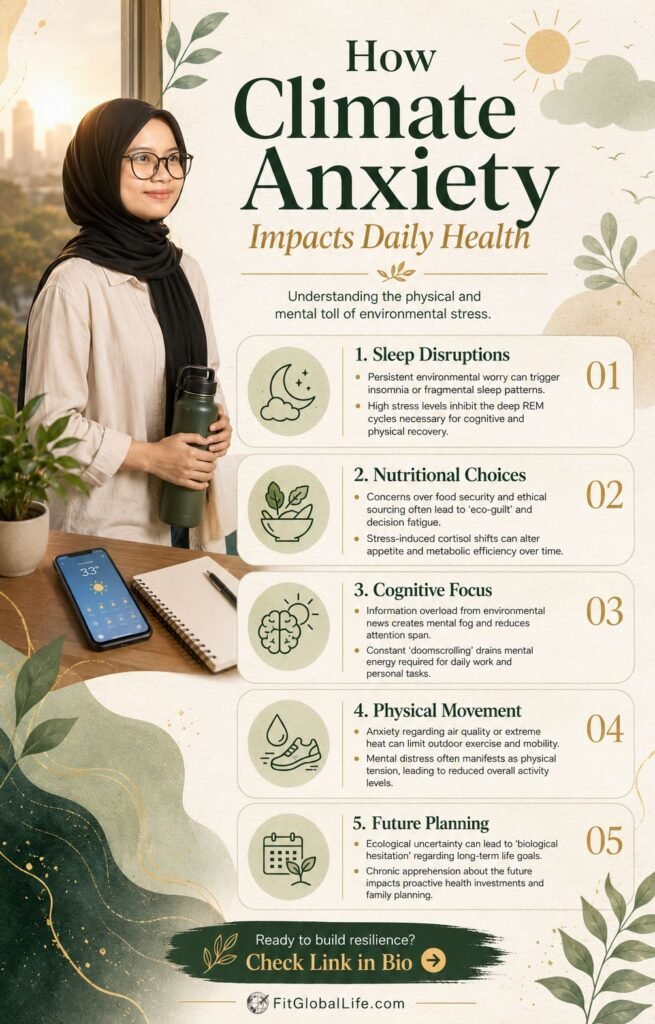
Climate anxiety changes daily health through a simple but powerful loop: perception, physiology, behavior, and environment. You read or experience something threatening. Your body prepares for danger. Then your behavior changes, sometimes wisely and sometimes in ways that make the stress worse. If the environment keeps sending new signals, the loop repeats.
That loop is why climate anxiety is not just “in your head.” Stress changes breathing, muscle tone, digestion, attention, sleep pressure, social behavior, and motivation. When the source of stress is huge, global, and slow-moving, the body can get stuck trying to solve the unsolvable at 11:47 p.m. Classic body behavior. Terrible timing.
Below are five ways climate anxiety is already reshaping daily health, plus practical ways to respond without pretending everything is fine.
1. Climate Anxiety Keeps the Nervous System Half-Alert
The first daily health shift is nervous system vigilance. Climate anxiety often works like a low-grade alarm. The person may be sitting in a normal meeting, cooking dinner, or checking emails, but somewhere in the background their mind is tracking heat waves, flood maps, storm alerts, fire season, air quality, or political inaction. The body does not always separate “real-time danger” from “future threat.” If the brain believes something important is unresolved, it keeps scanning.
This half-alert state can look subtle. Jaw tension. Shallow breathing. A tight chest after reading climate news. Restless in strange weather. Irritation when someone makes a joke about the planet burning. A sudden need to check forecasts again, even when there is nothing new to learn. The person may not say, “I am anxious about climate change.” They may say, “I feel wired, tired, and weirdly on edge.”
The problem is not that the concern is irrational. The problem is that the body cannot live in emergency mode forever. Chronic stress can make everyday decisions feel heavier than they are. It can make small inconveniences feel like evidence of collapse. It can also reduce the mental flexibility needed to respond well to actual climate challenges. A nervous system stuck in alarm is not more prepared. It is just more exhausted.
A practical first step is to rebuild body awareness before trying to “think positive.” If someone cannot sense their own stress state, they will probably overuse intellectual coping: more reading, more debates, more data, more scrolling. Data has its place, but a dysregulated body will turn even good data into another alarm bell. This is where a simple body-based reset can help. FitGlobalLife's guide to easy mind-body recovery techniques is a natural companion because climate stress often needs regulation before analysis.
Try this small check-in: pause, drop your shoulders, unclench your jaw, and ask, “What is my body trying to prepare for right now?” The answer may be “a storm,” “bad news,” “helplessness,” or simply “too much information.” Naming the threat does not solve climate change. But it tells the body that someone competent is at home. That matters.
People who experience climate anxiety may also benefit from learning the difference between activation and action. Activation is the body getting ready. Action is a chosen step. When activation is high, action becomes impulsive or avoidant. When activation is regulated, action becomes clearer: prepare a heat plan, check on a neighbor, support a local resilience project, adjust a travel plan, or close the phone and sleep. Not every feeling needs a global response by midnight. Some feelings need water and a slower exhale. Wild, but true.
For readers who want a simple nervous system practice, a short breathwork reset for stress can be more useful than another hour of climate content. For people who feel stress first as stomach tightness, chest pressure, or restlessness, interoception training can help them read body signals earlier, before anxiety becomes a full-body takeover.
2. Sleep Becomes More Fragile and More Climate-Sensitive
The second shift is sleep. Climate anxiety affects sleep in two overlapping ways: emotional arousal and environmental disruption. Emotional arousal is the worry loop: reading disaster news, imagining the future, feeling angry or helpless, and trying to think your way to safety. Environmental disruption is the physical reality: hotter nights, poor air quality, power outages, storms, humidity, or noise from emergency conditions.
Sleep is where abstract climate stress becomes brutally practical. A person can care about the planet all day, but at 2 a.m. the issue becomes very specific: the room is too hot, the mind will not shut down, and tomorrow's workday is coming fast. The body needs lower core temperature and psychological safety to sleep well. Climate change pokes both.
A 2025 study in Nature Communications found that warmer room temperatures were associated with less total sleep and a higher likelihood of insufficient sleep. The study, which looked at repeated sleep records, also found that deep sleep was affected and that some groups were hit harder than others. This matches what many people notice at home: hot nights are not just uncomfortable—they can make it harder for your body to recover.
Climate anxiety adds another layer. Some people lie awake after reading about heat mortality, wildfire smoke, sea-level rise, or food insecurity. Others wake earlier and check weather apps before they even check in with their own body. In disaster-prone regions, the sleeping brain may stay alert for sirens, wind, smoke, rain, or evacuation messages. That is adaptive during real danger, but draining when it becomes the default.
The key is to separate climate information from bedtime. You do not need to be uninformed. You need an information curfew. Choose a climate-news window earlier in the day, preferably paired with one concrete action. Then make the bedroom a recovery zone, not a crisis dashboard. FitGlobalLife's guides on circadian lighting at home and sleep-friendly bedroom layout can support this part because sleep resilience is not only about mindset; it is also about light, temperature, air, noise, and layout.
A climate-aware sleep routine can be simple: check the forecast before dinner, not in bed; prepare cooling or air-quality tools early; dim lights one hour before sleep; keep a paper note beside the bed for worries; and write one action for tomorrow so the mind does not keep rehearsing it. When worry says, “Do something,” the note says, “Already scheduled.” Tiny hack, surprisingly effective.
It also helps to stop treating poor sleep as a personal failure. If the room is hotter than usual, if smoke is in the air, or if storm alerts are active, the body is responding to context. That does not mean giving up. It means designing sleep around reality. Climate-aware sleep is not luxury wellness. It is adaptation at mattress level.
3. Food Choices Become a Mix of Health, Guilt, and Resilience
The third daily health shift is food. Climate anxiety can change what people buy, cook, crave, avoid, and feel guilty about. Food is personal, cultural, financial, emotional, and biological. Then climate change walks in and adds carbon footprints, drought, food prices, soil quality, animal welfare, supply chains, packaging, water use, and seasonal disruption. Suddenly dinner is not just dinner. It is a group project with the entire planet. No pressure.
For some people, climate anxiety pushes them toward more plant-forward eating, less food waste, local sourcing, or seasonal cooking. That can be a healthy and meaningful response. For others, it creates food guilt, rigidity, shame, or decision fatigue. They may overthink every purchase or feel hypocritical for eating something they enjoy. In daily life, the question becomes: is this choice nourishing me, or is it making me smaller?
The food system context is real. “Climate change to date has already affected food security through changes in temperature, rainfall and extreme events, and the IPCC projects future pressure on cereal prices and hunger risk. The World Bank's May 2026 food security update also identifies conflict and climate shocks as continuing primary drivers of acute food insecurity. These are not abstract concerns for people trying to feed a family on a budget.
Climate anxiety can also influence appetite. Stress may increase cravings for quick energy foods, reduce appetite, or make meal planning feel like another impossible task. When someone is tired, overheated, and worried, the brain prefers convenience. That is not a moral failure. It is biology doing budget cuts. The solution is not shame. The solution is a resilient food system at home: simple meals, repeatable staples, flexible proteins, low-waste habits, and enough pleasure to make the routine stick.
This is where climate-aware nutrition can become practical rather than performative. A person does not need a perfect climate diet. They need a pattern that supports energy, mood, and affordability while reducing waste where possible. FitGlobalLife's anti-inflammatory weekday meal guide can fit naturally here because climate anxiety often increases inflammatory lifestyle patterns: poor sleep, stress eating, skipped meals, and reduced recovery. A steady meal rhythm is not small. It is nervous system infrastructure.
Readers who care about the deeper food system can also connect this to regenerative soil and vitamin intake. Soil health is not just a farming topic; it shapes nutrient density, resilience, water retention, and long-term food security. Still, the daily rule should be gentle: choose the most nourishing realistic option available, reduce waste one meal at a time, and avoid turning every plate into a courtroom.
A helpful framework is the “three-plate test.” Ask three questions: Does this plate support my body today? Does it reduce waste or unnecessary packaging where realistic? Does it fit my actual budget and culture? If yes, it is a good climate-aware plate. If it is imperfect but gets you fed, it is still a human plate. We are not robots with reusable tote bags. We are people with nervous systems, bills, preferences, and limited Tuesday-night energy.
4. Movement, Outdoor Time, and Travel Become More Negotiated
The fourth shift is movement. Climate anxiety changes how people relate to the outdoors. For some, time in nature becomes more precious because it restores perspective. For others, outdoor movement becomes more complicated: extreme heat, wildfire smoke, flooding, storm risk, air pollution, or unsafe walking conditions can make exercise feel like a planning session instead of a release.
This matters because movement is one of the strongest daily tools for mental and physical health. Walking, cycling, stretching, gardening, and low-intensity outdoor time help regulate stress, improve sleep pressure, support metabolic health, and reconnect attention to the present. But climate conditions may throw those routines out of whack. When the healthiest thing you usually do becomes weather-dependent, anxiety can rise.
The answer is not to force outdoor exercise at any cost. Climate conscious movement means flexibility. On safe days, get out early or late, take shaded routes and bring water. On poor air-quality days, move indoors. During heat waves, reduce intensity. During storm seasons, have a backup routine. A person who adapts movement is not being lazy. They are being literate.
This is especially important for people who travel for wellness. Climate anxiety is changing travel choices: when to go, where to go, how far to fly, whether a destination is prepared for heat or water stress, and whether tourism helps or harms local communities. It can also create a strange emotional split: wanting beauty, but not wanting to damage what is beautiful. That tension is becoming normal among conscious travelers.
For everyday routines, FitGlobalLife's guide to walkable cities for a healthier reset can help readers think about movement as design, not willpower. For deeper restoration, nature retreats for a gentle nervous reset offer a useful bridge between mental health and environmental awareness. Nature can calm climate anxiety, not because it denies the crisis, but because it reminds the body that connection still exists.
Awe also matters here. When people feel awe, they often experience a smaller self in a larger world. That can soften rumination and widen perspective. FitGlobalLife's article on awe psychology as a biological need can support this idea. Climate anxiety narrows attention toward threat; awe widens attention toward relationship. Both are information. The trick is not to live only in threat.
Travel decisions may also become healthier when people shift from escapism to responsibility. Instead of asking, “Where can I forget the world?” they ask, “Where can I recover without adding unnecessary pressure to a place?” This makes eco-conscious escapes relevant as an internal bridge. The future of wellness travel is likely to be less about collecting destinations and more about selecting places with care, timing and humility.
5. Future Planning Becomes a Health Behavior
The fifth shift may be the most underestimated: climate anxiety changes future planning. Where should I live? Should I have children? What career is stable? Is this city safe long term? Should I move closer to family? Is buying a house near the coast wise? Should I travel before certain places change? Should I choose work that helps the problem? These are not just philosophical questions. They impact everyday stress, relationships, money, identity and health behaviors.
A systematic review in PLOS Climate found a complex relationship between climate change concerns, mental health, and reproductive decision-making, with many studies linking stronger climate concerns to less positive attitudes toward reproduction or desire for fewer children. Another study of UK university students found that highly climate-anxious students were more likely to factor climate change into domains such as career, family planning, long-term habitation, finances, and travel. That is a massive daily-health point: climate anxiety is not only about feeling worried. It can shape the architecture of a life.
Future planning stress often becomes decision fatigue. A person may feel responsible for making the “right” choice in a situation where no option is clean or certain. This can lead to overresearch, avoidance, conflict with partners or parents, or a sense of being frozen between values and reality. Again, the goal is not to dismiss the concern. The goal is to make planning tolerable enough to stay human.
One practical approach is to separate decisions into three circles: daily control, shared influence, and uncertain future. Daily control: sleep cycles, food choices, shopping decisions, means of travel, emergency preparedness, media consumption limits. Shared control: resilience in the community, voting when possible, workplace sustainability, mutual aid, local adaptation, collective action. Unknown future: forecasts, international policy, events beyond the grasp of any individual. Anxiety becomes heavier when these circles collapse into one giant responsibility blob. Very technical term, obviously.
Future planning also needs social support. Climate anxiety can feel lonelier when people feel dismissed, mocked, or told to “stop being negative.” But isolation increases distress. FitGlobalLife’s piece on micro-communities for mental longevity fits this section because climate resilience is not just solar panels and emergency kits. It is knowing who will check on whom when the heat index spikes, the power goes out, or the news feels unbearable.
Meaningful action can also protect mental health when it is realistic and shared. Research in npj Climate Action notes that climate-related distress can be associated with collective climate action, while very high distress may sometimes reduce engagement. That nuance is important. Action helps when it restores agency. Action harms when it becomes compulsive, perfectionistic, or self-punishing.
For readers who feel their focus has been hijacked by future worry, FitGlobalLife's guide to mental fitness drills for stronger focus can help turn abstract dread into trainable attention. For those whose climate anxiety is amplified by constant screen exposure, digital detox habits that reduce screen anxiety offer another internal path. The future will require attention management. That sounds less dramatic than survival, but it may be one of the daily skills that makes survival feel livable.
The Hidden Health Pattern: Micro-Adaptation Fatigue
One under-discussed pattern is micro-adaptation fatigue. This is the tiredness that comes from constantly making small adjustments to climate-related uncertainty: checking air quality, changing walking times, choosing backup indoor plans, worrying about food prices, adjusting travel dates, preparing for heat, watching storm alerts, updating insurance, filtering water, explaining climate concerns to family, and managing news exposure. None of these tasks may look huge alone. Together, they become a second calendar.
Micro-adaptation fatigue is sneaky because it looks like responsibility. You are not having a breakdown. You are being practical. But the mental load still counts. Parents may carry it for children. Older adults may carry it around medication storage, heat vulnerability, or mobility. Travelers may carry it around destination safety. People with chronic illness may carry it around power outages, air quality, or heat sensitivity. Low-income households may carry it with the least margin, which is exactly why climate anxiety cannot be separated from equity.
The APA and ecoAmerica report on mental health and climate emphasizes that climate impacts are not distributed equally and that structural inequities shape who is affected first and worst. This is one reason the wellness conversation must avoid turning climate anxiety into a purely individual self-care problem. Meditation can help. Better policy, resilient infrastructure, cleaner energy, and community support also help. Both can be true. Wellness without systems thinking is basically scented denial.
A better question is: what repeatable systems can reduce daily climate load? The answer may be a shared family heat plan, a simple emergency shelf, a neighborhood check-in group, a low-waste meal rotation, an indoor movement routine, a trusted news list, or a fixed weekly climate action instead of constant mental rumination. Systems turn anxiety into fewer decisions. Fewer decisions free energy for health.
A Practical Climate-Aware Health Plan
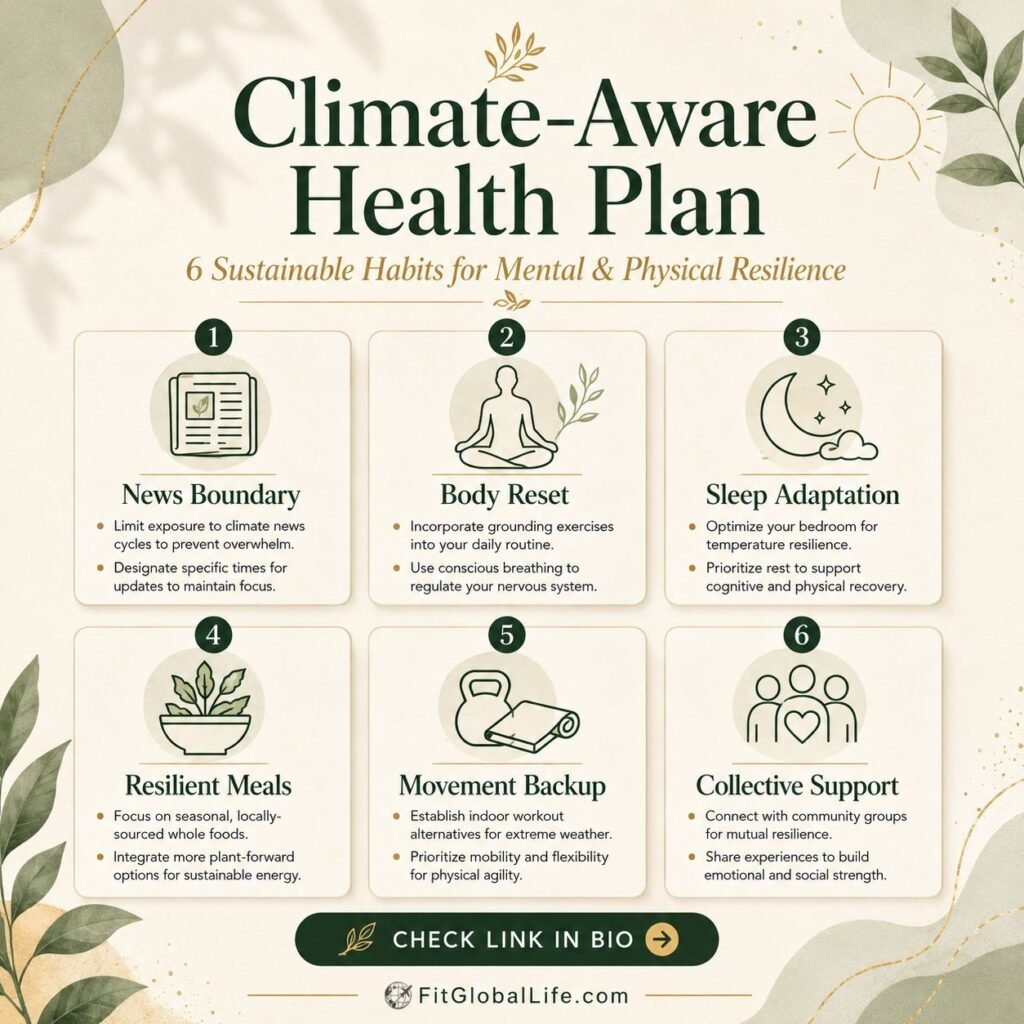
Climate-aware health is not about becoming perfectly calm while the world changes. It is about building routines that respect the reality of climate risk without letting it dominate every breath. The plan below is intentionally ordinary because ordinary is what people can repeat.
| Practice | Why it helps | How to start |
| News boundary | Reduces constant threat scanning | Choose one or two reliable update windows, not all-day checking |
| Body reset | Moves stress out of pure thinking | Use 2-5 minutes of breathing, stretching, or grounding after climate news |
| Sleep adaptation | Protects recovery during heat and worry | Create a cooling, dim-light, no-news bedtime routine |
| Resilient meals | Supports mood, energy, and budget | Repeat 3 low-waste meals that use flexible ingredients |
| Movement backup | Keeps exercise from disappearing during heat or smoke | Have one indoor routine and one shaded outdoor route |
| Collective support | Turns helplessness into shared agency | Join or create a small local resilience habit, not a heroic solo mission |
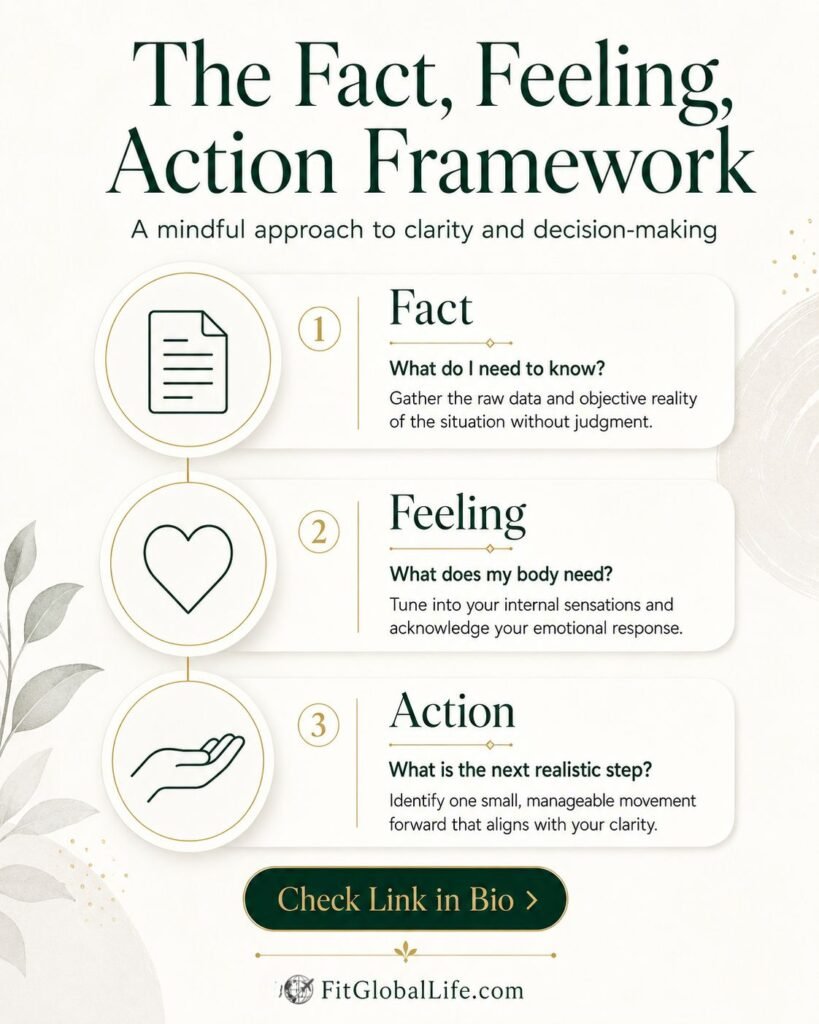
1. Name the Layer: Fact, Feeling, or Action
When climate anxiety spikes, ask: is this a fact I need to understand, a feeling I need to process, or an action I need to take? Many people try to solve feelings with more facts, which can become an infinite scroll. Others try to solve facts with avoidance, which creates more uncertainty. Naming the layer keeps coping cleaner.
The heat index is high tomorrow” is a fact. “I feel scared and trapped” is a feeling. “I will shift my walk to 7 a.m., refill water bottles and check on my neighbor” is an action. Three layers. Three tools. Much less chaos.
2. Build a Climate-Stable Morning
Mornings set the nervous system's first vote of the day. If the first input is disaster news, the body begins in defense mode. A climate-stable morning does not ignore reality; it sequences reality better. Hydrate, get light, move gently, eat something steady, then check necessary updates. FitGlobalLife's guide to mindfulness at work during busy days can extend this into the workday, especially for readers whose focus is fractured by climate and productivity pressure.
3. Use Planet-Friendly Self-Care Without Perfectionism
Sustainable habits work best when they are identity-light and repeatable. Bring a bottle, waste less food, repair something, choose slower travel when possible, support local growers, use energy wisely, vote and advocate where you can. But do not turn every missed habit into a character flaw. Planet-friendly self-care should heal the person and the environment, not create a new guilt economy.
4. Opt for collective coping rather than individual despair
Climate anxiety is easier to manage when we don’t frame it as a personal failure. Join a neighborhood preparedness group. Talk with friends about practical plans. Support youth climate conversations without dismissing them. Share transport, tools, food, or shade. Collective coping is not always dramatic activism. Sometimes it is making sure the elderly person next door has a fan and a phone number to call. That counts.
5. Make Space for Joy Without Looking Away
Some people feel guilty for joy during a crisis. But joy is not betrayal. Joy is fuel. Music, food, friendship, prayer, art, movement, nature, humor, and rest help people stay emotionally available for long-term care. The world does not need more burned-out people doomscrolling under a blanket. It needs regulated people who can love, think, repair, organize, and keep showing up.
When Climate Anxiety Needs More Support
Climate anxiety becomes more concerning when it repeatedly interferes with daily functioning: persistent insomnia, panic symptoms, inability to work or study, withdrawal from relationships, major appetite changes, hopelessness, compulsive checking, or feeling unable to enjoy life. It also deserves support after direct exposure to disaster, displacement, loss, or repeated extreme weather. In those cases, climate-aware counseling or medical support is not overreacting. It is care.
Support should not try to convince people that climate change is harmless. That would be invalidating and, frankly, unserious. Better support helps people regulate the body, process grief, rebuild agency, identify realistic action, and reconnect with community. The goal is not denial. The goal is capacity.
If someone is supporting a child or young adult, listening matters. The global youth survey mentioned earlier shows that many young people experience climate worry as a daily-life issue, not a debate-club topic. Adults do not need to have perfect answers. They need to avoid eye-rolling, offer honest reassurance without false promises, and help young people find both practical preparedness and meaningful action.
Conclusion: Climate Anxiety Is a Signal, Not a Life Sentence
Climate anxiety is changing daily health because climate change is changing daily life. It affects sleep, food, movement, attention, relationships, and future planning. Some of those effects come from direct exposure to heat, smoke, floods, drought, and food pressure. Others come from the psychological weight of living in a time when the future feels less stable than people were promised.
But climate anxiety does not have to become a permanent state of alarm. It can become a signal: protect sleep, build resilient meals, move flexibly, reduce information overload, choose sustainable habits without perfectionism, and connect with others. The healthier response is not “calm down, nothing is wrong.” The healthier response is “something is wrong, and I can meet it with steadier systems, better support, and more grounded action.”
Daily health in the climate era will not be built only in clinics, gyms, kitchens, or retreats. It will be built in the small ways people learn to regulate, adapt, prepare, and care together. That is not a soft idea. That is survival with a nervous system still intact.
FAQ: Climate Anxiety and Daily Health
Not necessarily. It’s a perfectly reasonable emotional response to real climate threats. It becomes a clinical concern when it causes persistent impairment, severe distress, panic symptoms, insomnia, withdrawal, or inability to function. The key question is not whether the concern is valid; it is whether the response is overwhelming daily life.
Yes. Stress can affect sleep, digestion, appetite, muscle tension, headaches, breathing, concentration, and energy. Climate-related exposures such as heat, smoke, storms, and food insecurity can also affect physical health directly. The mind-body line is thinner than people like to pretend.
Choose limited news windows, follow a small number of credible sources, pair information with one realistic action, and avoid climate updates right before bed. Staying informed should increase preparedness, not keep your nervous system in a permanent emergency meeting.
Start with regulation before problem-solving. Breathe, walk, hydrate, sleep, talk to someone grounded, or write down the next practical action. Once your body is calmer, decisions become clearer and less extreme.
Often yes especially when the action is shared realistic and value based. Collective action can restore agency. But action can backfire if it becomes perfectionistic or compulsive. The healthiest action is sustainable enough to repeat.
Disclaimer
This article is for educational and wellness information only. It is not medical advice, diagnosis, or treatment. If climate anxiety, sleep problems, panic symptoms, depression, trauma, or hopelessness are interfering with your daily life, please consult a qualified mental health professional or healthcare provider. If you are in immediate danger or may harm yourself, contact local emergency services or a crisis hotline right away.