

The best retreat questions are not the ones that make a booking page sound more inspiring. They are the ones that reveal what will happen when the weather changes, your body needs a modification, the group dynamic feels wrong, or the “all-inclusive” price starts growing extra limbs. A retreat can be restorative, challenging, social, spiritual, clinical-looking, or beautifully quiet. None of those labels tells you whether the experience is suitable, competently run, financially transparent, or safe for you.
That matters in 2026 because retreat marketing has become exceptionally polished. A cinematic drone shot can show the pool, the mountains, and the sunrise bowl of fruit. It cannot show the facilitator’s scope of practice, the nearest appropriate medical care, the refund clause, the number of hours you are expected to participate, or whether you can say no without being framed as “resistant.” Those details live in documents and direct answers, not in the reel.
This guide gives you six retreat questions to ask before you book. They are designed for wellness, yoga, meditation, digital-detox, fitness, nature, creative, and general self-development retreats. They are not a substitute for personal medical advice, legal review, destination guidance, or insurance terms. They are a way to make the invisible parts of the purchase visible before your deposit becomes non-refundable.
If you are still deciding what kind of reset fits your needs, compare different silent retreat formats and their intensity or explore nature-based resets with gentler pacing. Choosing the category first prevents a luxury setting from making the decision on your behalf.
Affiliate disclosure: This article may include a limited insurance referral. FitGlobalLife may earn a commission at no extra cost to the reader. Insurance availability, eligibility, exclusions, limits, and claims decisions belong to the provider and policy wording; no mention here guarantees coverage.
Why Retreat Questions Matter More Than Retreat Aesthetics
A retreat is not simply a hotel stay with yoga attached. You are often buying a package of accommodation, food, transport, instruction, group norms, emotional expectations, and non-refundable commitments. The more remote or intensive the program, the more those layers interact. A dietary mismatch can affect energy. An unclear “digital detox” rule can cut access to family. A poorly defined emotional workshop can exceed what a participant expected. A transfer delay can collide with a fixed opening ceremony.
The older way of evaluating retreats was vibe-first: Where is it? Does the schedule look relaxing? Is the facilitator charismatic? The stronger method is evidence-first. Ask what the retreat promises, which part of the program is supposed to produce that result, who is qualified to deliver it, what happens when the plan does not fit, and how easily you can exit.
This does not mean treating every organizer as suspicious. It means matching the seriousness of your due diligence to the seriousness of the claim and the cost of failure. A two-hour local writing workshop needs less scrutiny than a seven-day silent retreat in a remote area. A general yoga holiday needs different questions from a program advertising trauma release, metabolic repair, detoxification, or treatment-like outcomes.
For a lower-commitment option, micro-retreats that create space without a long journey can help you test whether structured withdrawal actually suits you. The useful decision is not “retreat or no retreat.” It is the smallest format that can realistically serve the goal.
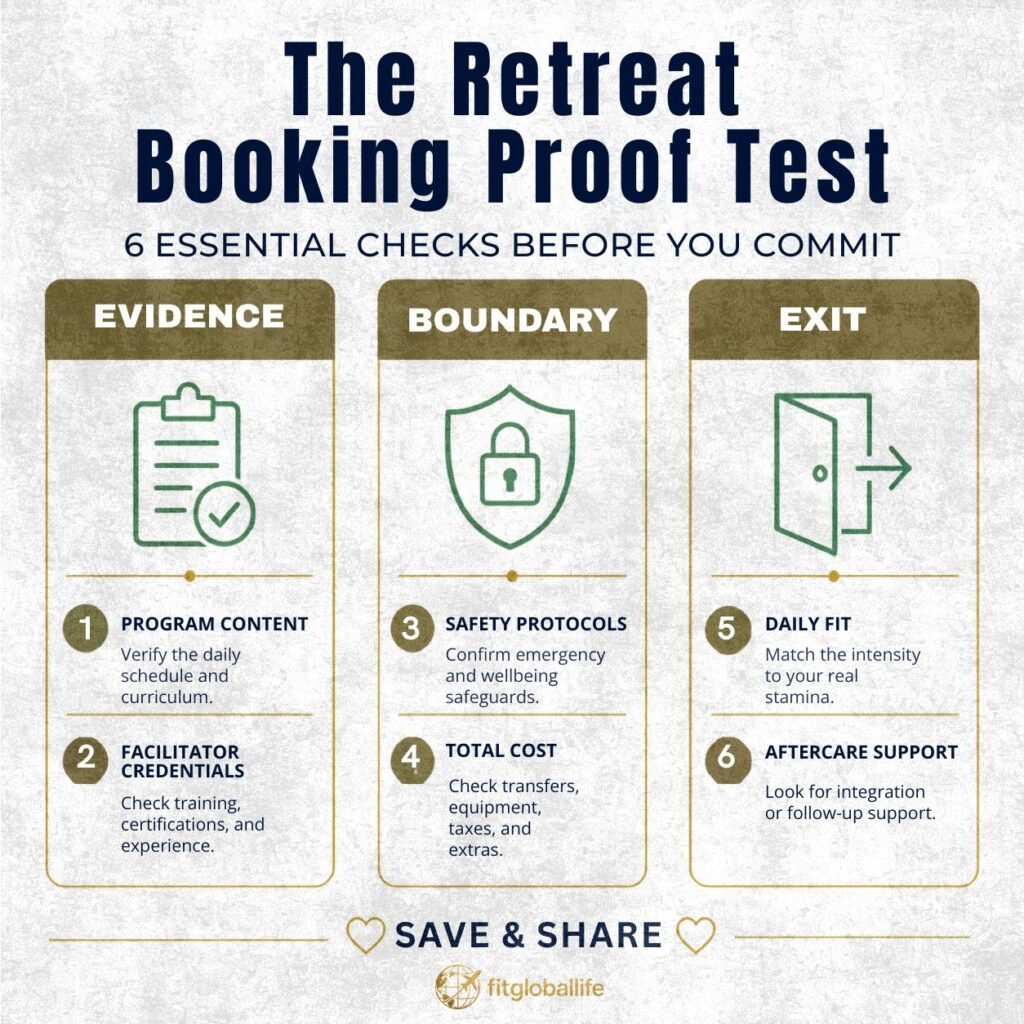
The Retreat Booking Proof Test
For every important promise, request three things: evidence, boundary, and exit. Evidence tells you what is actually provided. Boundary tells you what is not provided and who should not participate. Exit tells you what happens if circumstances change.
| Promise | Evidence to request | Boundary to identify | Exit route |
| “Deep transformation” | Exact sessions, hours, methods, and facilitator roles | Not therapy; no guaranteed outcome | Ability to opt out without pressure |
| “All-inclusive” | Itemized inclusions and mandatory fees | Flights, transfers, treatments, tips, taxes | Written cancellation and transfer terms |
| “Safe for beginners” | Intensity, prerequisites, modifications, group size | Contraindications and unsuitable participants | On-site escalation and early-departure plan |
| “Personalized” | Intake process and who reviews it | Limits of customization | Alternative activity or rest option |
A clear answer does not have to be long. “Two daily 75-minute yoga sessions; chairs and rest options available; not appropriate for acute injury; participant may skip any class” is far more useful than three paragraphs about awakening your highest self. Specificity is not unspiritual. It is hospitable.
1. What Outcome Is Actually Being Promised—and How Is It Delivered?
Start by translating marketing language into a program map. If the retreat promises better sleep, ask which parts of the schedule support sleep: quiet hours, caffeine timing, private rooms, light exposure, late-night ceremonies, or simply more time in bed? If it promises stress reduction, ask whether the days contain genuine unstructured time or whether “rest” means moving quickly between breathwork, hiking, lectures, ice baths, and a compulsory sharing circle.
Turn adjectives into observable details
Words such as transformative, healing, detoxifying, immersive, trauma-informed, personalized, and science-backed can mean very different things. Ask: “What will participants actually do each day, for how long, and which sessions are optional?” Then request a representative schedule, not merely a list of possible activities. A sample day reveals pacing, meal gaps, sleep opportunities, free time, and whether the advertised diversity is real.
A credible organizer should also describe who the retreat is not for. Beginner-friendly does not mean universally appropriate. Silent practice, prolonged fasting, cold exposure, intensive exercise, altered sleep schedules, and emotionally evocative workshops can carry different risks and demands. The U.S. National Center for Complementary and Integrative Health notes that meditation and mindfulness have been studied for potential benefits but also advises people not to use meditation as a replacement for conventional care or as a reason to postpone seeing a health professional. Review NCCIH’s evidence and safety overview.
Ask what evidence supports any health claim. A retreat may legitimately offer relaxation, education, practice, community, and a change of environment without proving that it treats a condition. Be wary when testimonials are used as if they establish medical effectiveness. One guest’s powerful week is a story, not a treatment standard.
If your real goal is digital quiet rather than health intervention, consider whether a structured unplugged destination or a self-designed seven-day digital reset at home could deliver most of the value with less financial exposure.
A useful email question
“Could you send the current daily schedule, identify which sessions are required or optional, and explain what participants should realistically expect to take home—without guaranteeing a health outcome?” The quality of the answer matters more than its enthusiasm.
2. Who Is Responsible for the Program, and Where Does Their Scope End?
A retreat can involve several separate roles: organizer, venue, lead facilitator, yoga teacher, coach, therapist, physician, nutrition practitioner, outdoor guide, massage therapist, and transport provider. Do not let a single founder biography blur those responsibilities. Ask who delivers each high-stakes element and who holds responsibility when something goes wrong.
Verify the credential that matches the claim
Credentials should be relevant, current where applicable, and verifiable through the issuing body or regulator. A yoga teaching qualification does not create competence in psychotherapy. A coaching certificate does not authorize diagnosis. A physician’s involvement in one consultation does not automatically place every workshop under medical supervision. “Trauma-informed” training can describe an approach, but it does not necessarily mean the facilitator is a licensed trauma clinician.
- Ask for the full name and professional role of each person leading health-adjacent or emotionally intensive sessions.
- Ask which license, certification, or professional registration applies and where it can be verified.
- Ask whether the facilitator carries relevant professional and public-liability insurance.
- Ask who reviews health questionnaires and how referrals or exclusions are handled.
- Ask what the program will not assess, diagnose, or treat.
This is especially important for retreats that borrow the visual language of medicine or neuroscience. FitGlobalLife’s article on biohacking retreats and their regeneration claims can help you recognize where high-tech presentation needs stronger evidence, while its guide to elite biohacking campuses shows why equipment lists alone do not establish suitability.
Watch the power dynamic
Good facilitation protects consent. Participants should be able to decline touch, sharing, photography, cold exposure, fasting, breath retention, or emotionally intense exercises without humiliation or spiritual pressure. Statements such as “discomfort means the process is working” can shut down legitimate feedback. Ask how the retreat handles opt-outs and whether alternative activities are available.
The strongest answer sounds operational: “Consent is requested before touch; participants may leave any session; a staff member checks in privately; no one is required to disclose personal history.” A vague answer about trusting the journey is not a policy.
3. What Happens If I Become Unwell, Overwhelmed, or Need to Leave?
Safety is not a first-aid kit photographed beside a singing bowl. It is a chain of decisions: who notices a problem, who is trained to respond, how emergency services are contacted, how far appropriate care is, who accompanies the guest, what language barriers exist, and how payment or evacuation is handled.
Ask for the escalation pathway
- Is a staff member on site overnight, and how can guests reach them?
- Which team members hold current first-aid or activity-specific rescue training?
- How far away is the nearest appropriate clinic or hospital in realistic travel time?
- What is the plan for severe weather, wildfire, flooding, transport disruption, or communications failure?
- Can a participant leave early, and who arranges and pays for the transfer?
- How are psychiatric distress, panic, disorientation, or medication problems handled?
For international retreats, ordinary health insurance may not cover treatment or evacuation abroad. The CDC Yellow Book guide to travel, health, and evacuation insurance notes that trip-disruption coverage is not the same as travel health or medical evacuation coverage and policy details need to be reviewed closely. The U.S. Department of State’s insurance guidance similarly recommends medical evacuation coverage for higher-risk destinations or those with limited care.
Mental-health exclusions need special attention. CDC guidance for mental health in travelers notes that some policies exclude psychiatric emergencies or evacuation related to preexisting conditions. A retreat described as emotionally transformational may be located precisely where specialist support is limited. Read the exclusions; do not infer coverage from the word “comprehensive.”
If you are comparing international travel insurance, you can review current SafetyWing travel insurance options. Always check the latest policy wording, country availability, age limits, activity exclusions, preexisting-condition rules, mental-health coverage, and evacuation provisions before purchasing.
Retreat safety also begins before departure. Share relevant conditions, allergies, mobility needs, medications, dietary requirements, and emergency contacts through the organizer’s secure process. Do not stop prescribed medication because a program markets a “clean reset.” Speak with the appropriate clinician when the retreat involves fasting, intense exercise, heat, cold, altitude, prolonged silence, breathwork, or major sleep disruption.
4. What Is the Real All-In Cost, Cancellation Exposure, and Insurance Gap?
A retreat price is not useful until it becomes a total-trip number. Add accommodation supplements, required treatments, taxes, service charges, transfers, flights, visas, vaccinations, equipment, tips, food outside the program, pre- and post-retreat nights, payment-card fees, and the cost of leaving early. Then separate refundable, transferable, insured, and fully exposed amounts.
Build a cancellation ladder
| Money layer | Question to ask | Evidence to retain |
| Deposit | Is it refundable, transferable, or credit-only? | Invoice and dated terms |
| Balance | When does it become non-refundable? | Payment schedule |
| Organizer cancellation | Cash refund, credit, or reschedule? | Organizer-cancellation clause |
| Low enrollment | Is there a go/no-go date? | Written confirmation before flights |
| Guest illness or emergency | What documentation is required? | Policy and insurance wording |
| Travel disruption | Who covers missed nights or transfers? | Carrier and insurer terms |

In the United States, the FTC’s rule addressing unfair or deceptive fees took effect in May 2025 for short-term lodging and live-event tickets. It requires covered businesses to display the total price including mandatory fees prominently, although retreat packages may involve multiple services and jurisdictions. The useful consumer lesson is broader: ask for the mandatory all-in amount before paying. See the FTC’s current fee-rule guidance.
Do not rely on “travel insurance recommended” as proof that your loss is insurable. Policies may exclude known events, preexisting conditions, elective cancellation, certain activities, unattended belongings, or destinations under advisory. Coverage can also depend on when the policy was purchased. Compare the retreat’s refund terms with the insurance policy line by line. The organizer controls its cancellation contract; the insurer controls covered reasons. Those are different doors.
Budget alternatives can reduce exposure. FitGlobalLife’s collection of affordable retreat models for 2026 and its guide to weekend resets near Jakarta show how shorter distance and fewer transfers can preserve the core reset while lowering the amount at risk.
5. What Will an Ordinary Day Require From My Body, Diet, Privacy, and Attention?
A retreat itinerary should be read like an operating manual, not a mood board. The relevant question is not “Does this look beautiful?” but “Can I live this schedule for the full stay?” Ask for wake time, lights-out expectations, activity duration, elevation, walking surfaces, temperature, swim requirements, meal timing, caffeine and alcohol rules, Wi-Fi access, room type, bathroom arrangements, noise, and free time.
Check accessibility with specifics
“Accessible” is not a complete answer. A property can have a step-free room while the yoga deck, dining area, beach, trails, vehicles, or emergency route remain inaccessible. Ask about door widths, stairs, gradients, roll-in showers, grab bars, hearing or visual alerts, refrigeration for medication, power reliability, service animals, and whether staff can provide the specific assistance you need. Official ADA lodging guidance for guests with low vision illustrates why equal access depends on communication and service practices as well as physical design. Laws and standards vary by destination, so request current property-specific details.
Food deserves the same precision. “Plant-based” may still include allergens. “Detox menu” may be too low in energy for a high-activity schedule. Ask who plans meals, how cross-contact is handled, whether portions are adjustable, whether snacks are available, and whether guests can store prescribed food or medication. A retreat is a poor place to discover that dietary flexibility was a caption, not a kitchen capability.
Protect autonomy and privacy
Ask whether phones are restricted, collected, locked away, or merely discouraged. Clarify whether an emergency contact can reach you and whether you can retain a device for medical, family, accessibility, translation, or authentication needs. If silence is required, ask where and when conversation is permitted and how to request help.
Also ask about photos, testimonials, group chats, health forms, and personal disclosures. Is photography opt-in? Can consent be withdrawn? Who sees intake information? How long is it retained? Are emotional sharing circles recorded or summarized? A participant should not have to trade privacy for belonging.
If low stimulation is the main goal, compare the schedule with silent retreats designed around different levels of guidance or consider the practical recovery principles in mind-body recovery for everyday life. A retreat should add a useful container, not simply relocate your usual overload to a nicer postcode.
6. What Support, Consent, and Responsibility Continue After Checkout?
A retreat does not need a twelve-month community funnel to be responsible. It does need honest closure. Ask what happens on the last day, how participants are prepared to return to ordinary routines, whether post-retreat contact is educational or clinical, and who responds if someone reports a concern about facilitator conduct, injury, billing, privacy, or emotional harm.
Separate integration from upselling
Integration can be simple: written practices, rest guidance, a list of warning signs that warrant professional support, an optional group call, or a reminder to reintroduce ordinary demands gradually. It should not imply that progress depends on buying the next retreat, coaching package, supplement subscription, or private membership.
Ask whether follow-up is included in the original price, who provides it, what communication channel is used, and how long it lasts. If the retreat includes therapy or medical services, obtain clear records, referral information, and aftercare instructions from the licensed provider. If it is a general wellness retreat, the organizer should not drift into clinical monitoring after guests return home.
Ask how complaints are handled
- Is there a named safeguarding or complaints contact who is not the subject of the complaint?
- Can concerns be submitted privately after departure?
- What is the process and response timeline?
- Which insurer, professional board, venue, or authority is relevant if the matter cannot be resolved internally?
- How are incident records and participant privacy protected?
The strongest retreat may be the one that sends you home with less dependence on the retreat itself. FitGlobalLife’s article on retreat lessons that survive ordinary routines and its framework for recovery rituals that do not depend on motivation can help turn a temporary change of setting into smaller repeatable practices.
A Retreat Evidence Scorecard
Score each area from 0 to 2 before paying: 0 means absent or evasive, 1 means partly clear, and 2 means specific and documented. This is not a scientific rating and cannot certify safety. It is a friction detector.
| Area | 0 points | 1 point | 2 points |
| Program fit | Vague promise | Basic schedule | Detailed schedule, options, exclusions |
| Facilitator scope | Bio only | Some credentials | Role-matched, verifiable credentials |
| Safety pathway | “We take safety seriously” | Basic first-aid answer | Named escalation, care access, exit plan |
| Financial terms | Price headline only | Some inclusions | All-in cost and written cancellation ladder |
| Access and autonomy | Generic reassurance | Partial details | Specific accommodations and opt-out rules |
| Aftercare and complaints | No process | Informal contact | Defined closure, privacy, complaint route |
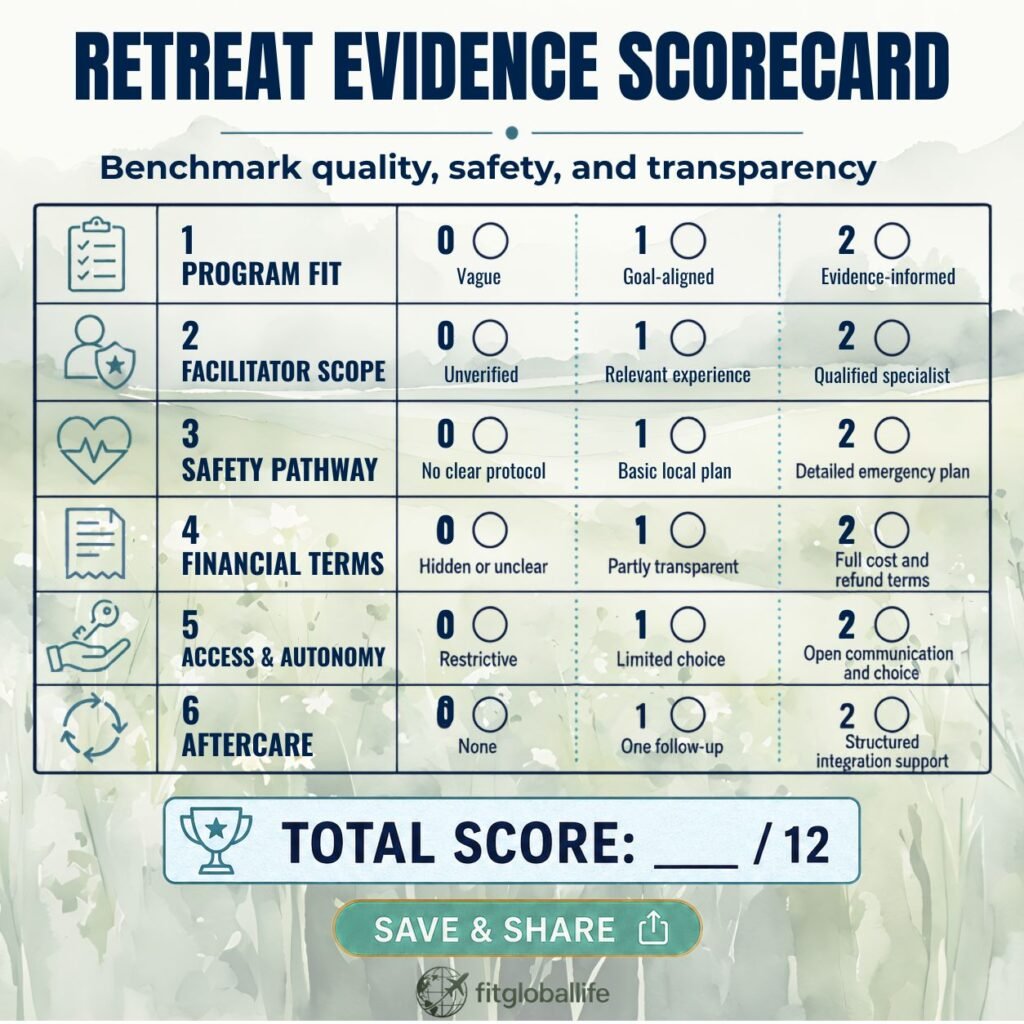
A score below 8 out of 12 does not automatically mean the retreat is unsafe, but it means too much of the decision remains unverified. Pause and request written answers. A high score is not a guarantee either; it simply indicates that the organizer has made key responsibilities easier to inspect.
Red Flags That Should Pause a Booking
- Guaranteed healing, detoxification, trauma release, cure, or permanent transformation.
- Pressure to pay immediately because “your intuition already knows.”
- No current schedule, named facilitator, written terms, or legal business identity.
- Credentials that cannot be verified or do not match the claimed service.
- Compulsory disclosure, touch, fasting, silence, cold exposure, breathwork, medication changes, or photography.
- A remote venue with no credible emergency, communication, transport, or evacuation plan.
- Non-refundable payment combined with no organizer-cancellation protection or go/no-go date.
- An “all-inclusive” price that excludes mandatory transfers, treatments, taxes, or fees.
- Shaming participants who ask about accessibility, diet, health history, privacy, or opting out.
- Testimonials presented as clinical evidence or criticism dismissed as “negative energy.”
One imperfect answer is not necessarily a deal-breaker. Small organizers may need time to retrieve details. The pattern matters: do they become more specific when asked, or do they replace information with urgency and charisma? Clear operators generally welcome clear guests.
Conclusion: Book the Evidence, Not the Fantasy
A retreat can be a meaningful pause, a demanding practice, a joyful group trip, or a practical way to change context long enough to see your routines differently. It does not need to be perfect. It does need to be understandable. Before paying, know what the program actually does, who is qualified to lead it, how the team responds when someone needs help, what the full financial exposure is, whether daily life fits your body and boundaries, and what responsibility continues after checkout.
Those six retreat questions turn a glossy promise into a decision you can inspect. They also protect good organizers. A well-run retreat should not have to compete with operators who hide costs, blur professional scope, or treat consent as a lack of commitment. Better questions reward better practice.
Save the schedule, terms, receipts, insurance wording, facilitator details, and written answers in one folder. Share the itinerary and emergency contacts with someone at home. Then make the decision based on fit, evidence, and acceptable risk—not on the fear that your best self has only one room left. FOMO is a terrible travel agent.
Frequently Asked Questions
Ask what outcome is promised and how it is delivered; who is responsible and qualified; what happens during illness, distress, or early departure; what the all-in cost and cancellation exposure are; whether the daily schedule fits your body and boundaries; and what aftercare, consent, privacy, and complaint processes exist.
Request the facilitator’s full name, role, relevant credential, issuing organization, and jurisdiction. Verify the credential with the official registry or professional body where one exists. Match the credential to the activity; a qualification in one wellness discipline does not authorize clinical work in another.
Not necessarily. Coverage for trip cancelation, travel health, medical evacuation, pre-existing conditions, psychiatric emergencies and adventure activities may be excluded or offered at varying levels. Before you buy, compare the cancelation terms of the retreat with the covered reasons and exclusions of the insurer.
Not necessarily, but know what you could lose, the transfer options, the terms for organizer cancelation, the go/no-go date and if insurance would cover your realistic cancelation reasons. Do not book non-refundable flights before the organizer confirms minimum enrollment when that is relevant.
Suitability depends on the condition, program, intensity, location, facilitator scope, and access to care. Discuss relevant plans with a qualified clinician and disclose necessary information securely to the organizer. A general wellness retreat should not replace treatment or promise to manage a condition it is not equipped to handle.
Disclaimer
This article provides general educational and travel-planning information. It is not medical, mental-health, legal, financial, accessibility, or insurance advice. Retreat programs, credentials, laws, entry rules, transport, safety conditions, healthcare access, prices, cancellation terms, and insurance coverage can change. Verify current details directly with organizers, venues, credentialing bodies, government authorities, clinicians, and policy documents before booking or traveling. Get professional help if you have ongoing or serious health or mental-health issues.
Affiliate notice: This article may contain an affiliate link. FitGlobalLife may earn a commission from qualifying purchases at no extra cost to the reader. Insurance mentions are for contextual relevance only and do not guarantee eligibility, coverage, claims payment, evacuation, or suitability. Review the full policy wording and exclusions.