
Creative retreats for burned-out professionals are not about returning from vacation with an impressive new skill. They are about spending a little time making something without a quarterly target, a performance review, or a screen full of people asking for updates. That difference matters when even planning a holiday feels like work.
Your days are doable in theory but your attention is always crowded. You finish a presentation and reach for your phone; you get a free afternoon and immediately feel awful about not using it well. A sold-out “transformational” retreat can then look a lot like a job with beautiful surroundings. A small porcelain bowl, a messy notebook, a slow photo walk- these are invitations to join in, not to be good at.
The timing is not imaginary. In the latest Gallup global employee stress figures, 40% of employees surveyed reported experiencing stress for much of the previous day in 2025. Stress is not the same as occupational burnout, however. The World Health Organization’s definition of burnout specifically concerns chronic workplace stress and three dimensions: exhaustion, increased distance or cynicism toward work, and reduced professional efficacy. A retreat may offer respite, but it does not fix an unhealthy workload or substitute for appropriate care.
This guide compares seven types of creative retreats rather than endorsing named resorts. It combines research with an original, practical selection framework: energy demand, social exposure, permission to be a beginner, and the difficulty of carrying the benefits home. No venue was visited or independently inspected for this article; program descriptions and travel conditions must be confirmed before booking.
Burned-out Professionals Say Creative Retreats Just Seem Different
Most of labor is judged by result A creative retreat can be helpful precisely because the process counts more than the product. You can spend an hour molding clay, or photographing a street corner in changing light, or composing a reminiscence that no one else will read. It creates a valid cause not to answer a message and gives your attention something real, flawed and limited to focus on.
This is plausible and not magic. Linked to the WHO, a review of arts and health evidence mapped more than 3,000 research across many various demographics, interventions and designs and found potential contributions to health and well-being. A review of craft-based therapies in 2025 found 19 suitable research and short-term gains in measurable outcomes, but noted broad variations in methodologies and a lack of convincing evidence for enduring effects. A beginners pottery weekend is not a clinically proven cure for burnout.
What the research supports—and what it cannot promise
A 2026 systematic review of arts-on-prescription programmes reported improvements in well-being across eight included studies, while acknowledging important limitations: no randomized controlled trials in the included evidence, no control groups, varied interventions, and limited follow-up. Arts-on-prescription programmes are also not identical to recreational travel retreats. The sensible conclusion is that making art may be a meaningful part of a restorative break, not that an expensive workshop delivers a predictable health outcome.
Another 2025 meta-analysis of holidays and employee well-being combined 32 research and 256 effect sizes . It found stronger, more lasting vacation benefits than previous reviews . Psychological detachment from work and physical activity were useful correlates. That research argues for some real off-duty time, whether you go far or take a smaller, local pause. For the everyday version of this notion, see why unstructured relaxation deserves a place in a healthy schedule.
None of this means employees alone are responsible for solving burnout with hobbies. The CDC/NIOSH guidance on workplace psychosocial hazards places strong emphasis on changes to work conditions, including workload and control, rather than relying only on individual stress-management activities. Pair any retreat with realistic boundaries at work. Even a modest change to how you stay present during busy workdays may need managerial support to stick.
How to Choose a Creative Retreat When You’re Already Exhausted
The finest retreat is not always the one with the nicest view, the longest itinerary or the highest number of workshops. Begin with your actual ability. If you’re feeling drained, an early morning walk, five hours of painting, a group criticism, and required sharing in the evening can be more taxing than restorative. If your attention seems overdrawn already, less stimulus may be a feature, not a missed opportunity.
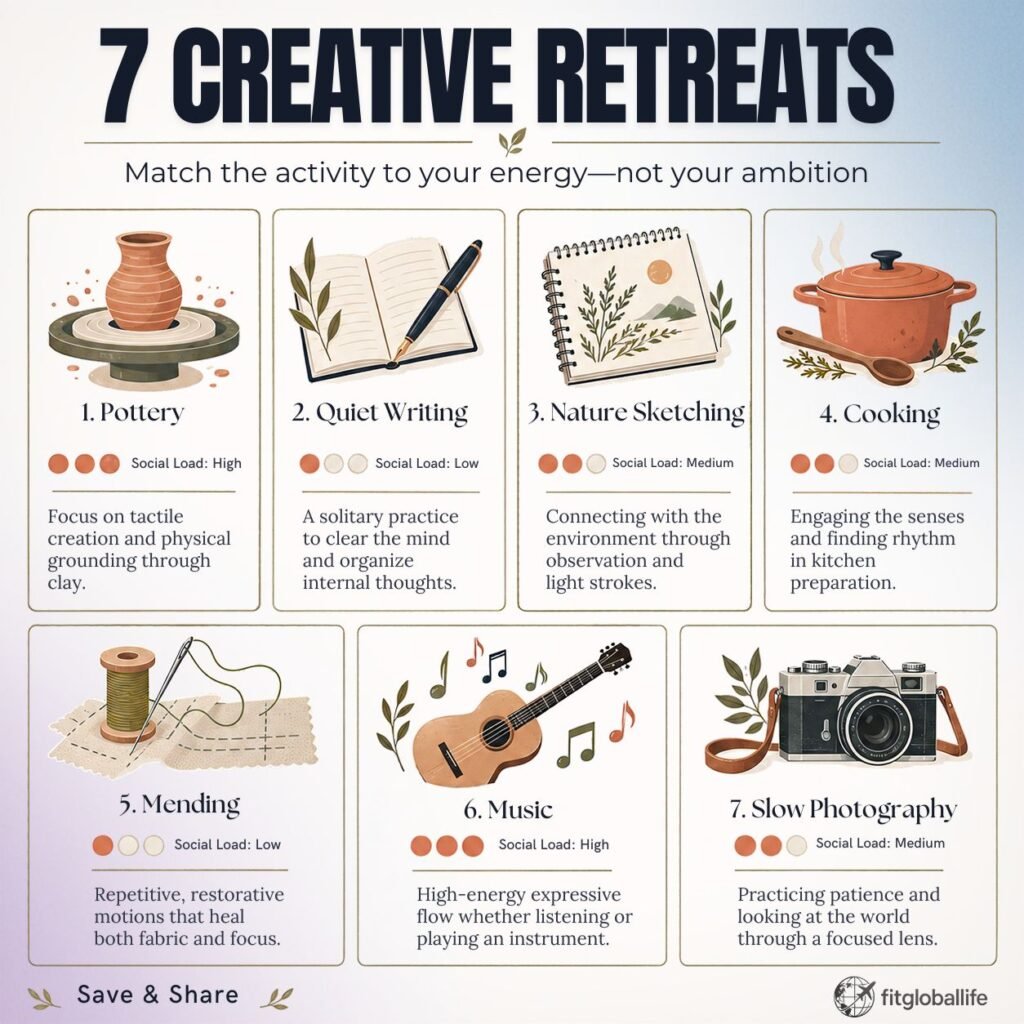
The Recovery-Fit Test: Energy, Exposure, Re-entry
Answer four questions before you start browsing destinations. These are editorial prompts and not a validated clinical test:
- Energy demand: Can you manage the core exercise for 60-90 minutes today without too much strain? Choose a drop-in or half-day version if needed.
- Social Exposure: Do you like to produce alone, with others but in silence, or with people in collaboration? Ask if intros, critiques, group lunches and public performances are optional.
- Permission to be a beginner: Does the program specifically welcome first-timers? Is there an expectation/competition/portfolio review for finished product?
- Re-entry friction: Does the experience leave you with a modest activity you can repeat at home without buying equipment, arranging lessons or opening another app?
If your responses show little dedication, choose short-format resets close to home, rather than a flight. The aim isn’t to work your way to a bigger trip so you can earn the right to rest.
7 Creative Retreat Formats Worth Considering
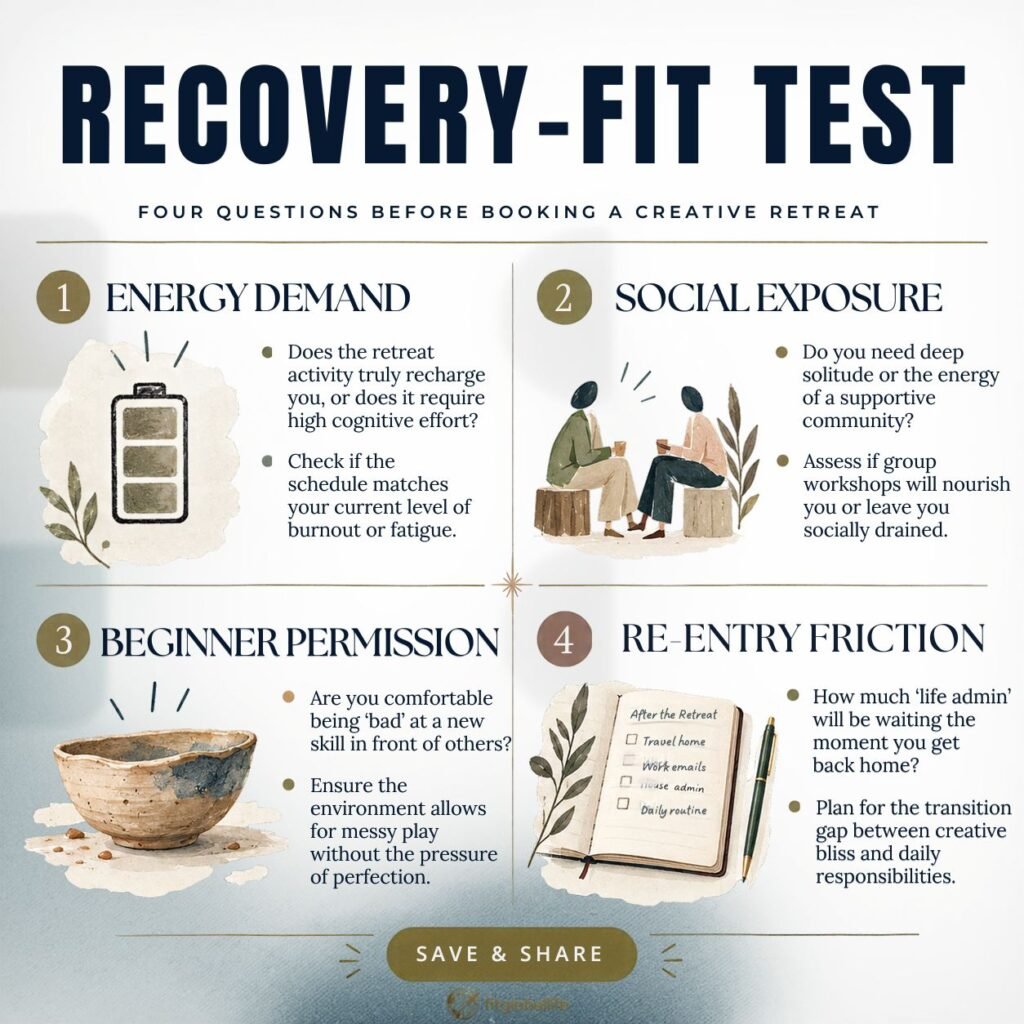
1. Pottery and hand-building retreats: something your hands can finish
Pottery appeals to professionals who spend all day managing abstractions: budgets, strategy decks, code, meetings, and inboxes. Working with a lump of clay is literal. You can feel the shape changing; you can also see it collapse and start again. In a beginner-friendly retreat, that is part of the exercise, not a setback.
Look for hand-building, pinch pots, coiling, or slab work rather than assuming you must learn the wheel. Wheel throwing can be delightful but physically awkward for beginners, and some workshops create a subtly competitive atmosphere when everyone expects an Instagram-ready mug. Ask whether participants can work at their own pace and whether the instructor accepts lopsided results.
A simple two-night format works well: a brief studio introduction on arrival, one longer making session the next morning, and ample time afterward to walk, read, or do nothing. Before paying, check who handles kiln firing, shipping, breakage, and customs restrictions if the work cannot travel home with you.
Best for: people who want tactile focus without personal disclosure. Potential mismatch: those with wrist or hand pain, sensory sensitivities to messy materials, or a strong wish to avoid a class environment. A local ceramics studio is a lower-risk trial.
2. Quiet writing and personal storytelling retreats: words without deadlines
A writing retreat for someone exhausted by reports and emails should not feel like a miniature publishing accelerator. The restorative version may be a notebook, a comfortable desk, a view you do not need to photograph, and permission to write badly. Memoir fragments, imagined conversations, poems, and lists of things you miss are all legitimate outputs; none requires an audience.
Check the language of the invitation. “Finish your manuscript in three days” is a productivity promise. “Optional prompts, generous unstructured writing time, and confidential discussion” is a different proposition. The second is more likely to fit someone who has already spent the week being evaluated. Ask if all feedback and group reading are opt-in and whether participants can decline emotionally personal prompts.
To prepare without turning it into homework, bring three lines instead of a detailed project plan: “I wish I had more time for…,” “A place I still remember is…,” and “Something I do not need to prove anymore is….” Readers who want gentle practice first can experiment with reflection prompts that build self-trust.
Best for: people who crave solitude, language, or private meaning. Potential mismatch: anyone whose work already involves intense writing, or for whom autobiographical material could be distressing. Choose fiction or observational exercises rather than forced confession.
3. Nature sketching and botanical observation retreats: learn to notice again
Not every nature break needs a summit, a sunrise chase, or a digital-detox challenge. A nature-sketching retreat might ask participants to spend twenty minutes observing one leaf, tree, rock formation, or changing shadow. Drawing skill is optional. The aim is sustained curiosity, not accurate botanical illustration.
The strongest format combines brief accessible walks with long stopping points, shelter options, and a teacher who can adapt exercises indoors. Participants might keep a “three textures, two sounds, one question” field notebook. That practice makes the retreat more about attention than scenery, and it can continue in a city park at home.
Choose programs with local ecological knowledge and clear rules about not taking plants or disturbing protected habitats. If you are exhausted by travel logistics, lower-intensity nature escapes may be more suitable than a remote expedition. In contrast, a gentle slow-travel mindset can turn an ordinary neighborhood into the subject of a whole afternoon.
Best for: visually curious people who need quiet movement and fresh air. Potential mismatch: heat sensitivity, inaccessible trails, unpredictable weather, or an itinerary that markets strenuous outdoor activity as effortless wellness.
4. Community cooking and food-story retreats: connection with a useful rhythm
Cooking can be surprisingly restorative when the objective is to learn a family recipe rather than produce a perfect dinner service. Imagine a small group gathering around a table to fold dumplings, grind spices, or prepare a regional vegetable dish while hearing how the recipe travelled through generations. The point is sensory engagement and conversation with a purpose.
This format offers something solitary crafts do not: low-stakes social contact. You can join the group through a task instead of telling strangers your professional frustrations. For people who spend most days isolated at a screen, chopping herbs together may be a gentler entry into company than an intensive networking-style retreat.
Choose operator-led sessions that compensate local cooks fairly, credit traditions accurately, and discuss allergies and food handling in advance. If dietary restrictions are important, insist on written ingredient and cross-contact information. For ordinary weekdays after the trip, keep the cooking mood practical with simple meal ideas built around nourishment rather than spectacle.
Best for: people who enjoy guided conversation, flavor, and collaborative tasks. Potential mismatch: social fatigue, strong food-related anxiety, mobility barriers in the kitchen, or allergens the host cannot manage safely.
5. Visible-mending and textile craft retreats: repair rather than replace
A fabric repair workshop carries a quiet message that many high-performing people rarely hear: a mistake is not necessarily the end of the object. Visible mending, sashiko-inspired stitching, patchwork, simple weaving, and hand embroidery all invite patient repetition. You can keep the worn garment and make a repair that tells the truth about its history.
Good workshops acknowledge the cultural origin of techniques, teach safe handling of tools and dyes, and avoid presenting traditional crafts as generic wellness accessories. Small class size matters less than having enough guidance and a schedule that permits breaks. A retreat can include an optional visit to a textile maker, but it should not turn local artisans into uncredited photo opportunities.
Bring one shirt or tote with a small repair, or use practice fabric if you prefer. Start with a visible stitch you can repeat after returning home. This is a useful counterweight to the feeling of having too many fragmented tasks: one needle, one thread, one manageable section at a time.
Best for: beginners seeking quiet repetition and a take-home practice. Potential mismatch: limited hand dexterity, visual strain, perfectionism, or programs with heavy technical instruction and little rest.
6. Low-pressure music and songwriting retreats: make noise without a stage
Music-based creative breaks do not have to involve vocal solos, public performances, or prior training. Some programs center on simple percussion, listening walks, group humming, or writing a few lines of song about a place. A supportive instructor should make it easy to participate lightly or observe for a while without being singled out.
For some guests, shared rhythm provides connection without the pressure of conversation. For others, sound is overstimulating. Request the sample session schedule and ask about volume levels, quiet spaces, ear protection, and opt-outs. “Everyone must perform on closing night” may be exciting for confident musicians and deeply unhelpful for a depleted first-timer.
If what you need most is human warmth, this approach may sit naturally beside the ideas in small communities and social well-being. But be clear: group music in a recreational retreat is not the same as treatment delivered by a qualified music therapist.
Best for: people who want playful connection and a nonverbal activity. Potential mismatch: noise sensitivity, performance anxiety, or an organizer who treats consent as a challenge to overcome.
7. Slow photography and visual-noticing retreats: a new relationship with the camera
Photography retreats sometimes encourage chasing landmarks, producing portfolios, and posting daily highlights. For a burned-out professional, try the opposite: photograph a single color, one street during three different hours, or the spaces between buildings. Use a phone or basic camera. There is no prize for owning the most expensive lens.
A city-based slow-photography retreat can be more accessible than remote travel. A calm host might offer a morning walk, a long café break, quiet editing, and an optional sharing session. Some participants may prefer to keep every image private. The important skill is noticing, not publishing.
For an accessible test, try a route inspired by walking-friendly urban travel, then limit yourself to twelve photographs and no same-day posting. Ask instructors about photographing people, children, sacred places, and private property; local consent and privacy expectations come before artistic ambition.
Best for: visual thinkers who enjoy gentle exploration. Potential mismatch: people who struggle to separate photography from social-media metrics, or participants who dislike walking or screen-based editing. In that case, a paper sketchbook may be kinder than a camera.
Creative Retreat Comparison: Find Your Energy Match
Use the table as a practical conversation starter, not a clinical ranking. Suggested durations and social-demand levels are editorial planning estimates, not measured outcomes or guarantees about any specific operator.
| Creative format | Gentle entry point | Likely social load | Watch-out before booking |
| Pottery / hand-building | One afternoon to 2 nights | Low–medium | Kiln/shipping fees; wrist strain |
| Quiet writing | One day to 3 nights | Low if sharing optional | Mandatory critique; emotional prompts |
| Nature sketching | Half-day to 3 nights | Low–medium | Trail access; weather contingency |
| Food storytelling | One day to 2 nights | Medium–high | Allergens; kitchen access; pacing |
| Visible mending | Half-day to 2 nights | Low–medium | Fine-motor demand; long class blocks |
| Music / songwriting | One day to 3 nights | Medium–high | Sound levels; performance pressure |
| Slow photography | Half-day to 2 nights | Low–medium | Walking distance; privacy; screen habits |
An inexpensive class close to home can be a better match than a costly international retreat. The relevant comparison is total effort, not only the advertised accommodation rate. If you are working within a tight budget, browse lower-cost retreat structures before committing to a destination.
Plan the Retreat Without Creating Another Project
Choose a single primary activity, not a seven-item wellness checklist. Then set boundaries before arrival: an emergency contact method, an out-of-office reply, a limit on work calls, and an understanding with people who depend on you. Total digital disconnection is not safe or realistic for everyone. A selective version of screen boundaries that reduce digital overload may work better than handing over your phone without a backup plan.
A realistic three-day sample rhythm
| When | Example plan | Why it leaves room to recover |
| Day 1: arrival | Travel, light meal, 45-minute studio introduction | No high-effort workshop immediately after transit |
| Day 2: morning | One 90-minute beginner session; break as needed | Enough structure to engage without overscheduling |
| Day 2: afternoon | Unstructured rest, short optional walk, quiet observation | Protects psychological detachment from work |
| Day 2: evening | Optional shared dinner or private time | Connection without mandatory disclosure |
| Day 3: departure | Short reflection, travel buffer, early return home | Avoids a rushed arrival before work resumes |
Notice what is absent: dawn challenges, mandatory vulnerability circles, five separate healing modalities, and a closing ceremony requiring a polished final piece. Someone with more energy may enjoy a fuller schedule; the important point is that the baseline itinerary should not punish a participant for resting.
Six safety and booking questions that matter
- Can I see a representative daily schedule, including free time, physical demands, and what can be skipped?
- Who leads the creative sessions, and what training or experience is relevant to the specific medium?
- What are the rules for photography, group sharing, touch, confidentiality, and opting out?
- Is the venue appropriate for my mobility, sensory, dietary, communication, and medical needs?
- What is the all-in cost, including materials, equipment, shipping, transfers, taxes, and cancellation exposure?
- Who handles emergencies and early departures, and what travel-health coverage or medical evacuation arrangements might be needed?
The answers should be specific and written down. For a deeper due-diligence process, use the complete retreat-booking questions framework; this creative-format guide is not meant to duplicate it.
For international travel, you may compare current SafetyWing travel-insurance options. Coverage depends on the plan, residence, destination, eligibility and policy wording; exclusions may apply, including for medical or mental-health needs. Its country and home-country coverage explanation is one example of why the fine print matters. An insurance referral does not imply that a particular retreat activity or cancellation reason is covered.
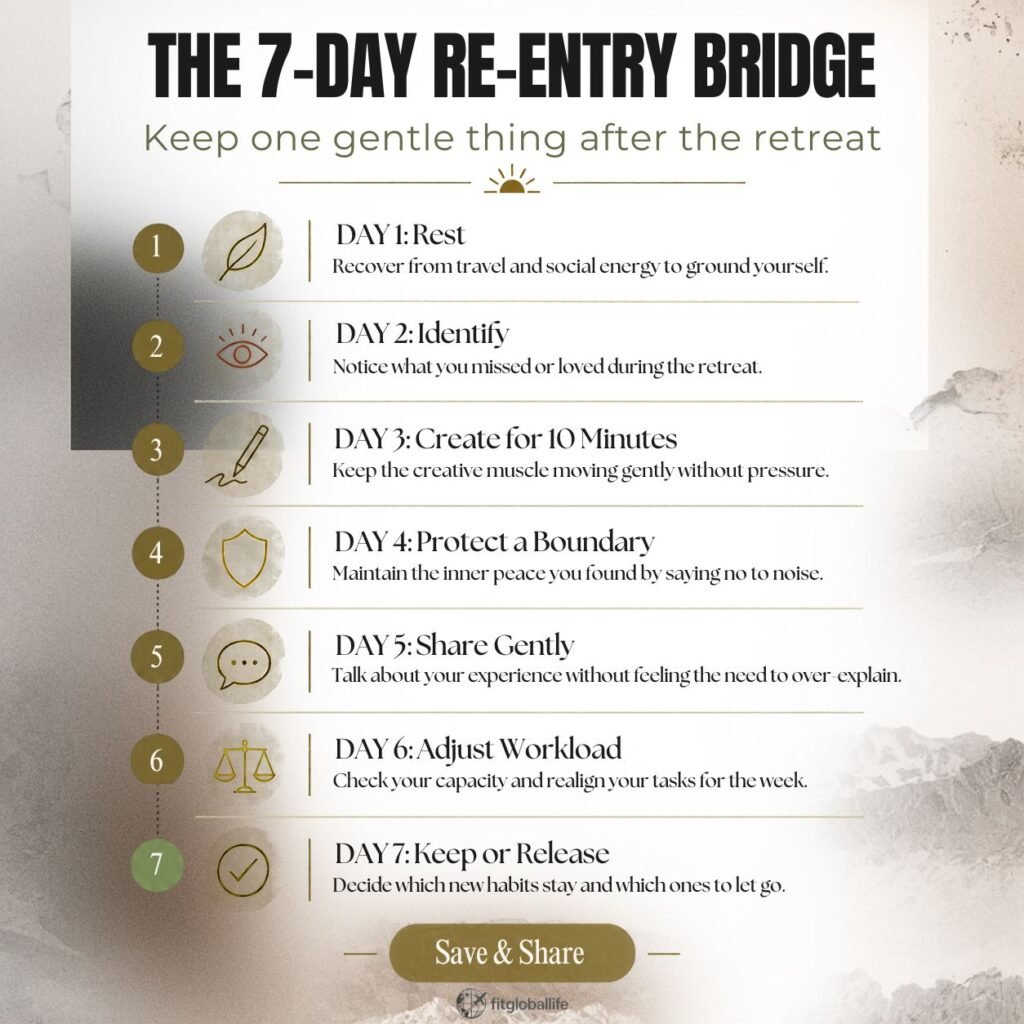
What to Do After the Retreat: A Seven-Day Re-Entry Bridge
The most overlooked part of creative travel happens after the suitcase is unpacked. An inspiring workshop can be followed by 300 unread messages, laundry, sleep debt, and an overloaded Monday. Rather than trying to recreate a whole holiday at home, preserve one small ingredient from it.
Try this seven-day re-entry bridge, an editorial planning tool rather than a tested therapeutic protocol:
- Day 1 — Do not sprint back. Leave a travel buffer if possible. Sleep and eat normally; postpone nonessential commitments.
- Day 2 — Name the useful condition. Was it quiet, shared making, a slower pace, a different environment, or permission to be imperfect? Write one sentence.
- Day 3 — Re-create ten minutes. Mend two stitches, sketch a cup, write five lines, or take three photographs on a walk.
- Day 4 — Protect one boundary. Turn off a nonessential alert or ask for a manageable meeting-free block. Keep necessary accessibility and emergency contact available.
- Day 5 — Share without performing. Tell one trusted person what you enjoyed, without needing to show the finished product or prove the trip was worth the money.
- Day 6 — Notice what work immediately erased. If workload or staffing is the problem, raise a concrete, feasible change rather than silently adding more self-care tasks.
- Day 7 — Keep or release the habit. If your creative practice feels like another obligation, make it easier or stop. Rest does not need a streak.
The aim is a smaller, more repeatable rhythm like recovery habits that do not depend on motivation, not a lifestyle transformation staged for social media. If you prefer more structured screen boundaries, compare a weeklong reset you can adjust at home rather than treating all technology as the enemy.
There is a final boundary worth protecting: if you return to the exact work conditions that caused exhaustion, a retreat cannot be expected to counteract them indefinitely. Consider conversations about workload, role clarity, leave, flexibility, or professional support where relevant. Creative time can coexist with structural change; it should not become a substitute for it.
Conclusion: Choose the Retreat That Lets You Be a Beginner
The most appropriate creative retreat might be three nights at an art lodge. It might also be a Saturday ceramics class followed by an unplanned Sunday. What matters is not the prestige of the destination but whether the experience gives you a genuine break from being evaluated, keeps your choices intact, and leaves a little room for curiosity.
Start with the medium that feels easiest to approach, then make the itinerary smaller than your ambition. Before booking, ask whether you can rest without explaining yourself. A well-designed retreat will make that question easy to answer. When the goal is recovery rather than another achievement, unfinished can be enough.
Frequently Asked Questions
No retreat should promise to cure burnout. The WHO describes burnout as an occupational phenomenon related to chronic workplace stress, not a standalone medical diagnosis. Creative breaks may support rest and well-being, but meaningful improvement can require changes to work conditions and, when appropriate, professional support.
Beginner pottery hand-building, guided sketching, visible mending, and optional-prompt writing are approachable when instructors explicitly welcome first-timers. The deciding factor is not the art form alone; it is whether the program avoids compulsory critique, rigid outcomes, and unnecessary social pressure.
There is no universal ideal length. A half-day class can test whether a medium feels restorative; a two- or three-night break can create room to disconnect. A longer retreat may suit someone who enjoys immersion, but extra days do not guarantee a better result. Account for travel fatigue, cost, and re-entry time.
They can be, if group introductions, sharing, performances, and communal meals are optional and the venue offers private downtime. Request the actual schedule and participation rules before booking. If anxiety is significantly affecting daily life, a retreat is not a substitute for tailored mental-health care.
Yes. Block two or three hours, prepare one simple activity, keep the materials ready, and establish realistic interruption boundaries. Choose a comfortable, accessible environment and a low-pressure finish. The point is the protected experience of creating, not the travel receipt.
Disclaimer
This article provides general travel and wellness information, not medical, psychological, occupational-health, or insurance advice. Research about arts participation, vacation, and well-being does not establish that any particular retreat treats or prevents burnout. Symptoms such as persistent exhaustion, depression, anxiety, sleep disturbance, or impaired functioning deserve assessment by an appropriately qualified professional. Verify current retreat itineraries, accessibility, facilitators, costs, refunds, destination advisories, and policy documents directly with providers before paying. Affiliate disclosure: FitGlobalLife may earn a commission if a reader purchases through the SafetyWing referral link, at no additional cost to the reader; coverage and eligibility are not guaranteed.